Chapter # 21
XII FDC Prepared by: Sidra Javed
Prepared by: Sidra Javed
Friedreik Miescher
 Isolated a substance
called Nuclein from
the Nuclei of puss
cells 1868
 Nuclein showed acidic
properties so it was
named Nucleic Acid
 Found Nucleic acids in
sperm heads in 1872
Prepared by: Sidra Javed
Nucleic Acids are present in:
 Every Living cells as well as Viruses
 Essential substance of genes
Prepared by: Sidra Javed
Properties
 Contains the Blue-
prints for the normal
growth and
development of
organism
 Able to reproduce,
store and transmit
genetic information
 Undergo mutation
Prepared by: Sidra Javed
Types
 Deoxyribonucleic
Acids (DNA)
 Ribonucleic Acid
(RNA)
Prepared by: Sidra Javed
Nucleic Acid and Protein
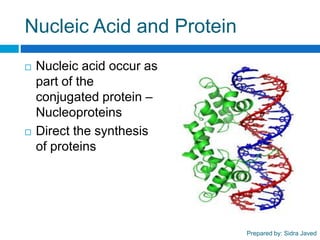
 Nucleic acid occur as
part of the
conjugated protein –
Nucleoproteins
 Direct the synthesis
of proteins
Prepared by: Sidra Javed
Structure of DNA and RNA
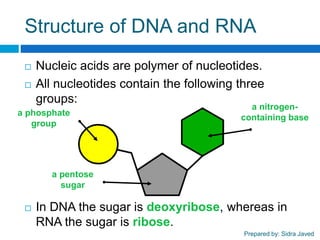
 Nucleic acids are polymer of nucleotides.
 All nucleotides contain the following three
groups:
 In DNA the sugar is deoxyribose, whereas in
RNA the sugar is ribose.
a phosphate
group
a pentose
sugar
a nitrogen-
containing base
Prepared by: Sidra Javed
Deoxyribose vs. Ribose Sugar
 Contains one less oxygen atom.
 Carbon-2 contains two H atoms instead of one
H and one OH as in Ribose sugar.
Prepared by: Sidra Javed
Nitrogenous Bases
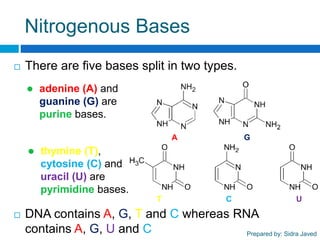
 There are five bases split in two types.
 DNA contains A, G, T and C whereas RNA
contains A, G, U and C
 adenine (A) and
guanine (G) are
purine bases.
A G
 thymine (T),
cytosine (C) and
uracil (U) are
pyrimidine bases.
T UC
Prepared by: Sidra Javed
The Sugar phosphate backbone
 The nucleotides are all
orientated in the same
direction
 The phosphate group
joins the 3rd Carbon of
one sugar to the 5th
Carbon of the next in line.
P
P
P
P
P
P
Prepared by: Sidra Javed
Adding in the bases
 The bases are
attached to the 1st
Carbon
 Their order is
important
It determines the
genetic information of
the molecule
P
P
P
P
P
P
G
C
C
A
T
T
Prepared by: Sidra Javed
DNA – Double Stranded
 Each base is paired with a specific partner:
A is always paired with T via Double bond
G is always paired with C via Triple bond
(Purine with Pyrimidine)
 The bases are joined by hydrogen bonds,
individually weak but collectively strong
Prepared by: Sidra Javed
DNA
P
P
P
P
P
P
C
G
G
T
A
A
P
P
P
P
P
P
G
C
C
A
T
T
Hydrogen bonds
Prepared by: Sidra Javed
DNA vs. RNA
DNA
-Store the information
-Deoxyribose Sugar
-Nitrogenouse bases are A, C,
G and T
-Double stranded structure
RNA
-Transfer the information
-Ribose Sugar
-Nitrogenous bases are A , C ,
G and U
-Single stranded structure
Prepared by: Sidra Javed
Prepared by, Sidra Javed

Nucleic Acids

  • 1.
    Chapter # 21 XIIFDC Prepared by: Sidra Javed
  • 2.
  • 3.
    Friedreik Miescher  Isolateda substance called Nuclein from the Nuclei of puss cells 1868  Nuclein showed acidic properties so it was named Nucleic Acid  Found Nucleic acids in sperm heads in 1872 Prepared by: Sidra Javed
  • 4.
    Nucleic Acids arepresent in:  Every Living cells as well as Viruses  Essential substance of genes Prepared by: Sidra Javed
  • 5.
    Properties  Contains theBlue- prints for the normal growth and development of organism  Able to reproduce, store and transmit genetic information  Undergo mutation Prepared by: Sidra Javed
  • 6.
    Types  Deoxyribonucleic Acids (DNA) Ribonucleic Acid (RNA) Prepared by: Sidra Javed
  • 7.
    Nucleic Acid andProtein  Nucleic acid occur as part of the conjugated protein – Nucleoproteins  Direct the synthesis of proteins Prepared by: Sidra Javed
  • 8.
    Structure of DNAand RNA  Nucleic acids are polymer of nucleotides.  All nucleotides contain the following three groups:  In DNA the sugar is deoxyribose, whereas in RNA the sugar is ribose. a phosphate group a pentose sugar a nitrogen- containing base Prepared by: Sidra Javed
  • 9.
    Deoxyribose vs. RiboseSugar  Contains one less oxygen atom.  Carbon-2 contains two H atoms instead of one H and one OH as in Ribose sugar. Prepared by: Sidra Javed
  • 10.
    Nitrogenous Bases  Thereare five bases split in two types.  DNA contains A, G, T and C whereas RNA contains A, G, U and C  adenine (A) and guanine (G) are purine bases. A G  thymine (T), cytosine (C) and uracil (U) are pyrimidine bases. T UC Prepared by: Sidra Javed
  • 11.
    The Sugar phosphatebackbone  The nucleotides are all orientated in the same direction  The phosphate group joins the 3rd Carbon of one sugar to the 5th Carbon of the next in line. P P P P P P Prepared by: Sidra Javed
  • 12.
    Adding in thebases  The bases are attached to the 1st Carbon  Their order is important It determines the genetic information of the molecule P P P P P P G C C A T T Prepared by: Sidra Javed
  • 13.
    DNA – DoubleStranded  Each base is paired with a specific partner: A is always paired with T via Double bond G is always paired with C via Triple bond (Purine with Pyrimidine)  The bases are joined by hydrogen bonds, individually weak but collectively strong Prepared by: Sidra Javed
  • 14.
  • 15.
    DNA vs. RNA DNA -Storethe information -Deoxyribose Sugar -Nitrogenouse bases are A, C, G and T -Double stranded structure RNA -Transfer the information -Ribose Sugar -Nitrogenous bases are A , C , G and U -Single stranded structure Prepared by: Sidra Javed
  • 16.