Nucleic Acids Structure and Function
              Dr. Atif H. Khirelsied

          Department of Biochemistry
             p                         y
               Faculty of Medicine
        International University of Africa
                               y

                                             atifkhirelsied@gmail
The learning objectives
           g j

By the end of this session the student should be able to:
By the end of this session the student should be able to:

1.
1  Outline the molecular structure of DNA and RNA.
   Outline the molecular structure of DNA and RNA
2. Explain the significance of specific base pairing.
3.
3  Define the main properties of DNA.
   D fi th        i        ti    f DNA
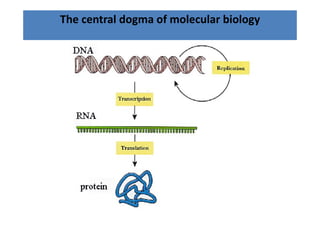
4. Define the central dogma of molecular biology.
5. Distinguish between single‐ stranded and double‐stranded 
   nucleic acids.
6. Explain the meaning of denaturation and re‐annealing of DNA.
6 E l i h             i   fd           i     d        li f DNA
The deoxyribonucleic acid (DNA)
The deoxyribonucleic acid (DNA)
• DNA: is the store of the genetic information
  DNA: is the store of the genetic information.

• It is the principal regulator of the cell physiology
  It is the principal regulator of the cell physiology.


• DNA contains the instructions for creation and  functioning 
  of the organism, it acts as; 
  of the organism it acts as;

      Template for replication.

      Codes for proteins.
The central dogma of molecular biology
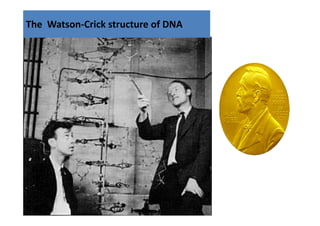
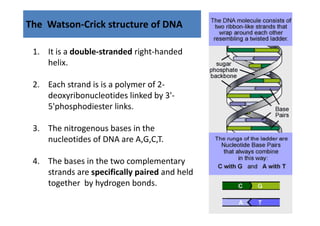
The  Watson‐Crick structure of DNA

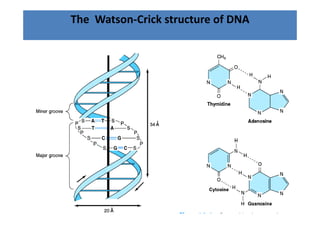
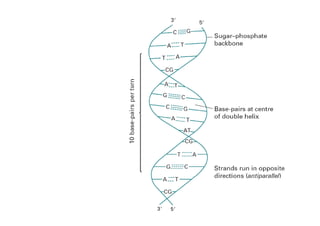
 1. It is a double‐stranded right‐handed 
    helix. 
    helix

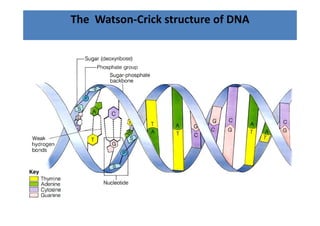
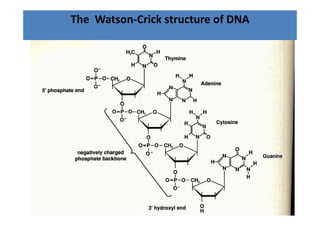
 2. Each strand is is a polymer of 2‐
  . ach strand is is a polymer of
    deoxyribonucleotides linked by 3'‐
    5'phosphodiester links.

 3. The nitrogenous bases in the 
    nucleotides of DNA are A,G,C,T.
    nucleotides of DNA are A G C T

 4. The bases in the two complementary 
                               p         y
    strands are specifically paired and held
    together  by hydrogen bonds.
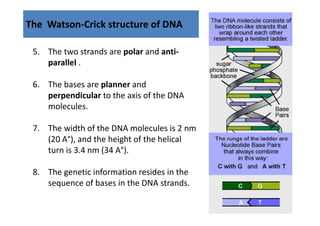
The  Watson‐Crick structure of DNA

 5. The two strands are polar and anti‐
    parallel .

 6. The bases are planner and 
    The bases are planner and
    perpendicular to the axis of the DNA 
    molecules.

 7. The width of the DNA molecules is 2 nm 
    (20 A ), and the height of the helical 
    (20 A°) and the height of the helical
    turn is 3.4 nm (34 A°). 

 8. The genetic information resides in the 
    sequence of bases in the DNA strands.
The  Watson‐Crick structure of DNA
The structure of DNA

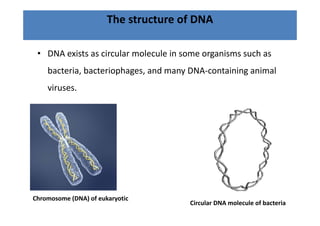
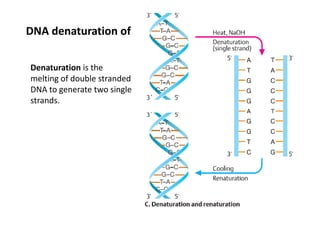
 • DNA exists as circular molecule in some organisms such as 
    bacteria, bacteriophages, and many DNA‐containing animal 
    viruses.
    viruses


Chromosome (DNA) of eukaryotic
                                       Circular DNA molecule of bacteria
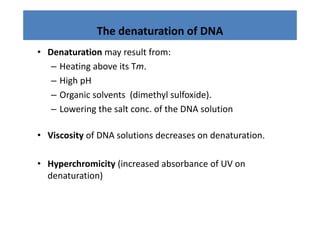
DNA denaturation of

Denaturation is the 
melting of double stranded 
DNA to generate two single 
DNA t         t t     i l
strands.
The denaturation of DNA
• Denaturation may result from:
   – Heating above its Tm.
   – High pH
   – Organic solvents  (dimethyl sulfoxide).
   – Lowering the salt conc. of the DNA solution
             g

• Viscosity of DNA solutions decreases on denaturation.
          y

• Hyperchromicity (increased absorbance of UV on
  Hyperchromicity (increased absorbance of UV on 
  denaturation)
The Reannealing of DNA

• R
  Reannealing is the reformation of the double stranded 
         li i th       f    ti    f th d bl t d d
  DNA.

• Viscosity of DNA solutions increases on reannealing.

• Hyporchromicity (decreased absorbance of UV on 
  reannealing)
The  RNA structure differs from that of DNA

The RNAs are polymers of ribonucleotides linked together by 
3'‐5' phosphodiester bonds. 


RNAs share many structural features with DNA but have some 
specific characteristics, these are:
– it is usually single rather than double stranded
  it is usually single rather than double stranded 
– it contains ribose rather than deoxyribose
– it contains the base uracil rather than thymine
  it contains the base uracil rather than thymine 
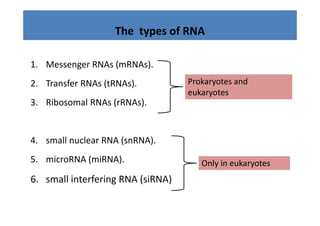
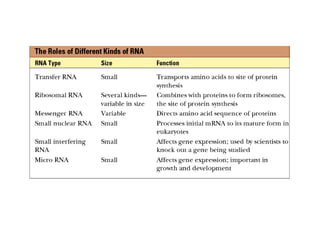
The  types of RNA
                         yp

1. Messenger RNAs (mRNAs). 
1 M          RNA ( RNA )
                 (     )
2. Transfer RNAs (tRNAs).          Prokaryotes and 
                                   eukaryotes
3. Ribosomal RNAs (rRNAs).


4.
4 small nuclear RNA (snRNA).
     ll    l    RNA ( RNA)
5. microRNA (miRNA).                  Only in eukaryotes
                                      Only in eukaryotes
6. small interfering RNA (siRNA)
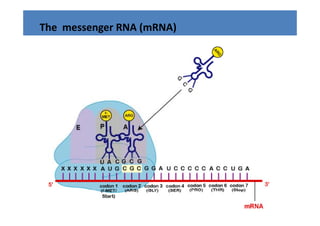
The  messenger RNA (mRNA)
            g       (    )
• Heterogeneous in size and stability.

• Carries the codons specifying amino acid sequences in 
  proteins

• Act as templates for protein synthesis.
The  messenger RNA (mRNA)
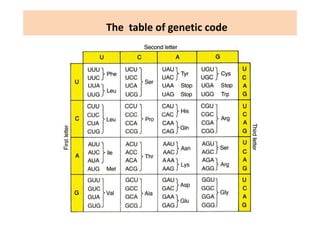
The  table of genetic code
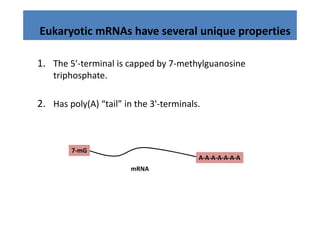
Eukaryotic mRNAs have several unique properties
     y                           q p p

1. The 5'‐terminal is capped by 7‐methylguanosine 
1 Th 5' t i l i            db 7     th l      i
    triphosphate. 

2. Has poly(A) “tail” in the 3'‐terminals. 


        7‐mG
                                          A‐A‐A‐A‐A‐A‐A
                        mRNA
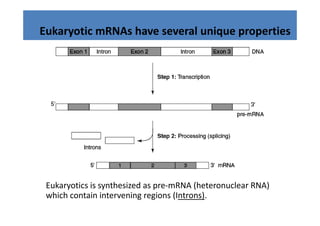
Eukaryotic mRNAs have several unique properties
     y                           q p p


 Eukaryotics is synthesized as pre‐mRNA (heteronuclear RNA) 
 which contain intervening regions (Introns).
Transfer RNA (tRNA)

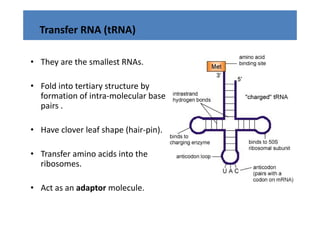
• They are the smallest RNAs
  They are the smallest RNAs.

• Fold into tertiary structure by
  Fold into tertiary structure by 
  formation of intra‐molecular base 
  pairs .

• Have clover leaf shape (hair‐pin).

• Transfer amino acids into the 
  ribosomes.
  ribosomes

• Act as an adaptor molecule.
  Act as an adaptor molecule. 
Ribosomal RNA (rRNA)

• Have structural and catalytic functions.
  Have structural and catalytic functions. 


• They have a ribozyme function, the 28S rRNA catalyze 
  the synthesis of  peptide bonds (peptidyl transferase).
Ribosomal RNA (rRNA)

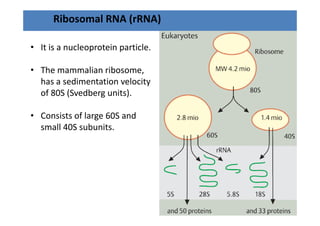
• It is a nucleoprotein particle.

• The mammalian ribosome, 
  has a sedimentation velocity 
  of 80S (Svedberg units).

• C i
  Consists of large 60S and 
            fl      60S d
  small 40S subunits.
Small nuclear RNA (snRNA)

• A large number of highly conserved small stable molecules 
  of RNA found in eukaryotic cells. 

• The majority of them exists as nucleoproteins distributed in 
  both the nucleus and the cytosol. 

• They are involved in mRNA processing and gene regulation. 
microRNA (miRNA)

•    Are  short RNA molecules found in eukaryotic cells. 

•    Have very few nucleotides (an average of 22) compared with 
     other RNAs.
       h

•    Have multiple roles in regulation of gene expression.
     Have multiple roles in regulation of gene expression
Small interfering RNA (siRNA)

Also  known as short interfering RNA or silencing RNA
                               g                g

Are double‐stranded RNA molecules

Have 20‐25 nucleotides in length

They interfere with the expression of a specific gene.

Nucleic Acids Structure and Functions