BY:Lara Jane B. Cunanan
DNA, short for deoxyribonucleic acid, is the
molecule that contains the genetic code of
organisms. This includes animals, plants,
protists, archaea and bacteria. DNA is in each
cell in the organism and tells cells what proteins
to make.
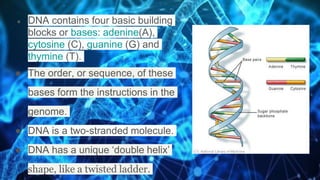
● DNA contains four basic building
blocks or bases: adenine(A),
cytosine (C), guanine (G) and
thymine (T).
● The order, or sequence, of these
bases form the instructions in the
genome.
● DNA is a two-stranded molecule.
● DNA has a unique ‘double helix’
shape, like a twisted ladder.
The DNA in prokaryotes is
contained in a central area of the
cell called the nucleoid, which is
not surrounded by a nuclear
membrane. Many prokaryotes
also carry small, circular DNA
molecules called plasmids, which
are distinct from the chromosomal
DNA and can provide genetic
advantages in specific
environments.
In organisms called eukaryotes, DNA
is found inside a special area of the
cell called the nucleus. Because the
cell is very small, and because
organisms have many DNA molecules
per cell, each DNA molecule must be
tightly packaged. This packaged form
of the DNA is called a chromosome
DNA was first recognized and identified by
the Swiss biologist, Johannes Friedrich
Miescher in 1869 during his research on
white blood cells.
6 Weird But True Facts
About DNA
1. Your DNA could stretch from the earth to the sun and back ~600
times.
If unwound and linked together, the strands of DNA in each of your
cells would be 6 feet long. With 100 trillion cells in your body, that
means if all your DNA were put end-to-end, it would stretch over 110
billion miles. That’s hundreds of round trips to the sun!
2. We’re all 99.9 percent alike.
Of the 3 billion base pairs in the human genome, only 0.1% are unique to us. While
that 0.1% is still what makes us unique, it means we’re all more similar than we are
different.
3. Genes make up only about 3 percent of your DNA.
Genes are short segments of DNA, but not all DNA is genes. All told, genes are
only about 1-3% of your DNA. The rest of your DNA controls the activity of your
genes.
4. A DNA test can reveal you’re more Irish than your siblings.
Your sister could be much more Irish than you. And this is true for any of over 350 regions
covered by the AncestryDNA test. So your sibling could also be more (or less) British, Nigerian, or
Scandinavian than you.
5. The human genome contains 3 billion base pairs of DNA.
DNA molecules are shaped like twisted ladders. And the rungs on that ladder are made of bases –
adenine (A), cytosine (C), guanine (G), and thymine (T) – locked together in pairs with hydrogen
bonds. The really cool part is, they pair up in a very specific way: ‘A’ always pairs with ‘T,’ and ‘C’
always pairs with ‘G.’
6. Your DNA could link you to places you’d never imagine.
Genetics has the power to tell you things you never dreamed of knowing, from just the DNA
in your saliva.
DNA

DNA

  • 1.
  • 2.
    DNA, short fordeoxyribonucleic acid, is the molecule that contains the genetic code of organisms. This includes animals, plants, protists, archaea and bacteria. DNA is in each cell in the organism and tells cells what proteins to make.
  • 3.
    ● DNA containsfour basic building blocks or bases: adenine(A), cytosine (C), guanine (G) and thymine (T). ● The order, or sequence, of these bases form the instructions in the genome. ● DNA is a two-stranded molecule. ● DNA has a unique ‘double helix’ shape, like a twisted ladder.
  • 5.
    The DNA inprokaryotes is contained in a central area of the cell called the nucleoid, which is not surrounded by a nuclear membrane. Many prokaryotes also carry small, circular DNA molecules called plasmids, which are distinct from the chromosomal DNA and can provide genetic advantages in specific environments.
  • 6.
    In organisms calledeukaryotes, DNA is found inside a special area of the cell called the nucleus. Because the cell is very small, and because organisms have many DNA molecules per cell, each DNA molecule must be tightly packaged. This packaged form of the DNA is called a chromosome DNA was first recognized and identified by the Swiss biologist, Johannes Friedrich Miescher in 1869 during his research on white blood cells.
  • 8.
    6 Weird ButTrue Facts About DNA
  • 9.
    1. Your DNAcould stretch from the earth to the sun and back ~600 times. If unwound and linked together, the strands of DNA in each of your cells would be 6 feet long. With 100 trillion cells in your body, that means if all your DNA were put end-to-end, it would stretch over 110 billion miles. That’s hundreds of round trips to the sun! 2. We’re all 99.9 percent alike. Of the 3 billion base pairs in the human genome, only 0.1% are unique to us. While that 0.1% is still what makes us unique, it means we’re all more similar than we are different.
  • 10.
    3. Genes makeup only about 3 percent of your DNA. Genes are short segments of DNA, but not all DNA is genes. All told, genes are only about 1-3% of your DNA. The rest of your DNA controls the activity of your genes. 4. A DNA test can reveal you’re more Irish than your siblings. Your sister could be much more Irish than you. And this is true for any of over 350 regions covered by the AncestryDNA test. So your sibling could also be more (or less) British, Nigerian, or Scandinavian than you.
  • 11.
    5. The humangenome contains 3 billion base pairs of DNA. DNA molecules are shaped like twisted ladders. And the rungs on that ladder are made of bases – adenine (A), cytosine (C), guanine (G), and thymine (T) – locked together in pairs with hydrogen bonds. The really cool part is, they pair up in a very specific way: ‘A’ always pairs with ‘T,’ and ‘C’ always pairs with ‘G.’ 6. Your DNA could link you to places you’d never imagine. Genetics has the power to tell you things you never dreamed of knowing, from just the DNA in your saliva.