Nucleic acid chemistry and structure
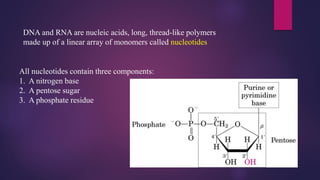
DNA and RNA are nucleic acids, long, thread-like polymers
made up of a linear array of monomers called nucleotides
All nucleotides contain three components:
1. A nitrogen base
2. A pentose sugar
3. A phosphate residue
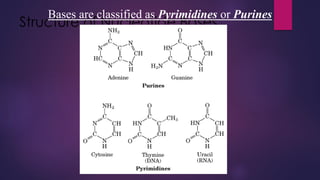
Structure of Nucleotide Bases
Bases are classified as Pyrimidines or Purines
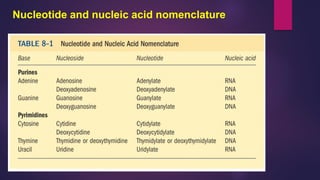
Nucleotide and nucleic acid nomenclature
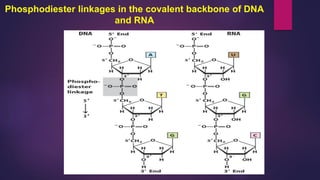
Phosphodiester linkages in the covalent backbone of DNA
and RNA
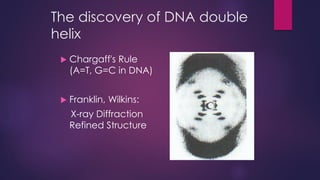
The discovery of DNA double
helix
 Chargaff's Rule
(A=T, G=C in DNA)
 Franklin, Wilkins:
X-ray Diffraction
Refined Structure
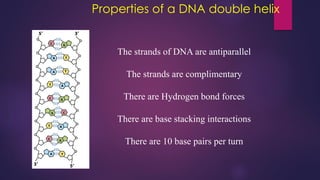
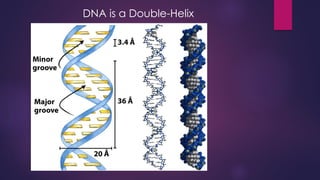
Properties of a DNA double helix
The strands of DNA are antiparallel
The strands are complimentary
There are Hydrogen bond forces
There are base stacking interactions
There are 10 base pairs per turn
DNA is a Double-Helix
Primary structure
The base sequence (or the nucleotide sequence)
in polydeoxynucleotide chain
Secondary structure
The secondary structure is defined as the relative
spatial position of all the atoms of nucleotide
residues.
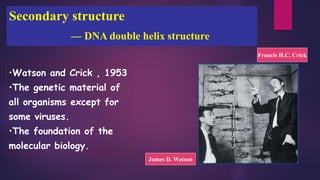
Secondary structure
— DNA double helix structure
•Watson and Crick , 1953
•The genetic material of
all organisms except for
some viruses.
•The foundation of the
molecular biology.
James D. Watson
Francis H.C. Crick
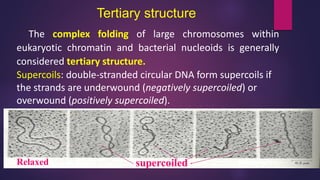
The complex folding of large chromosomes within
eukaryotic chromatin and bacterial nucleoids is generally
considered tertiary structure.
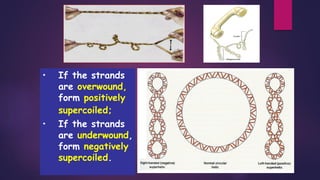
Supercoils: double-stranded circular DNA form supercoils if
the strands are underwound (negatively supercoiled) or
overwound (positively supercoiled).
Tertiary structure
Relaxed supercoiled
• If the strands
are overwound,
form positively
supercoiled;
• If the strands
are underwound,
form negatively
supercoiled.
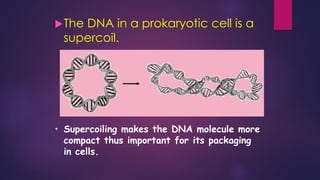
The DNA in a prokaryotic cell is a
supercoil.
• Supercoiling makes the DNA molecule more
compact thus important for its packaging
in cells.
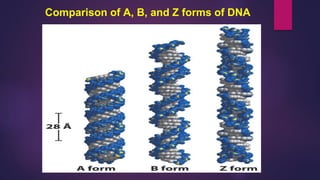
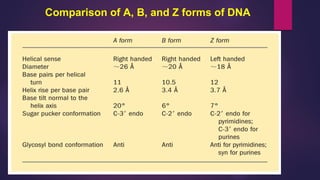
Comparison of A, B, and Z forms of DNA
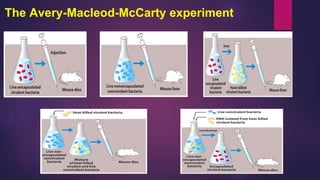
The Avery-Macleod-McCarty experiment
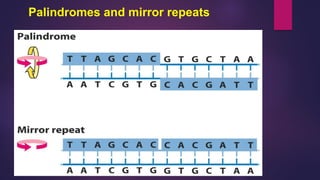
Palindromes and mirror repeats
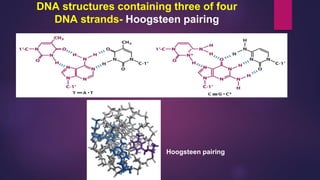
DNA structures containing three of four
DNA strands- Hoogsteen pairing
Hoogsteen pairing
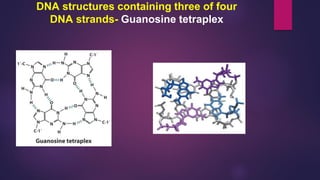
DNA structures containing three of four
DNA strands- Guanosine tetraplex
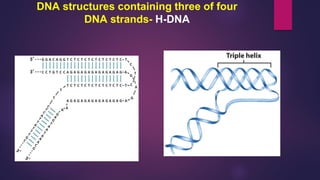
DNA structures containing three of four
DNA strands- H-DNA
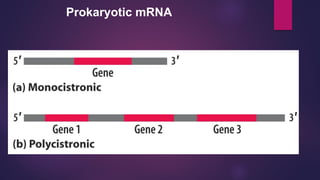
Prokaryotic mRNA
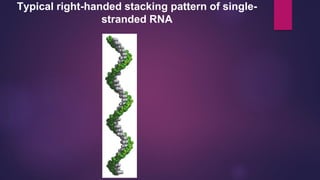
Typical right-handed stacking pattern of single-
stranded RNA
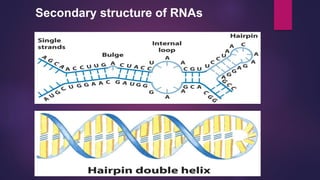
Secondary structure of RNAs
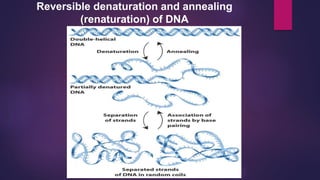
Reversible denaturation and annealing
(renaturation) of DNA
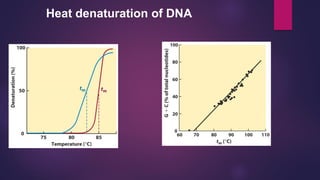
Heat denaturation of DNA
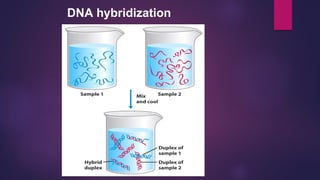
DNA hybridization
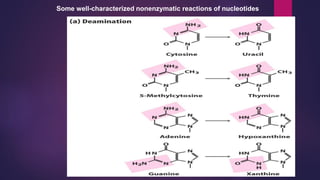
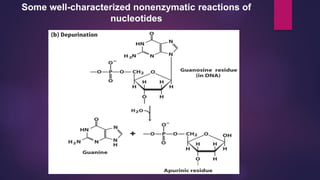
Some well-characterized nonenzymatic reactions of nucleotides
Some well-characterized nonenzymatic reactions of
nucleotides
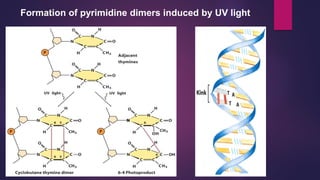
Formation of pyrimidine dimers induced by UV light
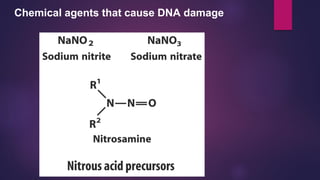
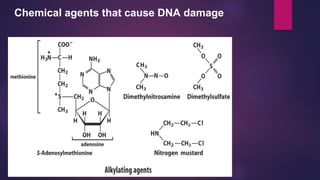
Chemical agents that cause DNA damage
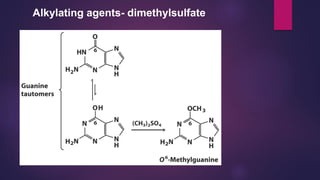
Alkylating agents- dimethylsulfate
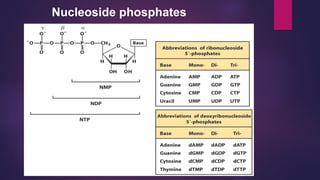
Nucleoside phosphates
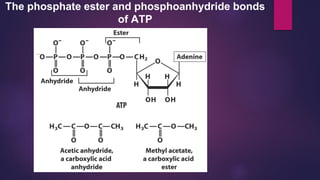
The phosphate ester and phosphoanhydride bonds
of ATP
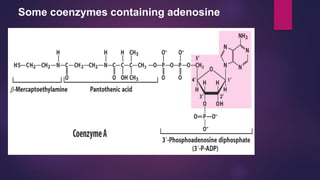
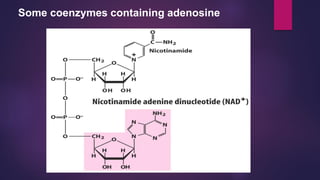
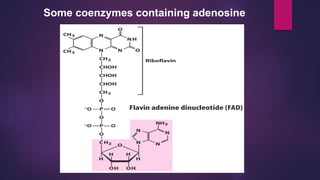
Some coenzymes containing adenosine
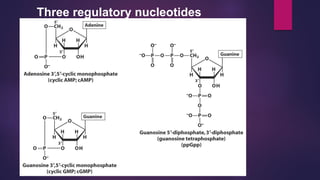
Three regulatory nucleotides
Eukaryotic DNA
• DNA in eukaryotic cells is highly packed.
• DNA appears in a highly ordered form
called chromosomes during metaphase,
whereas shows a relatively loose form of
chromatin in other phases.
• The basic unit of chromatin is
nucleosome.
• Nucleosomes are composed of DNA and
histone proteins.
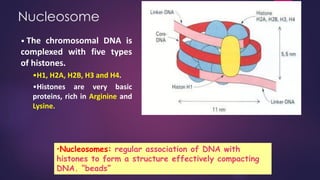
Nucleosome
• The chromosomal DNA is
complexed with five types
of histones.
•H1, H2A, H2B, H3 and H4.
•Histones are very basic
proteins, rich in Arginine and
Lysine.
•Nucleosomes: regular association of DNA with
histones to form a structure effectively compacting
DNA. ”beads”
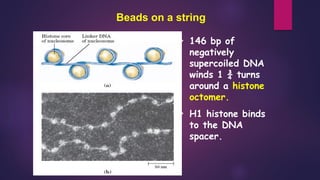
Beads on a string
• 146 bp of
negatively
supercoiled DNA
winds 1 ¾ turns
around a histone
octomer.
• H1 histone binds
to the DNA
spacer.
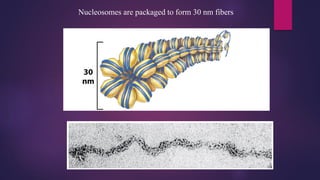
Nucleosomes are packaged to form 30 nm fibers
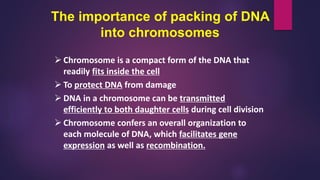
The importance of packing of DNA
into chromosomes
 Chromosome is a compact form of the DNA that
readily fits inside the cell
 To protect DNA from damage
 DNA in a chromosome can be transmitted
efficiently to both daughter cells during cell division
 Chromosome confers an overall organization to
each molecule of DNA, which facilitates gene
expression as well as recombination.
Functions of DNA
 The carrier of genetic information.
 The template strand is involved in
replication and transcription.
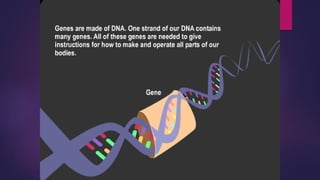
Gene: the minimum functional unit in DNA
Genome: the total genes in a living cell or
living beings.
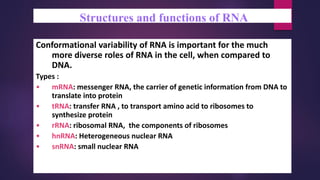
Structures and functions of RNA
Conformational variability of RNA is important for the much
more diverse roles of RNA in the cell, when compared to
DNA.
Types :
• mRNA: messenger RNA, the carrier of genetic information from DNA to
translate into protein
• tRNA: transfer RNA , to transport amino acid to ribosomes to
synthesize protein
• rRNA: ribosomal RNA, the components of ribosomes
• hnRNA: Heterogeneous nuclear RNA
• snRNA: small nuclear RNA
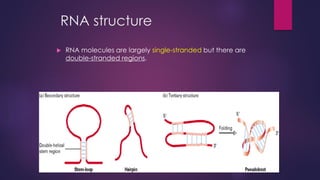
RNA structure
 RNA molecules are largely single-stranded but there are
double-stranded regions.
3.1 Messenger RNA( mRNA)
• Function: the carrier of genetic information
from DNA for the synthesis of protein.
• Comprises only about 5% of the RNA in the
cell.
• Composition: vary considerably in size (500-
6000 bases in E. coli)
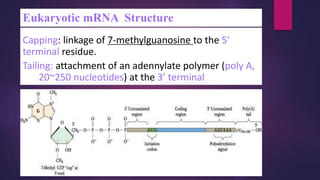
Eukaryotic mRNA Structure
Capping: linkage of 7-methylguanosine to the 5’
terminal residue.
Tailing: attachment of an adennylate polymer (poly A,
20~250 nucleotides) at the 3’ terminal

Nucleic acid chemistry and structure