
NUCLEIC
ACID
Prepared by:
Ms. Shivanee Vyas
Assistant Professor
NUCLEI ACID
Nuclei acid is a naturally occurring chemical compound containing phosphoric
acid, sugars, and a mixture of organic bases (purines and pyrimidines).
• The two main classes of nucleic acids are deoxyribonucleic acid (DNA) and ribonucleic acid
(RNA).
• DNA is the master blueprint for life and constitutes the genetic material in all free-living organisms
and most viruses. DNA is the chemical basis of heredity and may be regarded as the reserve
bank of genetic formation. DNA is exclusively responsible for maintaining the identity of different
species of organisms over millions of years.
• RNA is the genetic material of certain viruses, but it is also found in all living cells. The genes
control protein synthesis through the mediation of RNA.
1. DNA is required for replication and heredity.
2. DNA is the reserve bank of genetic information.
3. DNA is responsible for maintaining the identity of different
species of organisms.
4. Various cellular functions are under the control of DNA.
5. DNA takes part in protein synthesis from RNA.
6. Nucleotides are precursors of nucleic acids;
deoxyribonucleic acid (DNA) and ribonucleic acid (RNA).
7. The nucleic acids are concerned with the storage and
transfer of genetic information.
Functions of Nucleic Acid
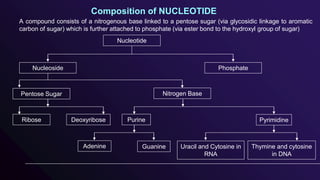
Composition of NUCLEOTIDE
A compound consists of a nitrogenous base linked to a pentose sugar (via glycosidic linkage to aromatic
carbon of sugar) which is further attached to phosphate (via ester bond to the hydroxyl group of sugar)
Nucleotide
Phosphate
Nucleoside
Pentose Sugar Nitrogen Base
Purine
Ribose Deoxyribose Pyrimidine
Guanine
Adenine Thymine and cytosine
in DNA
Uracil and Cytosine in
RNA
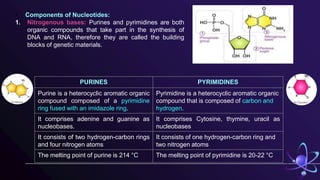
• Components of Nucleotides:
1. Nitrogenous bases: Purines and pyrimidines are both
organic compounds that take part in the synthesis of
DNA and RNA, therefore they are called the building
blocks of genetic materials.
PURINES PYRIMIDINES
Purine is a heterocyclic aromatic organic
compound composed of a pyrimidine
ring fused with an imidazole ring.
Pyrimidine is a heterocyclic aromatic organic
compound that is composed of carbon and
hydrogen.
It comprises adenine and guanine as
nucleobases.
It comprises Cytosine, thymine, uracil as
nucleobases
It consists of two hydrogen-carbon rings
and four nitrogen atoms
It consists of one hydrogen-carbon ring and
two nitrogen atoms
The melting point of purine is 214 °C The melting point of pyrimidine is 20-22 °C
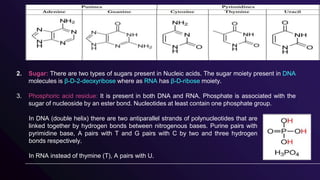
2. Sugar: There are two types of sugars present in Nucleic acids. The sugar moiety present in DNA
molecules is β-D-2-deoxyribose where as RNA has β-D-ribose moiety.
3. Phosphoric acid residue: It is present in both DNA and RNA. Phosphate is associated with the
sugar of nucleoside by an ester bond. Nucleotides at least contain one phosphate group.
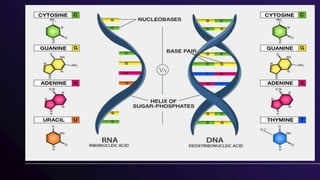
In DNA (double helix) there are two antiparallel strands of polynucleotides that are
linked together by hydrogen bonds between nitrogenous bases. Purine pairs with
pyrimidine base, A pairs with T and G pairs with C by two and three hydrogen
bonds respectively.
In RNA instead of thymine (T), A pairs with U.
Biological importance of Nucleotides
1. Nucleotides are the essential part of the formation of Ribonucleic Acid (RNA) and Deoxyribonucleic
Acid (DNA).
2. It has been useful acting as an antiviral against dangerous diseases like hepatitis and HIV.
3. Helps in building metabolism of the cell inside the living beings.
4. Involved in storing chemical energy.
5. Required for DNA replication and RNA transcription in stages that rapidly divide.
6. Provides cellular energy sources and other metabolic functions.
7. Required for chemical associations in the response of cells to the hormones and other extracellular
stimuli.
8. Nucleotides act as coenzymes, which are required to catalyze many biochemical reactions by
enzymes.
9. Improve the immune system of a human body.
A compound that consists of a purine or pyrimidine base combined with deoxyribose or ribose and
is found especially in DNA or RNA. Examples: Adenosine, Guanosine.
Composition of NUCLEOSIDE
TYPE OF NUCLEOSIDE
1. ADENOSINE: Deoxyribose sugar or Ribose Sugar which is attached to the Adenine (a
nitrogenous base) by an ester bond.
2. GUANOSINE: Deoxyribose sugar or Ribose Sugar is attached to the Guanine (a nitrogenous
base) by an ester bond.
3. CYTIDINE: Deoxyribose sugar or Ribose Sugar is attached to the Cytosine (a nitrogenous
base) by an ester bond.
4. THYMIDINE: Deoxyribose sugar that is attached to the Thymine (a nitrogenous base) by an
ester bond.
5. URIDINE: Ribose Sugar which is attached to uracil (a nitrogenous base) by ester bond.
• Nucleoside = Nitrogenous base + Sugar
Nucleosides are named as Adenosine, Guanosine, Thymidine, Cytidine, Uridine
• Nucleotide = Nucleoside + Phosphate
Nucleotides are named as Adenylic acid, Guanylic acid, Thymidylic acid, Cytidylic acid and Uridylic
acid.
How do nucleotides and nucleosides differ?
In 1953, J.D. Watson (an American biologist) and F.H.C. Crick (a British
Physicist) proposed the three dimensional model of DNA.
For this they got Nobel Prize in medicine in 1962. Term DNA was given by
Zacharias.
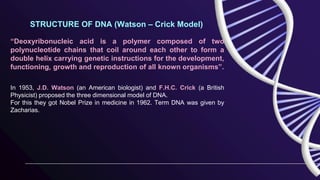
STRUCTURE OF DNA (Watson – Crick Model)
“Deoxyribonucleic acid is a polymer composed of two
polynucleotide chains that coil around each other to form a
double helix carrying genetic instructions for the development,
functioning, growth and reproduction of all known organisms”.
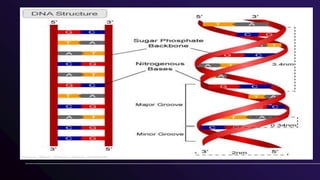
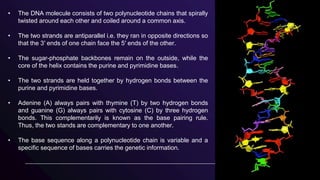
• The DNA molecule consists of two polynucleotide chains that spirally
twisted around each other and coiled around a common axis.
• The two strands are antiparallel i.e. they ran in opposite directions so
that the 3′ ends of one chain face the 5′ ends of the other.
• The sugar-phosphate backbones remain on the outside, while the
core of the helix contains the purine and pyrimidine bases.
• The two strands are held together by hydrogen bonds between the
purine and pyrimidine bases.
• Adenine (A) always pairs with thymine (T) by two hydrogen bonds
and guanine (G) always pairs with cytosine (C) by three hydrogen
bonds. This complementarily is known as the base pairing rule.
Thus, the two stands are complementary to one another.
• The base sequence along a polynucleotide chain is variable and a
specific sequence of bases carries the genetic information.
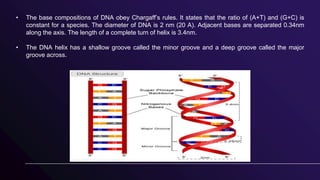
• The base compositions of DNA obey Chargaff’s rules. It states that the ratio of (A+T) and (G+C) is
constant for a species. The diameter of DNA is 2 nm (20 A). Adjacent bases are separated 0.34nm
along the axis. The length of a complete turn of helix is 3.4nm.
• The DNA helix has a shallow groove called the minor groove and a deep groove called the major
groove across.
1. Hereditary material: The genetic information stored in the nucleotide sequence of DNA helps in
the synthesis of specific proteins or polypeptides and transmits the information to daughter cells.
2. Autocatalytic role DNA: DNA undergoes replication (self-duplication) in the S-phase of the cell
cycle. During the process, each DNA strand of a double helix can act as a template for the
synthesis of the daughter strand.
3. Hetero catalytic role: During transcription, any one strand of DNA acts as a template for the
synthesis of RNA. This is called the hetero-catalytic role of RNA.
4. Variations: DNA undergoes recombination in its meiosis and occasional mutation (changes in
nucleotide sequences) which creates variations in population.
5. DNA controls cellular metabolism, and growth.
Biological importance of DNA:
6. DNA finger printing (-DNA typing or profiling): This technique is used to identify
criminals, determine paternity, verification of immigrant etc.
7. Recombinant DNA technology (Genetic engineering): It involves the artificial cleaving
and rejoining DNA sequences from two or more organisms to create recombinant DNA.
This technology is employed for production of genetically modified organisms (GMOs),
genetically modified foods (GMFs), vaccines, hormones, enzymes, clones etc.
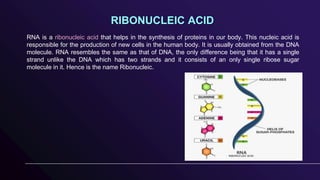
RNA is a ribonucleic acid that helps in the synthesis of proteins in our body. This nucleic acid is
responsible for the production of new cells in the human body. It is usually obtained from the DNA
molecule. RNA resembles the same as that of DNA, the only difference being that it has a single
strand unlike the DNA which has two strands and it consists of an only single ribose sugar
molecule in it. Hence is the name Ribonucleic.
RIBONUCLEIC ACID
RNA is a polymer of ribonucleotides held together by 3',5'-phosphodiester bridges. Although RNA
has certain similarities with DNA structure, they have specific differences:
• Pentose: The sugar in RNA is ribose in contrast to deoxyribose in DNA.
• Pyrimidine: RNA contains the pyrimidine uracil in place of thymine (in DNA).
• Single strand: RNA is usually a single-stranded polynucleotide. However, this strand may fold at
certain places to give a double-stranded structure, if complementary base pairs are in close
proximity.
• Chargaff's rule not obeyed: Due to the single-stranded nature, there is no specific relation
between purine and pyrimidine contents. Thus the guanine content is not equal to cytosine (as is
the case in DNA).
TYPES OF RNA
1. Messenger RNA (mRNA): This type of RNA functions as a carrier of genetic information
from the DNA in the cell nucleus to the site of protein synthesis in the cytoplasm. mRNA
has a short lifetime (usually less than one hour); it is synthesized as it is needed, then
rapidly degraded to the constituent nucleotides.
2. Transfer RNA (tRNA): The transfer RNA delivers individual amino acids to the site of
protein synthesis. tRNA is specific to one type of amino acid; cells contain at least one
specific type of tRNA for each of the 20 common amino acids. tRNA is the smallest of the
nucleic acids, with 73-93 nucleotides per chain.
3. Ribosomal RNA (rRNA): The rRNA is the component of the ribosome and are located
within the cytoplasm of a cell, where ribosomes are found. In all living cells, the ribosomal
RNA plays a fundamental role in the synthesis and translation of mRNA into proteins.
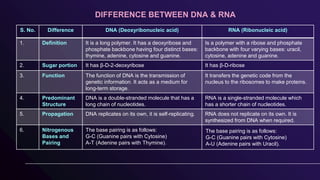
S. No. Difference DNA (Deoxyribonucleic acid) RNA (Ribonucleic acid)
1. Definition It is a long polymer. It has a deoxyribose and
phosphate backbone having four distinct bases:
thymine, adenine, cytosine and guanine.
Is a polymer with a ribose and phosphate
backbone with four varying bases: uracil,
cytosine, adenine and guanine.
2. Sugar portion It has β-D-2-deoxyribose It has β-D-ribose
3. Function The function of DNA is the transmission of
genetic information. It acts as a medium for
long-term storage.
It transfers the genetic code from the
nucleus to the ribosomes to make proteins.
4. Predominant
Structure
DNA is a double-stranded molecule that has a
long chain of nucleotides.
RNA is a single-stranded molecule which
has a shorter chain of nucleotides.
5. Propagation DNA replicates on its own, it is self-replicating. RNA does not replicate on its own. It is
synthesized from DNA when required.
6. Nitrogenous
Bases and
Pairing
The base pairing is as follows:
G-C (Guanine pairs with Cytosine)
A-T (Adenine pairs with Thymine).
The base pairing is as follows:
G-C (Guanine pairs with Cytosine)
A-U (Adenine pairs with Uracil).
DIFFERENCE BETWEEN DNA & RNA
FUNCTIONS OF RNA:
1. Make it easier for DNA to be translated into proteins.
2. It functions as an adapter molecule during protein synthesis.
3. Between the DNA and the ribosomes, it acts as a messenger.
4. In all living cells, they are the carriers of genetic material.
5. Encourages ribosomes to choose the appropriate amino acid for the formation of new proteins
in the body.
THANK
YOU

Nucleic Acid

  • 1.
  • 2.
    NUCLEI ACID Nuclei acidis a naturally occurring chemical compound containing phosphoric acid, sugars, and a mixture of organic bases (purines and pyrimidines). • The two main classes of nucleic acids are deoxyribonucleic acid (DNA) and ribonucleic acid (RNA). • DNA is the master blueprint for life and constitutes the genetic material in all free-living organisms and most viruses. DNA is the chemical basis of heredity and may be regarded as the reserve bank of genetic formation. DNA is exclusively responsible for maintaining the identity of different species of organisms over millions of years. • RNA is the genetic material of certain viruses, but it is also found in all living cells. The genes control protein synthesis through the mediation of RNA.
  • 3.
    1. DNA isrequired for replication and heredity. 2. DNA is the reserve bank of genetic information. 3. DNA is responsible for maintaining the identity of different species of organisms. 4. Various cellular functions are under the control of DNA. 5. DNA takes part in protein synthesis from RNA. 6. Nucleotides are precursors of nucleic acids; deoxyribonucleic acid (DNA) and ribonucleic acid (RNA). 7. The nucleic acids are concerned with the storage and transfer of genetic information. Functions of Nucleic Acid
  • 4.
    Composition of NUCLEOTIDE Acompound consists of a nitrogenous base linked to a pentose sugar (via glycosidic linkage to aromatic carbon of sugar) which is further attached to phosphate (via ester bond to the hydroxyl group of sugar) Nucleotide Phosphate Nucleoside Pentose Sugar Nitrogen Base Purine Ribose Deoxyribose Pyrimidine Guanine Adenine Thymine and cytosine in DNA Uracil and Cytosine in RNA
  • 5.
    • Components ofNucleotides: 1. Nitrogenous bases: Purines and pyrimidines are both organic compounds that take part in the synthesis of DNA and RNA, therefore they are called the building blocks of genetic materials. PURINES PYRIMIDINES Purine is a heterocyclic aromatic organic compound composed of a pyrimidine ring fused with an imidazole ring. Pyrimidine is a heterocyclic aromatic organic compound that is composed of carbon and hydrogen. It comprises adenine and guanine as nucleobases. It comprises Cytosine, thymine, uracil as nucleobases It consists of two hydrogen-carbon rings and four nitrogen atoms It consists of one hydrogen-carbon ring and two nitrogen atoms The melting point of purine is 214 °C The melting point of pyrimidine is 20-22 °C
  • 6.
    2. Sugar: Thereare two types of sugars present in Nucleic acids. The sugar moiety present in DNA molecules is β-D-2-deoxyribose where as RNA has β-D-ribose moiety. 3. Phosphoric acid residue: It is present in both DNA and RNA. Phosphate is associated with the sugar of nucleoside by an ester bond. Nucleotides at least contain one phosphate group. In DNA (double helix) there are two antiparallel strands of polynucleotides that are linked together by hydrogen bonds between nitrogenous bases. Purine pairs with pyrimidine base, A pairs with T and G pairs with C by two and three hydrogen bonds respectively. In RNA instead of thymine (T), A pairs with U.
  • 7.
    Biological importance ofNucleotides 1. Nucleotides are the essential part of the formation of Ribonucleic Acid (RNA) and Deoxyribonucleic Acid (DNA). 2. It has been useful acting as an antiviral against dangerous diseases like hepatitis and HIV. 3. Helps in building metabolism of the cell inside the living beings. 4. Involved in storing chemical energy. 5. Required for DNA replication and RNA transcription in stages that rapidly divide. 6. Provides cellular energy sources and other metabolic functions. 7. Required for chemical associations in the response of cells to the hormones and other extracellular stimuli. 8. Nucleotides act as coenzymes, which are required to catalyze many biochemical reactions by enzymes. 9. Improve the immune system of a human body.
  • 8.
    A compound thatconsists of a purine or pyrimidine base combined with deoxyribose or ribose and is found especially in DNA or RNA. Examples: Adenosine, Guanosine. Composition of NUCLEOSIDE TYPE OF NUCLEOSIDE 1. ADENOSINE: Deoxyribose sugar or Ribose Sugar which is attached to the Adenine (a nitrogenous base) by an ester bond. 2. GUANOSINE: Deoxyribose sugar or Ribose Sugar is attached to the Guanine (a nitrogenous base) by an ester bond. 3. CYTIDINE: Deoxyribose sugar or Ribose Sugar is attached to the Cytosine (a nitrogenous base) by an ester bond. 4. THYMIDINE: Deoxyribose sugar that is attached to the Thymine (a nitrogenous base) by an ester bond. 5. URIDINE: Ribose Sugar which is attached to uracil (a nitrogenous base) by ester bond.
  • 9.
    • Nucleoside =Nitrogenous base + Sugar Nucleosides are named as Adenosine, Guanosine, Thymidine, Cytidine, Uridine • Nucleotide = Nucleoside + Phosphate Nucleotides are named as Adenylic acid, Guanylic acid, Thymidylic acid, Cytidylic acid and Uridylic acid. How do nucleotides and nucleosides differ?
  • 10.
    In 1953, J.D.Watson (an American biologist) and F.H.C. Crick (a British Physicist) proposed the three dimensional model of DNA. For this they got Nobel Prize in medicine in 1962. Term DNA was given by Zacharias. STRUCTURE OF DNA (Watson – Crick Model) “Deoxyribonucleic acid is a polymer composed of two polynucleotide chains that coil around each other to form a double helix carrying genetic instructions for the development, functioning, growth and reproduction of all known organisms”.
  • 12.
    • The DNAmolecule consists of two polynucleotide chains that spirally twisted around each other and coiled around a common axis. • The two strands are antiparallel i.e. they ran in opposite directions so that the 3′ ends of one chain face the 5′ ends of the other. • The sugar-phosphate backbones remain on the outside, while the core of the helix contains the purine and pyrimidine bases. • The two strands are held together by hydrogen bonds between the purine and pyrimidine bases. • Adenine (A) always pairs with thymine (T) by two hydrogen bonds and guanine (G) always pairs with cytosine (C) by three hydrogen bonds. This complementarily is known as the base pairing rule. Thus, the two stands are complementary to one another. • The base sequence along a polynucleotide chain is variable and a specific sequence of bases carries the genetic information.
  • 13.
    • The basecompositions of DNA obey Chargaff’s rules. It states that the ratio of (A+T) and (G+C) is constant for a species. The diameter of DNA is 2 nm (20 A). Adjacent bases are separated 0.34nm along the axis. The length of a complete turn of helix is 3.4nm. • The DNA helix has a shallow groove called the minor groove and a deep groove called the major groove across.
  • 14.
    1. Hereditary material:The genetic information stored in the nucleotide sequence of DNA helps in the synthesis of specific proteins or polypeptides and transmits the information to daughter cells. 2. Autocatalytic role DNA: DNA undergoes replication (self-duplication) in the S-phase of the cell cycle. During the process, each DNA strand of a double helix can act as a template for the synthesis of the daughter strand. 3. Hetero catalytic role: During transcription, any one strand of DNA acts as a template for the synthesis of RNA. This is called the hetero-catalytic role of RNA. 4. Variations: DNA undergoes recombination in its meiosis and occasional mutation (changes in nucleotide sequences) which creates variations in population. 5. DNA controls cellular metabolism, and growth. Biological importance of DNA:
  • 15.
    6. DNA fingerprinting (-DNA typing or profiling): This technique is used to identify criminals, determine paternity, verification of immigrant etc. 7. Recombinant DNA technology (Genetic engineering): It involves the artificial cleaving and rejoining DNA sequences from two or more organisms to create recombinant DNA. This technology is employed for production of genetically modified organisms (GMOs), genetically modified foods (GMFs), vaccines, hormones, enzymes, clones etc.
  • 16.
    RNA is aribonucleic acid that helps in the synthesis of proteins in our body. This nucleic acid is responsible for the production of new cells in the human body. It is usually obtained from the DNA molecule. RNA resembles the same as that of DNA, the only difference being that it has a single strand unlike the DNA which has two strands and it consists of an only single ribose sugar molecule in it. Hence is the name Ribonucleic. RIBONUCLEIC ACID
  • 17.
    RNA is apolymer of ribonucleotides held together by 3',5'-phosphodiester bridges. Although RNA has certain similarities with DNA structure, they have specific differences: • Pentose: The sugar in RNA is ribose in contrast to deoxyribose in DNA. • Pyrimidine: RNA contains the pyrimidine uracil in place of thymine (in DNA). • Single strand: RNA is usually a single-stranded polynucleotide. However, this strand may fold at certain places to give a double-stranded structure, if complementary base pairs are in close proximity. • Chargaff's rule not obeyed: Due to the single-stranded nature, there is no specific relation between purine and pyrimidine contents. Thus the guanine content is not equal to cytosine (as is the case in DNA).
  • 18.
    TYPES OF RNA 1.Messenger RNA (mRNA): This type of RNA functions as a carrier of genetic information from the DNA in the cell nucleus to the site of protein synthesis in the cytoplasm. mRNA has a short lifetime (usually less than one hour); it is synthesized as it is needed, then rapidly degraded to the constituent nucleotides. 2. Transfer RNA (tRNA): The transfer RNA delivers individual amino acids to the site of protein synthesis. tRNA is specific to one type of amino acid; cells contain at least one specific type of tRNA for each of the 20 common amino acids. tRNA is the smallest of the nucleic acids, with 73-93 nucleotides per chain. 3. Ribosomal RNA (rRNA): The rRNA is the component of the ribosome and are located within the cytoplasm of a cell, where ribosomes are found. In all living cells, the ribosomal RNA plays a fundamental role in the synthesis and translation of mRNA into proteins.
  • 20.
    S. No. DifferenceDNA (Deoxyribonucleic acid) RNA (Ribonucleic acid) 1. Definition It is a long polymer. It has a deoxyribose and phosphate backbone having four distinct bases: thymine, adenine, cytosine and guanine. Is a polymer with a ribose and phosphate backbone with four varying bases: uracil, cytosine, adenine and guanine. 2. Sugar portion It has β-D-2-deoxyribose It has β-D-ribose 3. Function The function of DNA is the transmission of genetic information. It acts as a medium for long-term storage. It transfers the genetic code from the nucleus to the ribosomes to make proteins. 4. Predominant Structure DNA is a double-stranded molecule that has a long chain of nucleotides. RNA is a single-stranded molecule which has a shorter chain of nucleotides. 5. Propagation DNA replicates on its own, it is self-replicating. RNA does not replicate on its own. It is synthesized from DNA when required. 6. Nitrogenous Bases and Pairing The base pairing is as follows: G-C (Guanine pairs with Cytosine) A-T (Adenine pairs with Thymine). The base pairing is as follows: G-C (Guanine pairs with Cytosine) A-U (Adenine pairs with Uracil). DIFFERENCE BETWEEN DNA & RNA
  • 21.
    FUNCTIONS OF RNA: 1.Make it easier for DNA to be translated into proteins. 2. It functions as an adapter molecule during protein synthesis. 3. Between the DNA and the ribosomes, it acts as a messenger. 4. In all living cells, they are the carriers of genetic material. 5. Encourages ribosomes to choose the appropriate amino acid for the formation of new proteins in the body.
  • 22.