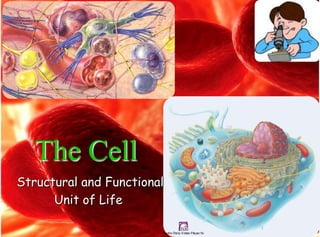
The Cell
Structural and Functional
Unit of Life
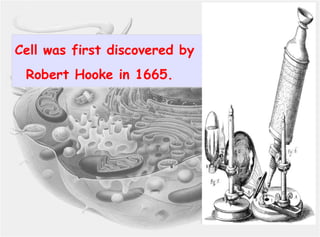
Cell was first discovered by
Robert Hooke in 1665.
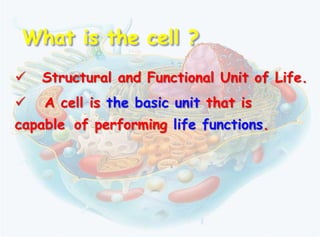
What is the cell ?


Structural and Functional Unit of Life.



A cell is the basic unit that is

capable of performing life functions.
Types of Cells
 Prokaryotic cell lack a nucleus or
membrane-bound structures (e.g.bacteria)
 Eukaryotic cell have a nucleus and
membrane-bound organelles (e.g.animals plants, fungi)
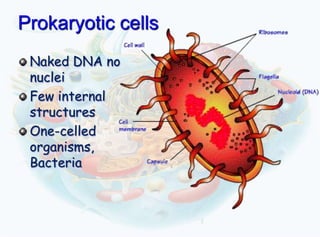
Prokaryotic cells
Naked DNA no
nuclei
Few internal
structures
One-celled
organisms,
Bacteria
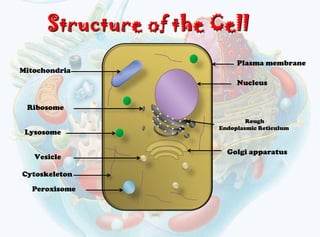
Structure of the Cell
Mitochondria

Plasma membrane
Nucleus

Ribosome
Lysosome
Vesicle
Cytoskeleton
Peroxisome

Rough
Endoplasmic Reticulum

Golgi apparatus
Structure of the Cell
ISOLATION OF SUBCELLULAR ORGANELLES

Homogenizationwith help of glass/teflon homogenizer cells are
disrupted by- suspending in isotonic soln (0.25 M
buffer at pH 7.4)
Differential velocity Centrifugation.


Separation based on their size.
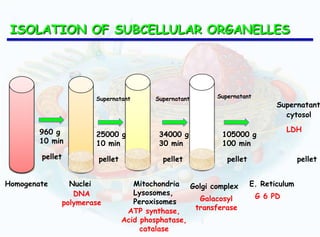
ISOLATION OF SUBCELLULAR ORGANELLES

Supernatant

960 g
10 min
pellet
Homogenate

25000 g
10 min
pellet

Nuclei
DNA
polymerase

Supernatant

34000 g
30 min
pellet

Supernatant

Supernatant
cytosol

105000 g
100 min

LDH

pellet

Mitochondria Golgi complex
Lysosomes,
Galacosyl
Peroxisomes
transferase
ATP synthase,
Acid phosphatase,
catalase

pellet
E. Reticulum
G 6 PD
Parts of the Cell


Plasma membrane



Nucleus



Cytoplasm
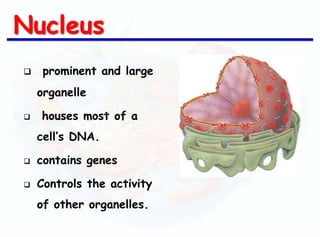
Nucleus


prominent and large
organelle



houses most of a
cell’s DNA.



contains genes



Controls the activity
of other organelles.
Structure of Nucleus
a spherical or oval-shaped structure.
Most cells have a single nucleus, although some,
such as mature RBCs, have none. In contrast,
skeletal muscle cells have multiple nuclei.

the nuclear envelope, membrane of the nuclear is
continuous with rough ER
nuclear pores

Each nuclear pore consists of a circular
arrangement of proteins surrounding a large
central opening
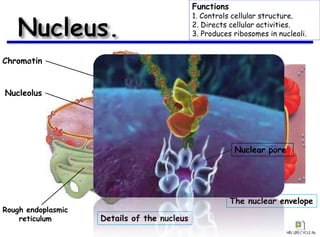
Functions

1. Controls cellular structure.
2. Directs cellular activities.
3. Produces ribosomes in nucleoli.

Chromatin

Polyribosome

Nucleolus

Nuclear
envelope
Nuclear pore
Nuclear
pore

Rough endoplasmic
reticulum

The nuclear envelope

Details of the nucleus
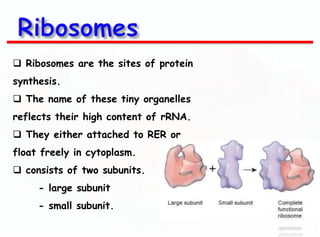
 Ribosomes are the sites of protein

synthesis.
 The name of these tiny organelles
reflects their high content of rRNA.

 They either attached to RER or
float freely in cytoplasm.
 consists of two subunits.

- large subunit
- small subunit.


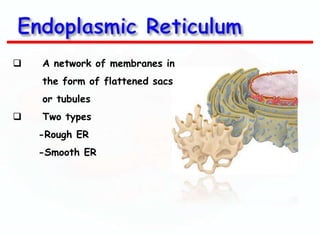
A network of membranes in

the form of flattened sacs
or tubules


Two types

-Rough ER
-Smooth ER
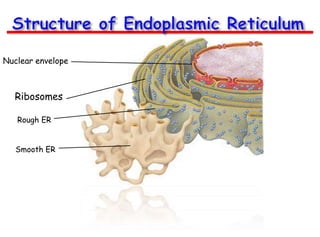
Nuclear envelope

Ribosomes
Rough ER
Smooth ER
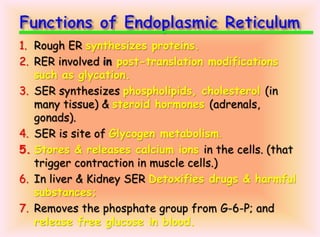
1. Rough ER synthesizes proteins.
2. RER involved in post-translation modifications
such as glycation.
3. SER synthesizes phospholipids, cholesterol (in
many tissue) & steroid hormones (adrenals,
gonads).
4. SER is site of Glycogen metabolism.
5. Stores & releases calcium ions in the cells. (that
trigger contraction in muscle cells.)
6. In liver & Kidney SER Detoxifies drugs & harmful
substances;
7. Removes the phosphate group from G-6-P; and
release free glucose in blood.
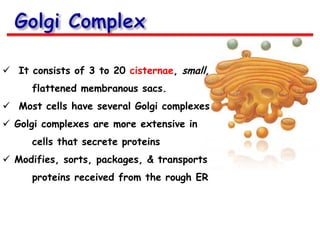
 It consists of 3 to 20 cisternae, small,
flattened membranous sacs.
 Most cells have several Golgi complexes
 Golgi complexes are more extensive in
cells that secrete proteins
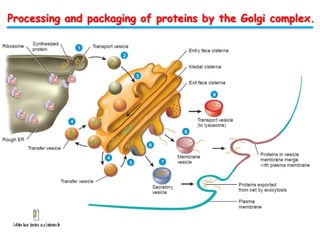
 Modifies, sorts, packages, & transports

proteins received from the rough ER
Processing and packaging of proteins by the Golgi complex.
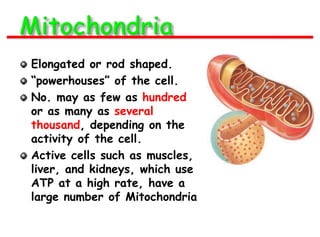
Elongated or rod shaped.
“powerhouses” of the cell.
No. may as few as hundred
or as many as several
thousand, depending on the
activity of the cell.
Active cells such as muscles,
liver, and kidneys, which use
ATP at a high rate, have a
large number of Mitochondria
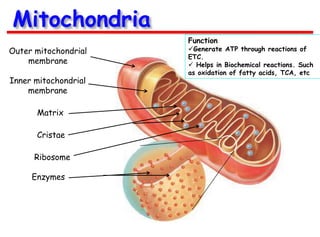
Mitochondria
Outer mitochondrial
membrane
Inner mitochondrial
membrane
Matrix
Cristae
Ribosome

Enzymes

Function

Generate ATP through reactions of
ETC.
 Helps in Biochemical reactions. Such
as oxidation of fatty acids, TCA, etc
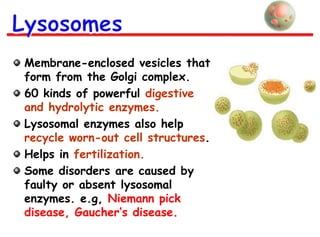
Membrane-enclosed vesicles that
form from the Golgi complex.
60 kinds of powerful digestive
and hydrolytic enzymes.
Lysosomal enzymes also help
recycle worn-out cell structures.
Helps in fertilization.
Some disorders are caused by
faulty or absent lysosomal
enzymes. e.g, Niemann pick
disease, Gaucher’s disease.
 Similar in structure to lysosomes, but smaller in size.

 Contain several oxidases, enzymes that can oxidize
various organic substances.

Functions : Degradation of amino acids, oxidation of long chain
fatty acids.
 Oxidize toxic substances, such as alcohol.

 protect other parts of the cell from the toxic effects
of H2O2.
 Dysfunction of Peroxisomes leads to Zellweger syndrome
The Cytoskeleton
 A network of protein filaments that
extends throughout the cytoplasm.
Three types of filamentous proteins
contribute to the cytoskeleton’s structure,




Microtubules
Intermediate filaments
Microfilaments
The Cytoskeleton

cont…..

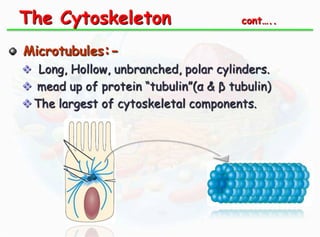
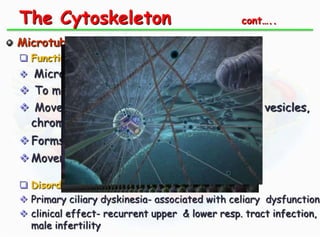
Microtubules: Long, Hollow, unbranched, polar cylinders.
 mead up of protein “tubulin”(α & β tubulin)
 The largest of cytoskeletal components.
The Cytoskeleton

cont…..

Microtubules: Functions:-

 Microtubules help in structural support,

 To maintain the shape of the cell.
 Movement of organelles such as secretary vesicles,
chromosomes during cell division.
 Forms mitotic spindles during mitosis.
 Movement of cilia and flagella.
 Disorder: Primary ciliary dyskinesia- associated with celiary dysfunction
 clinical effect- recurrent upper & lower resp. tract infection,
male infertility
The Cytoskeleton

cont…..

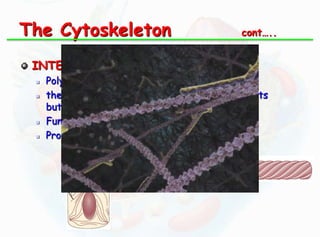
INTERMEDIATE FILAMENTS :





Polymers of long rod like proteins.
these filaments are thicker than microfilaments
but thinner than microtubules.
Functions :Provide mechanical support to the cell.
The Cytoskeleton

cont…..

Microfilament







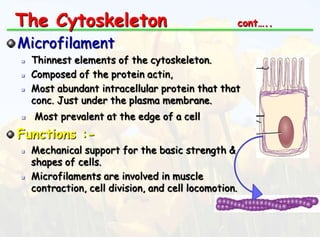
Thinnest elements of the cytoskeleton.
Composed of the protein actin,
Most abundant intracellular protein that that
conc. Just under the plasma membrane.
Most prevalent at the edge of a cell

Functions :



Mechanical support for the basic strength &
shapes of cells.
Microfilaments are involved in muscle
contraction, cell division, and cell locomotion.

Cell and cell organelles

  • 1.
    The Cell Structural andFunctional Unit of Life
  • 3.
    Cell was firstdiscovered by Robert Hooke in 1665.
  • 4.
    What is thecell ?  Structural and Functional Unit of Life.  A cell is the basic unit that is capable of performing life functions.
  • 5.
    Types of Cells Prokaryotic cell lack a nucleus or membrane-bound structures (e.g.bacteria)  Eukaryotic cell have a nucleus and membrane-bound organelles (e.g.animals plants, fungi)
  • 6.
    Prokaryotic cells Naked DNAno nuclei Few internal structures One-celled organisms, Bacteria
  • 7.
    Structure of theCell Mitochondria Plasma membrane Nucleus Ribosome Lysosome Vesicle Cytoskeleton Peroxisome Rough Endoplasmic Reticulum Golgi apparatus
  • 8.
  • 9.
    ISOLATION OF SUBCELLULARORGANELLES Homogenizationwith help of glass/teflon homogenizer cells are disrupted by- suspending in isotonic soln (0.25 M buffer at pH 7.4) Differential velocity Centrifugation.  Separation based on their size.
  • 10.
    ISOLATION OF SUBCELLULARORGANELLES Supernatant 960 g 10 min pellet Homogenate 25000 g 10 min pellet Nuclei DNA polymerase Supernatant 34000 g 30 min pellet Supernatant Supernatant cytosol 105000 g 100 min LDH pellet Mitochondria Golgi complex Lysosomes, Galacosyl Peroxisomes transferase ATP synthase, Acid phosphatase, catalase pellet E. Reticulum G 6 PD
  • 11.
    Parts of theCell  Plasma membrane  Nucleus  Cytoplasm
  • 12.
    Nucleus  prominent and large organelle  housesmost of a cell’s DNA.  contains genes  Controls the activity of other organelles.
  • 13.
    Structure of Nucleus aspherical or oval-shaped structure. Most cells have a single nucleus, although some, such as mature RBCs, have none. In contrast, skeletal muscle cells have multiple nuclei. the nuclear envelope, membrane of the nuclear is continuous with rough ER nuclear pores Each nuclear pore consists of a circular arrangement of proteins surrounding a large central opening
  • 14.
    Functions 1. Controls cellularstructure. 2. Directs cellular activities. 3. Produces ribosomes in nucleoli. Chromatin Polyribosome Nucleolus Nuclear envelope Nuclear pore Nuclear pore Rough endoplasmic reticulum The nuclear envelope Details of the nucleus
  • 15.
     Ribosomes arethe sites of protein synthesis.  The name of these tiny organelles reflects their high content of rRNA.  They either attached to RER or float freely in cytoplasm.  consists of two subunits. - large subunit - small subunit.
  • 16.
     A network ofmembranes in the form of flattened sacs or tubules  Two types -Rough ER -Smooth ER
  • 17.
  • 18.
    1. Rough ERsynthesizes proteins. 2. RER involved in post-translation modifications such as glycation. 3. SER synthesizes phospholipids, cholesterol (in many tissue) & steroid hormones (adrenals, gonads). 4. SER is site of Glycogen metabolism. 5. Stores & releases calcium ions in the cells. (that trigger contraction in muscle cells.) 6. In liver & Kidney SER Detoxifies drugs & harmful substances; 7. Removes the phosphate group from G-6-P; and release free glucose in blood.
  • 19.
     It consistsof 3 to 20 cisternae, small, flattened membranous sacs.  Most cells have several Golgi complexes  Golgi complexes are more extensive in cells that secrete proteins  Modifies, sorts, packages, & transports proteins received from the rough ER
  • 20.
    Processing and packagingof proteins by the Golgi complex.
  • 21.
    Elongated or rodshaped. “powerhouses” of the cell. No. may as few as hundred or as many as several thousand, depending on the activity of the cell. Active cells such as muscles, liver, and kidneys, which use ATP at a high rate, have a large number of Mitochondria
  • 22.
    Mitochondria Outer mitochondrial membrane Inner mitochondrial membrane Matrix Cristae Ribosome Enzymes Function GenerateATP through reactions of ETC.  Helps in Biochemical reactions. Such as oxidation of fatty acids, TCA, etc
  • 23.
    Membrane-enclosed vesicles that formfrom the Golgi complex. 60 kinds of powerful digestive and hydrolytic enzymes. Lysosomal enzymes also help recycle worn-out cell structures. Helps in fertilization. Some disorders are caused by faulty or absent lysosomal enzymes. e.g, Niemann pick disease, Gaucher’s disease.
  • 24.
     Similar instructure to lysosomes, but smaller in size.  Contain several oxidases, enzymes that can oxidize various organic substances. Functions : Degradation of amino acids, oxidation of long chain fatty acids.  Oxidize toxic substances, such as alcohol.  protect other parts of the cell from the toxic effects of H2O2.  Dysfunction of Peroxisomes leads to Zellweger syndrome
  • 25.
    The Cytoskeleton  Anetwork of protein filaments that extends throughout the cytoplasm. Three types of filamentous proteins contribute to the cytoskeleton’s structure,    Microtubules Intermediate filaments Microfilaments
  • 26.
    The Cytoskeleton cont….. Microtubules: Long,Hollow, unbranched, polar cylinders.  mead up of protein “tubulin”(α & β tubulin)  The largest of cytoskeletal components.
  • 27.
    The Cytoskeleton cont….. Microtubules: Functions:- Microtubules help in structural support,  To maintain the shape of the cell.  Movement of organelles such as secretary vesicles, chromosomes during cell division.  Forms mitotic spindles during mitosis.  Movement of cilia and flagella.  Disorder: Primary ciliary dyskinesia- associated with celiary dysfunction  clinical effect- recurrent upper & lower resp. tract infection, male infertility
  • 28.
    The Cytoskeleton cont….. INTERMEDIATE FILAMENTS:    Polymers of long rod like proteins. these filaments are thicker than microfilaments but thinner than microtubules. Functions :Provide mechanical support to the cell.
  • 29.
    The Cytoskeleton cont….. Microfilament     Thinnest elementsof the cytoskeleton. Composed of the protein actin, Most abundant intracellular protein that that conc. Just under the plasma membrane. Most prevalent at the edge of a cell Functions :  Mechanical support for the basic strength & shapes of cells. Microfilaments are involved in muscle contraction, cell division, and cell locomotion.