This document discusses the genetic material in living organisms. It covers:
1. The key properties of genetic material, including that it contains information passed from parents to offspring, replicates accurately, and is capable of change through evolution.
2. Experiments by Griffith, Avery, Hershey and Chase that identified DNA as the genetic material through labeling and tracking its transmission.
3. The history and structure of nucleic acids, including that they are made of nucleotides with a phosphate group, sugar (ribose in RNA, deoxyribose in DNA), and nitrogenous base. The two types are DNA and RNA.
4. DNA is a double-stranded molecule that exists in B-form and
CONTENT
Principal Pointsof Genetic Material
Expiriments to search Genetic Material
History of Nucleic acid
What is Nucleic acid ?
Structure of Nucleic acid
Types of Nucleic acid
Differences between DNA vs RNA
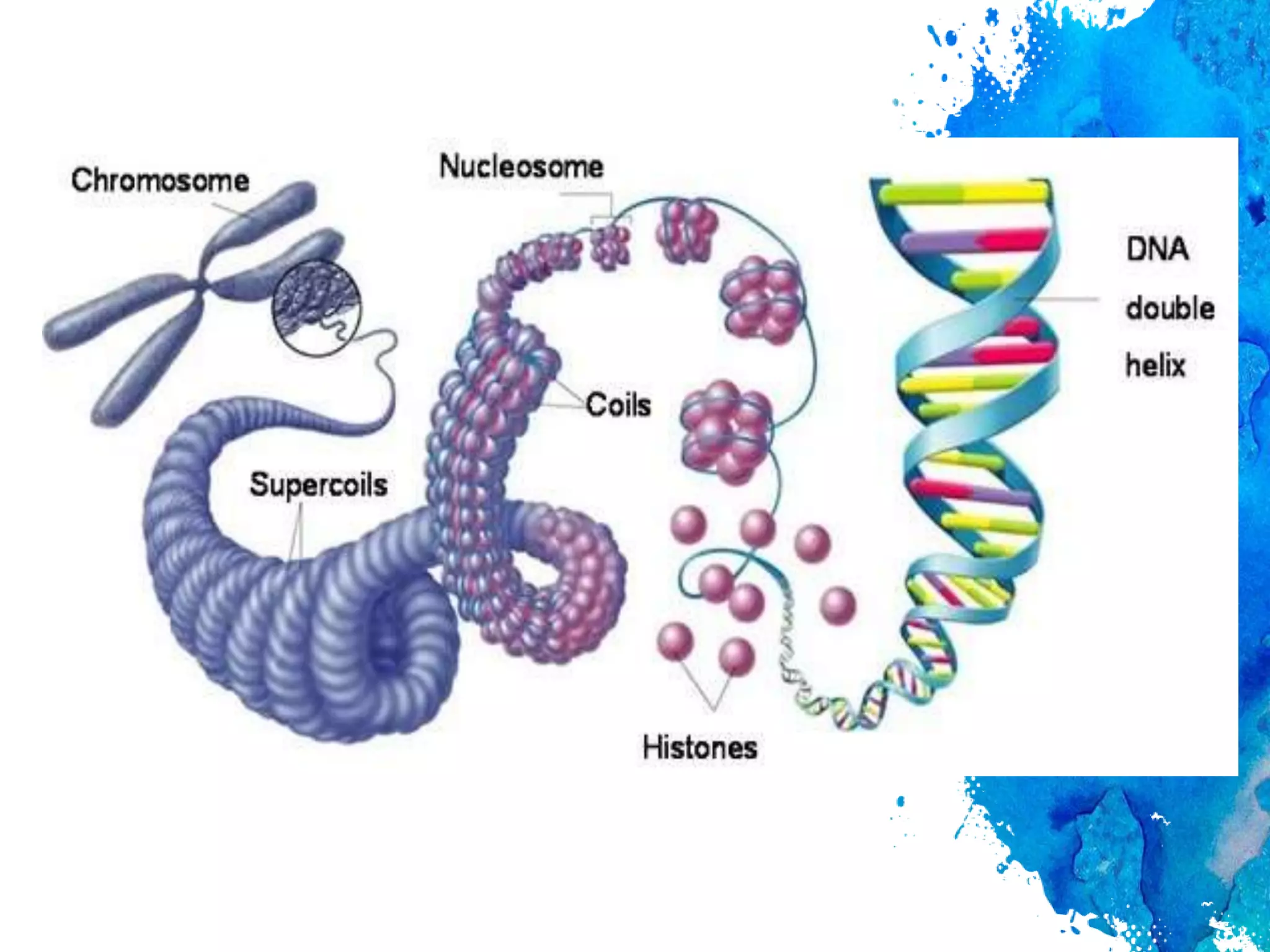
Organization of DNA in Chromosomes
3
4.
Principal Points
4
Organismscontain genetic material that
governs an individual’s characteristics and
that is transferred from parent to progeny.
The Genetic Material must contain in
stable form, the information about an
organism’s cell structure, function,
development, and reproduction.
It must replicate accurately, so that
progeny cell have same genetic information
as the parent cell
It must be capable of change. without
change, organism would be incapable of
variation and adaptation, and evolution could
not occur.
7
Avery et alalso conducted the following
experiments
further verify that DNA, and not a contaminant
(RNA or protein) is the genetic material
8.
1.T2 bacteriophage iscomposed of DNA and
proteins:
2.Set-up two replicates:
•Label DNA with 32P
•Label Protein with 35S
3. Infected E. coli bacteria with two types of
labeled T2
4. 32P is discovered within the bacteria and
progeny phages, whereas 35S is not found within
the bacteria but released with phage ghosts. 8
Hershey and Chase
Experiments
Friedrich Miescherisolated a new
compound from the nuclei of white
blood cells.
Miescher named his discovery
“Nuclein” because he had isolated
it from nuclei of cells.
Nuclein was shown to have acidic
properties, hence it became called
Nucleic acid.
Friedrich Miescher
(1869)
11.
What is Nucleicacid??
Nucleic acids are the most important of all
biomolecules.
They are found in abundance in all living things,
where they function to create and encode and then
store information in the nucleus.
In turn, they function to transmit and express that
information inside and outside the cell nucleus to
the interior operations of the cell and ultimately to
the next generation of each living organism.
The encoded information is contained and
conveyed via the nucleic acid sequence, which
provides the 'ladder-step' ordering of nucleotides
within the molecules of RNA and DNA.
11
12.
Nucleic acidsis made of polynucleotide
Their building blocks are nucleotides
We can say Nucleic acid is linear arrangement
of nucleotides
12
Structure of Nucleic acid
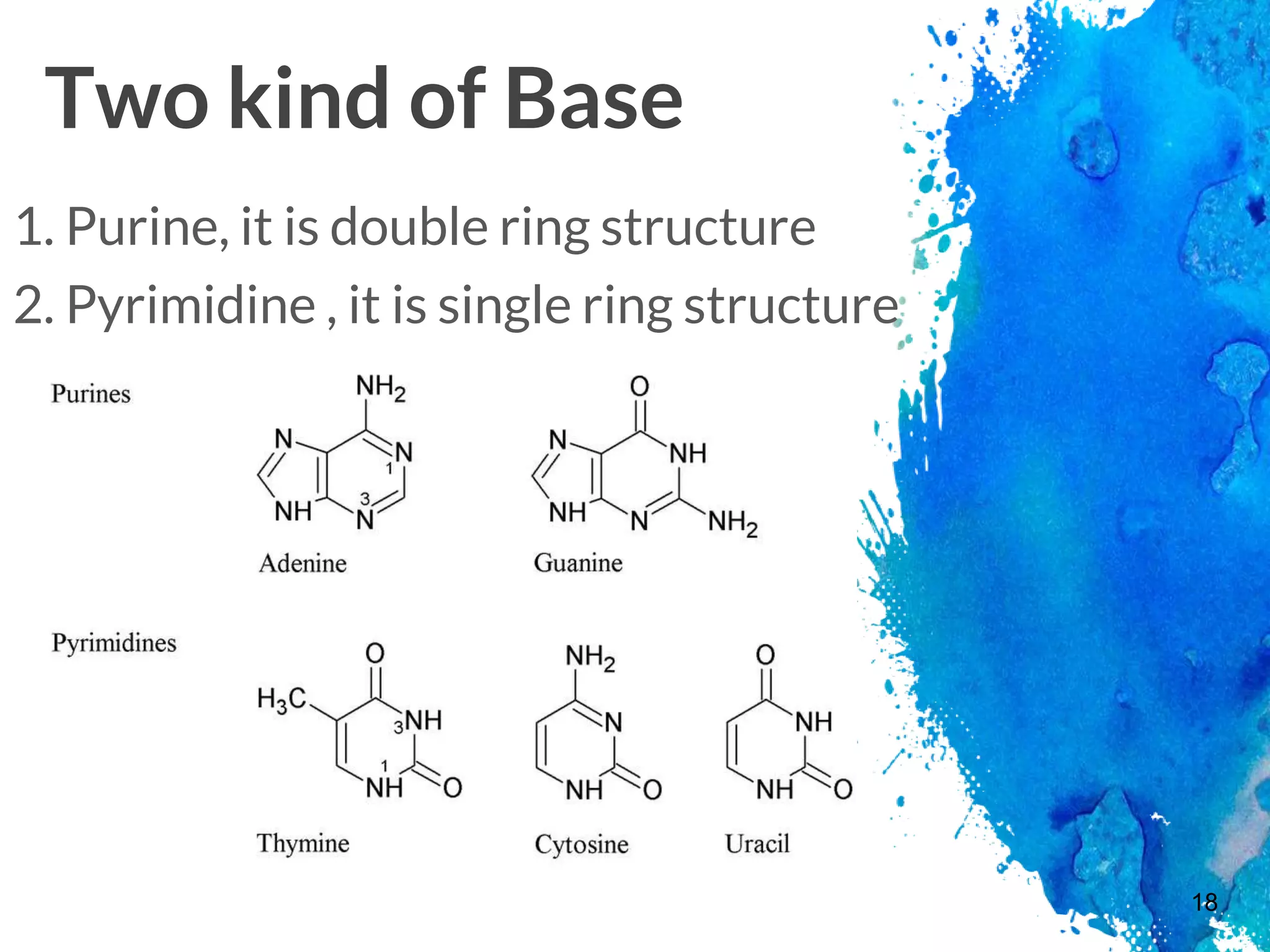
Two kind ofBase
1. Purine, it is double ring structure
18
2. Pyrimidine , it is single ring structure
19.
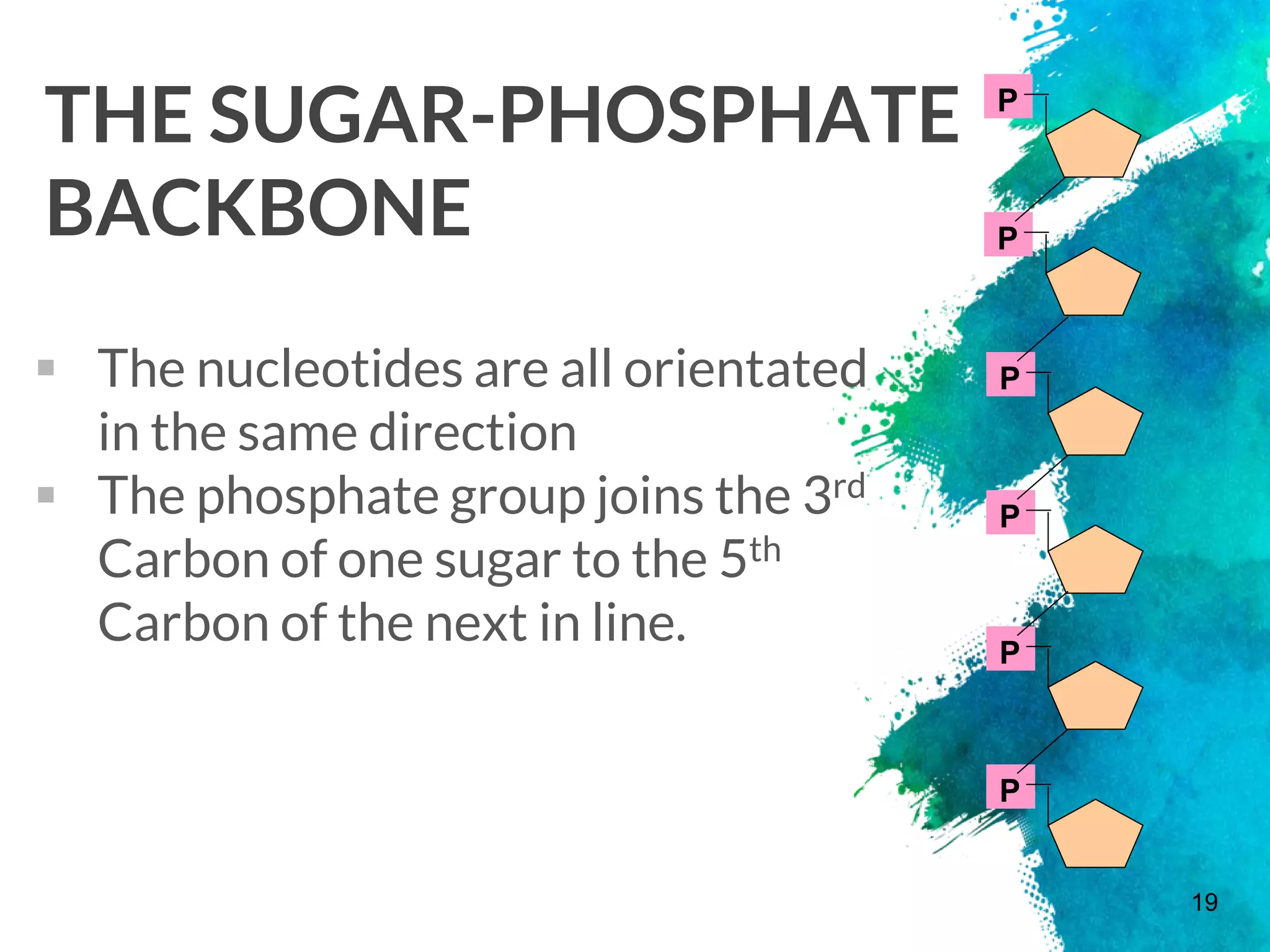
THE SUGAR-PHOSPHATE
BACKBONE
Thenucleotides are all orientated
in the same direction
The phosphate group joins the 3rd
Carbon of one sugar to the 5th
Carbon of the next in line.
19
P
P
P
P
P
P
20.
ADDING IN THEBASES
The bases are attached to the 1st
Carbon
Their order is important
It determines the genetic
information of the molecule
20
P
P
P
P
P
P
G
C
C
A
T
T
21.
DNA
IS MADE OF
TWOSTRANDS
OF
POLYNUCLEOTIDE
21
P
P
P
P
P
P
C
G
G
T
A
A
P
P
P
P
P
P
G
C
C
A
T
T
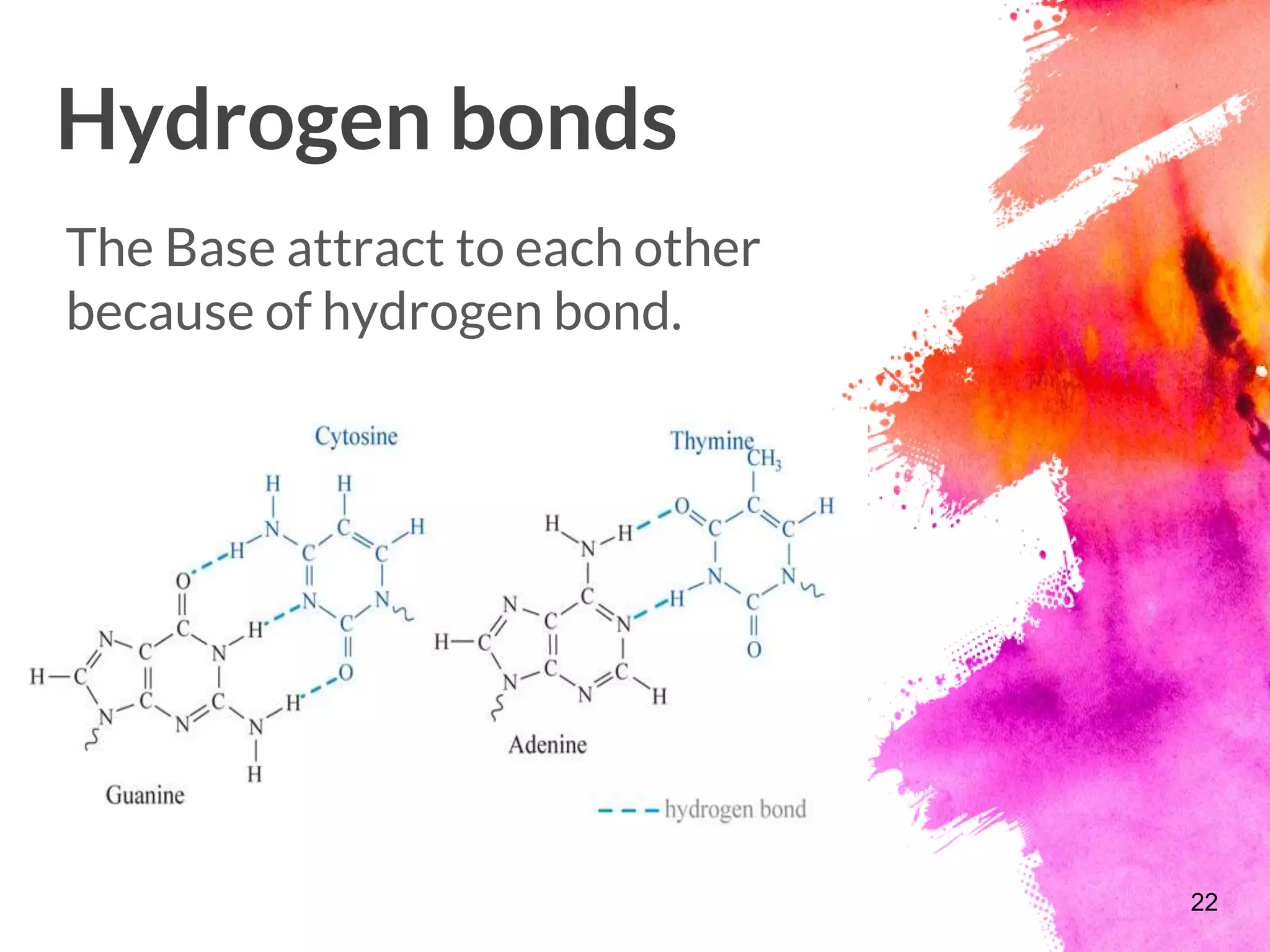
Hydrogen bonds
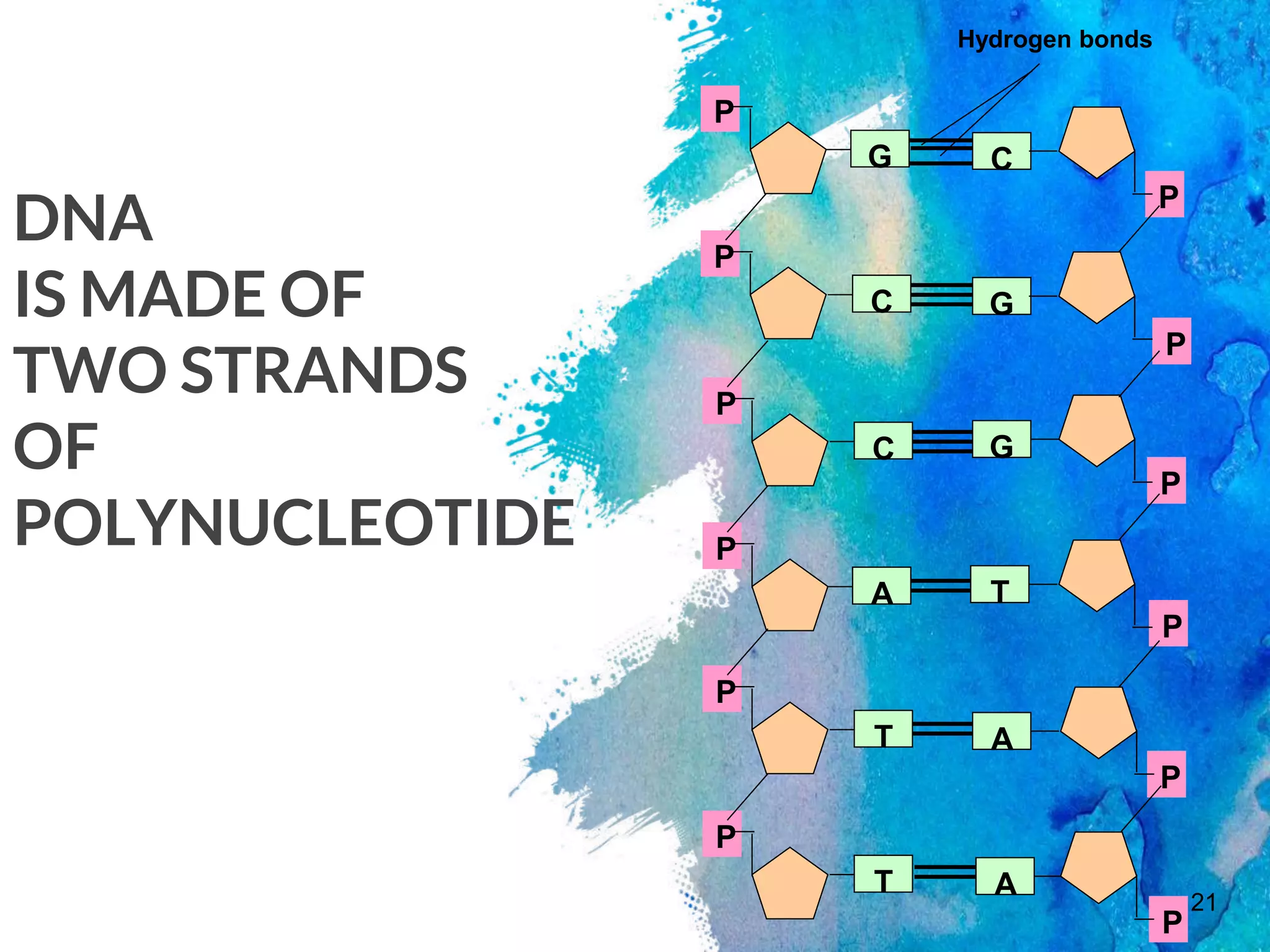
DNA isa double stranded molecule consists of 2
polynucleotide chains running in opposite directions.
Both strands are complementary to each other.
The bases are on the inside of the molecules and the 2 chains
are joined together by double H-bond between A and T and
triple H-bond between C and G.
The base pairing is very specific which make the 2 strands
complementary to each other.
So each strand contain all the required information for
synthesis (replication) of a new copy to its complementary.
Deoxyribonucleic acid (DNA)
25
26.
Forms of DNA
B-form helix:
It is the most common form of DNA in cells.
Right-handed helix
Turn every 3.4 nm.
Each turn contain 10 base pairs (the
distance between each 2 successive bases is
0.34 nm)
Contain 2 grooves;
Major groove (wide): provide easy access to
bases
Minor groove (narrow): provide poor access.
26
A-form DNA:
Less common form of DNA , more common in RNA
Right handed helix
Each turn contain 11 b.p/turn
Contain 2 different grooves:
Major groove: very deep and narrow
Minor groove: very shallow and wide (binding site for
RNA)
Z-form DNA:
Radical change of B-form
Left handed helix, very extended
It is GC rich DNA regions.
The sugar base backbone form Zig-Zag shape
The B to Z transition of DNA molecule may play
a role in gene regulation. 28
29.
Ribonucleic acid (RNA)
29
•It is formed of linear polynucleotide
• Is generally single stranded
• The pentose sugar is Ribose
• Uracil (U) replace Thymine (T) in the
pyrimidine bases.
• Although RNA is generally single stranded,
intra-molecular H-bond base pairing occur
between complementary bases on the same
molecule (secondary structure)
30.
Types of RNA
MessengerRNA (mRNA):
Carries genetic information copied from DNA in
the form of a series of 3-base code, each of which
specifies a particular amino acid.
Transfer RNA (tRNA):
It is the key that read the code on the mRNA.
Each amino acid has its own tRNA, which binds to it
and carries it to the growing end of a polypeptide
chain.
Ribosomal RNA (rRNA):
Associated with a set of proteins to form the
ribosomes.
These complex structures, which physically move
along the mRNA molecule, catalyze the assembly
of amino acids into protein chain.
They also bind tRNAs that have the specific amino
acids according to the code.
30