DNA)
Hari Sharan Makaju
M.Sc. Clinical Biochemistry
1st year
 History
 Introduction
 Functions
 Structures
 Types of DNA
 Chemical basis of DNA
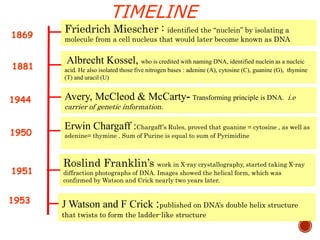
TIMELINE
1869
Friedrich Miescher : identified the “nuclein” by isolating a
molecule from a cell nucleus that would later become known as DNA
1881
Albrecht Kossel, who is credited with naming DNA, identified nuclein as a nucleic
acid. He also isolated those five nitrogen bases : adenine (A), cytosine (C), guanine (G), thymine
(T) and uracil (U)
1950
Avery, McCleod & McCarty- Transforming principle is DNA. i.e
carrier of genetic information.
1944
Roslind Franklin’s work in X-ray crystallography, started taking X-ray
diffraction photographs of DNA. Images showed the helical form, which was
confirmed by Watson and Crick nearly two years later.
Erwin Chargaff :Chargaff’s Rules, proved that guanine = cytosine , as well as
adenine= thymine . Sum of Purine is equal to sum of Pyrimidine
1951
1953 J Watson and F Crick :published on DNA’s double helix structure
that twists to form the ladder-like structure
DNA is a polymer of deoxyribonucleoside
monophosphates covalently linked by 3′→5′–
phosphodiester bonds
Found in chromosomes, mitochondria and
chloroplasts
Carries the genetic information
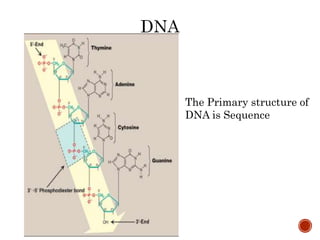
The Primary structure of
DNA is Sequence
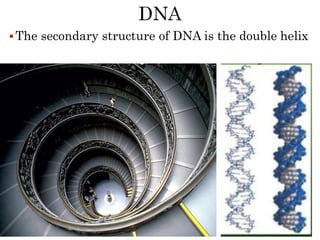
The secondary structure of DNA is the double helix
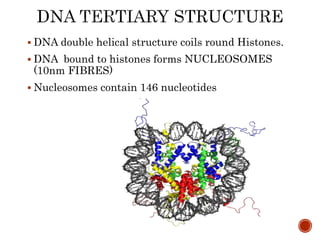
 DNA double helical structure coils round Histones.
 DNA bound to histones forms NUCLEOSOMES
(10nm FIBRES)
 Nucleosomes contain 146 nucleotides
1. Genetic Information (Genetic Blue Print):
 DNA is the genetic material which carries all the hereditary
information.
 The genetic information is coded in the arrangement of its nitrogen bases.
2. Replication:
 DNA has unique property of replication or production of carbon
copies (Autocatalytic function).
 This is essential for transfer of genetic information from one cell to its daughters
and from one generation to the next.
3. Mutations:
 Changes in sequence of nitrogen bases due to addition, deletion or
wrong replication give rise to mutations.
 Mutations are the fountain head of all variations and evolution.
4. Transcription:
 DNA gives rise to RNAs through the process of transcription. It is
heterocatalytic activity of DNA.

5. Cellular Metabolism:
 It controls the metabolic reactions of the cells
 through the help of specific RNAs, synthesis of specific proteins,
enzymes and hormones.
6. Differentiation:
 Due to differential functioning of some specific regions of DNA or
genes,
 different parts of the organisms get differentiated in shape, size
and functions.
7. Development:
 DNA controls development of an organism through working of an
internal genetic clock
 with or without the help of extrinsic information.
8. DNA Finger Printing:
 Hypervariable microsatellite DNA sequences of each individual are
distinct.
 They are used in identification of individuals and deciphering their
relationships.
 The mechanism is called DNA finger printing.
9. Gene Therapy:
 Defective heredity can be rectified
 by incorporating correct genes in place of defective ones.
10
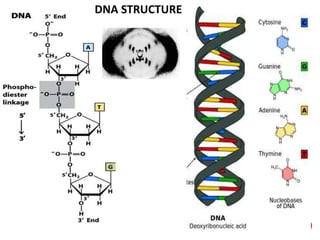
DNA STRUCTURE
DNA STRUCTURE
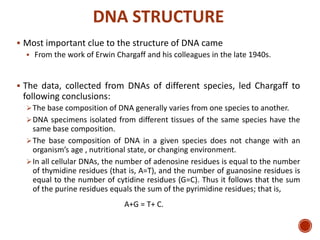
 Most important clue to the structure of DNA came
 From the work of Erwin Chargaff and his colleagues in the late 1940s.
 The data, collected from DNAs of different species, led Chargaff to
following conclusions:
The base composition of DNA generally varies from one species to another.
DNA specimens isolated from different tissues of the same species have the
same base composition.
The base composition of DNA in a given species does not change with an
organism’s age , nutritional state, or changing environment.
In all cellular DNAs, the number of adenosine residues is equal to the number
of thymidine residues (that is, A=T), and the number of guanosine residues is
equal to the number of cytidine residues (G=C). Thus it follows that the sum
of the purine residues equals the sum of the pyrimidine residues; that is,
A+G = T+ C.
11
DNA STRUCTURE
Double helix
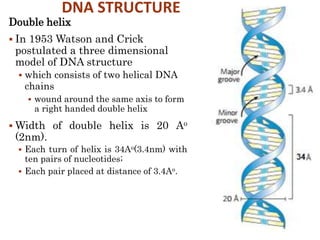
 In 1953 Watson and Crick
postulated a three dimensional
model of DNA structure
 which consists of two helical DNA
chains
 wound around the same axis to form
a right handed double helix
 Width of double helix is 20 Ao
(2nm).
 Each turn of helix is 34Ao(3.4nm) with
ten pairs of nucleotides;
 Each pair placed at distance of 3.4Ao.
12
DNA STRUCTURE
Double helix
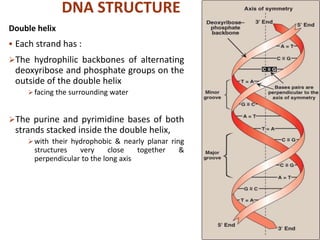
 Each strand has :
The hydrophilic backbones of alternating
deoxyribose and phosphate groups on the
outside of the double helix
facing the surrounding water
The purine and pyrimidine bases of both
strands stacked inside the double helix,
with their hydrophobic & nearly planar ring
structures very close together &
perpendicular to the long axis
13
BASE PAIRING
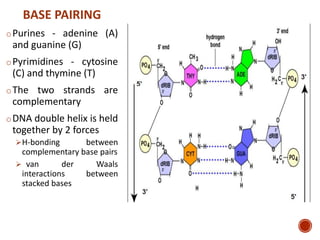
oPurines - adenine (A)
and guanine (G)
oPyrimidines - cytosine
(C) and thymine (T)
oThe two strands are
complementary
oDNA double helix is held
together by 2 forces
H-bonding between
complementary base pairs
 van der Waals
interactions between
stacked bases
14
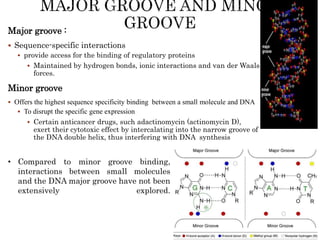
Major groove :
 Sequence-specific interactions
 provide access for the binding of regulatory proteins
 Maintained by hydrogen bonds, ionic interactions and van der Waals
forces.
Minor groove
 Offers the highest sequence specificity binding between a small molecule and DNA
 To disrupt the specific gene expression
 Certain anticancer drugs, such adactinomycin (actinomycin D),
exert their cytotoxic effect by intercalating into the narrow groove of
the DNA double helix, thus interfering with DNA synthesis
• Compared to minor groove binding,
interactions between small molecules
and the DNA major groove have not been
extensively explored.
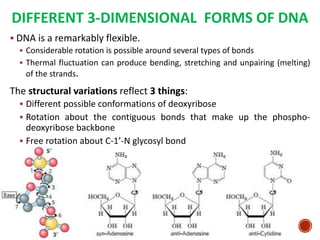
DIFFERENT 3-DIMENSIONAL FORMS OF DNA
 DNA is a remarkably flexible.
 Considerable rotation is possible around several types of bonds
 Thermal fluctuation can produce bending, stretching and unpairing (melting)
of the strands.
The structural variations reflect 3 things:
 Different possible conformations of deoxyribose
 Rotation about the contiguous bonds that make up the phospho-
deoxyribose backbone
 Free rotation about C-1’-N glycosyl bond
16
VARIOUS TYPES OF DNA
 At least 6 different forms of DNA (A-E, Z) have been found
out.
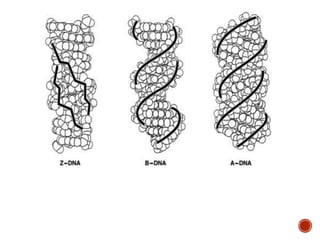
 Amongst these, A,B,Z are predominant.
 The Watson-Crick structure is also referred to as B form DNA,
or B DNA.
 Most stable structure for a random-sequence DNA molecule
under physiological conditions
 Therefore the standard point of reference in any study of the
properties of DNA.
17
A-DNA
o X-ray diffraction studies of less-hydrated DNA fibers revealed a A
form DNA
o When the relative humidity of B-form DNA falls to less than 75%,
o the B-form undergoes a reversible transition into the A-form of DNA
o It is also a right-handed helix
o Helix is wider ,
o Number of base pairs per helical turn is 11
o The plane of the base pairs is tilted about 20° with respect to the
helix axis.
18
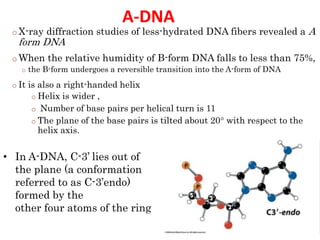
• In A-DNA, C-3’ lies out of
the plane (a conformation
referred to as C-3’endo)
formed by the
other four atoms of the ring
Z-DNA
o Z-DNA is a left handed helix containing 12 base pairs per turn.
oTo form the left-handed helix in Z-DNA
o the purine residues flip to the synconformation, alternating with pyrimidines
in the anti conformation.
owhen the sequence of nucleotides consists of alternating
purine/pyrimidine stretches- form, Z-DNA
o is also favored at high ionic concentrations
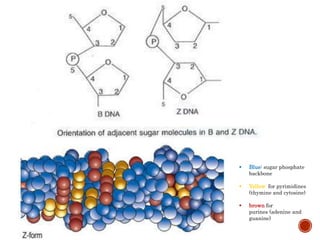
oDNA with a zigzag configuration along the sugar phosphate backbone.
o hence named Z-DNA
oThe major groove is barely apparent in Z-DNA, and the minor groove
is narrow and deep.
o The Z-DNA tracts may play a role (as yet undefined) in regulating the
expression of some genes or in genetic recombination.
19
 Blue: sugar phosphate
backbone
 Yellow: for pyrimidines
(thymine and cytosine)
 brown for
purines (adenine and
guanine)
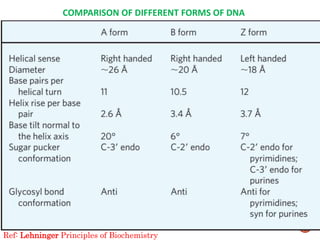
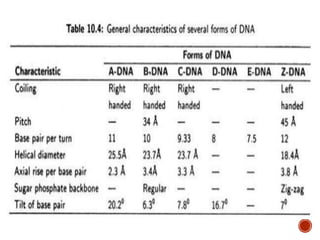
COMPARISON OF DIFFERENT FORMS OF DNA
21
Ref: Lehninger Principles of Biochemistry
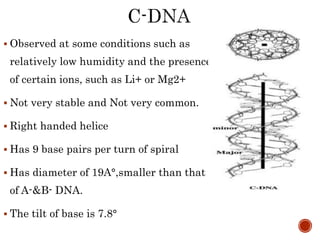
 Observed at some conditions such as
relatively low humidity and the presence
of certain ions, such as Li+ or Mg2+
 Not very stable and Not very common.
 Right handed helice
 Has 9 base pairs per turn of spiral
 Has diameter of 19A°,smaller than that
of A-&B- DNA.
 The tilt of base is 7.8°
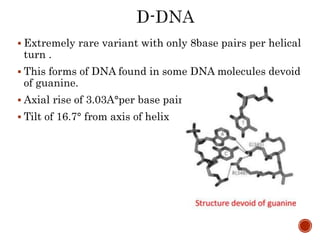
 Extremely rare variant with only 8base pairs per helical
turn .
 This forms of DNA found in some DNA molecules devoid
of guanine.
 Axial rise of 3.03A°per base pairs .
 Tilt of 16.7° from axis of helix
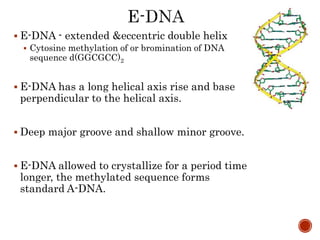
 E-DNA - extended &eccentric double helix
 Cytosine methylation of or bromination of DNA
sequence d(GGCGCC)2
 E-DNA has a long helical axis rise and base
perpendicular to the helical axis.
 Deep major groove and shallow minor groove.
 E-DNA allowed to crystallize for a period time
longer, the methylated sequence forms
standard A-DNA.
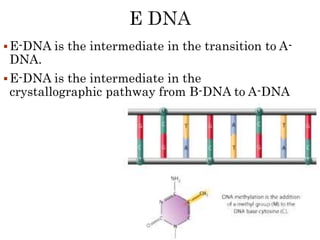
E-DNA is the intermediate in the transition to A-
DNA.
E-DNA is the intermediate in the
crystallographic pathway from B-DNA to A-DNA
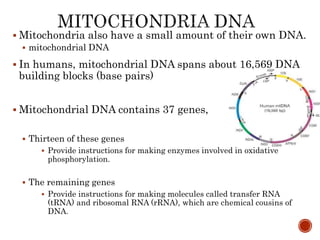
 Mitochondria also have a small amount of their own DNA.
 mitochondrial DNA
 In humans, mitochondrial DNA spans about 16,569 DNA
building blocks (base pairs)
 Mitochondrial DNA contains 37 genes,
 Thirteen of these genes
 Provide instructions for making enzymes involved in oxidative
phosphorylation.
 The remaining genes
 Provide instructions for making molecules called transfer RNA
(tRNA) and ribosomal RNA (rRNA), which are chemical cousins of
DNA.
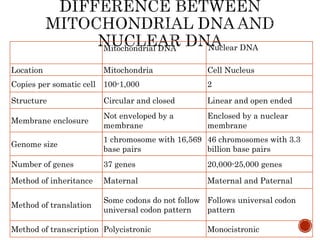
Mitochondrial DNA Nuclear DNA
Location Mitochondria Cell Nucleus
Copies per somatic cell 100-1,000 2
Structure Circular and closed Linear and open ended
Membrane enclosure
Not enveloped by a
membrane
Enclosed by a nuclear
membrane
Genome size
1 chromosome with 16,569
base pairs
46 chromosomes with 3.3
billion base pairs
Number of genes 37 genes 20,000-25,000 genes
Method of inheritance Maternal Maternal and Paternal
Method of translation
Some codons do not follow
universal codon pattern
Follows universal codon
pattern
Method of transcription Polycistronic Monocistronic
SATELLITE DNA
 Originally identified as a subfraction of DNA with a
buoyant density slightly lower than that of genomic DNA
 because of its higher content of AT base pairs.
 Consists of clusters of short, species-specific, nearly
identical sequences that are tandemly repeated hundreds
of thousands of times.
 These clusters lack protein-coding genes
 Found principally near the centromeres of chromosomes.
 Two types
 Microsatellite sequences
 1-6 bp repeat units flanked by conserved sequences
 Minisatellite sequences
 11-60 bp flanked by conserved restriction sites.
 Used for DNA matching or finger printing as first found
out by Jeffreys et al (1985).
Viral DNA (and in some, RNA)
 Some circular, some linear
 Some double stranded, some single stranded
 Very small amount, packed very tightly
 Small size is an advantage
 Viruses use host cell enzymes, need few genes
Bacterial DNA
 Usually single copy of double stranded
 Usually circular
Eukaryotic DNA
 Linear, in several pieces
UNUSUAL SEQUENCES /
STRUCTURES OF DNA
 Important for molecular recognition of DNA by proteins
and enzymes
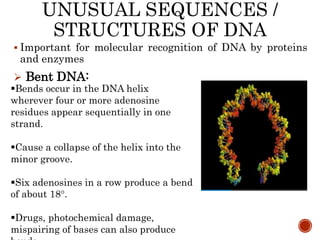
 Bent DNA:
32
Bends occur in the DNA helix
wherever four or more adenosine
residues appear sequentially in one
strand.
Cause a collapse of the helix into the
minor groove.
Six adenosines in a row produce a bend
of about 18°.
Drugs, photochemical damage,
mispairing of bases can also produce
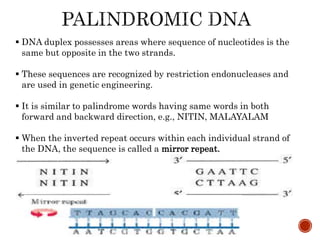
 DNA duplex possesses areas where sequence of nucleotides is the
same but opposite in the two strands.
 These sequences are recognized by restriction endonucleases and
are used in genetic engineering.
 It is similar to palindrome words having same words in both
forward and backward direction, e.g., NITIN, MALAYALAM
 When the inverted repeat occurs within each individual strand of
the DNA, the sequence is called a mirror repeat.
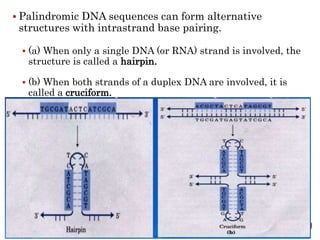
 Palindromic DNA sequences can form alternative
structures with intrastrand base pairing.
 (a) When only a single DNA (or RNA) strand is involved, the
structure is called a hairpin.
 (b) When both strands of a duplex DNA are involved, it is
called a cruciform.
TRIPLEX DNA/ TRIPLE
STRANDED DNA
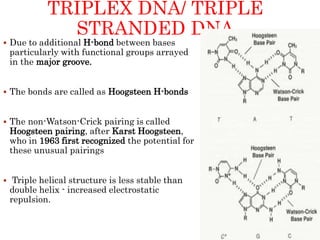
 Due to additional H-bond between bases
particularly with functional groups arrayed
in the major groove.
 The bonds are called as Hoogsteen H-bonds
 The non-Watson-Crick pairing is called
Hoogsteen pairing, after Karst Hoogsteen,
who in 1963 first recognized the potential for
these unusual pairings
 Triple helical structure is less stable than
double helix - increased electrostatic
repulsion.
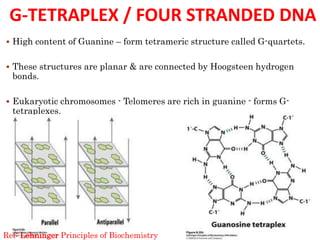
G-TETRAPLEX / FOUR STRANDED DNA
 High content of Guanine – form tetrameric structure called G-quartets.
 These structures are planar & are connected by Hoogsteen hydrogen
bonds.
 Eukaryotic chromosomes - Telomeres are rich in guanine - forms G-
tetraplexes.
Ref: Lehninger Principles of Biochemistry
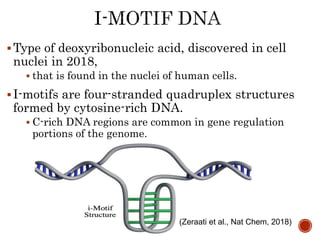
Type of deoxyribonucleic acid, discovered in cell
nuclei in 2018,
 that is found in the nuclei of human cells.
I-motifs are four-stranded quadruplex structures
formed by cytosine-rich DNA.
 C-rich DNA regions are common in gene regulation
portions of the genome.
(Zeraati et al., Nat Chem, 2018)
 Postulated to play a role in gene regulation and
expression in the cell
 I-motifs have potential applications in nano-technology
and nano-medicine,
 because size is more than 1nm and less than 100nm due to
their unique pH sensitivity
 Have been used as biosensors, nanomachines, and
molecular switches.
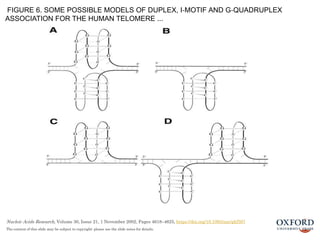
Nucleic Acids Research, Volume 30, Issue 21, 1 November 2002, Pages 4618–4625, https://doi.org/10.1093/nar/gkf597
The content of this slide may be subject to copyright: please see the slide notes for details.
FIGURE 6. SOME POSSIBLE MODELS OF DUPLEX, I‐MOTIF AND G‐QUADRUPLEX
ASSOCIATION FOR THE HUMAN TELOMERE ...
NUCLEIC ACID CHEMISTRY
 The chemical transformations that do occur are generally
very low in the absence of an enzyme catalyst.
 Understanding the nucleic acid chemistry gives us:
 Powerful array of technologies that have applications in molecular
biology, medicine & forensic medicine.
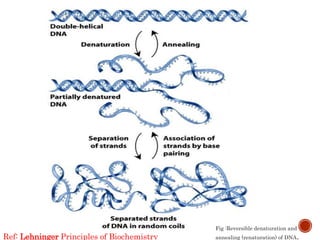
 DENATURATION
 Disruption of the hydrogen bonds between paired bases and
of base stacking
 causes unwinding of the double helix to form two single
strands,
 completely separate from each other along the entire length or
part of length 41
DENATURATION
 Causes:
 Extreme pH,
 Temperature above 80 ̊C,
 Chemicals such as formamide and urea
 Hyperchromic effect
 Denaturation of a double stranded nucleic acid produces an increase in
absorption of UV light
 Relative to that of a solution with the same concentration of paired
complementary nucleic acid strands
 The transition from double stranded DNA to the single stranded
denatured form can be detected by monitoring UV absorption at
260nm
42
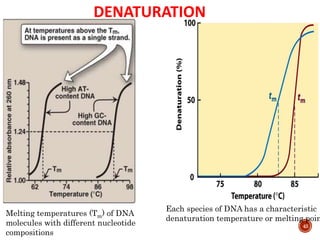
DENATURATION
43
Each species of DNA has a characteristic
denaturation temperature or melting poin
Melting temperatures (Tm) of DNA
molecules with different nucleotide
compositions
ANNEALING
 Process by which separated complementary strands
form a double helix
 Occurs when the temperature and pH is returned to the
range in which most organisms live
 Rapid one step process
 If double helical segment of a dozen or more residues still
unites the two strands
44
ANNEALING
 If the two strands are completely separated, renaturation
occurs in two steps
 First step:
 Slow, the two strands find each other by random collisons
 Form a short segment of complementary double helix
 Second step:
 Faster, the remaining unpaired bases successively come into
register as base pair
 The two strands unite to form double helix
45
46
Fig :Reversible denaturation and
annealing (renaturation) of DNA.Ref: Lehninger Principles of Biochemistry
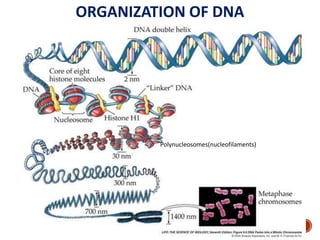
ORGANIZATION OF DNA
 A segment of DNA molecule that contains the
information required for the synthesis of a functional
biological product (RNA or protein) is called gene
 A cell has many thousands of genes and so the DNA
molecules are very large
 Large DNA molecules must be packaged in such a way
that they can fit inside the cell and still be functional
47
ORGANIZATION OF DNA
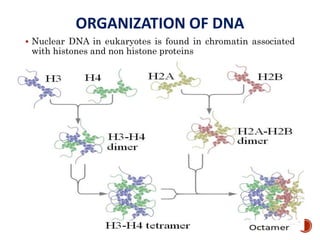
 Nuclear DNA in eukaryotes is found in chromatin associated
with histones and non histone proteins
48
ORGANIZATION OF DNA
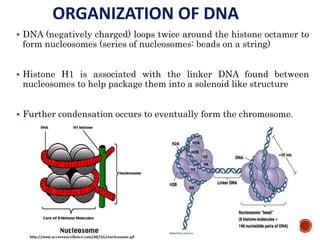
 DNA (negatively charged) loops twice around the histone octamer to
form nucleosomes (series of nucleosomes: beads on a string)
 Histone H1 is associated with the linker DNA found between
nucleosomes to help package them into a solenoid like structure
 Further condensation occurs to eventually form the chromosome.
49
ORGANIZATION OF DNA
Polynucleosomes(nucleofilaments)
50
REFERENCES
 Lehninger Principle of Biochemistry 4th edition
 Robert k. Murray, D.K.Granner ,P.A.Mayes & Victor W.Rodwell
Harpers illustrated biochemistry 26th edition
 Lubert Stryer, Jeremy M. Berg , John L. Tymoczko Biochemistry, 4th
edition
 Lippincott’s Illustrated Reviews: Biochemistry, 4th Edition
 https://www.lunadna.com/blog/history-of-dna/
 http://www.biologydiscussion.com/dna/dna-types-structure-and-
function-of-dna/1301
 http://www.differencebetween.net/science/difference-between-
mitochondrial-dna-and-nuclear-dna/
 https://bio.libretexts.org/Bookshelves/Genetics/Book%3A_Working_with
_Molecular_Genetics_(Hardison)/Unit_I%3A_Genes%2C_Nucleic_Acids
%2C_Genomes_and_Chromosomes/2%3A_Structures_of_Nucleic_Acids/
2.5%3A_B-Form%2C_A-Form%2C_and_Z-Form_of_DNA
 https://www.ncbi.nlm.nih.gov/pubmed/10966645
 https://academic.oup.com/nar/article/30/21/4618/1105212
Deoxyribonucleic Acid (DNA)

Deoxyribonucleic Acid (DNA)

  • 1.
    DNA) Hari Sharan Makaju M.Sc.Clinical Biochemistry 1st year
  • 2.
     History  Introduction Functions  Structures  Types of DNA  Chemical basis of DNA
  • 3.
    TIMELINE 1869 Friedrich Miescher :identified the “nuclein” by isolating a molecule from a cell nucleus that would later become known as DNA 1881 Albrecht Kossel, who is credited with naming DNA, identified nuclein as a nucleic acid. He also isolated those five nitrogen bases : adenine (A), cytosine (C), guanine (G), thymine (T) and uracil (U) 1950 Avery, McCleod & McCarty- Transforming principle is DNA. i.e carrier of genetic information. 1944 Roslind Franklin’s work in X-ray crystallography, started taking X-ray diffraction photographs of DNA. Images showed the helical form, which was confirmed by Watson and Crick nearly two years later. Erwin Chargaff :Chargaff’s Rules, proved that guanine = cytosine , as well as adenine= thymine . Sum of Purine is equal to sum of Pyrimidine 1951 1953 J Watson and F Crick :published on DNA’s double helix structure that twists to form the ladder-like structure
  • 4.
    DNA is apolymer of deoxyribonucleoside monophosphates covalently linked by 3′→5′– phosphodiester bonds Found in chromosomes, mitochondria and chloroplasts Carries the genetic information
  • 5.
    The Primary structureof DNA is Sequence
  • 6.
    The secondary structureof DNA is the double helix
  • 7.
     DNA doublehelical structure coils round Histones.  DNA bound to histones forms NUCLEOSOMES (10nm FIBRES)  Nucleosomes contain 146 nucleotides
  • 8.
    1. Genetic Information(Genetic Blue Print):  DNA is the genetic material which carries all the hereditary information.  The genetic information is coded in the arrangement of its nitrogen bases. 2. Replication:  DNA has unique property of replication or production of carbon copies (Autocatalytic function).  This is essential for transfer of genetic information from one cell to its daughters and from one generation to the next. 3. Mutations:  Changes in sequence of nitrogen bases due to addition, deletion or wrong replication give rise to mutations.  Mutations are the fountain head of all variations and evolution. 4. Transcription:  DNA gives rise to RNAs through the process of transcription. It is heterocatalytic activity of DNA.
  • 9.
     5. Cellular Metabolism: It controls the metabolic reactions of the cells  through the help of specific RNAs, synthesis of specific proteins, enzymes and hormones. 6. Differentiation:  Due to differential functioning of some specific regions of DNA or genes,  different parts of the organisms get differentiated in shape, size and functions. 7. Development:  DNA controls development of an organism through working of an internal genetic clock  with or without the help of extrinsic information. 8. DNA Finger Printing:  Hypervariable microsatellite DNA sequences of each individual are distinct.  They are used in identification of individuals and deciphering their relationships.  The mechanism is called DNA finger printing. 9. Gene Therapy:  Defective heredity can be rectified  by incorporating correct genes in place of defective ones.
  • 10.
  • 11.
    DNA STRUCTURE  Mostimportant clue to the structure of DNA came  From the work of Erwin Chargaff and his colleagues in the late 1940s.  The data, collected from DNAs of different species, led Chargaff to following conclusions: The base composition of DNA generally varies from one species to another. DNA specimens isolated from different tissues of the same species have the same base composition. The base composition of DNA in a given species does not change with an organism’s age , nutritional state, or changing environment. In all cellular DNAs, the number of adenosine residues is equal to the number of thymidine residues (that is, A=T), and the number of guanosine residues is equal to the number of cytidine residues (G=C). Thus it follows that the sum of the purine residues equals the sum of the pyrimidine residues; that is, A+G = T+ C. 11
  • 12.
    DNA STRUCTURE Double helix In 1953 Watson and Crick postulated a three dimensional model of DNA structure  which consists of two helical DNA chains  wound around the same axis to form a right handed double helix  Width of double helix is 20 Ao (2nm).  Each turn of helix is 34Ao(3.4nm) with ten pairs of nucleotides;  Each pair placed at distance of 3.4Ao. 12
  • 13.
    DNA STRUCTURE Double helix Each strand has : The hydrophilic backbones of alternating deoxyribose and phosphate groups on the outside of the double helix facing the surrounding water The purine and pyrimidine bases of both strands stacked inside the double helix, with their hydrophobic & nearly planar ring structures very close together & perpendicular to the long axis 13
  • 14.
    BASE PAIRING oPurines -adenine (A) and guanine (G) oPyrimidines - cytosine (C) and thymine (T) oThe two strands are complementary oDNA double helix is held together by 2 forces H-bonding between complementary base pairs  van der Waals interactions between stacked bases 14
  • 15.
    Major groove : Sequence-specific interactions  provide access for the binding of regulatory proteins  Maintained by hydrogen bonds, ionic interactions and van der Waals forces. Minor groove  Offers the highest sequence specificity binding between a small molecule and DNA  To disrupt the specific gene expression  Certain anticancer drugs, such adactinomycin (actinomycin D), exert their cytotoxic effect by intercalating into the narrow groove of the DNA double helix, thus interfering with DNA synthesis • Compared to minor groove binding, interactions between small molecules and the DNA major groove have not been extensively explored.
  • 16.
    DIFFERENT 3-DIMENSIONAL FORMSOF DNA  DNA is a remarkably flexible.  Considerable rotation is possible around several types of bonds  Thermal fluctuation can produce bending, stretching and unpairing (melting) of the strands. The structural variations reflect 3 things:  Different possible conformations of deoxyribose  Rotation about the contiguous bonds that make up the phospho- deoxyribose backbone  Free rotation about C-1’-N glycosyl bond 16
  • 17.
    VARIOUS TYPES OFDNA  At least 6 different forms of DNA (A-E, Z) have been found out.  Amongst these, A,B,Z are predominant.  The Watson-Crick structure is also referred to as B form DNA, or B DNA.  Most stable structure for a random-sequence DNA molecule under physiological conditions  Therefore the standard point of reference in any study of the properties of DNA. 17
  • 18.
    A-DNA o X-ray diffractionstudies of less-hydrated DNA fibers revealed a A form DNA o When the relative humidity of B-form DNA falls to less than 75%, o the B-form undergoes a reversible transition into the A-form of DNA o It is also a right-handed helix o Helix is wider , o Number of base pairs per helical turn is 11 o The plane of the base pairs is tilted about 20° with respect to the helix axis. 18 • In A-DNA, C-3’ lies out of the plane (a conformation referred to as C-3’endo) formed by the other four atoms of the ring
  • 19.
    Z-DNA o Z-DNA isa left handed helix containing 12 base pairs per turn. oTo form the left-handed helix in Z-DNA o the purine residues flip to the synconformation, alternating with pyrimidines in the anti conformation. owhen the sequence of nucleotides consists of alternating purine/pyrimidine stretches- form, Z-DNA o is also favored at high ionic concentrations oDNA with a zigzag configuration along the sugar phosphate backbone. o hence named Z-DNA oThe major groove is barely apparent in Z-DNA, and the minor groove is narrow and deep. o The Z-DNA tracts may play a role (as yet undefined) in regulating the expression of some genes or in genetic recombination. 19
  • 20.
     Blue: sugarphosphate backbone  Yellow: for pyrimidines (thymine and cytosine)  brown for purines (adenine and guanine)
  • 21.
    COMPARISON OF DIFFERENTFORMS OF DNA 21 Ref: Lehninger Principles of Biochemistry
  • 23.
     Observed atsome conditions such as relatively low humidity and the presence of certain ions, such as Li+ or Mg2+  Not very stable and Not very common.  Right handed helice  Has 9 base pairs per turn of spiral  Has diameter of 19A°,smaller than that of A-&B- DNA.  The tilt of base is 7.8°
  • 24.
     Extremely rarevariant with only 8base pairs per helical turn .  This forms of DNA found in some DNA molecules devoid of guanine.  Axial rise of 3.03A°per base pairs .  Tilt of 16.7° from axis of helix
  • 25.
     E-DNA -extended &eccentric double helix  Cytosine methylation of or bromination of DNA sequence d(GGCGCC)2  E-DNA has a long helical axis rise and base perpendicular to the helical axis.  Deep major groove and shallow minor groove.  E-DNA allowed to crystallize for a period time longer, the methylated sequence forms standard A-DNA.
  • 26.
    E-DNA is theintermediate in the transition to A- DNA. E-DNA is the intermediate in the crystallographic pathway from B-DNA to A-DNA
  • 28.
     Mitochondria alsohave a small amount of their own DNA.  mitochondrial DNA  In humans, mitochondrial DNA spans about 16,569 DNA building blocks (base pairs)  Mitochondrial DNA contains 37 genes,  Thirteen of these genes  Provide instructions for making enzymes involved in oxidative phosphorylation.  The remaining genes  Provide instructions for making molecules called transfer RNA (tRNA) and ribosomal RNA (rRNA), which are chemical cousins of DNA.
  • 29.
    Mitochondrial DNA NuclearDNA Location Mitochondria Cell Nucleus Copies per somatic cell 100-1,000 2 Structure Circular and closed Linear and open ended Membrane enclosure Not enveloped by a membrane Enclosed by a nuclear membrane Genome size 1 chromosome with 16,569 base pairs 46 chromosomes with 3.3 billion base pairs Number of genes 37 genes 20,000-25,000 genes Method of inheritance Maternal Maternal and Paternal Method of translation Some codons do not follow universal codon pattern Follows universal codon pattern Method of transcription Polycistronic Monocistronic
  • 30.
    SATELLITE DNA  Originallyidentified as a subfraction of DNA with a buoyant density slightly lower than that of genomic DNA  because of its higher content of AT base pairs.  Consists of clusters of short, species-specific, nearly identical sequences that are tandemly repeated hundreds of thousands of times.  These clusters lack protein-coding genes  Found principally near the centromeres of chromosomes.  Two types  Microsatellite sequences  1-6 bp repeat units flanked by conserved sequences  Minisatellite sequences  11-60 bp flanked by conserved restriction sites.  Used for DNA matching or finger printing as first found out by Jeffreys et al (1985).
  • 31.
    Viral DNA (andin some, RNA)  Some circular, some linear  Some double stranded, some single stranded  Very small amount, packed very tightly  Small size is an advantage  Viruses use host cell enzymes, need few genes Bacterial DNA  Usually single copy of double stranded  Usually circular Eukaryotic DNA  Linear, in several pieces
  • 32.
    UNUSUAL SEQUENCES / STRUCTURESOF DNA  Important for molecular recognition of DNA by proteins and enzymes  Bent DNA: 32 Bends occur in the DNA helix wherever four or more adenosine residues appear sequentially in one strand. Cause a collapse of the helix into the minor groove. Six adenosines in a row produce a bend of about 18°. Drugs, photochemical damage, mispairing of bases can also produce
  • 33.
     DNA duplexpossesses areas where sequence of nucleotides is the same but opposite in the two strands.  These sequences are recognized by restriction endonucleases and are used in genetic engineering.  It is similar to palindrome words having same words in both forward and backward direction, e.g., NITIN, MALAYALAM  When the inverted repeat occurs within each individual strand of the DNA, the sequence is called a mirror repeat.
  • 34.
     Palindromic DNAsequences can form alternative structures with intrastrand base pairing.  (a) When only a single DNA (or RNA) strand is involved, the structure is called a hairpin.  (b) When both strands of a duplex DNA are involved, it is called a cruciform.
  • 35.
    TRIPLEX DNA/ TRIPLE STRANDEDDNA  Due to additional H-bond between bases particularly with functional groups arrayed in the major groove.  The bonds are called as Hoogsteen H-bonds  The non-Watson-Crick pairing is called Hoogsteen pairing, after Karst Hoogsteen, who in 1963 first recognized the potential for these unusual pairings  Triple helical structure is less stable than double helix - increased electrostatic repulsion.
  • 36.
    G-TETRAPLEX / FOURSTRANDED DNA  High content of Guanine – form tetrameric structure called G-quartets.  These structures are planar & are connected by Hoogsteen hydrogen bonds.  Eukaryotic chromosomes - Telomeres are rich in guanine - forms G- tetraplexes. Ref: Lehninger Principles of Biochemistry
  • 38.
    Type of deoxyribonucleicacid, discovered in cell nuclei in 2018,  that is found in the nuclei of human cells. I-motifs are four-stranded quadruplex structures formed by cytosine-rich DNA.  C-rich DNA regions are common in gene regulation portions of the genome. (Zeraati et al., Nat Chem, 2018)
  • 39.
     Postulated toplay a role in gene regulation and expression in the cell  I-motifs have potential applications in nano-technology and nano-medicine,  because size is more than 1nm and less than 100nm due to their unique pH sensitivity  Have been used as biosensors, nanomachines, and molecular switches.
  • 40.
    Nucleic Acids Research,Volume 30, Issue 21, 1 November 2002, Pages 4618–4625, https://doi.org/10.1093/nar/gkf597 The content of this slide may be subject to copyright: please see the slide notes for details. FIGURE 6. SOME POSSIBLE MODELS OF DUPLEX, I‐MOTIF AND G‐QUADRUPLEX ASSOCIATION FOR THE HUMAN TELOMERE ...
  • 41.
    NUCLEIC ACID CHEMISTRY The chemical transformations that do occur are generally very low in the absence of an enzyme catalyst.  Understanding the nucleic acid chemistry gives us:  Powerful array of technologies that have applications in molecular biology, medicine & forensic medicine.  DENATURATION  Disruption of the hydrogen bonds between paired bases and of base stacking  causes unwinding of the double helix to form two single strands,  completely separate from each other along the entire length or part of length 41
  • 42.
    DENATURATION  Causes:  ExtremepH,  Temperature above 80 ̊C,  Chemicals such as formamide and urea  Hyperchromic effect  Denaturation of a double stranded nucleic acid produces an increase in absorption of UV light  Relative to that of a solution with the same concentration of paired complementary nucleic acid strands  The transition from double stranded DNA to the single stranded denatured form can be detected by monitoring UV absorption at 260nm 42
  • 43.
    DENATURATION 43 Each species ofDNA has a characteristic denaturation temperature or melting poin Melting temperatures (Tm) of DNA molecules with different nucleotide compositions
  • 44.
    ANNEALING  Process bywhich separated complementary strands form a double helix  Occurs when the temperature and pH is returned to the range in which most organisms live  Rapid one step process  If double helical segment of a dozen or more residues still unites the two strands 44
  • 45.
    ANNEALING  If thetwo strands are completely separated, renaturation occurs in two steps  First step:  Slow, the two strands find each other by random collisons  Form a short segment of complementary double helix  Second step:  Faster, the remaining unpaired bases successively come into register as base pair  The two strands unite to form double helix 45
  • 46.
    46 Fig :Reversible denaturationand annealing (renaturation) of DNA.Ref: Lehninger Principles of Biochemistry
  • 47.
    ORGANIZATION OF DNA A segment of DNA molecule that contains the information required for the synthesis of a functional biological product (RNA or protein) is called gene  A cell has many thousands of genes and so the DNA molecules are very large  Large DNA molecules must be packaged in such a way that they can fit inside the cell and still be functional 47
  • 48.
    ORGANIZATION OF DNA Nuclear DNA in eukaryotes is found in chromatin associated with histones and non histone proteins 48
  • 49.
    ORGANIZATION OF DNA DNA (negatively charged) loops twice around the histone octamer to form nucleosomes (series of nucleosomes: beads on a string)  Histone H1 is associated with the linker DNA found between nucleosomes to help package them into a solenoid like structure  Further condensation occurs to eventually form the chromosome. 49
  • 50.
  • 51.
    REFERENCES  Lehninger Principleof Biochemistry 4th edition  Robert k. Murray, D.K.Granner ,P.A.Mayes & Victor W.Rodwell Harpers illustrated biochemistry 26th edition  Lubert Stryer, Jeremy M. Berg , John L. Tymoczko Biochemistry, 4th edition  Lippincott’s Illustrated Reviews: Biochemistry, 4th Edition  https://www.lunadna.com/blog/history-of-dna/  http://www.biologydiscussion.com/dna/dna-types-structure-and- function-of-dna/1301  http://www.differencebetween.net/science/difference-between- mitochondrial-dna-and-nuclear-dna/  https://bio.libretexts.org/Bookshelves/Genetics/Book%3A_Working_with _Molecular_Genetics_(Hardison)/Unit_I%3A_Genes%2C_Nucleic_Acids %2C_Genomes_and_Chromosomes/2%3A_Structures_of_Nucleic_Acids/ 2.5%3A_B-Form%2C_A-Form%2C_and_Z-Form_of_DNA  https://www.ncbi.nlm.nih.gov/pubmed/10966645  https://academic.oup.com/nar/article/30/21/4618/1105212