Nucleic Acid 
DNA & RNA 
Structure 
Central Dogma 
Mutations 
The Nucleic Acids
Nucleic Acid 
DNA & RNA 
Structure 
Central Dogma 
Mutations 
Nucleic Acid 
 a complex organic substance 
present in living cell esp. DNA & 
RNA whose molecules consist of 
many nucleotides linked in a long 
chain. 
Functions: 
• Transmission of hereditary 
characters. 
• Synthesis of proteins.
Nucleic Acid Components 
DNA & RNA 
Structure 
Central Dogma 
Mutations 
A. Kinds of Nucleic Acid 
1. RNA (Ribonucleic acid) – it is 
located elsewhere in the nucleus 
and in the cytoplasm. 
2. DNA (Deoxyribonucleic acid) – it is 
located in the chromosomes of the 
nucleus. 
Nucleotides – building blocks of 
nucleic acid chain. It is composed of 
base, sugar and phosphate.
Nucleic Acid 
DNA & RNA 
Structure 
Central Dogma 
Mutations 
Base 
• Base found in DNA & RNA are 
basic because they are 
heterocyclic amines. 
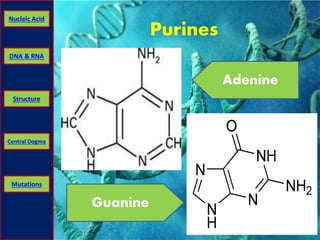
• Two of these bases (adenine and 
guanine) are purines and the 
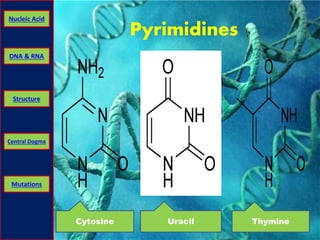
other three (cytosine, thymine & 
uracil) are pyrimidines. 
• DNA bases: A, G, C & T while RNA: 
A, G, C & U.
Nucleic Acid 
DNA & RNA 
Structure 
Central Dogma 
Mutations 
Purines 
Adenine 
Guanine
Nucleic Acid 
DNA & RNA 
Structure 
Central Dogma 
Mutations 
Pyrimidines 
Cytosine Uracil Thymine
Nucleic Acid 
DNA & RNA 
Structure 
Central Dogma 
Mutations 
Sugar 
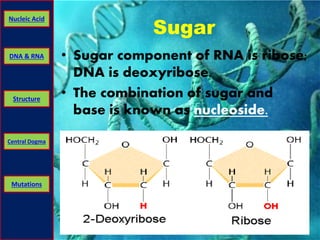
• Sugar component of RNA is ribose; 
DNA is deoxyribose. 
• The combination of sugar and 
base is known as nucleoside.
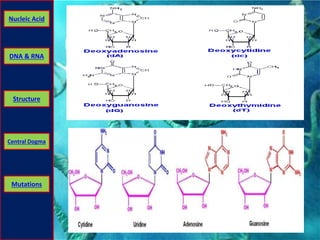
Nucleic Acid Base Sugar Nucleoside 
DNA & RNA 
Structure 
Central Dogma 
Mutations 
Adenine Deoxyribose Deoxyadenosine 
Adenine Ribose Adenosine 
Guanine Deoxyribose Deoxyguanosine 
Guanine Ribose Guanosine 
Cytosine Deoxyribose Deoxycytidine 
Cytosine Ribose Cytidine 
Thymine Deoxyribose Deoxythymidine 
Uracil Ribose Uridine
Nucleic Acid 
DNA & RNA 
Structure 
Central Dogma 
Mutations
Nucleic Acid 
DNA & RNA 
Structure 
Central Dogma 
Mutations 
Phosphate 
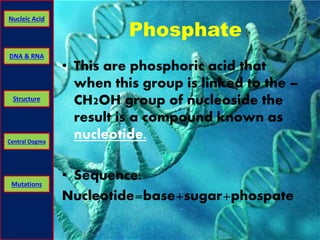
• This are phosphoric acid that 
when this group is linked to the – 
CH2OH group of nucleoside the 
result is a compound known as 
nucleotide. 
• Sequence: 
Nucleotide=base+sugar+phospate
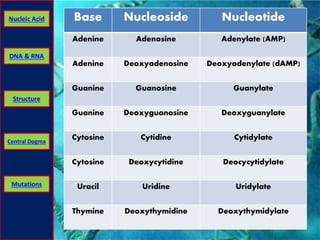
Nucleic Acid Base Nucleoside Nucleotide 
DNA & RNA 
Structure 
Central Dogma 
Mutations 
Adenine Adenosine Adenylate (AMP) 
Adenine Deoxyadenosine Deoxyadenylate (dAMP) 
Guanine Guanosine Guanylate 
Guanine Deoxyguanosine Deoxyguanylate 
Cytosine Cytidine Cytidylate 
Cytosine Deoxycytidine Deocycytidylate 
Uracil Uridine Uridylate 
Thymine Deoxythymidine Deoxythymidylate
Nucleic Acid 
DNA & RNA 
Structure 
Central Dogma 
Mutations 
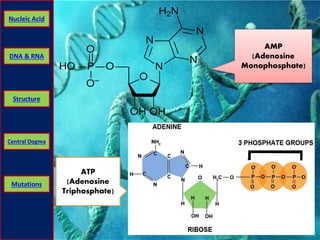
AMP 
(Adenosine 
Monophosphate) 
ATP 
(Adenosine 
Triphosphate)
Nucleic Acid 
DNA & RNA 
Structure 
Central Dogma 
Mutations 
DNA & RNA 
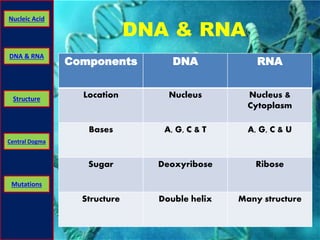
Components DNA RNA 
Location Nucleus Nucleus & 
Cytoplasm 
Bases A, G, C & T A, G, C & U 
Sugar Deoxyribose Ribose 
Structure Double helix Many structure
Nucleic Acid 
DNA & RNA 
Structure 
Central Dogma 
Mutations 
Structures 
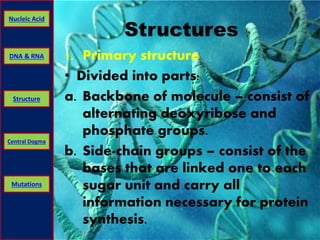
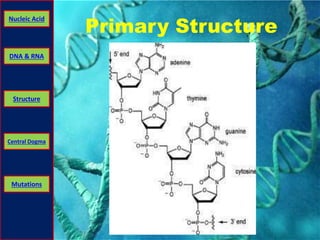
1. Primary structure 
• Divided into parts: 
a. Backbone of molecule – consist of 
alternating deoxyribose and 
phosphate groups. 
b. Side-chain groups – consist of the 
bases that are linked one to each 
sugar unit and carry all 
information necessary for protein 
synthesis.
Nucleic Acid Primary Structure 
DNA & RNA 
Structure 
Central Dogma 
Mutations
Nucleic Acid 2. Secondary structure (Double 
DNA & RNA 
Structure 
Central Dogma 
Mutations 
helix) 
• In 1953, James Watson & Francis Crick 
established the 3D structure of DNA. 
• The model of DNA established by 
watson and crick was based on two 
important pieces of information 
obtained by other workers: (1) the 
chargaff rule that (A&T) and (G&C) 
are present in equivalent quantities. 
(2) X-ray diffraction photographs 
obtained by Rosalind Franklin and 
Maurice Wilkins.
Nucleic Acid 
DNA & RNA 
Structure 
Central Dogma 
Mutations 
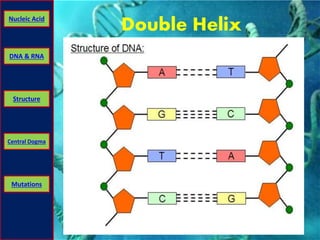
• Watson and Crick concluded that 
DNA is composed of two strands in 
double helix. 
• In the DNA double helix the two 
polynucleotide run in opposite 
directions in 5’ to 3’. 
• The sugar-phosphate backbone is on 
the outside and bases are point 
inward. 
• The bases are paired according to 
chargaff rule. The bases so paired 
form hydrogen bonds with each 
other thereby stabilizing the double 
helix. They are called complimentary 
base pairs.
Nucleic Acid Double Helix 
DNA & RNA 
Structure 
Central Dogma 
Mutations
Nucleic Acid 
DNA & RNA 
Structure 
Central Dogma 
Mutations 
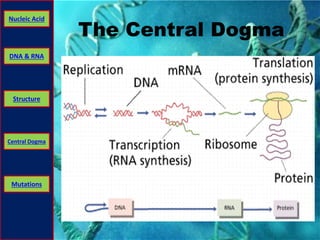
The Central Dogma
Nucleic Acid Replication 
DNA & RNA 
Structure 
Central Dogma 
Mutations 
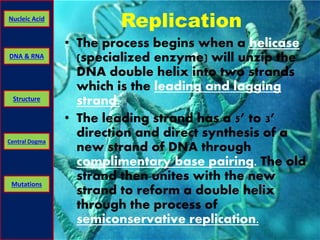
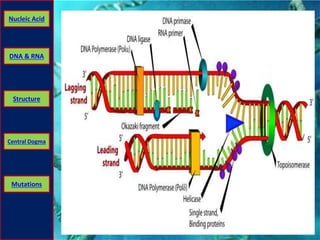
• The process begins when a helicase 
(specialized enzyme) will unzip the 
DNA double helix into two strands 
which is the leading and lagging 
strand. 
• The leading strand has a 5’ to 3’ 
direction and direct synthesis of a 
new strand of DNA through 
complimentary base pairing. The old 
strand then unites with the new 
strand to reform a double helix 
through the process of 
semiconservative replication.
Nucleic Acid • In the lagging strand, the 
DNA & RNA 
Structure 
Central Dogma 
Mutations 
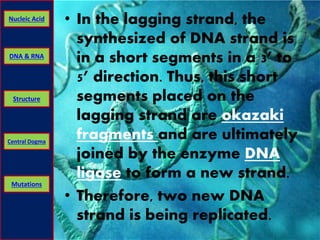
synthesized of DNA strand is 
in a short segments in a 3’ to 
5’ direction. Thus, this short 
segments placed on the 
lagging strand are okazaki 
fragments and are ultimately 
joined by the enzyme DNA 
ligase to form a new strand. 
• Therefore, two new DNA 
strand is being replicated.
Nucleic Acid 
DNA & RNA 
Structure 
Central Dogma 
Mutations
Nucleic Acid Transcription 
DNA & RNA 
Structure 
Central Dogma 
Mutations 
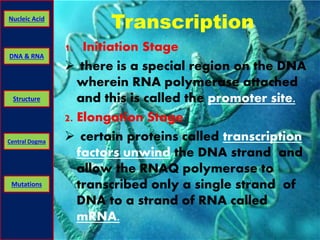
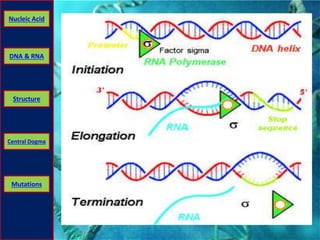
1. Initiation Stage 
 there is a special region on the DNA 
wherein RNA polymerase attached 
and this is called the promoter site. 
2. Elongation Stage 
 certain proteins called transcription 
factors unwind the DNA strand and 
allow the RNAQ polymerase to 
transcribed only a single strand of 
DNA to a strand of RNA called 
mRNA.
Nucleic Acid • Antisense strand – strand that 
DNA & RNA 
Structure 
Central Dogma 
Mutations 
serve as the template. 
• Sense strand – strand that is not 
transcribed. 
3. Termination Stage 
RNA polymerase moves along the 
DNA strand until it reaches a 
terminator sequence at the point 
RNA polymerase releases the 
mRNA polymer and detaches 
from the DNA. The DNA strand 
will bind again.
Nucleic Acid 
DNA & RNA 
Structure 
Central Dogma 
Mutations
Nucleic Acid Translation 
DNA & RNA 
Structure 
Central Dogma 
Mutations 
1. Initiation stage 
The small ribosomal subunit enters in 
the methylated cap of the mRNA and 
goes to the initiation site. The tRNA 
contains anti-codon (UAC) which is 
complimentary to the mRNA codon 
(AUG) which will bind. The large 
ribosomal subunit will bind to small 
ribosomal subunit to peptidyl site and 
aminoacyl site. The 1st tRNA will 
occupy the p-site and 2nd tRNA (AAA) 
will enter the A-site which is 
complimentary to 2nd mRNA (UUU) 
codon.
Nucleic Acid 2. Elongation Stage 
DNA & RNA 
Structure 
Central Dogma 
Mutations 
The methionine then transferred to A-site 
amino acid. The 1st tRNA exits and 
ribosomes move along the mRNA. The 
3rd mRNA enters. The process will just 
continue. As the elongation continues 
the growing peptide is continuously 
transfer to A-site tRNA. Ribosomes 
move to mRNA and new tRNA enters. 
3. Termination stage 
When stop codon encountered in the 
A-site, release factor enters the A-site 
and translation is terminated. The 
ribosomes dissociates and newly 
form protein release.
Nucleic Acid 
DNA & RNA 
Structure 
Central Dogma 
Mutations
Nucleic Acid Mutation and Cloning 
DNA & RNA 
Structure 
Central Dogma 
Mutations 
Mutation – an error in the copying 
of a sequence of bases. 
Occur during replication and it can 
be classified as microlesion and 
macrolesion. 
a. Microlesion – involving the 
replacement of one base pair by 
another (Substitution). 
 it divided into three subclasses: 
1. Transition 2. Transversion 3. Frame-shift
Nucleic Acid • In the transition, the replacement of 
DNA & RNA 
Structure 
Central Dogma 
Mutations 
purine by another purine or a 
pyrimidine by another pyrimidine. 
• In the transversion, the replacement 
of a purine by a pyrimidine or vice 
versa.. 
• In the frame-shift, the loss or 
addition of one of few pairs of 
bases. 
b. Macrolesion – classified as 
deletions, duplication and 
rearrangement. 
• In deletions is the inability to revert.
Nucleic Acid • Mutagens – chemicals that can 
DNA & RNA 
Structure 
Central Dogma 
Mutations 
cause mutation. 
Urethane 
Lead 
Dimethylnitrosoamine 
Diethylnitrosoamine 
Hydroxylamine 
Hydrazine compound 
Nitrosoamides 
Acridine orange 
benzopyrene
Nucleic Acid Cloning 
DNA & RNA 
Structure 
Central Dogma 
Mutations 
• Cloning is the process of creating genetically 
identical copies of biological matter. 
Types of Cloning: 
1. Molecular Cloning 
 Molecular cloning focuses on making identical 
copies of DNA molecules. This type of cloning is 
also called gene cloning. 
2. Organism Cloning 
 Organism cloning involves making an identical 
copy of an entire organism. This type of cloning is 
also called reproductive cloning. 
3. Therapeutic Cloning 
 Therapeutic cloning involves the cloning of human 
embryos for the production of stem cells. The 
embryos are eventually destroyed in this process.
Nucleic Acid 
DNA & RNA 
Structure 
Central Dogma 
Mutations 
Thank You! 
Presented by: 
Den Mark Galapir 
Xandrad Abigail Garduque 
Edmar Luban 
Jovilyn Padilla 
Jessa Marie Ipac

The nucleic acids

  • 1.
    Nucleic Acid DNA& RNA Structure Central Dogma Mutations The Nucleic Acids
  • 2.
    Nucleic Acid DNA& RNA Structure Central Dogma Mutations Nucleic Acid  a complex organic substance present in living cell esp. DNA & RNA whose molecules consist of many nucleotides linked in a long chain. Functions: • Transmission of hereditary characters. • Synthesis of proteins.
  • 3.
    Nucleic Acid Components DNA & RNA Structure Central Dogma Mutations A. Kinds of Nucleic Acid 1. RNA (Ribonucleic acid) – it is located elsewhere in the nucleus and in the cytoplasm. 2. DNA (Deoxyribonucleic acid) – it is located in the chromosomes of the nucleus. Nucleotides – building blocks of nucleic acid chain. It is composed of base, sugar and phosphate.
  • 4.
    Nucleic Acid DNA& RNA Structure Central Dogma Mutations Base • Base found in DNA & RNA are basic because they are heterocyclic amines. • Two of these bases (adenine and guanine) are purines and the other three (cytosine, thymine & uracil) are pyrimidines. • DNA bases: A, G, C & T while RNA: A, G, C & U.
  • 5.
    Nucleic Acid DNA& RNA Structure Central Dogma Mutations Purines Adenine Guanine
  • 6.
    Nucleic Acid DNA& RNA Structure Central Dogma Mutations Pyrimidines Cytosine Uracil Thymine
  • 7.
    Nucleic Acid DNA& RNA Structure Central Dogma Mutations Sugar • Sugar component of RNA is ribose; DNA is deoxyribose. • The combination of sugar and base is known as nucleoside.
  • 8.
    Nucleic Acid BaseSugar Nucleoside DNA & RNA Structure Central Dogma Mutations Adenine Deoxyribose Deoxyadenosine Adenine Ribose Adenosine Guanine Deoxyribose Deoxyguanosine Guanine Ribose Guanosine Cytosine Deoxyribose Deoxycytidine Cytosine Ribose Cytidine Thymine Deoxyribose Deoxythymidine Uracil Ribose Uridine
  • 9.
    Nucleic Acid DNA& RNA Structure Central Dogma Mutations
  • 10.
    Nucleic Acid DNA& RNA Structure Central Dogma Mutations Phosphate • This are phosphoric acid that when this group is linked to the – CH2OH group of nucleoside the result is a compound known as nucleotide. • Sequence: Nucleotide=base+sugar+phospate
  • 11.
    Nucleic Acid BaseNucleoside Nucleotide DNA & RNA Structure Central Dogma Mutations Adenine Adenosine Adenylate (AMP) Adenine Deoxyadenosine Deoxyadenylate (dAMP) Guanine Guanosine Guanylate Guanine Deoxyguanosine Deoxyguanylate Cytosine Cytidine Cytidylate Cytosine Deoxycytidine Deocycytidylate Uracil Uridine Uridylate Thymine Deoxythymidine Deoxythymidylate
  • 12.
    Nucleic Acid DNA& RNA Structure Central Dogma Mutations AMP (Adenosine Monophosphate) ATP (Adenosine Triphosphate)
  • 13.
    Nucleic Acid DNA& RNA Structure Central Dogma Mutations DNA & RNA Components DNA RNA Location Nucleus Nucleus & Cytoplasm Bases A, G, C & T A, G, C & U Sugar Deoxyribose Ribose Structure Double helix Many structure
  • 14.
    Nucleic Acid DNA& RNA Structure Central Dogma Mutations Structures 1. Primary structure • Divided into parts: a. Backbone of molecule – consist of alternating deoxyribose and phosphate groups. b. Side-chain groups – consist of the bases that are linked one to each sugar unit and carry all information necessary for protein synthesis.
  • 15.
    Nucleic Acid PrimaryStructure DNA & RNA Structure Central Dogma Mutations
  • 16.
    Nucleic Acid 2.Secondary structure (Double DNA & RNA Structure Central Dogma Mutations helix) • In 1953, James Watson & Francis Crick established the 3D structure of DNA. • The model of DNA established by watson and crick was based on two important pieces of information obtained by other workers: (1) the chargaff rule that (A&T) and (G&C) are present in equivalent quantities. (2) X-ray diffraction photographs obtained by Rosalind Franklin and Maurice Wilkins.
  • 17.
    Nucleic Acid DNA& RNA Structure Central Dogma Mutations • Watson and Crick concluded that DNA is composed of two strands in double helix. • In the DNA double helix the two polynucleotide run in opposite directions in 5’ to 3’. • The sugar-phosphate backbone is on the outside and bases are point inward. • The bases are paired according to chargaff rule. The bases so paired form hydrogen bonds with each other thereby stabilizing the double helix. They are called complimentary base pairs.
  • 18.
    Nucleic Acid DoubleHelix DNA & RNA Structure Central Dogma Mutations
  • 19.
    Nucleic Acid DNA& RNA Structure Central Dogma Mutations The Central Dogma
  • 20.
    Nucleic Acid Replication DNA & RNA Structure Central Dogma Mutations • The process begins when a helicase (specialized enzyme) will unzip the DNA double helix into two strands which is the leading and lagging strand. • The leading strand has a 5’ to 3’ direction and direct synthesis of a new strand of DNA through complimentary base pairing. The old strand then unites with the new strand to reform a double helix through the process of semiconservative replication.
  • 21.
    Nucleic Acid •In the lagging strand, the DNA & RNA Structure Central Dogma Mutations synthesized of DNA strand is in a short segments in a 3’ to 5’ direction. Thus, this short segments placed on the lagging strand are okazaki fragments and are ultimately joined by the enzyme DNA ligase to form a new strand. • Therefore, two new DNA strand is being replicated.
  • 22.
    Nucleic Acid DNA& RNA Structure Central Dogma Mutations
  • 23.
    Nucleic Acid Transcription DNA & RNA Structure Central Dogma Mutations 1. Initiation Stage  there is a special region on the DNA wherein RNA polymerase attached and this is called the promoter site. 2. Elongation Stage  certain proteins called transcription factors unwind the DNA strand and allow the RNAQ polymerase to transcribed only a single strand of DNA to a strand of RNA called mRNA.
  • 24.
    Nucleic Acid •Antisense strand – strand that DNA & RNA Structure Central Dogma Mutations serve as the template. • Sense strand – strand that is not transcribed. 3. Termination Stage RNA polymerase moves along the DNA strand until it reaches a terminator sequence at the point RNA polymerase releases the mRNA polymer and detaches from the DNA. The DNA strand will bind again.
  • 25.
    Nucleic Acid DNA& RNA Structure Central Dogma Mutations
  • 26.
    Nucleic Acid Translation DNA & RNA Structure Central Dogma Mutations 1. Initiation stage The small ribosomal subunit enters in the methylated cap of the mRNA and goes to the initiation site. The tRNA contains anti-codon (UAC) which is complimentary to the mRNA codon (AUG) which will bind. The large ribosomal subunit will bind to small ribosomal subunit to peptidyl site and aminoacyl site. The 1st tRNA will occupy the p-site and 2nd tRNA (AAA) will enter the A-site which is complimentary to 2nd mRNA (UUU) codon.
  • 27.
    Nucleic Acid 2.Elongation Stage DNA & RNA Structure Central Dogma Mutations The methionine then transferred to A-site amino acid. The 1st tRNA exits and ribosomes move along the mRNA. The 3rd mRNA enters. The process will just continue. As the elongation continues the growing peptide is continuously transfer to A-site tRNA. Ribosomes move to mRNA and new tRNA enters. 3. Termination stage When stop codon encountered in the A-site, release factor enters the A-site and translation is terminated. The ribosomes dissociates and newly form protein release.
  • 28.
    Nucleic Acid DNA& RNA Structure Central Dogma Mutations
  • 29.
    Nucleic Acid Mutationand Cloning DNA & RNA Structure Central Dogma Mutations Mutation – an error in the copying of a sequence of bases. Occur during replication and it can be classified as microlesion and macrolesion. a. Microlesion – involving the replacement of one base pair by another (Substitution).  it divided into three subclasses: 1. Transition 2. Transversion 3. Frame-shift
  • 30.
    Nucleic Acid •In the transition, the replacement of DNA & RNA Structure Central Dogma Mutations purine by another purine or a pyrimidine by another pyrimidine. • In the transversion, the replacement of a purine by a pyrimidine or vice versa.. • In the frame-shift, the loss or addition of one of few pairs of bases. b. Macrolesion – classified as deletions, duplication and rearrangement. • In deletions is the inability to revert.
  • 31.
    Nucleic Acid •Mutagens – chemicals that can DNA & RNA Structure Central Dogma Mutations cause mutation. Urethane Lead Dimethylnitrosoamine Diethylnitrosoamine Hydroxylamine Hydrazine compound Nitrosoamides Acridine orange benzopyrene
  • 32.
    Nucleic Acid Cloning DNA & RNA Structure Central Dogma Mutations • Cloning is the process of creating genetically identical copies of biological matter. Types of Cloning: 1. Molecular Cloning  Molecular cloning focuses on making identical copies of DNA molecules. This type of cloning is also called gene cloning. 2. Organism Cloning  Organism cloning involves making an identical copy of an entire organism. This type of cloning is also called reproductive cloning. 3. Therapeutic Cloning  Therapeutic cloning involves the cloning of human embryos for the production of stem cells. The embryos are eventually destroyed in this process.
  • 33.
    Nucleic Acid DNA& RNA Structure Central Dogma Mutations Thank You! Presented by: Den Mark Galapir Xandrad Abigail Garduque Edmar Luban Jovilyn Padilla Jessa Marie Ipac