
Namrata Chhabra
M.D.Biochemistry
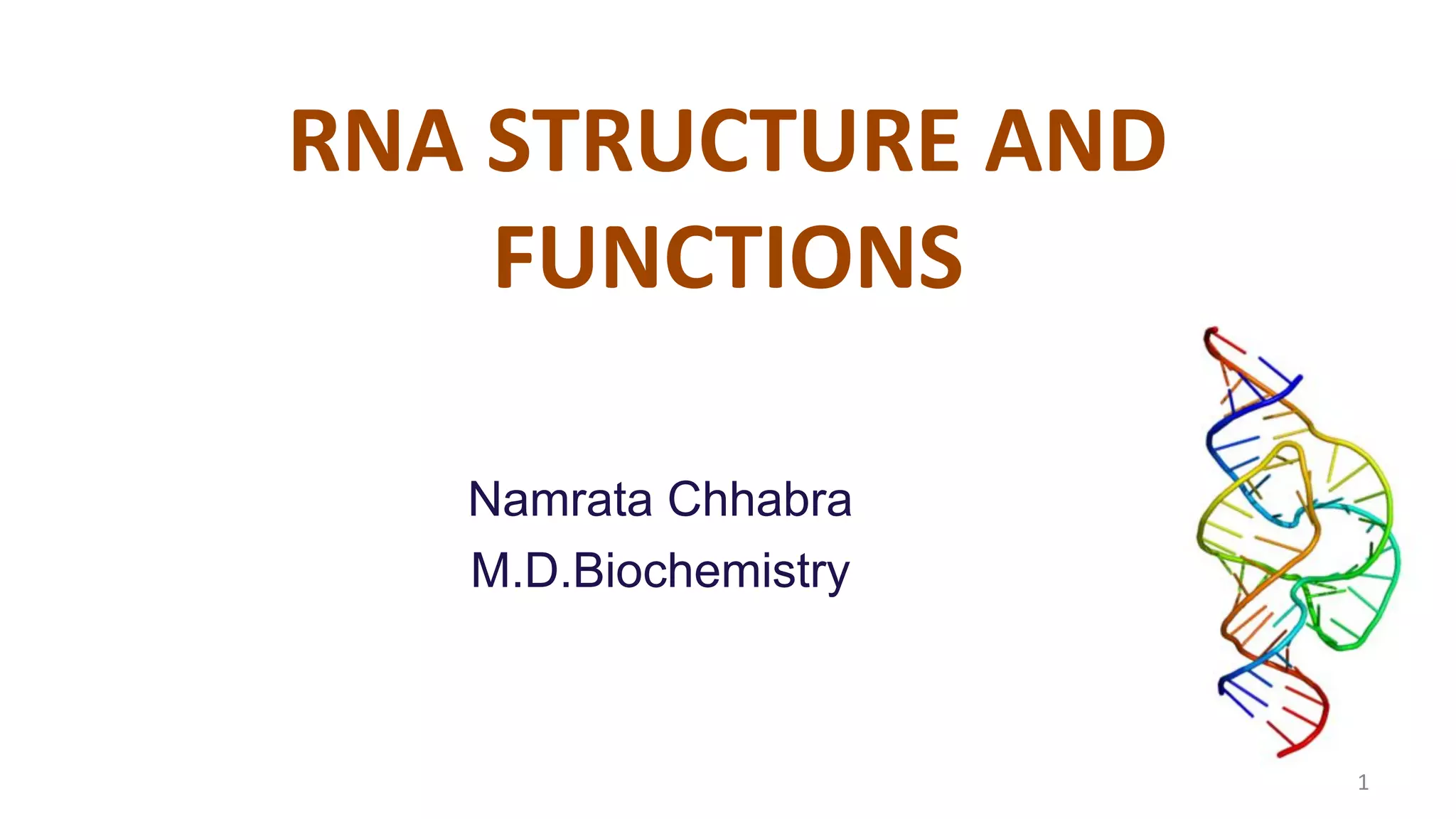
RNA STRUCTURE AND
FUNCTIONS
1
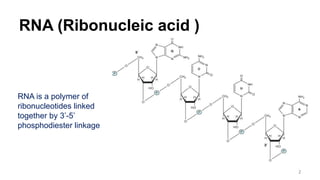
RNA (Ribonucleic acid )
RNA is a polymer of
ribonucleotides linked
together by 3’-5’
phosphodiester linkage
2
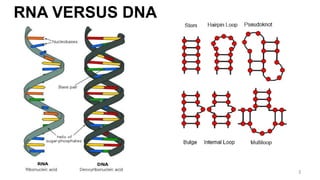
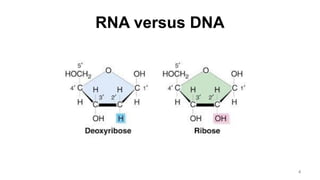
RNA VERSUS DNA
3
RNA versus DNA
4
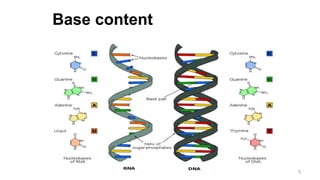
Base content
5
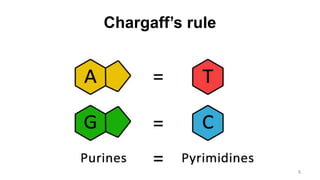
Chargaff’s rule
6
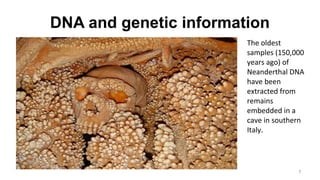
DNA and genetic information
7
The oldest
samples (150,000
years ago) of
Neanderthal DNA
have been
extracted from
remains
embedded in a
cave in southern
Italy.
8
Pop up
question
RNA Stability
Why DNA makes use of the less common 2'-deoxyribose.
1.The hydrogen bonding character of the 2'-OH interferes with
a uniform double helix structure, preventing the efficient
packing of such a molecule in the chromosome.
2.RNA undergoes spontaneous hydrolytic cleavage about one
hundred times faster than DNA.
9
RNA Stability
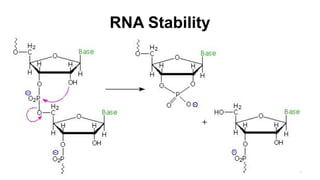
● This is believed due to intramolecular attack of the
2'-hydroxyl function on the neighboring phosphate
diester, yielding a 2',3'-cyclic phosphate.
● If stability over the lifetime of an organism is an
essential characteristic of a gene, then nature's
selection of 2'-deoxyribose for DNA makes sense.
10
Structural Stability-Is it a serious challenge for
RNA ?
● Structural stability is not a serious challenge for RNA.
● The information carried by mRNA,as it is transported to a ribosome should
be secure only for a few hours,.
● Once in the ribosome, the codon language is immediately translated for
protein synthesis.
● The tRNA molecules that carry amino acids to the ribosome are similarly
short lived, and are in fact continuously recycled by the cellular enzymes.
11
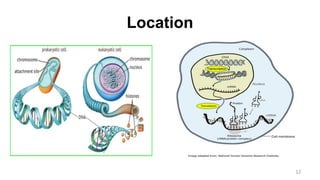
Location
12
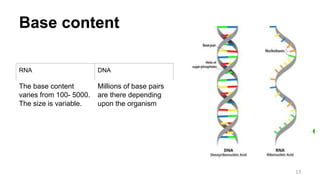
Base content
13
RNA DNA
The base content
varies from 100- 5000.
The size is variable.
Millions of base pairs
are there depending
upon the organism
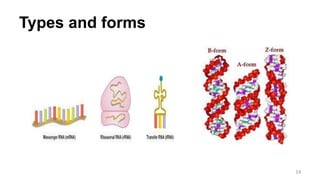
Types and forms
14
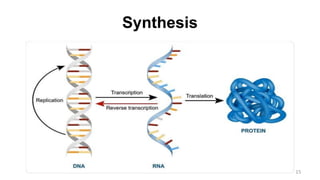
Synthesis
15
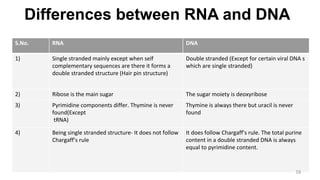
Differences between RNA and DNA
S.No. RNA DNA
1) Single stranded mainly except when self
complementary sequences are there it forms a
double stranded structure (Hair pin structure)
Double stranded (Except for certain viral DNA s
which are single stranded)
2) Ribose is the main sugar The sugar moiety is deoxyribose
3) Pyrimidine components differ. Thymine is never
found(Except
tRNA)
Thymine is always there but uracil is never
found
4) Being single stranded structure- It does not follow
Chargaff’s rule
It does follow Chargaff's rule. The total purine
content in a double stranded DNA is always
equal to pyrimidine content.
16
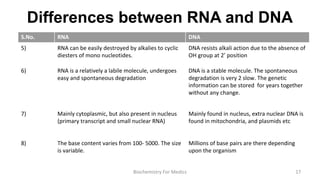
Differences between RNA and DNA
S.No. RNA DNA
5) RNA can be easily destroyed by alkalies to cyclic
diesters of mono nucleotides.
DNA resists alkali action due to the absence of
OH group at 2’ position
6) RNA is a relatively a labile molecule, undergoes
easy and spontaneous degradation
DNA is a stable molecule. The spontaneous
degradation is very 2 slow. The genetic
information can be stored for years together
without any change.
7) Mainly cytoplasmic, but also present in nucleus
(primary transcript and small nuclear RNA)
Mainly found in nucleus, extra nuclear DNA is
found in mitochondria, and plasmids etc
8) The base content varies from 100- 5000. The size
is variable.
Millions of base pairs are there depending
upon the organism
17Biochemistry For Medics
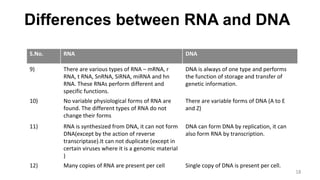
Differences between RNA and DNA
S.No. RNA DNA
9) There are various types of RNA – mRNA, r
RNA, t RNA, SnRNA, SiRNA, miRNA and hn
RNA. These RNAs perform different and
specific functions.
DNA is always of one type and performs
the function of storage and transfer of
genetic information.
10) No variable physiological forms of RNA are
found. The different types of RNA do not
change their forms
There are variable forms of DNA (A to E
and Z)
11) RNA is synthesized from DNA, it can not form
DNA(except by the action of reverse
transcriptase).It can not duplicate (except in
certain viruses where it is a genomic material
)
DNA can form DNA by replication, it can
also form RNA by transcription.
12) Many copies of RNA are present per cell Single copy of DNA is present per cell.
18
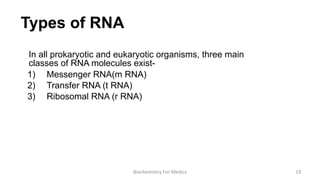
Types of RNA
In all prokaryotic and eukaryotic organisms, three main
classes of RNA molecules exist-
1) Messenger RNA(m RNA)
2) Transfer RNA (t RNA)
3) Ribosomal RNA (r RNA)
19Biochemistry For Medics
Types of RNA
The other are –
o Small nuclear RNA (SnRNA),
o Micro RNA(mi RNA) and
o Small interfering RNA(SiRNA) and
o Heterogeneous nuclear RNA (hnRNA).
20
Messenger RNA (m-RNA)
● Comprises only 5% of the RNA in the cell
● Most heterogeneous in size and base sequence
● All members of the class function as messengers carrying the
information in a gene to the protein synthesizing machinery
21
Structural Characteristics of m-RNA
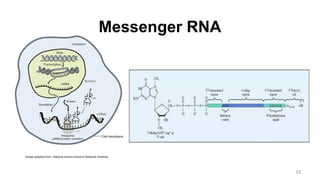
● The 5’ terminal end is capped by 7- methyl guanosine
triphosphate cap.
● The cap is involved in the recognition of mRNA by the
translating machinery
● It stabilizes mRNA by protecting it from 5’ exonuclease
22
Messenger RNA
23
Structural Characteristics of mRNA
● The 3’end of most mRNAs have a polymer of Adenylate
residues( 20-250)
● The tail prevents the attack by 3’ exonucleases
24
25
Pop up
question
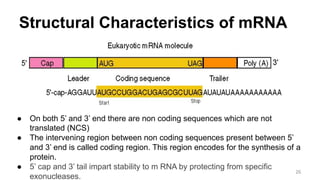
Structural Characteristics of mRNA
● On both 5’ and 3’ end there are non coding sequences which are not
translated (NCS)
● The intervening region between non coding sequences present between 5’
and 3’ end is called coding region. This region encodes for the synthesis of a
protein.
● 5’ cap and 3’ tail impart stability to m RNA by protecting from specific
exonucleases.
26
Structural Characteristics of mRNA
● The mRNA molecules are formed with the help of DNA template
during the process of transcription.
● The sequence of nucleotides in mRNA is complementary to the
sequence of nucleotides on template DNA.
● The sequence carried on mRNA is read in the form of codons.
● A codon is made up of 3 nucleotides
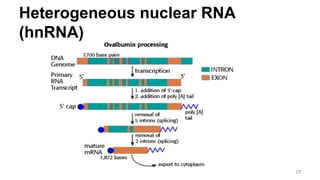
● The mRNA is formed after processing of heterogeneous nuclear
RNA
27
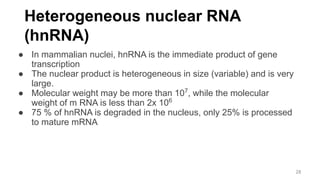
Heterogeneous nuclear RNA
(hnRNA)
● In mammalian nuclei, hnRNA is the immediate product of gene
transcription
● The nuclear product is heterogeneous in size (variable) and is very
large.
● Molecular weight may be more than 107
, while the molecular
weight of m RNA is less than 2x 10⁶
● 75 % of hnRNA is degraded in the nucleus, only 25% is processed
to mature mRNA
28
Heterogeneous nuclear RNA
(hnRNA)
29
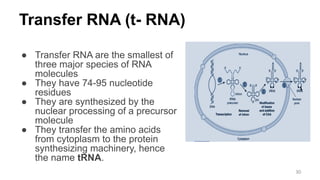
Transfer RNA (t- RNA)
● Transfer RNA are the smallest of
three major species of RNA
molecules
● They have 74-95 nucleotide
residues
● They are synthesized by the
nuclear processing of a precursor
molecule
● They transfer the amino acids
from cytoplasm to the protein
synthesizing machinery, hence
the name tRNA.
30
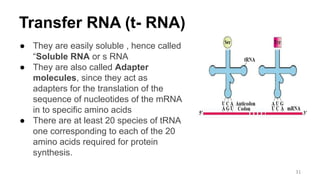
Transfer RNA (t- RNA)
● They are easily soluble , hence called
“Soluble RNA or s RNA
● They are also called Adapter
molecules, since they act as
adapters for the translation of the
sequence of nucleotides of the mRNA
in to specific amino acids
● There are at least 20 species of tRNA
one corresponding to each of the 20
amino acids required for protein
synthesis.
31
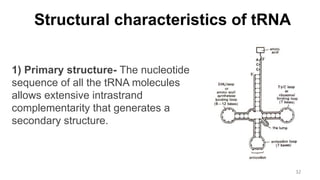
Structural characteristics of tRNA
1) Primary structure- The nucleotide
sequence of all the tRNA molecules
allows extensive intrastrand
complementarity that generates a
secondary structure.
32
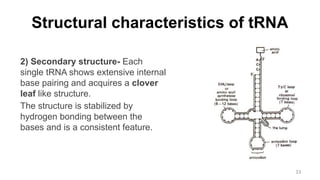
Structural characteristics of tRNA
2) Secondary structure- Each
single tRNA shows extensive internal
base pairing and acquires a clover
leaf like structure.
The structure is stabilized by
hydrogen bonding between the
bases and is a consistent feature.
33
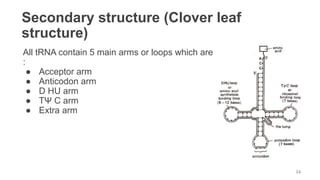
Secondary structure (Clover leaf
structure)
All tRNA contain 5 main arms or loops which are
:
● Acceptor arm
● Anticodon arm
● D HU arm
● TΨ C arm
● Extra arm
34
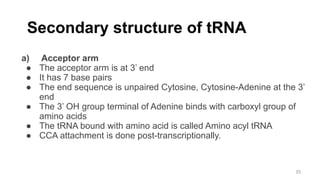
Secondary structure of tRNA
a) Acceptor arm
● The acceptor arm is at 3’ end
● It has 7 base pairs
● The end sequence is unpaired Cytosine, Cytosine-Adenine at the 3’
end
● The 3’ OH group terminal of Adenine binds with carboxyl group of
amino acids
● The tRNA bound with amino acid is called Amino acyl tRNA
● CCA attachment is done post-transcriptionally.
35
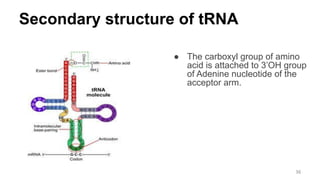
Secondary structure of tRNA
● The carboxyl group of amino
acid is attached to 3’OH group
of Adenine nucleotide of the
acceptor arm.
36
Secondary structure of tRNA
b) Anticodon arm
● Lies at the opposite end of acceptor arm
● 5-7 base pairs long
● Recognizes the triplet codon present in the mRNA
● Base sequence of anticodon arm is complementary to the
base sequence of mRNA codon.
● Due to complementarity it can bind specifically with mRNA
by hydrogen bonds.
37
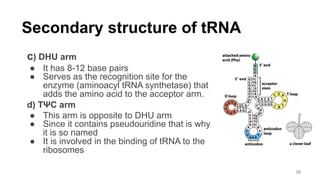
Secondary structure of tRNA
c) DHU arm
● It has 8-12 base pairs
● Serves as the recognition site for the
enzyme (aminoacyl tRNA synthetase) that
adds the amino acid to the acceptor arm.
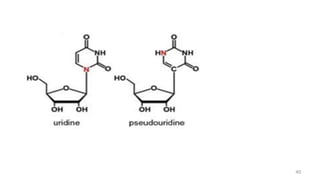
d) TΨC arm
● This arm is opposite to DHU arm
● Since it contains pseudouridine that is why
it is so named
● It is involved in the binding of tRNA to the
ribosomes
38
39
Pop up
question
40
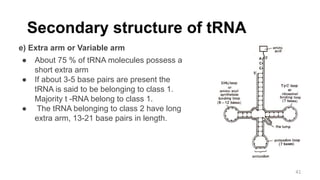
Secondary structure of tRNA
e) Extra arm or Variable arm
● About 75 % of tRNA molecules possess a
short extra arm
● If about 3-5 base pairs are present the
tRNA is said to be belonging to class 1.
Majority t -RNA belong to class 1.
● The tRNA belonging to class 2 have long
extra arm, 13-21 base pairs in length.
41
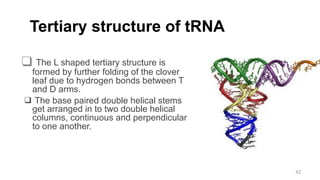
Tertiary structure of tRNA
❑ The L shaped tertiary structure is
formed by further folding of the clover
leaf due to hydrogen bonds between T
and D arms.
❑ The base paired double helical stems
get arranged in to two double helical
columns, continuous and perpendicular
to one another.
42
Ribosomal RNA (rRNA)
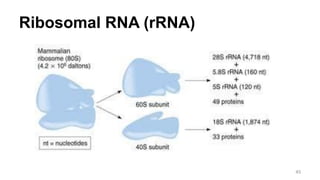
● The mammalian ribosome contains two major
nucleoprotein subunits—a larger one with a molecular
weight of 2.8 x 10⁶ (60S) and a smaller subunit with a
molecular weight of 1.4 x 10⁶ (40S).
● The 60S subunit contains a 5S ribosomal RNA (rRNA), a
5.8S rRNA, and a 28S rRNA; there are also probably
more than 50 specific polypeptides.
43
Ribosomal RNA (rRNA)
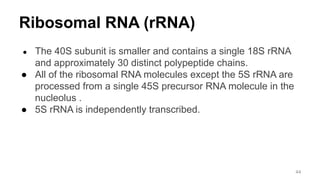
● The 40S subunit is smaller and contains a single 18S rRNA
and approximately 30 distinct polypeptide chains.
● All of the ribosomal RNA molecules except the 5S rRNA are
processed from a single 45S precursor RNA molecule in the
nucleolus .
● 5S rRNA is independently transcribed.
44
Ribosomal RNA (rRNA)
45
Ribosomal RNA (rRNA)
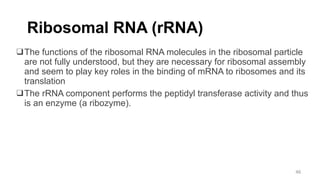
❑The functions of the ribosomal RNA molecules in the ribosomal particle
are not fully understood, but they are necessary for ribosomal assembly
and seem to play key roles in the binding of mRNA to ribosomes and its
translation
❑The rRNA component performs the peptidyl transferase activity and thus
is an enzyme (a ribozyme).
46
Small RNA
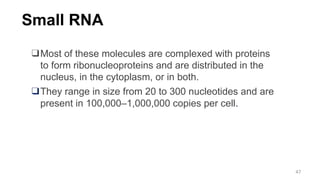
❑Most of these molecules are complexed with proteins
to form ribonucleoproteins and are distributed in the
nucleus, in the cytoplasm, or in both.
❑They range in size from 20 to 300 nucleotides and are
present in 100,000–1,000,000 copies per cell.
47
Small Nuclear RNAs (snRNAs)
● snRNAs, a subset of the small RNAs, are significantly
involved in mRNA processing and gene regulation
● Of the several snRNAs, U1, U2, U4, U5, and U6 are
involved in intron removal and the processing of hnRNA into
mRNA
● The U7 snRNA is involved in production of the correct 3'
ends of histone mRNA—which lacks a poly(A) tail.
48
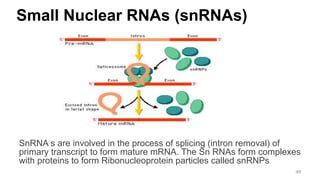
Small Nuclear RNAs (snRNAs)
SnRNA s are involved in the process of splicing (intron removal) of
primary transcript to form mature mRNA. The Sn RNAs form complexes
with proteins to form Ribonucleoprotein particles called snRNPs
49
MicroRNAs(miRNAs), and Small
Interfering RNAs (siRNAs)
● These two classes of RNAs represent a subset of small
RNAs; both play important roles in gene regulation.
● miRNAs and siRNAs cause inhibition of gene expression by
decreasing specific protein production apparently via distinct
mechanisms
50
MicroRNAs (miRNAs)
❑miRNAs are typically 21–25 nucleotides in length and are
generated by nucleolytic processing of the products of distinct
genes/transcription units
❑The small processed mature miRNAs typically hybridize, via the
formation of imperfect RNA-RNA duplexes within the
3'-untranslated regions of specific target mRNAs, leading via
unknown mechanisms to translation arrest.
51
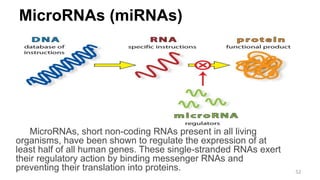
MicroRNAs (miRNAs)
MicroRNAs, short non-coding RNAs present in all living
organisms, have been shown to regulate the expression of at
least half of all human genes. These single-stranded RNAs exert
their regulatory action by binding messenger RNAs and
preventing their translation into proteins. 52
Small Interfering RNAs (siRNAs)
● siRNAs are derived by the specific nucleolytic cleavage of larger,
double-stranded RNAs to again form small 21–25 nucleotide-long
products.
●These short siRNAs usually form perfect RNA-RNA hybrids with
their distinct targets potentially anywhere within the length of the
mRNA where the complementary sequence exists.
● Formation of such RNA-RNA duplexes between siRNA and mRNA
results in reduced specific protein production because the
siRNA-mRNA complexes are degraded by dedicated nucleolytic
machinery;
● Some or all of this mRNA degradation occurs in specific organelles
termed P bodies.
53
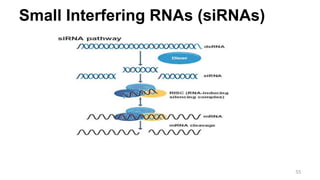
Small Interfering RNAs (siRNAs)
● Small interfering RNA (siRNA) are 20-25 nucleotide-long
double-stranded RNA molecules that have a variety of roles in the
cell.
● They are involved in the RNA interference (RNAi) pathway, where it
interferes with the expression of a specific gene by hybridizing to its
corresponding RNA sequence in the target mRNA.
● This then activates the degrading mRNA. Once the target mRNA is
degraded, the mRNA cannot be translated into protein.
54
Small Interfering RNAs (siRNAs)
55
Significance of miRNAs and siRNAs
● Both miRNAs and siRNAs represent exciting new
potential targets for therapeutic drug development in
humans.
● In addition, siRNAs are frequently used to decrease or
"knock-down" specific protein levels in experimental
procedures in the laboratory, an extremely useful and
powerful alternative to gene-knockout technology.
56
Therapeutic significance of siRNA
57
RNA Interference (RNAi)
Summary
● RNA exists in several different single-stranded structures, most of
which are directly or indirectly involved in protein synthesis or its
regulation.
● The linear array of nucleotides in RNA consists of A, G, C, and U,
and the sugar moiety is ribose.
● The major forms of RNA include messenger RNA (mRNA),
ribosomal RNA (rRNA), transfer RNA (tRNA), and small nuclear
RNAs (snRNAs; miRNAs).
● Certain RNA molecules act as catalysts (ribozymes).
● miRNAs and siRNAs represent exciting new potential targets for
therapeutic drug development in humans.
58
Key references
1. Harper’s illustrated Biochemistry 31st edition.
2. Lehninger principles of Biochemistry 7the edition
3. Lippincott Illustrated Review Biochemistry, 5th edition
59
Quiz time
60
Thank
you
61

RNA structure and functions

  • 1.
  • 2.
    RNA (Ribonucleic acid) RNA is a polymer of ribonucleotides linked together by 3’-5’ phosphodiester linkage 2
  • 3.
  • 4.
  • 5.
  • 6.
  • 7.
    DNA and geneticinformation 7 The oldest samples (150,000 years ago) of Neanderthal DNA have been extracted from remains embedded in a cave in southern Italy.
  • 8.
  • 9.
    RNA Stability Why DNAmakes use of the less common 2'-deoxyribose. 1.The hydrogen bonding character of the 2'-OH interferes with a uniform double helix structure, preventing the efficient packing of such a molecule in the chromosome. 2.RNA undergoes spontaneous hydrolytic cleavage about one hundred times faster than DNA. 9
  • 10.
    RNA Stability ● Thisis believed due to intramolecular attack of the 2'-hydroxyl function on the neighboring phosphate diester, yielding a 2',3'-cyclic phosphate. ● If stability over the lifetime of an organism is an essential characteristic of a gene, then nature's selection of 2'-deoxyribose for DNA makes sense. 10
  • 11.
    Structural Stability-Is ita serious challenge for RNA ? ● Structural stability is not a serious challenge for RNA. ● The information carried by mRNA,as it is transported to a ribosome should be secure only for a few hours,. ● Once in the ribosome, the codon language is immediately translated for protein synthesis. ● The tRNA molecules that carry amino acids to the ribosome are similarly short lived, and are in fact continuously recycled by the cellular enzymes. 11
  • 12.
  • 13.
    Base content 13 RNA DNA Thebase content varies from 100- 5000. The size is variable. Millions of base pairs are there depending upon the organism
  • 14.
  • 15.
  • 16.
    Differences between RNAand DNA S.No. RNA DNA 1) Single stranded mainly except when self complementary sequences are there it forms a double stranded structure (Hair pin structure) Double stranded (Except for certain viral DNA s which are single stranded) 2) Ribose is the main sugar The sugar moiety is deoxyribose 3) Pyrimidine components differ. Thymine is never found(Except tRNA) Thymine is always there but uracil is never found 4) Being single stranded structure- It does not follow Chargaff’s rule It does follow Chargaff's rule. The total purine content in a double stranded DNA is always equal to pyrimidine content. 16
  • 17.
    Differences between RNAand DNA S.No. RNA DNA 5) RNA can be easily destroyed by alkalies to cyclic diesters of mono nucleotides. DNA resists alkali action due to the absence of OH group at 2’ position 6) RNA is a relatively a labile molecule, undergoes easy and spontaneous degradation DNA is a stable molecule. The spontaneous degradation is very 2 slow. The genetic information can be stored for years together without any change. 7) Mainly cytoplasmic, but also present in nucleus (primary transcript and small nuclear RNA) Mainly found in nucleus, extra nuclear DNA is found in mitochondria, and plasmids etc 8) The base content varies from 100- 5000. The size is variable. Millions of base pairs are there depending upon the organism 17Biochemistry For Medics
  • 18.
    Differences between RNAand DNA S.No. RNA DNA 9) There are various types of RNA – mRNA, r RNA, t RNA, SnRNA, SiRNA, miRNA and hn RNA. These RNAs perform different and specific functions. DNA is always of one type and performs the function of storage and transfer of genetic information. 10) No variable physiological forms of RNA are found. The different types of RNA do not change their forms There are variable forms of DNA (A to E and Z) 11) RNA is synthesized from DNA, it can not form DNA(except by the action of reverse transcriptase).It can not duplicate (except in certain viruses where it is a genomic material ) DNA can form DNA by replication, it can also form RNA by transcription. 12) Many copies of RNA are present per cell Single copy of DNA is present per cell. 18
  • 19.
    Types of RNA Inall prokaryotic and eukaryotic organisms, three main classes of RNA molecules exist- 1) Messenger RNA(m RNA) 2) Transfer RNA (t RNA) 3) Ribosomal RNA (r RNA) 19Biochemistry For Medics
  • 20.
    Types of RNA Theother are – o Small nuclear RNA (SnRNA), o Micro RNA(mi RNA) and o Small interfering RNA(SiRNA) and o Heterogeneous nuclear RNA (hnRNA). 20
  • 21.
    Messenger RNA (m-RNA) ●Comprises only 5% of the RNA in the cell ● Most heterogeneous in size and base sequence ● All members of the class function as messengers carrying the information in a gene to the protein synthesizing machinery 21
  • 22.
    Structural Characteristics ofm-RNA ● The 5’ terminal end is capped by 7- methyl guanosine triphosphate cap. ● The cap is involved in the recognition of mRNA by the translating machinery ● It stabilizes mRNA by protecting it from 5’ exonuclease 22
  • 23.
  • 24.
    Structural Characteristics ofmRNA ● The 3’end of most mRNAs have a polymer of Adenylate residues( 20-250) ● The tail prevents the attack by 3’ exonucleases 24
  • 25.
  • 26.
    Structural Characteristics ofmRNA ● On both 5’ and 3’ end there are non coding sequences which are not translated (NCS) ● The intervening region between non coding sequences present between 5’ and 3’ end is called coding region. This region encodes for the synthesis of a protein. ● 5’ cap and 3’ tail impart stability to m RNA by protecting from specific exonucleases. 26
  • 27.
    Structural Characteristics ofmRNA ● The mRNA molecules are formed with the help of DNA template during the process of transcription. ● The sequence of nucleotides in mRNA is complementary to the sequence of nucleotides on template DNA. ● The sequence carried on mRNA is read in the form of codons. ● A codon is made up of 3 nucleotides ● The mRNA is formed after processing of heterogeneous nuclear RNA 27
  • 28.
    Heterogeneous nuclear RNA (hnRNA) ●In mammalian nuclei, hnRNA is the immediate product of gene transcription ● The nuclear product is heterogeneous in size (variable) and is very large. ● Molecular weight may be more than 107 , while the molecular weight of m RNA is less than 2x 10⁶ ● 75 % of hnRNA is degraded in the nucleus, only 25% is processed to mature mRNA 28
  • 29.
  • 30.
    Transfer RNA (t-RNA) ● Transfer RNA are the smallest of three major species of RNA molecules ● They have 74-95 nucleotide residues ● They are synthesized by the nuclear processing of a precursor molecule ● They transfer the amino acids from cytoplasm to the protein synthesizing machinery, hence the name tRNA. 30
  • 31.
    Transfer RNA (t-RNA) ● They are easily soluble , hence called “Soluble RNA or s RNA ● They are also called Adapter molecules, since they act as adapters for the translation of the sequence of nucleotides of the mRNA in to specific amino acids ● There are at least 20 species of tRNA one corresponding to each of the 20 amino acids required for protein synthesis. 31
  • 32.
    Structural characteristics oftRNA 1) Primary structure- The nucleotide sequence of all the tRNA molecules allows extensive intrastrand complementarity that generates a secondary structure. 32
  • 33.
    Structural characteristics oftRNA 2) Secondary structure- Each single tRNA shows extensive internal base pairing and acquires a clover leaf like structure. The structure is stabilized by hydrogen bonding between the bases and is a consistent feature. 33
  • 34.
    Secondary structure (Cloverleaf structure) All tRNA contain 5 main arms or loops which are : ● Acceptor arm ● Anticodon arm ● D HU arm ● TΨ C arm ● Extra arm 34
  • 35.
    Secondary structure oftRNA a) Acceptor arm ● The acceptor arm is at 3’ end ● It has 7 base pairs ● The end sequence is unpaired Cytosine, Cytosine-Adenine at the 3’ end ● The 3’ OH group terminal of Adenine binds with carboxyl group of amino acids ● The tRNA bound with amino acid is called Amino acyl tRNA ● CCA attachment is done post-transcriptionally. 35
  • 36.
    Secondary structure oftRNA ● The carboxyl group of amino acid is attached to 3’OH group of Adenine nucleotide of the acceptor arm. 36
  • 37.
    Secondary structure oftRNA b) Anticodon arm ● Lies at the opposite end of acceptor arm ● 5-7 base pairs long ● Recognizes the triplet codon present in the mRNA ● Base sequence of anticodon arm is complementary to the base sequence of mRNA codon. ● Due to complementarity it can bind specifically with mRNA by hydrogen bonds. 37
  • 38.
    Secondary structure oftRNA c) DHU arm ● It has 8-12 base pairs ● Serves as the recognition site for the enzyme (aminoacyl tRNA synthetase) that adds the amino acid to the acceptor arm. d) TΨC arm ● This arm is opposite to DHU arm ● Since it contains pseudouridine that is why it is so named ● It is involved in the binding of tRNA to the ribosomes 38
  • 39.
  • 40.
  • 41.
    Secondary structure oftRNA e) Extra arm or Variable arm ● About 75 % of tRNA molecules possess a short extra arm ● If about 3-5 base pairs are present the tRNA is said to be belonging to class 1. Majority t -RNA belong to class 1. ● The tRNA belonging to class 2 have long extra arm, 13-21 base pairs in length. 41
  • 42.
    Tertiary structure oftRNA ❑ The L shaped tertiary structure is formed by further folding of the clover leaf due to hydrogen bonds between T and D arms. ❑ The base paired double helical stems get arranged in to two double helical columns, continuous and perpendicular to one another. 42
  • 43.
    Ribosomal RNA (rRNA) ●The mammalian ribosome contains two major nucleoprotein subunits—a larger one with a molecular weight of 2.8 x 10⁶ (60S) and a smaller subunit with a molecular weight of 1.4 x 10⁶ (40S). ● The 60S subunit contains a 5S ribosomal RNA (rRNA), a 5.8S rRNA, and a 28S rRNA; there are also probably more than 50 specific polypeptides. 43
  • 44.
    Ribosomal RNA (rRNA) ●The 40S subunit is smaller and contains a single 18S rRNA and approximately 30 distinct polypeptide chains. ● All of the ribosomal RNA molecules except the 5S rRNA are processed from a single 45S precursor RNA molecule in the nucleolus . ● 5S rRNA is independently transcribed. 44
  • 45.
  • 46.
    Ribosomal RNA (rRNA) ❑Thefunctions of the ribosomal RNA molecules in the ribosomal particle are not fully understood, but they are necessary for ribosomal assembly and seem to play key roles in the binding of mRNA to ribosomes and its translation ❑The rRNA component performs the peptidyl transferase activity and thus is an enzyme (a ribozyme). 46
  • 47.
    Small RNA ❑Most ofthese molecules are complexed with proteins to form ribonucleoproteins and are distributed in the nucleus, in the cytoplasm, or in both. ❑They range in size from 20 to 300 nucleotides and are present in 100,000–1,000,000 copies per cell. 47
  • 48.
    Small Nuclear RNAs(snRNAs) ● snRNAs, a subset of the small RNAs, are significantly involved in mRNA processing and gene regulation ● Of the several snRNAs, U1, U2, U4, U5, and U6 are involved in intron removal and the processing of hnRNA into mRNA ● The U7 snRNA is involved in production of the correct 3' ends of histone mRNA—which lacks a poly(A) tail. 48
  • 49.
    Small Nuclear RNAs(snRNAs) SnRNA s are involved in the process of splicing (intron removal) of primary transcript to form mature mRNA. The Sn RNAs form complexes with proteins to form Ribonucleoprotein particles called snRNPs 49
  • 50.
    MicroRNAs(miRNAs), and Small InterferingRNAs (siRNAs) ● These two classes of RNAs represent a subset of small RNAs; both play important roles in gene regulation. ● miRNAs and siRNAs cause inhibition of gene expression by decreasing specific protein production apparently via distinct mechanisms 50
  • 51.
    MicroRNAs (miRNAs) ❑miRNAs aretypically 21–25 nucleotides in length and are generated by nucleolytic processing of the products of distinct genes/transcription units ❑The small processed mature miRNAs typically hybridize, via the formation of imperfect RNA-RNA duplexes within the 3'-untranslated regions of specific target mRNAs, leading via unknown mechanisms to translation arrest. 51
  • 52.
    MicroRNAs (miRNAs) MicroRNAs, shortnon-coding RNAs present in all living organisms, have been shown to regulate the expression of at least half of all human genes. These single-stranded RNAs exert their regulatory action by binding messenger RNAs and preventing their translation into proteins. 52
  • 53.
    Small Interfering RNAs(siRNAs) ● siRNAs are derived by the specific nucleolytic cleavage of larger, double-stranded RNAs to again form small 21–25 nucleotide-long products. ●These short siRNAs usually form perfect RNA-RNA hybrids with their distinct targets potentially anywhere within the length of the mRNA where the complementary sequence exists. ● Formation of such RNA-RNA duplexes between siRNA and mRNA results in reduced specific protein production because the siRNA-mRNA complexes are degraded by dedicated nucleolytic machinery; ● Some or all of this mRNA degradation occurs in specific organelles termed P bodies. 53
  • 54.
    Small Interfering RNAs(siRNAs) ● Small interfering RNA (siRNA) are 20-25 nucleotide-long double-stranded RNA molecules that have a variety of roles in the cell. ● They are involved in the RNA interference (RNAi) pathway, where it interferes with the expression of a specific gene by hybridizing to its corresponding RNA sequence in the target mRNA. ● This then activates the degrading mRNA. Once the target mRNA is degraded, the mRNA cannot be translated into protein. 54
  • 55.
  • 56.
    Significance of miRNAsand siRNAs ● Both miRNAs and siRNAs represent exciting new potential targets for therapeutic drug development in humans. ● In addition, siRNAs are frequently used to decrease or "knock-down" specific protein levels in experimental procedures in the laboratory, an extremely useful and powerful alternative to gene-knockout technology. 56
  • 57.
    Therapeutic significance ofsiRNA 57 RNA Interference (RNAi)
  • 58.
    Summary ● RNA existsin several different single-stranded structures, most of which are directly or indirectly involved in protein synthesis or its regulation. ● The linear array of nucleotides in RNA consists of A, G, C, and U, and the sugar moiety is ribose. ● The major forms of RNA include messenger RNA (mRNA), ribosomal RNA (rRNA), transfer RNA (tRNA), and small nuclear RNAs (snRNAs; miRNAs). ● Certain RNA molecules act as catalysts (ribozymes). ● miRNAs and siRNAs represent exciting new potential targets for therapeutic drug development in humans. 58
  • 59.
    Key references 1. Harper’sillustrated Biochemistry 31st edition. 2. Lehninger principles of Biochemistry 7the edition 3. Lippincott Illustrated Review Biochemistry, 5th edition 59
  • 60.
  • 61.