Polymerase Chain Reaction (PCR)
Nucleic acids - DNA
DNA Example of bonding pattern. Primary strand CC G AA T GGG A T G C GG C TT A CCC T A C G Complementary strand
Nucleotides and nucleic acids Nucleotides  are the building blocks of  nucleic acids Nucleotide DNA RNA
Roles of nucleic acids Genes consist of DNA Genes hold the information needed to synthesize the functional proteins and RNAs needed by an organism. DNA also plays a role in regulating gene expression RNA serves a number of roles: Messenger: mRNA moves genetic information from DNA to the ribosome Translator: tRNA translates the mRNA message into an amino acid sequence at the ribosome Translator/protein synthesis: ribosomes contain rRNA (as well as proteins) and rRNA forms the active site for protein synthesis
DNA synthesis in vivo This reaction is catalyzed by the enzyme DNA polymerase. DNA polymerase was first purified and characterized by Arthur Kornberg and coworkers. For this he was awarded the 1959 Nobel Prize in medicine. He received his M.D. from the University of Rochester in 1941.
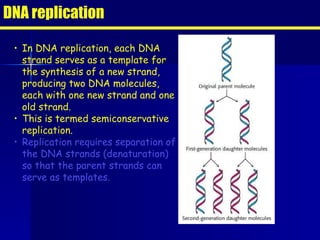
DNA replication In DNA replication, each DNA strand serves as a template for the synthesis of a new strand, producing two DNA molecules, each with one new strand and one old strand. This is termed semiconservative replication. Replication requires separation of the DNA strands (denaturation) so that the parent strands can serve as templates.
Denaturation and annealing DNA denaturation is reversible. The formation of double helical DNA from denatured DNA is called annealing. Lowering the temperature below T m  (given the right pH, ionic strength, etc.) will allow annealing.
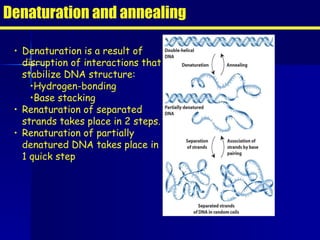
Denaturation and annealing Denaturation is a result of  disruption of interactions that stabilize DNA structure: Hydrogen-bonding Base stacking Renaturation of separated strands takes place in 2 steps. Renaturation of partially denatured DNA takes place in 1 quick step
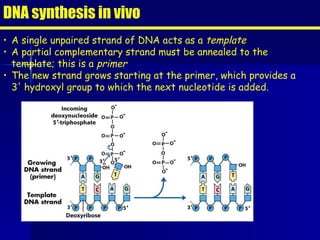
DNA synthesis in vivo A single unpaired strand of DNA acts as a  template A partial complementary strand must be annealed to the template; this is a  primer The new strand grows starting at the primer, which provides a 3' hydroxyl group to which the next nucleotide is added.
DNA synthesis in vivo The key reaction is a phosphoryl group transfer The 3' hydroxyl of the nucleotide at the 3' end of the growing strand is the nucleophile Nucleophilic attack occurs at the    phosphorous of an incoming deoxynucleoside 5'-triphosphate. Pyrophosphate is the leaving group.
Addition of a nucleotide Note the nucleophile and leaving group.  What kind of nucleic acid is being synthesize here?
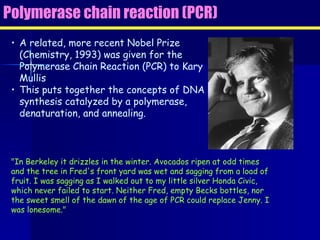
Polymerase chain reaction (PCR) A related, more recent Nobel Prize (Chemistry, 1993) was given for the Polymerase Chain Reaction (PCR) to Kary Mullis This puts together the concepts of DNA synthesis catalyzed by a polymerase, denaturation, and annealing. "In Berkeley it drizzles in the winter. Avocados ripen at odd times and the tree in Fred's front yard was wet and sagging from a load of fruit. I was sagging as I walked out to my little silver Honda Civic, which never failed to start. Neither Fred, empty Becks bottles, nor the sweet smell of the dawn of the age of PCR could replace Jenny. I was lonesome."
Advances due to PCR Generate very large quantities of specific DNA sequences, aiding in cloning  Genomic sequencing DNA “fingerprinting”--forensic science Disease diagnosis Paternity determination Don’t forget cloning dinosaurs  ( Jurassic Park )   Many more to come….
PCR PCR is a technique that takes a specific  sequence of DNA of small amounts and  amplifies it to be used for further testing.
Outline 1.  DNA   2.  PCR Targets   Denaturing Primers Annealing Cycles   Requirements
Targets The targets in PCR are the sequences of DNA on each end of the region of interest, which  can be a complete gene or small sequence.
Targets The number of bases in the targets can vary. TT AA GG C T C G A  . . . .  AA TT GG TT AA The  . . . .  Represents the middle DNA sequence, and does not have to be known to replicate it.
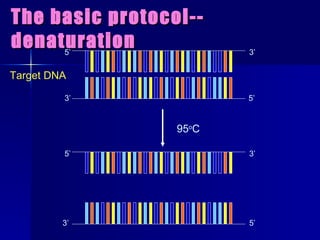
Denaturing Denaturing is the first step in PCR,  in which the DNA strands are separated  by heating to  95°C.
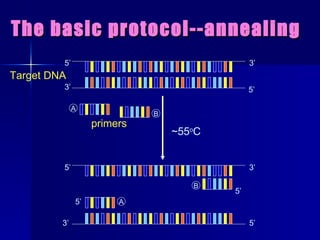
Primers Primers range from 15 to 30 nucleotides,  are single-stranded, and are used for the complementary building blocks of the target sequence.
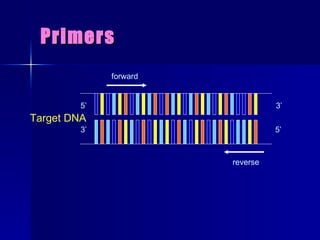
Primers  A primer for each target sequence on  the end of your DNA is needed.  This allows both strands to be copied simultaneously in both directions.
Primers TT AA C GG CC TT AA  . . .  TTT AAA CC GG TT AA TT G CC GG AA TT  . . . . . . . . . .> and <. . . . . . . . . .  AAA TTT GG CC AA TT AA C GG CC TT AA  . . .  TTT AAA CC GG TT
Primers Target DNA 5’ 3’ 3’ 5’ forward reverse
Primers Usually about 20 nucleotides in length Designed to flank the region to be amplified Melting point determined by G-C and A-T content T m  = 4 o C (G+C) + 2 o C (A+T) Ex: a primer with 10 G/C and 10 A/T would have a T m  of 60 o C  4(10) + 2(10)=60 o C Target DNA 5’ 3’ 3’ 5’
PCR Primers The primers are added in excess so they  will bind to the target DNA, instead of the  two strands binding back to each other.
PCR Annealing  Annealing is the process of allowing two  sequences of DNA to form hydrogen bonds. The annealing of the target sequences and primers is done by cooling the DNA to 55°C.
PCR Taq DNA Polymerase T aq  stands for  Thermus aquaticus , which is a microbe found in 176°F hot  springs in Yellow Stone National Forest.
PCR Taq DNA Polymerase T aq   produces an enzyme called DNA polymerase, that amplifies the DNA  from the  primers by the polymerase chain  reaction, in  the presence of Mg.
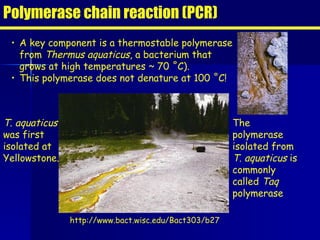
Polymerase chain reaction (PCR) A key component is a thermostable polymerase from  Thermus aquaticus , a bacterium that grows at high temperatures ~ 70 ˚C). This polymerase does not denature at 100 ˚C! http://www.bact.wisc.edu/Bact303/b27 T. aquaticus  was first isolated at Yellowstone. The polymerase isolated from  T. aquaticus  is commonly called  Taq  polymerase
DNA (purified or a crude extract) Primers specific for the target DNA Free nucleotides (A, G, T, C) DNA polymerase Buffer (containing magnesium) The reaction mixture
The basic protocol—what’s in the tube Target DNA 5’ 3’ 3’ 5’ primers A B Free nucleotides Taq  DNA polymerase Mg 2+ Mg 2+ Mg 2+ Mg 2+ Mg 2+ Mg 2+ Buffer containing magnesium
The basic protocol--denaturation Target DNA 95 o C 5’ 3’ 3’ 5’ 5’ 3’ 3’ 5’
The basic protocol--annealing ~55 o C 5’ 3’ 3’ 5’ 5’ 3’ 3’ 5’ 5’ 5’ Target DNA A B primers A B
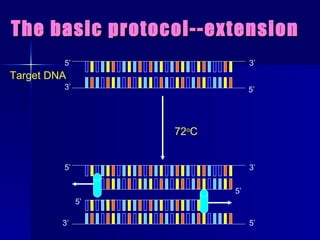
The basic protocol--extension 72 o C 5’ 3’ 3’ 5’ 5’ 3’ 3’ 5’ 5’ 5’ Target DNA Taq  polymerase
The basic protocol--extension 72 o C 5’ 3’ 3’ 5’ 5’ 3’ 3’ 5’ 5’ 5’ Target DNA
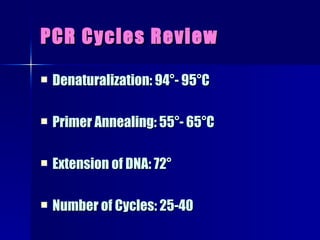
PCR Cycles Review Denaturalization: 94°- 95°C Primer Annealing: 55°- 65°C Extension of DNA: 72° Number of Cycles: 25-40
One  One billion in about 2 hours! At the end of each cycle, the amount of DNA has doubled By the end of 30 cycles, you will have about 1 billion molecules from the original one you started with!! 2 30 =1,073,741,824
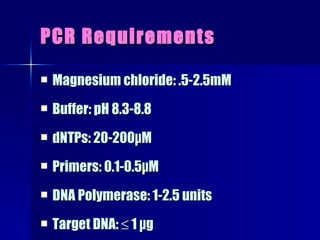
PCR Requirements Magnesium chloride: .5-2.5mM Buffer: pH 8.3-8.8 dNTPs: 20-200µM Primers: 0.1-0.5µM DNA Polymerase: 1-2.5 units Target DNA:    1 µg
The PCR machine Very rapidly changes the temperature between the various stages of the PCR process Programmable for use with many different cycling parameters
Applications of PCR Neisseria gonorrhea Chlamydia trachomatis HIV-1 Factor V Leiden Forensic testing and many others
Applications of PCR Neisseria gonorrhea and Chlamydia trachomatis are two of the most common sexually transmitted diseases.  The infections are asymptomatic and can lead to pelvic inflammatory disease, salpingitis in women, epididymitis in men, infertility, and ectopic pregnancy.
Applications of PCR Specimens include endocervical swabs,urethral swabs, and urine samples. The swabs are placed in a vial with transport buffer containing    50mM MgCL2 and sodium azide as a preservative.
Applications of PCR The swab specimens can be stored 2-30°C for 4 days or frozen at -20°C. The urine samples are refrigerated at 2-8°C or stored at -20°C. A target sequence is chosen for both, amplified with polymerase, and then evaluated with an enzyme immunoassay.
Applications of PCR HIV-1 and Factor V Leiden also have a specific target sequence amplified, and then quantitated by using a microwell probe, horse-radish peroxidase enzyme, and chromogen substrate.
Applications of PCR The HIV-1 test is used as a monitor of the severity of the virus.  The HIV-1 causes a depletion of CD4+ T lymphocytes, causing immunodeficiency, multiple opportunistic infections, malignancies, and death.
Applications of PCR The HIV-1 specimen is plasma collected in EDTA that must be separated from the cells within 6 hours. Heparin cannot be used as an anticoagulant because it inhibits PCR.
Applications of PCR A 142 base target sequence in the HIV-1 gag gene is converted from RNA to complementary DNA, and to double stranded DNA using Thermus thermophilus DNA polymerase in the presence of manganese and buffers, which performs the reverse transcription and the amplification steps simultaneously.
Applications of PCR The standard specimen procedure can quantitate HIV-1 RNA in a range of 400-75,000 copies/mL.
Applications of PCR Factor V Leiden is the Factor V in the coagulation cascade. Factor V is a genetic point mutation that causes increased risk of life-threatening blood clots. The mutation causes the Factor V molecule to be unresponsive to the natural anti-coagulant protein C.
Applications of PCR Factor V Leiden shifts the patient’s hemostatic balance to thrombosis. Factor V mutation gives an increase risk of venous thrombosis in a homozygous person, during pregnancy, surgery, or while using oral contraceptives.
Applications of PCR Thrombosis - is the development of a blood clot that occurs in 20-40% of patients with venous thrombosis. Thrombophilia - a tendency towards clotting that occurs in 40-65% of adults with unexplained thrombophilia. Protein C - a naturally occurring anti- coagulant that occurs in 95-100% of people with activated protein C resistance.
Application of PCR Treatment for patients with Factor V Leiden mutations are to give lifelong coumadin. Women with the mutation should not take oral contraceptives, and they have increased risk of thrombosis during pregnancy.
Applications of PCR PCR can also be used in forensic testing. The DNA sequences used are of short repeating patterns called VNTR (variable number of tandem repeat), which can range from 4 to 40 nucleotides in different individuals.
Applications of PCR One set of VNTR locus are inherited from the mother and one set from the father. The genes are amplified using PCR, and then run through electrophoresis. The position of the two bands on the electrophoresis gel depends on the exact number of repeats at the locus.
VARIATIONS OF PCR Allele specific PCR Assembly PCR Asymmetric PCR Helicase dependent Amplification Hot start PCR Inter sequence-specific PCR Inverse PCR
VARIATIONS OF PCR Ligation mediated PCR Methylation-specific PCR MIniprimer PCR Multiplex ligation-dependent probe amplification Multiplex PCR Nested PCR Overlap extension PCR
VARIATIONS OF PCR Quantitative PCR RT-PCR Solid phase PCR Thermal asymmetric integrated PCR Touchdown PCR PAN-AC Universal fast walking
Conclusion PCR is not only vital in the clinical laboratory by amplifying small amounts of DNA for STD detection, but it is also important for genetic predisposing for defects such as Factor V Leiden.  The PCR technology can also be employed in law enforcement, genetic testing of animal stocks and vegetable hybrids, and drug screening along with many more areas.
THANK YOU

Dwd pcr

  • 1.
  • 2.
  • 3.
    DNA Example ofbonding pattern. Primary strand CC G AA T GGG A T G C GG C TT A CCC T A C G Complementary strand
  • 4.
    Nucleotides and nucleicacids Nucleotides are the building blocks of nucleic acids Nucleotide DNA RNA
  • 5.
    Roles of nucleicacids Genes consist of DNA Genes hold the information needed to synthesize the functional proteins and RNAs needed by an organism. DNA also plays a role in regulating gene expression RNA serves a number of roles: Messenger: mRNA moves genetic information from DNA to the ribosome Translator: tRNA translates the mRNA message into an amino acid sequence at the ribosome Translator/protein synthesis: ribosomes contain rRNA (as well as proteins) and rRNA forms the active site for protein synthesis
  • 6.
    DNA synthesis invivo This reaction is catalyzed by the enzyme DNA polymerase. DNA polymerase was first purified and characterized by Arthur Kornberg and coworkers. For this he was awarded the 1959 Nobel Prize in medicine. He received his M.D. from the University of Rochester in 1941.
  • 7.
    DNA replication InDNA replication, each DNA strand serves as a template for the synthesis of a new strand, producing two DNA molecules, each with one new strand and one old strand. This is termed semiconservative replication. Replication requires separation of the DNA strands (denaturation) so that the parent strands can serve as templates.
  • 8.
    DNA replication InDNA replication, each DNA strand serves as a template for the synthesis of a new strand, producing two DNA molecules, each with one new strand and one old strand. This is termed semiconservative replication. Replication requires separation of the DNA strands (denaturation) so that the parent strands can serve as templates.
  • 9.
    Denaturation and annealingDNA denaturation is reversible. The formation of double helical DNA from denatured DNA is called annealing. Lowering the temperature below T m (given the right pH, ionic strength, etc.) will allow annealing.
  • 10.
    Denaturation and annealingDenaturation is a result of disruption of interactions that stabilize DNA structure: Hydrogen-bonding Base stacking Renaturation of separated strands takes place in 2 steps. Renaturation of partially denatured DNA takes place in 1 quick step
  • 11.
    DNA synthesis invivo A single unpaired strand of DNA acts as a template A partial complementary strand must be annealed to the template; this is a primer The new strand grows starting at the primer, which provides a 3' hydroxyl group to which the next nucleotide is added.
  • 12.
    DNA synthesis invivo The key reaction is a phosphoryl group transfer The 3' hydroxyl of the nucleotide at the 3' end of the growing strand is the nucleophile Nucleophilic attack occurs at the  phosphorous of an incoming deoxynucleoside 5'-triphosphate. Pyrophosphate is the leaving group.
  • 13.
    Addition of anucleotide Note the nucleophile and leaving group. What kind of nucleic acid is being synthesize here?
  • 14.
    Polymerase chain reaction(PCR) A related, more recent Nobel Prize (Chemistry, 1993) was given for the Polymerase Chain Reaction (PCR) to Kary Mullis This puts together the concepts of DNA synthesis catalyzed by a polymerase, denaturation, and annealing. &quot;In Berkeley it drizzles in the winter. Avocados ripen at odd times and the tree in Fred's front yard was wet and sagging from a load of fruit. I was sagging as I walked out to my little silver Honda Civic, which never failed to start. Neither Fred, empty Becks bottles, nor the sweet smell of the dawn of the age of PCR could replace Jenny. I was lonesome.&quot;
  • 15.
    Advances due toPCR Generate very large quantities of specific DNA sequences, aiding in cloning Genomic sequencing DNA “fingerprinting”--forensic science Disease diagnosis Paternity determination Don’t forget cloning dinosaurs ( Jurassic Park )  Many more to come….
  • 16.
    PCR PCR isa technique that takes a specific sequence of DNA of small amounts and amplifies it to be used for further testing.
  • 17.
    Outline 1. DNA 2. PCR Targets Denaturing Primers Annealing Cycles Requirements
  • 18.
    Targets The targetsin PCR are the sequences of DNA on each end of the region of interest, which can be a complete gene or small sequence.
  • 19.
    Targets The numberof bases in the targets can vary. TT AA GG C T C G A . . . . AA TT GG TT AA The . . . . Represents the middle DNA sequence, and does not have to be known to replicate it.
  • 20.
    Denaturing Denaturing isthe first step in PCR, in which the DNA strands are separated by heating to 95°C.
  • 21.
    Primers Primers rangefrom 15 to 30 nucleotides, are single-stranded, and are used for the complementary building blocks of the target sequence.
  • 22.
    Primers Aprimer for each target sequence on the end of your DNA is needed. This allows both strands to be copied simultaneously in both directions.
  • 23.
    Primers TT AAC GG CC TT AA . . . TTT AAA CC GG TT AA TT G CC GG AA TT . . . . . . . . . .> and <. . . . . . . . . . AAA TTT GG CC AA TT AA C GG CC TT AA . . . TTT AAA CC GG TT
  • 24.
    Primers Target DNA5’ 3’ 3’ 5’ forward reverse
  • 25.
    Primers Usually about20 nucleotides in length Designed to flank the region to be amplified Melting point determined by G-C and A-T content T m = 4 o C (G+C) + 2 o C (A+T) Ex: a primer with 10 G/C and 10 A/T would have a T m of 60 o C 4(10) + 2(10)=60 o C Target DNA 5’ 3’ 3’ 5’
  • 26.
    PCR Primers Theprimers are added in excess so they will bind to the target DNA, instead of the two strands binding back to each other.
  • 27.
    PCR Annealing Annealing is the process of allowing two sequences of DNA to form hydrogen bonds. The annealing of the target sequences and primers is done by cooling the DNA to 55°C.
  • 28.
    PCR Taq DNAPolymerase T aq stands for Thermus aquaticus , which is a microbe found in 176°F hot springs in Yellow Stone National Forest.
  • 29.
    PCR Taq DNAPolymerase T aq produces an enzyme called DNA polymerase, that amplifies the DNA from the primers by the polymerase chain reaction, in the presence of Mg.
  • 30.
    Polymerase chain reaction(PCR) A key component is a thermostable polymerase from Thermus aquaticus , a bacterium that grows at high temperatures ~ 70 ˚C). This polymerase does not denature at 100 ˚C! http://www.bact.wisc.edu/Bact303/b27 T. aquaticus was first isolated at Yellowstone. The polymerase isolated from T. aquaticus is commonly called Taq polymerase
  • 31.
    DNA (purified ora crude extract) Primers specific for the target DNA Free nucleotides (A, G, T, C) DNA polymerase Buffer (containing magnesium) The reaction mixture
  • 32.
    The basic protocol—what’sin the tube Target DNA 5’ 3’ 3’ 5’ primers A B Free nucleotides Taq DNA polymerase Mg 2+ Mg 2+ Mg 2+ Mg 2+ Mg 2+ Mg 2+ Buffer containing magnesium
  • 33.
    The basic protocol--denaturationTarget DNA 95 o C 5’ 3’ 3’ 5’ 5’ 3’ 3’ 5’
  • 34.
    The basic protocol--annealing~55 o C 5’ 3’ 3’ 5’ 5’ 3’ 3’ 5’ 5’ 5’ Target DNA A B primers A B
  • 35.
    The basic protocol--extension72 o C 5’ 3’ 3’ 5’ 5’ 3’ 3’ 5’ 5’ 5’ Target DNA Taq polymerase
  • 36.
    The basic protocol--extension72 o C 5’ 3’ 3’ 5’ 5’ 3’ 3’ 5’ 5’ 5’ Target DNA
  • 37.
    PCR Cycles ReviewDenaturalization: 94°- 95°C Primer Annealing: 55°- 65°C Extension of DNA: 72° Number of Cycles: 25-40
  • 38.
    One Onebillion in about 2 hours! At the end of each cycle, the amount of DNA has doubled By the end of 30 cycles, you will have about 1 billion molecules from the original one you started with!! 2 30 =1,073,741,824
  • 39.
    PCR Requirements Magnesiumchloride: .5-2.5mM Buffer: pH 8.3-8.8 dNTPs: 20-200µM Primers: 0.1-0.5µM DNA Polymerase: 1-2.5 units Target DNA:  1 µg
  • 40.
    The PCR machineVery rapidly changes the temperature between the various stages of the PCR process Programmable for use with many different cycling parameters
  • 41.
    Applications of PCRNeisseria gonorrhea Chlamydia trachomatis HIV-1 Factor V Leiden Forensic testing and many others
  • 42.
    Applications of PCRNeisseria gonorrhea and Chlamydia trachomatis are two of the most common sexually transmitted diseases. The infections are asymptomatic and can lead to pelvic inflammatory disease, salpingitis in women, epididymitis in men, infertility, and ectopic pregnancy.
  • 43.
    Applications of PCRSpecimens include endocervical swabs,urethral swabs, and urine samples. The swabs are placed in a vial with transport buffer containing  50mM MgCL2 and sodium azide as a preservative.
  • 44.
    Applications of PCRThe swab specimens can be stored 2-30°C for 4 days or frozen at -20°C. The urine samples are refrigerated at 2-8°C or stored at -20°C. A target sequence is chosen for both, amplified with polymerase, and then evaluated with an enzyme immunoassay.
  • 45.
    Applications of PCRHIV-1 and Factor V Leiden also have a specific target sequence amplified, and then quantitated by using a microwell probe, horse-radish peroxidase enzyme, and chromogen substrate.
  • 46.
    Applications of PCRThe HIV-1 test is used as a monitor of the severity of the virus. The HIV-1 causes a depletion of CD4+ T lymphocytes, causing immunodeficiency, multiple opportunistic infections, malignancies, and death.
  • 47.
    Applications of PCRThe HIV-1 specimen is plasma collected in EDTA that must be separated from the cells within 6 hours. Heparin cannot be used as an anticoagulant because it inhibits PCR.
  • 48.
    Applications of PCRA 142 base target sequence in the HIV-1 gag gene is converted from RNA to complementary DNA, and to double stranded DNA using Thermus thermophilus DNA polymerase in the presence of manganese and buffers, which performs the reverse transcription and the amplification steps simultaneously.
  • 49.
    Applications of PCRThe standard specimen procedure can quantitate HIV-1 RNA in a range of 400-75,000 copies/mL.
  • 50.
    Applications of PCRFactor V Leiden is the Factor V in the coagulation cascade. Factor V is a genetic point mutation that causes increased risk of life-threatening blood clots. The mutation causes the Factor V molecule to be unresponsive to the natural anti-coagulant protein C.
  • 51.
    Applications of PCRFactor V Leiden shifts the patient’s hemostatic balance to thrombosis. Factor V mutation gives an increase risk of venous thrombosis in a homozygous person, during pregnancy, surgery, or while using oral contraceptives.
  • 52.
    Applications of PCRThrombosis - is the development of a blood clot that occurs in 20-40% of patients with venous thrombosis. Thrombophilia - a tendency towards clotting that occurs in 40-65% of adults with unexplained thrombophilia. Protein C - a naturally occurring anti- coagulant that occurs in 95-100% of people with activated protein C resistance.
  • 53.
    Application of PCRTreatment for patients with Factor V Leiden mutations are to give lifelong coumadin. Women with the mutation should not take oral contraceptives, and they have increased risk of thrombosis during pregnancy.
  • 54.
    Applications of PCRPCR can also be used in forensic testing. The DNA sequences used are of short repeating patterns called VNTR (variable number of tandem repeat), which can range from 4 to 40 nucleotides in different individuals.
  • 55.
    Applications of PCROne set of VNTR locus are inherited from the mother and one set from the father. The genes are amplified using PCR, and then run through electrophoresis. The position of the two bands on the electrophoresis gel depends on the exact number of repeats at the locus.
  • 56.
    VARIATIONS OF PCRAllele specific PCR Assembly PCR Asymmetric PCR Helicase dependent Amplification Hot start PCR Inter sequence-specific PCR Inverse PCR
  • 57.
    VARIATIONS OF PCRLigation mediated PCR Methylation-specific PCR MIniprimer PCR Multiplex ligation-dependent probe amplification Multiplex PCR Nested PCR Overlap extension PCR
  • 58.
    VARIATIONS OF PCRQuantitative PCR RT-PCR Solid phase PCR Thermal asymmetric integrated PCR Touchdown PCR PAN-AC Universal fast walking
  • 59.
    Conclusion PCR isnot only vital in the clinical laboratory by amplifying small amounts of DNA for STD detection, but it is also important for genetic predisposing for defects such as Factor V Leiden. The PCR technology can also be employed in law enforcement, genetic testing of animal stocks and vegetable hybrids, and drug screening along with many more areas.
  • 60.