NUCLEIC ACIDS
Chasama Costantine, MD
Introduction
• Discovered in 1869 by a Swiss physiologist Johan
Friedrich Miescher while studying the nuclei of
white blood cells.
– Thus called Nucleic acids.
• However it is now known that nucleic acids are
found throughout a cell, not just in the nucleus.
• They serve as the repository and transmitter of
genetic information in every cell and organism.
• Due to their ability of self replication
Definition
• Nucleic Acids
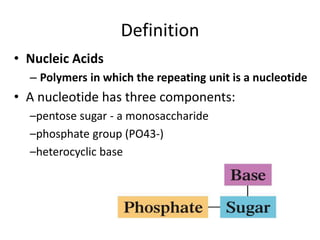
– Polymers in which the repeating unit is a nucleotide
• A nucleotide has three components:
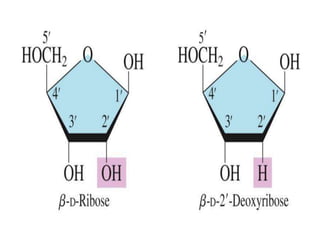
–pentose sugar - a monosaccharide
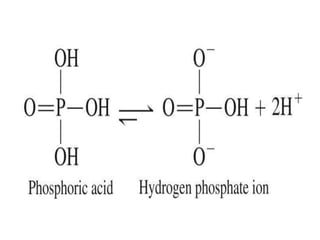
–phosphate group (PO43-)
–heterocyclic base
Two types of Nucleic Acids:
• DNA: Deoxyribonucleic Acid:
– Found within cell nucleus
– The pentose sugar is a Deoxyribose
– Storage and transfer of genetic information
– Passed from one cell to other during cell division
• RNA: Ribonucleic Acid:
– Occurs in all parts of cell
– The pentose sugar is Ribose
– Primary function is to synthesize proteins
Nitrogenous bases
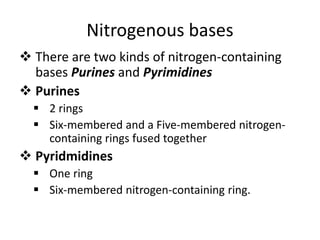
 There are two kinds of nitrogen-containing
bases Purines and Pyrimidines
 Purines
 2 rings
 Six-membered and a Five-membered nitrogen-
containing rings fused together
 Pyridmidines
 One ring
 Six-membered nitrogen-containing ring.
Purines
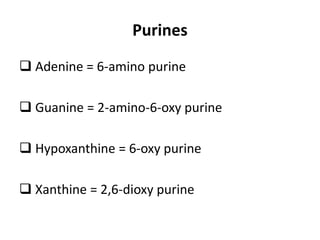
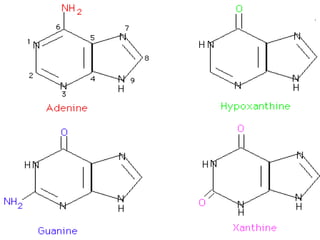
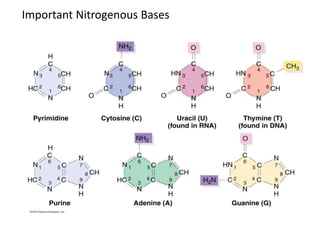
 Adenine = 6-amino purine
 Guanine = 2-amino-6-oxy purine
 Hypoxanthine = 6-oxy purine
 Xanthine = 2,6-dioxy purine
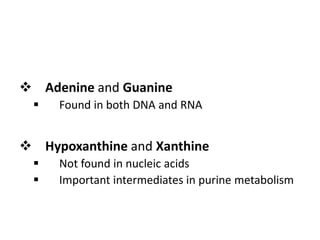
 Adenine and Guanine
 Found in both DNA and RNA
 Hypoxanthine and Xanthine
 Not found in nucleic acids
 Important intermediates in purine metabolism
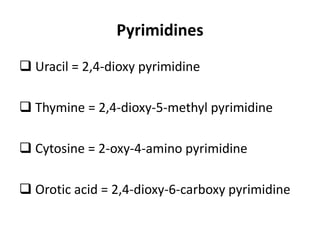
Pyrimidines
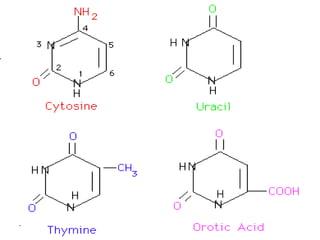
 Uracil = 2,4-dioxy pyrimidine
 Thymine = 2,4-dioxy-5-methyl pyrimidine
 Cytosine = 2-oxy-4-amino pyrimidine
 Orotic acid = 2,4-dioxy-6-carboxy pyrimidine
pyrimidines
 Cytosine is found in both DNA and RNA
 Uracil is found only in RNA
 Thymine is normally found in DNA and not in
RNA
 Sometimes tRNA may contain some Thymine as
well as Uracil
Important Nitrogenous Bases
Nucleotide formation
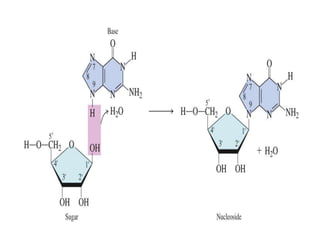
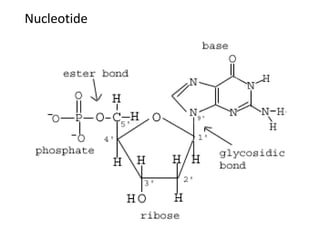
Step 1- Nucleoside formation:
– Condensation reaction between a five-carbon
monosaccharide and a purine or pyrimidine base
derivative.
– The N9 of a purine or N1 of a pyrimidine base is
attached to C1’ position of sugar (beta-
conformation) in an N-C-glycosidic linkage
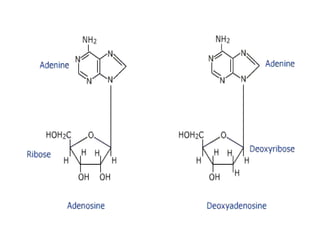
 Nucleoside nomenclature:
– For pyrimidine bases
• suffix -idine is used (cytidine, thymidine, uridine)
– For purine bases
• suffix -osine is used (adenosine, guanosine)
– prefix “-deoxy” is used to indicate deoxyribose
present (e.g: deoxythymidine )
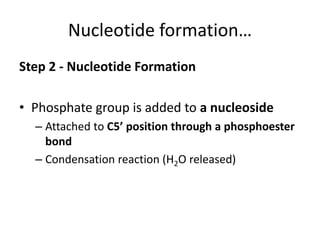
Nucleotide formation…
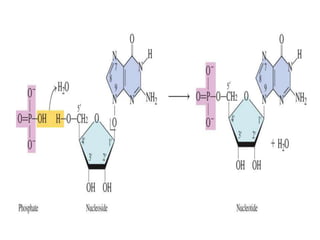
Step 2 - Nucleotide Formation
• Phosphate group is added to a nucleoside
– Attached to C5’ position through a phosphoester
bond
– Condensation reaction (H2O released)
Nucleotide
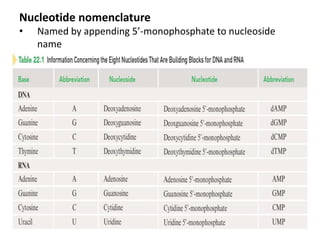
Nucleotide nomenclature
• Named by appending 5’-monophosphate to nucleoside
name
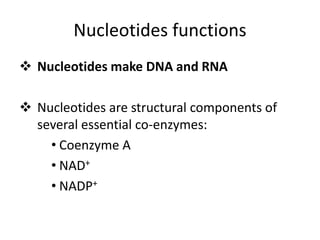
Nucleotides functions
 Nucleotides make DNA and RNA
 Nucleotides are structural components of
several essential co-enzymes:
• Coenzyme A
• NAD+
• NADP+
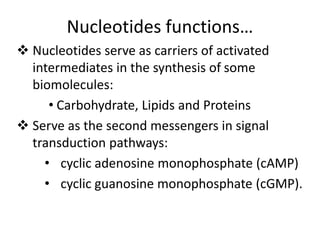
Nucleotides functions…
 Nucleotides serve as carriers of activated
intermediates in the synthesis of some
biomolecules:
• Carbohydrate, Lipids and Proteins
 Serve as the second messengers in signal
transduction pathways:
• cyclic adenosine monophosphate (cAMP)
• cyclic guanosine monophosphate (cGMP).
Nucleotide functions…
 Nucleotide plays an important role as Energy
currency in the cell
• ATP, GTP
 Nucleotides are important regulatory
compounds for many of the pathways of
intermediary metabolism, inhibiting or
activating key enzymes
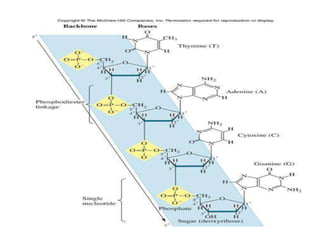
Polynucleotide formation
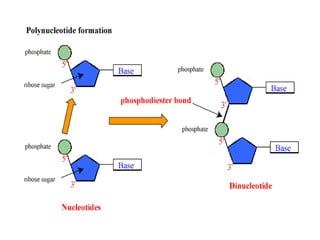
 The nucleotides of a polynucleotide chain are
linked to one another in 3’,5’-phosphodiester
bonds
 Phosphoric acid forms a phosphate ester to
connect the 3’-hydroxyl group of one pentose
to the 5’-carbon on another pentose
 Sugar-phosphate groups are referred to as
nucleic acid backbone
• This backbone is found in all nucleic acids
• Sugars are different in DNA and RNA
 5’ end has free phosphate group and 3’ end
has a free OH group
 The sequence of bases is read from 5’ to 3’
 The next nucleotide binds at the 3’ end
DNA
• It is the chemical basis of heredity and may be
regarded as the reserve bank of genetic
inforormation.
• The genetic information is encoded in its
primary structure (nucleotide sequence)
• It controls every aspect of cellular function
DNA…
• DNA is organized into genes, the fundamental
units of genetic information.
• Gene is a segment of DNA which specifies the
chain of amino acids that comprises the
protein molecule
– Most human genes are ~1000–3500 nucleotide
units long
• Genome:
– All of the genetic material (the total DNA)
contained in the chromosomes of an organism
– Human genome is about 20,000–25,000 genes
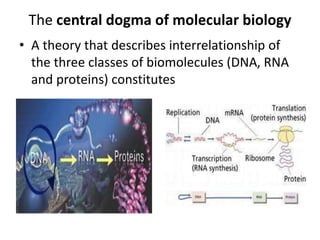
The central dogma of molecular biology
• A theory that describes interrelationship of
the three classes of biomolecules (DNA, RNA
and proteins) constitutes
 A DNA molecule must comprise many
nucleotides to carry the genetic information
necessary for even the simplest organisms
 E.g., the RNA of a virus such as HIV, which
causes AIDS, is 9719 nucleotides in length
 The E. coli genome is a single DNA molecule
consisting of 4.6 million nucleotides( 4.6 x 10⁶
base pairs =4.6 x 10³ kilo base pairs) kbp
DNA molecules from higher organisms can be
much larger
The human genome comprises of 3 billion
nucleotides [3 x 10⁹], divided among 23 distinct
DNA molecules (chromosomes) of different
sizes.
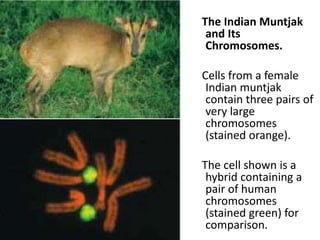
One of the largest known DNA molecules is
found in the Indian muntjak, an Asiatic deer; its
genome is nearly as large as the human genome
but is distributed on only 3 chromosomes
The Indian Muntjak
and Its
Chromosomes.
Cells from a female
Indian muntjak
contain three pairs of
very large
chromosomes
(stained orange).
The cell shown is a
hybrid containing a
pair of human
chromosomes
(stained green) for
comparison.
DNA structure
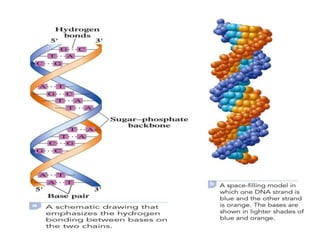
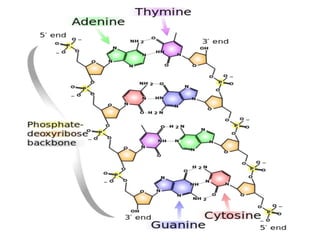
 DNA structure is a double helix whose chains
are complementary and antiparallel
o 1953, Watson & Crick- x-ray diffraction
 Complementary
–A binds to T and C to G between the chains
–The sequence of bases on one strand
automatically determines the sequence of
bases on the other
 Antiparallel
– Each end of the helix contains the 5’ end of one
strand and the 3’ end of the other.
• The chains travel in opposite directions
• This allows for formation of H-bonds
between base pairs
Forces in DNA Double Helix
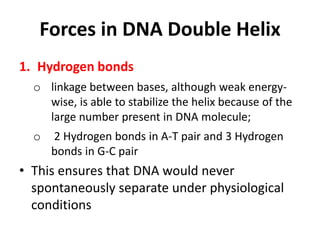
1. Hydrogen bonds
o linkage between bases, although weak energy-
wise, is able to stabilize the helix because of the
large number present in DNA molecule;
o 2 Hydrogen bonds in A-T pair and 3 Hydrogen
bonds in G-C pair
• This ensures that DNA would never
spontaneously separate under physiological
conditions
 Chargaff’s rule of base pairing
 Molar equivalence between the purines
and pyrimidines in DNA (A=T and GΞC)
• %A = %T and %C = %G
• Human DNA contains 30% adenine,
30% thymine, 20% guanine and 20%
cytosine
Forces in DNA Double Helix…
2. Stacking interactions
o Also known as Van der Waals interactions
o Also occur between bases and are weak,
o The large amounts of these interactions
help to stabilize the overall structure of the
helix.
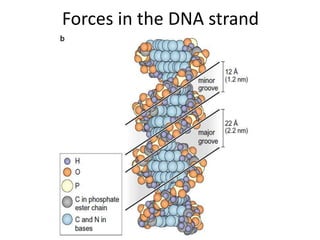
Forces in the DNA strand
Significance of complementary base
pairing
• Complementary base pairing is very
important in the conservation of the base
sequence of DNA.
• Each strand of DNA can act as a template
to direct the synthesis of another strand
similar to its complementary one and thus
DNA is capable of directing its own self
replication.
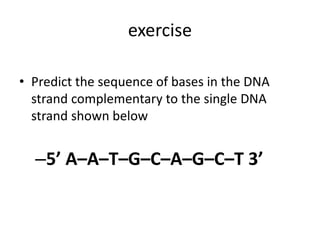
exercise
• Predict the sequence of bases in the DNA
strand complementary to the single DNA
strand shown below
–5’ A–A–T–G–C–A–G–C–T 3’
The Watson and Crick Model of DNA
• Named after American Biologist James
Watson and English Physicist Francis Crick.
• B DNA was the form upon which the model
is derived. DNA occurs primarily in this form
in vivo
• The important features of this model of DNA
are:
Features of the Watson and Crick DNA
model
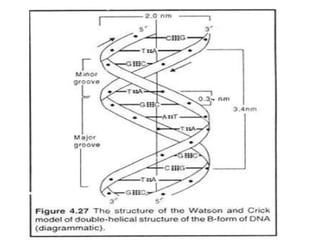
 The DNA molecule consists of two helical
polynucleotide chains or strands coiled
around a common axis.
 The two strands are antiparallel in polarity;
they run in opposite directions so that the 3’
end of one chain faces the 5’ end of the
other
 The purine and pyrimidine bases are inside
the helix, whereas the phosphate and
deoxyribose(sugar) backbones are on the
outside.
 The two chains are held together by
hydrogen bonds between (the purine and
pyrimidine) pairs of bases of the opposite
strands
 Adenine (A) always pairs with thymine (T) by
two hydrogen bonds and Guanine (G) always
pairs with cytosine (C) by three hydrogen
bonds.
 This complementarity is known as the base
pairing rule.
 Thus the two strands are complementary to
one another.
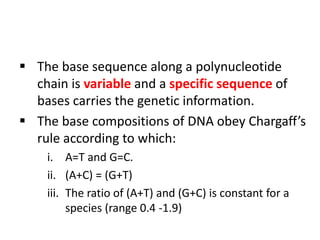
 The base sequence along a polynucleotide
chain is variable and a specific sequence of
bases carries the genetic information.
 The base compositions of DNA obey Chargaff’s
rule according to which:
i. A=T and G=C.
ii. (A+C) = (G+T)
iii. The ratio of (A+T) and (G+C) is constant for a
species (range 0.4 -1.9)
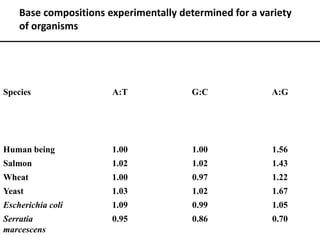
Base compositions experimentally determined for a variety
of organisms
Species A:T G:C A:G
Human being 1.00 1.00 1.56
Salmon 1.02 1.02 1.43
Wheat 1.00 0.97 1.22
Yeast 1.03 1.02 1.67
Escherichia coli 1.09 0.99 1.05
Serratia
marcescens
0.95 0.86 0.70
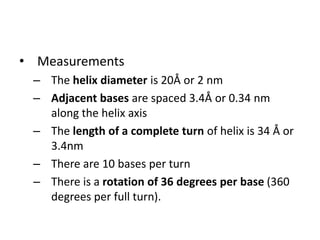
• Measurements
– The helix diameter is 20Å or 2 nm
– Adjacent bases are spaced 3.4Å or 0.34 nm
along the helix axis
– The length of a complete turn of helix is 34 Å or
3.4nm
– There are 10 bases per turn
– There is a rotation of 36 degrees per base (360
degrees per full turn).
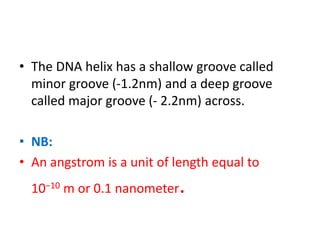
• The DNA helix has a shallow groove called
minor groove (-1.2nm) and a deep groove
called major groove (- 2.2nm) across.
• NB:
• An angstrom is a unit of length equal to
10−10 m or 0.1 nanometer.
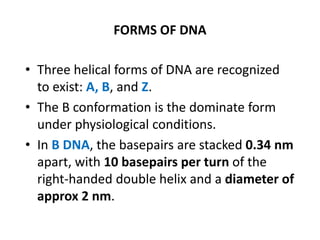
FORMS OF DNA
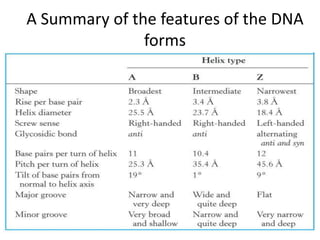
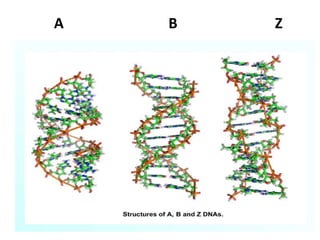
• Three helical forms of DNA are recognized
to exist: A, B, and Z.
• The B conformation is the dominate form
under physiological conditions.
• In B DNA, the basepairs are stacked 0.34 nm
apart, with 10 basepairs per turn of the
right-handed double helix and a diameter of
approx 2 nm.
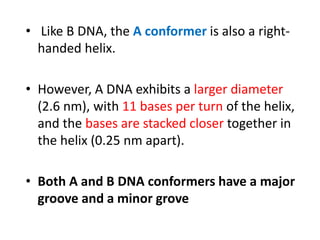
• Like B DNA, the A conformer is also a right-
handed helix.
• However, A DNA exhibits a larger diameter
(2.6 nm), with 11 bases per turn of the helix,
and the bases are stacked closer together in
the helix (0.25 nm apart).
• Both A and B DNA conformers have a major
groove and a minor grove
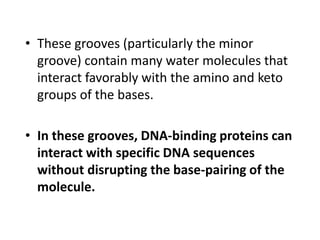
• These grooves (particularly the minor
groove) contain many water molecules that
interact favorably with the amino and keto
groups of the bases.
• In these grooves, DNA-binding proteins can
interact with specific DNA sequences
without disrupting the base-pairing of the
molecule.
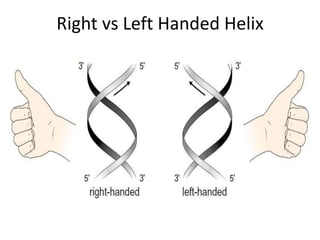
• In contrast to the A and B conformers of
DNA, Z DNA is a left handed helix.
• This form of DNA has been observed
primarily in synthetic double-stranded
oligonucleotides, especially those with
purine and pyrimidines alternating in the
polynucleotide strands.
• In addition, high salt concentrations are
required for the maintenance of the Z DNA
conformer.
• Z DNA possesses a minor groove but no
major groove, and the minor groove is
sufficiently deep that it reaches the axis of
the DNA helix.
• The natural occurrence and potential
physiological significance of Z DNA in living
cells has been the subject of much
speculation.
• However, these issues with respect to Z DNA
have not yet been fully resolved.
Right vs Left Handed Helix
A Summary of the features of the DNA
forms
A B Z
Denaturation of DNA
• The loss of helical structure due to disruption
of H–bonds is called denaturation or melting,
where the double strands separate into single
strands.
• This can be due to extremes of pH, heat, or
chemicals that disrupt H-bonds.
• DNAs which are G-C rich denature at a higher
temperature (Tm) than those which are A-T
rich
Types of DNA sequences:
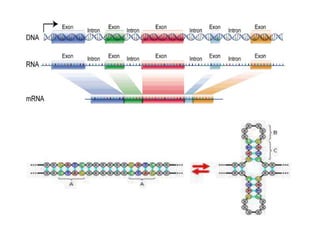
• Exons
– The coding sequences; interrupted by noncoding
sequences
• Introns
– The noncoding sequences; from 10 to 10,000 bases
long
• Palindrome
– Also known as inverted repeats
– DNA sequence that contains the same information
whether it is read forward or backward; e.g. CGAAGC
– Tendency to form hairpin loops and a snapback
(cruciform)
RNA
• Like DNA, RNA is composed of repeating
purine and pyrimidine nucleotide subunits.
• However, several distinctions can be made
with respect to the chemical nature of RNA
and DNA.
• Unlike the 2′-deoxyribose sugar moiety of
DNA, the sugar moiety in RNA is ribose.
• Like DNA, RNA usually contains adenine,
guanine, and cytosine, but does not contain
thymidine.
• In place of thymidine, RNA contains uracil.
• The concentration of purines and pyrimidine
bases do not necessarily equal one another
in RNA because of the single-stranded
nature of the molecule.
• The monomeric units of RNA are linked
together by 3′,5′-phosphodiester bonds
analogous to those in DNA.
• RNAs have molecular weights between 1 ×
104 Daltons for transfer RNA (tRNA) and 1 ×
107 Daltons for ribosomal RNA (rRNA).
• Three major classes of RNA are found in
eukaryotic organisms: messenger RNA (mRNA),
transfer RNA (tRNA), and ribosomal RNA
(rRNA).
• Each class differs from the others in the size,
function, and general stability of the RNA
molecules.
• Minor classes of RNA include heterogeneous
nuclear RNA (hnRNA), small nuclear RNA
(snRNA), and small cytoplasmic RNA (scRNA).

NUCLEIC ACIDS chasama.pptx

  • 1.
  • 2.
    Introduction • Discovered in1869 by a Swiss physiologist Johan Friedrich Miescher while studying the nuclei of white blood cells. – Thus called Nucleic acids. • However it is now known that nucleic acids are found throughout a cell, not just in the nucleus. • They serve as the repository and transmitter of genetic information in every cell and organism. • Due to their ability of self replication
  • 3.
    Definition • Nucleic Acids –Polymers in which the repeating unit is a nucleotide • A nucleotide has three components: –pentose sugar - a monosaccharide –phosphate group (PO43-) –heterocyclic base
  • 4.
    Two types ofNucleic Acids: • DNA: Deoxyribonucleic Acid: – Found within cell nucleus – The pentose sugar is a Deoxyribose – Storage and transfer of genetic information – Passed from one cell to other during cell division • RNA: Ribonucleic Acid: – Occurs in all parts of cell – The pentose sugar is Ribose – Primary function is to synthesize proteins
  • 7.
    Nitrogenous bases  Thereare two kinds of nitrogen-containing bases Purines and Pyrimidines  Purines  2 rings  Six-membered and a Five-membered nitrogen- containing rings fused together  Pyridmidines  One ring  Six-membered nitrogen-containing ring.
  • 8.
    Purines  Adenine =6-amino purine  Guanine = 2-amino-6-oxy purine  Hypoxanthine = 6-oxy purine  Xanthine = 2,6-dioxy purine
  • 10.
     Adenine andGuanine  Found in both DNA and RNA  Hypoxanthine and Xanthine  Not found in nucleic acids  Important intermediates in purine metabolism
  • 11.
    Pyrimidines  Uracil =2,4-dioxy pyrimidine  Thymine = 2,4-dioxy-5-methyl pyrimidine  Cytosine = 2-oxy-4-amino pyrimidine  Orotic acid = 2,4-dioxy-6-carboxy pyrimidine
  • 13.
    pyrimidines  Cytosine isfound in both DNA and RNA  Uracil is found only in RNA  Thymine is normally found in DNA and not in RNA  Sometimes tRNA may contain some Thymine as well as Uracil
  • 14.
  • 15.
    Nucleotide formation Step 1-Nucleoside formation: – Condensation reaction between a five-carbon monosaccharide and a purine or pyrimidine base derivative. – The N9 of a purine or N1 of a pyrimidine base is attached to C1’ position of sugar (beta- conformation) in an N-C-glycosidic linkage
  • 17.
     Nucleoside nomenclature: –For pyrimidine bases • suffix -idine is used (cytidine, thymidine, uridine) – For purine bases • suffix -osine is used (adenosine, guanosine) – prefix “-deoxy” is used to indicate deoxyribose present (e.g: deoxythymidine )
  • 19.
    Nucleotide formation… Step 2- Nucleotide Formation • Phosphate group is added to a nucleoside – Attached to C5’ position through a phosphoester bond – Condensation reaction (H2O released)
  • 21.
  • 22.
    Nucleotide nomenclature • Namedby appending 5’-monophosphate to nucleoside name
  • 23.
    Nucleotides functions  Nucleotidesmake DNA and RNA  Nucleotides are structural components of several essential co-enzymes: • Coenzyme A • NAD+ • NADP+
  • 24.
    Nucleotides functions…  Nucleotidesserve as carriers of activated intermediates in the synthesis of some biomolecules: • Carbohydrate, Lipids and Proteins  Serve as the second messengers in signal transduction pathways: • cyclic adenosine monophosphate (cAMP) • cyclic guanosine monophosphate (cGMP).
  • 25.
    Nucleotide functions…  Nucleotideplays an important role as Energy currency in the cell • ATP, GTP  Nucleotides are important regulatory compounds for many of the pathways of intermediary metabolism, inhibiting or activating key enzymes
  • 26.
    Polynucleotide formation  Thenucleotides of a polynucleotide chain are linked to one another in 3’,5’-phosphodiester bonds  Phosphoric acid forms a phosphate ester to connect the 3’-hydroxyl group of one pentose to the 5’-carbon on another pentose  Sugar-phosphate groups are referred to as nucleic acid backbone • This backbone is found in all nucleic acids • Sugars are different in DNA and RNA
  • 28.
     5’ endhas free phosphate group and 3’ end has a free OH group  The sequence of bases is read from 5’ to 3’  The next nucleotide binds at the 3’ end
  • 30.
    DNA • It isthe chemical basis of heredity and may be regarded as the reserve bank of genetic inforormation. • The genetic information is encoded in its primary structure (nucleotide sequence) • It controls every aspect of cellular function
  • 31.
    DNA… • DNA isorganized into genes, the fundamental units of genetic information. • Gene is a segment of DNA which specifies the chain of amino acids that comprises the protein molecule – Most human genes are ~1000–3500 nucleotide units long • Genome: – All of the genetic material (the total DNA) contained in the chromosomes of an organism – Human genome is about 20,000–25,000 genes
  • 32.
    The central dogmaof molecular biology • A theory that describes interrelationship of the three classes of biomolecules (DNA, RNA and proteins) constitutes
  • 33.
     A DNAmolecule must comprise many nucleotides to carry the genetic information necessary for even the simplest organisms  E.g., the RNA of a virus such as HIV, which causes AIDS, is 9719 nucleotides in length  The E. coli genome is a single DNA molecule consisting of 4.6 million nucleotides( 4.6 x 10⁶ base pairs =4.6 x 10³ kilo base pairs) kbp
  • 34.
    DNA molecules fromhigher organisms can be much larger The human genome comprises of 3 billion nucleotides [3 x 10⁹], divided among 23 distinct DNA molecules (chromosomes) of different sizes. One of the largest known DNA molecules is found in the Indian muntjak, an Asiatic deer; its genome is nearly as large as the human genome but is distributed on only 3 chromosomes
  • 35.
    The Indian Muntjak andIts Chromosomes. Cells from a female Indian muntjak contain three pairs of very large chromosomes (stained orange). The cell shown is a hybrid containing a pair of human chromosomes (stained green) for comparison.
  • 36.
    DNA structure  DNAstructure is a double helix whose chains are complementary and antiparallel o 1953, Watson & Crick- x-ray diffraction  Complementary –A binds to T and C to G between the chains –The sequence of bases on one strand automatically determines the sequence of bases on the other
  • 37.
     Antiparallel – Eachend of the helix contains the 5’ end of one strand and the 3’ end of the other. • The chains travel in opposite directions • This allows for formation of H-bonds between base pairs
  • 39.
    Forces in DNADouble Helix 1. Hydrogen bonds o linkage between bases, although weak energy- wise, is able to stabilize the helix because of the large number present in DNA molecule; o 2 Hydrogen bonds in A-T pair and 3 Hydrogen bonds in G-C pair • This ensures that DNA would never spontaneously separate under physiological conditions
  • 40.
     Chargaff’s ruleof base pairing  Molar equivalence between the purines and pyrimidines in DNA (A=T and GΞC) • %A = %T and %C = %G • Human DNA contains 30% adenine, 30% thymine, 20% guanine and 20% cytosine
  • 42.
    Forces in DNADouble Helix… 2. Stacking interactions o Also known as Van der Waals interactions o Also occur between bases and are weak, o The large amounts of these interactions help to stabilize the overall structure of the helix.
  • 43.
    Forces in theDNA strand
  • 44.
    Significance of complementarybase pairing • Complementary base pairing is very important in the conservation of the base sequence of DNA. • Each strand of DNA can act as a template to direct the synthesis of another strand similar to its complementary one and thus DNA is capable of directing its own self replication.
  • 45.
    exercise • Predict thesequence of bases in the DNA strand complementary to the single DNA strand shown below –5’ A–A–T–G–C–A–G–C–T 3’
  • 46.
    The Watson andCrick Model of DNA • Named after American Biologist James Watson and English Physicist Francis Crick. • B DNA was the form upon which the model is derived. DNA occurs primarily in this form in vivo • The important features of this model of DNA are:
  • 47.
    Features of theWatson and Crick DNA model  The DNA molecule consists of two helical polynucleotide chains or strands coiled around a common axis.  The two strands are antiparallel in polarity; they run in opposite directions so that the 3’ end of one chain faces the 5’ end of the other
  • 48.
     The purineand pyrimidine bases are inside the helix, whereas the phosphate and deoxyribose(sugar) backbones are on the outside.  The two chains are held together by hydrogen bonds between (the purine and pyrimidine) pairs of bases of the opposite strands
  • 49.
     Adenine (A)always pairs with thymine (T) by two hydrogen bonds and Guanine (G) always pairs with cytosine (C) by three hydrogen bonds.  This complementarity is known as the base pairing rule.  Thus the two strands are complementary to one another.
  • 50.
     The basesequence along a polynucleotide chain is variable and a specific sequence of bases carries the genetic information.  The base compositions of DNA obey Chargaff’s rule according to which: i. A=T and G=C. ii. (A+C) = (G+T) iii. The ratio of (A+T) and (G+C) is constant for a species (range 0.4 -1.9)
  • 51.
    Base compositions experimentallydetermined for a variety of organisms Species A:T G:C A:G Human being 1.00 1.00 1.56 Salmon 1.02 1.02 1.43 Wheat 1.00 0.97 1.22 Yeast 1.03 1.02 1.67 Escherichia coli 1.09 0.99 1.05 Serratia marcescens 0.95 0.86 0.70
  • 52.
    • Measurements – Thehelix diameter is 20Å or 2 nm – Adjacent bases are spaced 3.4Å or 0.34 nm along the helix axis – The length of a complete turn of helix is 34 Å or 3.4nm – There are 10 bases per turn – There is a rotation of 36 degrees per base (360 degrees per full turn).
  • 53.
    • The DNAhelix has a shallow groove called minor groove (-1.2nm) and a deep groove called major groove (- 2.2nm) across. • NB: • An angstrom is a unit of length equal to 10−10 m or 0.1 nanometer.
  • 55.
    FORMS OF DNA •Three helical forms of DNA are recognized to exist: A, B, and Z. • The B conformation is the dominate form under physiological conditions. • In B DNA, the basepairs are stacked 0.34 nm apart, with 10 basepairs per turn of the right-handed double helix and a diameter of approx 2 nm.
  • 56.
    • Like BDNA, the A conformer is also a right- handed helix. • However, A DNA exhibits a larger diameter (2.6 nm), with 11 bases per turn of the helix, and the bases are stacked closer together in the helix (0.25 nm apart). • Both A and B DNA conformers have a major groove and a minor grove
  • 57.
    • These grooves(particularly the minor groove) contain many water molecules that interact favorably with the amino and keto groups of the bases. • In these grooves, DNA-binding proteins can interact with specific DNA sequences without disrupting the base-pairing of the molecule.
  • 58.
    • In contrastto the A and B conformers of DNA, Z DNA is a left handed helix. • This form of DNA has been observed primarily in synthetic double-stranded oligonucleotides, especially those with purine and pyrimidines alternating in the polynucleotide strands.
  • 59.
    • In addition,high salt concentrations are required for the maintenance of the Z DNA conformer. • Z DNA possesses a minor groove but no major groove, and the minor groove is sufficiently deep that it reaches the axis of the DNA helix.
  • 60.
    • The naturaloccurrence and potential physiological significance of Z DNA in living cells has been the subject of much speculation. • However, these issues with respect to Z DNA have not yet been fully resolved.
  • 61.
    Right vs LeftHanded Helix
  • 62.
    A Summary ofthe features of the DNA forms
  • 63.
  • 64.
    Denaturation of DNA •The loss of helical structure due to disruption of H–bonds is called denaturation or melting, where the double strands separate into single strands. • This can be due to extremes of pH, heat, or chemicals that disrupt H-bonds. • DNAs which are G-C rich denature at a higher temperature (Tm) than those which are A-T rich
  • 65.
    Types of DNAsequences: • Exons – The coding sequences; interrupted by noncoding sequences • Introns – The noncoding sequences; from 10 to 10,000 bases long • Palindrome – Also known as inverted repeats – DNA sequence that contains the same information whether it is read forward or backward; e.g. CGAAGC – Tendency to form hairpin loops and a snapback (cruciform)
  • 67.
    RNA • Like DNA,RNA is composed of repeating purine and pyrimidine nucleotide subunits. • However, several distinctions can be made with respect to the chemical nature of RNA and DNA. • Unlike the 2′-deoxyribose sugar moiety of DNA, the sugar moiety in RNA is ribose.
  • 68.
    • Like DNA,RNA usually contains adenine, guanine, and cytosine, but does not contain thymidine. • In place of thymidine, RNA contains uracil. • The concentration of purines and pyrimidine bases do not necessarily equal one another in RNA because of the single-stranded nature of the molecule.
  • 69.
    • The monomericunits of RNA are linked together by 3′,5′-phosphodiester bonds analogous to those in DNA. • RNAs have molecular weights between 1 × 10⁴ Daltons for transfer RNA (tRNA) and 1 × 10⁷ Daltons for ribosomal RNA (rRNA).
  • 70.
    • Three majorclasses of RNA are found in eukaryotic organisms: messenger RNA (mRNA), transfer RNA (tRNA), and ribosomal RNA (rRNA). • Each class differs from the others in the size, function, and general stability of the RNA molecules. • Minor classes of RNA include heterogeneous nuclear RNA (hnRNA), small nuclear RNA (snRNA), and small cytoplasmic RNA (scRNA).