C 13 NMR
GUIDED BY: PRESENTED BY:
Prof.Dr.Shantha Kumari T.Rani (1st M.Pharm)
M.Pharm,Ph.D Dept: Pharmaceutical Analysis
DEFINITION
 NMR is a phenomenon exhibited by when atomic nuclei
in a static magnetic field absorbs energy from radio
frequency field of certain characteristic frequency. It
results to give a spectrum with frequency on x-axis and
intensity of absorption on y-axis.
PRINCIPLE & THEORY
 The nuclear magnetic resonance occurs when nuclei aligned
with an applied field are induced to absorb energy and change
their spin orientation with respect to the applied field.
 The energy absorption is a quantized process, and energy
absorbed must equal the energy difference between the two
states involved.
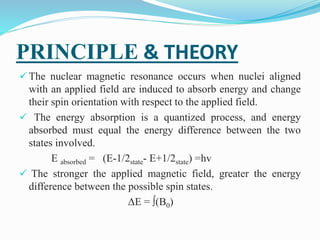
E absorbed = (E-1/2state- E+1/2state) =hv
 The stronger the applied magnetic field, greater the energy
difference between the possible spin states.
ΔE = ∫(B0)
 The magnitude of energy level separation also depends on
the particular nucleus involved. Each nucleus has a
different ratio of magnetic moment to angular momentum
since each has different charge and mass.
This ratio, is called the magnetogyric ratio ϒ, is a
constant for each nucleus and determines the energy
dependence on the magnetic field.
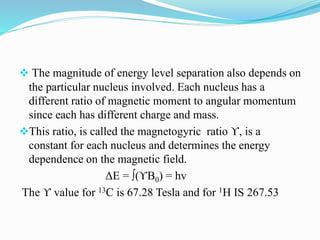
ΔE = ∫(ϒB0) = hv
The ϒ value for 13C is 67.28 Tesla and for 1H IS 267.53
ABUNDANCE
13C is difficult to record because of
1. The most abundant isotope of carbon that is
12C (99.1%) is not detected by nmr because it has
an even no of protons and neutrons 12C is nmr
inactive.
2. Magnetic resonance of 13C is much weaker.
Moreover, gyromagnectic ratio of 13C being only
one fourth that of proton, so the resonance
frequency of 13C is one fourth that of proton nmr.
Advantages of 13C- NMR over 1H- NMR
1. 13C- provides information about the backbone of
molecules rather than the periphery.
2. The chemical shifts range for 13C- NMR for most
organic compounds is 200 ppm compared to 10 –15
ppm for H, hence there is less overlap of peaks for
13C- NMR.
3. Homonuclear spin-spin coupling between carbon
atoms is not observed because the natural abundance
of 13C is too low for two 13C to be next to one
another.
Heteronuclear spin coupling between 13C and
12C does not occur because the spin quantum
number of 12C is zero.
4. There are a number of excellent methods for
decoupling the interaction between 13 C and 1H.
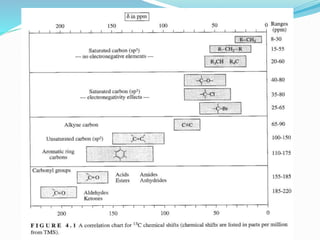
13C chemical shifts
The most significant factors affecting the chemical shifts are:
•Electro negativity of the groups attached to the C
•Hybridization of C
•The intensity (size) of each peak is NOT directly related to the
number of that type of carbon.
Other factors contribute to the size of a peak:
•Peaks from carbon atoms that have attached hydrogen atoms are
bigger than those that don’t have hydrogens attached.
•Carbon chemical shifts are usually reported as downfield from the
carbon signal of tetramethylsilane (TMS).
Proton Decoupling
Three types:
1. Broad band decoupling
2. Off-resonance decoupling
3. Pulse decoupling
Broad band decoupling
1. It avoid spin-spin splitting of 13C lines by 1H nuclei.
2. In this, all the protons are simultaneously irradiated with a
broad band radiofrequency signal. Irradiation causes the protons
to become saturated and they undergo rapid upward and
downward transition among all their possible spin state. This is
produced by a second coil located in the sample probe.
3. Without decoupling 13C spectra would show complex overlapping
multiplets that would be hard to interpret.
4. The spin-spin information get lost, but we can use off-resonance
decoupling to get spin-spin shifts back.
Nuclear Overhauser Enhancement (NOE)
A. Under conditions of broad band decoupling it found that the area of
the 13C peaks are enhanced by a factor that is significantly greater than
that which is expected from the collapse of multiplets into single lines.
B. This is a manifestation of nuclear overhauser enhancement.
C. Arises from direct magnetic coupling between a decoupled proton and
a neighboring 13C nucleus that results in an increase in the population of
the lower energy state of the 13C nucleus than that predicted by the
Boltzmann relation.
D. 13C signal may be enhanced by as much as a factor of 3 x
E. Disadvantage –
1. Lose the proportionality between peak areas and the number of nuclei
of that type of 13C.
Off-resonance decoupling
1. The coupling between each carbon atom and each hydrogen
attached directly to it, s observed acc to n+1 rule.
2. Apparent magnitude of the coupling constant is reduced and
overlap of the resulting multiplets is less frequent
3. Set decoupling frequency at 1000 to 2000 Hz above
the proton spectral region which leads to a partial
decoupled spectrum in which all but the largest spin spin
shifts are absent.
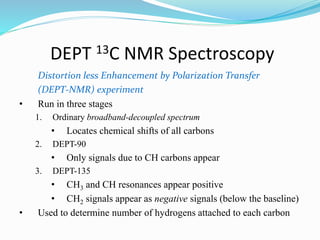
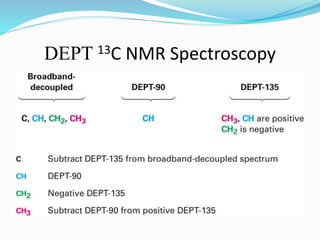
DEPT 13C NMR Spectroscopy
Distortion less Enhancement by Polarization Transfer
(DEPT-NMR) experiment
• Run in three stages
1. Ordinary broadband-decoupled spectrum
• Locates chemical shifts of all carbons
2. DEPT-90
• Only signals due to CH carbons appear
3. DEPT-135
• CH3 and CH resonances appear positive
• CH2 signals appear as negative signals (below the baseline)
• Used to determine number of hydrogens attached to each carbon
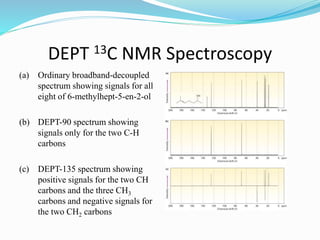
DEPT 13C NMR Spectroscopy
(a) Ordinary broadband-decoupled
spectrum showing signals for all
eight of 6-methylhept-5-en-2-ol
(b) DEPT-90 spectrum showing
signals only for the two C-H
carbons
(c) DEPT-135 spectrum showing
positive signals for the two CH
carbons and the three CH3
carbons and negative signals for
the two CH2 carbons
References
 A Text book of organic spectroscopy by Y.R.Sharma
 A Text book of organic spectroscopy by William Kemp
 www.wikipedia.com
 Introduction to Instrumental analysis by
Robert R.Braun
 Instrumental spectroscopy of Chemical analysis by
Chatwal
THANKYOU

C 13 NMR

  • 1.
    C 13 NMR GUIDEDBY: PRESENTED BY: Prof.Dr.Shantha Kumari T.Rani (1st M.Pharm) M.Pharm,Ph.D Dept: Pharmaceutical Analysis
  • 2.
    DEFINITION  NMR isa phenomenon exhibited by when atomic nuclei in a static magnetic field absorbs energy from radio frequency field of certain characteristic frequency. It results to give a spectrum with frequency on x-axis and intensity of absorption on y-axis.
  • 3.
    PRINCIPLE & THEORY The nuclear magnetic resonance occurs when nuclei aligned with an applied field are induced to absorb energy and change their spin orientation with respect to the applied field.  The energy absorption is a quantized process, and energy absorbed must equal the energy difference between the two states involved. E absorbed = (E-1/2state- E+1/2state) =hv  The stronger the applied magnetic field, greater the energy difference between the possible spin states. ΔE = ∫(B0)
  • 4.
     The magnitudeof energy level separation also depends on the particular nucleus involved. Each nucleus has a different ratio of magnetic moment to angular momentum since each has different charge and mass. This ratio, is called the magnetogyric ratio ϒ, is a constant for each nucleus and determines the energy dependence on the magnetic field. ΔE = ∫(ϒB0) = hv The ϒ value for 13C is 67.28 Tesla and for 1H IS 267.53
  • 5.
    ABUNDANCE 13C is difficultto record because of 1. The most abundant isotope of carbon that is 12C (99.1%) is not detected by nmr because it has an even no of protons and neutrons 12C is nmr inactive. 2. Magnetic resonance of 13C is much weaker. Moreover, gyromagnectic ratio of 13C being only one fourth that of proton, so the resonance frequency of 13C is one fourth that of proton nmr.
  • 6.
    Advantages of 13C-NMR over 1H- NMR 1. 13C- provides information about the backbone of molecules rather than the periphery. 2. The chemical shifts range for 13C- NMR for most organic compounds is 200 ppm compared to 10 –15 ppm for H, hence there is less overlap of peaks for 13C- NMR. 3. Homonuclear spin-spin coupling between carbon atoms is not observed because the natural abundance of 13C is too low for two 13C to be next to one another. Heteronuclear spin coupling between 13C and 12C does not occur because the spin quantum number of 12C is zero. 4. There are a number of excellent methods for decoupling the interaction between 13 C and 1H.
  • 7.
    13C chemical shifts Themost significant factors affecting the chemical shifts are: •Electro negativity of the groups attached to the C •Hybridization of C •The intensity (size) of each peak is NOT directly related to the number of that type of carbon. Other factors contribute to the size of a peak: •Peaks from carbon atoms that have attached hydrogen atoms are bigger than those that don’t have hydrogens attached. •Carbon chemical shifts are usually reported as downfield from the carbon signal of tetramethylsilane (TMS).
  • 9.
    Proton Decoupling Three types: 1.Broad band decoupling 2. Off-resonance decoupling 3. Pulse decoupling
  • 10.
    Broad band decoupling 1.It avoid spin-spin splitting of 13C lines by 1H nuclei. 2. In this, all the protons are simultaneously irradiated with a broad band radiofrequency signal. Irradiation causes the protons to become saturated and they undergo rapid upward and downward transition among all their possible spin state. This is produced by a second coil located in the sample probe. 3. Without decoupling 13C spectra would show complex overlapping multiplets that would be hard to interpret. 4. The spin-spin information get lost, but we can use off-resonance decoupling to get spin-spin shifts back.
  • 11.
    Nuclear Overhauser Enhancement(NOE) A. Under conditions of broad band decoupling it found that the area of the 13C peaks are enhanced by a factor that is significantly greater than that which is expected from the collapse of multiplets into single lines. B. This is a manifestation of nuclear overhauser enhancement. C. Arises from direct magnetic coupling between a decoupled proton and a neighboring 13C nucleus that results in an increase in the population of the lower energy state of the 13C nucleus than that predicted by the Boltzmann relation. D. 13C signal may be enhanced by as much as a factor of 3 x E. Disadvantage – 1. Lose the proportionality between peak areas and the number of nuclei of that type of 13C.
  • 12.
    Off-resonance decoupling 1. Thecoupling between each carbon atom and each hydrogen attached directly to it, s observed acc to n+1 rule. 2. Apparent magnitude of the coupling constant is reduced and overlap of the resulting multiplets is less frequent 3. Set decoupling frequency at 1000 to 2000 Hz above the proton spectral region which leads to a partial decoupled spectrum in which all but the largest spin spin shifts are absent.
  • 13.
    DEPT 13C NMRSpectroscopy Distortion less Enhancement by Polarization Transfer (DEPT-NMR) experiment • Run in three stages 1. Ordinary broadband-decoupled spectrum • Locates chemical shifts of all carbons 2. DEPT-90 • Only signals due to CH carbons appear 3. DEPT-135 • CH3 and CH resonances appear positive • CH2 signals appear as negative signals (below the baseline) • Used to determine number of hydrogens attached to each carbon
  • 14.
    DEPT 13C NMRSpectroscopy
  • 15.
    DEPT 13C NMRSpectroscopy (a) Ordinary broadband-decoupled spectrum showing signals for all eight of 6-methylhept-5-en-2-ol (b) DEPT-90 spectrum showing signals only for the two C-H carbons (c) DEPT-135 spectrum showing positive signals for the two CH carbons and the three CH3 carbons and negative signals for the two CH2 carbons
  • 16.
    References  A Textbook of organic spectroscopy by Y.R.Sharma  A Text book of organic spectroscopy by William Kemp  www.wikipedia.com  Introduction to Instrumental analysis by Robert R.Braun  Instrumental spectroscopy of Chemical analysis by Chatwal
  • 17.