various factor affecting vibrational frequency in IR
Coupledvibrations
Fermi resonance
Electronic effects
Hydrogenbonding
 COUPLED VIBRATIONS
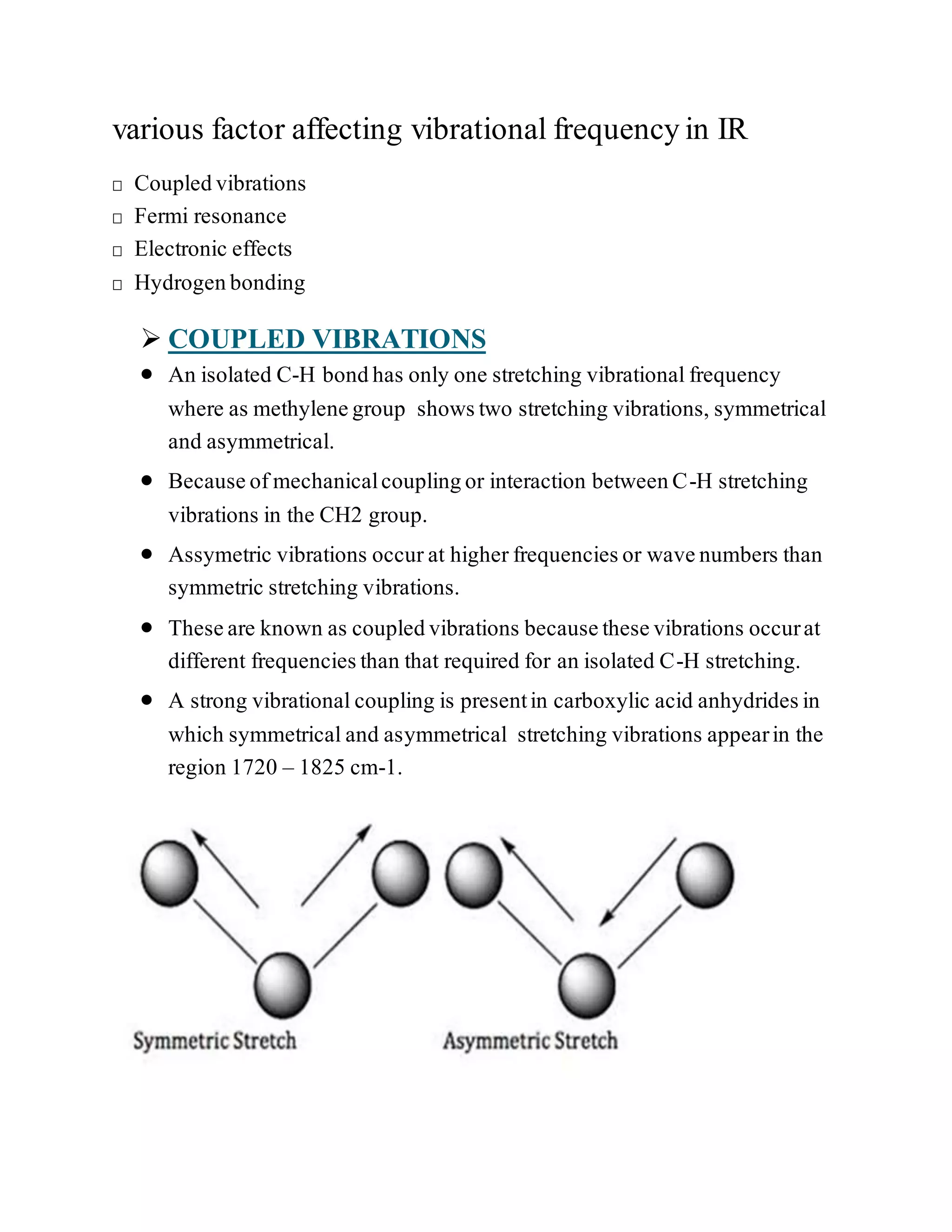
 An isolated C-H bondhas only one stretching vibrationalfrequency
where as methylenegroup showstwo stretching vibrations, symmetrical
and asymmetrical.
 Becauseofmechanicalcouplingor interaction betweenC-H stretching
vibrations in the CH2 group.
 Assymetric vibrations occurat higherfrequenciesor wavenumbers than
symmetric stretching vibrations.
 Theseare known as coupledvibrations becausethesevibrations occurat
different frequenciesthan that required for an isolated C-H stretching.
 A strong vibrationalcoupling is presentin carboxylic acid anhydridesin
which symmetricaland asymmetrical stretching vibrations appearin the
region 1720 – 1825 cm-1.
 The interaction is very effective probablybecauseofthe partial double
bondcharacterin the carbonyloxygenbondsdueto resonancewhichalso
keepsthe system planarfor effective coupling.
 For interaction to occur, the vibrations must be of samesymmetry species.
 There mustbe a commonatom betweenthe groups for strong coupling
betweenstretching vibrations.
 For couplingof bendingvibrations , a common bondis necessary.
 Interaction is greatestwhen coupledgroupsabsorb, individually, nearthe
same frequency.
 Coupling is negligible whengroups are separatedby one or more carbon
atoms and the vibrations are mutually perpendicular.
 FERMI RESONANCE
 Resonance
 A vibration of large amplitude producedby a relatively small vibration.
 Coupling of two fundamentalvibration modesproducestwo new modes
of vibration ,with frequencieshigherandlower than that observedin
absenceofinteraction. Interaction canalso take place between
fundamentalvibrations andovertonesor combination tone vibrations and
suchinteractions are knownas FermiResonance.
 In this , a moleculetransfers its energyfrom fundamentalvibrational level
to overtoneor combination tone leveland back.
 Resonancepushesthetwo levels apart andmixes their character,
consequentlyeachlevelhas partly fundamentaland partly overtoneor
combinat
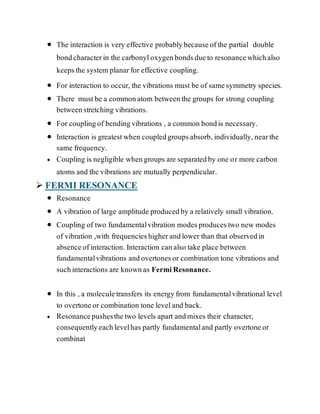
 For eg. symmetricalstretching vibration of CO2 in Ramanspectrum shows
bandat 1337 cm-1.Thetwo bendingvibrations are equivalentand absorbat
the same frequencyof 667.3cm-1.
 The first overtoneof this is 2 X 667.3= 1334.6cm-1..
 Fermi resonance occurs
 There is mixing of 1337cm-1and 1334.6cm-1to give two bandsat1285.5
cm-1 andat 1388.3cm-1 with intensity ratio 1 : 0.9 respectively.
Hydrogen bonding
 It occursin any systemcontaininga proton donorgroup(X-H) and a
proton acceptor.if the s-orbital of the proton can effectively overlap the P
or π orbital of the acceptorgroup.
 The strongerthe hydrogenbond, the longerthe O-H bond,the lowerthe
vibration frequencyandbroaderand more intensewill be the absorption
band.
 The N-H stretching frequenciesof amines are also affected by hydrogen
bondingas that of the hydroxylgroup butfrequencyshifts for aminesare
lesserthan that for hydroxylcompounds.
 Becausenitrogenis less electronegativethan oxygenso the hydrogen
bondingin amines is weakerthan that in hydroxylcompounds.
 Intermolecular hydrogenbondsgivesrise to broadbands,while
intramolecular hydrogenbondsgivesharp and well defined bands.
 The inter and intramolecularhydrogenbondingcan be distinguishedby
dilution.
 Intramolecular hydrogenbondingremains unaffectedon dilution and as a
result the absorption bandalso remains unaffectedwhere as in
intermolecular, bondsare brokenon dilution and as a result there is a
decreasein the bondedO-H absorption.
The strength of hydrogenbondingis also affected by :
 Ring strain
 Moleculargeometry
 Relative acidity andbasicity of the proton donorand acceptor
groups
Electroniceffect
Changesin the absorptionfrequenciesfor a particular group take placewhen the
substituentsin the neighbourhoodofthat particular group are changed.
It includes :
1. .Inductive effect
2. .Mesomeric effect
3. Field effect
 INDUCTIVE EFFECT
 The introduction of alkyl groupcauses+I effect which results in the
lengtheningor the weakeningof the bond
 Hencethe force constantis lowered and wave numberof absorption
decreases.
 Let us comparethe wave numbersof v (C=O) absorptionsfor the following
compounds:
Formaldehyde(HCHO) 1750cm-1.
Acetaldehyde(CH3CHO) 1745 cm-1.
Acetone(CH3COCH3) 1715cm-1.
 Introduction of an electronegativeatom or group causes –Ieffect which
results in the bondorder to increase.
 Hencethe force constantincreasesand the wave numberof absorptionrises.
 Mesomeric effect :
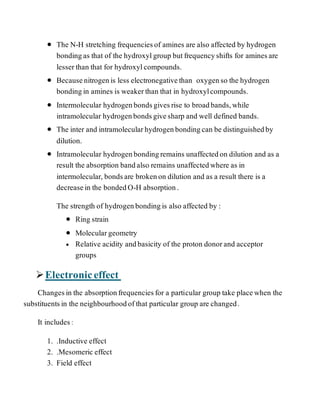
 It causeslengtheningorthe weakeningof a bond leadingin the lowering of
absorptionfrequency.
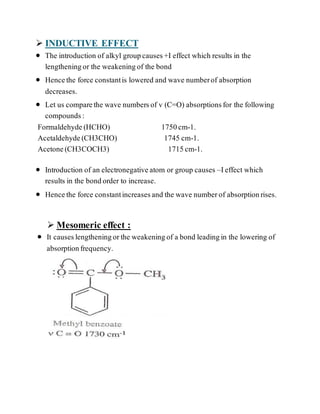
 As nitrogen atom is less electronegativethan oxygenatom, the electron pair
on nitrogen atom in amide is more labile and participatesmore in
conjugation.
 Due to this greaterdegreeof conjugation,the C=O absorption frequencyis
much less in amides as comparedto that in esters.
 FIELD EFFECT
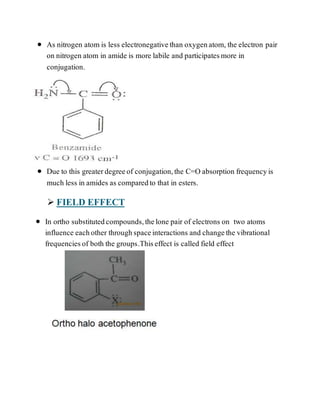
 In ortho substitutedcompounds,thelone pair of electrons on two atoms
influence eachother throughspaceinteractions and changethe vibrational
frequenciesof both the groups.Thiseffect is called field effect

Various factor affecting vibrational frequency in IR spectroscopy.

  • 1.
    various factor affectingvibrational frequency in IR Coupledvibrations Fermi resonance Electronic effects Hydrogenbonding  COUPLED VIBRATIONS  An isolated C-H bondhas only one stretching vibrationalfrequency where as methylenegroup showstwo stretching vibrations, symmetrical and asymmetrical.  Becauseofmechanicalcouplingor interaction betweenC-H stretching vibrations in the CH2 group.  Assymetric vibrations occurat higherfrequenciesor wavenumbers than symmetric stretching vibrations.  Theseare known as coupledvibrations becausethesevibrations occurat different frequenciesthan that required for an isolated C-H stretching.  A strong vibrationalcoupling is presentin carboxylic acid anhydridesin which symmetricaland asymmetrical stretching vibrations appearin the region 1720 – 1825 cm-1.
  • 2.
     The interactionis very effective probablybecauseofthe partial double bondcharacterin the carbonyloxygenbondsdueto resonancewhichalso keepsthe system planarfor effective coupling.  For interaction to occur, the vibrations must be of samesymmetry species.  There mustbe a commonatom betweenthe groups for strong coupling betweenstretching vibrations.  For couplingof bendingvibrations , a common bondis necessary.  Interaction is greatestwhen coupledgroupsabsorb, individually, nearthe same frequency.  Coupling is negligible whengroups are separatedby one or more carbon atoms and the vibrations are mutually perpendicular.  FERMI RESONANCE  Resonance  A vibration of large amplitude producedby a relatively small vibration.  Coupling of two fundamentalvibration modesproducestwo new modes of vibration ,with frequencieshigherandlower than that observedin absenceofinteraction. Interaction canalso take place between fundamentalvibrations andovertonesor combination tone vibrations and suchinteractions are knownas FermiResonance.  In this , a moleculetransfers its energyfrom fundamentalvibrational level to overtoneor combination tone leveland back.  Resonancepushesthetwo levels apart andmixes their character, consequentlyeachlevelhas partly fundamentaland partly overtoneor combinat
  • 3.
     For eg.symmetricalstretching vibration of CO2 in Ramanspectrum shows bandat 1337 cm-1.Thetwo bendingvibrations are equivalentand absorbat the same frequencyof 667.3cm-1.  The first overtoneof this is 2 X 667.3= 1334.6cm-1..  Fermi resonance occurs  There is mixing of 1337cm-1and 1334.6cm-1to give two bandsat1285.5 cm-1 andat 1388.3cm-1 with intensity ratio 1 : 0.9 respectively. Hydrogen bonding  It occursin any systemcontaininga proton donorgroup(X-H) and a proton acceptor.if the s-orbital of the proton can effectively overlap the P or π orbital of the acceptorgroup.  The strongerthe hydrogenbond, the longerthe O-H bond,the lowerthe vibration frequencyandbroaderand more intensewill be the absorption band.
  • 4.
     The N-Hstretching frequenciesof amines are also affected by hydrogen bondingas that of the hydroxylgroup butfrequencyshifts for aminesare lesserthan that for hydroxylcompounds.  Becausenitrogenis less electronegativethan oxygenso the hydrogen bondingin amines is weakerthan that in hydroxylcompounds.  Intermolecular hydrogenbondsgivesrise to broadbands,while intramolecular hydrogenbondsgivesharp and well defined bands.  The inter and intramolecularhydrogenbondingcan be distinguishedby dilution.  Intramolecular hydrogenbondingremains unaffectedon dilution and as a result the absorption bandalso remains unaffectedwhere as in intermolecular, bondsare brokenon dilution and as a result there is a decreasein the bondedO-H absorption. The strength of hydrogenbondingis also affected by :  Ring strain  Moleculargeometry  Relative acidity andbasicity of the proton donorand acceptor groups Electroniceffect Changesin the absorptionfrequenciesfor a particular group take placewhen the substituentsin the neighbourhoodofthat particular group are changed. It includes : 1. .Inductive effect 2. .Mesomeric effect 3. Field effect
  • 5.
     INDUCTIVE EFFECT The introduction of alkyl groupcauses+I effect which results in the lengtheningor the weakeningof the bond  Hencethe force constantis lowered and wave numberof absorption decreases.  Let us comparethe wave numbersof v (C=O) absorptionsfor the following compounds: Formaldehyde(HCHO) 1750cm-1. Acetaldehyde(CH3CHO) 1745 cm-1. Acetone(CH3COCH3) 1715cm-1.  Introduction of an electronegativeatom or group causes –Ieffect which results in the bondorder to increase.  Hencethe force constantincreasesand the wave numberof absorptionrises.  Mesomeric effect :  It causeslengtheningorthe weakeningof a bond leadingin the lowering of absorptionfrequency.
  • 6.
     As nitrogenatom is less electronegativethan oxygenatom, the electron pair on nitrogen atom in amide is more labile and participatesmore in conjugation.  Due to this greaterdegreeof conjugation,the C=O absorption frequencyis much less in amides as comparedto that in esters.  FIELD EFFECT  In ortho substitutedcompounds,thelone pair of electrons on two atoms influence eachother throughspaceinteractions and changethe vibrational frequenciesof both the groups.Thiseffect is called field effect