“INFRARED ABSORPTION
SPECTROSCOPY”
ROLL NO: 1214180
“Introduction To
IR Spectroscopy”
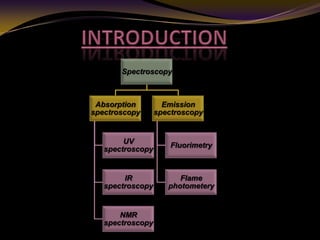
Spectroscopy
Absorption
spectroscopy
UV
spectroscopy
IR
spectroscopy
NMR
spectroscopy
Emission
spectroscopy
Fluorimetry
Flame
photometery
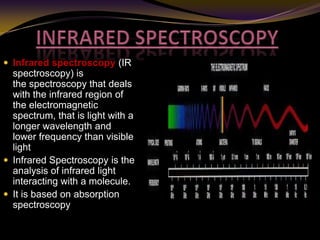
 Infrared spectroscopy (IR
spectroscopy) is
the spectroscopy that deals
with the infrared region of
the electromagnetic
spectrum, that is light with a
longer wavelength and
lower frequency than visible
light
 Infrared Spectroscopy is the
analysis of infrared light
interacting with a molecule.
 It is based on absorption
spectroscopy
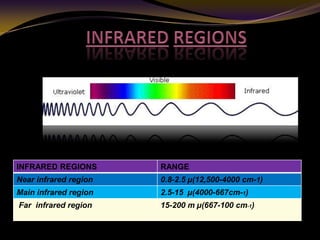
INFRARED REGIONS RANGE
Near infrared region 0.8-2.5 µ(12,500-4000 cm-1)
Main infrared region 2.5-15 µ(4000-667cm-1)
Far infrared region 15-200 m µ(667-100 cm-1)
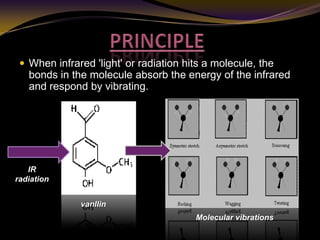
 When infrared 'light' or radiation hits a molecule, the
bonds in the molecule absorb the energy of the infrared
and respond by vibrating.
IR
radiation
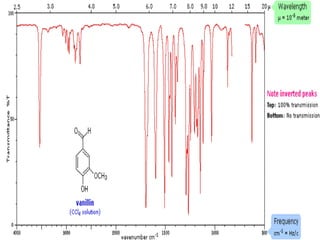
vanllin
Molecular vibrations
ROLL NO. 1214230
“Molecular Vibrations”
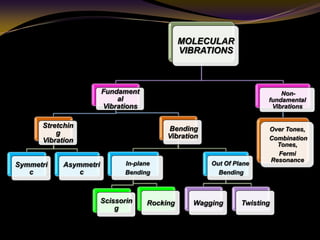
MOLECULAR
VIBRATIONS
Fundament
al
Vibrations
Stretchin
g
Vibration
Symmetri
c
Asymmetri
c
Bending
Vibration
In-plane
Bending
Scissorin
g
Rocking
Out Of Plane
Bending
Wagging Twisting
Non-
fundamental
Vibrations
Over Tones,
Combination
Tones,
Fermi
Resonance
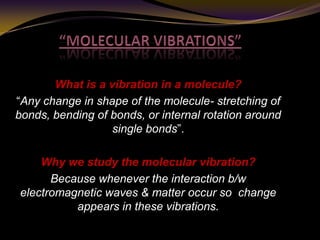
What is a vibration in a molecule?
“Any change in shape of the molecule- stretching of
bonds, bending of bonds, or internal rotation around
single bonds”.
Why we study the molecular vibration?
Because whenever the interaction b/w
electromagnetic waves & matter occur so change
appears in these vibrations.
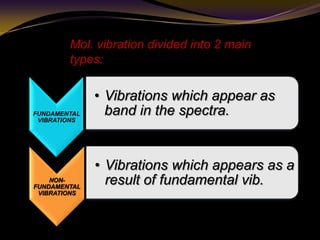
FUNDAMENTAL
VIBRATIONS
• Vibrations which appear as
band in the spectra.
NON-
FUNDAMENTAL
VIBRATIONS
• Vibrations which appears as a
result of fundamental vib.
Mol. vibration divided into 2 main
types:
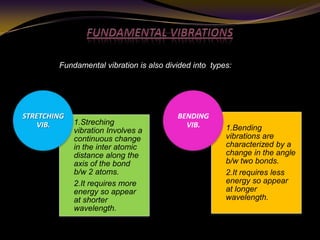
1.Streching
vibration Involves a
continuous change
in the inter atomic
distance along the
axis of the bond
b/w 2 atoms.
2.It requires more
energy so appear
at shorter
wavelength.
STRETCHING
VIB. 1.Bending
vibrations are
characterized by a
change in the angle
b/w two bonds.
2.It requires less
energy so appear
at longer
wavelength.
BENDING
VIB.
Fundamental vibration is also divided into types:
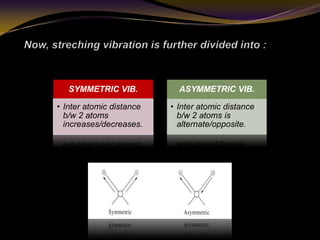
SYMMETRIC VIB.
• Inter atomic distance
b/w 2 atoms
increases/decreases.
ASYMMETRIC VIB.
• Inter atomic distance
b/w 2 atoms is
alternate/opposite.
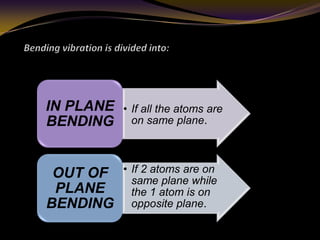
• If all the atoms are
on same plane.
IN PLANE
BENDING
• If 2 atoms are on
same plane while
the 1 atom is on
opposite plane.
OUT OF
PLANE
BENDING
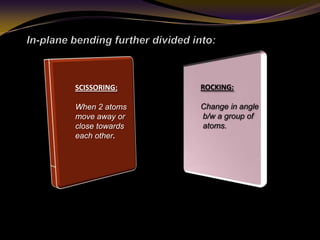
SCISSORING:
When 2 atoms
move away or
close towards
each other.
ROCKING:
Change in angle
b/w a group of
atoms.
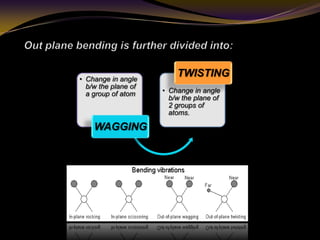
• Change in angle
b/w the plane of
a group of atom
WAGGING
• Change in angle
b/w the plane of
2 groups of
atoms.
TWISTING
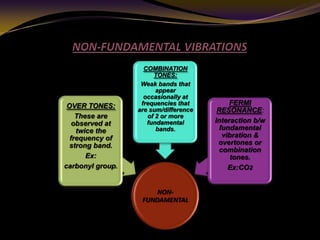
NON-
FUNDAMENTAL
OVER TONES:
These are
observed at
twice the
frequency of
strong band.
Ex:
carbonyl group.
COMBINATION
TONES:
Weak bands that
appear
occasionally at
frequencies that
are sum/difference
of 2 or more
fundamental
bands.
FERMI
RESONANCE:
Interaction b/w
fundamental
vibration &
overtones or
combination
tones.
Ex:CO2
ROLL NO. 1214229
“Coupled Interactions And
Factors”
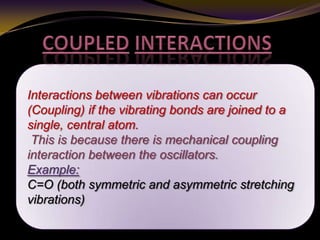
Interactions between vibrations can occur
(Coupling) if the vibrating bonds are joined to a
single, central atom.
This is because there is mechanical coupling
interaction between the oscillators.
Example:
C=O (both symmetric and asymmetric stretching
vibrations)
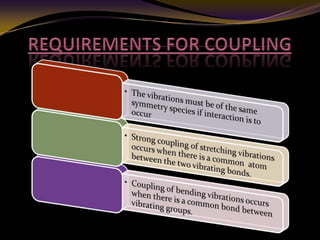
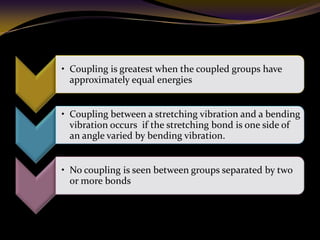
• Coupling is greatest when the coupled groups have
approximately equal energies
• Coupling between a stretching vibration and a bending
vibration occurs if the stretching bond is one side of
an angle varied by bending vibration.
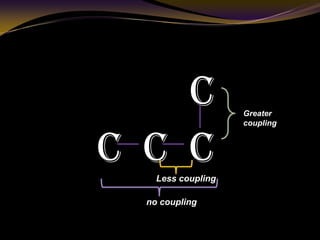
• No coupling is seen between groups separated by two
or more bonds
c
C c cLess coupling
no coupling
Greater
coupling
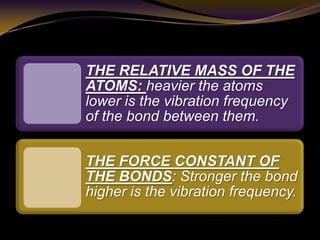
THE RELATIVE MASS OF THE
ATOMS: heavier the atoms
lower is the vibration frequency
of the bond between them.
THE FORCE CONSTANT OF
THE BONDS: Stronger the bond
higher is the vibration frequency.
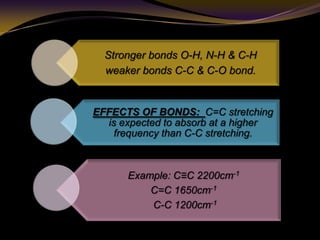
Stronger bonds O-H, N-H & C-H
weaker bonds C-C & C-O bond.
EFFECTS OF BONDS: C=C stretching
is expected to absorb at a higher
frequency than C-C stretching.
Example: C≡C 2200cm-1
C=C 1650cm-1
C-C 1200cm-1
ROLL NO. 1214191
“Degree Of Freedom”
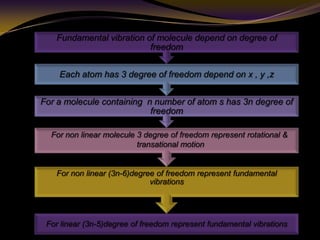
For linear (3n-5)degree of freedom represent fundamental vibrations
For non linear (3n-6)degree of freedom represent fundamental
vibrations
For a molecule containing n number of atom s has 3n degree of
freedom
Each atom has 3 degree of freedom depend on x , y ,z
Fundamental vibration of molecule depend on degree of
freedom
For non linear molecule 3 degree of freedom represent rotational &
transational motion
Only those vibrational changes that result in
change in dipole movement appear as band
All vibrational changes don’t appear as
band
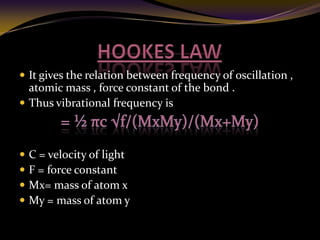
 It gives the relation between frequency of oscillation ,
atomic mass , force constant of the bond .
 Thus vibrational frequency is
 C = velocity of light
 F = force constant
 Mx= mass of atom x
 My = mass of atom y
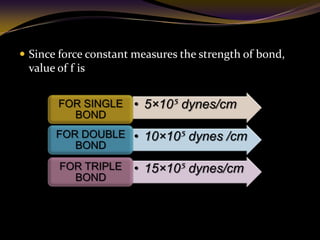
 Since force constant measures the strength of bond,
value of f is
• 5×10⁵ dynes/cmFOR SINGLE
BOND
• 10×10⁵ dynes /cmFOR DOUBLE
BOND
• 15×10⁵ dynes/cmFOR TRIPLE
BOND
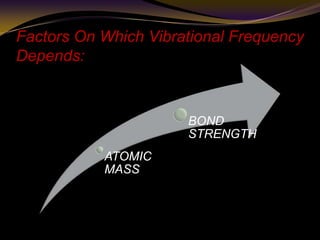
Factors On Which Vibrational Frequency
Depends:
ATOMIC
MASS
BOND
STRENGTH
ROLL NO. 1214195
“Hydrogen Bonding”
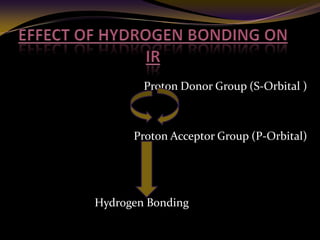
Proton Donor Group (S-Orbital )
Proton Acceptor Group (P-Orbital)
Hydrogen Bonding
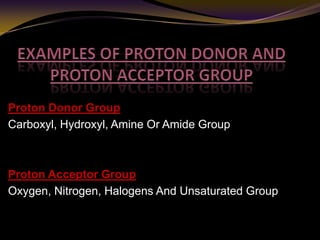
Proton Donor Group
Carboxyl, Hydroxyl, Amine Or Amide Group
Proton Acceptor Group
Oxygen, Nitrogen, Halogens And Unsaturated Group
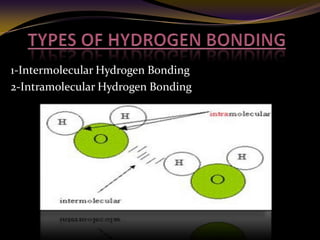
1-Intermolecular Hydrogen Bonding
2-Intramolecular Hydrogen Bonding
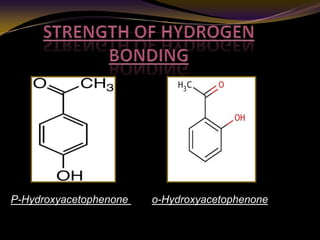
Collinear Non-linear
P-Hydroxyacetophenone o-Hydroxyacetophenone
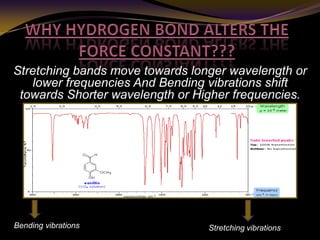
Stretching bands move towards longer wavelength or
lower frequencies And Bending vibrations shift
towards Shorter wavelength or Higher frequencies.
Bending vibrations Stretching vibrations
Temperature
Concentration
Molecular Geometry
Relative Acidity
Basicity
ROLL NO. 1214208
“Instrumentation”
The main parts of IR spectrometer are as follows:
 radiation source
 sample cells and sampling of substances
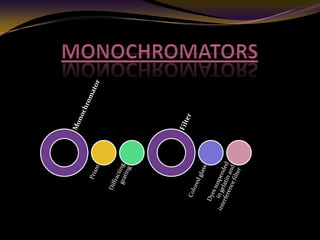
 monochromators
 detectors
 recorder
IR instruments require a source of radiant energy
which emit IR radiation which must be:
Sufficient
intensity
Continuous Stable
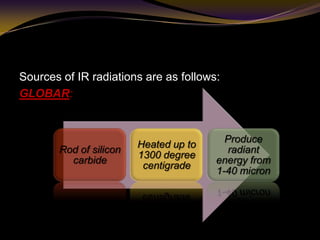
Sources of IR radiations are as follows:
GLOBAR:
Rod of silicon
carbide
Heated up to
1300 degree
centigrade
Produce
radiant
energy from
1-40 micron
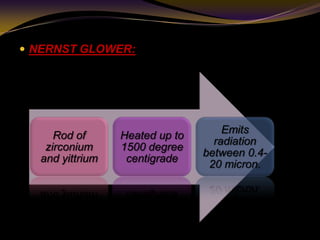
 NERNST GLOWER:
Rod of
zirconium
and yittrium
Heated up to
1500 degree
centigrade
Emits
radiation
between 0.4-
20 micron.
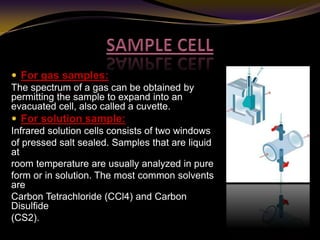
 For gas samples:
The spectrum of a gas can be obtained by
permitting the sample to expand into an
evacuated cell, also called a cuvette.
 For solution sample:
Infrared solution cells consists of two windows
of pressed salt sealed. Samples that are liquid
at
room temperature are usually analyzed in pure
form or in solution. The most common solvents
are
Carbon Tetrachloride (CCl4) and Carbon
Disulfide
(CS2).
 For solid sample:
Solids reduced to small particles (less than 2 micron) can
be examined as a thin paste or mull. The mull is formed by
grinding a 2-5 milligrams of the sample in the presence of
one or two drops of a hydrocarbon oil (nujol oil). The
resulting mull is then examined as a film between flat salt
plates.
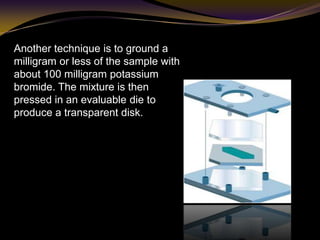
Another technique is to ground a
milligram or less of the sample with
about 100 milligram potassium
bromide. The mixture is then
pressed in an evaluable die to
produce a transparent disk.
ROLL NO. 1214232
“Detectors”
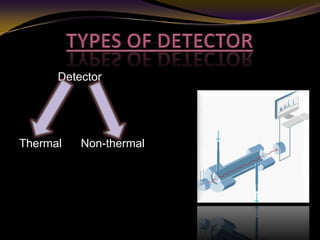
Detector
Thermal Non-thermal
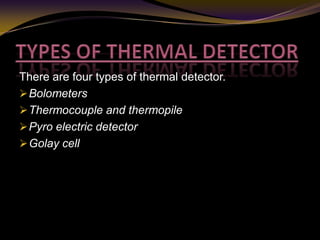
There are four types of thermal detector.
Bolometers
Thermocouple and thermopile
Pyro electric detector
Golay cell
Bolometer is derived from a Greek word
(bolometron)
Bolo = for something thrown
Metron = measure
Construction
 A bolometer consists of an absorptive element, such
as a thin layer of metal.
 Most bolometers use semiconductor or
superconductor absorptive elements rather than
metals.
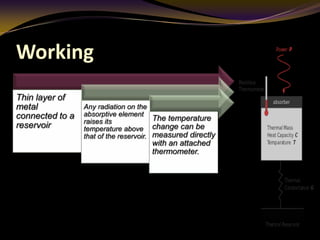
Working
Thin layer of
metal
connected to a
reservoir
Any radiation on the
absorptive element
raises its
temperature above
that of the reservoir.
The temperature
change can be
measured directly
with an attached
thermometer.
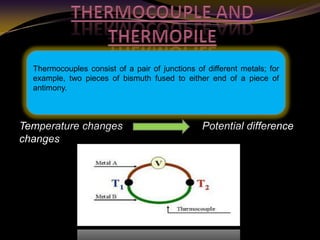
Temperature changes Potential difference
changes
Thermocouples consist of a pair of junctions of different metals; for
example, two pieces of bismuth fused to either end of a piece of
antimony.
Thermopile detectors are voltage-generating
devices, which can be thought of as
miniature arrays of thermocouple junctions.
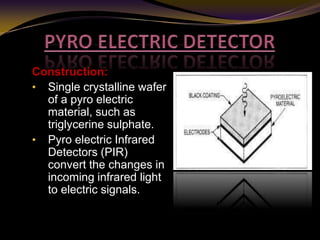
Construction:
• Single crystalline wafer
of a pyro electric
material, such as
triglycerine sulphate.
• Pyro electric Infrared
Detectors (PIR)
convert the changes in
incoming infrared light
to electric signals.
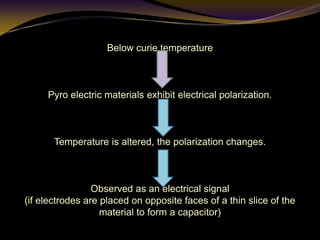
Below curie temperature
Pyro electric materials exhibit electrical polarization.
Temperature is altered, the polarization changes.
Observed as an electrical signal
(if electrodes are placed on opposite faces of a thin slice of the
material to form a capacitor)
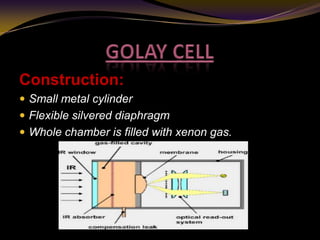
Construction:
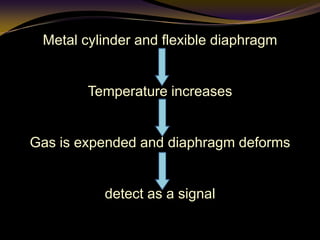
 Small metal cylinder
 Flexible silvered diaphragm
 Whole chamber is filled with xenon gas.
Metal cylinder and flexible diaphragm
Temperature increases
Gas is expended and diaphragm deforms
detect as a signal
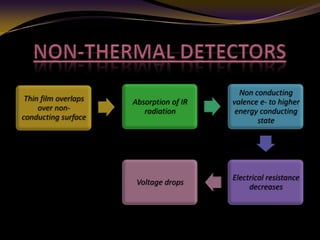
Thin film overlaps
over non-
conducting surface
Absorption of IR
radiation
Non conducting
valence e- to higher
energy conducting
state
Electrical resistance
decreases
Voltage drops
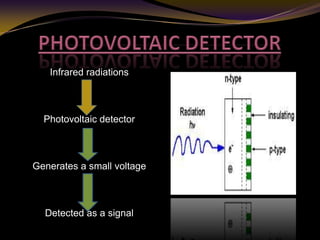
Infrared radiations
Photovoltaic detector
Generates a small voltage
Detected as a signal
ROLL NO. 1214265
“Single/Double Beam
IR Absorption Spectrophotometers”
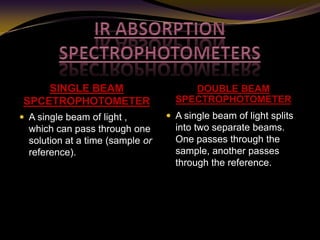
SINGLE BEAM
SPCETROPHOTOMETER
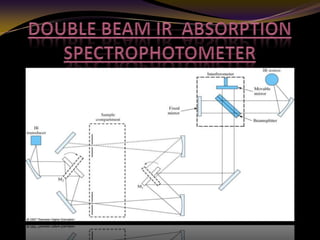
DOUBLE BEAM
SPECTROPHOTOMETER
 A single beam of light ,
which can pass through one
solution at a time (sample or
reference).
 A single beam of light splits
into two separate beams.
One passes through the
sample, another passes
through the reference.
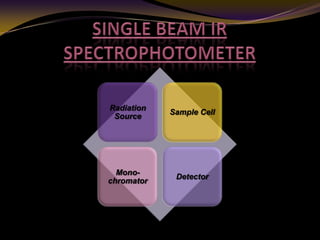
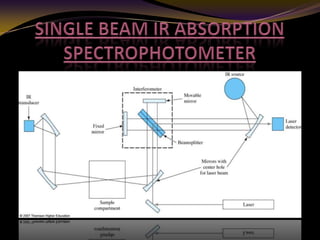
Radiation
Source
Sample Cell
Mono-
chromator
Detector
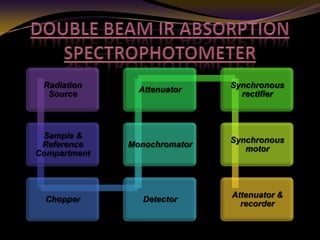
Radiation
Source
Sample &
Reference
Compartment
Chopper Detector
Monochromator
Attenuator
Synchronous
rectifier
Synchronous
motor
Attenuator &
recorder
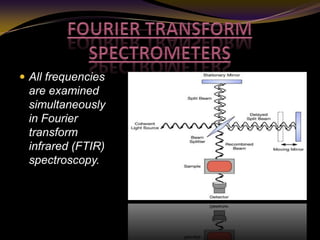
 All frequencies
are examined
simultaneously
in Fourier
transform
infrared (FTIR)
spectroscopy.
ROLL NO. 1214265
“Applications Of
IR Absorption Spectrocopy”
Since different molecules
with different combination
of atoms produce their
unique spectra, infrared
spectroscopy can be used
to qualitatively identify
substances.
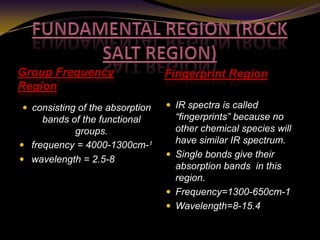
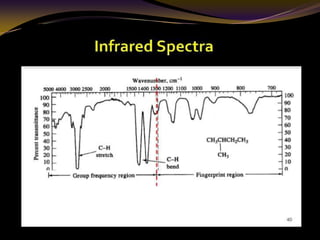
Group Frequency
Region
Fingerprint Region
 consisting of the absorption
bands of the functional
groups.
 frequency = 4000-1300cm-¹
 wavelength = 2.5-8
 IR spectra is called
“fingerprints” because no
other chemical species will
have similar IR spectrum.
 Single bonds give their
absorption bands in this
region.
 Frequency=1300-650cm-1
 Wavelength=8-15.4
 Organic groups differ from one another both in the
strength of the bond and the masses of the atom
involved.
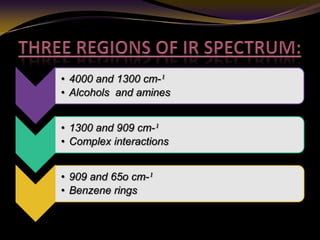
• 4000 and 1300 cm-¹
• Alcohols and amines
• 1300 and 909 cm-¹
• Complex interactions
• 909 and 65o cm-¹
• Benzene rings
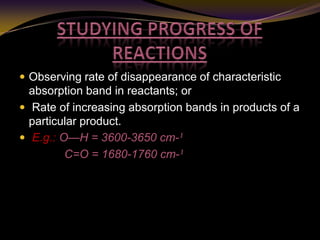
 Observing rate of disappearance of characteristic
absorption band in reactants; or
 Rate of increasing absorption bands in products of a
particular product.
 E.g.: O—H = 3600-3650 cm-¹
C=O = 1680-1760 cm-¹
Infrared spectroscopy

Infrared spectroscopy

  • 1.
  • 2.
    ROLL NO: 1214180 “IntroductionTo IR Spectroscopy”
  • 3.
  • 4.
     Infrared spectroscopy(IR spectroscopy) is the spectroscopy that deals with the infrared region of the electromagnetic spectrum, that is light with a longer wavelength and lower frequency than visible light  Infrared Spectroscopy is the analysis of infrared light interacting with a molecule.  It is based on absorption spectroscopy
  • 5.
    INFRARED REGIONS RANGE Nearinfrared region 0.8-2.5 µ(12,500-4000 cm-1) Main infrared region 2.5-15 µ(4000-667cm-1) Far infrared region 15-200 m µ(667-100 cm-1)
  • 6.
     When infrared'light' or radiation hits a molecule, the bonds in the molecule absorb the energy of the infrared and respond by vibrating. IR radiation vanllin Molecular vibrations
  • 8.
  • 9.
  • 10.
    What is avibration in a molecule? “Any change in shape of the molecule- stretching of bonds, bending of bonds, or internal rotation around single bonds”. Why we study the molecular vibration? Because whenever the interaction b/w electromagnetic waves & matter occur so change appears in these vibrations.
  • 11.
    FUNDAMENTAL VIBRATIONS • Vibrations whichappear as band in the spectra. NON- FUNDAMENTAL VIBRATIONS • Vibrations which appears as a result of fundamental vib. Mol. vibration divided into 2 main types:
  • 12.
    1.Streching vibration Involves a continuouschange in the inter atomic distance along the axis of the bond b/w 2 atoms. 2.It requires more energy so appear at shorter wavelength. STRETCHING VIB. 1.Bending vibrations are characterized by a change in the angle b/w two bonds. 2.It requires less energy so appear at longer wavelength. BENDING VIB. Fundamental vibration is also divided into types:
  • 13.
    SYMMETRIC VIB. • Interatomic distance b/w 2 atoms increases/decreases. ASYMMETRIC VIB. • Inter atomic distance b/w 2 atoms is alternate/opposite.
  • 14.
    • If allthe atoms are on same plane. IN PLANE BENDING • If 2 atoms are on same plane while the 1 atom is on opposite plane. OUT OF PLANE BENDING
  • 15.
    SCISSORING: When 2 atoms moveaway or close towards each other. ROCKING: Change in angle b/w a group of atoms.
  • 16.
    • Change inangle b/w the plane of a group of atom WAGGING • Change in angle b/w the plane of 2 groups of atoms. TWISTING
  • 17.
    NON- FUNDAMENTAL OVER TONES: These are observedat twice the frequency of strong band. Ex: carbonyl group. COMBINATION TONES: Weak bands that appear occasionally at frequencies that are sum/difference of 2 or more fundamental bands. FERMI RESONANCE: Interaction b/w fundamental vibration & overtones or combination tones. Ex:CO2
  • 18.
    ROLL NO. 1214229 “CoupledInteractions And Factors”
  • 19.
    Interactions between vibrationscan occur (Coupling) if the vibrating bonds are joined to a single, central atom. This is because there is mechanical coupling interaction between the oscillators. Example: C=O (both symmetric and asymmetric stretching vibrations)
  • 21.
    • Coupling isgreatest when the coupled groups have approximately equal energies • Coupling between a stretching vibration and a bending vibration occurs if the stretching bond is one side of an angle varied by bending vibration. • No coupling is seen between groups separated by two or more bonds
  • 22.
    c C c cLesscoupling no coupling Greater coupling
  • 24.
    THE RELATIVE MASSOF THE ATOMS: heavier the atoms lower is the vibration frequency of the bond between them. THE FORCE CONSTANT OF THE BONDS: Stronger the bond higher is the vibration frequency.
  • 25.
    Stronger bonds O-H,N-H & C-H weaker bonds C-C & C-O bond. EFFECTS OF BONDS: C=C stretching is expected to absorb at a higher frequency than C-C stretching. Example: C≡C 2200cm-1 C=C 1650cm-1 C-C 1200cm-1
  • 26.
  • 27.
    For linear (3n-5)degreeof freedom represent fundamental vibrations For non linear (3n-6)degree of freedom represent fundamental vibrations For a molecule containing n number of atom s has 3n degree of freedom Each atom has 3 degree of freedom depend on x , y ,z Fundamental vibration of molecule depend on degree of freedom For non linear molecule 3 degree of freedom represent rotational & transational motion
  • 28.
    Only those vibrationalchanges that result in change in dipole movement appear as band All vibrational changes don’t appear as band
  • 29.
     It givesthe relation between frequency of oscillation , atomic mass , force constant of the bond .  Thus vibrational frequency is  C = velocity of light  F = force constant  Mx= mass of atom x  My = mass of atom y
  • 30.
     Since forceconstant measures the strength of bond, value of f is • 5×10⁵ dynes/cmFOR SINGLE BOND • 10×10⁵ dynes /cmFOR DOUBLE BOND • 15×10⁵ dynes/cmFOR TRIPLE BOND
  • 31.
    Factors On WhichVibrational Frequency Depends: ATOMIC MASS BOND STRENGTH
  • 32.
  • 33.
    Proton Donor Group(S-Orbital ) Proton Acceptor Group (P-Orbital) Hydrogen Bonding
  • 34.
    Proton Donor Group Carboxyl,Hydroxyl, Amine Or Amide Group Proton Acceptor Group Oxygen, Nitrogen, Halogens And Unsaturated Group
  • 35.
  • 36.
  • 37.
    Stretching bands movetowards longer wavelength or lower frequencies And Bending vibrations shift towards Shorter wavelength or Higher frequencies. Bending vibrations Stretching vibrations
  • 38.
  • 39.
  • 40.
    The main partsof IR spectrometer are as follows:  radiation source  sample cells and sampling of substances  monochromators  detectors  recorder
  • 41.
    IR instruments requirea source of radiant energy which emit IR radiation which must be: Sufficient intensity Continuous Stable
  • 42.
    Sources of IRradiations are as follows: GLOBAR: Rod of silicon carbide Heated up to 1300 degree centigrade Produce radiant energy from 1-40 micron
  • 43.
     NERNST GLOWER: Rodof zirconium and yittrium Heated up to 1500 degree centigrade Emits radiation between 0.4- 20 micron.
  • 44.
     For gassamples: The spectrum of a gas can be obtained by permitting the sample to expand into an evacuated cell, also called a cuvette.  For solution sample: Infrared solution cells consists of two windows of pressed salt sealed. Samples that are liquid at room temperature are usually analyzed in pure form or in solution. The most common solvents are Carbon Tetrachloride (CCl4) and Carbon Disulfide (CS2).
  • 45.
     For solidsample: Solids reduced to small particles (less than 2 micron) can be examined as a thin paste or mull. The mull is formed by grinding a 2-5 milligrams of the sample in the presence of one or two drops of a hydrocarbon oil (nujol oil). The resulting mull is then examined as a film between flat salt plates.
  • 46.
    Another technique isto ground a milligram or less of the sample with about 100 milligram potassium bromide. The mixture is then pressed in an evaluable die to produce a transparent disk.
  • 48.
  • 50.
  • 52.
    There are fourtypes of thermal detector. Bolometers Thermocouple and thermopile Pyro electric detector Golay cell
  • 53.
    Bolometer is derivedfrom a Greek word (bolometron) Bolo = for something thrown Metron = measure
  • 54.
    Construction  A bolometerconsists of an absorptive element, such as a thin layer of metal.  Most bolometers use semiconductor or superconductor absorptive elements rather than metals.
  • 55.
    Working Thin layer of metal connectedto a reservoir Any radiation on the absorptive element raises its temperature above that of the reservoir. The temperature change can be measured directly with an attached thermometer.
  • 56.
    Temperature changes Potentialdifference changes Thermocouples consist of a pair of junctions of different metals; for example, two pieces of bismuth fused to either end of a piece of antimony.
  • 57.
    Thermopile detectors arevoltage-generating devices, which can be thought of as miniature arrays of thermocouple junctions.
  • 58.
    Construction: • Single crystallinewafer of a pyro electric material, such as triglycerine sulphate. • Pyro electric Infrared Detectors (PIR) convert the changes in incoming infrared light to electric signals.
  • 59.
    Below curie temperature Pyroelectric materials exhibit electrical polarization. Temperature is altered, the polarization changes. Observed as an electrical signal (if electrodes are placed on opposite faces of a thin slice of the material to form a capacitor)
  • 60.
    Construction:  Small metalcylinder  Flexible silvered diaphragm  Whole chamber is filled with xenon gas.
  • 61.
    Metal cylinder andflexible diaphragm Temperature increases Gas is expended and diaphragm deforms detect as a signal
  • 62.
    Thin film overlaps overnon- conducting surface Absorption of IR radiation Non conducting valence e- to higher energy conducting state Electrical resistance decreases Voltage drops
  • 63.
    Infrared radiations Photovoltaic detector Generatesa small voltage Detected as a signal
  • 64.
    ROLL NO. 1214265 “Single/DoubleBeam IR Absorption Spectrophotometers”
  • 65.
    SINGLE BEAM SPCETROPHOTOMETER DOUBLE BEAM SPECTROPHOTOMETER A single beam of light , which can pass through one solution at a time (sample or reference).  A single beam of light splits into two separate beams. One passes through the sample, another passes through the reference.
  • 66.
  • 68.
  • 70.
     All frequencies areexamined simultaneously in Fourier transform infrared (FTIR) spectroscopy.
  • 71.
    ROLL NO. 1214265 “ApplicationsOf IR Absorption Spectrocopy”
  • 72.
    Since different molecules withdifferent combination of atoms produce their unique spectra, infrared spectroscopy can be used to qualitatively identify substances.
  • 74.
    Group Frequency Region Fingerprint Region consisting of the absorption bands of the functional groups.  frequency = 4000-1300cm-¹  wavelength = 2.5-8  IR spectra is called “fingerprints” because no other chemical species will have similar IR spectrum.  Single bonds give their absorption bands in this region.  Frequency=1300-650cm-1  Wavelength=8-15.4
  • 76.
     Organic groupsdiffer from one another both in the strength of the bond and the masses of the atom involved.
  • 77.
    • 4000 and1300 cm-¹ • Alcohols and amines • 1300 and 909 cm-¹ • Complex interactions • 909 and 65o cm-¹ • Benzene rings
  • 78.
     Observing rateof disappearance of characteristic absorption band in reactants; or  Rate of increasing absorption bands in products of a particular product.  E.g.: O—H = 3600-3650 cm-¹ C=O = 1680-1760 cm-¹