Nuclear Magnetic Resonance (NMR)
Spectroscopy
BY:
Mr. VIKAS CHANDRA SHARMA
Asst. Prof., Department of Chemistry
•NUCLEAR MAGNETIC RESONANCE SPECTROSCOPY:
Commonly referred to as NMR, is a technique which exploits the
magnetic properties of certain nuclei to study physical, chemical,
and biological properties of matter
Compared to mass spectrometry, larger amounts of sample are
needed, but non-destructive
DEFINITION
Fermions : Odd mass nuclei with an odd number of nucleons
have
fractional spins.
I = 1/2 ( 1H, 13C, 19F, 31P ), I = 3/2 ( 11B, 33S ) & I = 5/2 ( 17O ).
Bosons : Even mass nuclei with odd numbers of protons and
neutrons have integral spins.
I = 1 ( 2H, 14N )
Even mass nuclei composed of even numbers of protons
and neutrons have zero spin
I = 0 (12C, and 16O, 32S)
SPIN OF NUCLEI
A spinning charge generates a magnetic field, the
resulting spin-magnet has a magnetic moment (μ)
proportional to the spin I
magnetic moment m = g p
where g is the gyromagnetic ratio ,
and it is a constant for a given nucleus
ggm 2/)1( hIIp  When I=0, m=0
“Right Hand Rule”
determines the direction of the magnetic
field around a current-carrying wire and
vice-versa
** There is no spin for nuclei with I=0
ANGULAR MOMENTUM
ENERGY DIFFERENTIATION
In the presence of an external magnetic field (B0), two spin states
exist, +1/2 and -1/2 (For I=1/2).
The magnetic moment of the lower energy +1/2 state is aligned with
the external field, and that of the higher energy -1/2 spin state is
opposed to the external field.
Aligned against
the applied field
Aligned with
the applied field
When the energy of the photon matches the energy difference
between the two spin states , an absorption of energy occurs. We
call that phenomenon Resonance
Difference in energy between the two states is given by:
DE = g h Bo / 2
where:
Bo – external magnetic field
h – Planck’s constant
g – gyromagnetic ratio
DE = hu = ghBo / 2 So, u = g Bo / 2
ENERGY DIFFERENTIATION
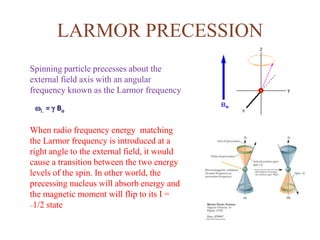
LARMOR PRECESSION
Spinning particle precesses about the
external field axis with an angular
frequency known as the Larmor frequency
wL = g Bo
When radio frequency energy matching
the Larmor frequency is introduced at a
right angle to the external field, it would
cause a transition between the two energy
levels of the spin. In other world, the
precessing nucleus will absorb energy and
the magnetic moment will flip to its I =
_1/2 state
g- VALUES FOR SOME NUCLEI
Isotope Net Spin g / MHz T-1 Abundance / %
1H 1/2 42.58 99.98
2H 1 6.54 0.015
3H 1/2 45.41 0.0
31P 1/2 17.25 100.0
23Na 3/2 11.27 100.0
14N 1 3.08 99.63
15N 1/2 4.31 0.37
13C 1/2 10.71 1.108
19F 1/2 40.08 100.0
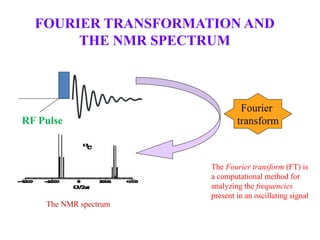
FOURIER TRANSFORMATION AND
THE NMR SPECTRUM
Fourier
transformRF Pulse
The Fourier transform (FT) is
a computational method for
analyzing the frequencies
present in an oscillating signal
The NMR spectrum
1H NMR spectra
13C NMR spectra
d ppm
d ppm
High fieldDown field
1H NMR and 13C NMR SPECTRUM
CHEMICAL SHIFT-d
When an atom is placed in a magnetic field, its electrons
circulate about the direction of the applied magnetic
field. This circulation causes a small magnetic field at
the nucleus which opposes the externally applied field
The magnetic field at the nucleus (the effective field)
is therefore generally less than the applied field by a
fraction :
B  B0 (1-s), So u  g B0 (1-s) / 2
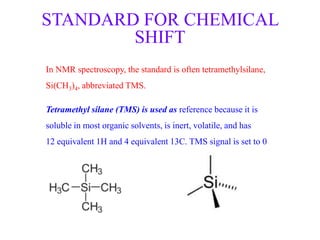
STANDARD FOR CHEMICAL
SHIFT
In NMR spectroscopy, the standard is often tetramethylsilane,
Si(CH3)4, abbreviated TMS.
Tetramethyl silane (TMS) is used as reference because it is
soluble in most organic solvents, is inert, volatile, and has
12 equivalent 1H and 4 equivalent 13C. TMS signal is set to 0
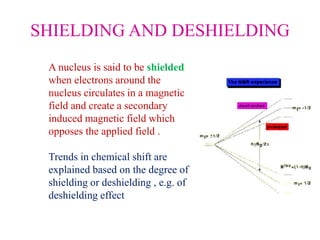
SHIELDING AND DESHIELDING
A nucleus is said to be shielded
when electrons around the
nucleus circulates in a magnetic
field and create a secondary
induced magnetic field which
opposes the applied field .
Trends in chemical shift are
explained based on the degree of
shielding or deshielding , e.g. of
deshielding effect
CHEMICAL SHIFT-d
Chemical shift depends on :
• Electronegativity of nearby atoms
• Hybridization of adjacent atoms
• diamagnetic effects
• paramagnetic effects
• solvent effect
Spin-spin coupling:
The coupling of the intrinsic angular momentum of different
particles. Such coupling between pairs of nuclear spins is an
important feature of nuclear magnetic resonance (NMR)
spectroscopy as it can provide detailed information about the
structure and conformation of molecules.
Spin-spin coupling between nuclear spin and electronic spin is
responsible for hyperfine structure in atomic spectra.
SPIN-SPIN COUPLING
J-Coupling
J-coupling:
also called indirect spin-spin coupling, is the coupling between two
nuclear spins due to the influence of bonding electrons on the
magnetic field running between the two nuclei. J-coupling provides
information about dihedral angles, which can be estimated using
the Karplus equation. It is an important observable effect in 1D
NMR spectroscopy.
The coupling constant, J (usually in frequency units, Hz) is a
measure of the interaction between a pair of nuclei
1H-NMR
• 1H experiencing the same chemical environment
or chemical shift are called equivalent hydrogens.
• 1H experiencing different environment or having
different chemical shifts are nonequivalent hydrogens.
CHEMICAL SHIFT - 1H-NMR
RCH2 OR
( CH3 ) 4 Si
ArCH3
RCH3
RC CH
RCCH3
ROH
RCH2 OH
ArCH2 R
O
O
RCH2 R
R3 CH
R2 NH
RCCH2 R
R2 C= CRCHR2
R2 C= CHR
RCH
O
RCOH
O
RCH2 Cl
RCH2 Br
RCH2 I
RCH2 F
ArH
O
O
R2 C= CH2
RCOCH3
RCOCH2 R
ArOH
9.5-10.1
3.7-3.9
3.4-3.6
Type of
Hydrogen
0 (by definition)
Type of
Hydrogen
Chemical
Shift (d)
1.6-2.6
2.0-3.0
0.8-1.0
1.2-1.4
1.4-1.7
2.1-2.3
0.5-6.0
2.2-2.6
3.4-4.0
Chemical
Shift (d)
3.3-4.0
2.2-2.5
2.3-2.8
0.5-5.0
4.6-5.0
5.0-5.7
10-13
4.1-4.7
3.1-3.3
3.6-3.8
4.4-4.5
6.5-8.5
4.5-4.7
1H CHEMICAL SHIFTS
Chemical shift : (1) electronegativity of nearby atoms, (2) hybridization of
adjacent atoms, and (3) diamagnetic effects
Electronegativity
CH3OH
CH3F
CH3Cl
CH3Br
CH3I
(CH3) 4C
(CH3) 4Si
CH3-X
Electroneg-
ativity of X
Chemical
Shift (d)
4.0
3.5
3.1
2.8
2.5
2.1
1.8
4.26
3.47
3.05
2.68
2.16
0.86
0.00
FACTORS TO AFFECT 1H CHEMICAL SHIFT
Hybridization of adjacent atoms
RCH3 , R2 CH2 , R3 CH
R2 C=CHR, R2 C=CH2
RCHO
R2 C=C(R)CHR2
RC CH
Allylic
Type of Hydrogen
(R = alkyl)
Name of
Hydrogen
Chemical
Shift (d)
Alkyl
Acetylenic
Vinylic
Aldehydic
0.8 - 1.7
1.6 - 2.6
4.6 - 5.7
9.5-10.1
2.0 - 3.0
Carbon-Carbon Triple Bond Effect
A carbon-carbon triple bond shields an acetylenic hydrogen
and shifts its signal to lower frequency (to the right) to a
smaller value
RCH3
R2 C=CH2
RC CH
Type of H Name
Alkyl
Vinylic
Acetylenic
0.8- 1.0
4.6 - 5.7
2.0 - 3.0
Chemical
Shift (d)
CARBON-CARBON DOUBLE BOND EFFECT
Magnetic induction in the p bond of a carbon-carbon double bond
deshields vinylic hydrogens and shifts their signal higher frequency
AROMATIC EFFECT
The magnetic field induced by circulation of p electrons in an aromatic
ring deshields the hydrogens on the ring and shifts their signal to
higher frequency
SIGNAL SPLITTING FOR 1H
Peak:
The units into which an NMR signal is split; doublet, triplet, quartet,
multiplet, etc.
Signal splitting:
Splitting of an NMR signal into a set of peaks by the influence of
neighboring nonequivalent hydrogens.
(n + 1) rule:
If a hydrogen has n hydrogens nonequivalent to it but equivalent
among themselves on the same or adjacent atom(s), its 1H-NMR
signal is split into (n + 1) peaks.
The relative peak intensities for
multiplet peaks arising from J-
coupling of a 1H to N equivalent
1H can be determined using Pascal’s
triangle:
PASCAL’S TRIANGLE
COUPLING CONSTANT
Coupling constant (J):
The separation on an NMR
spectrum (in hertz) between
adjacent peaks in a multiplet.
13C-NMR SPECTROSCOPY
Organic compounds contain carbon. Unfortunately, the C-12
nucleus does not have a nuclear spin, but the C-13 nucleus does due
to the presence of an unpaired neucarbon-1tron. C-13 nuclei make
up approximately 1% of the carbon nuclei on earth. Therefore, 13C
NMR will be much less sensitive than 1HNMR NMR
13C-NMR SPECTROSCOPY
The presence of spin-spin coupling between a 13C nucleus and
the nuclei of 1H atoms bonded to the 13C, splits the carbon-13
peaks and causes an even poorer signal-to-noise ratio
Each nonequivalent 13C gives a different signal
A 13C signal is split by the 1H bonded to it according to the
(n + 1) rule.
Coupling constants of 100-250 Hz are common, which
means that there is often significant overlap between signals,
and splitting patterns can be very difficult to determine.
The most common mode of operation of a 13C-NMR
spectrometer is a proton-decoupled mode.
proton-decoupled mode,
a sample is irradiated with two different radiofrequencies. One to
excite all 13C nuclei, a second to cause all protons in the molecule
to undergo rapid transitions between their nuclear spin states.
On the time scale of a 13C-NMR spectrum, each proton is in an
average or effectively constant nuclear spin state, with the result
that 1H-13C spin-spin interactions are not observed and they are
decoupled.
DECOUPLING
CHEMICAL SHIFT - 13C-NMR
Characteristic Carbon NMR Chemical Shifts (ppm)
(CH3)4Si = TMS = 0.00 ppm (singlet) CDCl3 (solvent) = 77.0 ppm (triplet)
RCH3 0 – 40 RCH2Cl 35 – 80 benzene ring 110 – 160
RCH2R 15 – 55 R3COH 40 – 80 C=O ester 160 – 180
R3CH 20 – 60 R3COR 40 - 80 C=O amide 165 – 180
RCH2I 0 – 40 RCCR 65 – 85 C=O carboxylic acid 175 – 185
RCH2Br 25 - 65 R2C=CR2 100 - 150 C=O aldehyde, ketone 180 – 210
Trends
•RCH3 < R2CH2 < R3CH
•Electronegative atoms cause downfield shift
•Pi bonds cause downfield shift
•C=O 160-210 ppm
13C-NMR: INTEGRATION
1H-NMR: Integration reveals relative number of hydrogens per signal
13C-NMR: Integration reveals relative number of carbons per signal
•Rarely useful due to slow relaxation time for 13C
time for nucleus to relax from
excited spin state to ground state
INTERPRETING NMR SPECTRA
Alkanes
1H-NMR signals appear in the range of 0.8-1.7.
13C-NMR signals appear in the considerably wider
range of 10-60.
Alkenes
1H-NMR signals appear in the range 4.6-5.7.
1H-NMR coupling constants are generally larger for
trans-vinylic hydrogens (J= 11-18 Hz) compared
with cis-vinylic hydrogens (J= 5-10 Hz).
13C-NMR signals for sp2 hybridized carbons appear in
the range 100-160, which is to higher frequency from
the signals of sp3 hybridized carbons.
INTERPRETING NMR SPECTRA
Alcohols
1H-NMR O-H chemical shift often appears in the range 3.0-4.0, but
may be as low as 0.5.
1H-NMR chemical shifts of hydrogens on the carbon bearing the -OH
group are deshielded by the electron-withdrawing inductive effect of
the oxygen and appear in the range 3.0-4.0.
Ethers
A distinctive feature in the 1H-NMR spectra of ethers is the chemical
shift, 3.3-4.0, of hydrogens on the carbons bonded to the ether oxygen.
a
a
b
b
Aldehydes and ketones
1H-NMR: aldehyde hydrogens appear at 9.5-10.1.
1H-NMR: a-hydrogens of aldehydes and ketones appear at 2.2-2.6.
13C-NMR: carbonyl carbons appear at 180-215.
Amines
1H-NMR: amine hydrogens appear at 0.5-5.0 depending on conditions.
INTERPRETING NMR SPECTRA
1H NMR isobutyraldehyde
1H NMR Methyl ethyl ketone
a
b c
b
c
a
a
a
b
c
c
b
INTERPRETING NMR SPECTRA
Carboxylic acids
1H-NMR: carboxyl hydrogens appear at 10-13 ppm, higher than most
other types of hydrogens.
13C-NMR: carboxyl carbons in acids and esters appear at 160-180 ppm.
c
c b
b
a
a
NMR

NMR

  • 1.
    Nuclear Magnetic Resonance(NMR) Spectroscopy BY: Mr. VIKAS CHANDRA SHARMA Asst. Prof., Department of Chemistry
  • 2.
    •NUCLEAR MAGNETIC RESONANCESPECTROSCOPY: Commonly referred to as NMR, is a technique which exploits the magnetic properties of certain nuclei to study physical, chemical, and biological properties of matter Compared to mass spectrometry, larger amounts of sample are needed, but non-destructive DEFINITION
  • 3.
    Fermions : Oddmass nuclei with an odd number of nucleons have fractional spins. I = 1/2 ( 1H, 13C, 19F, 31P ), I = 3/2 ( 11B, 33S ) & I = 5/2 ( 17O ). Bosons : Even mass nuclei with odd numbers of protons and neutrons have integral spins. I = 1 ( 2H, 14N ) Even mass nuclei composed of even numbers of protons and neutrons have zero spin I = 0 (12C, and 16O, 32S) SPIN OF NUCLEI
  • 4.
    A spinning chargegenerates a magnetic field, the resulting spin-magnet has a magnetic moment (μ) proportional to the spin I magnetic moment m = g p where g is the gyromagnetic ratio , and it is a constant for a given nucleus ggm 2/)1( hIIp  When I=0, m=0 “Right Hand Rule” determines the direction of the magnetic field around a current-carrying wire and vice-versa ** There is no spin for nuclei with I=0 ANGULAR MOMENTUM
  • 5.
    ENERGY DIFFERENTIATION In thepresence of an external magnetic field (B0), two spin states exist, +1/2 and -1/2 (For I=1/2). The magnetic moment of the lower energy +1/2 state is aligned with the external field, and that of the higher energy -1/2 spin state is opposed to the external field. Aligned against the applied field Aligned with the applied field
  • 6.
    When the energyof the photon matches the energy difference between the two spin states , an absorption of energy occurs. We call that phenomenon Resonance Difference in energy between the two states is given by: DE = g h Bo / 2 where: Bo – external magnetic field h – Planck’s constant g – gyromagnetic ratio DE = hu = ghBo / 2 So, u = g Bo / 2 ENERGY DIFFERENTIATION
  • 7.
    LARMOR PRECESSION Spinning particleprecesses about the external field axis with an angular frequency known as the Larmor frequency wL = g Bo When radio frequency energy matching the Larmor frequency is introduced at a right angle to the external field, it would cause a transition between the two energy levels of the spin. In other world, the precessing nucleus will absorb energy and the magnetic moment will flip to its I = _1/2 state
  • 8.
    g- VALUES FORSOME NUCLEI Isotope Net Spin g / MHz T-1 Abundance / % 1H 1/2 42.58 99.98 2H 1 6.54 0.015 3H 1/2 45.41 0.0 31P 1/2 17.25 100.0 23Na 3/2 11.27 100.0 14N 1 3.08 99.63 15N 1/2 4.31 0.37 13C 1/2 10.71 1.108 19F 1/2 40.08 100.0
  • 9.
    FOURIER TRANSFORMATION AND THENMR SPECTRUM Fourier transformRF Pulse The Fourier transform (FT) is a computational method for analyzing the frequencies present in an oscillating signal The NMR spectrum
  • 10.
    1H NMR spectra 13CNMR spectra d ppm d ppm High fieldDown field 1H NMR and 13C NMR SPECTRUM
  • 11.
    CHEMICAL SHIFT-d When anatom is placed in a magnetic field, its electrons circulate about the direction of the applied magnetic field. This circulation causes a small magnetic field at the nucleus which opposes the externally applied field The magnetic field at the nucleus (the effective field) is therefore generally less than the applied field by a fraction : B  B0 (1-s), So u  g B0 (1-s) / 2
  • 12.
    STANDARD FOR CHEMICAL SHIFT InNMR spectroscopy, the standard is often tetramethylsilane, Si(CH3)4, abbreviated TMS. Tetramethyl silane (TMS) is used as reference because it is soluble in most organic solvents, is inert, volatile, and has 12 equivalent 1H and 4 equivalent 13C. TMS signal is set to 0
  • 13.
    SHIELDING AND DESHIELDING Anucleus is said to be shielded when electrons around the nucleus circulates in a magnetic field and create a secondary induced magnetic field which opposes the applied field . Trends in chemical shift are explained based on the degree of shielding or deshielding , e.g. of deshielding effect
  • 14.
    CHEMICAL SHIFT-d Chemical shiftdepends on : • Electronegativity of nearby atoms • Hybridization of adjacent atoms • diamagnetic effects • paramagnetic effects • solvent effect
  • 15.
    Spin-spin coupling: The couplingof the intrinsic angular momentum of different particles. Such coupling between pairs of nuclear spins is an important feature of nuclear magnetic resonance (NMR) spectroscopy as it can provide detailed information about the structure and conformation of molecules. Spin-spin coupling between nuclear spin and electronic spin is responsible for hyperfine structure in atomic spectra. SPIN-SPIN COUPLING
  • 16.
    J-Coupling J-coupling: also called indirectspin-spin coupling, is the coupling between two nuclear spins due to the influence of bonding electrons on the magnetic field running between the two nuclei. J-coupling provides information about dihedral angles, which can be estimated using the Karplus equation. It is an important observable effect in 1D NMR spectroscopy. The coupling constant, J (usually in frequency units, Hz) is a measure of the interaction between a pair of nuclei
  • 17.
    1H-NMR • 1H experiencingthe same chemical environment or chemical shift are called equivalent hydrogens. • 1H experiencing different environment or having different chemical shifts are nonequivalent hydrogens.
  • 18.
  • 19.
    RCH2 OR ( CH3) 4 Si ArCH3 RCH3 RC CH RCCH3 ROH RCH2 OH ArCH2 R O O RCH2 R R3 CH R2 NH RCCH2 R R2 C= CRCHR2 R2 C= CHR RCH O RCOH O RCH2 Cl RCH2 Br RCH2 I RCH2 F ArH O O R2 C= CH2 RCOCH3 RCOCH2 R ArOH 9.5-10.1 3.7-3.9 3.4-3.6 Type of Hydrogen 0 (by definition) Type of Hydrogen Chemical Shift (d) 1.6-2.6 2.0-3.0 0.8-1.0 1.2-1.4 1.4-1.7 2.1-2.3 0.5-6.0 2.2-2.6 3.4-4.0 Chemical Shift (d) 3.3-4.0 2.2-2.5 2.3-2.8 0.5-5.0 4.6-5.0 5.0-5.7 10-13 4.1-4.7 3.1-3.3 3.6-3.8 4.4-4.5 6.5-8.5 4.5-4.7 1H CHEMICAL SHIFTS
  • 20.
    Chemical shift :(1) electronegativity of nearby atoms, (2) hybridization of adjacent atoms, and (3) diamagnetic effects Electronegativity CH3OH CH3F CH3Cl CH3Br CH3I (CH3) 4C (CH3) 4Si CH3-X Electroneg- ativity of X Chemical Shift (d) 4.0 3.5 3.1 2.8 2.5 2.1 1.8 4.26 3.47 3.05 2.68 2.16 0.86 0.00 FACTORS TO AFFECT 1H CHEMICAL SHIFT
  • 21.
    Hybridization of adjacentatoms RCH3 , R2 CH2 , R3 CH R2 C=CHR, R2 C=CH2 RCHO R2 C=C(R)CHR2 RC CH Allylic Type of Hydrogen (R = alkyl) Name of Hydrogen Chemical Shift (d) Alkyl Acetylenic Vinylic Aldehydic 0.8 - 1.7 1.6 - 2.6 4.6 - 5.7 9.5-10.1 2.0 - 3.0
  • 22.
    Carbon-Carbon Triple BondEffect A carbon-carbon triple bond shields an acetylenic hydrogen and shifts its signal to lower frequency (to the right) to a smaller value RCH3 R2 C=CH2 RC CH Type of H Name Alkyl Vinylic Acetylenic 0.8- 1.0 4.6 - 5.7 2.0 - 3.0 Chemical Shift (d)
  • 23.
    CARBON-CARBON DOUBLE BONDEFFECT Magnetic induction in the p bond of a carbon-carbon double bond deshields vinylic hydrogens and shifts their signal higher frequency
  • 24.
    AROMATIC EFFECT The magneticfield induced by circulation of p electrons in an aromatic ring deshields the hydrogens on the ring and shifts their signal to higher frequency
  • 25.
    SIGNAL SPLITTING FOR1H Peak: The units into which an NMR signal is split; doublet, triplet, quartet, multiplet, etc. Signal splitting: Splitting of an NMR signal into a set of peaks by the influence of neighboring nonequivalent hydrogens. (n + 1) rule: If a hydrogen has n hydrogens nonequivalent to it but equivalent among themselves on the same or adjacent atom(s), its 1H-NMR signal is split into (n + 1) peaks.
  • 26.
    The relative peakintensities for multiplet peaks arising from J- coupling of a 1H to N equivalent 1H can be determined using Pascal’s triangle: PASCAL’S TRIANGLE
  • 27.
    COUPLING CONSTANT Coupling constant(J): The separation on an NMR spectrum (in hertz) between adjacent peaks in a multiplet.
  • 28.
    13C-NMR SPECTROSCOPY Organic compoundscontain carbon. Unfortunately, the C-12 nucleus does not have a nuclear spin, but the C-13 nucleus does due to the presence of an unpaired neucarbon-1tron. C-13 nuclei make up approximately 1% of the carbon nuclei on earth. Therefore, 13C NMR will be much less sensitive than 1HNMR NMR
  • 29.
    13C-NMR SPECTROSCOPY The presenceof spin-spin coupling between a 13C nucleus and the nuclei of 1H atoms bonded to the 13C, splits the carbon-13 peaks and causes an even poorer signal-to-noise ratio Each nonequivalent 13C gives a different signal A 13C signal is split by the 1H bonded to it according to the (n + 1) rule. Coupling constants of 100-250 Hz are common, which means that there is often significant overlap between signals, and splitting patterns can be very difficult to determine. The most common mode of operation of a 13C-NMR spectrometer is a proton-decoupled mode.
  • 30.
    proton-decoupled mode, a sampleis irradiated with two different radiofrequencies. One to excite all 13C nuclei, a second to cause all protons in the molecule to undergo rapid transitions between their nuclear spin states. On the time scale of a 13C-NMR spectrum, each proton is in an average or effectively constant nuclear spin state, with the result that 1H-13C spin-spin interactions are not observed and they are decoupled. DECOUPLING
  • 31.
    CHEMICAL SHIFT -13C-NMR Characteristic Carbon NMR Chemical Shifts (ppm) (CH3)4Si = TMS = 0.00 ppm (singlet) CDCl3 (solvent) = 77.0 ppm (triplet) RCH3 0 – 40 RCH2Cl 35 – 80 benzene ring 110 – 160 RCH2R 15 – 55 R3COH 40 – 80 C=O ester 160 – 180 R3CH 20 – 60 R3COR 40 - 80 C=O amide 165 – 180 RCH2I 0 – 40 RCCR 65 – 85 C=O carboxylic acid 175 – 185 RCH2Br 25 - 65 R2C=CR2 100 - 150 C=O aldehyde, ketone 180 – 210 Trends •RCH3 < R2CH2 < R3CH •Electronegative atoms cause downfield shift •Pi bonds cause downfield shift •C=O 160-210 ppm
  • 32.
    13C-NMR: INTEGRATION 1H-NMR: Integrationreveals relative number of hydrogens per signal 13C-NMR: Integration reveals relative number of carbons per signal •Rarely useful due to slow relaxation time for 13C time for nucleus to relax from excited spin state to ground state
  • 33.
    INTERPRETING NMR SPECTRA Alkanes 1H-NMRsignals appear in the range of 0.8-1.7. 13C-NMR signals appear in the considerably wider range of 10-60. Alkenes 1H-NMR signals appear in the range 4.6-5.7. 1H-NMR coupling constants are generally larger for trans-vinylic hydrogens (J= 11-18 Hz) compared with cis-vinylic hydrogens (J= 5-10 Hz). 13C-NMR signals for sp2 hybridized carbons appear in the range 100-160, which is to higher frequency from the signals of sp3 hybridized carbons.
  • 35.
    INTERPRETING NMR SPECTRA Alcohols 1H-NMRO-H chemical shift often appears in the range 3.0-4.0, but may be as low as 0.5. 1H-NMR chemical shifts of hydrogens on the carbon bearing the -OH group are deshielded by the electron-withdrawing inductive effect of the oxygen and appear in the range 3.0-4.0. Ethers A distinctive feature in the 1H-NMR spectra of ethers is the chemical shift, 3.3-4.0, of hydrogens on the carbons bonded to the ether oxygen.
  • 36.
  • 37.
    Aldehydes and ketones 1H-NMR:aldehyde hydrogens appear at 9.5-10.1. 1H-NMR: a-hydrogens of aldehydes and ketones appear at 2.2-2.6. 13C-NMR: carbonyl carbons appear at 180-215. Amines 1H-NMR: amine hydrogens appear at 0.5-5.0 depending on conditions. INTERPRETING NMR SPECTRA
  • 38.
    1H NMR isobutyraldehyde 1HNMR Methyl ethyl ketone a b c b c a a a b c c b
  • 39.
    INTERPRETING NMR SPECTRA Carboxylicacids 1H-NMR: carboxyl hydrogens appear at 10-13 ppm, higher than most other types of hydrogens. 13C-NMR: carboxyl carbons in acids and esters appear at 160-180 ppm. c c b b a a