





NMR
SPECTROSCOPY
P. viji
M.Pharm I year
(pharmaceutics)
NMR SPECTROSCOPY
• Nuclear magnetic resonance is a branch of
spectroscopy in which radiofrequency waves induce
transition between magnetic energy level of nucleic
of atom .
Relaxation
• The excited nucleus loses its energy of excitation and
returns to the unexcited state . The process of losing
energy is called relaxation and time spent in the
excited state is the relaxation time .
There are two principle modes of relaxation,
 Longitudinal relaxation /spin lattice
 Transverse relaxation /spin spin
A. longitudinal / spin- spin relaxation
 When the nucleus loses its excitation energy to the surrounding
molecules, the system becomes warm as the energy is changed to
heat.
 The excitation energy becomes dispersed throughout the whole
system of molecules in which the sample finds it self. No radiation
energy appears, no other nuclei become excited. Instead, as
numerous nuclei lose their energy in this fashion, the temperature of
the sample goes up. This process is called longitudinal relaxation T1.
B. transverse / spin- spin relaxation
 An excited nucleus may transfer its energy to an similar unexcited nucleus
that is nearby.
 In this process, the nearby unexcited nucleus becomes excited a the
previously excited nucleus become unexcited. This mutual exchange of spin
energy is termed as spin-spin relaxation
 There is no net change in energy of the system, but the length of
the time that one nucleus stays excited is shortened. This process, which is called
transverse relaxation T2.
Shielding of proton :
 High electron density around a proton shields the proton from the external
magnetic field.
 Shielded proton requires less energy to spin .
 The signal are upfield in NMR spectrum .
Deshielding of proton:
 Lower electron density around a proton deshields theproton from the external
magnetic field.
 DeShielded proton requires high energy to spin .
 The signal are downfield in NMR spectrum .
 Electronegative value of the atom will be arranged as following :
F=4.0
O=3.5
N=3.0 Cl=3.0
I=2.5 S=2.5 C= 2.5
P=2.2
H=2.1
Si=1.9
CHEMICAL SHIFT
 The difference between the absorption position of a
proton and the absorption position of a reference
compound is known as the chemical shift.
Measurement of Chemical Shift
 0.5% Tetra methylsilane(TMS) is used as reference or standard
compound.
 Chemical shift is represented by δ
Reason for TMS as reference std
 Accepted internal standard.
 TMS has 12 equivalent protons and gives an intense single signal.
 Electro negativity of silicon is very low so the shielding of equivalent
protons in TMS is more than other compound so all the signal arrives in a
down field direction.
δ scale
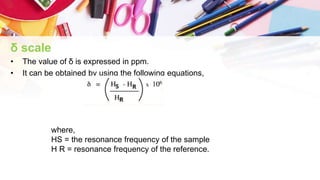
• The value of δ is expressed in ppm.
• It can be obtained by using the following equations,
where,
HS = the resonance frequency of the sample
H R = resonance frequency of the reference.
τ scale
 The value of τ is expressed as 10 ppm. i.e.,
τ = 10- δ
Factors Influencing Chemical Shift
Inductive effect.
Vander Waal’s deshielding
Anisotropic effects
Hydrogen bonding
a) Inductive effect
• The presence of electronegative atoms or groups in a molecule makes
the proton deshielded.
• Higher the electronegativity, greater will be the deshielding and thus the δ
value will also be more.
• i.e., F > Cl > Br > I
b) Vander Waal’s deshielding
• The presence of bulky groups in a molecule can cause deshielding due to the week
Vander Waal’s force and give slightly higher value of δ than expected.
• electronegative cloud of bulky group(hindering group) will tend to repell the electron
cloud surrounding proton.
• Thus such a proton will be deshielded and will resonate a slightly higher values of
delta then expected in the absence of this effect.This is considered as vanderwaal’s
deshielding.
c) Anisotropic effect (space effect)
 Anisotropic effect arises due to the orientation of nuclei with respect to the
applied magnetic field.
 Chemical bonds can set up magnetic field, the effect of this field on the
chemical shift is depend upon the spacial arrangements.
 π – bonds effects the chemical shift and cause downfield shift with higher δ
value.
d) Hydrogen bonding
• Intra-molecular hydrogen bonding does not show any change in absorption
due to change in concentration.
• While hydrogen atom involved in the intermolecular H-bonding shares its
electrons with two electronegative elements and as a result it itself
deshielded and get higher δ value.
• E.g. Carboxylic acid dimer and β-diketones.
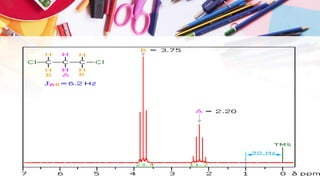
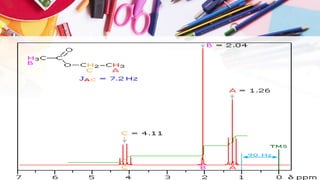
SPLITTING OF THE SIGNALS
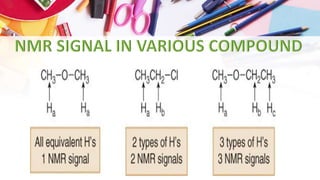
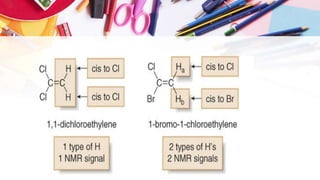
 Each signals in NMR spectrum represents one kind or one set of protons in
the molecule.
 In certain molecules, instead of a single peak, a group of peaks are
observed.
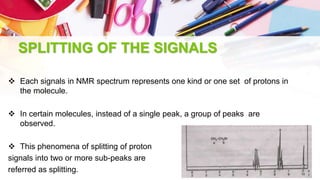
 This phenomena of splitting of proton
signals into two or more sub-peaks are
referred as splitting.
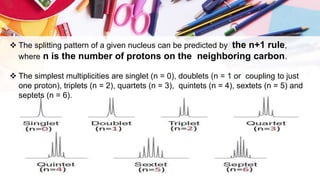
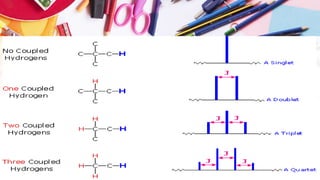
 The splitting pattern of a given nucleus can be predicted by the n+1 rule,
where n is the number of protons on the neighboring carbon.
 The simplest multiplicities are singlet (n = 0), doublets (n = 1 or coupling to just
one proton), triplets (n = 2), quartets (n = 3), quintets (n = 4), sextets (n = 5) and
septets (n = 6).
COUPLING CONSTANT
• The spacing of adjacent lines in the multiplet is a direct measure of the spin-
spin coupling and is known as coupling constant (J).
• It is the distance between two adjacent sub-peaks in a split signal.
• J value is expressed in Hertz(Hz) or in cycles per second(cps).
NMR SPECTROSCOPY
NMR SPECTROSCOPY
NMR SPECTROSCOPY
NMR SPECTROSCOPY
NMR SPECTROSCOPY
NMR SPECTROSCOPY
NMR SPECTROSCOPY
NMR SPECTROSCOPY
NMR SPECTROSCOPY
NMR SPECTROSCOPY
NMR SPECTROSCOPY

NMR SPECTROSCOPY

  • 1.
  • 2.
    NMR SPECTROSCOPY • Nuclearmagnetic resonance is a branch of spectroscopy in which radiofrequency waves induce transition between magnetic energy level of nucleic of atom .
  • 4.
    Relaxation • The excitednucleus loses its energy of excitation and returns to the unexcited state . The process of losing energy is called relaxation and time spent in the excited state is the relaxation time .
  • 5.
    There are twoprinciple modes of relaxation,  Longitudinal relaxation /spin lattice  Transverse relaxation /spin spin
  • 6.
    A. longitudinal /spin- spin relaxation  When the nucleus loses its excitation energy to the surrounding molecules, the system becomes warm as the energy is changed to heat.  The excitation energy becomes dispersed throughout the whole system of molecules in which the sample finds it self. No radiation energy appears, no other nuclei become excited. Instead, as numerous nuclei lose their energy in this fashion, the temperature of the sample goes up. This process is called longitudinal relaxation T1.
  • 7.
    B. transverse /spin- spin relaxation  An excited nucleus may transfer its energy to an similar unexcited nucleus that is nearby.  In this process, the nearby unexcited nucleus becomes excited a the previously excited nucleus become unexcited. This mutual exchange of spin energy is termed as spin-spin relaxation  There is no net change in energy of the system, but the length of the time that one nucleus stays excited is shortened. This process, which is called transverse relaxation T2.
  • 8.
    Shielding of proton:  High electron density around a proton shields the proton from the external magnetic field.  Shielded proton requires less energy to spin .  The signal are upfield in NMR spectrum . Deshielding of proton:  Lower electron density around a proton deshields theproton from the external magnetic field.  DeShielded proton requires high energy to spin .  The signal are downfield in NMR spectrum .
  • 9.
     Electronegative valueof the atom will be arranged as following : F=4.0 O=3.5 N=3.0 Cl=3.0 I=2.5 S=2.5 C= 2.5 P=2.2 H=2.1 Si=1.9
  • 12.
    CHEMICAL SHIFT  Thedifference between the absorption position of a proton and the absorption position of a reference compound is known as the chemical shift.
  • 13.
    Measurement of ChemicalShift  0.5% Tetra methylsilane(TMS) is used as reference or standard compound.  Chemical shift is represented by δ
  • 14.
    Reason for TMSas reference std  Accepted internal standard.  TMS has 12 equivalent protons and gives an intense single signal.  Electro negativity of silicon is very low so the shielding of equivalent protons in TMS is more than other compound so all the signal arrives in a down field direction.
  • 15.
    δ scale • Thevalue of δ is expressed in ppm. • It can be obtained by using the following equations, where, HS = the resonance frequency of the sample H R = resonance frequency of the reference.
  • 16.
    τ scale  Thevalue of τ is expressed as 10 ppm. i.e., τ = 10- δ
  • 17.
    Factors Influencing ChemicalShift Inductive effect. Vander Waal’s deshielding Anisotropic effects Hydrogen bonding
  • 18.
    a) Inductive effect •The presence of electronegative atoms or groups in a molecule makes the proton deshielded. • Higher the electronegativity, greater will be the deshielding and thus the δ value will also be more. • i.e., F > Cl > Br > I
  • 19.
    b) Vander Waal’sdeshielding • The presence of bulky groups in a molecule can cause deshielding due to the week Vander Waal’s force and give slightly higher value of δ than expected. • electronegative cloud of bulky group(hindering group) will tend to repell the electron cloud surrounding proton. • Thus such a proton will be deshielded and will resonate a slightly higher values of delta then expected in the absence of this effect.This is considered as vanderwaal’s deshielding.
  • 20.
    c) Anisotropic effect(space effect)  Anisotropic effect arises due to the orientation of nuclei with respect to the applied magnetic field.  Chemical bonds can set up magnetic field, the effect of this field on the chemical shift is depend upon the spacial arrangements.  π – bonds effects the chemical shift and cause downfield shift with higher δ value.
  • 21.
    d) Hydrogen bonding •Intra-molecular hydrogen bonding does not show any change in absorption due to change in concentration. • While hydrogen atom involved in the intermolecular H-bonding shares its electrons with two electronegative elements and as a result it itself deshielded and get higher δ value. • E.g. Carboxylic acid dimer and β-diketones.
  • 22.
    SPLITTING OF THESIGNALS  Each signals in NMR spectrum represents one kind or one set of protons in the molecule.  In certain molecules, instead of a single peak, a group of peaks are observed.  This phenomena of splitting of proton signals into two or more sub-peaks are referred as splitting.
  • 23.
     The splittingpattern of a given nucleus can be predicted by the n+1 rule, where n is the number of protons on the neighboring carbon.  The simplest multiplicities are singlet (n = 0), doublets (n = 1 or coupling to just one proton), triplets (n = 2), quartets (n = 3), quintets (n = 4), sextets (n = 5) and septets (n = 6).
  • 28.
    COUPLING CONSTANT • Thespacing of adjacent lines in the multiplet is a direct measure of the spin- spin coupling and is known as coupling constant (J). • It is the distance between two adjacent sub-peaks in a split signal. • J value is expressed in Hertz(Hz) or in cycles per second(cps).