Overview
• NMR is a sensitive, non-destructive method
for elucidating the structure of organic
molecules
• Information can be gained from the hydrogens
(proton NMR, the most common), carbons
(13C NMR) or other elements like 31P, 15N, 19F.
Types of NMR
 1D NMR
 2D NMR: Data plotted in a space defined by
two frequency axes rather than one
representing the chemical shift
 Types of 2DNMR:
 Correlation spectroscopy (COSY)
 J-spectroscopy exchange spectroscopy (EXSY)
 Nuclear Overhauser effect spectroscopy
(NOESY)
PRINCIPLE
Absorption of energy occurs and a NMR signal is recorded.
Applied Frequency = Precessional frequency,
Radiofrequency is applied
Spin of nuclei is aligned with the externally applied magnetic field.
The nucleus spins on its axis and a magnetic moment is created in a
precessional orbit, with a frequency called precessional frequency (Larmor
frequency).
Application of an external magnetic field (Ho)
Proton or nucleus with odd mass number spins on its own axis.
TYPES OF PROTONS
EQUIVALENT PROTON
A set of protons with same environment are
called equivalent protons
NON –EQUIVALENT PROTON
Sets of protons with different environments are
called non equivalent protons
NMR Signals
• The number of signals shows how many different
kinds of protons are present.
• The location of the signals shows how shielded or
deshielded the proton is.
• The intensity of the signal shows the number of
protons of that type.
• Signal splitting shows the number of protons on
adjacent atoms.
EQUIVALENT PROTONS
NON EQUIVALENT PROTONS
NMR signal splits into doublet, triplet, quartet
etc.
COUPLING CONSTANT
• Separation between the lines of each doublet is
equal.This constant is called the coupling constant
J value.
• It is measured in HZ
• Identical for each signal
• Independent of field strength
Fourier Transform- What it transforms?
a) Single frequency Sine Waves
b) Single frequency FID
c) Three sine wave combination
Instrumentation
Working- A Closer Look
Instrumentation- Sample Holder
Material: Borosilicate Glass
Dimensions:
1. 3mm – 10mm in diameter
2. 7-8 inches in height
Specifications:
1. Concentricity
 Difference between two radial centers using the outer and
inner tube's circumference as reference points.
 Larger difference Non-homogeneity of magnetic field
2. Camber
 Measurement of the degree of curvature of the tube
 Larger value Causes wobbling of the tube while
spinning
Spinner
Sample tube
 Minimum Concentration: 5mg/mL
 Solvents : CCl4, CDCl3, D2O, C6D6
 Why deuterated solvents?
 To avoid swamping of the solvent signal
 To stabilize the magnetic field
 To accurately define 0ppm
 Cleaning of tubes:
 Piranhana Solution/ Aqua Regia
Instrumentation- Sample Preparation
NMR Spectrum- Chemical Shift
 Chemical Shift: Difference in parts per million between the resonance frequency of
the observed proton and TMS (Trimethyl silane) hydrogens.
 TMS ppm is set to 0.
 Shielding/ Deshielding of protons
Factors affecting the Chemical Shift:
1. Electronegativity
2. Magnetic Anisotrophy
3. Hydrogen Bonding
High
Electron density
Low
Electron density
NMR Spectrum- Chemical Shift
NMR Spectrum- Intensity
Intensity  No. of Absorbing Protons
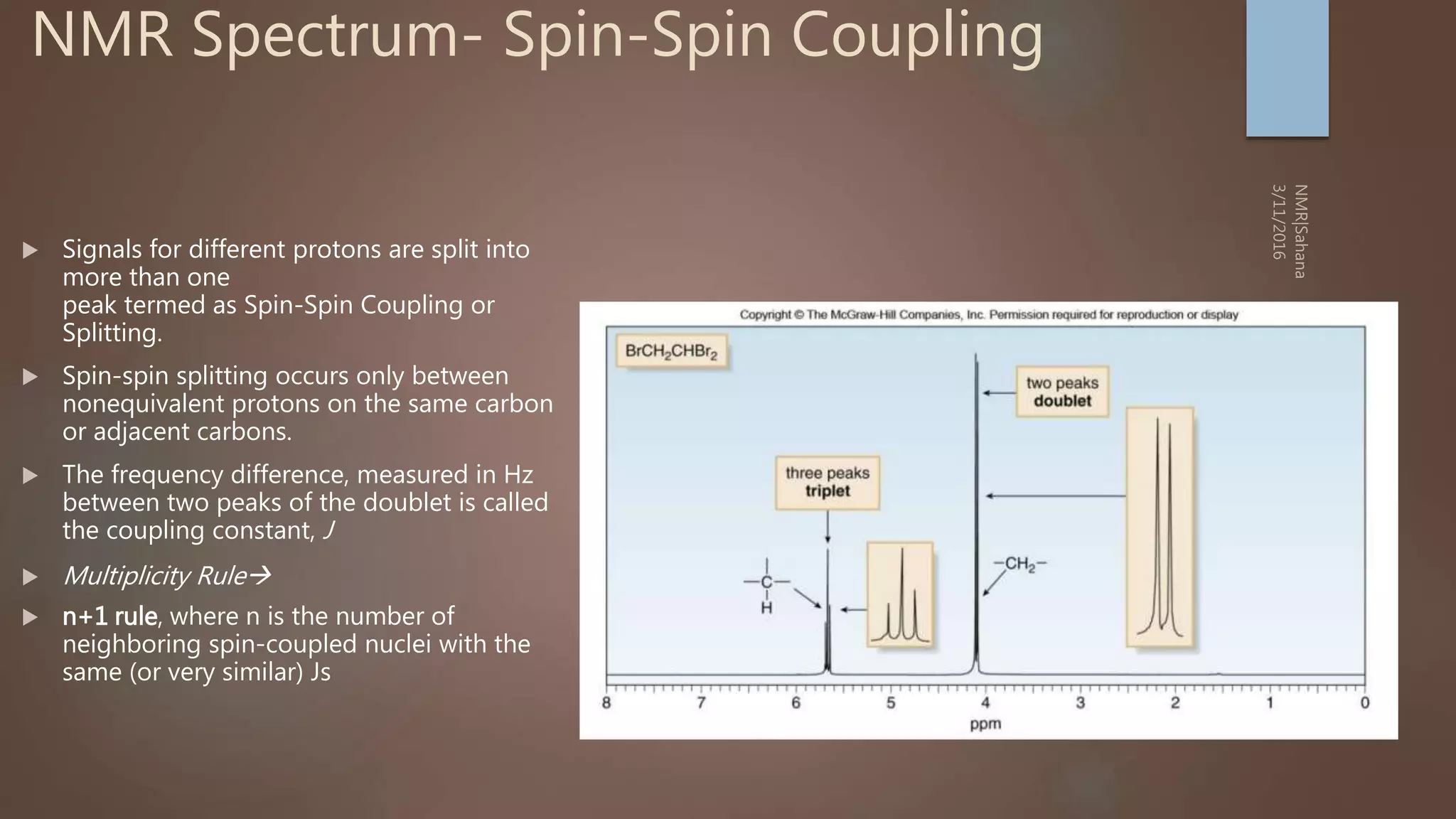
NMR Spectrum- Spin-Spin Coupling
 Signals for different protons are split into
more than one
peak termed as Spin-Spin Coupling or
Splitting.
 Spin-spin splitting occurs only between
nonequivalent protons on the same carbon
or adjacent carbons.
 The frequency difference, measured in Hz
between two peaks of the doublet is called
the coupling constant, J
 Multiplicity Rule
 n+1 rule, where n is the number of
neighboring spin-coupled nuclei with the
same (or very similar) Js
NMR Spectrum- Interpretation
 Number of signals: Indicates how many different kinds of
protons are present
 Position of signals: Indicates Magnetic environment of the
signal
 Relative Intensity: Proportional to number of protons present
 Splitting: Indicates number of splitting Nuclei [Usually
Protons]
Difference between Proton NMR and C13
NMR
Proton NMR 13C NMR
1. It is study of spin changes of
proton nuclei.
1. It is study of spin changes of
carbon nuclei.
2. Chemical shift range is
0-14 ppm.
2. Chemical shift range is
0-240 ppm.
3. Continuous wave method 3. Fourier transform Method
4.slow process 4.Very fast process.
Signature Ranges
In a magnetic field the states have different energies
Alignment with the magnetic field (called ) is
lower energy than against the magnetic field
(called ). How much lower it is, depends on the
strength of the magnetic field
Chemical shift
• Protons in different environments absorb at
different field strengths (for the same frequency)
• Different environment = different electron density
around the H
Aromatic Protons, 7-8
Vinyl Protons, 5-6
Acetylenic Protons, 2.5
O-H and N-H Signals
• Chemical shift depends on concentration.
• Hydrogen bonding in concentrated solutions deshield
the protons, so signal is around 3.5 for N-H and 4.5
for O-H.
• Proton exchange between the molecules broaden the
peak.
Identifying the O-H or N-H Peak
• Chemical shift will depend on concentration and
solvent.
• To verify that a particular peak is due to O-H or N-H,
shake the sample with D2O.
• Deuterium will exchange with the O-H or N-H
protons.
• On a second NMR spectrum the peak will be absent,
or much less intense.
Carboxylic Acid Proton, 10+
Intensity of Signals
• The area under each peak is proportional to
the number of protons.
• Shown by integral trace.
Spin-Spin Splitting
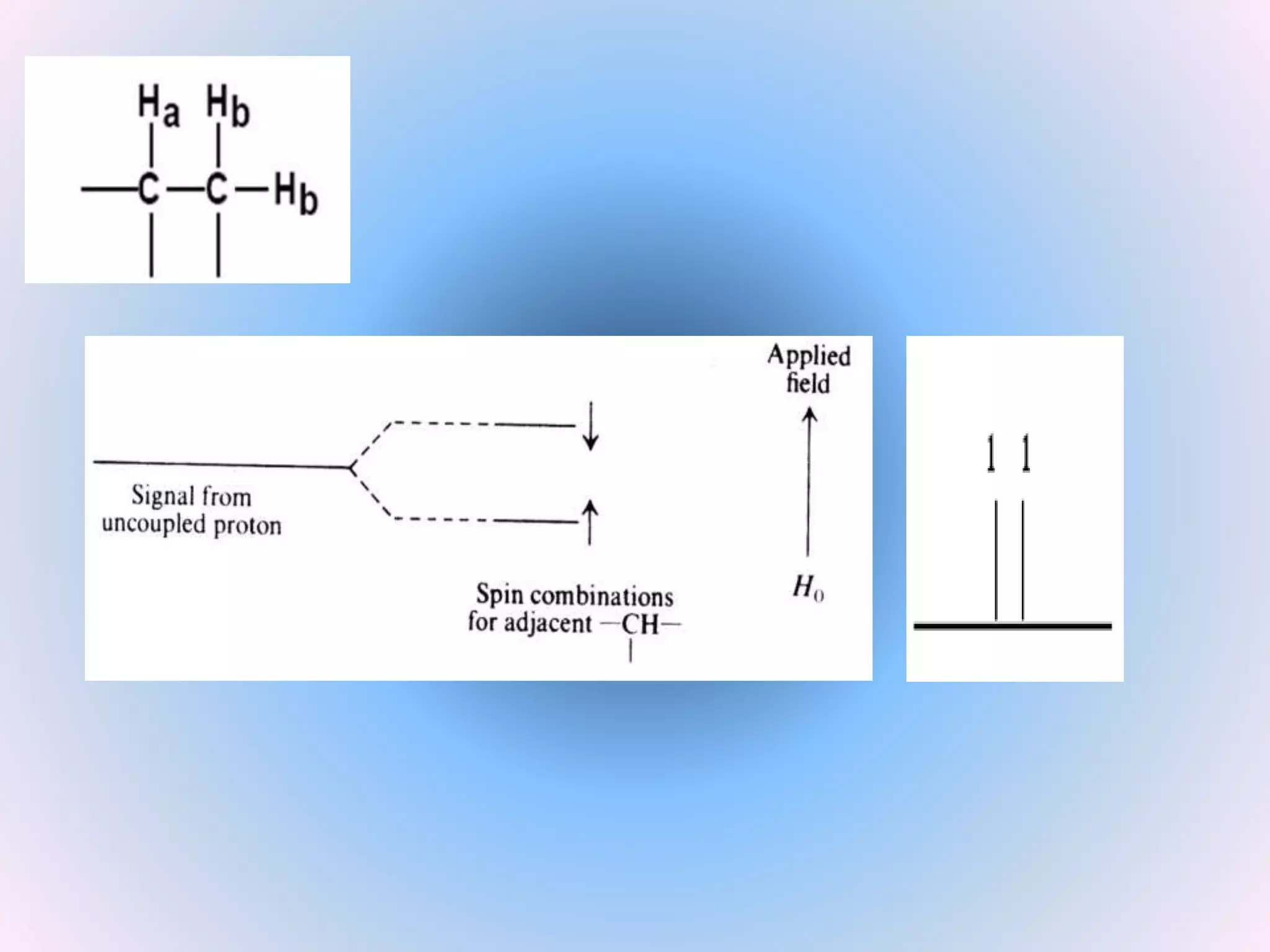
• Nonequivalent protons on adjacent carbons have
magnetic fields that may align with or oppose the
external field.
• This magnetic coupling causes the proton to absorb
slightly downfield when the external field is reinforced
and slightly upfield when the external field is opposed.
The N + 1 Rule
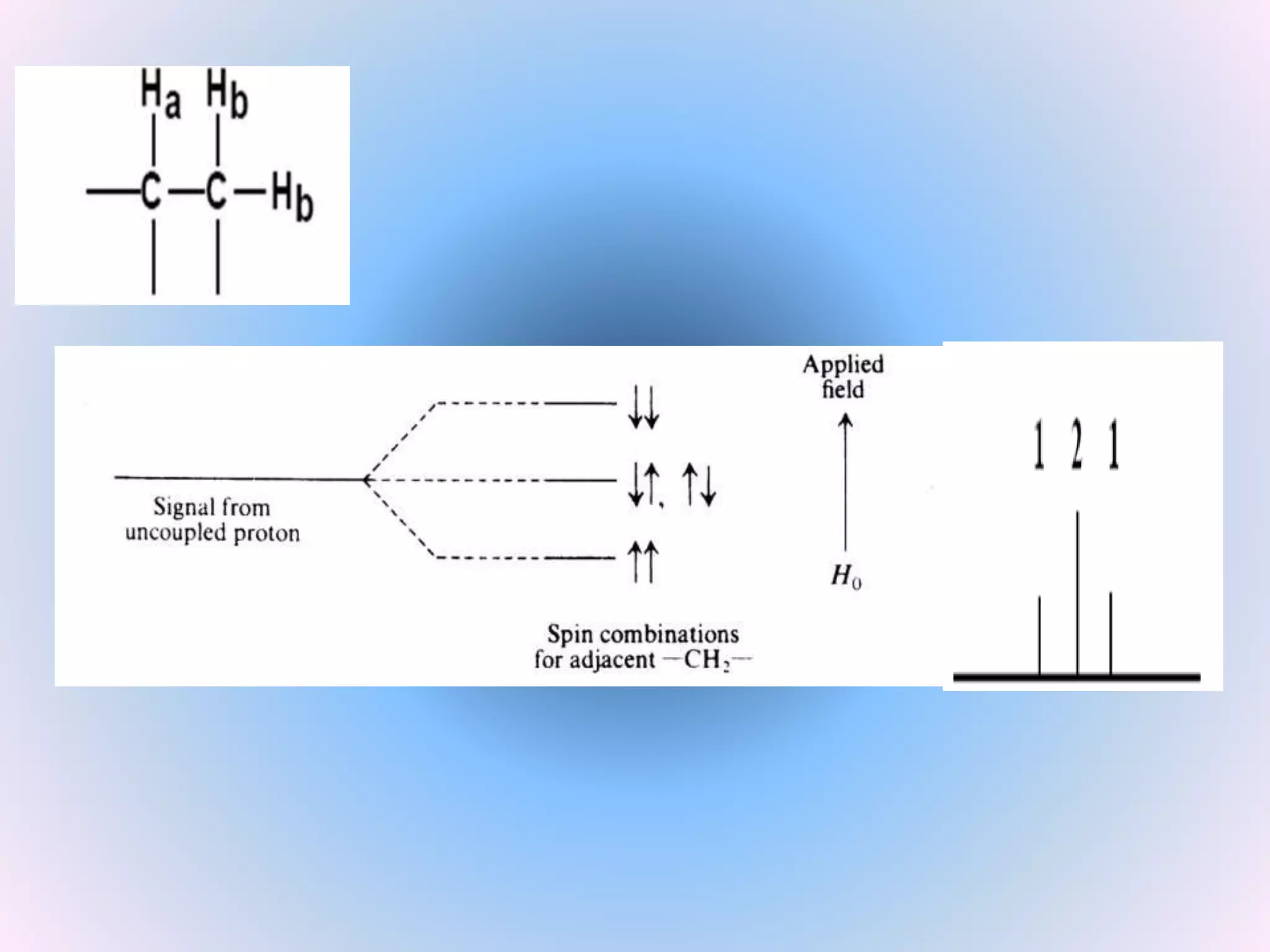
If a signal is split by N equivalent protons,
it is split into N + 1 peaks.
=>
Chapter 13
Doublet: 1 Adjacent Proton
=>
Chapter 13
Triplet: 2 Adjacent Protons
=>
Range of Magnetic Coupling
• Equivalent protons do not split each other.
• Protons bonded to the same carbon will split
each other only if they are not equivalent.
• Protons on adjacent carbons normally will
couple.
• Protons separated by four or more bonds will not
couple.
Coupling Constants
• Distance between the peaks of multiplet
• Measured in Hz
• Not dependent on strength of the external field
• Multiplets with the same coupling constants may
come from adjacent groups of protons that split each
other.
Values for Coupling Constants
Complex Splitting
• Signals may be split by adjacent protons, different
from each other, with different coupling constants.
• Example:
Ha of styrene which is split by an adjacent H trans to it
(J = 17 Hz) and an adjacent H cis to it (J = 11 Hz).
C C
H
H
H
a
b
c
General Regions of Chemical Shifts
Aldehydic
Aromatic and heteroaromatic
Olefinic
-Disubstitutid aliphatic
-Monosubstituted aliphatic
Acetylenic
-Substituted aliphatic
Aliphatic alicyclic
0 1345610 2789 = TMS
CH3-CH2-CH2-CH2-CH2-CH=CH-CH2-CH=CH-CH2-CH2-CH2-CH2-CH2-CH2-CH2-COOCH2
HOCH
HOCH2
cyclohexane
a singlet 12H
2,3-dimethyl-2-butene
C
CH3
C
H3C
H3C
CH3
a singlet 12H
benzene
a singlet 6H
p-xylene
H3C CH3
a a
b
a singlet 6H
b singlet 4H
tert-butyl bromide
C CH3H3C
Br
CH3 a singlet 9H
13C ~ 1.1% of carbons
1) number of signals: how many different types of carbons
2) chemical shift: hybridization of carbon sp, sp2, sp3
13C – NMR
2-bromobutane
a c d b
CH3CH2CHCH3
Br
NUCLEAR MAGNETIC RESONANCE
SPECTROSCOPY
NMR is a technique which is based on the absorption electromagnetic
radiation in the radio frequency region 4 to 900 MHz by nuclei of the
atoms.
Study of spin changes at the nuclear level when a radiofrequency
energy is absorbed by the nuclei in the presence of an external magnetic
field.
The frequency ν at which energy is absorbed or emitted is given by Bohr̕ s
relationship:
ν = E2 – E1 / h
ν = -1/2 [ γ h / 2π ] B0 + 1/2 [ γ h / 2π ] B0 / h
ν = (γ / 2π )B0
This is the Larmor equation which is the mathematical basis for NMR.
1 D NMR SPECTROSCOPY
• 1-D NMR spectroscopy is simple technique in which a 90 degree
pulse is provided to the sample which is placed in uniform magnetic
field.
• As a result a FID (Free Induction Decay) signal or time domain
signal is produced.
• To get meaningful data fourier transform program is applied on FID
to get frequency signal.
THE 2 STEPS OF A 1 D NMR
1) Preparation
• 90 degree pulse excite the nuclei in sample.
2) Detection
• Detect the signal or measuring of FID signal.
CONVERSION OF TIME DOMAIN SIGNAL INTO
FREQUENCY DOMAIN SIGNAL
LIMITATIONS OF 1 D NMR SPECTROSCOPY
 It is not possible to correlate two different chemical shift by 1 D
NMR spectroscopy.
 It is difficult to analyse a 1 D NMR spectrum in the case of large
molecules due to overlap of peaks.
Basic NMR

Basic NMR

  • 2.
    Overview • NMR isa sensitive, non-destructive method for elucidating the structure of organic molecules • Information can be gained from the hydrogens (proton NMR, the most common), carbons (13C NMR) or other elements like 31P, 15N, 19F.
  • 3.
    Types of NMR 1D NMR  2D NMR: Data plotted in a space defined by two frequency axes rather than one representing the chemical shift  Types of 2DNMR:  Correlation spectroscopy (COSY)  J-spectroscopy exchange spectroscopy (EXSY)  Nuclear Overhauser effect spectroscopy (NOESY)
  • 4.
    PRINCIPLE Absorption of energyoccurs and a NMR signal is recorded. Applied Frequency = Precessional frequency, Radiofrequency is applied Spin of nuclei is aligned with the externally applied magnetic field. The nucleus spins on its axis and a magnetic moment is created in a precessional orbit, with a frequency called precessional frequency (Larmor frequency). Application of an external magnetic field (Ho) Proton or nucleus with odd mass number spins on its own axis.
  • 6.
    TYPES OF PROTONS EQUIVALENTPROTON A set of protons with same environment are called equivalent protons NON –EQUIVALENT PROTON Sets of protons with different environments are called non equivalent protons
  • 7.
    NMR Signals • Thenumber of signals shows how many different kinds of protons are present. • The location of the signals shows how shielded or deshielded the proton is. • The intensity of the signal shows the number of protons of that type. • Signal splitting shows the number of protons on adjacent atoms.
  • 8.
  • 10.
    NMR signal splitsinto doublet, triplet, quartet etc.
  • 14.
    COUPLING CONSTANT • Separationbetween the lines of each doublet is equal.This constant is called the coupling constant J value. • It is measured in HZ • Identical for each signal • Independent of field strength
  • 16.
    Fourier Transform- Whatit transforms? a) Single frequency Sine Waves b) Single frequency FID c) Three sine wave combination
  • 17.
  • 18.
  • 19.
    Instrumentation- Sample Holder Material:Borosilicate Glass Dimensions: 1. 3mm – 10mm in diameter 2. 7-8 inches in height Specifications: 1. Concentricity  Difference between two radial centers using the outer and inner tube's circumference as reference points.  Larger difference Non-homogeneity of magnetic field 2. Camber  Measurement of the degree of curvature of the tube  Larger value Causes wobbling of the tube while spinning Spinner Sample tube
  • 20.
     Minimum Concentration:5mg/mL  Solvents : CCl4, CDCl3, D2O, C6D6  Why deuterated solvents?  To avoid swamping of the solvent signal  To stabilize the magnetic field  To accurately define 0ppm  Cleaning of tubes:  Piranhana Solution/ Aqua Regia Instrumentation- Sample Preparation
  • 21.
    NMR Spectrum- ChemicalShift  Chemical Shift: Difference in parts per million between the resonance frequency of the observed proton and TMS (Trimethyl silane) hydrogens.  TMS ppm is set to 0.  Shielding/ Deshielding of protons Factors affecting the Chemical Shift: 1. Electronegativity 2. Magnetic Anisotrophy 3. Hydrogen Bonding High Electron density Low Electron density
  • 22.
  • 23.
    NMR Spectrum- Intensity Intensity No. of Absorbing Protons
  • 24.
    NMR Spectrum- Spin-SpinCoupling  Signals for different protons are split into more than one peak termed as Spin-Spin Coupling or Splitting.  Spin-spin splitting occurs only between nonequivalent protons on the same carbon or adjacent carbons.  The frequency difference, measured in Hz between two peaks of the doublet is called the coupling constant, J  Multiplicity Rule  n+1 rule, where n is the number of neighboring spin-coupled nuclei with the same (or very similar) Js
  • 25.
    NMR Spectrum- Interpretation Number of signals: Indicates how many different kinds of protons are present  Position of signals: Indicates Magnetic environment of the signal  Relative Intensity: Proportional to number of protons present  Splitting: Indicates number of splitting Nuclei [Usually Protons]
  • 26.
    Difference between ProtonNMR and C13 NMR Proton NMR 13C NMR 1. It is study of spin changes of proton nuclei. 1. It is study of spin changes of carbon nuclei. 2. Chemical shift range is 0-14 ppm. 2. Chemical shift range is 0-240 ppm. 3. Continuous wave method 3. Fourier transform Method 4.slow process 4.Very fast process.
  • 27.
  • 28.
    In a magneticfield the states have different energies Alignment with the magnetic field (called ) is lower energy than against the magnetic field (called ). How much lower it is, depends on the strength of the magnetic field
  • 29.
    Chemical shift • Protonsin different environments absorb at different field strengths (for the same frequency) • Different environment = different electron density around the H
  • 30.
  • 31.
  • 32.
  • 33.
    O-H and N-HSignals • Chemical shift depends on concentration. • Hydrogen bonding in concentrated solutions deshield the protons, so signal is around 3.5 for N-H and 4.5 for O-H. • Proton exchange between the molecules broaden the peak.
  • 34.
    Identifying the O-Hor N-H Peak • Chemical shift will depend on concentration and solvent. • To verify that a particular peak is due to O-H or N-H, shake the sample with D2O. • Deuterium will exchange with the O-H or N-H protons. • On a second NMR spectrum the peak will be absent, or much less intense.
  • 35.
  • 36.
    Intensity of Signals •The area under each peak is proportional to the number of protons. • Shown by integral trace.
  • 37.
    Spin-Spin Splitting • Nonequivalentprotons on adjacent carbons have magnetic fields that may align with or oppose the external field. • This magnetic coupling causes the proton to absorb slightly downfield when the external field is reinforced and slightly upfield when the external field is opposed.
  • 38.
    The N +1 Rule If a signal is split by N equivalent protons, it is split into N + 1 peaks. =>
  • 39.
    Chapter 13 Doublet: 1Adjacent Proton =>
  • 40.
    Chapter 13 Triplet: 2Adjacent Protons =>
  • 41.
    Range of MagneticCoupling • Equivalent protons do not split each other. • Protons bonded to the same carbon will split each other only if they are not equivalent. • Protons on adjacent carbons normally will couple. • Protons separated by four or more bonds will not couple.
  • 42.
    Coupling Constants • Distancebetween the peaks of multiplet • Measured in Hz • Not dependent on strength of the external field • Multiplets with the same coupling constants may come from adjacent groups of protons that split each other.
  • 43.
  • 44.
    Complex Splitting • Signalsmay be split by adjacent protons, different from each other, with different coupling constants. • Example: Ha of styrene which is split by an adjacent H trans to it (J = 17 Hz) and an adjacent H cis to it (J = 11 Hz). C C H H H a b c
  • 45.
    General Regions ofChemical Shifts Aldehydic Aromatic and heteroaromatic Olefinic -Disubstitutid aliphatic -Monosubstituted aliphatic Acetylenic -Substituted aliphatic Aliphatic alicyclic 0 1345610 2789 = TMS CH3-CH2-CH2-CH2-CH2-CH=CH-CH2-CH=CH-CH2-CH2-CH2-CH2-CH2-CH2-CH2-COOCH2 HOCH HOCH2
  • 46.
  • 47.
  • 48.
  • 49.
    p-xylene H3C CH3 a a b asinglet 6H b singlet 4H
  • 50.
  • 51.
    13C ~ 1.1%of carbons 1) number of signals: how many different types of carbons 2) chemical shift: hybridization of carbon sp, sp2, sp3 13C – NMR
  • 52.
    2-bromobutane a c db CH3CH2CHCH3 Br
  • 53.
    NUCLEAR MAGNETIC RESONANCE SPECTROSCOPY NMRis a technique which is based on the absorption electromagnetic radiation in the radio frequency region 4 to 900 MHz by nuclei of the atoms. Study of spin changes at the nuclear level when a radiofrequency energy is absorbed by the nuclei in the presence of an external magnetic field.
  • 57.
    The frequency νat which energy is absorbed or emitted is given by Bohr̕ s relationship: ν = E2 – E1 / h ν = -1/2 [ γ h / 2π ] B0 + 1/2 [ γ h / 2π ] B0 / h ν = (γ / 2π )B0 This is the Larmor equation which is the mathematical basis for NMR.
  • 58.
    1 D NMRSPECTROSCOPY • 1-D NMR spectroscopy is simple technique in which a 90 degree pulse is provided to the sample which is placed in uniform magnetic field. • As a result a FID (Free Induction Decay) signal or time domain signal is produced. • To get meaningful data fourier transform program is applied on FID to get frequency signal.
  • 59.
    THE 2 STEPSOF A 1 D NMR 1) Preparation • 90 degree pulse excite the nuclei in sample. 2) Detection • Detect the signal or measuring of FID signal.
  • 60.
    CONVERSION OF TIMEDOMAIN SIGNAL INTO FREQUENCY DOMAIN SIGNAL
  • 61.
    LIMITATIONS OF 1D NMR SPECTROSCOPY  It is not possible to correlate two different chemical shift by 1 D NMR spectroscopy.  It is difficult to analyse a 1 D NMR spectrum in the case of large molecules due to overlap of peaks.