DISORDERS OF SKELETAL MUSCLES
Osama Ragab
Neurology. MD
INTRODUCTION
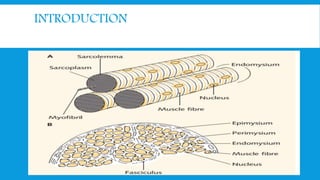
 Skeletal muscle is made up of large numbers of multinucleated
muscle fibres, which have an outer membrane (sarcolemma)
and cytoplasm (sarcoplasm) and in which lie the contractile
components of the muscle (myofibrils).
 The fibres are separated by connective tissue (endomysium) and
arranged in bundles (fasciculi).
 Each fasciculus has a connective tissue sheath (perimysium).
 The muscle is made up of a number of fasciculi bound together
and surrounded by a connective tissue sheath (epimysium).

INTRODUCTION
INTRODUCTION
Definition
Group of symptoms due to dysfunction of skeletal muscles .
Symptoms
Motor manifestations:
Weakness: bilateral . symmetrical affecting certain groups of
muscle e.g. proximal.
There may be a loss of tone (hypotonia)
INTRODUCTION
Changes in muscle bulk
Wasting of the affected muscles
Enlargement of muscle may an early sign in certain dystrophies,
(pseudohypertrophy).
Changes in reflexes
These are usually preserved in muscle disorders, at least until wasting is severe,
Changes in muscle contractility
Myotonia .
INTRODUCTION
Pain
Pain is a rare complaint in primary muscle disease except in
metabolic or inflammatory myopathy .
It is important to ask about a change in the colour of urine,
which can occur in some metabolic disorders.
No sensory manifestation
No sphincter manifestation
CLASSIFICATION
A] Primary: Progressive muscle dystrophy
B] Secondary:
1] Inflammatory: polymyositis
2] Metabolic: Periodic familial paralysis
3] Endocrinal: thyrotoxic .Chushing.
4] Drug induced: corticosteroid. Statin .
5] Miscellaneous: carcinomatous
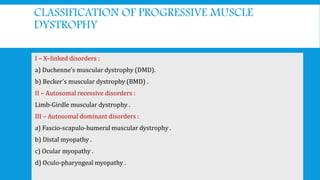
CLASSIFICATION OF PROGRESSIVE MUSCLE
DYSTROPHY
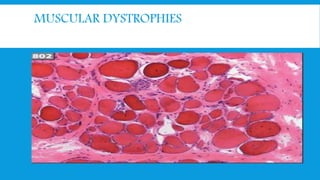
MUSCULAR DYSTROPHIES
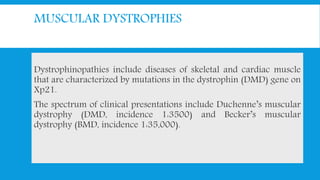
Dystrophinopathies include diseases of skeletal and cardiac muscle
that are characterized by mutations in the dystrophin (DMD) gene on
Xp21.
The spectrum of clinical presentations include Duchenne’s muscular
dystrophy (DMD, incidence 1:3500) and Becker’s muscular
dystrophy (BMD, incidence 1:35,000).
MUSCULAR DYSTROPHIES
Etiology and pathophysiology
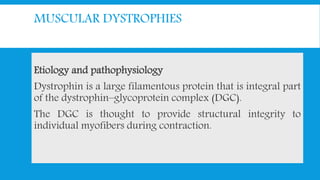
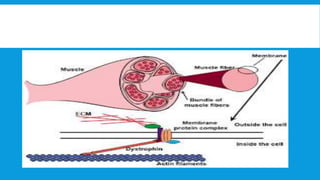
Dystrophin is a large filamentous protein that is integral part
of the dystrophin–glycoprotein complex (DGC).
The DGC is thought to provide structural integrity to
individual myofibers during contraction.
MUSCULAR DYSTROPHIES
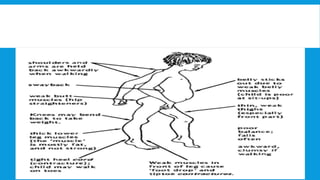
presentation of Duchenne’s muscular dystrophy
Early (ages 2–6)
Onset of walking delayed beyond 18 months.
 Abnormal gait with toe walking or waddling.
 Difficulty running.
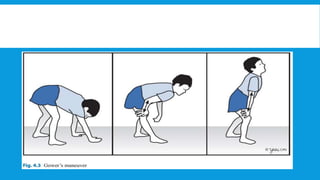
 Frequent falls, difficulty rising from the floor (Gower’s sign).
 Prominent calf muscle bulge (‘pseudo-hypertrophy’).
 Hyperlordosis resulting in a protruding abdomen.
In some patients there is global developmental delay, severe learning disabilities, failure to thrive
MUSCULAR DYSTROPHIES
Ages 7–10
Progressive leg weakness leading to loss of walking
and wheelchair dependence by mean age of 9.5 years.
 Joint contractures, especially of the iliotibial bands, hip flexors, and
heel cords.
 Progressive scoliosis and thoracic deformities after loss of mobility
MUSCULAR DYSTROPHIES
Teenage years
 Development of more apparent upper extremity weakness.
 Worsening respiratory reserve and sleep hypoventilation, and obstructive
apnea.
 Scoliosis progresses rapidly with the pubertal growth spurt, with adverse
effects on respiration, feeding, sitting, and comfort.
 In the past, most patients died in the late teens and early twenties.
MUSCULAR DYSTROPHIES
General features
Cognitive impairment and mental retardation occur in a subset of DMD and
BMD.
 Cardiac involvement with conduction defects as well as cardiomyopathy is
common in BMD and DMD.
INVESTIGATIONS AND DIAGNOSIS
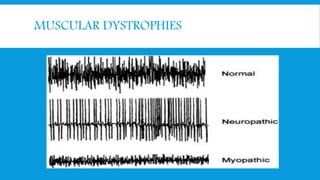
A. EMG: myopathic changes early in the disease course. small
amplitude, and polyphasic motor unit action potentials is the most
typical appearance of a myopathy.
B. serum creatine phosphokinase (CPK; creatine kinase, CK): this is
often significantly raise
C. Muscle biopsy with immunohistochemical studies and
immunoblot analysis .
D. Genetic testing is the most efficient way to confirm the diagnosis
in typical cases of DMD with a positive family history.
MUSCULAR DYSTROPHIES
Becker’s muscular dystrophy
BMD is characterized by a later onset of symptoms and a slower rate of
progression then that of DMD.
The onset of disease is variable, but often not until teenage years, with the
mean at 12 years and 90% before age 20.
The patients often show similar but milder features than those found in DMD.
The mean age at loss of ambulation is in the fourth decade, but patients may live
for many decades. For some, cardiomyopathy dominates the clinical
presentation.
MUSCULAR DYSTROPHIES
management
Corticosteroids or the prednisone derivative deflazocort are effective in
delaying loss of mobility by 6 months to 2 years. This therapy may have an
especially high long-term impact if it can decrease the development of scoliosis
by allowing some of the pubertal growth spurt to occur before loss of mobility.
Patients are typically started on 0.75 mg/kg/day to 1.5 mg/kg/day in the early
ambulatory phase (4–6 years).
MUSCULAR DYSTROPHIES
management
Rehabilitation with knee–ankle–foot orthoses can prolong walking for some 18–
24 months.
Respiratory therapy includes inspiratory resistive exercises that may increase the
endurance of respiratory muscles.
Angiotensin-converting enzyme (ACE) inhibitors and/ or beta-adrenergic
blockers may be beneficial in treating and potentially preventing/delaying
cardiomyopathy.
MUSCULAR DYSTROPHIES
management
Gene replacement:
• Use of viral vectors to replace a mutated dystrophin gene.
•stem cells may help muscle repair.
Blocking the effect of myostatin as a negative regulator of muscle mass could
have a beneficial effect.
Myasthenia gravis
MYASTHENIA GRAVIS
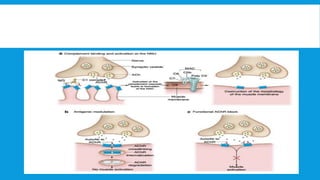
Myasthenia gravis (MG) is an acquired autoimmune disorder characterized by
fatigable and fluctuating muscle weakness preferentially affecting certain muscle
groups.
In most cases it results from serum antibodies targeting the acetylcholine
receptors (AChR) on the postsynaptic membrane of the neuromuscular junction
(NMJ)
MYASTHENIA GRAVIS
MG can occur at any age, but peaks at the 2nd decade and 6th–7th
decades.
Women are three times more likely to be affected than men before
age 40.
Incidence is nearly equal before puberty and after age 40.
Men have a higher incidence after age 50.
MYASTHENIA GRAVIS
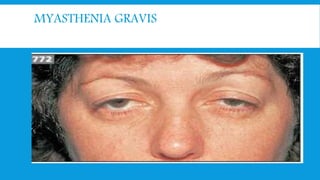
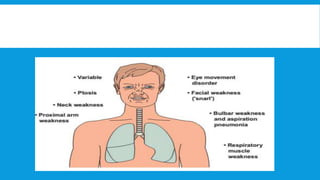
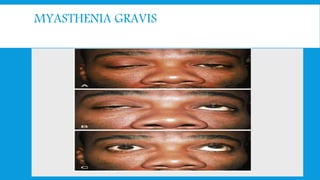
The hallmark of MG is fluctuating and fatigable muscle
weakness that improves with rest.
•Weakness to varying degrees affects the extraocular, facial,
bulbar, limb, and axial muscles.
Severe respiratory muscle involvement is seen in myasthenic
crisis .
MYASTHENIA GRAVIS
MYASTHENIA GRAVIS
Work-up
Edrophonium (Tensilon) test useful in MG patients with ocular
symptoms.
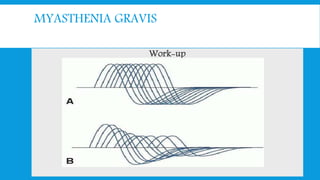
Repetitive nerve stimulation: successive stimulation shows decrement
of muscle action potential in clinically weak muscle.
Serum AChR antibodies found in up to 90% of patients.
A subset of patients with seronegative MG may have MuSK
antibodies.
CT scan or MRI with contrast of anterior chest to look for thymoma
Thyroid-stimulating hormone, free T4 to rule out thyroid disease
MYASTHENIA GRAVIS
Work-up
MYASTHENIA GRAVIS
Work-up
MYASTHENIA GRAVIS
Symptomatic therapy
Cholinesterase inhibitors (pyridostigmine or neostigmine) slow the
breakdown of acetylcholine, increasing its availability at the NMJ and
overcoming antibody-induced block. Adverse effects are .
(i) increased muscarinic activity, especially diarrhoea, which may be
treated with antimuscarinic drugs such as atropine or propantheline.
(ii) cholinergic crisis
MYASTHENIA GRAVIS
Immune therapy
. Corticosteroids are used, which occasionally produce a
paradoxical deterioration in the condition in the first 7–10
days of treatment – patients should be monitored closely.
Azathioprine has a steroid-sparing effect but takes months
to work.
MYASTHENIA GRAVIS
Immune therapy
Intravenous immunoglobulin or plasmapheresis may prevent
the need for ventilatory support, probably by washing out
the abnormal antibodies.
The role of thymectomy in the control of myasthenia remains
contentious. Most authorities advocate thymectomy in young
patients, increasing the chance of disease remission from 30
to 40% in 3 years.
MYASTHENIA GRAVIS
Absolutely contraindicated drugs :-
Interferone α, botulinum toxin and D-penucillamine.
Relatively contraindicated drugs :-
Succinylcholine and other neuro-muscular blockers.
Aminoglycoside antibiotics. Beta blockers and calcium
channel blockers. Magnesium salts. Quinine, quinidine and
procainamide.
Myopathy undergraduate

Myopathy undergraduate

  • 1.
    DISORDERS OF SKELETALMUSCLES Osama Ragab Neurology. MD
  • 2.
    INTRODUCTION  Skeletal muscleis made up of large numbers of multinucleated muscle fibres, which have an outer membrane (sarcolemma) and cytoplasm (sarcoplasm) and in which lie the contractile components of the muscle (myofibrils).  The fibres are separated by connective tissue (endomysium) and arranged in bundles (fasciculi).  Each fasciculus has a connective tissue sheath (perimysium).  The muscle is made up of a number of fasciculi bound together and surrounded by a connective tissue sheath (epimysium). 
  • 3.
  • 5.
    INTRODUCTION Definition Group of symptomsdue to dysfunction of skeletal muscles . Symptoms Motor manifestations: Weakness: bilateral . symmetrical affecting certain groups of muscle e.g. proximal. There may be a loss of tone (hypotonia)
  • 6.
    INTRODUCTION Changes in musclebulk Wasting of the affected muscles Enlargement of muscle may an early sign in certain dystrophies, (pseudohypertrophy). Changes in reflexes These are usually preserved in muscle disorders, at least until wasting is severe, Changes in muscle contractility Myotonia .
  • 7.
    INTRODUCTION Pain Pain is arare complaint in primary muscle disease except in metabolic or inflammatory myopathy . It is important to ask about a change in the colour of urine, which can occur in some metabolic disorders. No sensory manifestation No sphincter manifestation
  • 8.
    CLASSIFICATION A] Primary: Progressivemuscle dystrophy B] Secondary: 1] Inflammatory: polymyositis 2] Metabolic: Periodic familial paralysis 3] Endocrinal: thyrotoxic .Chushing. 4] Drug induced: corticosteroid. Statin . 5] Miscellaneous: carcinomatous
  • 9.
  • 10.
    MUSCULAR DYSTROPHIES Dystrophinopathies includediseases of skeletal and cardiac muscle that are characterized by mutations in the dystrophin (DMD) gene on Xp21. The spectrum of clinical presentations include Duchenne’s muscular dystrophy (DMD, incidence 1:3500) and Becker’s muscular dystrophy (BMD, incidence 1:35,000).
  • 11.
    MUSCULAR DYSTROPHIES Etiology andpathophysiology Dystrophin is a large filamentous protein that is integral part of the dystrophin–glycoprotein complex (DGC). The DGC is thought to provide structural integrity to individual myofibers during contraction.
  • 13.
    MUSCULAR DYSTROPHIES presentation ofDuchenne’s muscular dystrophy Early (ages 2–6) Onset of walking delayed beyond 18 months.  Abnormal gait with toe walking or waddling.  Difficulty running.  Frequent falls, difficulty rising from the floor (Gower’s sign).  Prominent calf muscle bulge (‘pseudo-hypertrophy’).  Hyperlordosis resulting in a protruding abdomen. In some patients there is global developmental delay, severe learning disabilities, failure to thrive
  • 15.
    MUSCULAR DYSTROPHIES Ages 7–10 Progressiveleg weakness leading to loss of walking and wheelchair dependence by mean age of 9.5 years.  Joint contractures, especially of the iliotibial bands, hip flexors, and heel cords.  Progressive scoliosis and thoracic deformities after loss of mobility
  • 16.
    MUSCULAR DYSTROPHIES Teenage years Development of more apparent upper extremity weakness.  Worsening respiratory reserve and sleep hypoventilation, and obstructive apnea.  Scoliosis progresses rapidly with the pubertal growth spurt, with adverse effects on respiration, feeding, sitting, and comfort.  In the past, most patients died in the late teens and early twenties.
  • 18.
    MUSCULAR DYSTROPHIES General features Cognitiveimpairment and mental retardation occur in a subset of DMD and BMD.  Cardiac involvement with conduction defects as well as cardiomyopathy is common in BMD and DMD.
  • 19.
    INVESTIGATIONS AND DIAGNOSIS A.EMG: myopathic changes early in the disease course. small amplitude, and polyphasic motor unit action potentials is the most typical appearance of a myopathy. B. serum creatine phosphokinase (CPK; creatine kinase, CK): this is often significantly raise C. Muscle biopsy with immunohistochemical studies and immunoblot analysis . D. Genetic testing is the most efficient way to confirm the diagnosis in typical cases of DMD with a positive family history.
  • 20.
  • 21.
  • 22.
    MUSCULAR DYSTROPHIES Becker’s musculardystrophy BMD is characterized by a later onset of symptoms and a slower rate of progression then that of DMD. The onset of disease is variable, but often not until teenage years, with the mean at 12 years and 90% before age 20. The patients often show similar but milder features than those found in DMD. The mean age at loss of ambulation is in the fourth decade, but patients may live for many decades. For some, cardiomyopathy dominates the clinical presentation.
  • 23.
    MUSCULAR DYSTROPHIES management Corticosteroids orthe prednisone derivative deflazocort are effective in delaying loss of mobility by 6 months to 2 years. This therapy may have an especially high long-term impact if it can decrease the development of scoliosis by allowing some of the pubertal growth spurt to occur before loss of mobility. Patients are typically started on 0.75 mg/kg/day to 1.5 mg/kg/day in the early ambulatory phase (4–6 years).
  • 24.
    MUSCULAR DYSTROPHIES management Rehabilitation withknee–ankle–foot orthoses can prolong walking for some 18– 24 months. Respiratory therapy includes inspiratory resistive exercises that may increase the endurance of respiratory muscles. Angiotensin-converting enzyme (ACE) inhibitors and/ or beta-adrenergic blockers may be beneficial in treating and potentially preventing/delaying cardiomyopathy.
  • 25.
    MUSCULAR DYSTROPHIES management Gene replacement: •Use of viral vectors to replace a mutated dystrophin gene. •stem cells may help muscle repair. Blocking the effect of myostatin as a negative regulator of muscle mass could have a beneficial effect.
  • 26.
  • 27.
    MYASTHENIA GRAVIS Myasthenia gravis(MG) is an acquired autoimmune disorder characterized by fatigable and fluctuating muscle weakness preferentially affecting certain muscle groups. In most cases it results from serum antibodies targeting the acetylcholine receptors (AChR) on the postsynaptic membrane of the neuromuscular junction (NMJ)
  • 28.
    MYASTHENIA GRAVIS MG canoccur at any age, but peaks at the 2nd decade and 6th–7th decades. Women are three times more likely to be affected than men before age 40. Incidence is nearly equal before puberty and after age 40. Men have a higher incidence after age 50.
  • 30.
    MYASTHENIA GRAVIS The hallmarkof MG is fluctuating and fatigable muscle weakness that improves with rest. •Weakness to varying degrees affects the extraocular, facial, bulbar, limb, and axial muscles. Severe respiratory muscle involvement is seen in myasthenic crisis .
  • 31.
  • 33.
    MYASTHENIA GRAVIS Work-up Edrophonium (Tensilon)test useful in MG patients with ocular symptoms. Repetitive nerve stimulation: successive stimulation shows decrement of muscle action potential in clinically weak muscle. Serum AChR antibodies found in up to 90% of patients. A subset of patients with seronegative MG may have MuSK antibodies. CT scan or MRI with contrast of anterior chest to look for thymoma Thyroid-stimulating hormone, free T4 to rule out thyroid disease
  • 34.
  • 35.
  • 36.
    MYASTHENIA GRAVIS Symptomatic therapy Cholinesteraseinhibitors (pyridostigmine or neostigmine) slow the breakdown of acetylcholine, increasing its availability at the NMJ and overcoming antibody-induced block. Adverse effects are . (i) increased muscarinic activity, especially diarrhoea, which may be treated with antimuscarinic drugs such as atropine or propantheline. (ii) cholinergic crisis
  • 37.
    MYASTHENIA GRAVIS Immune therapy .Corticosteroids are used, which occasionally produce a paradoxical deterioration in the condition in the first 7–10 days of treatment – patients should be monitored closely. Azathioprine has a steroid-sparing effect but takes months to work.
  • 38.
    MYASTHENIA GRAVIS Immune therapy Intravenousimmunoglobulin or plasmapheresis may prevent the need for ventilatory support, probably by washing out the abnormal antibodies. The role of thymectomy in the control of myasthenia remains contentious. Most authorities advocate thymectomy in young patients, increasing the chance of disease remission from 30 to 40% in 3 years.
  • 39.
    MYASTHENIA GRAVIS Absolutely contraindicateddrugs :- Interferone α, botulinum toxin and D-penucillamine. Relatively contraindicated drugs :- Succinylcholine and other neuro-muscular blockers. Aminoglycoside antibiotics. Beta blockers and calcium channel blockers. Magnesium salts. Quinine, quinidine and procainamide.