Neuromuscular Disorders –
Duchenne and Becker’s Muscular
          Dystrophy


                                   Dr. Kalpana Malla
                                       MD Pediatrics
                           Manipal Teaching Hospital

Download more documents and slide shows on The Medical Post [ www.themedicalpost.net ]
Neuromuscular disorders

Consists of - Motor neuron in brain stem
           - Ventral horn of spinal cord
           - Its axon with other axon forms
             peripheral nerve
           - Neuromuscular junction
           - All muscle fibers innervated by
             single motor neuron
May be
•   Genetic
•   Congenital
•   Acquired
•   Acute
•   Chronic
•   Progressive
•   Static
Myopathy

• Proximal distribution of weakness and muscle
  wasting except- myotonic muscular dystrophy
• Slow progression
• Tendon reflexes – preserved
• Sensation – intact
Neuropathy

• Distal distribution (except- juvenile spinal
  muscular atrophy
• Acute onset
• Tendon reflexes – lost
• Sensory abnormalities –neuropathy
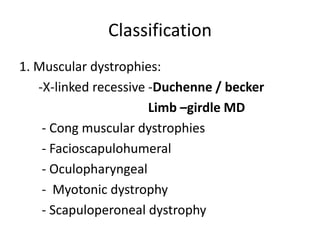
Classification
1. Muscular dystrophies:
   -X-linked recessive -Duchenne / becker
                       Limb –girdle MD
    - Cong muscular dystrophies
    - Facioscapulohumeral
    - Oculopharyngeal
    - Myotonic dystrophy
    - Scapuloperoneal dystrophy
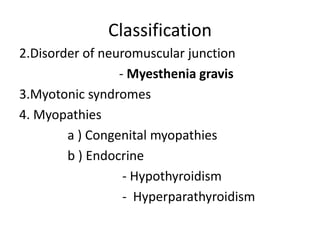
Classification
2.Disorder of neuromuscular junction
                 - Myesthenia gravis
3.Myotonic syndromes
4. Myopathies
        a ) Congenital myopathies
        b ) Endocrine
                  - Hypothyroidism
                  - Hyperparathyroidism
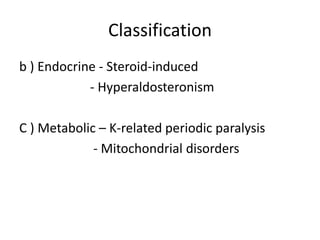
Classification
b ) Endocrine - Steroid-induced
            - Hyperaldosteronism

C ) Metabolic – K-related periodic paralysis
             - Mitochondrial disorders
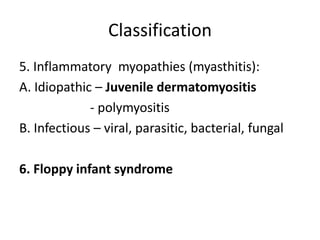
Classification
5. Inflammatory myopathies (myasthitis):
A. Idiopathic – Juvenile dermatomyositis
             - polymyositis
B. Infectious – viral, parasitic, bacterial, fungal

6. Floppy infant syndrome
Evaluation
Clinical –
• Muscle – bulk, tone ,power,
• Head lag
• See involvement of face, tongue, palate ,extra-
    ocular muscles
• Fasciculations – sign of denervation
Evaluation

• Undescended testes, funnel shaped thorax -
  congenital NMD

• Generalized hypotonia, delayed motor
  development
Laboratory findings
• Serum enzymes – CPK

• Nerve conduction velocity- motor & sensory
  conduction measured electrophysiologically

• Electromyelography - records maximum
  voluntary contraction of muscle
Laboratory findings

• Muscle biopsy – most important, specific and
                diagnostic (Vastus lateralis)
• Nerve biopsy (sural nerve)
• ECG-cardiac evaluation in myopathies
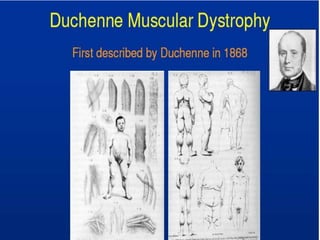
Duchenne muscular
    dystrophy
16
What is Duchenne Muscular Dystrophy?


• The disease characterized by:
 - Early onset often before school age

 - Progressive muscular deterioration and
   death by 14 - 18 years of age

 - Defect on a large gene on X chromosome
                                            17
Duchenne Muscular Dystrophy

• Commonest muscular dystrophy

• Incidence- 1/3600 male birth

• Inheritance – X- linked recessive
             30% - new mutations
                sporadic
                                      18
FACTS
• The abnormal gene is on the X chromosome at the
  Xp21 locus

• Becker muscular dystrophy is the same
  fundamental disease as Duchenne dystrophy, with a
  genetic defect at the same locus, but clinically it
  follows a milder and more protracted course
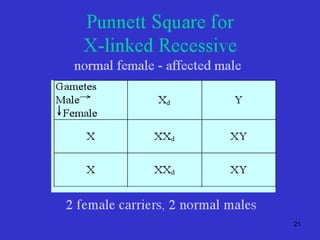
X-Linked recessive
Features-
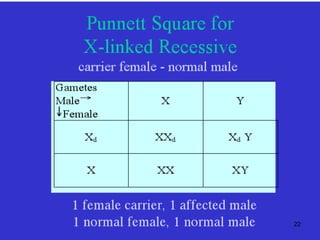
1.Only males are affected. All his daughters will be
  carriers as they receive abnormal X from father

2. Will not manifest in females- 50% sons affected
  50% daughters will be carriers when the mother is a
  carrier

                                                       20
21
22
X-Linked recessive
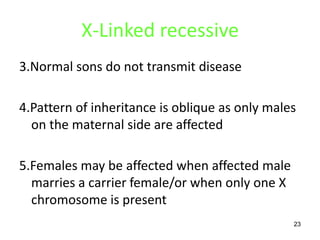
3.Normal sons do not transmit disease

4.Pattern of inheritance is oblique as only males
  on the maternal side are affected

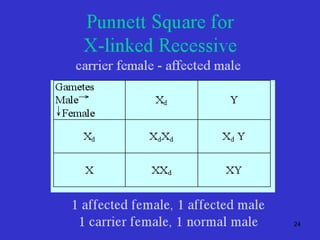
5.Females may be affected when affected male
  marries a carrier female/or when only one X
  chromosome is present
                                                23
24
X-Linked recessive

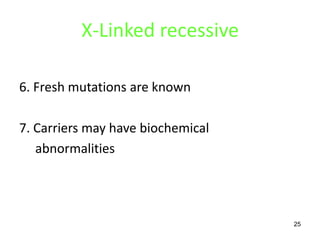
6. Fresh mutations are known

7. Carriers may have biochemical
   abnormalities


                                   25
• A muscular dystrophy is distinguished from all
  other neuromuscular diseases by four obligatory
  criteria:

(1) It is a primary myopathy
(2) It has a genetic basis
(3) The course is progressive
(4) Degeneration and death of muscle fibers occur
  at some stage in the disease
DMD - Muscle wasting

• In DMD - attachment of muscle fibers to their surrounding
  endomysium (extracellular matrix) becomes weakened due
  to mutations in the dystrophin gene.

• The absence of dystrophin leads to increased death and
  destruction

• In turn, scar tissue (a mix of collagen and blood vessels)
  replaces the muscle fibers, and it can gradually contract
  leading to increased muscle rigidity
Clinical features
• Asymptomatic at birth - Early gross motor skills (
  rolling over, sitting, standing) may be normal or
  mildly delayed

• Poor head control in infancy may be the first sign
  of weakness

• Walking achieved at the normal age - but hip girdle
  weakness may be seen in subtle form as early as
  the 2nd year - waddling gait
Clinical features
• Weakness starts in pelvic girdle- Extensor
  muscles of back affected – lordosis to stabilize
  spine by bony opposition
• Toddlers may assume a lordotic posture when
  standing to compensate for gluteal weakness.

• Cannot bend forward without falling
• Presents – 2- 4 yrs
• Frequently falls, has difficulty getting up,
  climbing stairs or getting in and out of a car
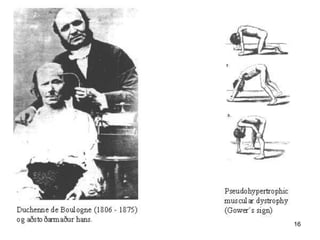
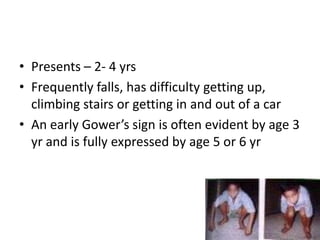
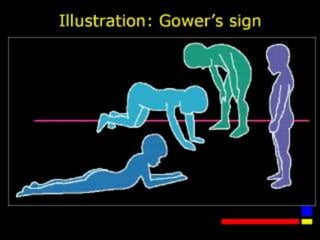
• An early Gower’s sign is often evident by age 3
  yr and is fully expressed by age 5 or 6 yr
Gets up climbing up his legs- Gower’s sign
• Enlargement of the calves
  (pseudohypertrophy) and wasting of thigh
  muscles is a classic feature.
• Next most common site of muscular
  hypertrophy - tongue, forearm.
• Pseudohypertrophy also seen - triceps,
  quadriceps

• Pseuhypertrophy of muscle fibers - infiltration
  of muscle by fat, and proliferation of collagen.


• Fasciculations of the tongue do not occur.
• Pseudohypertrophy seen in
  supra, infraspinatus, deltoids
  – Valley sign


                                   34
Clinical features
• Hypertrophy of calf muscles with
       tightening of tendo achillis-toe walking
• By 8 yrs –walking becomes difficult

• Knee jerks disappear early but ankle jerk may be
  preserved

• Positive valley sign
Clinical features cont.
• By 12 yrs – wheel chair bound –
• Loss of lordosis - lose stabilization of spine
              ↓
     Tendency to tilt to one side
              ↓
       Develop– Scoliosis
             ↓
  Bunching of ribs leads to E. reflux with acute
  esophagitis, hematemesis, aspiration
  pneumonitis                                      36
Clinical features cont.
• Intellectual impairment in all
• 20- 30% - IQ < 70
• Cardiac muscle may be affected –
  Cardiomyopathy
• Die by 18 yrs – respiratory failure, pneumonia,
  aspiration, heart failure


                                                37
Clinical features
• By 12 yrs –wheel chair bound – loss of lordosis
  lose stabilization of spine – tendency to tilt to
  one side - develop –scoliosis-bunching of ribs
  leads to E. reflux with acute esophagitis,
  hematemesis, aspiration pneumonitis
• Contractures most often involve the ankles,
  knees, hips, and elbows.
• Scoliosis is common.
• The function of distal muscles is usually well
  preserved - child can continue using eating
  utensils, a pencil, and a computer keyboard.

• Respiratory muscle involvement - weak and
  ineffective cough, frequent pulmonary infections

• Pharyngeal weakness - episodes of
  aspiration, nasal regurgitation of liquids, and an
  airy or nasal voice quality

• Extraocular muscles - well preserved
• Death occurs usually at about 18 yr of age.


• The causes of death are respiratory failure in sleep,
  intractable heart failure, pneumonia, or
  occasionally aspiration and airway obstruction
Laboratory findings
• Serum creatinine phosphokinase (CPK)  even in
   presymptomatic stages, including at birth
  > 10,000 units ( range 15,000 – 35,000 IU/L)
   Normal level < 160 IU/L
 - In severe cases, maybe lower
• Other lysosomal enzymes of muscles:
   Aldolase, Aspartate aminotransferase –
  increased (less specific)
                                              42
EMG

• Electromyography (EMG) shows characteristic
  myopathic features but is not specific for Duchenne
  muscular dystrophy
• Nerve conduction velocity- normal, No evidence of
  denervation
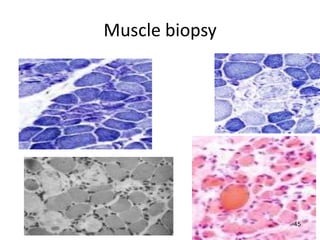
Muscle biopsy –
• Diagnostic (Vastus lateralis/ Gastrocnemius)
Myopathic changes –
• endomysial connective tissue proliferation
• Scattered degenerating and regenerating myofibers
• Foci of mononuclear inflammatory cell infiltrates
Muscle biopsy


                45
Others
•   Cardiac evaluation
•   CXR
•   ECG
•   ECHO
•   Molecular genetic diagnosis –
    Immunohistochemical staining of section of
    muscle biopsy or by DNA analysis from
    peripheral blood -- absent dystrophin
                                                 46
• Molecular genetic diagnosis - demonstrating
  deficient or defective dystrophin by
  immunohistochemical staining of sections of
  muscle biopsy
Treatment
• No medical cure or a method of slowing its
  progression.
• To improve mobility:
   – Physical therapy

  – Surgery on tight joints

  – Prednisone

  – Non-steroidal medications

  – Wheelchair
Management
Multidisciplinary approach:
• Exercise – physical exercise, physiotherapy
• Dietary – prevent obesity
• Orthopedic
• Psychological
• Education
• Genetic counselling

                                                49
• Physiotherapy delays but does not always
  prevent contractures.
• Preservation of a good nutritional state
• Adequate calcium intake - to minimize
  osteoporosis
• sedentary children burn fewer calories than active
  children and depression is an additional factor –
  these children tend to eat excessively and gain
  weight – Obesity makes a patient with myopathy
  even less functional
Management

• Pharmacological-treat complication
• Suggestion – To reduuce rate of deterioration
  cyclical ( 10 days /month)-catabolic steroid –
  prednisolone low dose -decreases the rate of
  apoptosis and may decelerate the myofiber
  necrosis
• Cyclosporin – under study
Some approaches
• Experimental approach – Myoblast transfer
  therapy

• Unproven approach – I/M injection of
  recombinant dystrophin gene
• "minigenes," which carry instructions for a
  slightly smaller version of dystrophin

                                                53
Advances in Gene Therapy

• Researchers - created the so-called gutted
  virus, a virus that has its own genes removed
  so that it is carrying only the dystrophin gene
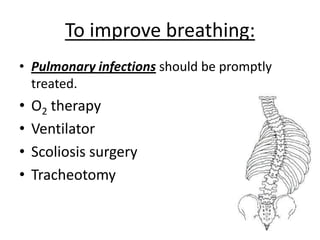
To improve breathing:
• Pulmonary infections should be promptly
  treated.
•   O2 therapy
•   Ventilator
•   Scoliosis surgery
•   Tracheotomy
• Cardiac decompensation often responds well to
  digoxin, at least in early stages.


• Immunizations for influenza virus and routine
  vaccinations are indicated.
GENETIC COUNCELLING
• Prenatal diagnosis for women having risk
  pregnancies - with a family history of muscular
  dystrophy.
• Identification of dystrophin gene exon deletions
  in a male fetus - Couples may elect to terminate
  the pregnancy if the fetus is affected.
• Carrier status may be determined in the mother
  and siblings of the proband.
Becker muscular dystrophy
• This Ds was first described by Becker and Klener in
  1955
• X-linked recessive
• Late onset – ambulatory till late adolescence
• Calf pseudohypertrophy, cardiomyopathy, increased
  CPK are similar to DMD
• Learning disabilities are less
• Death – in late 20s but severely disabled; fewer than
  half of patients are still alive by age 40 yr
Dermatomyositis
Pathognomonic feature -Gottron's
papules overlying the dorsal
interphalangeal joints.
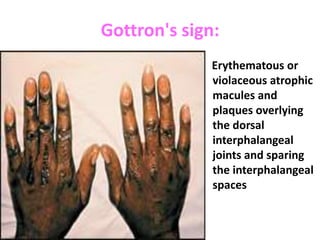
Gottron's sign:
              Erythematous or
              violaceous atrophic
              macules and
              plaques overlying
              the dorsal
              interphalangeal
              joints and sparing
              the interphalangeal
              spaces
Heliotrope
Characteristic finding a violaceous
 eruption with periorbital edema.
Shawl sign. Poikilodermatous macules appear in a
  "shawl" distribution over the shoulder, arms and
  upper back
Mechanic's hand.

Fissured, scaly, hyperkeratotic and
  hyperpigmented hands are suggestive of
  manual labor
Thank you
Download more documents and slide shows on The
    Medical Post [ www.themedicalpost.net ]

Muscular Dystrophy : Duchenne and Becker's

  • 1.
    Neuromuscular Disorders – Duchenneand Becker’s Muscular Dystrophy Dr. Kalpana Malla MD Pediatrics Manipal Teaching Hospital Download more documents and slide shows on The Medical Post [ www.themedicalpost.net ]
  • 2.
    Neuromuscular disorders Consists of- Motor neuron in brain stem - Ventral horn of spinal cord - Its axon with other axon forms peripheral nerve - Neuromuscular junction - All muscle fibers innervated by single motor neuron
  • 3.
    May be • Genetic • Congenital • Acquired • Acute • Chronic • Progressive • Static
  • 4.
    Myopathy • Proximal distributionof weakness and muscle wasting except- myotonic muscular dystrophy • Slow progression • Tendon reflexes – preserved • Sensation – intact
  • 5.
    Neuropathy • Distal distribution(except- juvenile spinal muscular atrophy • Acute onset • Tendon reflexes – lost • Sensory abnormalities –neuropathy
  • 6.
    Classification 1. Muscular dystrophies: -X-linked recessive -Duchenne / becker Limb –girdle MD - Cong muscular dystrophies - Facioscapulohumeral - Oculopharyngeal - Myotonic dystrophy - Scapuloperoneal dystrophy
  • 7.
    Classification 2.Disorder of neuromuscularjunction - Myesthenia gravis 3.Myotonic syndromes 4. Myopathies a ) Congenital myopathies b ) Endocrine - Hypothyroidism - Hyperparathyroidism
  • 8.
    Classification b ) Endocrine- Steroid-induced - Hyperaldosteronism C ) Metabolic – K-related periodic paralysis - Mitochondrial disorders
  • 9.
    Classification 5. Inflammatory myopathies(myasthitis): A. Idiopathic – Juvenile dermatomyositis - polymyositis B. Infectious – viral, parasitic, bacterial, fungal 6. Floppy infant syndrome
  • 10.
    Evaluation Clinical – • Muscle– bulk, tone ,power, • Head lag • See involvement of face, tongue, palate ,extra- ocular muscles • Fasciculations – sign of denervation
  • 11.
    Evaluation • Undescended testes,funnel shaped thorax - congenital NMD • Generalized hypotonia, delayed motor development
  • 12.
    Laboratory findings • Serumenzymes – CPK • Nerve conduction velocity- motor & sensory conduction measured electrophysiologically • Electromyelography - records maximum voluntary contraction of muscle
  • 13.
    Laboratory findings • Musclebiopsy – most important, specific and diagnostic (Vastus lateralis) • Nerve biopsy (sural nerve) • ECG-cardiac evaluation in myopathies
  • 14.
  • 16.
  • 17.
    What is DuchenneMuscular Dystrophy? • The disease characterized by: - Early onset often before school age - Progressive muscular deterioration and death by 14 - 18 years of age - Defect on a large gene on X chromosome 17
  • 18.
    Duchenne Muscular Dystrophy •Commonest muscular dystrophy • Incidence- 1/3600 male birth • Inheritance – X- linked recessive 30% - new mutations sporadic 18
  • 19.
    FACTS • The abnormalgene is on the X chromosome at the Xp21 locus • Becker muscular dystrophy is the same fundamental disease as Duchenne dystrophy, with a genetic defect at the same locus, but clinically it follows a milder and more protracted course
  • 20.
    X-Linked recessive Features- 1.Only malesare affected. All his daughters will be carriers as they receive abnormal X from father 2. Will not manifest in females- 50% sons affected 50% daughters will be carriers when the mother is a carrier 20
  • 21.
  • 22.
  • 23.
    X-Linked recessive 3.Normal sonsdo not transmit disease 4.Pattern of inheritance is oblique as only males on the maternal side are affected 5.Females may be affected when affected male marries a carrier female/or when only one X chromosome is present 23
  • 24.
  • 25.
    X-Linked recessive 6. Freshmutations are known 7. Carriers may have biochemical abnormalities 25
  • 26.
    • A musculardystrophy is distinguished from all other neuromuscular diseases by four obligatory criteria: (1) It is a primary myopathy (2) It has a genetic basis (3) The course is progressive (4) Degeneration and death of muscle fibers occur at some stage in the disease
  • 27.
    DMD - Musclewasting • In DMD - attachment of muscle fibers to their surrounding endomysium (extracellular matrix) becomes weakened due to mutations in the dystrophin gene. • The absence of dystrophin leads to increased death and destruction • In turn, scar tissue (a mix of collagen and blood vessels) replaces the muscle fibers, and it can gradually contract leading to increased muscle rigidity
  • 28.
    Clinical features • Asymptomaticat birth - Early gross motor skills ( rolling over, sitting, standing) may be normal or mildly delayed • Poor head control in infancy may be the first sign of weakness • Walking achieved at the normal age - but hip girdle weakness may be seen in subtle form as early as the 2nd year - waddling gait
  • 29.
    Clinical features • Weaknessstarts in pelvic girdle- Extensor muscles of back affected – lordosis to stabilize spine by bony opposition • Toddlers may assume a lordotic posture when standing to compensate for gluteal weakness. • Cannot bend forward without falling
  • 30.
    • Presents –2- 4 yrs • Frequently falls, has difficulty getting up, climbing stairs or getting in and out of a car • An early Gower’s sign is often evident by age 3 yr and is fully expressed by age 5 or 6 yr
  • 31.
    Gets up climbingup his legs- Gower’s sign
  • 32.
    • Enlargement ofthe calves (pseudohypertrophy) and wasting of thigh muscles is a classic feature. • Next most common site of muscular hypertrophy - tongue, forearm.
  • 33.
    • Pseudohypertrophy alsoseen - triceps, quadriceps • Pseuhypertrophy of muscle fibers - infiltration of muscle by fat, and proliferation of collagen. • Fasciculations of the tongue do not occur.
  • 34.
    • Pseudohypertrophy seenin supra, infraspinatus, deltoids – Valley sign 34
  • 35.
    Clinical features • Hypertrophyof calf muscles with tightening of tendo achillis-toe walking • By 8 yrs –walking becomes difficult • Knee jerks disappear early but ankle jerk may be preserved • Positive valley sign
  • 36.
    Clinical features cont. •By 12 yrs – wheel chair bound – • Loss of lordosis - lose stabilization of spine ↓ Tendency to tilt to one side ↓ Develop– Scoliosis ↓ Bunching of ribs leads to E. reflux with acute esophagitis, hematemesis, aspiration pneumonitis 36
  • 37.
    Clinical features cont. •Intellectual impairment in all • 20- 30% - IQ < 70 • Cardiac muscle may be affected – Cardiomyopathy • Die by 18 yrs – respiratory failure, pneumonia, aspiration, heart failure 37
  • 38.
    Clinical features • By12 yrs –wheel chair bound – loss of lordosis lose stabilization of spine – tendency to tilt to one side - develop –scoliosis-bunching of ribs leads to E. reflux with acute esophagitis, hematemesis, aspiration pneumonitis • Contractures most often involve the ankles, knees, hips, and elbows. • Scoliosis is common.
  • 40.
    • The functionof distal muscles is usually well preserved - child can continue using eating utensils, a pencil, and a computer keyboard. • Respiratory muscle involvement - weak and ineffective cough, frequent pulmonary infections • Pharyngeal weakness - episodes of aspiration, nasal regurgitation of liquids, and an airy or nasal voice quality • Extraocular muscles - well preserved
  • 41.
    • Death occursusually at about 18 yr of age. • The causes of death are respiratory failure in sleep, intractable heart failure, pneumonia, or occasionally aspiration and airway obstruction
  • 42.
    Laboratory findings • Serumcreatinine phosphokinase (CPK)  even in presymptomatic stages, including at birth > 10,000 units ( range 15,000 – 35,000 IU/L) Normal level < 160 IU/L - In severe cases, maybe lower • Other lysosomal enzymes of muscles: Aldolase, Aspartate aminotransferase – increased (less specific) 42
  • 43.
    EMG • Electromyography (EMG)shows characteristic myopathic features but is not specific for Duchenne muscular dystrophy • Nerve conduction velocity- normal, No evidence of denervation
  • 44.
    Muscle biopsy – •Diagnostic (Vastus lateralis/ Gastrocnemius) Myopathic changes – • endomysial connective tissue proliferation • Scattered degenerating and regenerating myofibers • Foci of mononuclear inflammatory cell infiltrates
  • 45.
  • 46.
    Others • Cardiac evaluation • CXR • ECG • ECHO • Molecular genetic diagnosis – Immunohistochemical staining of section of muscle biopsy or by DNA analysis from peripheral blood -- absent dystrophin 46
  • 47.
    • Molecular geneticdiagnosis - demonstrating deficient or defective dystrophin by immunohistochemical staining of sections of muscle biopsy
  • 48.
    Treatment • No medicalcure or a method of slowing its progression. • To improve mobility: – Physical therapy – Surgery on tight joints – Prednisone – Non-steroidal medications – Wheelchair
  • 49.
    Management Multidisciplinary approach: • Exercise– physical exercise, physiotherapy • Dietary – prevent obesity • Orthopedic • Psychological • Education • Genetic counselling 49
  • 50.
    • Physiotherapy delaysbut does not always prevent contractures.
  • 51.
    • Preservation ofa good nutritional state • Adequate calcium intake - to minimize osteoporosis • sedentary children burn fewer calories than active children and depression is an additional factor – these children tend to eat excessively and gain weight – Obesity makes a patient with myopathy even less functional
  • 52.
    Management • Pharmacological-treat complication •Suggestion – To reduuce rate of deterioration cyclical ( 10 days /month)-catabolic steroid – prednisolone low dose -decreases the rate of apoptosis and may decelerate the myofiber necrosis • Cyclosporin – under study
  • 53.
    Some approaches • Experimentalapproach – Myoblast transfer therapy • Unproven approach – I/M injection of recombinant dystrophin gene • "minigenes," which carry instructions for a slightly smaller version of dystrophin 53
  • 54.
    Advances in GeneTherapy • Researchers - created the so-called gutted virus, a virus that has its own genes removed so that it is carrying only the dystrophin gene
  • 55.
    To improve breathing: •Pulmonary infections should be promptly treated. • O2 therapy • Ventilator • Scoliosis surgery • Tracheotomy
  • 56.
    • Cardiac decompensationoften responds well to digoxin, at least in early stages. • Immunizations for influenza virus and routine vaccinations are indicated.
  • 57.
    GENETIC COUNCELLING • Prenataldiagnosis for women having risk pregnancies - with a family history of muscular dystrophy. • Identification of dystrophin gene exon deletions in a male fetus - Couples may elect to terminate the pregnancy if the fetus is affected. • Carrier status may be determined in the mother and siblings of the proband.
  • 58.
    Becker muscular dystrophy •This Ds was first described by Becker and Klener in 1955 • X-linked recessive • Late onset – ambulatory till late adolescence • Calf pseudohypertrophy, cardiomyopathy, increased CPK are similar to DMD • Learning disabilities are less • Death – in late 20s but severely disabled; fewer than half of patients are still alive by age 40 yr
  • 59.
    Dermatomyositis Pathognomonic feature -Gottron's papulesoverlying the dorsal interphalangeal joints.
  • 60.
    Gottron's sign: Erythematous or violaceous atrophic macules and plaques overlying the dorsal interphalangeal joints and sparing the interphalangeal spaces
  • 61.
    Heliotrope Characteristic finding aviolaceous eruption with periorbital edema.
  • 62.
    Shawl sign. Poikilodermatousmacules appear in a "shawl" distribution over the shoulder, arms and upper back
  • 63.
    Mechanic's hand. Fissured, scaly,hyperkeratotic and hyperpigmented hands are suggestive of manual labor
  • 64.
    Thank you Download moredocuments and slide shows on The Medical Post [ www.themedicalpost.net ]