JMJ Movement Disorders MJNF
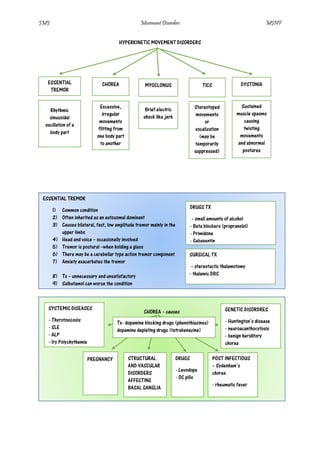
HYPERKINETIC MOVEMENT DISORDERS
ESSENTIAL TREMOR
1) Common condition
2) Often inherited as an autosomal dominant
3) Causes bilateral, fast, low amplitude tremor mainly in the
upper limbs
4) Head and voice – occasionally involved
5) Tremor is postural –when holding a glass
6) There may be a cerebellar type action tremor component
7) Anxiety exacerbates the tremor
8) Tx – unnecessary and unsatisfactory
9) Salbutamol can worse the condition
ESSENTIAL
TREMOR
CHOREA MYOCLONUS TICS DYSTONIA
Rhythmic
sinusoidal
oscillation of a
body part
Excessive,
irregular
movements
flitting from
one body part
to another
Brief electric
shock like jerk
Stereotyped
movements
or
vocalization
(may be
temporarily
suppressed)
Sustained
muscle spasms
causing
twisting
movements
and abnormal
postures
DRUGS TX
– small amounts of alcohol
- Beta blockers (propranolol)
- Primidone
- Gabapentin
SURGICAL TX
– stereotactic thalamotomy
- thalamic DBS
CHOREA – causes
SYSTEMIC DISEASES
- Thyrotoxicosis
- SLE
- ALP
- 1ry Polychythemia
GENETIC DISORDRES
- Huntington’s disease
- neuroacanthocytosis
- benign heriditory
chorea
STRUCTURAL
AND VASCULAR
DISORDERS
AFFECTING
BASAL GANGLIA
DRUGS
- Levodopa
- OC pills
POST INFECTIOUS
– Sydenham’s
chorea
- rheumatic fever
PREGNANCY
Tx- dopamine blocking drugs (phenothiazines)
dopamine depleting drugs (tetrabenazine)
JMJ Movement Disorders MJNF
HUNTINGTON’S DISEASE (HD)
1) Cause of chorea
2) Present in middle life
3) Initially with subtle ‘fidgetiness’ followed by development of progressive psychiatric and cognitive symptoms
4) Due CAG trinucleotide repeat expansion
5) Inherited as autosomal dominant
6) Progressive neurodegenerative leads to dementia and ultimately death after 10-20 years
HEMIBALLISMUS
1) Violent swinging movement of one side
2) Caused usually by infarction or hemorrhage in the contralateral sub thalamic nucleus
MYOCLONUS
PRIMARY MYOCLONUS
 Physiological myoclonus
o Nocturnal myoclonus
o Consisting a sudden jerks on
dropping off to sleep or
walking
 Myoclonic dystonia (DYT11)
o ‘Lightning jerks’ often with
dystonia
o Autosomal dominant
MYOCLONUS IN EPILEPSY
EPILEPSY-ATAXIA SYNDROMES
SECONDARY MYOCLONUS
 Metabolic diseases
o Hepatic and renal diseases
TICS
1) Common
2) Brief stereotyped movements usually affecting the face or neck
3) May affect any part of the body (vocal tics)
4) Simple transient tics common in childhood
a. Blinking
b. Sniffing
c. Facial grimacing
TOURETTE’S SYNDROME
- Commonest cause of tics
- characterized by multiple motor tics and at least one vocal tic, starting in childhood and persisting longer than a
year
- Boys affect more than girls
- behavioral problems
- Attention deficit hyperactivity disorder (ADHD)
- obsessive – compulsive disorders (OCD)
JMJ Movement Disorders MJNF
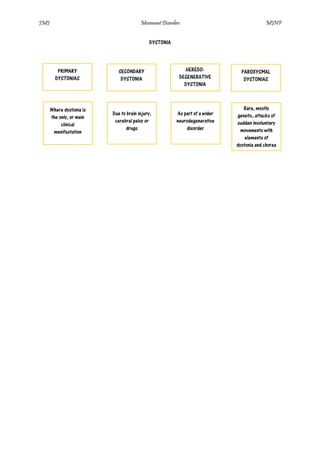
DYSTONIA
PRIMARY
DYSTONIAS
SECONDARY
DYSTONIA
HEREDO-
DEGENERATIVE
DYSTONIA
PAROXYSMAL
DYSTONIAS
Where dystonia is
the only, or main
clinical
menifestation
Due to brain injury,
cerebral palsy or
drugs
As part of a wider
neurodegenerative
disorder
Rare, mostly
genetic, attacks of
sudden involuntary
movements with
elements of
dystonia and chorea

Hyperkinetic movement disorders

  • 1.
    JMJ Movement DisordersMJNF HYPERKINETIC MOVEMENT DISORDERS ESSENTIAL TREMOR 1) Common condition 2) Often inherited as an autosomal dominant 3) Causes bilateral, fast, low amplitude tremor mainly in the upper limbs 4) Head and voice – occasionally involved 5) Tremor is postural –when holding a glass 6) There may be a cerebellar type action tremor component 7) Anxiety exacerbates the tremor 8) Tx – unnecessary and unsatisfactory 9) Salbutamol can worse the condition ESSENTIAL TREMOR CHOREA MYOCLONUS TICS DYSTONIA Rhythmic sinusoidal oscillation of a body part Excessive, irregular movements flitting from one body part to another Brief electric shock like jerk Stereotyped movements or vocalization (may be temporarily suppressed) Sustained muscle spasms causing twisting movements and abnormal postures DRUGS TX – small amounts of alcohol - Beta blockers (propranolol) - Primidone - Gabapentin SURGICAL TX – stereotactic thalamotomy - thalamic DBS CHOREA – causes SYSTEMIC DISEASES - Thyrotoxicosis - SLE - ALP - 1ry Polychythemia GENETIC DISORDRES - Huntington’s disease - neuroacanthocytosis - benign heriditory chorea STRUCTURAL AND VASCULAR DISORDERS AFFECTING BASAL GANGLIA DRUGS - Levodopa - OC pills POST INFECTIOUS – Sydenham’s chorea - rheumatic fever PREGNANCY Tx- dopamine blocking drugs (phenothiazines) dopamine depleting drugs (tetrabenazine)
  • 2.
    JMJ Movement DisordersMJNF HUNTINGTON’S DISEASE (HD) 1) Cause of chorea 2) Present in middle life 3) Initially with subtle ‘fidgetiness’ followed by development of progressive psychiatric and cognitive symptoms 4) Due CAG trinucleotide repeat expansion 5) Inherited as autosomal dominant 6) Progressive neurodegenerative leads to dementia and ultimately death after 10-20 years HEMIBALLISMUS 1) Violent swinging movement of one side 2) Caused usually by infarction or hemorrhage in the contralateral sub thalamic nucleus MYOCLONUS PRIMARY MYOCLONUS  Physiological myoclonus o Nocturnal myoclonus o Consisting a sudden jerks on dropping off to sleep or walking  Myoclonic dystonia (DYT11) o ‘Lightning jerks’ often with dystonia o Autosomal dominant MYOCLONUS IN EPILEPSY EPILEPSY-ATAXIA SYNDROMES SECONDARY MYOCLONUS  Metabolic diseases o Hepatic and renal diseases TICS 1) Common 2) Brief stereotyped movements usually affecting the face or neck 3) May affect any part of the body (vocal tics) 4) Simple transient tics common in childhood a. Blinking b. Sniffing c. Facial grimacing TOURETTE’S SYNDROME - Commonest cause of tics - characterized by multiple motor tics and at least one vocal tic, starting in childhood and persisting longer than a year - Boys affect more than girls - behavioral problems - Attention deficit hyperactivity disorder (ADHD) - obsessive – compulsive disorders (OCD)
  • 3.
    JMJ Movement DisordersMJNF DYSTONIA PRIMARY DYSTONIAS SECONDARY DYSTONIA HEREDO- DEGENERATIVE DYSTONIA PAROXYSMAL DYSTONIAS Where dystonia is the only, or main clinical menifestation Due to brain injury, cerebral palsy or drugs As part of a wider neurodegenerative disorder Rare, mostly genetic, attacks of sudden involuntary movements with elements of dystonia and chorea