CHARCOT-MARIE
TOOTH DISEASE
INTRODUCTION
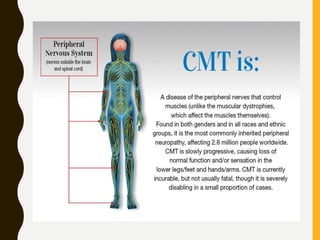
• Charcot-Marie-Tooth disease (CMT) is a group of
inherited conditions that damage the peripheral
nerves.
• It's also known as hereditary motor and sensory
neuropathy (HMSN).
• Characterized by progressive loss of muscle
tissue and touch sensation across various parts of
the body.
• This disease is the most commonly
inherited neurological disorder, and affects
approximately 1 in 2,500 people.
• Incurable
HISTORY
• Charcot-Marie-Tooth disease (CMT) is a
neurological disorder named after the
three physicians who first described it in
1886 — Jean-Martin Charcot and Pierre
Marie of France, and Howard Henry
Tooth of the United Kingdom.
CAUSES
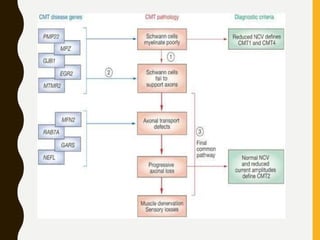
• Charcot–Marie–Tooth disease is caused by mutations
that cause defects in neuronal proteins.
• Most mutations in CMT affect the myelin sheath, but
some affect the axon.
• The most common cause of CMT is the duplication of
a large region on the short arm of chromosome 17
that includes the gene PMP22. Some mutations affect
the gene MFN2, which codes for a mitochondrial
protein
• In some forms of CMT, mutated MFN2 causes the
mitochondria to form large clusters, or clots, which
are unable to travel down the axon towards the
synapses. This prevents the synapses from
functioning.
PROGRESSION OF CMT
• Depending on the type of CMT, onset can be
from birth to adulthood, and progression is
generally slow. CMT usually isn't life-
threatening, and it almost never affects the
brain.
INHERITANCE
• CMT can be inherited in several ways: autosomal dominant (through a
faulty gene contributed by either parent); autosomal recessive (through
a faulty gene contributed by each parent); or X-linked (through a gene
on the X chromosome contributed by either parent.)
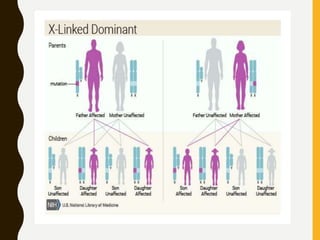
• X-linked means that the genetic defect (or mutation) is located on the X
chromosome. In females, who have two X chromosomes, a normal copy
of the gene on one chromosome can often compensate (at least
partially) for the defective copy. Therefore, X-linked diseases usually
affect males more severely than females, because males only have one
X chromosome. X-linked diseases (like CMTX) can’t be passed from
father to son.
• In males, who have one X chromosome which is defective which can be
passed on to the female offsprings born and they will be having the
disease.

• Autosomal means the mutation occurs on a chromosome other than
the X or Y. Therefore, autosomal diseases affect males and females
equally. Autosomal recessive means that two copies of a defective gene
are required for the full-blown disease. One copy is inherited from each
parent, neither of whom would normally have the disease. Autosomal
dominant means one copy of a defective gene is enough to cause
disease. A person who inherits the defective gene from a parent will
have the disease, as will the parent.
• When CMT is passed on in an autosomal dominant pattern, it
can be easy to recognize in the family tree. In contrast, X-linked
or autosomal recessive types of CMT might seem to occur “out
of the blue.” But in reality, the mother or both parents might
be carriers who silently harbor a genetic mutation. Many
parents have no idea they’re carriers of a disease until they have
a child with the disease.
• CMT also can occur when a new mutation occurs during the
child’s conception. These are called spontaneous mutations, and
after they occur, they can be passed on to the next generation.
TYPES OF CMT
• The many different types of Charcot-Marie-Tooth (CMT) are
distinguished by age of onset, inheritance pattern, severity, and
whether they're linked to defects in axon or myelin.
• CMT 1
CMT Type 1 is the most common subtype of CMT, accounting for roughly
two- thirds of all cases. CMT1 is inherited in an autosomal dominant
pattern
CMT1 is characterized by muscle weakness and atrophy, and changes in
sensation, mostly in the periphery of the body — particularly in the feet,
lower legs, hands and forearms.
CMT1 is caused by damage to the myelin sheath covering nerves.
CMT1 is commonly referred to as “demyelinating” CMT.
• CMT1A: A subtype of CMT1, called CMT1A (caused by a
duplication in the PMP22 gene on chromosome 17) accounts
for around 60 percent of CMT1 cases, making it the most
common subtype of CMT1. The PMP22 gene encodes for
peripheral myelin protein, and disruption of this gene leads to a
dysfunctional myelin sheath on nerves. CMT1A patients usually
present with typical CMT onset within adolescence, but remain
ambulatory with no reduced life expectancy.
• CMT1B: CMT1B is the second most common subtype of CMT1.
CMT1B is caused by a defect within the MPZgene, which lies on
chromosome 1. The MPZ gene produces myelin protein zero,
and disruption of this gene also causes deficits within the
myelin sheath. CMT1B patients have onset and symptoms
similar to those of CMT1A patients, although there is a wide
range of variability within CMT1B.
• CMT2
• CMT Type 2 (CMT2) is a subtype of CMT that is
similar to CMT1 but is less common. CMT2 is
autosomal dominant, but in some cases can be
recessive.
• Symptoms
• CMT2 is characterized by muscle weakness and
atrophy, and changes in sensation, mostly in the
periphery of the body — particularly in the feet,
lower legs, hands and forearms. CMT2 symptoms
similar to those of CMT1, but there is more variability
in age of onset and degree of disability.
• CMT2 also is sometimes associated with a treatable
condition called restless leg syndrome, an irresistible
urge to move the legs while sitting or lying down.
• What causes Charcot-Marie-Tooth disease type 2 (CMT2)?
• CMT2 is caused by direct damage to the nerve axon itself in
comparison to CMT1 which results from damage to the
myelin sheath insulating the axon. CMT2 is commonly
referred to as “axonal” CMT.
• CMT2A is the most common subtype of CMT2 and is caused
by defects in the MFN2 gene. The MFN2 gene encodes for
Mitofusin 2, which is a protein involved in the fusion of
cellular mitochondria.
• Other more rare forms of CMT2 and their gene defects
include:
• CMT2B is caused by defects in the RAB7 gene.
• CMT2C is caused by defects in the TRPV4 gene.
• CMT2D is caused by defects in the GARS gene.
• CMT2E is caused by defects in the NEFL gene.
• CMT4
• What is Charcot-Marie-Tooth disease type 4 (CMT4)?
• CMT4 is a rare subtype of CMT, a genetic, neurological disorder that
causes damage to the peripheral nerves — tracts of nerve cell fibers
that connect the brain and spinal cord to muscles and sensory organs.
CMT4 is a subtype of CMT that is inherited in an autosomal recessive
pattern.
• What are the symptoms of CMT4?
• CMT4 causes weakness, usually mostly distal (far from the center of the
body) but sometimes involving proximal (near the center of the body)
muscles. Impairment or changes in sensations (such as the sense of
touch or ability to perceive temperature changes) also can occur. When
CMT4 begins in infancy, it’s characterized by low muscle tone. CMT4
patients may also develop other symptoms such as cataracts or
deafness. Generally, cases of CMT4 present with more severe symptoms
compared to CMT1 or CMT2. Since some of the symptoms are severe
and the onset can be early, some subtypes of CMT4 may also be called
Severe, Early-Onset CMT.
• What causes CMT4?
• In general, CMT4 is caused by defects in the
myelin sheath which insulates the axon.
• CMT4A is caused by defects in the GDAP1 gene.
• CMT4B is caused by defects in the genes MTMR2
(CMT4B1), or MTMR13 (CMT4B2).
• CMT4C is caused by defects in the SH3TC2 gene.
• CMT4D is caused by defects in the NDRG1 gene.
• CMT4E is caused by defects in the EGR2 gene.
• CMT4F is caused by defects in the PRX gene.
• CMT4H is caused by defects in the FDG4 gene.
• CMT4J is caused by defects in the FIG4 gene.
• What is Charcot-Marie-Tooth disease type X (CMTX)?
• CMTX is a subtype of CMT, a genetic, neurological disorder
that causes damage to the peripheral nerves — tracts of
nerve cell fibers that connect the brain and spinal cord to
muscles and sensory organs.
• What are the symptoms of CMTX?
• CMTX has many of the same symptoms of CMT1 and CMT2,
including muscle weakness and atrophy, and changes in
sensation, mostly in the feet, lower legs, hands and forearms.
• Because of its linkage to the X chromosome, CMTX often
affects males more severely than females. What causes
CMTX?
• CMTX is caused by mutations in the gene for connexin 32,
which normally codes for a protein located in myelin, the
insulating sheath that surrounds nerve fibers.
SYMPTOMS
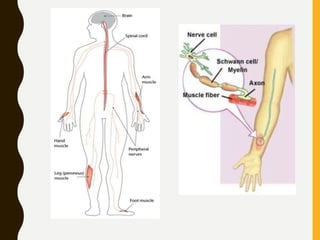
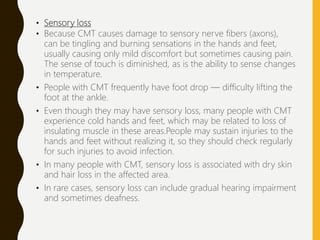
• CMT causes muscle weakness and atrophy, and some
loss of sensation in the feet, the lower legs, the hands
and the forearms. It also often causes contractures
(stiffened joints due to abnormal tightening of
muscles and associated tissues), and sometimes,
curvature of the spine (scoliosis).
• At the severe end of the CMT spectrum, the disease
can affect nerves other than those that go to and
from the extremities. If the nerves that go to and
from the diaphragm or intercostal (between the ribs)
muscles are affected, respiratory impairment can
result.
• Contractures and bone deformities
• Many people with CMT eventually develop contractures (stiffened
joints) that result in deformities of the feet and hands.
• The contractures occur because as some muscles around a joint
weaken, others remain strong, contracting and pulling on the joint.
Over time, the bones around the joint shift into abnormal positions.
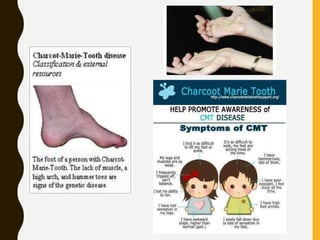
• For example, as muscles that lift the foot at the ankle become weak,
muscles that lower and curl the foot downward contract and tighten,
causing the most common type of foot deformity — a shortened foot
with a high arch (pes cavus). As the contracture gets worse, the toes
become locked in a flexed position.
• A small fraction of people with CMT develop “flat feet” (pes planus),
presumably because of a different pattern of muscle weakness.
• During walking, these deformities can cause unusual friction against
toes, heel and ball of the foot, leading to painful abrasions, blisters
calluses.
• If left untreated, the contractures and secondary abrasions tend to
worsen over time, making it increasingly difficult to walk.
• Hand contractures can occur late in the course of CMT.
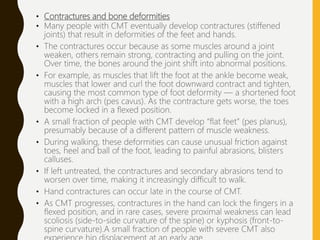
• As CMT progresses, contractures in the hand can lock the fingers in a
flexed position, and in rare cases, severe proximal weakness can lead
scoliosis (side-to-side curvature of the spine) or kyphosis (front-to-
spine curvature).A small fraction of people with severe CMT also
• Muscle weakness
• In general, people with CMT experience slowly progressive
weakness and wasting in the distal muscles, the muscles furthest
from the center of the body.
• The muscles that control the feet, lower legs, forearms and hands
are most affected.
• The proximal muscles, which are those closer to the center of the
body, such as the upper arm and upper leg muscles, are rarely
affected.
• Usually, weakness begins in the feet and ankles, and manifests
as foot drop — difficulty lifting the foot at the ankle, so that the
toes point downward during walking.
• Foot drop causes frequent tripping, and with increasing weakness
and attempts at compensation, the affected person develops an
abnormal gait.
• Although it’s usually too slight to cause disability or discomfort,
some people with CMT experience tremor (involuntary shaking).
• CMT with obvious tremor is sometimes called Roussy-Levy
syndrome.
• Sensory loss
• Because CMT causes damage to sensory nerve fibers (axons),
can be tingling and burning sensations in the hands and feet,
usually causing only mild discomfort but sometimes causing pain.
The sense of touch is diminished, as is the ability to sense changes
in temperature.
• People with CMT frequently have foot drop — difficulty lifting the
foot at the ankle.
• Even though they may have sensory loss, many people with CMT
experience cold hands and feet, which may be related to loss of
insulating muscle in these areas.People may sustain injuries to the
hands and feet without realizing it, so they should check regularly
for such injuries to avoid infection.
• In many people with CMT, sensory loss is associated with dry skin
and hair loss in the affected area.
• In rare cases, sensory loss can include gradual hearing impairment
and sometimes deafness.
• Diagnosis
• The diagnosis of CMT hereditary neuropathy can be challenging. The
diagnosis is based on physical symptoms, family history and clinical tests.
Clinical tests include nerve conduction velocity (NCV) which measures the
speed at which impulses travel along the nerves and electromyogram
(EMG) which records the electrical activity of muscle cell. . Molecular
testing is currently available for CMT1A, CMT1B, CMT1D, CMT2E, CMT4A,
CMT4E, CMT4F and CMTX.
• Therapies
• Physical therapy. Physical therapy can help strengthen and stretch your
muscles to prevent muscle tightening and loss. A program usually
low-impact exercises and stretching techniques guided by a trained
physical therapist and approved by your doctor. Started early and
regularly, physical therapy can help prevent disability.
• Occupational therapy. Weakness in the arms and hands can cause
difficulty with gripping and finger movements, such as fastening buttons
writing. Occupational therapy can help through the use of assistive
such as special rubber grips on doorknobs or clothing with snaps instead
buttons.
• Orthopaedic devices. Many people with Charcot-Marie-Tooth disease
require the help of certain orthopaedic devices to maintain everyday
mobility and to prevent injury. Leg and ankle braces or splints can provide
stability during walking and climbing stairs.
• Treatment
• Treatment of CMT hereditary neuropathy is symptomatic and
supportive. A cure is not available so it is important to minimize or
stall the symptoms. Comprehensive treatments include physical
therapy, shoe orthotics, leg braces and surgery to correct
deformities. Complementary therapies may help psychologically,
relieve pain and discomfort, and improve overall quality of life.
Vocational counseling, anticipating progression of the disorder,
may be useful for young patients.
• Surgery
• If foot deformities are severe, corrective foot surgery may help
alleviate pain and improve your ability to walk. Surgery can't
improve weakness or loss of sensation.
• Potential future treatments
• Researchers are investigating a number of potential therapies that
may one day treat Charcot-Marie-Tooth disease. Potential
include medications and in vitro procedures that may help prevent
passing the disease to future generations.
THANK YOU

Cmtppt

  • 1.
  • 2.
    INTRODUCTION • Charcot-Marie-Tooth disease(CMT) is a group of inherited conditions that damage the peripheral nerves. • It's also known as hereditary motor and sensory neuropathy (HMSN). • Characterized by progressive loss of muscle tissue and touch sensation across various parts of the body. • This disease is the most commonly inherited neurological disorder, and affects approximately 1 in 2,500 people. • Incurable
  • 4.
    HISTORY • Charcot-Marie-Tooth disease(CMT) is a neurological disorder named after the three physicians who first described it in 1886 — Jean-Martin Charcot and Pierre Marie of France, and Howard Henry Tooth of the United Kingdom.
  • 5.
    CAUSES • Charcot–Marie–Tooth diseaseis caused by mutations that cause defects in neuronal proteins. • Most mutations in CMT affect the myelin sheath, but some affect the axon. • The most common cause of CMT is the duplication of a large region on the short arm of chromosome 17 that includes the gene PMP22. Some mutations affect the gene MFN2, which codes for a mitochondrial protein • In some forms of CMT, mutated MFN2 causes the mitochondria to form large clusters, or clots, which are unable to travel down the axon towards the synapses. This prevents the synapses from functioning.
  • 7.
    PROGRESSION OF CMT •Depending on the type of CMT, onset can be from birth to adulthood, and progression is generally slow. CMT usually isn't life- threatening, and it almost never affects the brain.
  • 9.
    INHERITANCE • CMT canbe inherited in several ways: autosomal dominant (through a faulty gene contributed by either parent); autosomal recessive (through a faulty gene contributed by each parent); or X-linked (through a gene on the X chromosome contributed by either parent.) • X-linked means that the genetic defect (or mutation) is located on the X chromosome. In females, who have two X chromosomes, a normal copy of the gene on one chromosome can often compensate (at least partially) for the defective copy. Therefore, X-linked diseases usually affect males more severely than females, because males only have one X chromosome. X-linked diseases (like CMTX) can’t be passed from father to son. • In males, who have one X chromosome which is defective which can be passed on to the female offsprings born and they will be having the disease. • Autosomal means the mutation occurs on a chromosome other than the X or Y. Therefore, autosomal diseases affect males and females equally. Autosomal recessive means that two copies of a defective gene are required for the full-blown disease. One copy is inherited from each parent, neither of whom would normally have the disease. Autosomal dominant means one copy of a defective gene is enough to cause disease. A person who inherits the defective gene from a parent will have the disease, as will the parent.
  • 11.
    • When CMTis passed on in an autosomal dominant pattern, it can be easy to recognize in the family tree. In contrast, X-linked or autosomal recessive types of CMT might seem to occur “out of the blue.” But in reality, the mother or both parents might be carriers who silently harbor a genetic mutation. Many parents have no idea they’re carriers of a disease until they have a child with the disease. • CMT also can occur when a new mutation occurs during the child’s conception. These are called spontaneous mutations, and after they occur, they can be passed on to the next generation.
  • 12.
    TYPES OF CMT •The many different types of Charcot-Marie-Tooth (CMT) are distinguished by age of onset, inheritance pattern, severity, and whether they're linked to defects in axon or myelin. • CMT 1 CMT Type 1 is the most common subtype of CMT, accounting for roughly two- thirds of all cases. CMT1 is inherited in an autosomal dominant pattern CMT1 is characterized by muscle weakness and atrophy, and changes in sensation, mostly in the periphery of the body — particularly in the feet, lower legs, hands and forearms. CMT1 is caused by damage to the myelin sheath covering nerves. CMT1 is commonly referred to as “demyelinating” CMT.
  • 13.
    • CMT1A: Asubtype of CMT1, called CMT1A (caused by a duplication in the PMP22 gene on chromosome 17) accounts for around 60 percent of CMT1 cases, making it the most common subtype of CMT1. The PMP22 gene encodes for peripheral myelin protein, and disruption of this gene leads to a dysfunctional myelin sheath on nerves. CMT1A patients usually present with typical CMT onset within adolescence, but remain ambulatory with no reduced life expectancy. • CMT1B: CMT1B is the second most common subtype of CMT1. CMT1B is caused by a defect within the MPZgene, which lies on chromosome 1. The MPZ gene produces myelin protein zero, and disruption of this gene also causes deficits within the myelin sheath. CMT1B patients have onset and symptoms similar to those of CMT1A patients, although there is a wide range of variability within CMT1B.
  • 14.
    • CMT2 • CMTType 2 (CMT2) is a subtype of CMT that is similar to CMT1 but is less common. CMT2 is autosomal dominant, but in some cases can be recessive. • Symptoms • CMT2 is characterized by muscle weakness and atrophy, and changes in sensation, mostly in the periphery of the body — particularly in the feet, lower legs, hands and forearms. CMT2 symptoms similar to those of CMT1, but there is more variability in age of onset and degree of disability. • CMT2 also is sometimes associated with a treatable condition called restless leg syndrome, an irresistible urge to move the legs while sitting or lying down.
  • 15.
    • What causesCharcot-Marie-Tooth disease type 2 (CMT2)? • CMT2 is caused by direct damage to the nerve axon itself in comparison to CMT1 which results from damage to the myelin sheath insulating the axon. CMT2 is commonly referred to as “axonal” CMT. • CMT2A is the most common subtype of CMT2 and is caused by defects in the MFN2 gene. The MFN2 gene encodes for Mitofusin 2, which is a protein involved in the fusion of cellular mitochondria. • Other more rare forms of CMT2 and their gene defects include: • CMT2B is caused by defects in the RAB7 gene. • CMT2C is caused by defects in the TRPV4 gene. • CMT2D is caused by defects in the GARS gene. • CMT2E is caused by defects in the NEFL gene.
  • 16.
    • CMT4 • Whatis Charcot-Marie-Tooth disease type 4 (CMT4)? • CMT4 is a rare subtype of CMT, a genetic, neurological disorder that causes damage to the peripheral nerves — tracts of nerve cell fibers that connect the brain and spinal cord to muscles and sensory organs. CMT4 is a subtype of CMT that is inherited in an autosomal recessive pattern. • What are the symptoms of CMT4? • CMT4 causes weakness, usually mostly distal (far from the center of the body) but sometimes involving proximal (near the center of the body) muscles. Impairment or changes in sensations (such as the sense of touch or ability to perceive temperature changes) also can occur. When CMT4 begins in infancy, it’s characterized by low muscle tone. CMT4 patients may also develop other symptoms such as cataracts or deafness. Generally, cases of CMT4 present with more severe symptoms compared to CMT1 or CMT2. Since some of the symptoms are severe and the onset can be early, some subtypes of CMT4 may also be called Severe, Early-Onset CMT.
  • 17.
    • What causesCMT4? • In general, CMT4 is caused by defects in the myelin sheath which insulates the axon. • CMT4A is caused by defects in the GDAP1 gene. • CMT4B is caused by defects in the genes MTMR2 (CMT4B1), or MTMR13 (CMT4B2). • CMT4C is caused by defects in the SH3TC2 gene. • CMT4D is caused by defects in the NDRG1 gene. • CMT4E is caused by defects in the EGR2 gene. • CMT4F is caused by defects in the PRX gene. • CMT4H is caused by defects in the FDG4 gene. • CMT4J is caused by defects in the FIG4 gene.
  • 18.
    • What isCharcot-Marie-Tooth disease type X (CMTX)? • CMTX is a subtype of CMT, a genetic, neurological disorder that causes damage to the peripheral nerves — tracts of nerve cell fibers that connect the brain and spinal cord to muscles and sensory organs. • What are the symptoms of CMTX? • CMTX has many of the same symptoms of CMT1 and CMT2, including muscle weakness and atrophy, and changes in sensation, mostly in the feet, lower legs, hands and forearms. • Because of its linkage to the X chromosome, CMTX often affects males more severely than females. What causes CMTX? • CMTX is caused by mutations in the gene for connexin 32, which normally codes for a protein located in myelin, the insulating sheath that surrounds nerve fibers.
  • 19.
    SYMPTOMS • CMT causesmuscle weakness and atrophy, and some loss of sensation in the feet, the lower legs, the hands and the forearms. It also often causes contractures (stiffened joints due to abnormal tightening of muscles and associated tissues), and sometimes, curvature of the spine (scoliosis). • At the severe end of the CMT spectrum, the disease can affect nerves other than those that go to and from the extremities. If the nerves that go to and from the diaphragm or intercostal (between the ribs) muscles are affected, respiratory impairment can result.
  • 21.
    • Contractures andbone deformities • Many people with CMT eventually develop contractures (stiffened joints) that result in deformities of the feet and hands. • The contractures occur because as some muscles around a joint weaken, others remain strong, contracting and pulling on the joint. Over time, the bones around the joint shift into abnormal positions. • For example, as muscles that lift the foot at the ankle become weak, muscles that lower and curl the foot downward contract and tighten, causing the most common type of foot deformity — a shortened foot with a high arch (pes cavus). As the contracture gets worse, the toes become locked in a flexed position. • A small fraction of people with CMT develop “flat feet” (pes planus), presumably because of a different pattern of muscle weakness. • During walking, these deformities can cause unusual friction against toes, heel and ball of the foot, leading to painful abrasions, blisters calluses. • If left untreated, the contractures and secondary abrasions tend to worsen over time, making it increasingly difficult to walk. • Hand contractures can occur late in the course of CMT. • As CMT progresses, contractures in the hand can lock the fingers in a flexed position, and in rare cases, severe proximal weakness can lead scoliosis (side-to-side curvature of the spine) or kyphosis (front-to- spine curvature).A small fraction of people with severe CMT also
  • 22.
    • Muscle weakness •In general, people with CMT experience slowly progressive weakness and wasting in the distal muscles, the muscles furthest from the center of the body. • The muscles that control the feet, lower legs, forearms and hands are most affected. • The proximal muscles, which are those closer to the center of the body, such as the upper arm and upper leg muscles, are rarely affected. • Usually, weakness begins in the feet and ankles, and manifests as foot drop — difficulty lifting the foot at the ankle, so that the toes point downward during walking. • Foot drop causes frequent tripping, and with increasing weakness and attempts at compensation, the affected person develops an abnormal gait. • Although it’s usually too slight to cause disability or discomfort, some people with CMT experience tremor (involuntary shaking). • CMT with obvious tremor is sometimes called Roussy-Levy syndrome.
  • 23.
    • Sensory loss •Because CMT causes damage to sensory nerve fibers (axons), can be tingling and burning sensations in the hands and feet, usually causing only mild discomfort but sometimes causing pain. The sense of touch is diminished, as is the ability to sense changes in temperature. • People with CMT frequently have foot drop — difficulty lifting the foot at the ankle. • Even though they may have sensory loss, many people with CMT experience cold hands and feet, which may be related to loss of insulating muscle in these areas.People may sustain injuries to the hands and feet without realizing it, so they should check regularly for such injuries to avoid infection. • In many people with CMT, sensory loss is associated with dry skin and hair loss in the affected area. • In rare cases, sensory loss can include gradual hearing impairment and sometimes deafness.
  • 24.
    • Diagnosis • Thediagnosis of CMT hereditary neuropathy can be challenging. The diagnosis is based on physical symptoms, family history and clinical tests. Clinical tests include nerve conduction velocity (NCV) which measures the speed at which impulses travel along the nerves and electromyogram (EMG) which records the electrical activity of muscle cell. . Molecular testing is currently available for CMT1A, CMT1B, CMT1D, CMT2E, CMT4A, CMT4E, CMT4F and CMTX. • Therapies • Physical therapy. Physical therapy can help strengthen and stretch your muscles to prevent muscle tightening and loss. A program usually low-impact exercises and stretching techniques guided by a trained physical therapist and approved by your doctor. Started early and regularly, physical therapy can help prevent disability. • Occupational therapy. Weakness in the arms and hands can cause difficulty with gripping and finger movements, such as fastening buttons writing. Occupational therapy can help through the use of assistive such as special rubber grips on doorknobs or clothing with snaps instead buttons. • Orthopaedic devices. Many people with Charcot-Marie-Tooth disease require the help of certain orthopaedic devices to maintain everyday mobility and to prevent injury. Leg and ankle braces or splints can provide stability during walking and climbing stairs.
  • 25.
    • Treatment • Treatmentof CMT hereditary neuropathy is symptomatic and supportive. A cure is not available so it is important to minimize or stall the symptoms. Comprehensive treatments include physical therapy, shoe orthotics, leg braces and surgery to correct deformities. Complementary therapies may help psychologically, relieve pain and discomfort, and improve overall quality of life. Vocational counseling, anticipating progression of the disorder, may be useful for young patients. • Surgery • If foot deformities are severe, corrective foot surgery may help alleviate pain and improve your ability to walk. Surgery can't improve weakness or loss of sensation. • Potential future treatments • Researchers are investigating a number of potential therapies that may one day treat Charcot-Marie-Tooth disease. Potential include medications and in vitro procedures that may help prevent passing the disease to future generations.
  • 26.