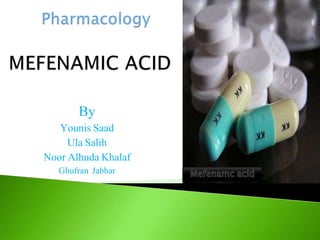
By 
Younis Saad 
Ula Salih 
Noor Alhuda Khalaf 
Ghufran Jabbar
 Introduction 
 Pharmacodynamics 
 Pharmacokinetics 
 Uses 
 Dosage & Administration 
 Side Effects 
 Brand names 
 References & Sources
What is mefenamic acid? 
Mefenamic acid is a non-steroidal 
anti-inflammatory 
drug used to treat pain. 
It is typically prescribed for 
oral administration.
 Mefenamic Acid is a white 
to greyish-white, odorless, 
microcrystalline powder with 
a melting point of 230° to 
231°C and water solubility of 
0.004% at pH 7.1. The chemical 
name is N-2,3-xylylanthranilic 
acid. The molecular weight is 
241.29.
 Its molecular formula is 
C15H15N02 and the structural formula of 
Mefenamic Acid is:
Mefenamic Acid is a non-steroidal anti-inflammatory 
drug (NSAID) that exhibits anti-inflammatory, 
analgesic, and antipyretic 
activities in animal models. The mechanism 
of action of Mefenamic Acid, like that of 
other NSAIDs, is not completely understood 
but may be related to prostaglandin 
inhibition.
Absorption 
usually reaches peak plasma levels 2 to 4 hours after 
oral administration with a half life of 2 hours. 
Distribution 
Mefenamic acid and its metabolites are firmly bound to 
plasma proteins.
MEFENAMIC ACID has demonstrated analgesic, anti-inflammatory 
and antipyretic properties in human clinical studies 
and in classical animal test systems. These effects may be due to 
its dual action on prostaglandins. It inhibits the enzymes of 
prostaglandin syntheses and also antagonises the actions of 
prostaglandin at the receptor sites. These effects may also be 
responsible for its effectiveness in the treatment of primary 
dysmenorrhoea.
Mefenamic acid metabolism is predominantly mediated 
via cytochrome P450 CYP 2C9 in the liver. Patients 
who are known or suspected to be poor CYP2C9 
metabolisers should be administered mefenamic acid 
with caution as they may have abnormally high plasma 
levels due to reduced metabolic clearance. 
Metabolism I 3-hydroxymethyl Mefenamic Acid 
Metabolism II 3-carboxy Mefenamic Acid
Elimination 
Following a single dose, 67% of the 
total dose is excreted in the urine as 
unchanged drug or as one of the two 
metabolites. 20% to 25% of the dose is 
excreted in the faeces during the first 
three days.
Mefenamic acid is used for: 
 Treatment of primary dysmenorrhoea 
 Inflammation and fever 
 soft tissue and dental pain. 
Mefenamic acid is an NSAID, NSAIDs treat the symptoms 
of pain and inflammation. They do not treat the disease that 
causes those symptoms.
 Dysmenorrhoea 
(500 mg) three times daily from the onset of pain and 
continued for the usual duration of pain. 
 Menorrhagia 
(500 mg) three times daily. Therapy should not be 
continued for more than 7 days except on the advice of a 
physician. 
 Other Indications 
(500 mg) three times daily
Dental pain or soft tissue 
500 mg three times daily 
Children 
250 mg three times daily 
Not recommended for children under 14 years of age. 
Food(before/after) 
Should be taken with food.
Symptoms 
Symptoms of over dosage are related to the amount of 
drug ingested and range from gastrointestinal 
discomfort and diarrhea to seizures, acute renal failure, 
vertigo, hallucination, coma and death. Plasma levels 
of up to 210 μg/mL (therapeutic range 1 to 10 μg/mL) 
have been reported resulting in repeated generalised 
convulsions, but are not generally useful for evaluation 
and management of over dosage.
There is no specific antidote for mefenamic acid overdose. 
Treatment is symptomatic and supportive, including fluid 
replacement and IV access especially to patients who are 
dehydrated or unable to ingest adequate fluids. 
Because mefenamic acid and its metabolites are firmly 
bound to plasma proteins, haemodialysis, and peritoneal 
dialysis may be of little value.
All medicines may cause side effects, but many 
people have no, or minor, side effects. 
Constipation, diarrhea, dizziness, gas, 
Headache, heartburn, nausea, stomach upset. 
Severe allergic reactions 
Rash, Hives, Itching, trouble breathing, 
tightness in the chest, swelling of the 
mouth, face, lips, or tongue.
Be careful if you are pregnant there a potential 
risk to the fetus. 
the benefits from use in pregnant women may be acceptable 
despite the risk (e.g., if the drug is needed in a life threatening 
situation or for a serious disease for which safer drugs cannot 
be used or are ineffective). 
The inhibition of prostaglandin synthesis by NSAIDs 
may adversely affect pregnancy. Epidemiological 
studies suggest an increased risk of spontaneous 
abortion after use of prostaglandin synthesis inhibitors 
in early pregnancy. In animals, administration of 
prostaglandin synthesis inhibitors has been shown to 
result in increased pre- and post-implantation loss.
NSAIDs given during the latter part of pregnancy may 
cause closure of the fetal ductus arteriosus, fetal renal 
impairment, inhibition of platelet aggregation. Continuous 
treatment with NSAIDs during the last trimester of 
pregnancy should only be given on sound indications. 
During the last few days before expected birth, agents with 
an inhibitory effect on prostaglandin synthesis should be 
avoided. 
It is not known if mefenamic acid or its metabolites 
crosses the placenta. Since there are no adequate and well-controlled 
studies in pregnant women
Use in Lactation 
Trace amounts of mefenamic acid may be present in breast 
milk and transmitted to the nursing infant. Thus mefenamic 
acid should not be taken by the nursing mother because of 
the effects of this class of drugs on the infant 
cardiovascular system.
 1. Patients showing evidence of chronic inflammation 
and/or active ulceration of either the upper or lower 
gastrointestinal tract and patients with pre-existing renal 
disease. 
 2. Patients in whom aspirin and/or other NSAIDs have 
induced symptoms of bronchospasm, allergic rhinitis 
because the potential exists for cross-sensitivity. 
 3. Patients with impaired renal function or hepatic failure.
 4. Patients previously experiencing diarrhea on taking 
this drug. 
 5. Patients who have previously exhibited 
hypersensitivity to mefenamic acid . 
 6. Patients with severe heart failure.
 Aspirin 
Mefenamic acid interferes with the anti-platelet effect 
of low-dose aspirin, and thus may interfere with 
aspirin’s prophylactic treatment of cardiovascular 
disease. 
 Corticosteroids 
Concurrent use with NSAIDs may increase the risk of 
gastrointestinal ulceration or bleeding.
 Cyclosporin or Tacrolimus 
Concomitant administration with NSAIDs increases the 
risk of nephrotoxicity. 
 Hypoglycaemic agents 
There have been reports of changes in the effects of oral 
hypoglycaemic agents in the presence of NSAIDs. 
Therefore, mefenamic acid should be administered with 
caution in patients receiving insulin or oral 
hypoglycaemic agents.
 Lithium 
Mefenamic acid has produced an elevation of plasma 
lithium levels and a reduction in renal lithium clearance. 
Thus, when mefenamic acid and lithium are administered 
concurrently, patients should be observed carefully for 
signs of lithium toxicity. 
 Methotrexate 
Caution is advised when methotrexate is administered 
concurrently with NSAIDs, including mefenamic acid, 
because NSAID administration may result in increased 
plasma levels of methotrexate, especially in patients 
receiving high doses of methotrexate.
Mefenamic acid is internal administration 
solid formulation: supplied in PVC/Al blister packs of 20 
or 50 capsules and in bottles of 50 capsules. 
liquid formulation: 120 ml 
Examples: 
Beafemic, Mefalth, Mefivan, Ponstel, Ponstan, 
Ponstal, Parkemed, Revalan, Mafepain,
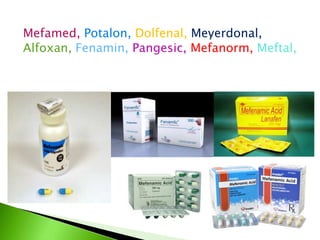
Mefamed, Potalon, Dolfenal, Meyerdonal, 
Alfoxan, Fenamin, Pangesic, Mefanorm, Meftal,
References : 
1. http://www.ncbi.nlm.nih.gov/pmc/articles/PMC27206 
41/ 
2. "Side effects for Mefenamic Acid". Medline Plus. 
National Institutes of Health. 
3. http://www.drugs.com/ppa/mefenamic-acid. 
html 
4. http://www.eci2012.net/ .1
5. http://www.drugs.com/ppa/mefenamic-acid. 
html 
6. http://www.drugsupdate.com/generic/view/ 
285 
Sources : 
 MedlinePlus Drug Information: Mefenamic Acid. Last 
accessed September 28, 2005. 
 Ponstel Pharmacology, Pharmacokinetics, Studies, 
Metabolism - Mefenamic Acid - RxList Monographs. Last 
accessed September 28, 2005.
Mefenamic acid

Mefenamic acid

  • 1.
    By Younis Saad Ula Salih Noor Alhuda Khalaf Ghufran Jabbar
  • 2.
     Introduction Pharmacodynamics  Pharmacokinetics  Uses  Dosage & Administration  Side Effects  Brand names  References & Sources
  • 3.
    What is mefenamicacid? Mefenamic acid is a non-steroidal anti-inflammatory drug used to treat pain. It is typically prescribed for oral administration.
  • 4.
     Mefenamic Acidis a white to greyish-white, odorless, microcrystalline powder with a melting point of 230° to 231°C and water solubility of 0.004% at pH 7.1. The chemical name is N-2,3-xylylanthranilic acid. The molecular weight is 241.29.
  • 5.
     Its molecularformula is C15H15N02 and the structural formula of Mefenamic Acid is:
  • 6.
    Mefenamic Acid isa non-steroidal anti-inflammatory drug (NSAID) that exhibits anti-inflammatory, analgesic, and antipyretic activities in animal models. The mechanism of action of Mefenamic Acid, like that of other NSAIDs, is not completely understood but may be related to prostaglandin inhibition.
  • 7.
    Absorption usually reachespeak plasma levels 2 to 4 hours after oral administration with a half life of 2 hours. Distribution Mefenamic acid and its metabolites are firmly bound to plasma proteins.
  • 8.
    MEFENAMIC ACID hasdemonstrated analgesic, anti-inflammatory and antipyretic properties in human clinical studies and in classical animal test systems. These effects may be due to its dual action on prostaglandins. It inhibits the enzymes of prostaglandin syntheses and also antagonises the actions of prostaglandin at the receptor sites. These effects may also be responsible for its effectiveness in the treatment of primary dysmenorrhoea.
  • 9.
    Mefenamic acid metabolismis predominantly mediated via cytochrome P450 CYP 2C9 in the liver. Patients who are known or suspected to be poor CYP2C9 metabolisers should be administered mefenamic acid with caution as they may have abnormally high plasma levels due to reduced metabolic clearance. Metabolism I 3-hydroxymethyl Mefenamic Acid Metabolism II 3-carboxy Mefenamic Acid
  • 10.
    Elimination Following asingle dose, 67% of the total dose is excreted in the urine as unchanged drug or as one of the two metabolites. 20% to 25% of the dose is excreted in the faeces during the first three days.
  • 11.
    Mefenamic acid isused for:  Treatment of primary dysmenorrhoea  Inflammation and fever  soft tissue and dental pain. Mefenamic acid is an NSAID, NSAIDs treat the symptoms of pain and inflammation. They do not treat the disease that causes those symptoms.
  • 12.
     Dysmenorrhoea (500mg) three times daily from the onset of pain and continued for the usual duration of pain.  Menorrhagia (500 mg) three times daily. Therapy should not be continued for more than 7 days except on the advice of a physician.  Other Indications (500 mg) three times daily
  • 13.
    Dental pain orsoft tissue 500 mg three times daily Children 250 mg three times daily Not recommended for children under 14 years of age. Food(before/after) Should be taken with food.
  • 14.
    Symptoms Symptoms ofover dosage are related to the amount of drug ingested and range from gastrointestinal discomfort and diarrhea to seizures, acute renal failure, vertigo, hallucination, coma and death. Plasma levels of up to 210 μg/mL (therapeutic range 1 to 10 μg/mL) have been reported resulting in repeated generalised convulsions, but are not generally useful for evaluation and management of over dosage.
  • 15.
    There is nospecific antidote for mefenamic acid overdose. Treatment is symptomatic and supportive, including fluid replacement and IV access especially to patients who are dehydrated or unable to ingest adequate fluids. Because mefenamic acid and its metabolites are firmly bound to plasma proteins, haemodialysis, and peritoneal dialysis may be of little value.
  • 16.
    All medicines maycause side effects, but many people have no, or minor, side effects. Constipation, diarrhea, dizziness, gas, Headache, heartburn, nausea, stomach upset. Severe allergic reactions Rash, Hives, Itching, trouble breathing, tightness in the chest, swelling of the mouth, face, lips, or tongue.
  • 17.
    Be careful ifyou are pregnant there a potential risk to the fetus. the benefits from use in pregnant women may be acceptable despite the risk (e.g., if the drug is needed in a life threatening situation or for a serious disease for which safer drugs cannot be used or are ineffective). The inhibition of prostaglandin synthesis by NSAIDs may adversely affect pregnancy. Epidemiological studies suggest an increased risk of spontaneous abortion after use of prostaglandin synthesis inhibitors in early pregnancy. In animals, administration of prostaglandin synthesis inhibitors has been shown to result in increased pre- and post-implantation loss.
  • 18.
    NSAIDs given duringthe latter part of pregnancy may cause closure of the fetal ductus arteriosus, fetal renal impairment, inhibition of platelet aggregation. Continuous treatment with NSAIDs during the last trimester of pregnancy should only be given on sound indications. During the last few days before expected birth, agents with an inhibitory effect on prostaglandin synthesis should be avoided. It is not known if mefenamic acid or its metabolites crosses the placenta. Since there are no adequate and well-controlled studies in pregnant women
  • 19.
    Use in Lactation Trace amounts of mefenamic acid may be present in breast milk and transmitted to the nursing infant. Thus mefenamic acid should not be taken by the nursing mother because of the effects of this class of drugs on the infant cardiovascular system.
  • 20.
     1. Patientsshowing evidence of chronic inflammation and/or active ulceration of either the upper or lower gastrointestinal tract and patients with pre-existing renal disease.  2. Patients in whom aspirin and/or other NSAIDs have induced symptoms of bronchospasm, allergic rhinitis because the potential exists for cross-sensitivity.  3. Patients with impaired renal function or hepatic failure.
  • 21.
     4. Patientspreviously experiencing diarrhea on taking this drug.  5. Patients who have previously exhibited hypersensitivity to mefenamic acid .  6. Patients with severe heart failure.
  • 22.
     Aspirin Mefenamicacid interferes with the anti-platelet effect of low-dose aspirin, and thus may interfere with aspirin’s prophylactic treatment of cardiovascular disease.  Corticosteroids Concurrent use with NSAIDs may increase the risk of gastrointestinal ulceration or bleeding.
  • 23.
     Cyclosporin orTacrolimus Concomitant administration with NSAIDs increases the risk of nephrotoxicity.  Hypoglycaemic agents There have been reports of changes in the effects of oral hypoglycaemic agents in the presence of NSAIDs. Therefore, mefenamic acid should be administered with caution in patients receiving insulin or oral hypoglycaemic agents.
  • 24.
     Lithium Mefenamicacid has produced an elevation of plasma lithium levels and a reduction in renal lithium clearance. Thus, when mefenamic acid and lithium are administered concurrently, patients should be observed carefully for signs of lithium toxicity.  Methotrexate Caution is advised when methotrexate is administered concurrently with NSAIDs, including mefenamic acid, because NSAID administration may result in increased plasma levels of methotrexate, especially in patients receiving high doses of methotrexate.
  • 25.
    Mefenamic acid isinternal administration solid formulation: supplied in PVC/Al blister packs of 20 or 50 capsules and in bottles of 50 capsules. liquid formulation: 120 ml Examples: Beafemic, Mefalth, Mefivan, Ponstel, Ponstan, Ponstal, Parkemed, Revalan, Mafepain,
  • 26.
    Mefamed, Potalon, Dolfenal,Meyerdonal, Alfoxan, Fenamin, Pangesic, Mefanorm, Meftal,
  • 27.
    References : 1.http://www.ncbi.nlm.nih.gov/pmc/articles/PMC27206 41/ 2. "Side effects for Mefenamic Acid". Medline Plus. National Institutes of Health. 3. http://www.drugs.com/ppa/mefenamic-acid. html 4. http://www.eci2012.net/ .1
  • 28.
    5. http://www.drugs.com/ppa/mefenamic-acid. html 6. http://www.drugsupdate.com/generic/view/ 285 Sources :  MedlinePlus Drug Information: Mefenamic Acid. Last accessed September 28, 2005.  Ponstel Pharmacology, Pharmacokinetics, Studies, Metabolism - Mefenamic Acid - RxList Monographs. Last accessed September 28, 2005.