
Normal Muscles
myopathies
Muscular Atrophy
Muscular Dystrophy
Inflammation of muscle (Myositis)
Disorders of Neuromuscular Transmission
Content
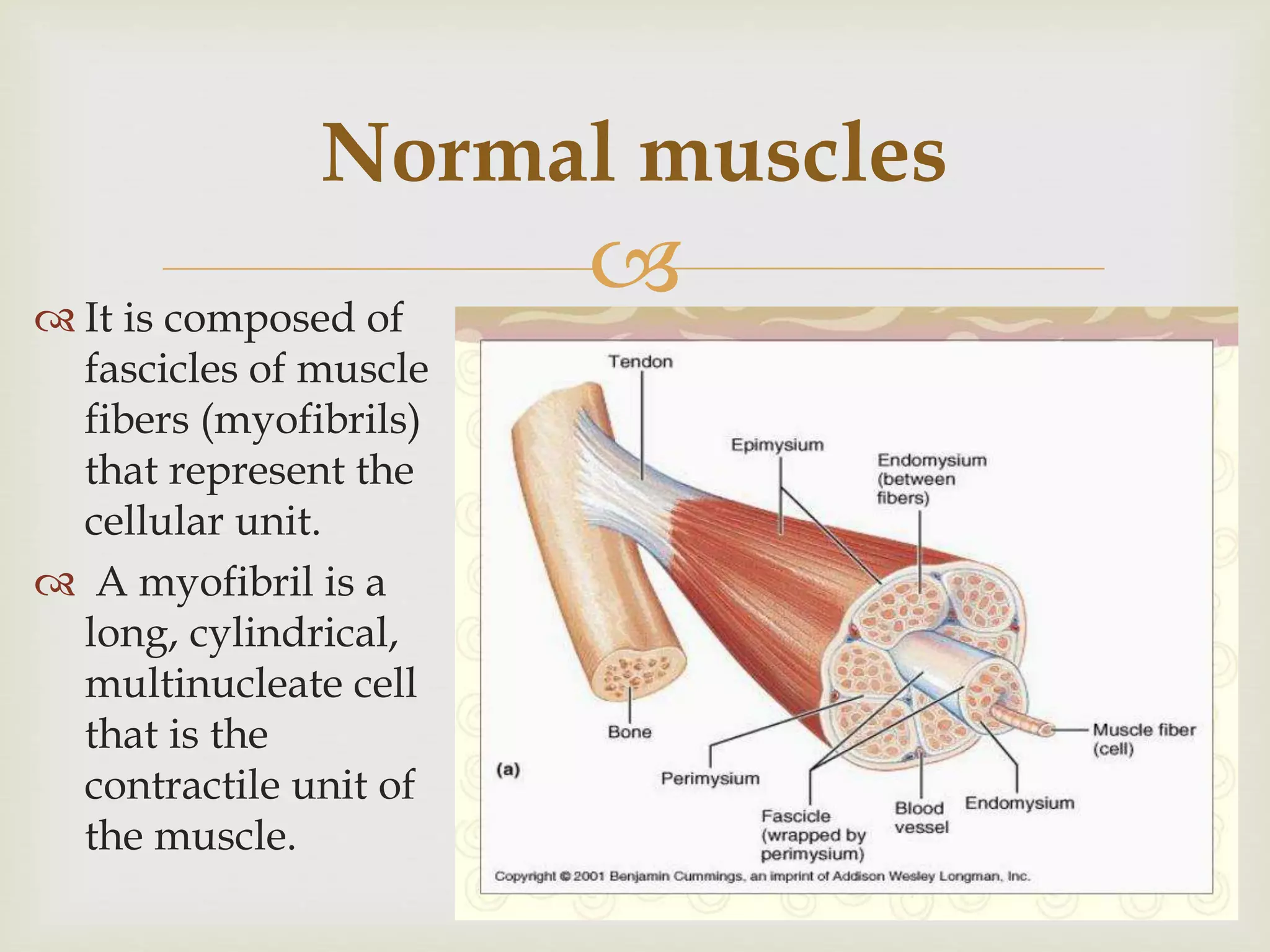
 It is composed of
fascicles of muscle
fibers (myofibrils)
that represent the
cellular unit.
 A myofibril is a
long, cylindrical,
multinucleate cell
that is the
contractile unit of
the muscle.
Normal muscles


Diseases and damage the brain or nerves that
stimulate muscles and disorders of muscle fibers.
 "Myopathy" simply means muscle disease (myo-
Greek "muscle" + patho-Greek "suffering").
Causes:
o Loss of innervation (neurogenic injury).
o Disuse.
o Old age.
o Primary myopathies (inflammatory or others).
Myopathies

 General clinical considerations- family history, age of
onsets, history of drugs, distribution of muscle
weakness and rate of progression.
 Special investigation of neuromuscular electrical
activity (electromyography).
 Laboratory test:-
I. muscle biopsy.
II. serum enzymes (CK).
III. chromosomal analysis.
Muscle disease- Diagnosis
• Muscular Atrophy.
• Muscular Dystrophy.
• Inflammation of muscle
(Myositis).
• Disorders of Neuromuscular
Transmission.
Muscles
disease
/
disorder
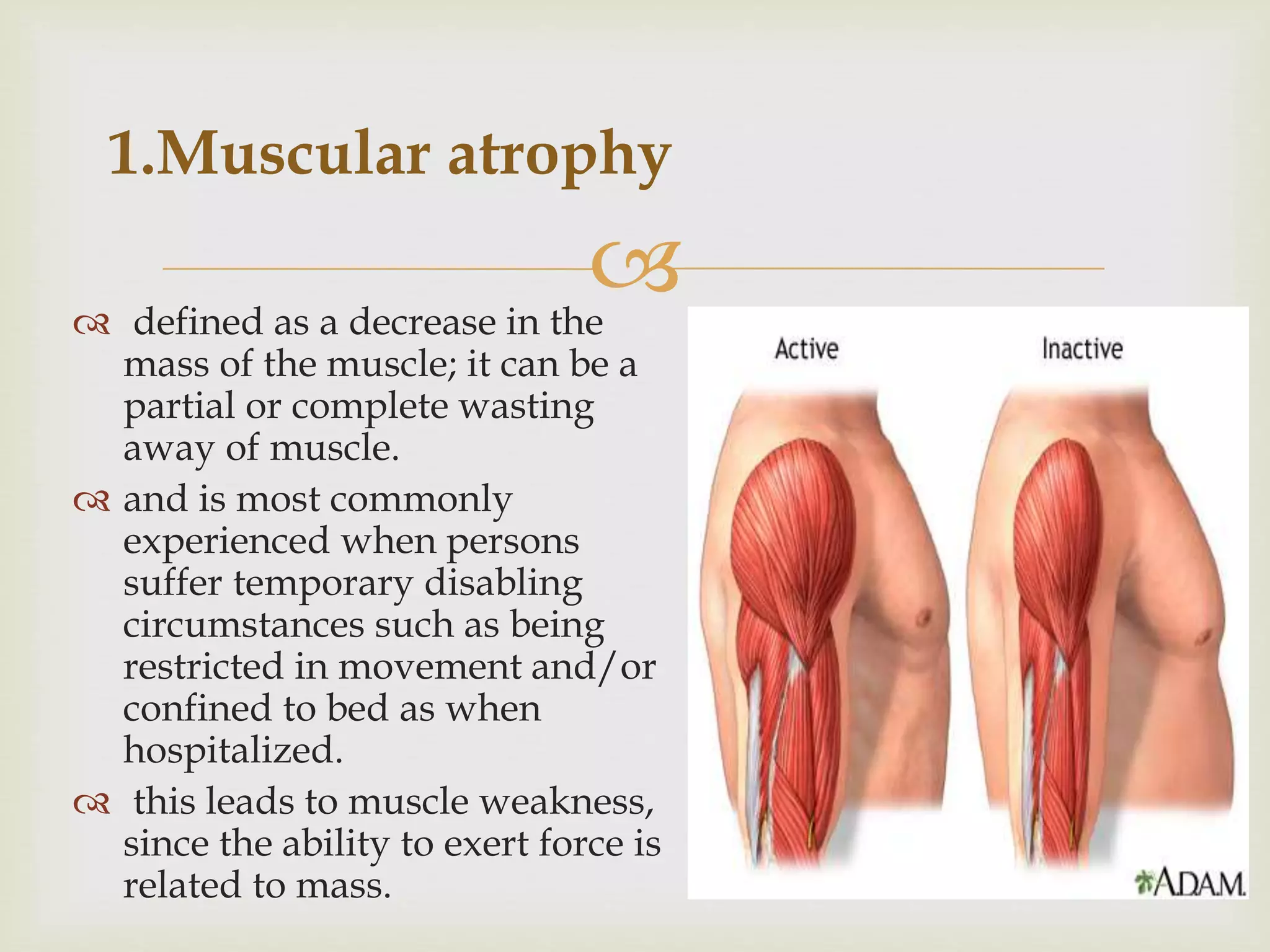
 defined as a decrease in the
mass of the muscle; it can be a
partial or complete wasting
away of muscle.
 and is most commonly
experienced when persons
suffer temporary disabling
circumstances such as being
restricted in movement and/or
confined to bed as when
hospitalized.
 this leads to muscle weakness,
since the ability to exert force is
related to mass.
1.Muscular atrophy

 Normal muscle which is
overused will end up weak or
spasm until rested.
 In severe cases of overuse,
especially where movements are
strong and erratic as might occur
during convulsions, damage to
muscle cells may result.
 Severe damages muscle cells
release myoglobin, a condition
known as rhabdomyolysis.
Rhabdomyolysis
 A group of genetic diseases that cause progressive
skeletal muscle weakness, defects in muscle proteins, and
the death of muscle cells and tissue.
 Duchenne Muscular Dystrophy (DMD) is the most
common.
2.Muscles dystrophy

 the most common and most rapidly
progressive childhood muscle disease .
 The disease is due to the absence of a
gene located on the short arm of the X
chromosome at the Xp21 site.
 It usually affects only boys .
 The first sign of the disease is difficulty
in walking from 2 to 6 years old.
 Later , the child falls frequently and can
not run. Walking and standing become
more difficult At adolescence a
wheelchair is needed. The disease
eventually affects most muscles of the
body.
Duchenne Muscular Dystrophy
(DMD)



 Steroids  main treatment option
 Vaccination to prevent Pneumonia & Influenza
 Screening (by Echo/MRI) at around 6 years age, and
treatment of Cardiomyopathy.
 Lung function testing at around 9 - 10 years age and
assisted ventilation if needed.
 Periodic monitoring of Vitamin D levels & diet rich in
Calcium & Vit. D.
 Physical therapy, leg braces
 Surgery for correction of contractures & scoliotic
deformities
Management

 The primary focus of Myositis Support and
Understanding is rare muscle diseases which are
referred to as “Idiopathic Inflammatory Myopathies”
or “Acquired Myopathies,” meaning muscle diseases
which are typically not inherited and are caused by
the immune system attacking muscles, connective
tissue, blood vessels, lungs, and/or the skin.
 All forms of Idiopathic Inflammatory Myopathies
are rare diseases.
Inflammation of muscle
(Myositis)

Types of myositis

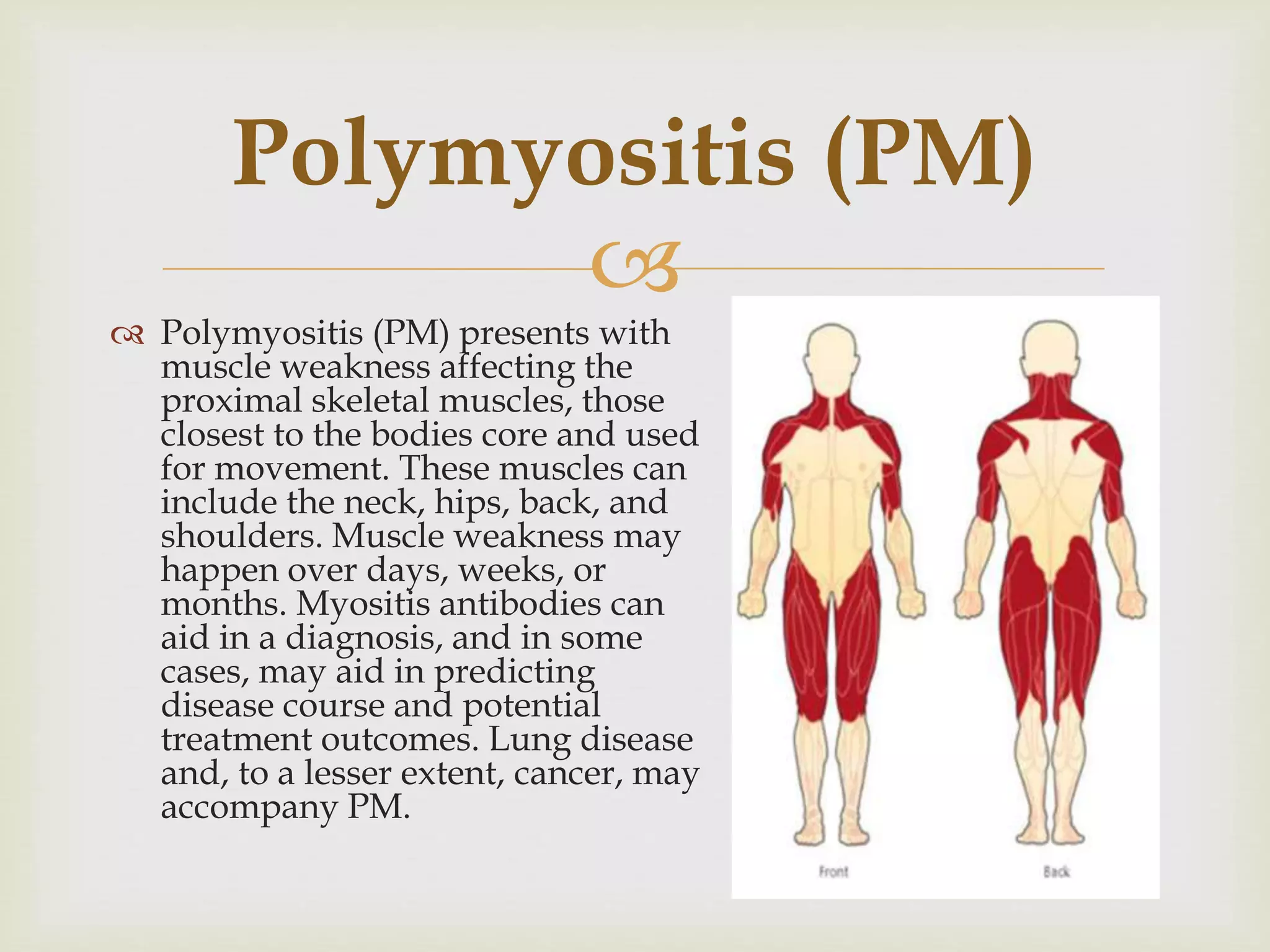
 Polymyositis (PM) presents with
muscle weakness affecting the
proximal skeletal muscles, those
closest to the bodies core and used
for movement. These muscles can
include the neck, hips, back, and
shoulders. Muscle weakness may
happen over days, weeks, or
months. Myositis antibodies can
aid in a diagnosis, and in some
cases, may aid in predicting
disease course and potential
treatment outcomes. Lung disease
and, to a lesser extent, cancer, may
accompany PM.
Polymyositis (PM)
 Symptoms vary from patient to patient.
o Proximal muscle weakness (muscles closest to the body’s core),
affecting upper arms, shoulders, thighs, hips, and neck.
o Symmetrical muscle weakness (same on both sides of the body).
o Arthritis.
o Muscle pain (myalgia).
o Difficulty swallowing (dysphagia).
o Fatigue (can be extreme and life-altering).
o Low-grade fever.
o Labored breathing (dyspnea).
o A hoarse or changing voice when speaking (dysphonia).
o Difficulty maintaining enough air to finish a sentence.
o Difficulty turning in bed, getting up from a seated position, and
raising arms over the head.
Symptoms of Polymyositis

 Myasthenia Gravis is a clinical syndrome resulting
from failure of neuromuscular transmission due to
blockage and destruction of acetylcholine receptors
by autoantibody.
 Myasthenia gravis is therefore an organ-specific
autoimmune disease.
 MG is characterized by muscle weakness that is
typically aggravated by repeated contraction.
Disorders of Neuromuscular
Transmission
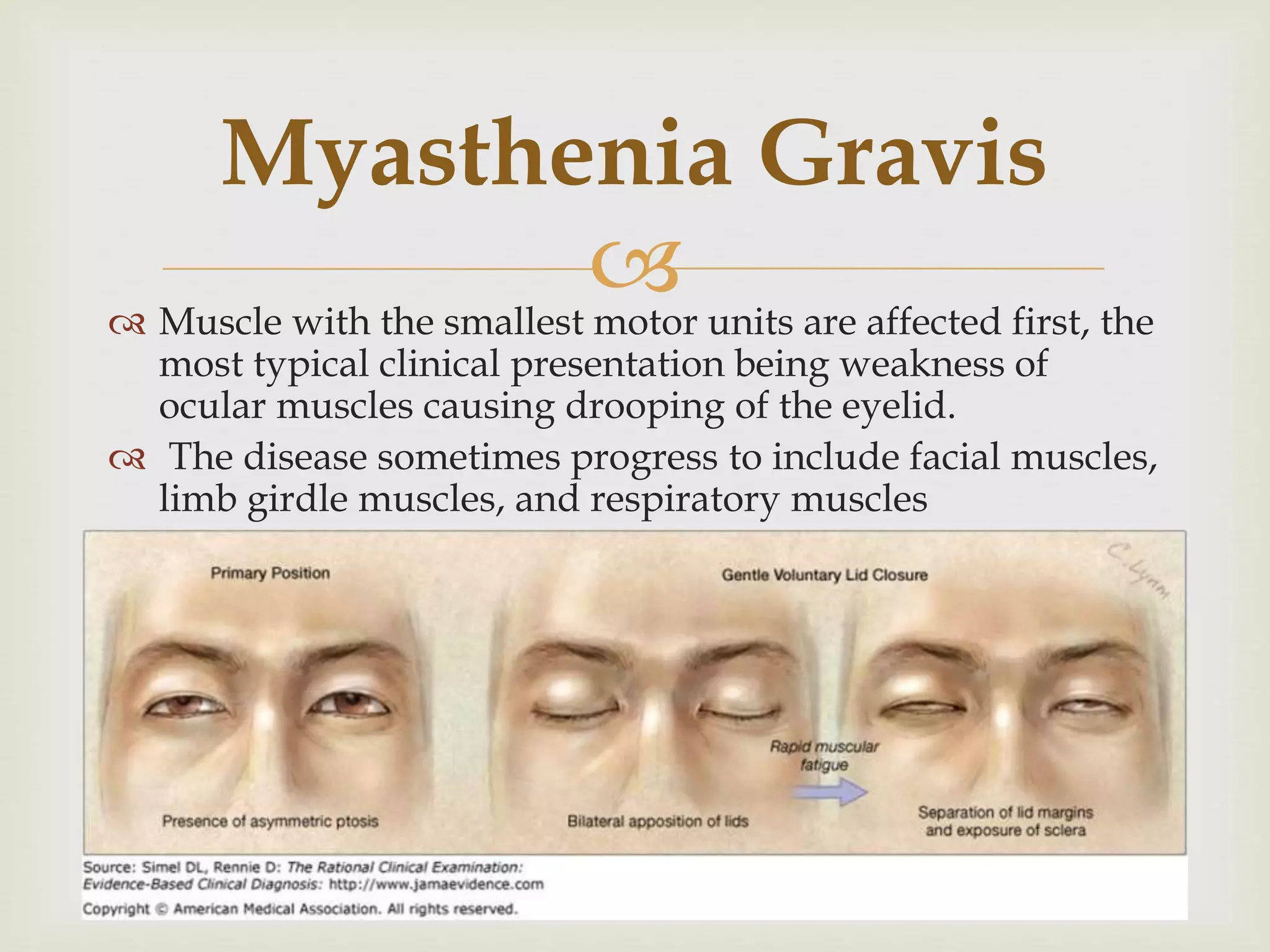
 Muscle with the smallest motor units are affected first, the
most typical clinical presentation being weakness of
ocular muscles causing drooping of the eyelid.
 The disease sometimes progress to include facial muscles,
limb girdle muscles, and respiratory muscles
Myasthenia Gravis

 Edrophonium (Tensilon)-short acting drug produce
immediate improvement in muscle weakness when
administered IV .
 EMG-↓ in amplitude of muscle action potentials
when muscle is subjected to repeated voluntary
contraction.
 Serum assay for anti-Ach receptor antibody.
Diagnosis of MG

Thank you
BY
Dina Amin

Skeletal muscles disease and disorder

  • 2.
     Normal Muscles myopathies Muscular Atrophy MuscularDystrophy Inflammation of muscle (Myositis) Disorders of Neuromuscular Transmission Content
  • 3.
     It iscomposed of fascicles of muscle fibers (myofibrils) that represent the cellular unit.  A myofibril is a long, cylindrical, multinucleate cell that is the contractile unit of the muscle. Normal muscles
  • 4.
  • 5.
     Diseases and damagethe brain or nerves that stimulate muscles and disorders of muscle fibers.  "Myopathy" simply means muscle disease (myo- Greek "muscle" + patho-Greek "suffering"). Causes: o Loss of innervation (neurogenic injury). o Disuse. o Old age. o Primary myopathies (inflammatory or others). Myopathies
  • 6.
      General clinicalconsiderations- family history, age of onsets, history of drugs, distribution of muscle weakness and rate of progression.  Special investigation of neuromuscular electrical activity (electromyography).  Laboratory test:- I. muscle biopsy. II. serum enzymes (CK). III. chromosomal analysis. Muscle disease- Diagnosis
  • 7.
    • Muscular Atrophy. •Muscular Dystrophy. • Inflammation of muscle (Myositis). • Disorders of Neuromuscular Transmission. Muscles disease / disorder
  • 8.
     defined asa decrease in the mass of the muscle; it can be a partial or complete wasting away of muscle.  and is most commonly experienced when persons suffer temporary disabling circumstances such as being restricted in movement and/or confined to bed as when hospitalized.  this leads to muscle weakness, since the ability to exert force is related to mass. 1.Muscular atrophy
  • 9.
      Normal musclewhich is overused will end up weak or spasm until rested.  In severe cases of overuse, especially where movements are strong and erratic as might occur during convulsions, damage to muscle cells may result.  Severe damages muscle cells release myoglobin, a condition known as rhabdomyolysis. Rhabdomyolysis
  • 10.
     A groupof genetic diseases that cause progressive skeletal muscle weakness, defects in muscle proteins, and the death of muscle cells and tissue.  Duchenne Muscular Dystrophy (DMD) is the most common. 2.Muscles dystrophy
  • 11.
  • 12.
     the mostcommon and most rapidly progressive childhood muscle disease .  The disease is due to the absence of a gene located on the short arm of the X chromosome at the Xp21 site.  It usually affects only boys .  The first sign of the disease is difficulty in walking from 2 to 6 years old.  Later , the child falls frequently and can not run. Walking and standing become more difficult At adolescence a wheelchair is needed. The disease eventually affects most muscles of the body. Duchenne Muscular Dystrophy (DMD)
  • 13.
  • 14.
  • 15.
      Steroids main treatment option  Vaccination to prevent Pneumonia & Influenza  Screening (by Echo/MRI) at around 6 years age, and treatment of Cardiomyopathy.  Lung function testing at around 9 - 10 years age and assisted ventilation if needed.  Periodic monitoring of Vitamin D levels & diet rich in Calcium & Vit. D.  Physical therapy, leg braces  Surgery for correction of contractures & scoliotic deformities Management
  • 16.
      The primaryfocus of Myositis Support and Understanding is rare muscle diseases which are referred to as “Idiopathic Inflammatory Myopathies” or “Acquired Myopathies,” meaning muscle diseases which are typically not inherited and are caused by the immune system attacking muscles, connective tissue, blood vessels, lungs, and/or the skin.  All forms of Idiopathic Inflammatory Myopathies are rare diseases. Inflammation of muscle (Myositis)
  • 17.
  • 18.
      Polymyositis (PM)presents with muscle weakness affecting the proximal skeletal muscles, those closest to the bodies core and used for movement. These muscles can include the neck, hips, back, and shoulders. Muscle weakness may happen over days, weeks, or months. Myositis antibodies can aid in a diagnosis, and in some cases, may aid in predicting disease course and potential treatment outcomes. Lung disease and, to a lesser extent, cancer, may accompany PM. Polymyositis (PM)
  • 19.
     Symptoms varyfrom patient to patient. o Proximal muscle weakness (muscles closest to the body’s core), affecting upper arms, shoulders, thighs, hips, and neck. o Symmetrical muscle weakness (same on both sides of the body). o Arthritis. o Muscle pain (myalgia). o Difficulty swallowing (dysphagia). o Fatigue (can be extreme and life-altering). o Low-grade fever. o Labored breathing (dyspnea). o A hoarse or changing voice when speaking (dysphonia). o Difficulty maintaining enough air to finish a sentence. o Difficulty turning in bed, getting up from a seated position, and raising arms over the head. Symptoms of Polymyositis
  • 20.
      Myasthenia Gravisis a clinical syndrome resulting from failure of neuromuscular transmission due to blockage and destruction of acetylcholine receptors by autoantibody.  Myasthenia gravis is therefore an organ-specific autoimmune disease.  MG is characterized by muscle weakness that is typically aggravated by repeated contraction. Disorders of Neuromuscular Transmission
  • 21.
     Muscle withthe smallest motor units are affected first, the most typical clinical presentation being weakness of ocular muscles causing drooping of the eyelid.  The disease sometimes progress to include facial muscles, limb girdle muscles, and respiratory muscles Myasthenia Gravis
  • 22.
      Edrophonium (Tensilon)-shortacting drug produce immediate improvement in muscle weakness when administered IV .  EMG-↓ in amplitude of muscle action potentials when muscle is subjected to repeated voluntary contraction.  Serum assay for anti-Ach receptor antibody. Diagnosis of MG
  • 23.