MYOSITIS
Zia ul Haq
Jawad Munir
Definition
Sabacute or slowly progressive, symmetrical
weakness primarily affecting the proximal
limb and trunk muscles.
Classification of Myositis
Polymyositis
Dermatomyositis
Poly/Dermato-myositis associated with
Malignancy
Poly/Dermato-myositis associated with Connective
Tissue Disease
Inclusion Body myositis
Amyopathic Dermatomyositis
EPIDEMIOLOGY
Annual Incidence: 2-10 case /million
Peak age : 10-15 and 45-55 years old
Female: Male ratio: 3:1 total
Black:White : 4:1
CLINICAL MANIFESTATIONS
Weakness of muscles
-shoulder girdle
- pelvic girdle
- neck flexors
Myalgia is minimal
Constitutional symptoms-fatigue, fever, weight
loss
CLINICAL MANIFESTATIONS
Rheumatic: Arthralgia/Arthritis 20-70%
Pulmonary: Interstitial Lung Disease 10%
GIT: Esophageal Dysmotility 10-30%
Cardiac: Conduction Blocks and Arrhythmia
Vascular: Raynaud’s Phenomenon 20-40%
Skin : Rash, Livedo Reticularis
Myositis-PROGNOSIS
5-YEAR SURVIVAL IS AROUND 85% IN PM,
DM, PM/DMASSOC. CTD.
MUCH LOWER IN PM/DMASSOC.
MALIGNANCY.
Polymyositis
A persistent inflammatory muscle disease that
causes weakness of the skeletal muscles, which
control movement.
Medically, polymyositis is classified as a chronic
inflammatory myopathy — one of only three such
diseases.
Polymyositis
Can occur at any age,
Adults -30s, 40s or 50s.
Blacks
Women
Polymyositis
signs and symptoms usually develop gradually,
over weeks or months.
Remissions - rare
Remissions: periods during which symptoms spontaneously
disappear
Signs and symptoms
appear gradually,
Progressive muscle weakness
Difficulty swallowing (dysphagia)
Difficulty speaking
Mild joint or muscle tenderness
Fatigue
Shortness of breath
Signs and symptoms
affects the muscles closest to the trunk,
particularly hips, thighs, shoulders, upper arms
and neck.
weakness is symmetrical
worsens over time.
As muscle weakness progresses,
difficult to climb stairs, rise from a seated position, lift
objects or reach overhead.
Complications
Dysphagia
Which in turn may cause weight loss and malnutrition.
Aspiration pneumonia
Shortness of breath or respiratory failure.
Calcinosis
Calcium deposits in muscles, skin and connective
tissues
Associated conditions
Polymyositis is often associated with other
conditions that may cause further complications
of their own, or in combination with polymyositis
symptoms. Associated conditions include:
Raynaud's phenomenon.
Other connective tissue diseases.
Cardiovascular disease.
Lung disease.
DIAGNOSTIC CRITERIA
1. PROXIMAL MOTOR WEAKNESS:
symmetric, proximal muscles
2. HIGH SERUM MUSCLE ENZYMES:
CPK, aldolase, myoglobin, AST,
ALT, LDH
DIAGNOSTIC CRITERIA
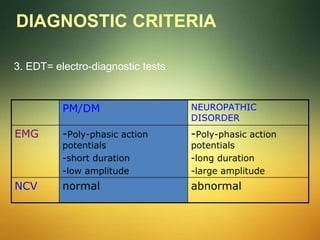
3. EDT= electro-diagnostic tests
NEUROPATHIC
DISORDER
PM/DM
-Poly-phasic action
potentials
-long duration
-large amplitude
-Poly-phasic action
potentials
-short duration
-low amplitude
EMG
abnormalnormalNCV
DIAGNOSTIC CRITERIA
4. MUSCLE BIOPSY:
biopsy a clinically weak muscle, contralateral to an
abnormal muscle ( by EDT), MRI directed.
a. Perivascular and endomysial inflammation
CD8+ T cells in PM,
CD8+, CD4+ T and B cells in DM
b. b. Muscle fiber necrosis and regeneration
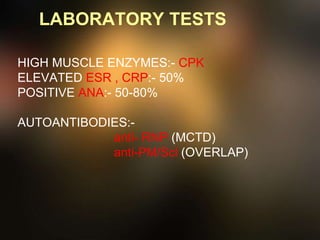
LABORATORY TESTS
HIGH MUSCLE ENZYMES:- CPK
ELEVATED ESR , CRP:- 50%
POSITIVE ANA:- 50-80%
AUTOANTIBODIES:-
anti- RNP (MCTD)
anti-PM/Scl (OVERLAP)
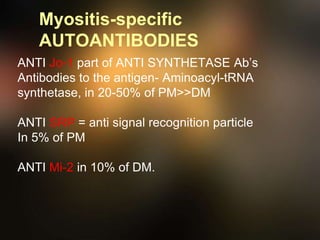
Myositis-specific
AUTOANTIBODIES
ANTI Jo-1 part of ANTI SYNTHETASE Ab’s
Antibodies to the antigen- Aminoacyl-tRNA
synthetase, in 20-50% of PM>>DM
ANTI SRP = anti signal recognition particle
In 5% of PM
ANTI Mi-2 in 10% of DM.
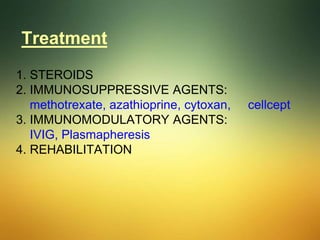
Treatment
1. STEROIDS
2. IMMUNOSUPPRESSIVE AGENTS:
methotrexate, azathioprine, cytoxan, cellcept
3. IMMUNOMODULATORY AGENTS:
IVIG, Plasmapheresis
4. REHABILITATION
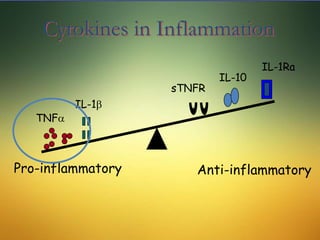
Cytokines in Inflammation
Pro-inflammatory Anti-inflammatory
TNFa
IL-1b
sTNFR
IL-10
IL-1Ra
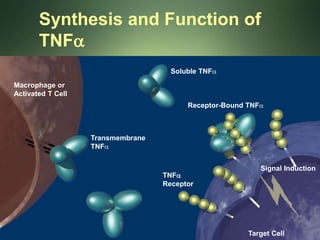
Macrophage or
Activated T Cell
Soluble TNFa
Target Cell
TNFa
Receptor
Signal Induction
Synthesis and Function of
TNFa
Transmembrane
TNFa
Receptor-Bound TNFa
Adapted with permission from Choy EHS, Panayi GS. N Engl J Med. 2001;344:907-916.
Copyright © 2001 Massachusetts Medical Society. All rights reserved.
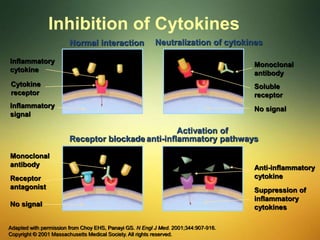
Inhibition of Cytokines
Inflammatory
cytokine
Normal interaction Neutralization of cytokines
Receptor blockade
Activation of
anti-inflammatory pathways
Cytokine
receptor
Soluble
receptor
Monoclonal
antibody
Monoclonal
antibody
Receptor
antagonist
Anti-inflammatory
cytokine
Suppression of
inflammatory
cytokines
No signal
No signal
Inflammatory
signal
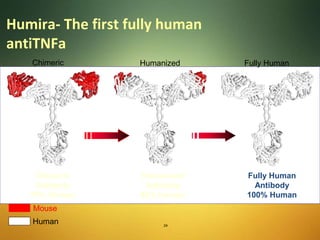
Humira- The first fully human
antiTNFa
Chimeric
Antibody
70% Human
Humanized
Antibody
95% Human
Fully Human
Antibody
100% Human
Mouse
Human
Chimeric Humanized Fully Human
24
Treatment
corticosteroid
When muscle strength improves, usually in 4 to 6
weeks, the medication is slowly tapered off.
Maintenance therapy with prednisone may be
continued indefinitely.
DMARDs - If unresponsive to corticosteroids
methotrexate and azathioprine,
Treatment
Intravenous gamma globulin
IVIG
is a purified blood product that contains healthy
antibodies from thousands of blood donors.
The healthy antibodies in IVIG can block the
damaging antibodies that attack muscle in
polymyositis.
Repeat infusions q 6-8 weeks
Other immunosuppressive
medicine
Tacrolimus (Prograf)
is a transplant-rejection drug that may work to inhibit
the immune system.
Immunosuppressants,
cyclophosphamide (Cytoxan) and cyclosporine
(Gengraf, Neoral, Sandimmune),
Biological therapies
Rituximab (Rituxan)
Tumor necrosis factor (TNF) inhibitors
etanercept (Enbrel) and infliximab (Remicade),
Nursing management
Coping and support
Educate about the illness
Balance Rest and exercise
Myositis associated with skin diseases
Dermatomyositis
a muscle disease characterized by inflammation
and a skin rash. It is a type of inflammatory
myopathy.
5 - 15 and adults age 40 - 60.
Women
Polymyositis is a similar condition, but the
symptoms occur without a skin rash.
Maria Carmela L. Domocmat, RN, MSN
Symptoms
Dysphagia
Muscle weakness, stiffness, or soreness
Purple or violet colored upper eyelids
Purple-red skin (violaceous) rash
SOB
Maria Carmela L. Domocmat, RN, MSN
Symptoms
The muscle weakness may appear suddenly or develop
slowly over weeks or months. may have difficulty raising
arms over head, rising from a sitting position, and
climbing stairs.
The rash may appear over the face, knuckles, neck,
shoulders, upper chest, and back.
Maria Carmela L. Domocmat, RN, MSN
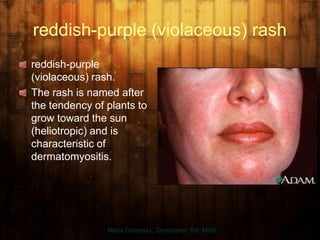
reddish-purple (violaceous) rash
reddish-purple
(violaceous) rash.
The rash is named after
the tendency of plants to
grow toward the sun
(heliotropic) and is
characteristic of
dermatomyositis.
Maria Carmela L. Domocmat, RN, MSN
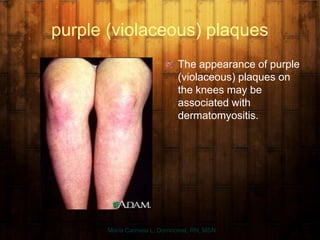
purple (violaceous) plaques
The appearance of purple
(violaceous) plaques on
the knees may be
associated with
dermatomyositis.
Maria Carmela L. Domocmat, RN, MSN
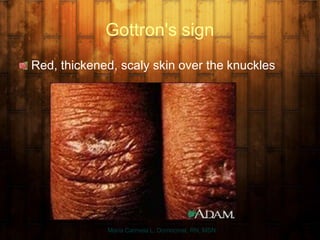
Gottron's sign
Red, thickened, scaly skin over the knuckles
Maria Carmela L. Domocmat, RN, MSN
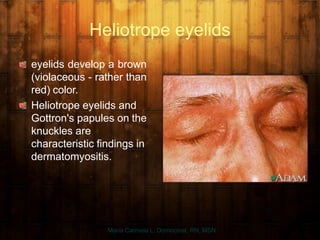
Heliotrope eyelids
eyelids develop a brown
(violaceous - rather than
red) color.
Heliotrope eyelids and
Gottron's papules on the
knuckles are
characteristic findings in
dermatomyositis.
Maria Carmela L. Domocmat, RN, MSN
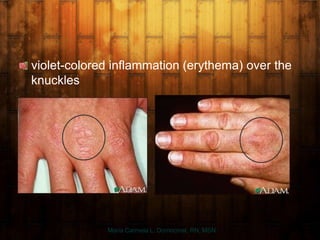
violet-colored inflammation (erythema) over the
knuckles
Maria Carmela L. Domocmat, RN, MSN
periungual erythema
Candida paronychia produced periungual
erythema, edema and nail fold maceration.
Maria Carmela L. Domocmat, RN, MSN
Dx Exams
CPK & aldolase
ECG
Electromyography
Magnetic resonance imaging (MRI)
Muscle biopsy
Maria Carmela L. Domocmat, RN, MSN
Treatment
Corticosteroids
Immunosuppressants
When muscle strength gets better – taper off
corticos
However, most people take prednisone
indefinitely.
If the condition is associated with a tumor, the
muscle weakness and rash may improve when
the tumor is removed.
Maria Carmela L. Domocmat, RN, MSN
Outlook (Prognosis)
Some recover and have symptoms completely
disappear - especially in children.
In adults, death may result from severe and
prolonged muscle weakness,
malnutrition, pneumonia, or lung failure. The
major causes of death are cancer (malignancy)
and lung disease.
Maria Carmela L. Domocmat, RN, MSN
Possible Complications
Acute renal failure
Cancer (malignancy)
Inflammation of the heart
Joint pain
Lung disease
Maria Carmela L. Domocmat, RN, MSN
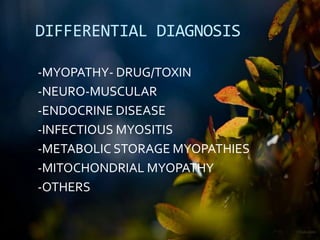
DIFFERENTIAL DIAGNOSIS
-MYOPATHY- DRUG/TOXIN
-NEURO-MUSCULAR
-ENDOCRINE DISEASE
-INFECTIOUS MYOSITIS
-METABOLIC STORAGE MYOPATHIES
-MITOCHONDRIAL MYOPATHY
-OTHERS
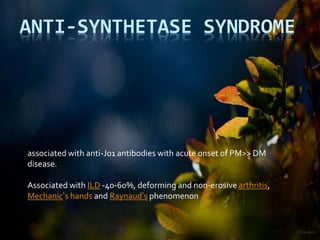
ANTI-SYNTHETASE SYNDROME
associated with anti-Jo1 antibodies with acute onset of PM>> DM
disease.
Associated with ILD -40-60%, deforming and non-erosive arthritis,
Mechanic’s hands and Raynaud’s phenomenon
Steroid
response
prognosisHLAClinical
association
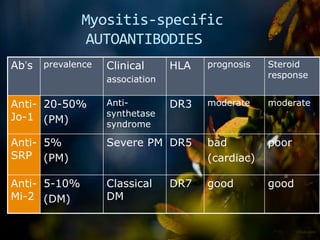
prevalenceAb’s
moderatemoderateDR3Anti-
synthetase
syndrome
20-50%
(PM)
Anti-
Jo-1
poorbad
(cardiac)
DR5Severe PM5%
(PM)
Anti-
SRP
goodgoodDR7Classical
DM
5-10%
(DM)
Anti-
Mi-2
Myositis-specific
AUTOANTIBODIES
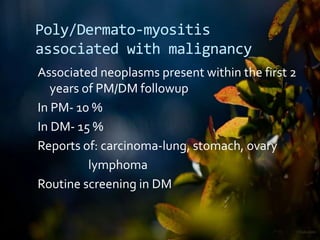
Poly/Dermato-myositis
associated with malignancy
Associated neoplasms present within the first 2
years of PM/DM followup
In PM- 10 %
In DM- 15 %
Reports of: carcinoma-lung, stomach, ovary
lymphoma
Routine screening in DM
Polymyositis Dermatomyositis

Polymyositis Dermatomyositis