AMYOTROPHIC
LATERAL SCLEROSIS
(ALS)
What is ALS?
Progressive neurodegenerative
disease in which the motor
neurons gradually degenerates
and after some time, they
eventually die.
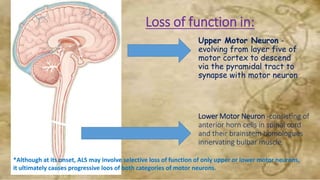
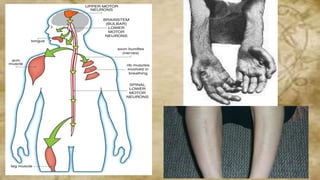
Upper Motor Neuron -
evolving from layer five of
motor cortex to descend
via the pyramidal tract to
synapse with motor neuron
Lower Motor Neuron -consisting of
anterior horn cells in spinal cord
and their brainstem homologues
innervating bulbar muscle.
Loss of function in:
*Although at its onset, ALS may involve selective loss of function of only upper or lower motor neurons,
it ultimately causes progressive loos of both categories of motor neurons.
MOTOR NEURONS
Motor neuron is a type of
nerve that can be found in
the spinal cord, brain, and
brain stem. It provides a
connection between
voluntary muscle of the
body and nervous system
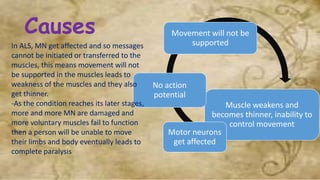
Causes Movement will not be
supported
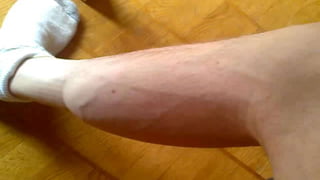
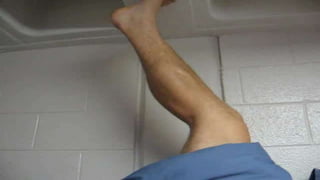
Muscle weakens and
becomes thinner, inability to
control movement
Motor neurons
get affected
No action
potential
In ALS, MN get affected and so messages
cannot be initiated or transferred to the
muscles, this means movement will not
be supported in the muscles leads to
weakness of the muscles and they also
get thinner.
-As the condition reaches its later stages,
more and more MN are damaged and
more voluntary muscles fail to function
then a person will be unable to move
their limbs and body eventually leads to
complete paralysis
PATHOPHYSIOLOGY
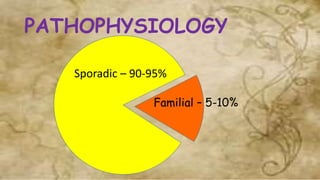
Familial – 5-10%
Sporadic – 90-95%
PATHOPHYSIOLOGY
It is unknown why the motor neuron
degenerate in ALS but researchers suggested
certain possibilities which are:
1. EXCITOTOXICITY
2. GENE MUTATION
PATHOPHYSIOLOGY
•EXCITOTOXICITY – Excitotoxic
neurotransmitters such as GLUTAMATE
PATHOPHYSIOLOGY
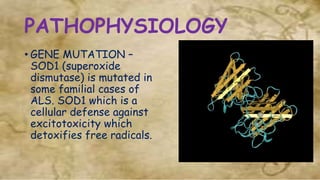
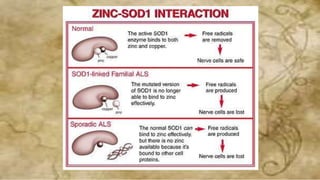
• GENE MUTATION –
SOD1 (superoxide
dismutase) is mutated in
some familial cases of
ALS. SOD1 which is a
cellular defense against
excitotoxicity which
detoxifies free radicals.
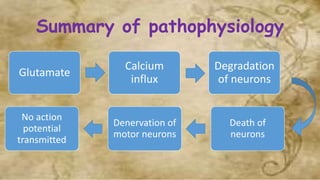
Summary of pathophysiology
Glutamate
Calcium
influx
Degradation
of neurons
Death of
neurons
Denervation of
motor neurons
No action
potential
transmitted
!!! The denervation of
the nerves now
causes the clinical
manifestations
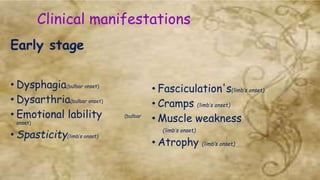
Clinical manifestations
Early stage
• Dysphagia(bulbar onset)
• Dysarthria(bulbar onset)
• Emotional lability (bulbar
onset)
• Spasticity(limb’s onset)
• Fasciculation's(limb’s onset)
• Cramps (limb’s onset)
• Muscle weakness
(limb’s onset)
• Atrophy (limb’s onset)
Progression
• Dyspnea
• Loose the ability to walk, or use
hands and arms
• Loose the ability to speak, and
swallow
Late stage
• Dementia
•Respiratory failure
•Aspiration pneumonia
•Occulomotor nerve of extra ocular muscle
is affected
•May resemble locked in syndrome
TREATMENT
•NO curative agent
•RILUZOLE- the only drug approved by the
FDA
THERAPY
• Physical Therapy
-involves exercises
• Speech Therapy
-text -to-speech applications
Dental health for ALS patients
Why keep the mouth clean?
-Maintain comfort
-Reduce halitosis
-Reduce risk for gum disease, which can further
endanger your health
-Reduce the risk of pneumonia (infection in the
lungs from bacteria in the mouth)
-Help manage saliva which can reduce drooling or
stimulate saliva flow
Physical changes that may occur with ALS might make it
difficult to keep the mouth clean. These include
1. Changes in hand/arm function
2. Changes in function of the mouth, lips, cheeks, and
tongue
3. Changes in function of the swallowing muscles
4. Changes in mobility
5. Changes in breathing
Dental hygiene
-Brush w/ soft bristle
- floss
-use tools that may help
During Dental Procedure
-use bite block
-semi supine position
-use strong suction
-have a short break
Maintenance
-get regular check ups
-nutritional counseling

Amyotrophic lateral sclerosis (als)

  • 1.
  • 2.
    What is ALS? Progressiveneurodegenerative disease in which the motor neurons gradually degenerates and after some time, they eventually die.
  • 3.
    Upper Motor Neuron- evolving from layer five of motor cortex to descend via the pyramidal tract to synapse with motor neuron Lower Motor Neuron -consisting of anterior horn cells in spinal cord and their brainstem homologues innervating bulbar muscle. Loss of function in: *Although at its onset, ALS may involve selective loss of function of only upper or lower motor neurons, it ultimately causes progressive loos of both categories of motor neurons.
  • 4.
    MOTOR NEURONS Motor neuronis a type of nerve that can be found in the spinal cord, brain, and brain stem. It provides a connection between voluntary muscle of the body and nervous system
  • 5.
    Causes Movement willnot be supported Muscle weakens and becomes thinner, inability to control movement Motor neurons get affected No action potential In ALS, MN get affected and so messages cannot be initiated or transferred to the muscles, this means movement will not be supported in the muscles leads to weakness of the muscles and they also get thinner. -As the condition reaches its later stages, more and more MN are damaged and more voluntary muscles fail to function then a person will be unable to move their limbs and body eventually leads to complete paralysis
  • 6.
  • 7.
    PATHOPHYSIOLOGY It is unknownwhy the motor neuron degenerate in ALS but researchers suggested certain possibilities which are: 1. EXCITOTOXICITY 2. GENE MUTATION
  • 8.
  • 9.
    PATHOPHYSIOLOGY • GENE MUTATION– SOD1 (superoxide dismutase) is mutated in some familial cases of ALS. SOD1 which is a cellular defense against excitotoxicity which detoxifies free radicals.
  • 11.
    Summary of pathophysiology Glutamate Calcium influx Degradation ofneurons Death of neurons Denervation of motor neurons No action potential transmitted
  • 12.
    !!! The denervationof the nerves now causes the clinical manifestations
  • 13.
    Clinical manifestations Early stage •Dysphagia(bulbar onset) • Dysarthria(bulbar onset) • Emotional lability (bulbar onset) • Spasticity(limb’s onset) • Fasciculation's(limb’s onset) • Cramps (limb’s onset) • Muscle weakness (limb’s onset) • Atrophy (limb’s onset)
  • 14.
    Progression • Dyspnea • Loosethe ability to walk, or use hands and arms • Loose the ability to speak, and swallow
  • 15.
    Late stage • Dementia •Respiratoryfailure •Aspiration pneumonia •Occulomotor nerve of extra ocular muscle is affected •May resemble locked in syndrome
  • 18.
    TREATMENT •NO curative agent •RILUZOLE-the only drug approved by the FDA
  • 19.
    THERAPY • Physical Therapy -involvesexercises • Speech Therapy -text -to-speech applications
  • 24.
    Dental health forALS patients
  • 25.
    Why keep themouth clean? -Maintain comfort -Reduce halitosis -Reduce risk for gum disease, which can further endanger your health -Reduce the risk of pneumonia (infection in the lungs from bacteria in the mouth) -Help manage saliva which can reduce drooling or stimulate saliva flow
  • 26.
    Physical changes thatmay occur with ALS might make it difficult to keep the mouth clean. These include 1. Changes in hand/arm function 2. Changes in function of the mouth, lips, cheeks, and tongue 3. Changes in function of the swallowing muscles 4. Changes in mobility 5. Changes in breathing
  • 27.
    Dental hygiene -Brush w/soft bristle - floss -use tools that may help
  • 28.
    During Dental Procedure -usebite block -semi supine position -use strong suction -have a short break
  • 29.
    Maintenance -get regular checkups -nutritional counseling

Editor's Notes

  • #4 UMN- LMN –
  • #7 About 90-95% of ALS occur randomly and no apparent associated risk factor has been discovered yet 5-10% are inherited at birth
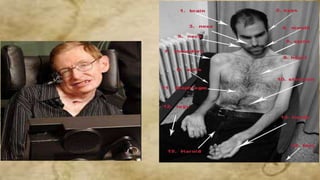
  • #14 first see the effects of the disease in a hand or arm as they experience difficulty with simple tasks such as buttoning a shirt, writing, or turning a key in a lock. In other cases, symptoms initially affect one of the legs, and people experience awkwardness when walking or running or they notice that they are tripping or stumbling more often. M.N shrink and disappear, so that the muscles no longer receive signals to move. As a result, the muscles become smaller and weaker. Gradually the body becomes paralyzed, which means that the muscles no longer work. Glutamate is the major excitatory transmitter in the brain, it is responsible for sending signals b/n nerve cells.
  • #16 Locked-in syndrome (LIS) is a condition in which a patient is aware but cannot move or communicate verbally due to complete paralysis of nearly all voluntary muscles in the body except for the eyes.one of its causes is als Glutamate for learning and memory
  • #19 Rilutek (riluzole) is an approved drug for the treatment of ALS. How it works is not exactly known, but it seems to prevent the damage that can result from the nerve cell being overexcited by glutamate. Studies have shown it may improve functioning and survival.
  • #20 Regular exercise can also help improve your sense of well-being. Appropriate stretching can help prevent pain and help your muscles function at their best. Because ALS affects the muscles you use to speak, communication becomes an issue as the disease progresses. A speech therapist can teach you adaptive techniques to make your speech more clearly understood. a speech therapist can recommend devices such as tablet computers with text-to-speech applications or computer-based equipment with synthesized speech that may help you communicate.
  • #27 Hold a toothbrush and brush with it ..Turn a faucet on and off..Squeeze toothpaste from a tube.. Hold floss and move it between teeth..Open a container of mouthwash..Hold a cup to use for rinsing..Use a towel to wipe the mouth..Put dentures in and/or take them out Clear food stuck in the mouth after swallowing a bite..Spit after brushing..Swish or hold water/mouthwash in mouth...Close mouth to avoid drooling.. Keep inside of mouth moistened Clear mouth of saliva..Eat/drink to help stimulate saliva Receive care in a traditional dental clinic exam chair..Perform daily oral care while sitting upright Keep mouth moist during use of breathing equipment (such as a BiPAP®)..Close mouth to avoid drooling
  • #28 Toothpaste dispenser (pump or hands-free) Dental wipes Oral irrigator (ex. WaterPik®, Water Flosser, Interplak® Water Jet) Electric toothbrush Floss holder Tongue scraper Dry mouth oral rinse Mouth Swabs (ex. Toothette®- for moisture relief) Portable oral suction device Suction toothbrush (ex. Plak-Vak®) Other adaptive equipment (ask for an evaluation by an Occupational Therapist) 
  • #29 Bite block bec of the paralysis of the mouth to keep mouth open 45degrees drooling To avoid spasticity and muscle weakness
  • #30 -Continue visits to the dentist once every six months -Update your medical history with the dentist’s office -Discuss physical accommodations with the dentist’s office, For instance, can the dental office space accommodate a wheelchair? -make short appointments