POLYMYOSITIS
Emily Jones
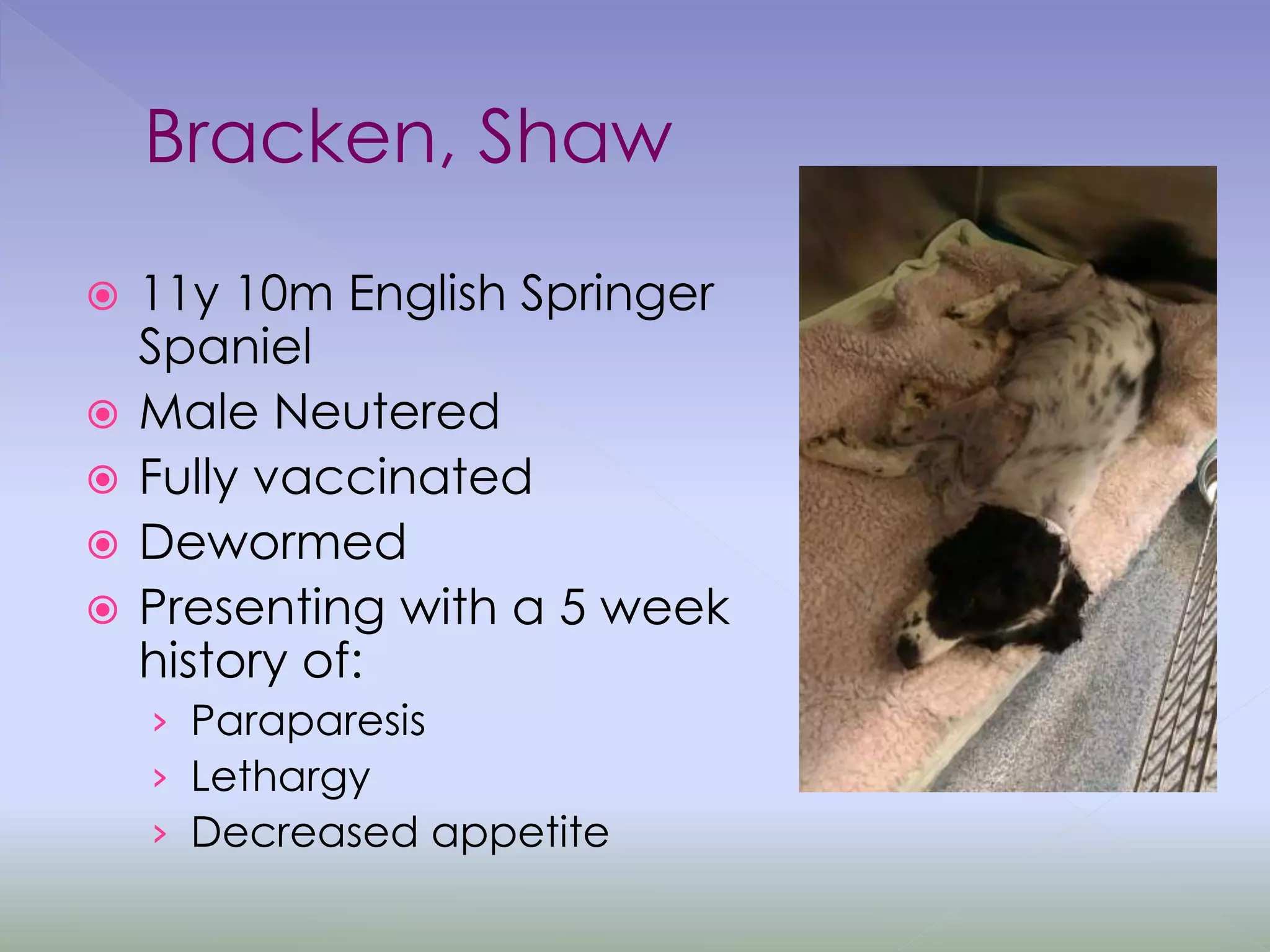
Bracken, Shaw
 11y 10m English Springer
Spaniel
 Male Neutered
 Fully vaccinated
 Dewormed
 Presenting with a 5 week
history of:
› Paraparesis
› Lethargy
› Decreased appetite
Clinical Exam
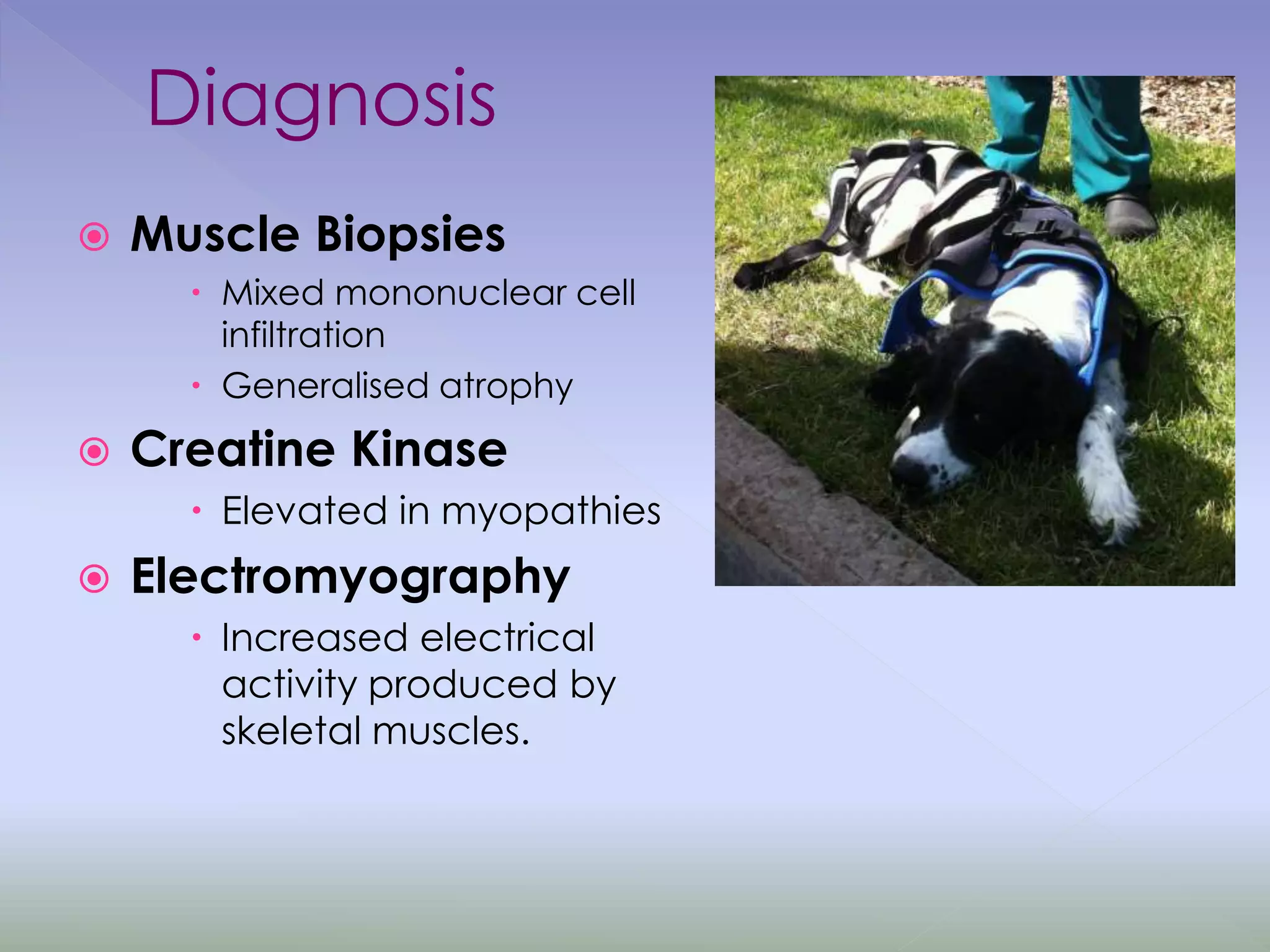
 Weakness seen in all limbs, especially the
hind limbs
 Able to move all four limbs
 No neurological deficits
 Non painful
 TPR within normal limits
Differential Diagnosis
 Immune Mediated Polymyositis
 Paraneoplastic polymyositis
 Chronic degenerative radiculomyelopathy
 Toxoplasma gondii
 Neospora caninum
 NEOPLASIA:
ď‚– Bronchogenic carcinoma
ď‚– Myeloid leukemia
ď‚– Tonsillar carcinoma
ď‚– Lymphoma
 Muscular dystrophy
 Idiopathic polyradiculoneuritis
 Rickettsial polymyositis
 Myasthenia gravis
Polymyositis
 The most frequently seen non-traumatic
muscle disease
 Middle aged, large breed dogs
 Generally assumed to be an immune-
mediated disease of skeletal muscle
› Can occur in association with Systemic Lupus
Erythematosus
 May be associated with neoplasia
ď‚– Lymphoma
ď‚– Thymoma
ď‚– Bronchogenic carcinoma
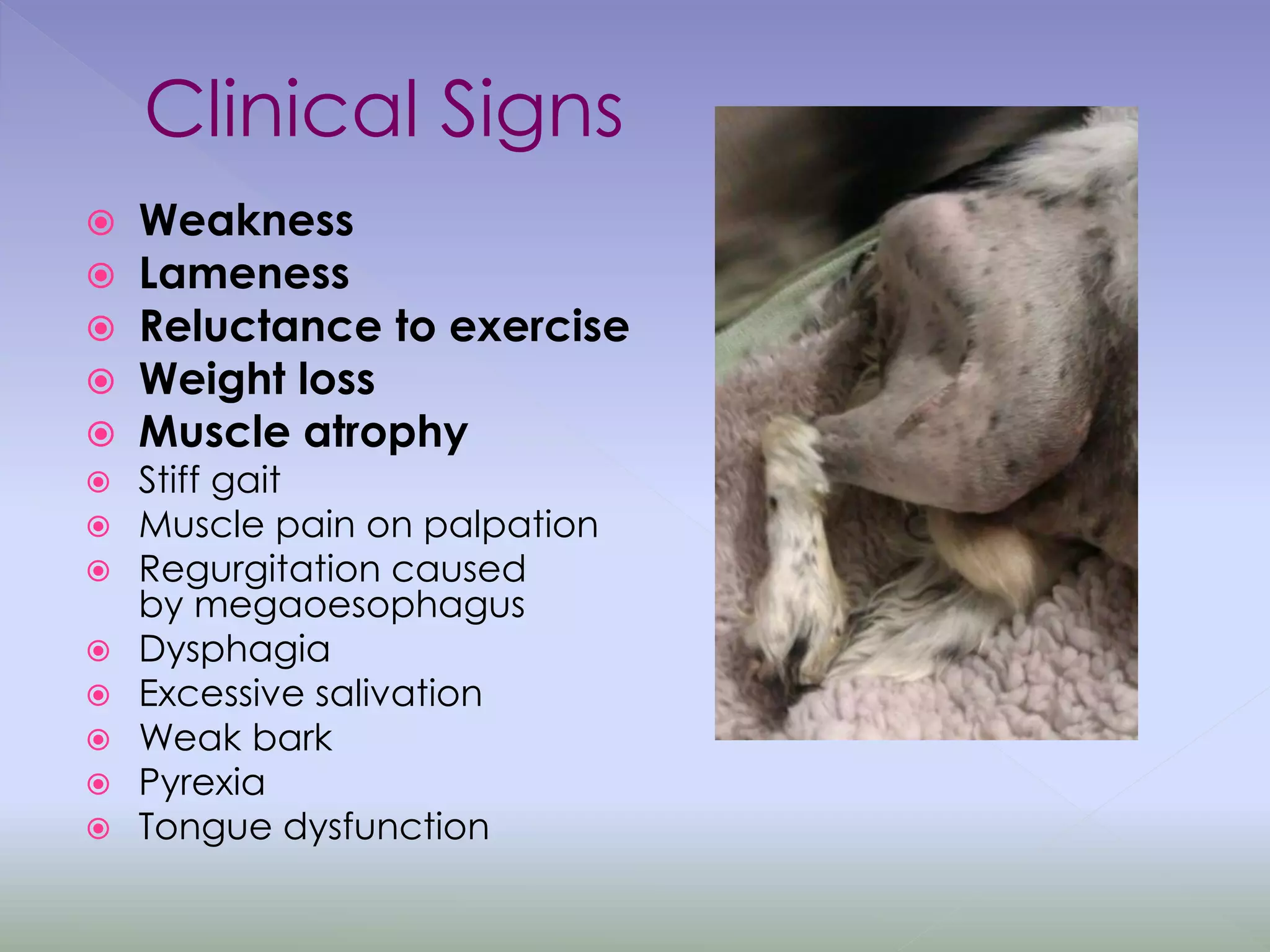
Clinical Signs
 Weakness
 Lameness
 Reluctance to exercise
 Weight loss
 Muscle atrophy
 Stiff gait
 Muscle pain on palpation
 Regurgitation caused
by megaoesophagus
 Dysphagia
 Excessive salivation
 Weak bark
 Pyrexia
 Tongue dysfunction
Diagnosis
 Muscle Biopsies
ď‚– Mixed mononuclear cell
infiltration
ď‚– Generalised atrophy
 Creatine Kinase
ď‚– Elevated in myopathies
 Electromyography
ď‚– Increased electrical
activity produced by
skeletal muscles.
Features required for a
diagnosis of Immune
Mediated Polymyositis?
1. Clinical signs of weakness
2. Elevated Creatinine Kinase
3. Abnormal Electromyography
4. Absence of an underlying cause
5. A muscle biopsy which shows an
inflammatory infiltrate
Approach to Bracken’s Case
 Haematology: unremarkable
 Biochemistry
› Elevated Creatine Kinase 4042 u/L (52-368)
› Elevated AST 230 u/L (13-15)
› Elevated ALT 218 u/L (10-109)
 Abdominal Ultrasound
› Small mass found in the dorsal wall of the
bladder (20x10mm)
› Slightly R enlarged medial iliac LN (7.5mm)
 Chest Radiographs
› Moderate shoulder DJD
 Cardiac Ultrasound
 Neospora and Toxoplasma
› Negative for neospora
 Electromyography
› Abnormal spontaneous electrical activity
recorded in the skeletal muscles
 CSF Tap
› 800 protein – normal?
Biopsy Report
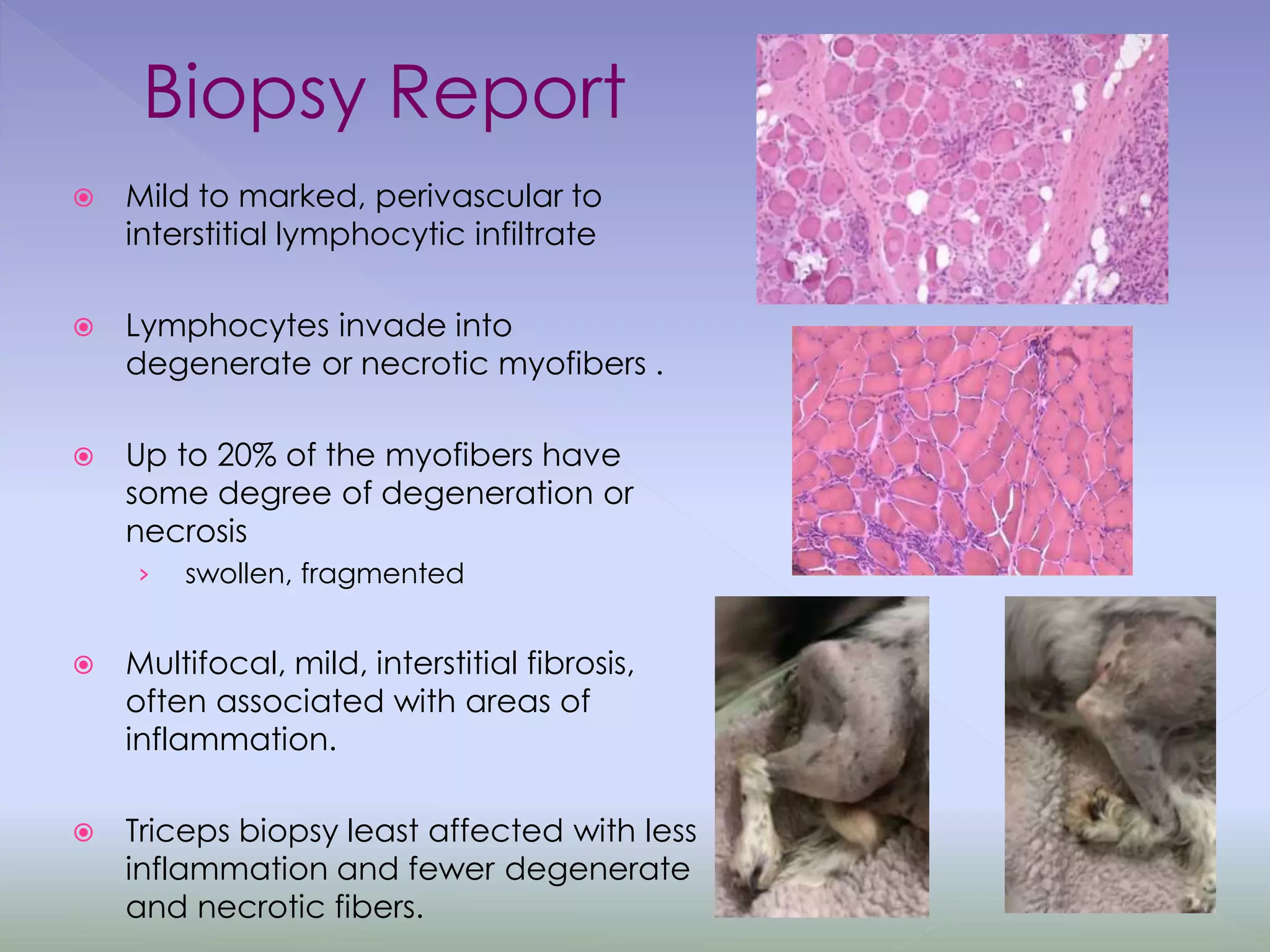
 Mild to marked, perivascular to
interstitial lymphocytic infiltrate
 Lymphocytes invade into
degenerate or necrotic myofibers .
 Up to 20% of the myofibers have
some degree of degeneration or
necrosis
› swollen, fragmented
 Multifocal, mild, interstitial fibrosis,
often associated with areas of
inflammation.
 Triceps biopsy least affected with less
inflammation and fewer degenerate
and necrotic fibers.
Treatment
 Immunosuppression
› Prednisolone
› Azathioprine
› Cyclosporin
› Cytarabine
 Analgesia
› Buprenorphine
 Antibiotics
› Amoxicillin/Clavulanic Acid
› Clindamycin
Prognosis
Bracken’s Progress?
 Slowly improving
 Receiving physiotherapy every day
References
 http://vetneuro.com/Portals/124/Forms/Evans%20Myopthies.
pdf
 http://vetbook.org/wiki/dog/index.php/Polymyositis
 http://vetneuromuscular.ucsd.edu/cases/2006/july06.html
 http://www.merckmanuals.com/vet/appendixes/reference_
guides/serum_biochemical_reference_ranges.html
 http://www.ed.ac.uk/polopoly_fs/1.98000!/fileManager/Case
_study_06.pdf
 http://cal.vet.upenn.edu/projects/saortho/chapter_72/72ma
st.htm
 http://www.dcavm.org/dec99.htm

Polymyositis

  • 1.
  • 2.
    Bracken, Shaw  11y10m English Springer Spaniel  Male Neutered  Fully vaccinated  Dewormed  Presenting with a 5 week history of: › Paraparesis › Lethargy › Decreased appetite
  • 3.
    Clinical Exam  Weaknessseen in all limbs, especially the hind limbs  Able to move all four limbs  No neurological deficits  Non painful  TPR within normal limits
  • 4.
    Differential Diagnosis  ImmuneMediated Polymyositis  Paraneoplastic polymyositis  Chronic degenerative radiculomyelopathy  Toxoplasma gondii  Neospora caninum  NEOPLASIA:  Bronchogenic carcinoma  Myeloid leukemia  Tonsillar carcinoma  Lymphoma  Muscular dystrophy  Idiopathic polyradiculoneuritis  Rickettsial polymyositis  Myasthenia gravis
  • 5.
    Polymyositis  The mostfrequently seen non-traumatic muscle disease  Middle aged, large breed dogs  Generally assumed to be an immune- mediated disease of skeletal muscle › Can occur in association with Systemic Lupus Erythematosus  May be associated with neoplasia  Lymphoma  Thymoma  Bronchogenic carcinoma
  • 6.
    Clinical Signs  Weakness Lameness  Reluctance to exercise  Weight loss  Muscle atrophy  Stiff gait  Muscle pain on palpation  Regurgitation caused by megaoesophagus  Dysphagia  Excessive salivation  Weak bark  Pyrexia  Tongue dysfunction
  • 7.
    Diagnosis  Muscle Biopsies Mixed mononuclear cell infiltration  Generalised atrophy  Creatine Kinase  Elevated in myopathies  Electromyography  Increased electrical activity produced by skeletal muscles.
  • 8.
    Features required fora diagnosis of Immune Mediated Polymyositis? 1. Clinical signs of weakness 2. Elevated Creatinine Kinase 3. Abnormal Electromyography 4. Absence of an underlying cause 5. A muscle biopsy which shows an inflammatory infiltrate
  • 9.
    Approach to Bracken’sCase  Haematology: unremarkable  Biochemistry › Elevated Creatine Kinase 4042 u/L (52-368) › Elevated AST 230 u/L (13-15) › Elevated ALT 218 u/L (10-109)  Abdominal Ultrasound › Small mass found in the dorsal wall of the bladder (20x10mm) › Slightly R enlarged medial iliac LN (7.5mm)
  • 10.
     Chest Radiographs ›Moderate shoulder DJD  Cardiac Ultrasound  Neospora and Toxoplasma › Negative for neospora  Electromyography › Abnormal spontaneous electrical activity recorded in the skeletal muscles  CSF Tap › 800 protein – normal?
  • 11.
    Biopsy Report  Mildto marked, perivascular to interstitial lymphocytic infiltrate  Lymphocytes invade into degenerate or necrotic myofibers .  Up to 20% of the myofibers have some degree of degeneration or necrosis › swollen, fragmented  Multifocal, mild, interstitial fibrosis, often associated with areas of inflammation.  Triceps biopsy least affected with less inflammation and fewer degenerate and necrotic fibers.
  • 13.
    Treatment  Immunosuppression › Prednisolone ›Azathioprine › Cyclosporin › Cytarabine  Analgesia › Buprenorphine  Antibiotics › Amoxicillin/Clavulanic Acid › Clindamycin
  • 14.
  • 15.
    Bracken’s Progress?  Slowlyimproving  Receiving physiotherapy every day
  • 16.
    References  http://vetneuro.com/Portals/124/Forms/Evans%20Myopthies. pdf  http://vetbook.org/wiki/dog/index.php/Polymyositis http://vetneuromuscular.ucsd.edu/cases/2006/july06.html  http://www.merckmanuals.com/vet/appendixes/reference_ guides/serum_biochemical_reference_ranges.html  http://www.ed.ac.uk/polopoly_fs/1.98000!/fileManager/Case _study_06.pdf  http://cal.vet.upenn.edu/projects/saortho/chapter_72/72ma st.htm  http://www.dcavm.org/dec99.htm

Editor's Notes

  • #3 The referring vet had suspected discospondylitis and had prescribed antibiotics to treat the infection, however after 5 weeks there was still no improvement/bracken’s condition was progressing.
  • #4 Shaking when trying to stand
  • #5 CDRM - The cause is unknown. The degeneration occurs in the in the white matter of the spinal cord, and in the dorsal spinal roots. Some have suggested an autoimmune basis for the disease, and depressed cell-mediated immunity may be present in some individuals.
  • #6 Immune mediated - Auto antibody attack of myosin by auto expression of MHC 1 & CD8+ Tcell infiltration resulting in serotonin release leading to fibrosis of skeletal muscles. Systemic Lupus Erythematosus =  It is a primary autoimmune disease in which the body loses 'self-tolerance' towards autoantigens and mounts an inappropriate attack on various target tissues of the body. The pathology can be attributed to true autoantibody binding, immune complex deposition causing a type III hypersensitivity reaction, or cell-mediated autoimmunity. The most common manifestations are: fever (constant or cyclic), polyarthritis (non-erosive, non-deforming), proteinuria and skin disease. Neoplasia – these diseases may result in secondary infiltration of muscle fibres with inflammatory by-products. You should do periodic screening because 10% develop neoplasia within 12 months of diagnosis. In a study of 200 PM dogs, 12 dogs developed neoplasia within 12 months of PM diagnosis. Myositis may also be associated with cancer. Inflammation may develop first and turn into cancer with time (pre-cancerous change), or cancer -elsewhere in the body may trigger an immune reaction to the muscle
  • #7 This picture shows the severe muscle atrophy on bracken’s hindlimb.
  • #8 Muscle biopsies are the most important thing to do when you suspect polymyositis – biceps femoris, vastus lateralis. EMG studies generally reveal fibrillation potentials, positive sharp waves, and sometimes bizarre high-frequency activity in affected areas of muscle, although if the muscle damage is sufficiently severe, electrical silence may prevail. Action potential duration decreased. Decreased motor unit number. Area to amplitude ratio of the AP is reduced.
  • #9 The criteria for a definitive diagnosis of immune mediated polymyositis is poorly defined in veterinary medicine although most authors agree that the disease can be diagnosed if the following features are present
  • #10 Abdominal ultrasound and Chest Xrays were carried out to check for neoplasia. Bladder mass – most likely to be benign. Possible malignant. Prostate - Enlarged, hyperechoic and heterogeneous parenchyma, associated with several hypoechoic cavities within, likely consistent with BPH. DDx would include prostatitis.  MILN - L wnl ( ~ 4.0mm), R slightly more prominent and rounded (~7.5mm), that may suggest mild reactive lymphadenopathy.
  • #11 Chest Xrays would have also allowed us to identify megaoesophagus Still waiting for Toxo result to come back. Serum Ab titres
  • #12 Muscle biopsies were taken from the gastrocnemius muscle, the vastus lateralis – part of the quadriceps muscle - and from the triceps muscle. The triceps muscle was found to be least affected which would match the clinical signs – bracken was stronger on his front legs.
  • #14 Treatment of immune mediated polymyositis is based on immunosuppression, initial pain relief and supportive care. Prednisolone is the most commonly used immunosuppressive drug although other drugs such as aziathioprine may also be helpful, particularly if long term therapy is required to control the clinical signs. Synulox was prescribed because we are immunosuppressing Bracken and he had invasive surgery for the muscle biopsies. Clindamycin treats toxoplasma
  • #15 The prognosis for dogs with idiopathic polymyositis is poorly characterised although is generally considered to be reasonably good. Muscle fibrosis and secondary contracture is a possible consequence of polymyositis which may lead to permanent gait abnormalities Fortunately, dogs with polymositis due to immune-mediated causes have a good prognosis. If cancer is the underlying cause of the diseases, however, prognosis is poor. Prognosis is favorable, although relapses are not uncommon. Polymyositis is usually responsive to prednisolone at immunosuppressive doses, and full recovery is not uncommon, as evidenced by histological evidence of muscle regeneration provided the inflammation and fibrosis can be stopped or reduced[22].