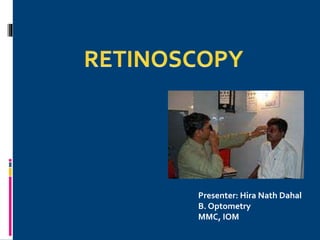
Presenter: Hira Nath Dahal
B. Optometry
MMC, IOM
Presentation Layout
 Introduction
 History
 Theory
 Procedure
 Types of retinoscopy
o Static and dynamic
 Problems
 Uses
Introduction
 Objective method of finding out the error of
refraction by utilizing the technique of
neutralization
 Based on the fact that when the light is
reflected from the mirror into the eye, the
direction in which the light will travel across
the pupil will depend upon the refractive
states of the eye
History
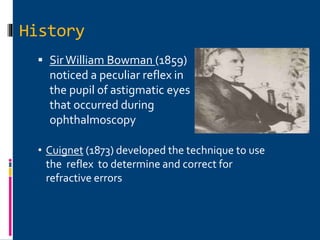
 Sir William Bowman (1859)
noticed a peculiar reflex in
the pupil of astigmatic eyes
that occurred during
ophthalmoscopy
• Cuignet (1873) developed the technique to use
the reflex to determine and correct for
refractive errors
 Explanation of optical concept was first
attempted by Landolt in 1878
 Parent in 1880 began to quantitatively assess
the refractive error through the use of lenses
inserted in front of the eye
 Retinoscopy ( “vision of the retina”) :
misnomer; was initiated by Parent in 1881
 Retinoscopy is actually modification of a
Focault knife-edge method for determining
the refractive power of the lens applied to the
eye
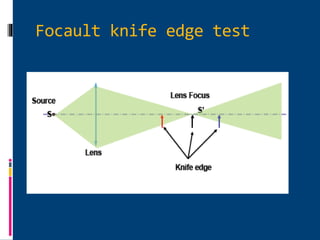
Focault knife edge test
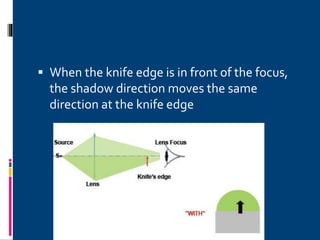
 When the knife edge is in front of the focus,
the shadow direction moves the same
direction at the knife edge
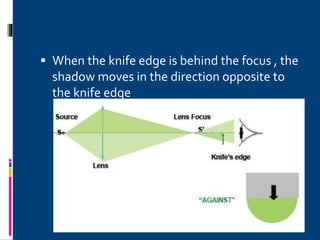
 When the knife edge is behind the focus , the
shadow moves in the direction opposite to
the knife edge
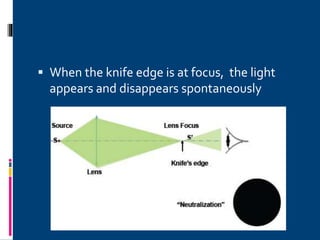
 When the knife edge is at focus, the light
appears and disappears spontaneously
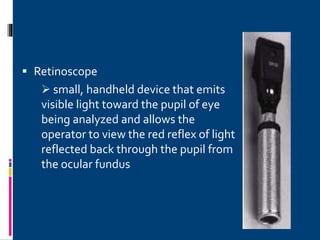
 Retinoscope
 small, handheld device that emits
visible light toward the pupil of eye
being analyzed and allows the
operator to view the red reflex of light
reflected back through the pupil from
the ocular fundus
Contd..
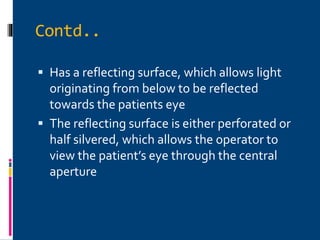
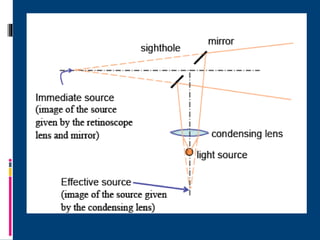
 Has a reflecting surface, which allows light
originating from below to be reflected
towards the patients eye
 The reflecting surface is either perforated or
half silvered, which allows the operator to
view the patient’s eye through the central
aperture
Optics of retinoscope
 The detail optics of retinoscopy can be
considered into three stages:
1. Illumination stage
2. Reflex stage
3. Projection stage
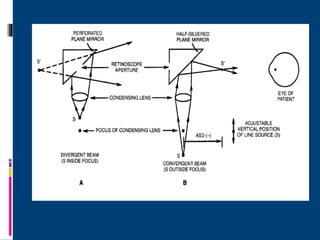
 A divergent beam of light from the filament
source is refracted by the plus condensing lens
below the reflecting surface, before it is reflected
by the perforated or half silvered mirror
 The reflected rays is usually divergent & is
directed towards the patient’s pupil
 Most retinoscopes now have a control for
changing the vergence of emitted light beam
such that the vergence of emitted beam can be
made significant divergent or convergent
Contd..
 Divergent beam emitted by retinoscope is
considered the incident beam of the optical
system underlying retinoscopy
 The incident beam can be moved back and
forth tilting the retinoscope and its reflecting
surface
Contd..
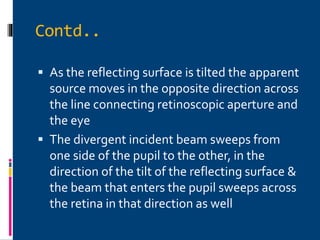
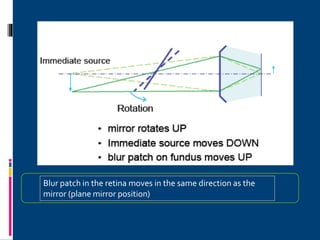
 As the reflecting surface is tilted the apparent
source moves in the opposite direction across
the line connecting retinoscopic aperture and
the eye
 The divergent incident beam sweeps from
one side of the pupil to the other, in the
direction of the tilt of the reflecting surface &
the beam that enters the pupil sweeps across
the retina in that direction as well
Blur patch in the retina moves in the same direction as the
mirror (plane mirror position)
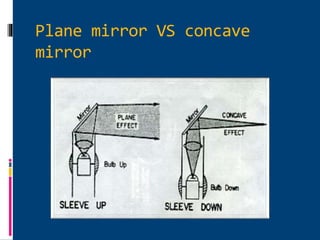
Plane mirror VS concave
mirror
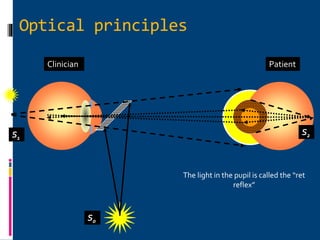
Clinician
So
S1
S2
Patient
Optical principles
The light in the pupil is called the “ret
reflex”
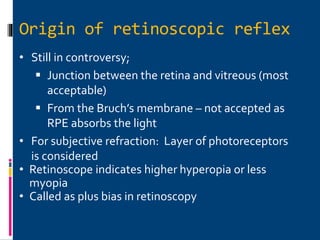
Origin of retinoscopic reflex
• Still in controversy;
 Junction between the retina and vitreous (most
acceptable)
 From the Bruch’s membrane – not accepted as
RPE absorbs the light
• For subjective refraction: Layer of photoreceptors
is considered
• Retinoscope indicates higher hyperopia or less
myopia
• Called as plus bias in retinoscopy
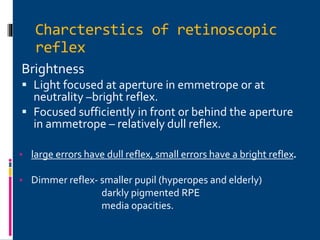
Charcterstics of retinoscopic
reflex
Brightness
 Light focused at aperture in emmetrope or at
neutrality –bright reflex.
 Focused sufficiently in front or behind the aperture
in ammetrope – relatively dull reflex.
• large errors have dull reflex, small errors have a bright reflex.
• Dimmer reflex- smaller pupil (hyperopes and elderly)
darkly pigmented RPE
media opacities.
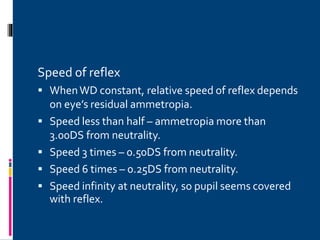
Speed of reflex
 WhenWD constant, relative speed of reflex depends
on eye’s residual ammetropia.
 Speed less than half – ammetropia more than
3.00DS from neutrality.
 Speed 3 times – 0.50DS from neutrality.
 Speed 6 times – 0.25DS from neutrality.
 Speed infinity at neutrality, so pupil seems covered
with reflex.
 Width
Streak narrow when you are far from far
point
Broadens as you approach far point
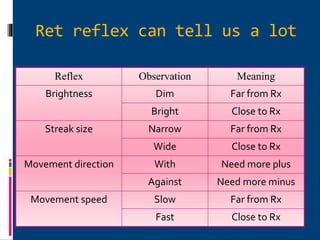
Ret reflex can tell us a lot
Reflex Observation Meaning
Brightness Dim Far from Rx
Bright Close to Rx
Streak size Narrow Far from Rx
Wide Close to Rx
Movement direction With Need more plus
Against Need more minus
Movement speed Slow Far from Rx
Fast Close to Rx
 There are mainly two kinds of retinoscopy:
1. Static retinoscopy and
2. Dynamic retinoscopy
Static retinoscopy
 Objective of static retinoscopy is to find the
position of the far point (punctum remotum)
of the eye
 Far point is the point that is optically
conjugate to the fovea when accommodation
is relaxed
Contd..
 Far point of the emmetropic eye is located at
the peephole of the retinoscope
 Far point of the myopic eye is located in front
of, or anterior to the eye along the line of
sight
Contd..
 In case of a hyperopic eye far point is located
behind or posterior to the eye
o Paraxial light that converges towards a
focus in the plane of the far point focuses at
the retina & light diverging from a hyperopic
retina exits the eye as if it is diverging from a
plane containing far point
 In case of astigmatism, retinoscopy finds two far
points one for each of the two primary power
meridians
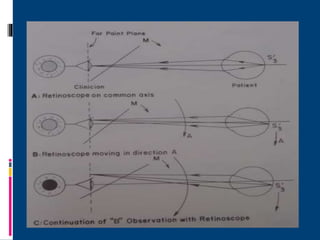
 In case of emmetropic eye all the rays from
the light source from the retina will enter the
clinician’s pupil and the entire pupil of the
patient will appear to be illuminated .
 It signifies that the clinician’s pupil is
conjugate to the patient’s retina
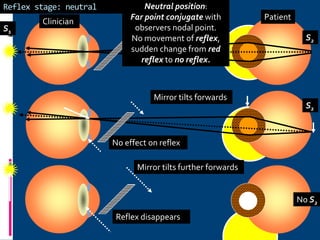
Reflex stage: neutral
Clinician
Patient
No effect on reflex
Reflex disappears
Mirror tilts forwards
Mirror tilts further forwards
S2
S2
No S2
S1
Neutral position:
Far point conjugate with
observers nodal point.
No movement of reflex,
sudden change from red
reflex to no reflex.
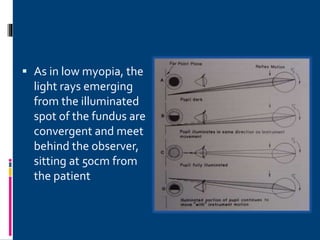
 As in low myopia, the
light rays emerging
from the illuminated
spot of the fundus are
convergent and meet
behind the observer,
sitting at 50cm from
the patient
Observer Subject
Reflex disappears
Reflex moves down,
i.e. with direction
of movement of light
Mirror tilts further forwards
Mirror tilts forwards
S2
S2
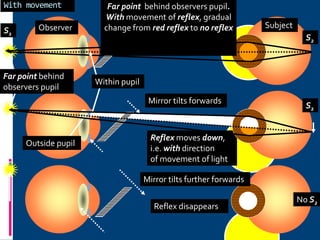
Far point behind
observers pupil
Within pupil
Outside pupil
No S2
S1
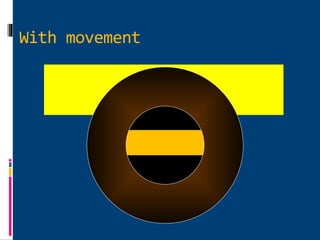
With movement Far point behind observers pupil.
With movement of reflex, gradual
change from red reflex to no reflex
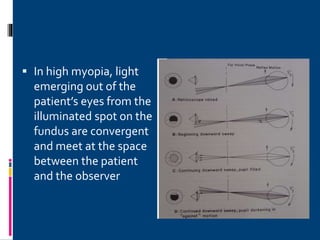
 In high myopia, light
emerging out of the
patient’s eyes from the
illuminated spot on the
fundus are convergent
and meet at the space
between the patient
and the observer
Observer Subject
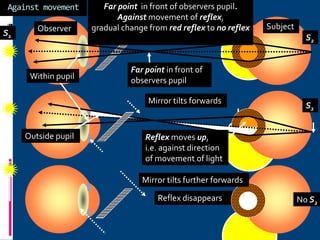
Far point in front of
observers pupil
Reflex disappears
Reflex moves up,
i.e. against direction
of movement of light
Mirror tilts forwards
Mirror tilts further forwards
S2
S2
Within pupil
Outside pupil
No S2
S1
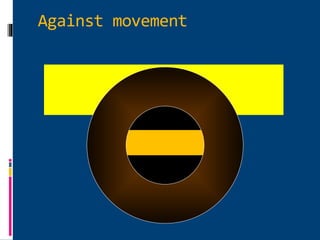
Against movement Far point in front of observers pupil.
Against movement of reflex,
gradual change from red reflex to no reflex
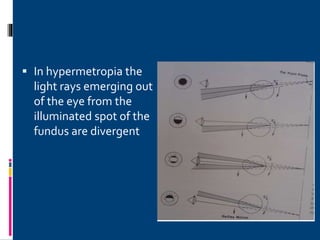
 In hypermetropia the
light rays emerging out
of the eye from the
illuminated spot of the
fundus are divergent
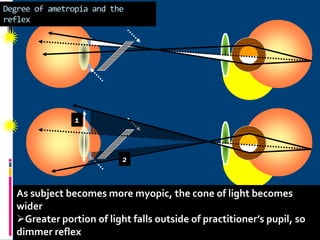
Degree of ametropia and the
reflex
As subject becomes more myopic, the cone of light becomes
wider
Greater portion of light falls outside of practitioner’s pupil, so
dimmer reflex
1
2
 "with" motion of the pupillary streak reflex-as
compared with movement of the incident
divergent beam indicates a far point location
behind the retinoscope aperture, in the
continuum between the operator and infinity
(slightly myopic and emmetropic eyes) or behind
the eye (hyperopic eyes).
 "Against" motion of the streak indicates a far
point location between the retinoscope aperture
and the patient's eye (moderately to highly
myopic eyes).
 If the retinoscopic reflex is at neutrality-
showing neither "with" nor "against" motion-
the far point is located at the aperture of the
retinoscope.
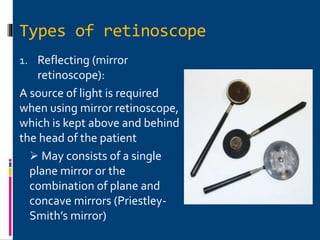
Types of retinoscope
1. Reflecting (mirror
retinoscope):
A source of light is required
when using mirror retinoscope,
which is kept above and behind
the head of the patient
 May consists of a single
plane mirror or the
combination of plane and
concave mirrors (Priestley-
Smith’s mirror)
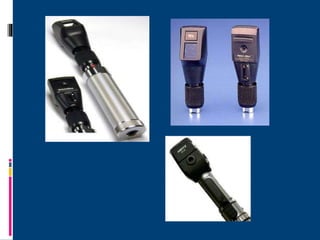
2. Self illuminated retinoscope:
more popular now a days
two types are available:
a. Spot retinoscope
b. Streak retinoscope
Spot Vs Streak
 The “spot retinoscope” reflects a beam of light
from a circular source, whereas the “streak
retinoscope” emits a beam from a line source
 Of these two major forms of retinoscope, the
streak retinoscope is more useful clinically
because it can be more readily applied to the
determination of astigmatic corrections by
assessment of the axis of cylinder and refractive
powers in the two primary ametropic meridians
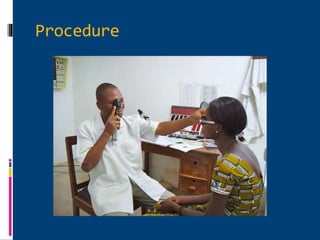
Procedure
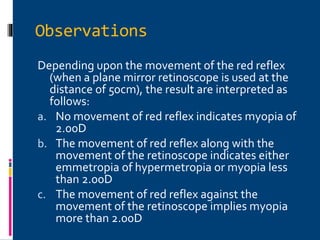
Observations
Depending upon the movement of the red reflex
(when a plane mirror retinoscope is used at the
distance of 50cm), the result are interpreted as
follows:
a. No movement of red reflex indicates myopia of
2.00D
b. The movement of red reflex along with the
movement of the retinoscope indicates either
emmetropia of hypermetropia or myopia less
than 2.00D
c. The movement of red reflex against the
movement of the retinoscope implies myopia
more than 2.00D
With movement
Against movement
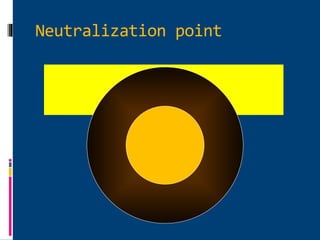
Neutralization point
Neutralization
 To estimate the degree of refractive error, the
movement of red reflex is neutralized by
addition of increasingly convex (+) spherical
lenses (when the red reflex was moving with
the movement of plane mirror)
Or
concave (-) spherical lenses (when the red reflex
was moving against the movement of plane
mirror)
 When simple spherical error alone is present,
the movement of red reflex will be
neutralized in both vertical and horizontal
meridian
 In the presence of astigmatism, with its
principal axis horizontal and vertical, one axis
is neutralized with the appropriate spherical
lens and the second axis (vertical or
horizontal) still shows the movement of reflex
in the direction of the axis of the astigmatism
 End point:
When streak retinoscopy is performed, the
width of the reflex widens progressively as
the neutralization is approached, and at the
end point, streak disappears and the pupil
appears completely illuminated or
completely dark
Confirm/identifytheaxisofthe
astigmatism
 TheThickness Phenomenon
 The Intensity Phenomenon
 The Break and Skew Phenomena
 Straddling the Axis
The thickness phenomena
 The streak reflex appears to be narrowest when
we are streaking the meridian of the correct
axis.
 As we move away from the correct axis, the
streak reflex becomes wider.
The Intensity Phenomenon
 The streak reflex appears brightest when you
are streaking the meridian of the correct axis.
 As you move away from the correct axis, the
streak reflex becomes more dim.
•In higher amounts of astigmatism, the streak
reflex will tend to stay on-axis even if the
streak is rotated off-axis, this guides you back
to the correct axis .
Break phenomenon
Straddling the cylinder axis
o Introduced by Copeland – finding and bracketing
astigmatic axis
o Rotate the retinoscopy streak such that it
becomes align 45 degrees oblique to the axis of
correcting cylinder, to either side
o Compare the speed of rotation and alignment of
fundus reflex streak with correcting cylinder axis
o If not align fundus reflex streak would be
misaligned in one of the 45 degree position
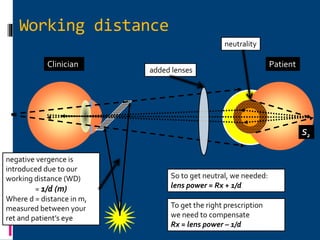
Clinician
S2
Patient
Working distance
neutrality
negative vergence is
introduced due to our
working distance (WD)
= 1/d (m)
Where d = distance in m,
measured between your
ret and patient’s eye
added lenses
To get the right prescription
we need to compensate
Rx = lens power – 1/d
So to get neutral, we needed:
lens power = Rx + 1/d
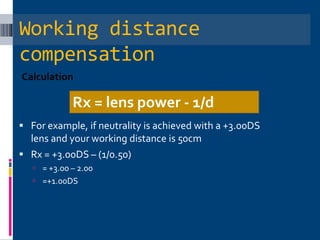
Working distance
compensation
Calculation
 For example, if neutrality is achieved with a +3.00DS
lens and your working distance is 50cm
 Rx = +3.00DS – (1/0.50)
 = +3.00 – 2.00
 =+1.00DS
Rx = lens power - 1/d
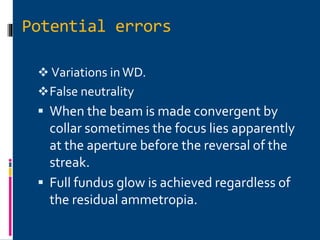
Potential errors
 Variations inWD.
False neutrality
 When the beam is made convergent by
collar sometimes the focus lies apparently
at the aperture before the reversal of the
streak.
 Full fundus glow is achieved regardless of
the residual ammetropia.
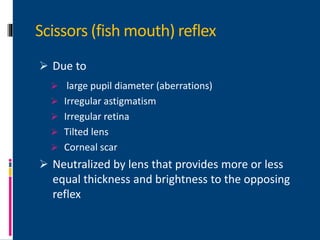
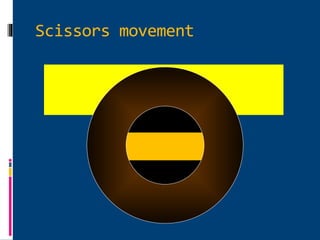
Scissors (fish mouth) reflex
 Due to
 large pupil diameter (aberrations)
 Irregular astigmatism
 Irregular retina
 Tilted lens
 Corneal scar
 Neutralized by lens that provides more or less
equal thickness and brightness to the opposing
reflex
Scissors movement
Contd..
Obliquity of observation
 As observer is slightly temporal there’s residual
oblique astigmatism induced
 Error is 0.12DC@ 90 if 5 degree 0.37DC@ 90 if
10 deg; 0.75DC@ 90 if 15 deg; & 1.37DC @ 90 if
20 deg oblique
 Accommodative status
 Plus bias: hyperopia of +0.25 to +0.50 in youthful
eyes is seen.
Is due to effective reflecting surface being behind
the outer limiting membrane.
also due to spectral composition of fundus reflex.
Contd..
66
 When retinoscopy is used to test accommodation
for near objects, it is called dynamic retinoscopy
 The patient views a nearpoint test card at a typical
nearpoint working distance, e.g., 40 cm.
 This establishes a known accommodative stimulus
Dynamic Retinoscopy
67
 Lag of accommodation can be assessed clinically
using various retinoscopic procedures.
 Lag of accommodation=
 Accm response < Accm stimulus
 Normal Lag: +0.50 or +0.75 diopters
 High Lag: +1.00 diopters or higher
 Lead : +0.25 diopters or less
68
 To investigate the accommodative state of the eye
in near vision.
 There are two different techniques:
 The patient observes a separate fixation object
with the retinoscope behind it. The distance
between the object and retinoscope at reversal
indicates the accuracy of accommodation.
Types of Dynamic Retinoscopy
 The fixation object is on the retinoscope, the
level of accommodation being measured by
trial lenses placed before the eyes.
 In both techniques the patient wears the distance
correction as found by the subjective.
Cross-Nott’s technique
 Doesn’t require the use of supplementary lenses
 Pt wears first the distance refractive correction,
and is directed to view the near target
 If the with movement is seen (reflecting the
typical lag of accommodation), then the
retinoscopist adjusts the working distance away
from the patient, while the fixation target
remains stationary
 The reciprocal of the retinoscopy WD (in metres)
at which the neutral reflex is observed indicates
the magnitude of accommodative response
Sheard’s technique
 He indicated that lag of accomodation could
measured by placing a target which is
attached to the retinoscope mirror at the
patient's usual reading distance, an
performing retinoscopy at that distance
 Appropriate spherical lenses are added until
the neutral reflex is observed
 Stated that the lag of accomodation is given
by the lens power which provides “the first
indication of neutral shadow”
72
 dynamic retinoscopy method using lenses, the
stimulus to accommodation is altered by the
presence of the trial lenses.
 the patient also binocularly fixates a stimulus
mounted on the retinoscope.
 The target is a set of letters on the retinoscope
or a card attached to the retinoscope
MEM Retinoscopy
 a single lens is briefly held in front of one eye
and the beam passed across.
 The method is applied to one eye at a time.
 The lens giving reversal gives the value of the low
neutral.
RADICAL RETINOSCOPY
 Due to small pupils/cataract/other media
opacities/faint retinoscopic reflex
 The practitioner find easy as moving closer to
the patient.
 Involve aWD as close as 20 cm/or even 10cm.
 Eg: if possible at 20 cm WD then +5.00D is
subtracted from lens power in the refractor.
STATIC Vs DYNAMIC
 Accomodation fully
relaxed.
 Working distance lens
added or subtracted
from the objective
finding.
 Fixates letters at 6m.
 Only ametropia or
emmetropia can be
determined.
 Accomodation fully in
play.
 No influence of working
distance.
 Fixates at the bulb of
retinoscope or letters
clinged on it.
 Accommodative lag can
be determined.
Uses
 Objective measurement of refractive error
 Evaluation of refractive state in nonverbal
patients and also in low vision patients
 Regularly used in laboratory for
measurement of refractive status in animals
 Starting point for subjective refraction
 Used to prescribe where subjective refraction
can’t be performed
 Screening for ocular disease
 Keratoconus, media opacities
 Also useful in determining accomodative
stability and accomodative lag
THANKYOU!!

Retinoscopy

  • 1.
    Presenter: Hira NathDahal B. Optometry MMC, IOM
  • 2.
    Presentation Layout  Introduction History  Theory  Procedure  Types of retinoscopy o Static and dynamic  Problems  Uses
  • 3.
    Introduction  Objective methodof finding out the error of refraction by utilizing the technique of neutralization  Based on the fact that when the light is reflected from the mirror into the eye, the direction in which the light will travel across the pupil will depend upon the refractive states of the eye
  • 4.
    History  Sir WilliamBowman (1859) noticed a peculiar reflex in the pupil of astigmatic eyes that occurred during ophthalmoscopy • Cuignet (1873) developed the technique to use the reflex to determine and correct for refractive errors
  • 5.
     Explanation ofoptical concept was first attempted by Landolt in 1878  Parent in 1880 began to quantitatively assess the refractive error through the use of lenses inserted in front of the eye
  • 6.
     Retinoscopy (“vision of the retina”) : misnomer; was initiated by Parent in 1881  Retinoscopy is actually modification of a Focault knife-edge method for determining the refractive power of the lens applied to the eye
  • 7.
  • 8.
     When theknife edge is in front of the focus, the shadow direction moves the same direction at the knife edge
  • 9.
     When theknife edge is behind the focus , the shadow moves in the direction opposite to the knife edge
  • 10.
     When theknife edge is at focus, the light appears and disappears spontaneously
  • 11.
     Retinoscope  small,handheld device that emits visible light toward the pupil of eye being analyzed and allows the operator to view the red reflex of light reflected back through the pupil from the ocular fundus
  • 12.
    Contd..  Has areflecting surface, which allows light originating from below to be reflected towards the patients eye  The reflecting surface is either perforated or half silvered, which allows the operator to view the patient’s eye through the central aperture
  • 13.
    Optics of retinoscope The detail optics of retinoscopy can be considered into three stages: 1. Illumination stage 2. Reflex stage 3. Projection stage
  • 14.
     A divergentbeam of light from the filament source is refracted by the plus condensing lens below the reflecting surface, before it is reflected by the perforated or half silvered mirror  The reflected rays is usually divergent & is directed towards the patient’s pupil  Most retinoscopes now have a control for changing the vergence of emitted light beam such that the vergence of emitted beam can be made significant divergent or convergent
  • 16.
    Contd..  Divergent beamemitted by retinoscope is considered the incident beam of the optical system underlying retinoscopy  The incident beam can be moved back and forth tilting the retinoscope and its reflecting surface
  • 18.
    Contd..  As thereflecting surface is tilted the apparent source moves in the opposite direction across the line connecting retinoscopic aperture and the eye  The divergent incident beam sweeps from one side of the pupil to the other, in the direction of the tilt of the reflecting surface & the beam that enters the pupil sweeps across the retina in that direction as well
  • 19.
    Blur patch inthe retina moves in the same direction as the mirror (plane mirror position)
  • 20.
    Plane mirror VSconcave mirror
  • 21.
    Clinician So S1 S2 Patient Optical principles The lightin the pupil is called the “ret reflex”
  • 22.
    Origin of retinoscopicreflex • Still in controversy;  Junction between the retina and vitreous (most acceptable)  From the Bruch’s membrane – not accepted as RPE absorbs the light • For subjective refraction: Layer of photoreceptors is considered • Retinoscope indicates higher hyperopia or less myopia • Called as plus bias in retinoscopy
  • 23.
    Charcterstics of retinoscopic reflex Brightness Light focused at aperture in emmetrope or at neutrality –bright reflex.  Focused sufficiently in front or behind the aperture in ammetrope – relatively dull reflex. • large errors have dull reflex, small errors have a bright reflex. • Dimmer reflex- smaller pupil (hyperopes and elderly) darkly pigmented RPE media opacities.
  • 24.
    Speed of reflex WhenWD constant, relative speed of reflex depends on eye’s residual ammetropia.  Speed less than half – ammetropia more than 3.00DS from neutrality.  Speed 3 times – 0.50DS from neutrality.  Speed 6 times – 0.25DS from neutrality.  Speed infinity at neutrality, so pupil seems covered with reflex.
  • 25.
     Width Streak narrowwhen you are far from far point Broadens as you approach far point
  • 26.
    Ret reflex cantell us a lot Reflex Observation Meaning Brightness Dim Far from Rx Bright Close to Rx Streak size Narrow Far from Rx Wide Close to Rx Movement direction With Need more plus Against Need more minus Movement speed Slow Far from Rx Fast Close to Rx
  • 27.
     There aremainly two kinds of retinoscopy: 1. Static retinoscopy and 2. Dynamic retinoscopy
  • 28.
    Static retinoscopy  Objectiveof static retinoscopy is to find the position of the far point (punctum remotum) of the eye  Far point is the point that is optically conjugate to the fovea when accommodation is relaxed
  • 29.
    Contd..  Far pointof the emmetropic eye is located at the peephole of the retinoscope  Far point of the myopic eye is located in front of, or anterior to the eye along the line of sight
  • 30.
    Contd..  In caseof a hyperopic eye far point is located behind or posterior to the eye o Paraxial light that converges towards a focus in the plane of the far point focuses at the retina & light diverging from a hyperopic retina exits the eye as if it is diverging from a plane containing far point  In case of astigmatism, retinoscopy finds two far points one for each of the two primary power meridians
  • 31.
     In caseof emmetropic eye all the rays from the light source from the retina will enter the clinician’s pupil and the entire pupil of the patient will appear to be illuminated .  It signifies that the clinician’s pupil is conjugate to the patient’s retina
  • 33.
    Reflex stage: neutral Clinician Patient Noeffect on reflex Reflex disappears Mirror tilts forwards Mirror tilts further forwards S2 S2 No S2 S1 Neutral position: Far point conjugate with observers nodal point. No movement of reflex, sudden change from red reflex to no reflex.
  • 34.
     As inlow myopia, the light rays emerging from the illuminated spot of the fundus are convergent and meet behind the observer, sitting at 50cm from the patient
  • 35.
    Observer Subject Reflex disappears Reflexmoves down, i.e. with direction of movement of light Mirror tilts further forwards Mirror tilts forwards S2 S2 Far point behind observers pupil Within pupil Outside pupil No S2 S1 With movement Far point behind observers pupil. With movement of reflex, gradual change from red reflex to no reflex
  • 36.
     In highmyopia, light emerging out of the patient’s eyes from the illuminated spot on the fundus are convergent and meet at the space between the patient and the observer
  • 37.
    Observer Subject Far pointin front of observers pupil Reflex disappears Reflex moves up, i.e. against direction of movement of light Mirror tilts forwards Mirror tilts further forwards S2 S2 Within pupil Outside pupil No S2 S1 Against movement Far point in front of observers pupil. Against movement of reflex, gradual change from red reflex to no reflex
  • 38.
     In hypermetropiathe light rays emerging out of the eye from the illuminated spot of the fundus are divergent
  • 39.
    Degree of ametropiaand the reflex As subject becomes more myopic, the cone of light becomes wider Greater portion of light falls outside of practitioner’s pupil, so dimmer reflex 1 2
  • 40.
     "with" motionof the pupillary streak reflex-as compared with movement of the incident divergent beam indicates a far point location behind the retinoscope aperture, in the continuum between the operator and infinity (slightly myopic and emmetropic eyes) or behind the eye (hyperopic eyes).  "Against" motion of the streak indicates a far point location between the retinoscope aperture and the patient's eye (moderately to highly myopic eyes).
  • 41.
     If theretinoscopic reflex is at neutrality- showing neither "with" nor "against" motion- the far point is located at the aperture of the retinoscope.
  • 42.
    Types of retinoscope 1.Reflecting (mirror retinoscope): A source of light is required when using mirror retinoscope, which is kept above and behind the head of the patient  May consists of a single plane mirror or the combination of plane and concave mirrors (Priestley- Smith’s mirror)
  • 43.
    2. Self illuminatedretinoscope: more popular now a days two types are available: a. Spot retinoscope b. Streak retinoscope
  • 44.
    Spot Vs Streak The “spot retinoscope” reflects a beam of light from a circular source, whereas the “streak retinoscope” emits a beam from a line source  Of these two major forms of retinoscope, the streak retinoscope is more useful clinically because it can be more readily applied to the determination of astigmatic corrections by assessment of the axis of cylinder and refractive powers in the two primary ametropic meridians
  • 46.
  • 47.
    Observations Depending upon themovement of the red reflex (when a plane mirror retinoscope is used at the distance of 50cm), the result are interpreted as follows: a. No movement of red reflex indicates myopia of 2.00D b. The movement of red reflex along with the movement of the retinoscope indicates either emmetropia of hypermetropia or myopia less than 2.00D c. The movement of red reflex against the movement of the retinoscope implies myopia more than 2.00D
  • 48.
  • 49.
  • 50.
  • 51.
    Neutralization  To estimatethe degree of refractive error, the movement of red reflex is neutralized by addition of increasingly convex (+) spherical lenses (when the red reflex was moving with the movement of plane mirror) Or concave (-) spherical lenses (when the red reflex was moving against the movement of plane mirror)
  • 52.
     When simplespherical error alone is present, the movement of red reflex will be neutralized in both vertical and horizontal meridian  In the presence of astigmatism, with its principal axis horizontal and vertical, one axis is neutralized with the appropriate spherical lens and the second axis (vertical or horizontal) still shows the movement of reflex in the direction of the axis of the astigmatism
  • 53.
     End point: Whenstreak retinoscopy is performed, the width of the reflex widens progressively as the neutralization is approached, and at the end point, streak disappears and the pupil appears completely illuminated or completely dark
  • 54.
    Confirm/identifytheaxisofthe astigmatism  TheThickness Phenomenon The Intensity Phenomenon  The Break and Skew Phenomena  Straddling the Axis
  • 55.
    The thickness phenomena The streak reflex appears to be narrowest when we are streaking the meridian of the correct axis.  As we move away from the correct axis, the streak reflex becomes wider.
  • 56.
    The Intensity Phenomenon The streak reflex appears brightest when you are streaking the meridian of the correct axis.  As you move away from the correct axis, the streak reflex becomes more dim.
  • 57.
    •In higher amountsof astigmatism, the streak reflex will tend to stay on-axis even if the streak is rotated off-axis, this guides you back to the correct axis . Break phenomenon
  • 58.
    Straddling the cylinderaxis o Introduced by Copeland – finding and bracketing astigmatic axis o Rotate the retinoscopy streak such that it becomes align 45 degrees oblique to the axis of correcting cylinder, to either side o Compare the speed of rotation and alignment of fundus reflex streak with correcting cylinder axis o If not align fundus reflex streak would be misaligned in one of the 45 degree position
  • 59.
    Clinician S2 Patient Working distance neutrality negative vergenceis introduced due to our working distance (WD) = 1/d (m) Where d = distance in m, measured between your ret and patient’s eye added lenses To get the right prescription we need to compensate Rx = lens power – 1/d So to get neutral, we needed: lens power = Rx + 1/d
  • 60.
    Working distance compensation Calculation  Forexample, if neutrality is achieved with a +3.00DS lens and your working distance is 50cm  Rx = +3.00DS – (1/0.50)  = +3.00 – 2.00  =+1.00DS Rx = lens power - 1/d
  • 61.
    Potential errors  VariationsinWD. False neutrality  When the beam is made convergent by collar sometimes the focus lies apparently at the aperture before the reversal of the streak.  Full fundus glow is achieved regardless of the residual ammetropia.
  • 62.
    Scissors (fish mouth)reflex  Due to  large pupil diameter (aberrations)  Irregular astigmatism  Irregular retina  Tilted lens  Corneal scar  Neutralized by lens that provides more or less equal thickness and brightness to the opposing reflex
  • 63.
  • 64.
    Contd.. Obliquity of observation As observer is slightly temporal there’s residual oblique astigmatism induced  Error is 0.12DC@ 90 if 5 degree 0.37DC@ 90 if 10 deg; 0.75DC@ 90 if 15 deg; & 1.37DC @ 90 if 20 deg oblique
  • 65.
     Accommodative status Plus bias: hyperopia of +0.25 to +0.50 in youthful eyes is seen. Is due to effective reflecting surface being behind the outer limiting membrane. also due to spectral composition of fundus reflex. Contd..
  • 66.
    66  When retinoscopyis used to test accommodation for near objects, it is called dynamic retinoscopy  The patient views a nearpoint test card at a typical nearpoint working distance, e.g., 40 cm.  This establishes a known accommodative stimulus Dynamic Retinoscopy
  • 67.
    67  Lag ofaccommodation can be assessed clinically using various retinoscopic procedures.  Lag of accommodation=  Accm response < Accm stimulus  Normal Lag: +0.50 or +0.75 diopters  High Lag: +1.00 diopters or higher  Lead : +0.25 diopters or less
  • 68.
    68  To investigatethe accommodative state of the eye in near vision.  There are two different techniques:  The patient observes a separate fixation object with the retinoscope behind it. The distance between the object and retinoscope at reversal indicates the accuracy of accommodation. Types of Dynamic Retinoscopy
  • 69.
     The fixationobject is on the retinoscope, the level of accommodation being measured by trial lenses placed before the eyes.  In both techniques the patient wears the distance correction as found by the subjective.
  • 70.
    Cross-Nott’s technique  Doesn’trequire the use of supplementary lenses  Pt wears first the distance refractive correction, and is directed to view the near target  If the with movement is seen (reflecting the typical lag of accommodation), then the retinoscopist adjusts the working distance away from the patient, while the fixation target remains stationary  The reciprocal of the retinoscopy WD (in metres) at which the neutral reflex is observed indicates the magnitude of accommodative response
  • 71.
    Sheard’s technique  Heindicated that lag of accomodation could measured by placing a target which is attached to the retinoscope mirror at the patient's usual reading distance, an performing retinoscopy at that distance  Appropriate spherical lenses are added until the neutral reflex is observed  Stated that the lag of accomodation is given by the lens power which provides “the first indication of neutral shadow”
  • 72.
    72  dynamic retinoscopymethod using lenses, the stimulus to accommodation is altered by the presence of the trial lenses.  the patient also binocularly fixates a stimulus mounted on the retinoscope.  The target is a set of letters on the retinoscope or a card attached to the retinoscope MEM Retinoscopy
  • 73.
     a singlelens is briefly held in front of one eye and the beam passed across.  The method is applied to one eye at a time.  The lens giving reversal gives the value of the low neutral.
  • 74.
    RADICAL RETINOSCOPY  Dueto small pupils/cataract/other media opacities/faint retinoscopic reflex  The practitioner find easy as moving closer to the patient.  Involve aWD as close as 20 cm/or even 10cm.  Eg: if possible at 20 cm WD then +5.00D is subtracted from lens power in the refractor.
  • 75.
    STATIC Vs DYNAMIC Accomodation fully relaxed.  Working distance lens added or subtracted from the objective finding.  Fixates letters at 6m.  Only ametropia or emmetropia can be determined.  Accomodation fully in play.  No influence of working distance.  Fixates at the bulb of retinoscope or letters clinged on it.  Accommodative lag can be determined.
  • 76.
    Uses  Objective measurementof refractive error  Evaluation of refractive state in nonverbal patients and also in low vision patients  Regularly used in laboratory for measurement of refractive status in animals  Starting point for subjective refraction
  • 77.
     Used toprescribe where subjective refraction can’t be performed  Screening for ocular disease  Keratoconus, media opacities  Also useful in determining accomodative stability and accomodative lag
  • 78.