AGE RELATED CHANGES IN THE
EYE?
“ARE WE AWARE ABOUT IT”
Hira Nath Dahal
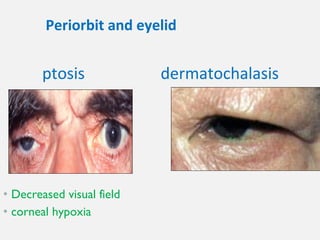
• Decreased visual field
• corneal hypoxia
dermatochalasisptosis
Periorbit and eyelid
skin & soft tissue atrophy
glabellar rhytids
poliosis
orbital septal dehiscene ⇒ herniation of orbital fat
lacrimal gland dysfunction, ↓ed tear production,
meibomian gland disease & goblet cell dysfunction ⇒
dry eye
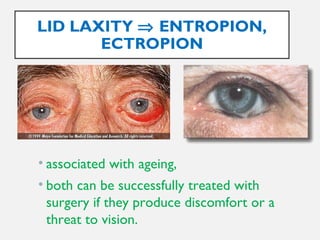
LID LAXITY ⇒ ENTROPION,
ECTROPION
• associated with ageing,
• both can be successfully treated with
surgery if they produce discomfort or a
threat to vision.
CONJUNCTIVA:
• atrophy & degeneration
• ↓ in no. & height of epithelial cells
• shortening of inferior fornix
• the number of mucous cells decreases leading to
dry eye.
CORNEA:
• ↓ed corneal sensitivity
• ↑ against-the-rule astigmatism
• no. of the people having with-the-rule astigmatism ↓es with
age
• Arcus senilis
• corneal endothelial cell population decreases along with
polymegathism and pleomorphism
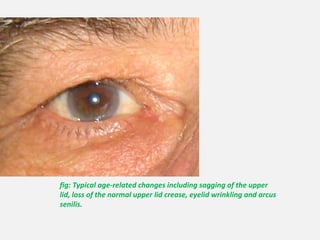
fig: Typical age-related changes including sagging of the upper
lid, loss of the normal upper lid crease, eyelid wrinkling and arcus
senilis.
ANTERIOR CHAMBER:
• depth ↓es with age, causing
• the increment in the refractive power of the eye
(↑ myopia)
• More interference with aqueous outflow
PUPIL AND UVEA:
• senile miosis
• due to
• atrophy of the dilator muscle fibres,
or
• an increased rigidity of the iris blood
vessels, or
• both
• ↓ retinal blur circles and retinal illuminance
 less difference in the diameter of the pupil in the light- and
dark-adapted state
 less reactive to light
 slight ↑ in the latency of pupillary responses
 hypertrophy of ciliary muscle
LENS:
• Morphological Changes:
• ↑ in both the mass & dimension of the lens
• axial thickness of the lens ↑es by about 28% by age 70
over that which existed at age 15 to 20 yrs
• the nuclear thickness remains constant while the cortical
thicknesses increase
• the anterior cortex increases by 0.6mm & the posterior,
by 0.4mm
• flattening of the anterior lens surface & conical bulging of
the posterior lens surface
LENS:…
 Morphological Changes:
 epithelial cells- becomes flatter & density ↓es
 lens fibers- total loss or partial degradation of a no. of plasma
membrane & cytoskeletal proteins
 cholesterol:phospholipid ratio ↑es
 lens capsule- thickens throughout life (collagen type IV vs. I, III,
IV)
LENS:…
 Physiological Changes:
 Changes to the cellular junctions and alteration on cation
permeability
 membrane potential- from –50mV (at age of 20 yrs) to –20mV (at
the age of 80 yrs)
• sodium concentration - ↑es
• Na+
:K+
permeability ratio ↑es by six fold
• free calcium level ↑es Ca ATPase inhibited
LENS:…
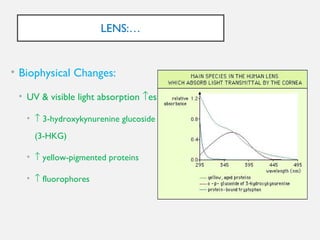
• Biophysical Changes:
• UV & visible light absorption ↑es
• ↑ 3-hydroxykynurenine glucoside
(3-HKG)
• ↑ yellow-pigmented proteins
• ↑ fluorophores
• thus transmission of visible light & lens transparency ↓es
• the amount of light reaching the retina in a normal 60-
year-old is only about 1/3rd
that reaching the retina of a 20-
year old
• amplitude of accommodation ↓es
LENS:…
• Biochemical Changes:
• overall metabolic activity of the lens ↓es
• ↓ glycolytic activity
• ↓ level / activity of antioxidants
• Changes in Crystallins:
• accumulation of high molecular weight aggregates
• some act as scatter points for light
• ↑ed insolubility
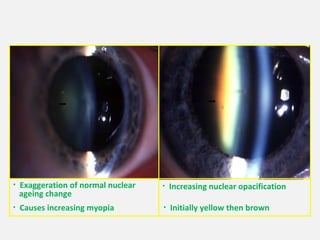
• Exaggeration of normal nuclear
ageing change
• Causes increasing myopia
• Increasing nuclear opacification
• Initially yellow then brown
VITREOUS:
 index of refraction of the vitreous
increases ( hypermetropia)↑
 syneresis of the vitreous
 Increased vitreous floaters
 Decreased support to the posterior
lens surface
RETINA AND NEURAL CONNECTIONS:
in the absence of pathology, only little decline in static
visual acuity with age that can not be accounted for by
miosis and increased density of the lens
pathologies that are the major cause of decline in static
visual acuity are cataract, macular degeneration and
glaucoma
• mesopia occurs at higher levels of ambient illuminace
in older people
• The arteries and veins of the retina become narrower
with age, reducing the flow of blood.
The ageing retina is duller and exhibits a less
responsive light reflex.
The optic disk may be paler also.
 This creates a need for more light in order to read or
accomplish other tasks.
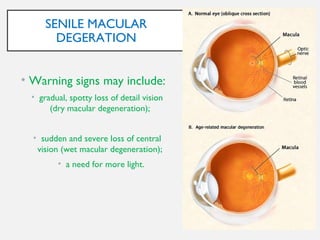
SENILE MACULAR
DEGERATION
• Warning signs may include:
• gradual, spotty loss of detail vision
(dry macular degeneration);
• sudden and severe loss of central
vision (wet macular degeneration);
• a need for more light.
RETINA AND NEURAL CONNECTIONS:…
• ↓ contrast sensitivity due to increased lens
fluorescence and light scatter
• with shift of peak sensitivity to lower frequencies
• ↓ in the ability to discriminate colours
• ↓ visual field size and sensitivity
• absolute level of dark adaptation reached by the elderly is
less than that reached by younger individuals
REFRACTIVE STATUS:
• static power of the eye: hypermetropic shift
• cornea: ↑ against-the-rule astigmatism
• anterior chamber: ↑ myopia
• lens: hypermetropia or myopia
• vitreous: ↑ hypermetropia
OCULAR MOTOR SYSTEM:
 under scotopic conditions, aging people have difficulty
with fixation
 ↑ exotropia with age
 the range of voluntary eye movements becomes limited
 supraduction ↓es with age
 ↑ tonic vergence with distance heterophoria (esophoria)
↓ positive fusional vergence but same negative
fusional vergence
↓ accommodation with ↑ AC/A ratio & ↓ CA/C
↓ stereopsis
OTHER CHANGES WITH AGING:
• ↓ aqueous secretion
• ↓ resistance to distraction
• ↓ ability to selectively attend to one source of
information in the presence of competing
messages
 ↓ ability to separate visual events that happen serially declines
with age
 ↓ dynamic visual acuity (VA for moving targets)
 related to ↓ in the rate of smooth following eye movements
 ↑ variability in visual performance between individuals

Anatomic and physiological ocular changes with age final

  • 1.
    AGE RELATED CHANGESIN THE EYE? “ARE WE AWARE ABOUT IT” Hira Nath Dahal
  • 3.
    • Decreased visualfield • corneal hypoxia dermatochalasisptosis Periorbit and eyelid
  • 4.
    skin & softtissue atrophy glabellar rhytids poliosis orbital septal dehiscene ⇒ herniation of orbital fat lacrimal gland dysfunction, ↓ed tear production, meibomian gland disease & goblet cell dysfunction ⇒ dry eye
  • 5.
    LID LAXITY ⇒ENTROPION, ECTROPION • associated with ageing, • both can be successfully treated with surgery if they produce discomfort or a threat to vision.
  • 7.
    CONJUNCTIVA: • atrophy &degeneration • ↓ in no. & height of epithelial cells • shortening of inferior fornix • the number of mucous cells decreases leading to dry eye.
  • 8.
    CORNEA: • ↓ed cornealsensitivity • ↑ against-the-rule astigmatism • no. of the people having with-the-rule astigmatism ↓es with age • Arcus senilis • corneal endothelial cell population decreases along with polymegathism and pleomorphism
  • 9.
    fig: Typical age-relatedchanges including sagging of the upper lid, loss of the normal upper lid crease, eyelid wrinkling and arcus senilis.
  • 10.
    ANTERIOR CHAMBER: • depth↓es with age, causing • the increment in the refractive power of the eye (↑ myopia) • More interference with aqueous outflow
  • 11.
    PUPIL AND UVEA: •senile miosis • due to • atrophy of the dilator muscle fibres, or • an increased rigidity of the iris blood vessels, or • both • ↓ retinal blur circles and retinal illuminance
  • 12.
     less differencein the diameter of the pupil in the light- and dark-adapted state  less reactive to light  slight ↑ in the latency of pupillary responses  hypertrophy of ciliary muscle
  • 13.
    LENS: • Morphological Changes: •↑ in both the mass & dimension of the lens • axial thickness of the lens ↑es by about 28% by age 70 over that which existed at age 15 to 20 yrs
  • 14.
    • the nuclearthickness remains constant while the cortical thicknesses increase • the anterior cortex increases by 0.6mm & the posterior, by 0.4mm • flattening of the anterior lens surface & conical bulging of the posterior lens surface
  • 15.
    LENS:…  Morphological Changes: epithelial cells- becomes flatter & density ↓es  lens fibers- total loss or partial degradation of a no. of plasma membrane & cytoskeletal proteins  cholesterol:phospholipid ratio ↑es  lens capsule- thickens throughout life (collagen type IV vs. I, III, IV)
  • 16.
    LENS:…  Physiological Changes: Changes to the cellular junctions and alteration on cation permeability  membrane potential- from –50mV (at age of 20 yrs) to –20mV (at the age of 80 yrs)
  • 17.
    • sodium concentration- ↑es • Na+ :K+ permeability ratio ↑es by six fold • free calcium level ↑es Ca ATPase inhibited
  • 18.
    LENS:… • Biophysical Changes: •UV & visible light absorption ↑es • ↑ 3-hydroxykynurenine glucoside (3-HKG) • ↑ yellow-pigmented proteins • ↑ fluorophores
  • 19.
    • thus transmissionof visible light & lens transparency ↓es • the amount of light reaching the retina in a normal 60- year-old is only about 1/3rd that reaching the retina of a 20- year old • amplitude of accommodation ↓es
  • 20.
    LENS:… • Biochemical Changes: •overall metabolic activity of the lens ↓es • ↓ glycolytic activity • ↓ level / activity of antioxidants
  • 21.
    • Changes inCrystallins: • accumulation of high molecular weight aggregates • some act as scatter points for light • ↑ed insolubility
  • 22.
    • Exaggeration ofnormal nuclear ageing change • Causes increasing myopia • Increasing nuclear opacification • Initially yellow then brown
  • 23.
    VITREOUS:  index ofrefraction of the vitreous increases ( hypermetropia)↑  syneresis of the vitreous  Increased vitreous floaters  Decreased support to the posterior lens surface
  • 24.
    RETINA AND NEURALCONNECTIONS: in the absence of pathology, only little decline in static visual acuity with age that can not be accounted for by miosis and increased density of the lens pathologies that are the major cause of decline in static visual acuity are cataract, macular degeneration and glaucoma
  • 25.
    • mesopia occursat higher levels of ambient illuminace in older people • The arteries and veins of the retina become narrower with age, reducing the flow of blood.
  • 26.
    The ageing retinais duller and exhibits a less responsive light reflex. The optic disk may be paler also.  This creates a need for more light in order to read or accomplish other tasks.
  • 27.
    SENILE MACULAR DEGERATION • Warningsigns may include: • gradual, spotty loss of detail vision (dry macular degeneration); • sudden and severe loss of central vision (wet macular degeneration); • a need for more light.
  • 28.
    RETINA AND NEURALCONNECTIONS:… • ↓ contrast sensitivity due to increased lens fluorescence and light scatter • with shift of peak sensitivity to lower frequencies • ↓ in the ability to discriminate colours
  • 29.
    • ↓ visualfield size and sensitivity • absolute level of dark adaptation reached by the elderly is less than that reached by younger individuals
  • 30.
    REFRACTIVE STATUS: • staticpower of the eye: hypermetropic shift • cornea: ↑ against-the-rule astigmatism • anterior chamber: ↑ myopia • lens: hypermetropia or myopia • vitreous: ↑ hypermetropia
  • 31.
    OCULAR MOTOR SYSTEM: under scotopic conditions, aging people have difficulty with fixation  ↑ exotropia with age  the range of voluntary eye movements becomes limited  supraduction ↓es with age  ↑ tonic vergence with distance heterophoria (esophoria)
  • 32.
    ↓ positive fusionalvergence but same negative fusional vergence ↓ accommodation with ↑ AC/A ratio & ↓ CA/C ↓ stereopsis
  • 33.
    OTHER CHANGES WITHAGING: • ↓ aqueous secretion • ↓ resistance to distraction • ↓ ability to selectively attend to one source of information in the presence of competing messages
  • 34.
     ↓ abilityto separate visual events that happen serially declines with age  ↓ dynamic visual acuity (VA for moving targets)  related to ↓ in the rate of smooth following eye movements  ↑ variability in visual performance between individuals