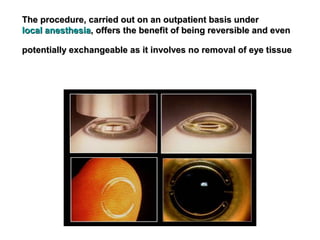
RETINOSCOPY
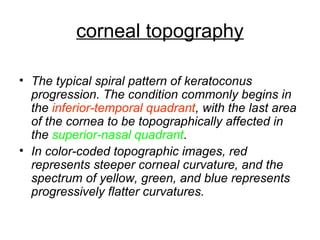
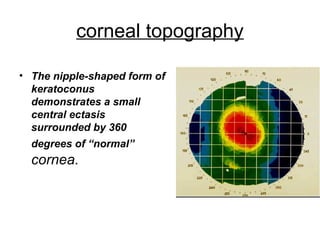
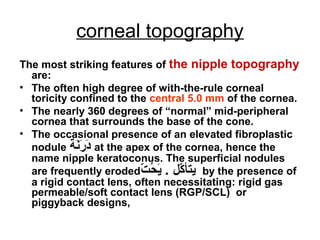
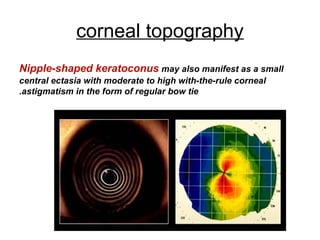
By Dr. Mohamed A.A Etarshawi
M.D Ophthalmology
HISTORY OF THE RETINOSCOPE
• The observations that led to clinical <
retinoscopy> were made in 1859 with a plane
mirror ophthalmoscope lighted by a candle,
when Sir William Bowman noted a linear
shadow seen when examining an astigmatic
eye.
• By 1875, the optics were explained and the
procedure was described as a “shadow test,”
an allusion ‫إشارة‬ . ‫إلماع‬ to neutralization. H.
Parent coined the term <retinoscopy> in 1881
HISTORY OF THE RETINOSCOPE
• The earliest retinoscopes used a mirror to
reflect a candle, which produced a “spot” of
light. It was soon discovered that a linear
streak of light could be produced with slit-
shaped mirrors.
• Early electric retinoscopes used spiral
filament bulbs and a rotating slit. Jacob
Copeland introduced a linear filament bulb
that produced a sharp, bright line of light.
The Copeland streak retinoscope set the
standard for future retinoscopic
developments.
OPTICS OF THE RETINOSCOPE
• The streak retinoscope has supplanted ‫ل‬ّ ‫م‬ ‫ح‬ِ‫ّل‬ ‫ي‬َ‫ّلِح‬
‫ل ه‬ّ ‫م‬‫ح‬َ‫ّلِح‬ ‫م‬َ‫ّلِح‬ the spot retinoscope in the modern eye
clinic, and only the streak retinoscope is
discussed in this chapter.
• Although the various brands ‫ماركة‬ of streak
retinoscopes differ in design, they all work
similarly. Light is produced by a luminous
filament within the base of the handle and
emanates from a mirror in the head as a
linear streak, with both orientation‫ج ه‬ُّ‫ه‬ ‫و‬َ‫ّلِح‬ ‫ت‬َ‫ّلِح‬ ; and
vergence ‫إنحدار‬ ، ‫ميل‬ controlled by the
retinoscopist.
HISTORY OF THE RETINOSCOPE
• The streak of light passes through the
patient's tear film, cornea, anterior chamber,
lens, vitreous chamber, and retina. It is then
reflected from the choroid and retinal
pigment epithelium as a linear red reflex that
passes back through the sensory retina,
vitreous, lens, aqueous, cornea, and tear
film, through the air between the patient and
the examiner, and into the head of the
retinoscope, through an aperture in the
mirror.
OPTICS OF THE RETINOSCOPE
• Finally exiting through the back of the
retinoscope into the retinoscopist's
own eye.
• By observing qualities of the reflected
light (the reflex) after it leaves the
patient's eye, the retinoscopist can
make determinations about the
patient's refractive state.
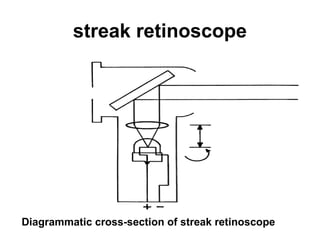
streak retinoscope
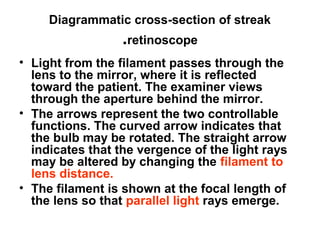
Diagrammatic cross-section of streak retinoscope
Diagrammatic cross-section of streak
retinoscope.
• Light from the filament passes through the
lens to the mirror, where it is reflected
toward the patient. The examiner views
through the aperture behind the mirror.
• The arrows represent the two controllable
functions. The curved arrow indicates that
the bulb may be rotated. The straight arrow
indicates that the vergence of the light rays
may be altered by changing the filament to
lens distance.
• The filament is shown at the focal length of
the lens so that parallel light rays emerge.
OPTICS OF THE RETINOSCOPE
• Explaining the optics and proper usage
of the retinoscope can be a confusing
business. To help simplify the text, we
have chosen to use the feminine. ‫ن ث‬ّ ‫م‬‫مؤ‬
‫ضمير‬ pronouns (e.g., “she” and “her”)
when referring to the retinoscopist, and
the masculine ones (e.g., “he,” “him,”
and “his”) when referring to the patient.
OPTICS OF THE RETINOSCOPE
• All streak retinoscopes are made of the same
fundamental components: light source,
condensing lens, mirror, and sleeve .
• The light source is a light bulb with a fine,
linear filament, which projects a fine, linear
streak of light with the passage of an electric
current.
• The filament (therefore the streak), can be
rotated 360 degrees by rotating the sleeve of
the retinoscope. Currently, most retinoscopes
use a halogen bulb, which projects a very
bright streak.
OPTICS OF THE RETINOSCOPE
• The condensing lens is a plus lens, which
exerts positive vergence on the streak, which
is emitted from the point-source filament in a
highly diverging manner.
• The position of the lens in relation to the
light filament can be altered by raising or
lowering the sleeve.
• In this way, the vergence of the streak that is
emitted from the retinoscope can be
controlled by the retinoscopist, as described
subsequently.
OPTICS OF THE RETINOSCOPE
• The mirror bends light that originates in the
handle and is initially projected upward
toward the ceiling, to instead exit the
retinoscope along an axis parallel to the floor
so that it can be projected into the patient's
eye. The mirror should not reflect 100% of
visible light; rather, it must allow some light
to pass through it.
• Only in this way can the retinoscopist have a
view into the patient's pupil that is coaxial
‫المحور‬ ‫متحد‬ to the path of the streak.
CONTROLLING THE PROPERTIES OF THE
RETINOSCOPE
• The basic idea behind the retinoscope is that
the retinoscopist creates a streak of light,
projects it into a patient's eye, bounces it ‫د‬ّ ‫يرت‬
off his retina, and makes deductions ‫استنتاج‬
concerning the patient's refractive status
based on what the image of that streak looks
like when it reaches the retinoscopist's eye.
To aid her in this task, the retinoscopist has
control over, and can easily vary, certain
aspects of the system.
CONTROLLING THE PROPERTIES OF THE
RETINOSCOPE
Two things she can control have nothing to
do with the intrinsic properties of the
retinoscope she is holding:
• The distance between the retinoscopist's
eye and the patient's (W.D).
• Which lenses she may be holding between
the patient's eye and her own.
CONTROLLING THE PROPERTIES OF
THE RETINOSCOPE
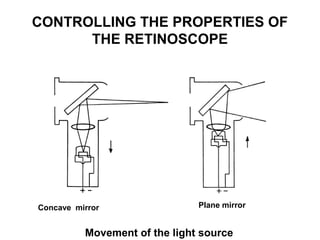
• Optical effects of moving the retinoscope
bulb to change the filament to lens distance;
this type of retinoscope emits convergent
light when the sleeve is moved up. Note the
vergences of the emerging rays:
• (left) concave mirror effect is produced
when bulb is moved down;
• (right) plane mirror effect is produced when
bulb is moved up.
CONTROLLING THE PROPERTIES OF
THE RETINOSCOPE
Plane mirrorConcave mirror
Movement of the light source
CONTROLLING THE PROPERTIES OF THE
RETINOSCOPE
However, two properties over which the
retinoscopist has total control are completely
intrinsic to the retinoscope she is holding.
• 1-The first is the orientation of the streak as
it leaves the retinoscope. Because the light
source for the retinoscope is a fine filament,
the light emanates from the retinoscope as a
fine streak.
CONTROLLING THE PROPERTIES OF THE
RETINOSCOPE
• By rotating the light source, the
retinoscopist can easily alter the
orientation of the streak by more than
360 degrees. Merely by rotating the
sleeve on the handle of the retinoscope,
she can project a streak whose
orientation is parallel to the floor, or
perpendicular to it, or any meridian in
between.
CONTROLLING THE PROPERTIES OF THE
RETINOSCOPE
• 2-The second property that can be controlled
easily by the retinoscopist is the vergence of
the incident streak. With the touch of a finger
(or thumb), the retinoscopist can alter the
streak so that it leaves the retinoscope as
converging, diverging, or even parallel light.
This feature gives the retinoscopist an
incredible ‫يصدق‬ ‫ل‬ amount of power in evaluating
a patient's refractive state. Unfortunately, it is
probably the most underused feature of the
retinoscope.
CONTROLLING THE PROPERTIES OF THE
RETINOSCOPE
• Changing the distance between the light
filament and the condensing lens alters the
vergence of the emitted streak. This can be
accomplished by raising or lowering the
sleeve in the handle of the retinoscope.
• This is the most fundamental way in which
different models of retinoscope will contrast,
‫يتغاير‬‫التختل ف‬ and it is obviously important for
the retinoscopist to be familiar with the type
of retinoscope with which she is working.
CONTROLLING THE PROPERTIES OF THE
RETINOSCOPE
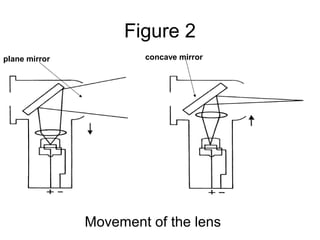
• The condensing lens is fixed, and the light
source can be raised or lowered by moving
the sleeve up or down (Fig. 2).
• When the sleeve is raised in these
retinoscopes, the streak emanates as a
diverging beam; when the sleeve is lowered,
the streak emanates in a converging nature ,
and therefore we use the term “sleeve up”
when the retinoscope emits diverging light
and “sleeve down” when it emits converging
light.
CONTROLLING THE PROPERTIES OF THE
RETINOSCOPE
By altering the vergence of the emitted streak, the
retinoscopist is actually manipulating its focal
point, the point where the emitted light comes
to focus in a point in real or virtual space.
When in maximum convergence (sleeve up), that
focal point is a real image located 33 cm in front
of the retinoscope. (You can test this by moving
the palm of your hand in front of the
retinoscope at a distance of 33 cm, then turning
it on with the sleeve raised all the way up.
Figure 2
concave mirrorplane mirror
Movement of the lens
CONTROLLING THE PROPERTIES OF
THE RETINOSCOPE
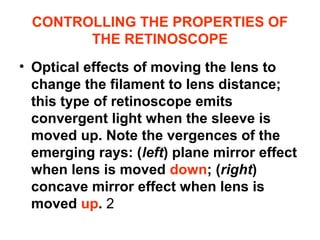
• Optical effects of moving the lens to
change the filament to lens distance;
this type of retinoscope emits
convergent light when the sleeve is
moved up. Note the vergences of the
emerging rays: (left) plane mirror effect
when lens is moved down; (right)
concave mirror effect when lens is
moved up. 2
DETERMINING THE VERGENCE OF THE
RETINOSCOPE BEAM Lecture 1
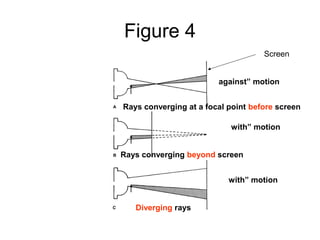
To determine the vergence of a retinoscope
at any sleeve adjustment, a simple trick
called Foucault's Method (Fig. 4) can be
used. The most instructive‫ي‬ّ  ‫ف‬ِ‫ي‬‫قي‬ِ‫ي‬‫ث‬ْ‫ِق‬‫ت‬َ part of
this exercise is shown in Figure 4A.
Note that when a card is introduced at the
edge of a converging beam, an opposite
movement is produced on a screen
located beyond the focal point.
Figure 4
against” motion
with” motion
with” motion
Screen
Rays converging beyond screen
Diverging rays
Rays converging at a focal point before screen
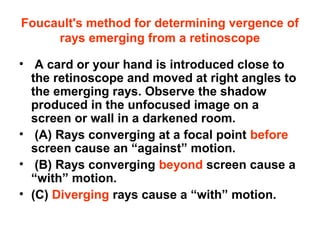
Foucault's method for determining vergence of
rays emerging from a retinoscope
• A card or your hand is introduced close to
the retinoscope and moved at right angles to
the emerging rays. Observe the shadow
produced in the unfocused image on a
screen or wall in a darkened room.
• (A) Rays converging at a focal point before
screen cause an “against” motion.
• (B) Rays converging beyond screen cause a
“with” motion.
• (C) Diverging rays cause a “with” motion.
• Foucault's method for determining vergence
of rays emerging from a retinoscope. A card
or your hand is introduced close to the
retinoscope and moved at right angles to the
emerging rays.
• Observe the shadow produced in the
unfocused image on a screen or wall in a
darkened room.
• A. Rays converging at a focal point before
screen cause an “against” motion.
• B. Rays converging beyond screen cause a
“with” motion.
• C. Diverging rays cause a “with” motion.
Calibration of the Converging
Beam
Bring the sleeve all the way up and place it
against a reflecting surface such as the wall.
Move away from the wall and observe from
the side (not through the peephole) until the
streak is in sharp focus on the wall. You
should note that when the retinoscope is
moved beyond that distance, the streak will
go out of focus because the filament light
has converged and then diverged (seeFig. 4
A).
• Return to the point of sharp focus and
measure to determine the focal point of
the retinoscope: it should be about 33
cm, which corresponds to + 3.00 D.
• Sit in the patient's examination chair
and aim the retinoscope toward the
distant wall while moving the sleeve up
and down.
Calibration of the Parallel Beam
• Watch where the finest focused image of
the filament is observed. Note the
relative position of the bottom of the
sleeve with regard to the range of sleeve
movement.
• In that position, the retinoscope beam is
as parallel as possible and it has no
vergence and thus is focused at infinity.
NEUTRALIZATION
RETINOSCOPY
Neutralization is performed with the retinoscope
held at a constant predetermined distance
from the patient with the sleeve all the way
down (light emitted in a diverging manner).
The retinoscopist makes decisions about the
patient's refractive error based on the
appearance of the retinoscope reflex after it is
reflected off the patient's fundus and back
through the pupil(Fig. 16).
NEUTRALIZATION
RETINOSCOPY
• What the retinoscopist sees is not the
image “on the retina” ,but rather the
magnified image “of the retina.”
• Therefore, discussion about
neutralization must begin with
discussion about the retinoscopic
reflex at neutralization.
THE NEUTRALIZATION REFLEX
• When performing neutralization the
retinoscopist shines diverging light
through the patient's pupil from a
standard working distance (usually 66
cm).
• This light is reflected off the patient's
fundus, and in this way, the fundus
acts as a new point source of light.
This is called the illuminating system.
THE NEUTRALIZATION REFLEX
• The light that originates from the luminous
retina then passes through the patient's
vitreous, lens, pupil, aqueous, and cornea,
until it finally exits the patient's eye on its
way back to the retinoscope. This is called
the viewing system.
• The retinoscopist must be able to
differentiate between the illuminating and
viewing systems because different
techniques of retinoscopy can depend on
varying the components of one but not the
other.
THE NEUTRALIZATION REFLEX
• 1-When diverging light is shone onto an
emmetrope's retina, the retina becomes
luminous and acts as a point source of light.
The rays of light then escape his eye in a
parallel fashion. If this concept is not
intuitive, ‫ي‬ّ  ‫ديه‬َ‫ب‬َ merely follow the standard
light ray diagram backward.
• 2-In similar fashion, light starting as a point
on a myope's luminous retina is emitted as
converging light, where more myopic
individuals emit more highly converging light
than less myopic ones.
THE NEUTRALIZATION REFLEX
• 3-Similarly, light starting as a point on a
hyperope's luminous retina is emitted as
diverging light, and hyperopic patients emit
more diverging light than less hyperopic
ones.
• The vergence of the rays emitted from the
eye determines the qualities of the reflex
seen by the retinoscopist.
• A neutralization reflex occurs under the
circumstance when the far point of the eye
correlates ‫نظامية‬ ‫بصورة‬ ‫يربط‬ with the location
of the peephole of the retinoscope
• If a retinoscopist were to examine an
emmetropic eye at infinity, she could make
assumptions ‫افتراض‬ on the diverging,
converging, or parallel nature of the reflected
light by sweeping the retinoscope streak
back and forth across the patient's pupil.
• However, it is not possible to perform
retinoscopy from an infinite distance; it is
customary to adapt a working distance of 66
cm, corresponding to + 1.50 D.
• By introducing + 1.5 lens in front of the
subject's eye, the far point of a plano
prescription is relocated to 66 cm.
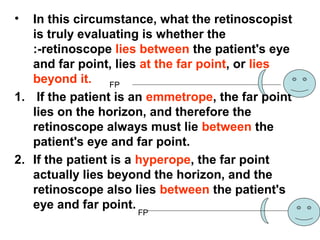
• In this circumstance, what the retinoscopist
is truly evaluating is whether the
:-retinoscope lies between the patient's eye
and far point, lies at the far point, or lies
beyond it.
1. If the patient is an emmetrope, the far point
lies on the horizon, and therefore the
retinoscope always must lie between the
patient's eye and far point.
2. If the patient is a hyperope, the far point
actually lies beyond the horizon, and the
retinoscope also lies between the patient's
eye and far point.
FP
FP
3-Things are more interesting, however, when
evaluating myopes in this way.
Light is emitted from a myope in a converging
manner so that the far point is somewhere in
real space (finite) in front of the myope's eye.
It is possible for the retinoscope to be placed
A- between the patient and far point,
B-exactly on the far point, or
C-out beyond the far point.
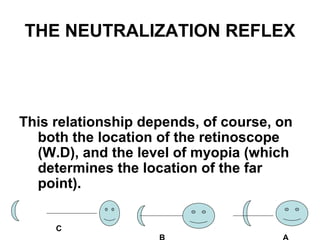
THE NEUTRALIZATION REFLEX
This relationship depends, of course, on
both the location of the retinoscope
(W.D), and the level of myopia (which
determines the location of the far
point).
C
• If the retinoscope is placed between the eye
and far point (as it is for all emmetropes and
hyperopes, and some myopes) and turned so
that the emitted streak is swept from side to
side across the patient's pupil, the light
reflex seen inside the pupil appears to sweep
in the same direction as the light emitted
from the retinoscope (seen on the patient's
iris, lids, brow, and cheek).
• This motion is called “with” motion because
the light that is afferent to the retinoscope
seems to move “with” the light that is
efferent from the retinoscope
THE NEUTRALIZATION REFLEX
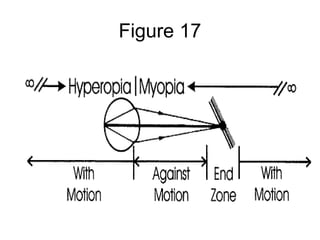
• Fig. 17. The optical basis for neutralization <
retinoscopy>. The location of far points
produces the “with” and “against” motions
for a retinoscope with a divergent beam
when performing neutralization retinoscopy.
“With” motion is seen under all
circumstances except when the far point of
the eye-corrective lens system is situated
between the cornea and the peephole ‫ثقب‬ of
the retinoscope. The far point of the
illustrated eye is at the peephole and is thus
neutralized.
Figure 17
Lecture 2
With” motion reflex in
hyperopia
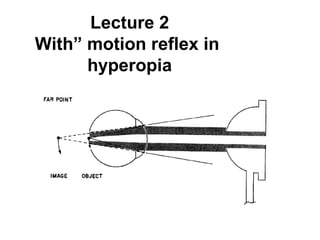
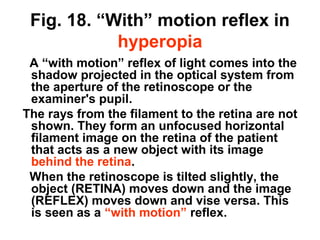
Fig. 18. “With” motion reflex in
hyperopia
A “with motion” reflex of light comes into the
shadow projected in the optical system from
the aperture of the retinoscope or the
examiner's pupil.
The rays from the filament to the retina are not
shown. They form an unfocused horizontal
filament image on the retina of the patient
that acts as a new object with its image
behind the retina.
When the retinoscope is tilted slightly, the
object (RETINA) moves down and the image
(REFLEX) moves down and vise versa. This
is seen as a “with motion” reflex.
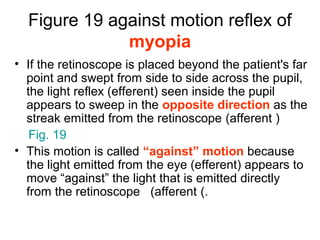
Figure 19 against motion reflex of
myopia
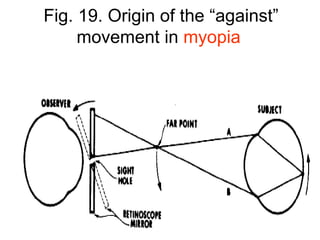
• If the retinoscope is placed beyond the patient's far
point and swept from side to side across the pupil,
the light reflex (efferent) seen inside the pupil
appears to sweep in the opposite direction as the
streak emitted from the retinoscope (afferent )
Fig. 19
• This motion is called “against” motion because
the light emitted from the eye (efferent) appears to
move “against” the light that is emitted directly
from the retinoscope (afferent (.
Fig. 19. Origin of the “against”
movement in myopia
“On-off” phenomenon
• When the retinoscope is placed exactly on the
patient's far point, neither “with” nor “against”
motion is seen. At this point, all the light emitted
from the patient's eye enters the retinoscopist's
eye simultaneously.
• At exact neutrality, in a spherical eye with a small
pupil, the retinoscopist may see no motion at all;
rather, the patient's pupil seems to suddenly fill
with light as the streak moves across it.
• This is obtained in myopic eye exactly reciprocal
to W.D in diopters.
• This “on-off” phenomenon is important to
recognize because it serves as the end point
when performing the technique of neutralization.
Other qualities of the reflex
• In addition to its direction of movement, other
qualities of the reflected retinoscope streak
can be evaluated. These qualities all give the
retinoscopist clues as to how close to the far
point the retinoscope is being held.
The three most important qualities of the reflex
are:
1. the speed at which it moves,
2. its brightness,
3. its width.
Other qualities of the reflex
If one thinks of the reflex at the
neutralization point as :
• infinitely fast (so fast that it immediately
fills the pupil without apparent motion),
• infinitely ‫ ه‬ُ b ‫ل‬َ‫ّلِح‬ ‫د‬َّ ‫ح‬َ‫ّلِح‬ ‫ل‬ ; ‫ددود‬ُ b‫ح‬ْ‫ُد‬ ‫م‬َ‫ّلِح‬ ‫ر‬ُ b ‫ي‬ْ‫ُد‬‫غ‬َ‫ّلِح‬ bright, and
• infinitely wide, it is easy to understand
what the reflex should look like when the
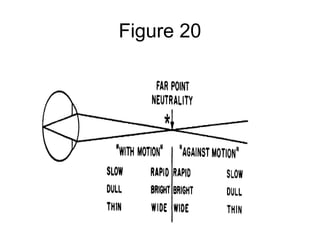
retinoscope is either near to, or far from,
the neutralization point Fig. 20
qualities of the reflex
• When the retinoscope is held near the patient's
far point, the reflex should appear fairly fast,
bright, and wide.
• As the retinoscope is moved farther from the far
point, the reflex appears to move slower and is
dimmer and thinner.
• The retinoscope can eventually be moved so far
from the patient's far point that the reflex is slow,
wide, and dim enough that it is quite difficult to
recognize as a reflex at all.
Other qualities of the reflex
• Fig. 20 .Neutralization retinoscopy diagram of
changes in characteristics of reflex as in the
zone surrounding the point of neutrality.
• At neutrality, the reflex motion may be so fast
that it cannot be detected. The end point or
end zone should be approached from the
“with” reflex side and the judgment of
neutrality made erring ‫زل‬ِ‫ي‬ ‫ي‬َ . ‫يخطئ‬
toward the “with” reflex rather than the
“against” reflex.
• The neutral point lies within the
neutralization zone where neutralization is
best observed. (
Figure 20
Fig_ 20.htm
Optics of the Neutralization
Reflex
• Five features characterize the neutralization end
point, the point at which neither a “with” nor
“against” reflex can be identified. Three of these
are considered to define the end point, but two
others can also be observed. The three standard
characteristics are :
• Increases in speed, brightness, and width of
the moving image. )1,2 3 )
• To these can be added : the “on-off phenomenon”
(the intermittent disappearance of the observed
reflex) and the scissors reflex) .4 5 (
Optics of the Neutralization
Reflex
1-Speed of the “with” or “against” motion:
• If the retinoscope mirror is tilted in a highly
ametropic eye, the resultant reflex is (more rapid )
imaged at a far point that is much closer to the
eye than the reflex of an almost emmetropic eye,
the far point of which is located at a much greater
distance.
• With regard to the subject's pupil, movement of
the image at the far point of the almost
emmetropic eye will seem to have a greater
angular velocity or speed.
Optics of the Neutralization
Reflex
• It should be stressed that the direction of
movement of the fundus image is not influenced
by the patient's ametropia ( illuminating system).
• The “with” or “against” movement is a function of
the observation (VIEWING) system, thus an
“against” movement occurs only when the eye
and external lens system have a far point lying
between the patient's eye and the retinoscope
peephole )High myopia)
Optics of the Neutralization
Reflex
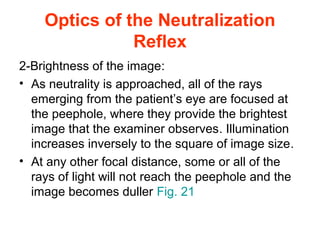
2-Brightness of the image:
• As neutrality is approached, all of the rays
emerging from the patient’s eye are focused at
the peephole, where they provide the brightest
image that the examiner observes. Illumination
increases inversely to the square of image size.
• At any other focal distance, some or all of the
rays of light will not reach the peephole and the
image becomes duller Fig. 21
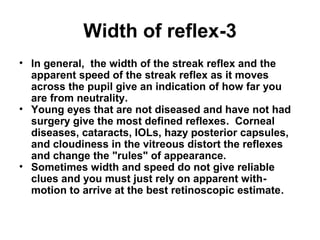
3-Width of reflex
• In general, the width of the streak reflex and the
apparent speed of the streak reflex as it moves
across the pupil give an indication of how far you
are from neutrality.
• Young eyes that are not diseased and have not had
surgery give the most defined reflexes. Corneal
diseases, cataracts, IOLs, hazy posterior capsules,
and cloudiness in the vitreous distort the reflexes
and change the rules of appearance.
• Sometimes width and speed do not give reliable
clues and you must just rely on apparent with-
motion to arrive at the best retinoscopic estimate.
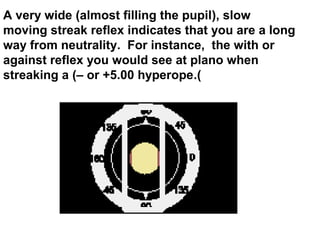
A very wide (almost filling the pupil), slow
moving streak reflex indicates that you are a long
way from neutrality. For instance, the with or
against reflex you would see at plano when
streaking a (– or +5.00 hyperope.(
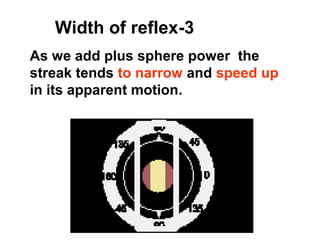
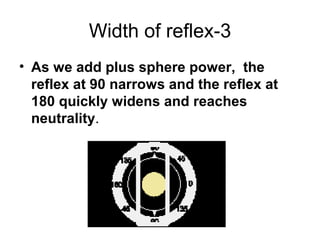
As we add plus sphere power the
streak tends to narrow and speed up
in its apparent motion.
3-Width of reflex
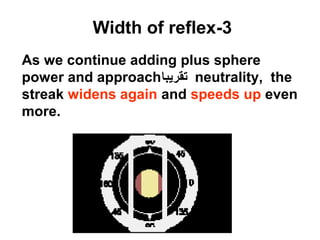
As we continue adding plus sphere
power and approach‫تقريبا‬ neutrality, the
streak widens again and speeds up even
more.
3-Width of reflex
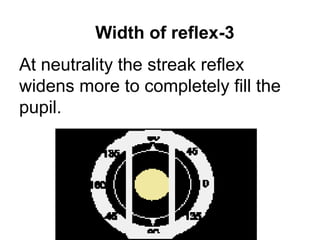
At neutrality the streak reflex
widens more to completely fill the
pupil.
3-Width of reflex
3-Width of reflex
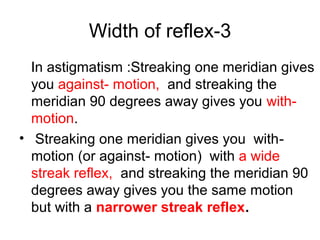
In astigmatism :Streaking one meridian gives
you against- motion, and streaking the
meridian 90 degrees away gives you with-
motion.
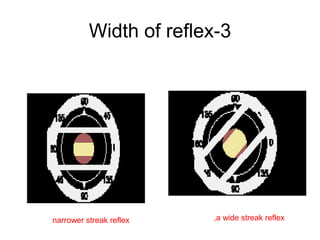
• Streaking one meridian gives you with-
motion (or against- motion) with a wide
streak reflex, and streaking the meridian 90
degrees away gives you the same motion
but with a narrower streak reflex.
3-Width of reflex
a wide streak reflex,narrower streak reflex
3-Width of reflex
• As we add plus sphere power, the
reflex at 90 narrows and the reflex at
180 quickly widens and reaches
neutrality.
Optics of the Neutralization
Reflex
4-The on-off phenomenon: Although the
retinoscopic reflex is bright and wide on
either side of neutrality, the reflex may
disappear completely when the retinoscope
peephole is exactly conjugate to the eye-
corrective lens system i.e far point of the
examined eye. (see Fig. 21 (.
• Fortunately, neither the patient's eye nor the
examiner's eye and hand can maintain this
exact position for long, but astute ‫ذكي‬
retinoscopist may notice the on-off
phenomenon at neutrality.
Optics of the Neutralization
Reflex
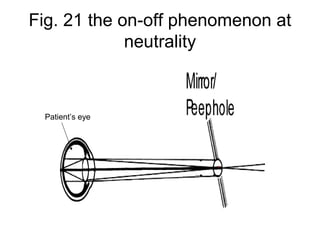
• Fig. 21. The origin of the on-off
phenomenon at neutrality. The far point of
the eye is situated at the peephole of the
retinoscope. Either all or none of the rays
will pass through the peephole with the
slightest shift in the subject's eye or the
retinoscope or the retinoscopist's eye,
causing the retinoscopist to see the
contents of the pupil as either filled with
light or black.
Fig. 21 the on-off phenomenon at
neutrality
Patient’s eye
Optics of the Neutralization
Reflex Lecture 3
5-The scissors reflex: The refractive elements of
the eye are not perfectly spherical. Thus, the
center of the optical path may be slightly myopic
when compared with that of the periphery.
The amount of aberration may be small, but under
circumstances of perfect neutralization and a
widely dilated pupil, the center of the optical path
may return a “with” motion while the periphery
returns an “against” motion.
Optics of the Neutralization
Reflex
• This pattern of opposing central and
peripheral retinoscopic movements is
known as a scissors reflex. There is only a
small dioptric distance over which the
scissors reflex can be detected. The entire
reflex returns to all “with” or all “against”
motion within about 0.50 D on either side
of neutralization). narrow zone)
Estimating Low Myopes via
Neutralization Without Lenses
• By now the reader should have determined that
it is in fact quite possible to neutralize low
myopes without the use of lenses.
• The trick is to place the retinoscope directly on
the patient's far point, sweep the retinoscope
streak across the patient's pupil with the sleeve
down, recognize the “on-off” phenomenon of the
neutralization reflex, measure the distance from
the patient's eye to the retinoscope in meters,
take the reciprocal—thus converting from meters
(distance) to diopters (vergence)—and the
patient's refractive error has been determined.
Neutralization Without Lenses
• For example, neutralization for a -2.00-D myope
can be seen by placing the retinoscope 50 cm
from the patient's eye, and for a -4.00-D myope
by placing the retinoscope 25 cm from this
patient's eye (without considering a certain W.D(
• Neutralization for an emmetrope can only be
done in this fashion by placing the retinoscope
infinitely far from the patient's eye—theoretically
possible, but not practically feasible. ‫ملمئم‬ . ‫ي‬ّ ‫م‬ ‫عمل‬
NEUTRALIZATION Without Lenses
• Because the far points of hyperopes do not lie in
real space (they lie beyond infinity), hyperopes
cannot be neutralized in this way.
• The aforementioned technique describes a way
to estimate a low myope's refractive error
without the use of lenses.
• The key to this method is that the retinoscopist
must change the distance that the retinoscope is
held from the patient's eye when trying to find
the far point.
Performing neutralization
• When performing neutralization she does exactly
the opposite—she holds the retinoscope at a
constant specific working distance and uses
lenses to bring the patient's far point to the
retinoscope.
• The first thing that a retinoscopist must do is
choose a comfortable working distance. She
wants to be as far from her patient as possible
while still being close enough to comfortably
manipulate lenses in front of his eye. Thus, the
working distance usually is described as “arms
length” away from the patient.
Performing neutralization
• For the average retinoscopist, this distance
works out to about 66 cm. Taller retinoscopists
may prefer 75 cm, whereas shorter ones may
use 50 cm.
• It is not uncommon for retinoscopists to work
closer than their usual working distance in
difficult cases, such as small children, or adults
with cataracts or small pupils.
• The actual working distance does not matter as
long the retinoscopist is aware of the distance
and adjusts her calculations accordingly.
Performing neutralization of
against” motion
• The retinoscopist should be able to sit at her
comfortable working distance while using lenses
to bring the patient's far point to her.
• The retinoscopist accomplishes this feat‫ل‬ٌ  ‫عم‬ . ‫ل‬ٌ  ‫عم‬
‫ذ‬ّ ‫م‬‫ف‬َ‫ّلِح‬ by sweeping the retinoscope streak across the
patient's pupil and evaluating the direction,
speed, brightness, and width of the reflex.
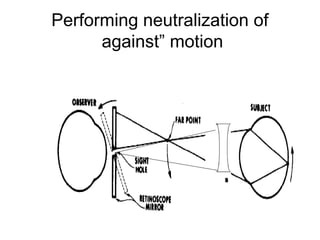
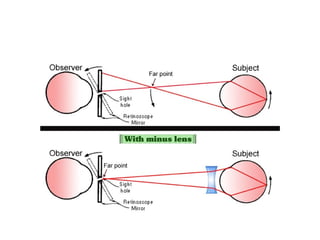
• If she observes “against” motion, the
retinoscope must lie beyond the patient's far
point, and the retinoscopist can move the far
point toward the retinoscope by placing a minus
lens in front of her patient's eye.
Performing neutralization of
against” motion
Performing neutralization of
against” motion
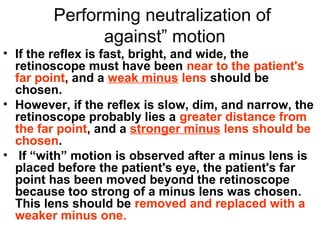
• If the reflex is fast, bright, and wide, the
retinoscope must have been near to the patient's
far point, and a weak minus lens should be
chosen.
• However, if the reflex is slow, dim, and narrow, the
retinoscope probably lies a greater distance from
the far point, and a stronger minus lens should be
chosen.
• If “with” motion is observed after a minus lens is
placed before the patient's eye, the patient's far
point has been moved beyond the retinoscope
because too strong of a minus lens was chosen.
This lens should be removed and replaced with a
weaker minus one.
Performing neutralization of “with”
motion
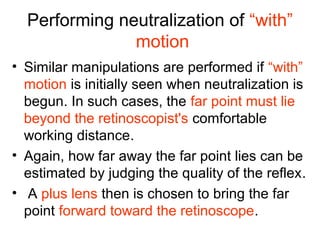
• Similar manipulations are performed if “with”
motion is initially seen when neutralization is
begun. In such cases, the far point must lie
beyond the retinoscopist's comfortable
working distance.
• Again, how far away the far point lies can be
estimated by judging the quality of the reflex.
• A plus lens then is chosen to bring the far
point forward toward the retinoscope.
Performing neutralization of “with”
motion
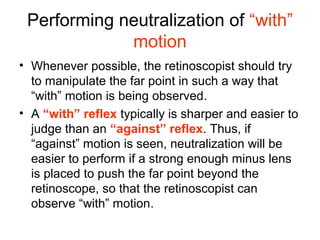
• Whenever possible, the retinoscopist should try
to manipulate the far point in such a way that
“with” motion is being observed.
• A “with” reflex typically is sharper and easier to
judge than an “against” reflex. Thus, if
“against” motion is seen, neutralization will be
easier to perform if a strong enough minus lens
is placed to push the far point beyond the
retinoscope, so that the retinoscopist can
observe “with” motion.
minus lenses in front of younger
patients can excite accommodation
• Care must always be taken, however, when
putting minus lenses in front of younger
patients because they can easily “eat up”
this minus by accommodating, thus leading
the less careful retinoscopist down the
wrong path.
• It should also be noted that the
neutralization end point is not exactly an
end point—rather it is an end zone that
measures about half a diopter in depth (see
Fig. 20(
“zone of doubt” varies with pupil
size and working distance
• The true size of this “zone of doubt” varies with
pupil size and working distance —it is narrowest
with a small pupil and close working distance.
• Best results are achieved when entering the
zone of doubt from the plus side, by watching
the “with” motion reflex get faster, brighter, and
wider until the retinoscopist is convinced the
neutralization reflex has been achieved.
• If the zone of doubt is entered from the minus
side (through “against” motion), there is a
greater chance for error.
The neutralization reflex
• Eventually, after just a few different lenses
are placed before the patient's eye, the
retinoscopist can observe the neutralization
reflex.
• At this point the goal is achieved, and the
retinoscopist has managed to bring the
patient's far point to the retinoscope (which
is being held at the working distance).
• The retinoscopist is now ready to write a
spectacle correction )‫؛‬ prescription(.
CORRECTING THE PRESCRIPTION FOR THE
WORKING DISTANCE LENS
• However, the lenses currently in front of
the patient's eye do not represent the
correction needed to see clearly at infinite
distance; rather, the lenses represent the
correction needed to see clearly at 66 cm.
• The patient will be quite dissatisfied ‫غير‬
‫ض‬ٍ  ‫را‬ if given a prescription for a pair of
glasses that allows for clear vision only 66
cm away or closer.
CORRECTING THE PRESCRIPTION FOR THE
WORKING DISTANCE LENS
• The retinoscopist must always remember
to modify the prescription for distance
vision, a mathematical manipulation called
correcting for the working distance.
• The gross power is that which the
retinoscopist is holding when retinoscopy
is completed.
• This corresponds to the power that brings
light from the patient's luminous retina to
focus at the working distanceِ‫ّل‬( on the
peephole of the retinoscope(.
CORRECTING THE PRESCRIPTION FOR THE
WORKING DISTANCE LENS
• The net power is that which neutralizes
the patient's refractive error for good
distance vision—the power that focuses
light from the luminous retina of the patient
to a point at the horizon. )His far point
must be at infinity after full correction).
CORRECTING THE PRESCRIPTION FOR
THE WORKING DISTANCE LENS
• The mathematical computation ‫سباب‬َ‫ّلِح‬ ‫ت‬ِ‫ّل‬‫ح‬ْ‫ُد‬ ‫ا‬ِ‫ّل‬ ; ‫حصباء‬ْ‫ُد‬ ‫إ‬ِ‫ّل‬ is
simple. The retinoscopist merely subtracts the
working distance (in diopters) from the gross to get
the net power.
• For example, when the working distance is 66 cm
1.50 +)= D) and the patient is neutralized with a
• -2.5 D. lens, the gross power minus the working
distance equals the net power,
or: -2.5 - (+ 1.5) = - 4D.
• The retinoscopist will give a prescription for a - 4D.
lens. The previous discussion describes
neutralization of spherical patients.
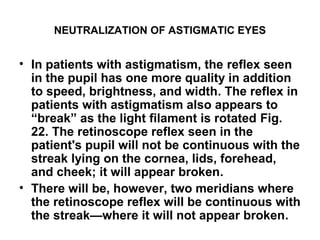
NEUTRALIZATION OF ASTIGMATIC EYES
• In patients with astigmatism, the reflex seen
in the pupil has one more quality in addition
to speed, brightness, and width. The reflex in
patients with astigmatism also appears to
“break” as the light filament is rotated Fig.
22. The retinoscope reflex seen in the
patient's pupil will not be continuous with the
streak lying on the cornea, lids, forehead,
and cheek; it will appear broken.
• There will be, however, two meridians where
the retinoscope reflex will be continuous with
the streak—where it will not appear broken.
NEUTRALIZATION OF ASTIGMATIC EYES
• These meridians correspond to the two axes of
the patient's astigmatism. The retinoscopist
merely needs to neutralize these two meridians
separately and combine them to come up with the
desired spectacle correction
• This can be done using only spherical lenses (as
is best when neutralizing children with loose
lenses), spherical and plus cylindrical lenses
(using a plus cylinder phoropter or loose lenses
and trial frames), or spherical and minus
cylindrical lenses (using a minus cylinder
phoropter or loose lenses and trial frames).
NEUTRALIZATION OF ASTIGMATIC EYES
• Let us further explore the methods of
neutralizing astigmatic individuals in whom
the less plus (or more minus) axis is
neutralized first and the more plus (or less
minus) axis is neutralized second.
• When neutralizing the axes in this order,
the retinoscopist can use either only
spherical lenses, or spherical and plus
cylindrical lenses.
Fig. 22.phenomenon Break
The line between the streak in the pupil
and outside the pupil is broken when
the streak is off the correct axis. (
BREAK PHENOMENON
• Astigmatism can also be detected by
observation of the break phenomenon.
It is useful in refining the axis of large
astigmatic cylinders because one can
observe a discontinuity, or “break,”
between the enhanced intercept axis
and that of the retinal reflex when the
retinoscope filament beam is rotated
somewhat away from the correct
cylinder axis (see Fig. 22).
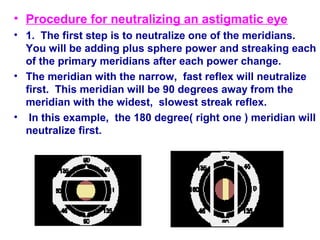
• Procedure for neutralizing an astigmatic eye
• 1. The first step is to neutralize one of the meridians.
You will be adding plus sphere power and streaking each
of the primary meridians after each power change.
• The meridian with the narrow, fast reflex will neutralize
first. This meridian will be 90 degrees away from the
meridian with the widest, slowest streak reflex.
• In this example, the 180 degree( right one ) meridian will
neutralize first.
As we add plus sphere power, the reflex at
90(left ) narrows and the reflex at 180 (right )
quickly widens and reaches neutral point.
Procedure for neutralizing an astigmatic eye
• 2. The next step is to confirm/identify the axis of
the astigmatism. We have a good idea of what the
axis is from the neutralization process. There are
several clues that we can use:
A. The Thickness Phenomenon
B. The Intensity Phenomenon
C. The Break and Skew Phenomena
D. Straddling the Axis
Procedure for neutralizing an astigmatic eye
The Thickness Phenomenon:
The streak reflex appears to be narrowest ( left ) when
we are streaking the meridian of the correct axis.
As you move away from the correct axis, the streak
reflex becomes wider ( right ).
Procedure for neutralizing an astigmatic eye
Procedure for neutralizing of an astigmatic
eye
• The Intensity Phenomenon
The streak reflex appears brightest
when you are streaking the
meridian of the correct axis.
As you move away from the correct
axis, the streak reflex becomes
more dim (less bright ).
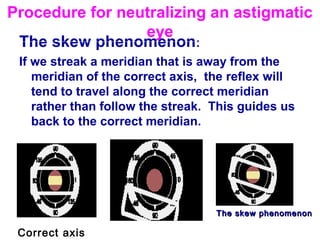
The skew phenomenon:
If we streak a meridian that is away from the
meridian of the correct axis, the reflex will
tend to travel along the correct meridian
rather than follow the streak. This guides us
back to the correct meridian.
The skew phenomenonThe skew phenomenon
Correct axis
Procedure for neutralizing an astigmatic
eye
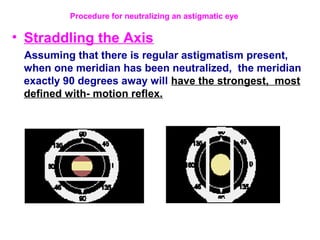
• Straddling the Axis
Assuming that there is regular astigmatism present,
when one meridian has been neutralized, the meridian
exactly 90 degrees away will have the strongest, most
defined with- motion reflex.
Procedure for neutralizing an astigmatic eye
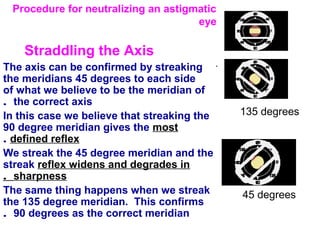
•
The axis can be confirmed by streaking
the meridians 45 degrees to each side
of what we believe to be the meridian of
the correct axis. 
In this case we believe that streaking the
90 degree meridian gives the most
defined reflex. 
We streak the 45 degree meridian and the
streak reflex widens and degrades in
sharpness. 
The same thing happens when we streak
the 135 degree meridian. This confirms
90 degrees as the correct meridian. 
45 degrees
135 degrees
Straddling the Axis
Procedure for neutralizing an astigmatic
eye
STRADDLING
When the cylinder power is weak, straddling
reveals an initial incorrect estimate of the axis
location.
The thinner image is called the “guide” because
it guides us to adjust the plus-cylinder axis
toward the thinner image.
This step provides the initial detection of
astigmatism, and the phoropter axis can be
adjusted so that plus lenses can be dialed into
place along the enhanced meridian.
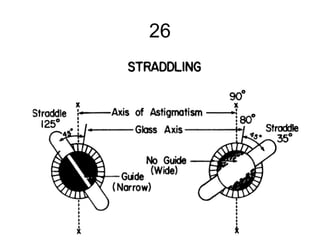
Straddling
• The straddling meridians are 45 degrees off
the glass axis, at roughly 35 and 125
degrees. As you move back from the eye
while comparing meridians, the reflex at 125
degrees remains narrow (A) at the same
distance that the reflex at 35 degrees has
become wide (B). This dissimilarity indicates
axis error; the narrow reflex (A) is the guide
toward which we must turn the glass axis.
Procedure for neutralizing an astigmatic
eye
• If the reflex in one of the straddle
meridians is narrower than the reflex in
the other straddle meridian, then we
would adjust our estimated axis in the
direction of the straddle meridian with
the narrower reflex (guide).
• We would retest 45 degrees to each
side of the new axis to confirm that the
reflex in each straddle meridian is
equally wide.
26
Spherical Lens Technique
• The first step is for the retinoscopist to find
the least plus axis. The retinoscope streak is
swept back and forth across the pupil while it
is rotated 360 degrees by rotating the light
filament in the handle.
• The retinoscopist then observes at which
two meridians the retinoscope reflex does
not appear broken—in cases of regular
astigmatism, these two meridians should be
90 degrees apart.
Spherical Lens Technique
• The retinoscopist then compares the reflex in one
meridian to the reflex in the other, noting which
meridian's streak exhibits more “against” (slower,,
broader , dimmer) or less “with” (faster, thinner,
brighter) qualities than the other.
• The second meridian is neutralized first. If the
reflex in one meridian shows “with” motion and in
the other shows “against” motion, the meridian
with the reflex that shows “with” is neutralized
first
• The more minus meridian of the astigmatic person
is then merely neutralized (second ) much as the
spherical myope or hyperope described
previously.
• The axis of the streak is held along the meridian
line and swept in a direction perpendicular to it i.e
(if the 90-degree axis is being neutralized, the
streak is oriented straight up and down and swept
from side to side) perpendicular to 90 degrees.
Spherical Lens Technique
• At first, it is not intuitive that the streak be held in
the same orientation as the axis meridian
because one is searching for the power of the
astigmatism, and the power lies not along the
axis, but perpendicular to it.
• Here the retinoscopist must remember that the
power is found not by holding the streak still
(fixed ) , but rather by sweeping (moving ) it
across the pupil.
• The retinoscope streak is rotated 90 degrees,
and the reflex is re-examined.
Spherical Lens Technique
• The reflex should not appear broken in the
new meridian—a broken reflex signifies that
either the retinoscope streak is not exactly
aligned along the patient's second axis or that
the patient has irregular astigmatism.
• If the reflex is not broken, it is neutralized
with spherical lenses. If spherical lenses are to
be used, the second meridian is neutralized in
exactly the same manner as the first after
removal of the lenses used before and starting
a new steps to neutralize the other meridian
also with spherical lenses .
Spherical Lens Technique
• Once the neutralization reflex has been
found in the second meridian, the
retinoscopist again subtracts the
working distance from the power in the
2 meridians and records the lens power
needed to correct the patient for each
particular axis. The difference in power
of lenses between the 2 meridians is
considered astigmatism.
Spherical Lens Technique
• A simple conversion then needs to be performed before
presenting the patient with the proper spectacle
prescription, as follows:
• Q: A patient is neutralized with the following lenses at a
working distance of 66 cm: [+ 3.50 axis 90] and
[+ 4.25 axis 180]. What is the eyeglasses prescription?
A: Step 1: Subtract the working distance. In this case,
the working distance is 66 cm, which is equal to 1.50 D:
[+ 3.50 axis 90] - 1.50 = + 2.00 axis 90
[+ 4.25 axis 180] - 1.50 = + 2.75 axis 180
Step 2: Transpose from cross-cylinder notation to plus-
cylinder notation:
+ 2.00 sphere + ([+ 2.75 - 2.00] axis 180)
Objective prescription = +2.0 DS+ 0.75 DC x 180
Plus-Cylinder Technique
• If the second meridian is to be neutralized
with a plus-cylinder lens (as is done with a
plus-cylinder phoropter or loose lenses
and trial frames), the first spherical lens
should be left in the phoropter or trial
frames.Keeping the spherical lenses in
place. The axis of the cylindrical lens is
oriented in the direction of the axis of the
streak for the second meridian.
Plus-Cylinder Technique
• Because a cylinder lens is being used, no
power is being added along the axis of the
second meridian (which, of course,
corresponds to the power of the first
meridian).
• When the neutralization reflex is found for
the second meridian, the streak is rotated
90 degrees to ensure that the first
meridian is still neutralized.
Plus-Cylinder Technique
• The working distance is then subtracted from the
spherical lens only, and the spectacle prescription is
easily determined as follows:
• Q: A patient is neutralized with the following lenses
at a working distance of 66 cm: [+ 3.50 sphere] and
[+ 0.75 axis 180]. What is the eyeglasses prescription?
• A: Step 1: Subtract the working distance from the
spherical lens only. In this case, the working distance
is 66 cm, which is equal to 1.50 D:
[+ 3.50 sphere] - 1.50 = + 2.00 sphere
Step 2: Add the cylindrical lens to the new power of
the spherical lens:
+ 2.00 sphere + [+ 0.75 axis 180]
Objective prescription= 2.00 + DS + 0.75 DC x180
Minus-Cylinder Technique
• Some clinicians prefer to work in minus cylinder,
patients are neutralized in the same aforementioned
manner, except that the more “with” or less
“against” meridian is neutralized first with spherical
lenses.
• Then the less “with” or more “against” meridian is
neutralized with a minus-cylinder in much the same
way as the previous example used a plus-cylinder
lens.
• The transposition is done as follows:
Minus-Cylinder Technique
• Q: A patient is neutralized with the following
lenses at a working distance of 66 cm: [+ 4.25
sphere] and [-0.75 axis 90]. What is the
eyeglasses prescription?
A: Step 1: Subtract the working distance from
the spherical lens only. In this case, the working
distance is 66 cm, which is equal to 1.50 D:
)+ 4.25 -1.50 (= + 2.75 sphere
Step 2: Add the minus cylindrical lens to the
new power of the spherical lens:
• + 2.75 sphere + (-0.75 axis 90(
90 × 0.75 - 2.75 + =
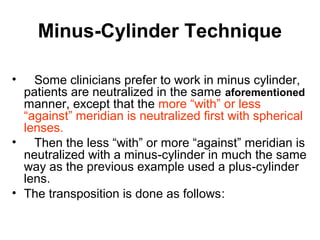
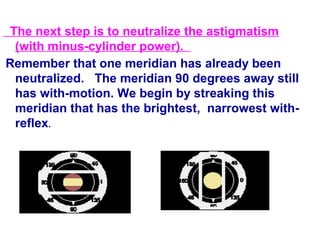
The next step is to neutralize the astigmatism
(with minus-cylinder power).
Remember that one meridian has already been
neutralized. The meridian 90 degrees away still
has with-motion. We begin by streaking this
meridian that has the brightest, narrowest with-
reflex.
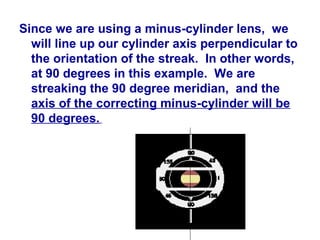
Since we are using a minus-cylinder lens, we
will line up our cylinder axis perpendicular to
the orientation of the streak. In other words,
at 90 degrees in this example. We are
streaking the 90 degree meridian, and the
axis of the correcting minus-cylinder will be
90 degrees.
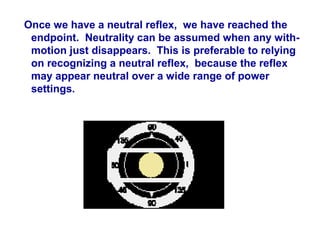
Once we have a neutral reflex, we have reached the
endpoint. Neutrality can be assumed when any with-
motion just disappears. This is preferable to relying
on recognizing a neutral reflex, because the reflex
may appear neutral over a wide range of power
settings.
The final step is to subtract for our
working distance. Lecture 6
• This is usually 1.50 D and it is subtracted from the
sphere power only. Suppose our phoropter reads
• -1.00-150x90 when we have finished neutralizing the
astigmatic meridian.
• We then would subtract 1.50 D sphere power for a
final retinoscopic estimate of -2.50-1.50x90.
• It is easiest to practice retinoscopy on younger
adults, ages 20 to 50. They usually have clear
media, relatively relaxed accommodation, and a
definite refractometric endpoint with which to
compare your retinoscopy.
RELIABILITY‫ية‬ّ‫ة‬‫الموثوق‬
Because important therapeutic judgments may
depend on the retinoscopic measurements, it
is necessary to know how reliable these
measurements are. Reliability and precision
‫إحكام‬ . ‫ضبط‬ . ‫قة‬ّ‫ة‬‫د‬are terms that describe the
degree to which repeated measurements
resemble one another. For example, five
repeated measurements for one patient
might yield the following five spherical
results: + 2.25, + 2.75, + 2.50, + 2.75, + 2.25.
RELIABILITY‫ية‬ّ‫ة‬‫الموثوق‬
• With another examiner, the following values
might be found: + 1.75, + 2.50, + 3.25, + 2.75,
+ 2.25. The first examiner displays‫ز‬َ a ‫ر‬َ a ‫ب‬ْ‫َر‬‫أ‬َ a ; ‫د ى‬َ a‫ب‬ْ‫َر‬‫أ‬َ a a
higher degree of reliability or precision than
the second one. Nevertheless, the average
value is the same for both: + 2.50.
• If any single measurements had been
accepted as the patient's true refractive
error, the patient might have been misjudged
by only ¼D by the first examiner, but by as
much as ¾D by the second.
RELIABILITY‫ية‬ّ‫ة‬‫الموثوق‬
• How is it possible, then, to judge the
reliability of any measurement? The answer
is straightforward: There must be repeated
measurements so that the variability of the
measurements can be assessed.
• The repeated measurements should be
independent of one another, each derived
without the measurer having knowledge of
what the preceding ones were.
RELIABILITY‫ية‬ّ‫ة‬‫الموثوق‬
• These are usually called “replicate ‫ثنى‬ ;‫طو ى‬
measurements,” and there is no way to judge
reliability without them. In clinical practice,
we often do these replicate measurements
informally and almost intuitively.
• Fluctuations in the measurement process are
unavoidable; statisticians call them “error.”
• The second examiner in the previous
example is less precise than the first. She
showed greater variability and larger error.
Reliability
• Reliability and error for retinoscopy have
been evaluated. One study by Safir and
coworkers entailed five clinicians performing
retinoscopy on ten healthy young subjects
on two separate occasions separated by one
to three weeks. Results showed a 50%
probability that the two measurements of
spherical power would differ by 0.40 D.
• The Safir study also showed a threefold
difference in reliability among retinoscopists.
Accuracy
• Accuracy is another concept that is
important in the understanding of
measurement.
• Accurate measurements are those that
are close to the “true” value being
measured. Accuracy is a relative
concept‫مفهوم‬
• One procedure may be more or less
accurate than another.
• Suppose, for example, that a subject's true
spherical refractive error were 2.00 D, and
that ophthalmologist A measured it five times
as 2.25, 2.25, 2.00, 2.00, 1.75, whereas
ophthalmologist B got values of 2.5, 2.5, 2.75,
2.75, and 3. It is apparent that the method of
ophthalmologist A is more accurate than that
of ophthalmologist B.
• The typical measurement for ophthalmologist
A is closer to the quantity sought than that of
ophthalmologist B, even though the
precision ‫ضبط‬ . ‫قة‬ّ‫ة‬‫د‬ of the two refractionists
is about the same. This example shows that
there is no predefined relationship between
precision and accuracy.
THE ROLE OF THE RETINOSCOPE IN A
MODERN EYE CLINIC-Autorefraction
• In the 21st century, we are faced with an
ever-more automated world, and the
ophthalmic practice has paralleled this move
toward automation. ‫اللى‬ ‫أو‬ ‫التوماتى‬ ‫التشغيل‬
• The retinoscope, really little more than a
light filament, lens, and mirror, is now joined
by many more sophisticated (and certainly
more expensive) devices developed to help
us obtain information regarding the refractive
state of our patients.
THE ROLE OF THE RETINOSCOPE IN A
MODERN EYE CLINIC-Autorefraction
• One family of such instruments consists of
the automated refractors—tabletop or hand-
held devices that perform an objective
refraction in a matter of seconds at the touch
of a button.
• The largest advantage of the automated
refractor is that clinic personnel‫الموظفين‬ ‫مجموع‬
who have almost no knowledge in the art of
refraction can use it. For the average patient,
automated refractors are reasonably
accurate when compared with the
retinoscope and generally agree within ½ D.
• Autorefraction
• If automated refractors err‫يخطئ‬ , they tend to
overestimate minus sphere by a fraction of a
diopter. This discrepancy ‫ق ض‬ُ‫ض‬‫تنا‬ . ‫ر ض‬ُ‫ض‬ ‫تعا‬
probably stems from the fact that patients
accommodate in response to their sense that
the automated refractor is at a closer
distance to the patient than is the 6 meter far
point used in retinoscopy. This is true even
though the devices are designed to relax
accommodation while fixing on an artificial
distant target.
Autorefraction
• Where the automated refractor is at an undeniable ‫ال‬
‫حد‬َ a ‫ج‬ْ‫َر‬ ‫ي‬ُ‫ض‬ ‫ال‬ . ‫كر‬َ a ‫ن‬ْ‫َر‬‫ي‬ُ‫ض‬ disadvantage to the retinoscope is in
evaluating patients with irregular astigmatism, either
from pathology (e.g., keratoconus, pellucid marginal
degeneration) or postsurgically (e.g., corneal
transplant, laser in situ keratomileusis [LASIK]). All
the automated refractor operator can do is press a
button while having the patient fixate on the target.
• The automated refractor then either calculates a
“best fit” refraction or flashes an error message that
there too much irregular astigmatism exists to make
a reading.( Over cylinder)
Autorefraction
• The retinoscopist, however, can gain much more
information about the refractive state of the patient
by judging the quality of the light reflex observed in
the patient's pupil.
• A skilled retinoscopist usually can deduce
quantities and qualities of astigmatism in patients
for whom the automated refractor fails. This is
especially true in patients with poor best-corrected
visual acuity.
• Other instruments that must be compared with the
retinoscope are the keratoscope and the automated
corneal modeling systems. Although it is tempting to
compare these instruments with the retinoscope
because they each provide important information
regarding astigmatism,
Autorefraction
• it must be remembered that these
instruments serve different purposes within
the ophthalmic practice. The keratoscope
and corneal topographers are used to
evaluate corneal astigmatism only.
• The retinoscope, however, is used to
determine the entire refractive state of the
eye. These instruments all have their place
and can complement‫تكملة‬ each other well.
THE ROLE OF THE RETINOSCOPE IN A
MODERN EYE CLINIC-Autorefraction
• A final issue, one that is becoming more
important with every passing year, is the role
of the retinoscope in managing the refractive
surgery patient. Few studies address this
problem. Retinoscopy has been shown to be
accurate in evaluating the postoperative
patient. Anecdotally, ‫هة‬َ a ‫كو‬ُ‫ض‬‫ف‬ْ‫َر‬‫أ‬ُ‫ض‬ ; ‫فة‬َ a‫رو‬ُ‫ض‬ ‫ط‬ْ‫َر‬ ‫أ‬ُ‫ض‬ we agree
with these results. In our practice, we rely
heavily on retinoscopy in evaluating pre- and
postoperative refractive surgery patients.
THE ROLE OF THE RETINOSCOPE IN A
MODERN EYE CLINIC-Autorefraction
• We believe that automated refractors cannot
accurately evaluate the refractive state of
someone with a surgically altered cornea and
therefore believe that they have no role in
providing data on these patients.
• Other studies have shown that corneal
topography alone is not adequate in
evaluating patient satisfaction after laser
refractive surgery.
THE ROLE OF THE RETINOSCOPE IN A
MODERN EYE CLINIC-Autorefraction
• Remembering that the critical zone of the
retinoscopy reflex is the central 3 mm, and
that the average excimer laser ablation
diameter is 6 mm, one can see that the
retinoscope is well suited to evaluate these
patients.
• When patients who had previously had
corneal refractive surgery subsequently
undergo cataract extraction with intraocular
lens (IOL) implantation, there is more
variability in the postoperative refractions
than for typical cataract patients.
THE ROLE OF THE RETINOSCOPE IN A
MODERN EYE CLINIC-Autorefraction
The IOL calculations rely not on retinoscopy
(objective refraction), but instead on
keratometry (corneal curvature) and a-scan
ultrasonography (axial length). One can only
wonder if the diagnostic procedure of choice
for these patients might someday be for the
surgeon to remove the cataract, perform
intraoperative retinoscopy of the aphakic
eye, calculate the necessary lens power, then
place the desired IOL implant.
THE ROLE OF THE RETINOSCOPE IN A
MODERN EYE CLINIC-Autorefraction
•In that way, the IOL would depend on
the patient's refractive state rather than
on artificial calculations based on the
patient's altered ocular anatomy.
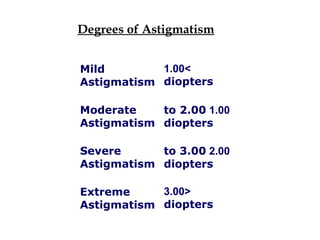
Degrees of Astigmatism
Mild
Astigmatism
1.00
diopters
Moderate
Astigmatism
1.00to 2.00
diopters
Severe
Astigmatism
2.00to 3.00
diopters
Extreme
Astigmatism
3.00
diopters
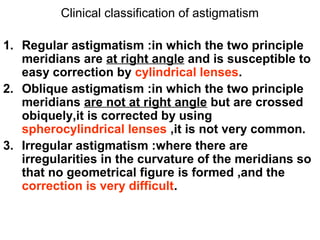
Clinical classification of astigmatism
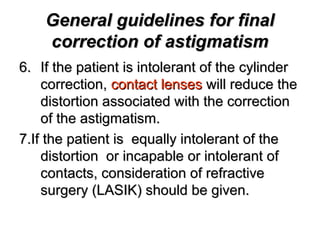
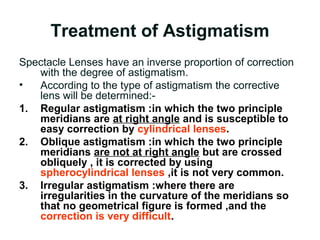
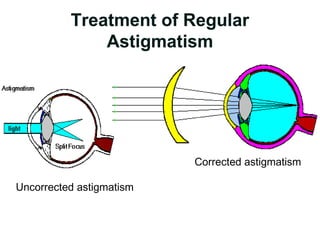
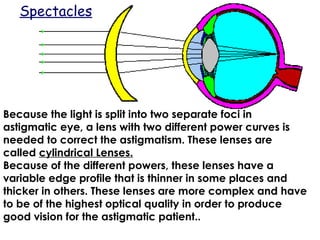
1. Regular astigmatism :in which the two principle
meridians are at right angle and is susceptible to
easy correction by cylindrical lenses.
2. Oblique astigmatism :in which the two principle
meridians are not at right angle but are crossed
obiquely,it is corrected by using
spherocylindrical lenses ,it is not very common.
3. Irregular astigmatism :where there are
irregularities in the curvature of the meridians so
that no geometrical figure is formed ,and the
correction is very difficult.
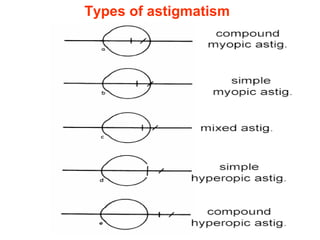
Types of astigmatism
1.Simple astigmatism :where one of
the foci falls upon the retina while
the other focus may fall in front or
behind the retina so that while one
meridian is emmetropic the other
meridian is either myopic or
hypermetropic .
Types of astigmatism
2.Compound astigmatism :where neither
of the two foci lies upon the retina but
both are placed in front of or behind
the retina on the same direction ,the
state of refraction is then entirely
myopic (compound myopic
astigmatism) or entirely hypermetropic
(compound hypermetropic
astigmatism) .
Types of astigmatism
3.Mixed astigmatism :where one focus is
in front of and the other is behind the
retina, so that the refraction is myopic
in one direction and hypermetropic in
the other.
Types of astigmatism
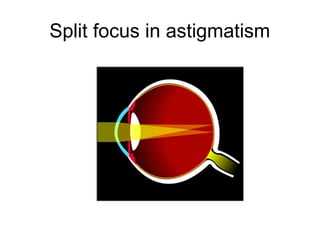
Split focus in astigmatism
Other classification
Direct astigmatism :when the
vertical curve is greater than the
horizontal curve.
Indirect astigmatism :when the
horizontal curve is greater than the
vertical curve.
B a c k
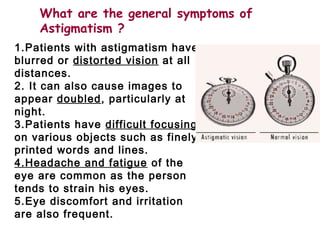
1.Patients with astigmatism have
blurred or distorted vision at all
distances.
2. It can also cause images to
appear doubled, particularly at
night.
3.Patients have difficult focusing
on various objects such as finely
printed words and lines.
4.Headache and fatigue of the
eye are common as the person
tends to strain his eyes.
5.Eye discomfort and irritation
are also frequent.
What are the general symptoms of
Astigmatism ?
Symptoms of low astigmatism
(1.0D) include
1. Asthenopia {tired eyes},
especially when doing precise ‫قيق‬ِ‫قي‬‫د‬َ a
work at a fixed distance.
2. Transient blurred vision relieved
by rubbing the eyes as in
hyperopia when doing precise
work at a fixed distance.
3. Frontal headaches with long
periods of visual concentration
on a task.
Symptoms of high astigmatism
(1.0D) include
1. Blurred vision , asthenopia and frontal headache
are more severe than in low astigmatism
2. Tilting of the head for oblique astigmatism
3. Slinting to achieve pinhole vision clarity.
4. Reading material held close to eyes to achieve
large (as in myopia) but blurred retinal image.
5. The letters in the book appear as running
together i.e. getting mixed up.
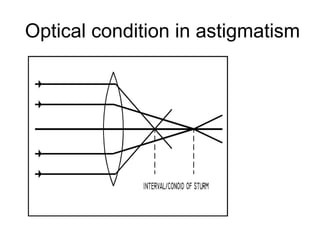
Optical condition in astigmatism
Causes of Astigmatism
Heriditary :
• The exact cause remains unknown; however some
common types of astigmatism seem to run in
families and may be inherited.
• It is thought that most people have some form of
astigmatism as it is rare to find perfectly shaped
curves in the cornea and lens, but the defect is
rarely serious.
• The majority of these studies demonstrate an
autosomal (of asexual chromosomes )dominant form
of genetic transmission. Autosomal recessive
transmission has been shown occasionally. Rarely,
X-linked recessive form has also been reported.
Acquired causes of astigmatism
1. Diseases of the cornea result in its deformity; an
extreme example is seen in conical cornea
(keratoconus), while inflammations and ulceration of
the cornea produce corneal scar.
2. Traumatic interference with the cornea may bring about
the same result in this category we should include
surgical trauma, particularly operations for cataract.
Furthermore, corneal astigmatism can be induced by
the pressure of swellings of the lids, whether the
humble chalazion or a true neoplasm.
3. A transient deviation form normal can be produced by
finger pressure on the eye, by contraction of the lids
(blepharospasm ), or by the action of the extra-ocular
muscles.
Acquired causes of astigmatism
4. Curvature astigmatism of the lens also
occurs with great frequency. In great
majority of cases such anomalies are small;
but on occasion, as in lenticonus, they may
be marked.
5. Not uncommonly the lens is placed slightly
obliquely or out of line in the optical system
and this, causing a certain amount of
decentring, produces a corresponding
astigmatism;
6. A traumatic subluxation of the lens has
similar results
Keratoconus (KC)
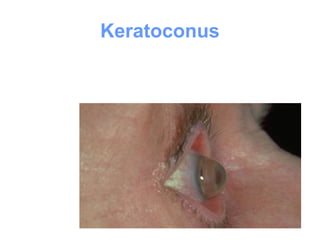
Keratoconus is a
progressive disorder in which
the cornea assumes an
irregular conical shape. The
onset is at around puberty with
slow progression thereafter.
Though the ectasia may
become stationary at any time,
both eyes are affected, if only
topographically, in almost all
cases.
Keratoconus
Characteristics
INCIDENCE:
Keratoconus is bilateral in approximately 96% of cases. Typically,
one eye is affected earlier, and the disease progresses further
than in the fellow eye. Keratoconus is often diagnosed in
persons in their early teens to early twenties.
There does not appear to be a significant difference in the
incidence of keratoconus between left and right eyes nor
between male and female subjects.
Histopathologic changes
It is still unclear what causes the corneal
changes that occur in keratoconus. A triad of
classic histopathologic changes has been
observed:
1. Thinning of the corneal stroma.
2. Breaks in bowman's layer.
3. Iron deposition in the basal layers of the
corneal epithelium( Fleischer’s ring).
Etiology Of KC
1. Heredity
2. Eye rubbing and atopy
3. Contact lens wear
4. Abnormalities in ocular rigidity
and structure
Associations
 Ocular associations include:
1. vernal keratoconjunctivities,
2. blue sclera,
3. aniridia,
4. ectopia lentis,
5. Leber congenital amaurosis and
6. retinitis pigmentosa.
predisposing factors
1. Rigid contact lens wear and
2. Constant eye rubbing have also
been proposed as predisposing
factors.
By keratometry keratoconus is
classified as mild (48 D),
moderate (48- 54D) and severe
(54D). Morphologically, the
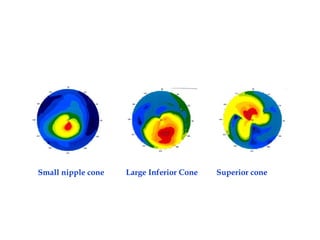
following are the three types:
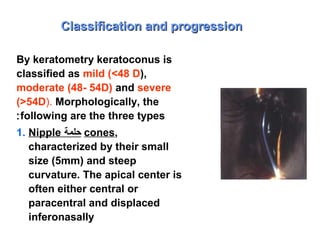
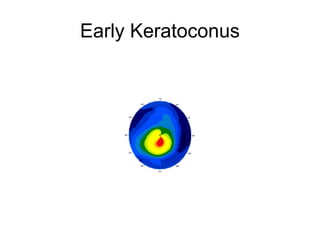
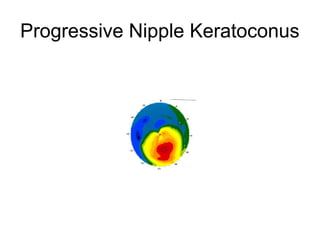
1. Nipple ‫حلمة‬ cones,
characterized by their small
size (5mm) and steep
curvature. The apical center is
often either central or
paracentral and displaced
inferonasally
Classification and progressionClassification and progression
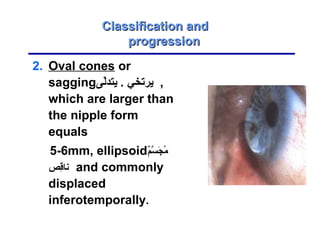
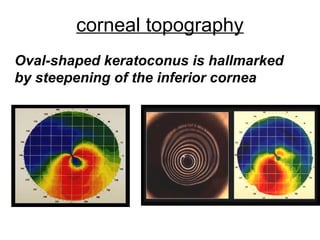
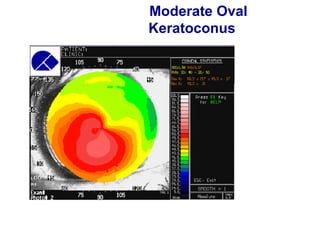
2. Oval cones or
sagging‫لى‬ّ‫ة‬‫يتد‬ . ‫يرتخي‬ ,
which are larger than
the nipple form
equals
5-6mm, ellipsoid‫م‬ٌ ‫ان‬‫س‬َّ‫م‬ ‫ج‬َ a ‫م‬ُ‫ض‬
‫ق ص‬ِ‫قي‬‫نا‬ and commonly
displaced
inferotemporally.
Classification andClassification and
progressionprogression
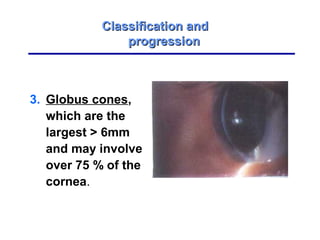
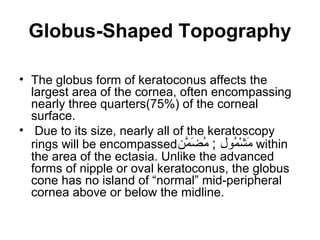
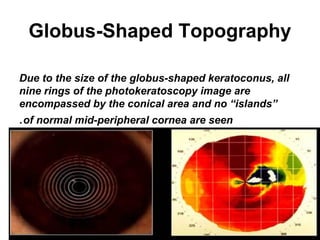
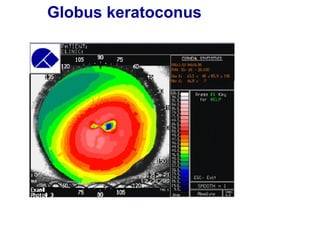
3. Globus cones,
which are the
largest  6mm
and may involve
over 75 % of the
cornea.
Classification andClassification and
progressionprogression
Clinical picture/ symptoms
1. Presentation is with impaired vision in one eye
caused by progressive astigmatism and myopia.
2. The patient may report frequent changes in
spectacle prescription or decreased tolerance to
contact lens wear.
3. As a result of the asymmetrical nature of the
condition, the fellow eye usually has normal vision
with negligible astigmatism at presentation, which
however, increases as the condition progresses.
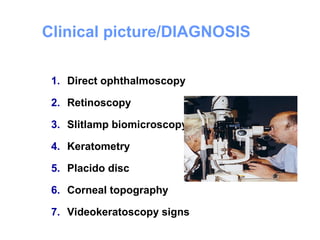
1. Direct ophthalmoscopy
2. Retinoscopy
3. Slitlamp biomicroscopy
4. Keratometry
5. Placido disc
6. Corneal topography
7. Videokeratoscopy signs
Clinical picture/DIAGNOSIS
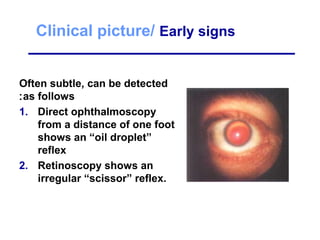
Often subtle, can be detected
as follows:
1. Direct ophthalmoscopy
from a distance of one foot
shows an “oil droplet”
reflex
2. Retinoscopy shows an
irregular “scissor” reflex.
Clinical picture/ Early signs
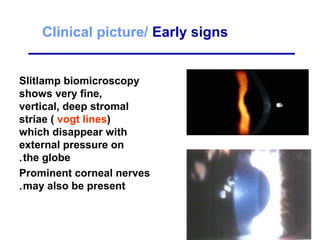
Slitlamp biomicroscopy
shows very fine,
vertical, deep stromal
striae ( vogt lines)
which disappear with
external pressure on
the globe.
Prominent corneal nerves
may also be present.
Clinical picture/ Early signs
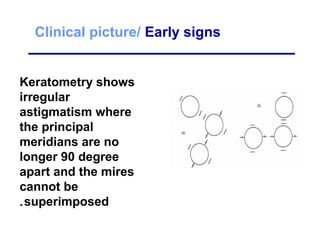
Keratometry shows
irregular
astigmatism where
the principal
meridians are no
longer 90 degree
apart and the mires
cannot be
superimposed.
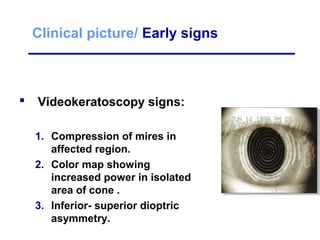
 Videokeratoscopy signs:
1. Compression of mires in
affected region.
2. Color map showing
increased power in isolated
area of cone .
3. Inferior- superior dioptric
asymmetry.
Clinical picture/ Early signs
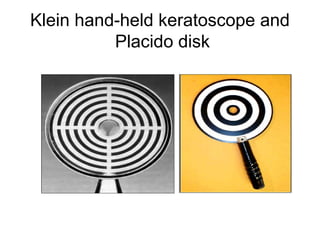
These devices are used to detect and
quantify corneal surface curvature and the
presence of astigmatism. A keratoscope
uses light to project rings on the cornea.
Observation through the keratoscope of
the reflection of light from the cornea
and inspection of the shape and spacing of
the rings provide information about the
degree of astigmatism.
Keratoscope and videokeratoscope
A keratoscope fitted with a video camera is
called a videokeratoscope.
A videokeratoscope is the most common
instrument used to quantify the change in
corneal surface curvature, in a process
called corneal topography.
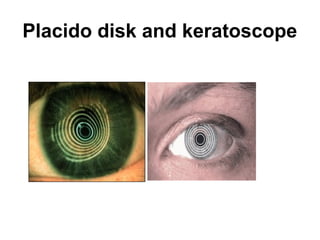
Placido disk and keratoscope
•Photokeratoscopy, which employ optical
principles that are similar to those of the
keratometer, measure a larger surface
area and provide a more complete
appreciation of corneal shape.
Placido disk and keratoscope
Klein hand-held keratoscope and
Placido disk
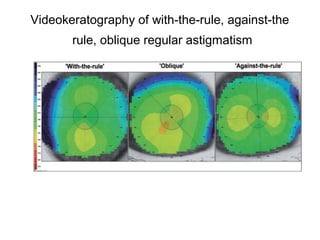
Videokeratography of with-the-rule, against-the
rule, oblique regular astigmatism
Clinical picture/ Early signs
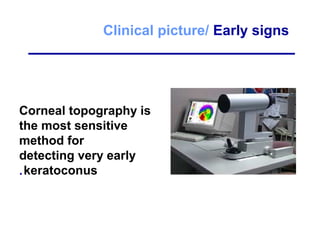
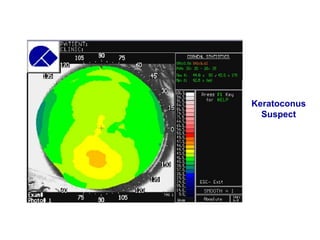
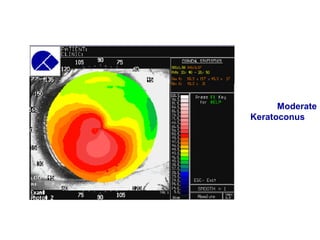
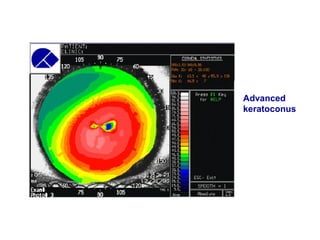
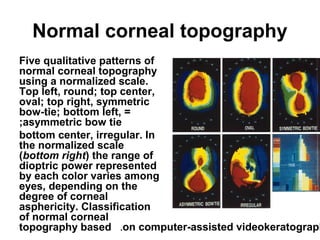
Corneal topography is
the most sensitive
method for
detecting very early
keratoconus.
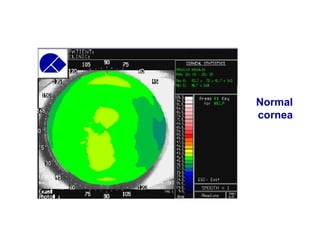
Normal
cornea
Keratoconus
Suspect
Moderate
Keratoconus
Advanced
keratoconus
Large Inferior Cone Superior coneSmall nipple cone
Clinical picture/ Late signs
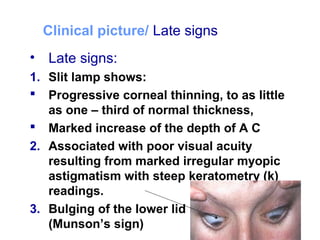
• Late signs:
1. Slit lamp shows:
 Progressive corneal thinning, to as little
as one – third of normal thickness,
 Marked increase of the depth of A C
2. Associated with poor visual acuity
resulting from marked irregular myopic
astigmatism with steep keratometry (k)
readings.
3. Bulging of the lower lid in down gaze
(Munson’s sign)
Clinical picture/ Late signs
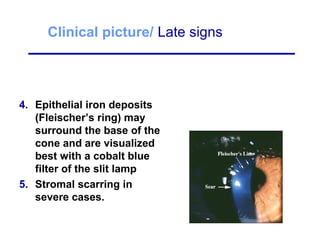
4. Epithelial iron deposits
(Fleischer’s ring) may
surround the base of the
cone and are visualized
best with a cobalt blue
filter of the slit lamp
5. Stromal scarring in
severe cases.
Clinical picture/ Late signs
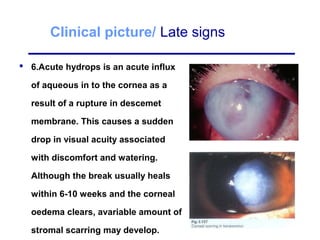
 6.Acute hydrops is an acute influx
of aqueous in to the cornea as a
result of a rupture in descemet
membrane. This causes a sudden
drop in visual acuity associated
with discomfort and watering.
Although the break usually heals
within 6-10 weeks and the corneal
oedema clears, avariable amount of
stromal scarring may develop.
Clinical picture/ Late signs
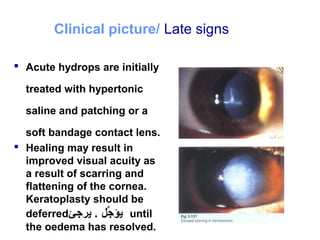
 Acute hydrops are initially
treated with hypertonic
saline and patching or a
soft bandage contact lens.
 Healing may result in
improved visual acuity as
a result of scarring and
flattening of the cornea.
Keratoplasty should be
deferred‫يرجئ‬ . ‫جل‬ِّ ‫يؤ‬ until
the oedema has resolved.
Differential diagnosis
1. Corneal Warpage ‫ج‬َ a ‫و‬َّ‫م‬ ‫ع‬َ a Syndrome
2. High-riding rigid Gas-permeable lens
3. Keratoglobus
The topography of keratoconus: LECTURE 8The topography of keratoconus: LECTURE 8
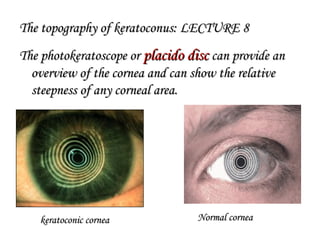
The photokeratoscope orThe photokeratoscope or placido discplacido disc can provide ancan provide an
overview of the cornea and can show the relativeoverview of the cornea and can show the relative
steepness of any corneal area.steepness of any corneal area.
keratoconic corneakeratoconic cornea Normal corneaNormal cornea
EyeSys System
The corneal surface has 75% of the refractive or light
focusing ability of the eye. The EyeSys System
utilizes placido disk technology to acquire images of
the corneal surface. Placido disk technology is
based on a technique that captures the reflection of
rings of light off the surface of the cornea and
measures the different distances between the ring
reflections.
Current software technology captures the reflected
images with a digital camera, processes ‫يعالج‬ . ‫يعامل‬ُ
the data, and displays‫باداء‬ْ‫اد‬‫إ‬ِ‫ب‬ ; ‫ن ة‬َ‫ة‬‫با‬َ‫ة‬‫إ‬ِ‫ب‬ the information in
multiple formats.
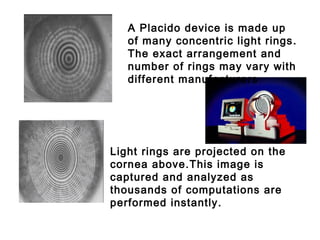
A Placido device is made up
of many concentric light rings.
The exact arrangement and
number of rings may vary with
different manufacturers
Light rings are projected on the
cornea above.This image is
captured and analyzed as
thousands of computations are
performed instantly.
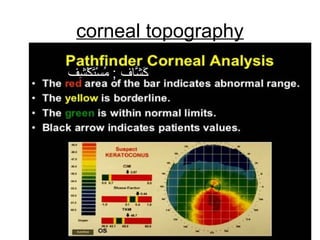
corneal topography
‫ش ف‬ِ‫ ف‬ ‫ك‬ْ‫ِش‬ ‫ت‬َ‫ْك‬‫س‬ْ‫ِش‬ ‫م‬ُ‫س‬ ; ‫ فاف‬‫ش‬َّ‫ا‬ ‫ك‬َ‫ْك‬
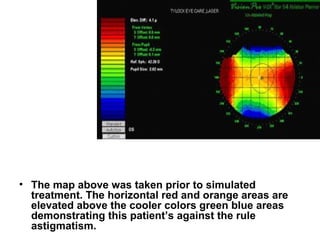
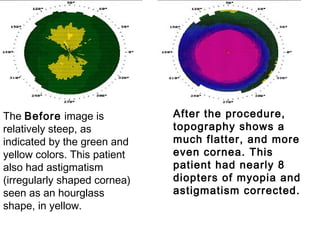
• The map above was taken prior to simulated
treatment. The horizontal red and orange areas are
elevated above the cooler colors green blue areas
demonstrating this patient’s against the rule
astigmatism.
corneal topography
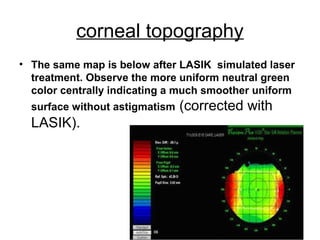
• The same map is below after LASIK simulated laser
treatment. Observe the more uniform neutral green
color centrally indicating a much smoother uniform
surface without astigmatism (corrected with
LASIK).
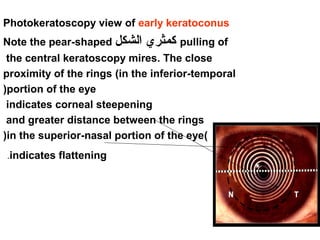
Photokeratoscopy view of early keratoconus
Note the pear-shaped ‫الشكل‬ ‫كمثري‬ pulling of
the central keratoscopy mires. The close
proximity of the rings (in the inferior-temporal
portion of the eye(
indicates corneal steepening
and greater distance between the rings
(in the superior-nasal portion of the eye(
indicates flattening.
corneal topography
• The typical spiral pattern of keratoconus
progression. The condition commonly begins in
the inferior-temporal quadrant, with the last area
of the cornea to be topographically affected in
the superior-nasal quadrant.
• In color-coded topographic images, red
represents steeper corneal curvature, and the
spectrum of yellow, green, and blue represents
progressively flatter curvatures.
corneal topography
• The nipple-shaped form of
keratoconus
demonstrates a small
central ectasis
surrounded by 360
degrees of “normal”
cornea.
corneal topography
The most striking features of the nipple topography
are:
• The often high degree of with-the-rule corneal
toricity confined to the central 5.0 mm of the cornea.
• The nearly 360 degrees of “normal” mid-peripheral
cornea that surrounds the base of the cone.
• The occasional presence of an elevated fibroplastic
nodule ‫ن ة‬َ‫ة‬‫ر‬َ‫ة‬ ‫د‬َ‫ة‬ at the apex of the cornea, hence the
name nipple keratoconus. The superficial nodules
are frequently eroded‫ت‬ّ   ‫ح‬ُ ‫ي‬َ‫ة‬ . ‫كل‬ّ   ‫يتأ‬ by the presence of
a rigid contact lens, often necessitating: rigid gas
permeable/soft contact lens (RGP/SCL( or
piggyback designs,
corneal topography
Nipple-shaped keratoconus may also manifest as a small
central ectasia with moderate to high with-the-rule corneal
astigmatism in the form of regular bow tie.
corneal topography
Oval-shaped keratoconus is hallmarked
by steepening of the inferior cornea
Globus-Shaped Topography
• The globus form of keratoconus affects the
largest area of the cornea, often encompassing
nearly three quarters(75%) of the corneal
surface.
• Due to its size, nearly all of the keratoscopy
rings will be encompassed‫ ن‬w‫م‬َّ‫ا‬ ‫ض‬َ‫ْك‬ ‫م‬ُ‫س‬ ; ‫ملول‬ُ‫س‬ ‫ش‬ْ‫ِش‬ ‫م‬َ‫ْك‬ within
the area of the ectasia. Unlike the advanced
forms of nipple or oval keratoconus, the globus
cone has no island of “normal” mid-peripheral
cornea above or below the midline.
Globus-Shaped Topography
Due to the size of the globus-shaped keratoconus, all
nine rings of the photokeratoscopy image are
encompassed by the conical area and no “islands”
of normal mid-peripheral cornea are seen.
Normal corneal topography
Five qualitative patterns of
normal corneal topography
using a normalized scale.
Top left, round; top center,
oval; top right, symmetric
bow-tie; bottom left, =
asymmetric bow tie;
bottom center, irregular. In
the normalized scale
(bottom right( the range of
dioptric power represented
by each color varies among
eyes, depending on the
degree of corneal
asphericity. Classification
of normal corneal
topography based on computer-assisted videokeratograph.
Keratoconus topography
• Videokeratographs mirror this distortion by
producing mires that are typically oval. The
distance between rings is smallest at the
steepest corneal slope and farthest apart
superiorly where the cornea is flattest.
• Tangential curvature maps of projection-based
systems provide additional information. On
these maps the steepest slope is easily located
as being inferior to the apex, producing an
asymmetric bow tie‫الشكل‬ ‫ي‬ّ   ‫ش‬ِ‫ب‬ ‫فرا‬َ‫ة‬ ‫رقب ة‬ ‫رباط‬ . This
corresponds to the exaggerated prolate‫متطاول‬
shape of the keratoconic eye.
• Projection-based systems can be used to
locate the apex of the cone on elevation maps
as the highest point.
Axial map
• Axial map. Also called the power or
sagittal map, this output is the simplest
of all the topographical displays. It shows
variations in corneal curvature as
projections ‫ فاشة‬‫ش‬‫ال‬ ‫على‬ ‫المتحركة‬ ‫الصلور‬ ‫عرض‬
and uses colors to represent dioptric
values. Warm colors such as red and
orange show steeper areas; cool colors
such as blue and green denote the flatter
areas.
Sometimes referred to as the instantaneous‫،فورى‬ ‫ىروف، ىوتوى‬
‫لحظى‬ , local, or true map, it also displays the cornea
as a topographical illustration, using colors to
represent changes in dioptric value. However, the
tangential strategy bases its calculations on a
different mathematical approach that can more
accurately determine the peripheral corneal
configuration.
Tangential ‫ي‬ّ ‫س‬ّ ‫ما‬َ ‫م‬ُ map
Tangential map
• It does not assume the eye is spherical, and
does not have as many presumptions‫رض‬ْ‫ِش‬ ‫ف‬َ‫ْك‬ as
the axial map regarding corneal shape.
• In fact it is the map that more closely represents
the actual curvature of the cornea over the axial
map. The tangential map recognizes sharp
power transitions more easily than the axial
map, and eliminates the smoothing
appearance that appears on the axial map.
This utilizes yet another algorithm to give additional
information about the cornea. An elevation map shows
the measured height from which the corneal curvature
varies (above or below) from a computer-generated
reference surface. Warm colors depict . .‫صف‬ِ ‫ي‬ ‫ور‬ّ ‫يص‬ ‫يرسم‬
points that are higher than the reference surface; cool
colors designate lower points.
This map is most useful in predicting fluorescein
patterns with rigid lenses. Higher elevations (reds)
represent potential areas of lens bearing, while the
lower areas (greens) will likely show fluorescein
pooling.
Elevation map.
Elevation map
Normal
cornea
Keratoconus
Suspect
Early Keratoconus
Progressive Nipple Keratoconus
Moderate Oval
Keratoconus
Globus keratoconus
Advanced Globus keratoconus
corneal topography
•Corneal topography and imaging.
Symmetric bow tie typical for regular
astigmatism.
corneal topography
•This elevation map shows inferior thinning
in a patient's left eye.
Treatment Of
keratoconus
Non-
surgical
Surgical
Spectacles
Contact lenses Penetrating
Keratoplasty
Lamellar
Keratoplasty
Lamellar
keratoplasty
Intracorneal rings
Other Surgery
C3RC3R
Treatment that preventTreatment that prevent
progression of KCprogression of KC
Collagen cross linking treatments (C3RCollagen cross linking treatments (C3R))
Recent treatment which is based on strengthenRecent treatment which is based on strengthen
the cross-linking of corneal collagen by utilizesthe cross-linking of corneal collagen by utilizes
riboflavin and ultraviolet (UV) light exposureriboflavin and ultraviolet (UV) light exposure..
During the 30-minute riboflavin eyedrops areDuring the 30-minute riboflavin eyedrops are
applied to the cornea, which are then activatedapplied to the cornea, which are then activated
by a UV light. This is the process that has beenby a UV light. This is the process that has been
shown in laboratory and clinical studies toshown in laboratory and clinical studies to
increase the amount of collagen cross-linking inincrease the amount of collagen cross-linking in
the cornea and strengthen the corneathe cornea and strengthen the cornea..
Collagen cross linking treatments causes theCollagen cross linking treatments causes the
collagen fibers to thicken, stiffen, crosslink collagen fibers to thicken, stiffen, crosslink 
re-attach to each other, making the corneare-attach to each other, making the cornea
stronger and more stable thus convincinglystronger and more stable thus convincingly
halting the progression of the disease. Thehalting the progression of the disease. The
figures below demonstrate almost 10 dioptersfigures below demonstrate almost 10 diopters
of corneal flattening in one patient before (left)of corneal flattening in one patient before (left)
after this combined treatment (rightafter this combined treatment (right).).
Advantages ofAdvantages of
C3RC3R::
1.1. Simple one time treatmentSimple one time treatment
2.2. No periodic treatments requiredNo periodic treatments required
3.3. Halts the progress and causes someHalts the progress and causes some
regressionregression
4.4. It is permanentIt is permanent
5.5. No handling of lenses every dayNo handling of lenses every day
6.6. Does not need any eye donationDoes not need any eye donation
7.7. No precautionNo precaution
8.8. No injectionNo injection
9.9. No stitches as in keratoplastyNo stitches as in keratoplasty
10.10. No incisions as in IntacsNo incisions as in Intacs
11.11. Quick recovery, short follows upQuick recovery, short follows up
spectacle lensesspectacle lenses
As keratoconus progresses,As keratoconus progresses, spectacle lensesspectacle lenses often fail tooften fail to
provide adequate visual acuityprovide adequate visual acuity::
1.1. EspeciallyEspecially at night.at night.
2.2. This can be further complicated by the fact that theThis can be further complicated by the fact that the
patient's glasses prescription maypatient's glasses prescription may change frequentlychange frequently duedue
to the disease progress and can be limited by the degreeto the disease progress and can be limited by the degree
ofof myopia and astigmatismmyopia and astigmatism that must be corrected.that must be corrected.
3.3. Also, keratoconus is often asymmetric therefore fullAlso, keratoconus is often asymmetric therefore full
spectacle correction may be intolerable because ofspectacle correction may be intolerable because of
anisometropia and aniseikoniaanisometropia and aniseikonia..
However, despite these limitations, spectacles can oftenHowever, despite these limitations, spectacles can often
provide surprisingly good visual results in theprovide surprisingly good visual results in the early stagesearly stages
of the condition.of the condition.
contact lenses
Contact lens options for keratoconusContact lens options for keratoconus
• When a keratoconic patient is no longer able toWhen a keratoconic patient is no longer able to
obtain good visual acuity with spectacle lensesobtain good visual acuity with spectacle lenses
because of increasing levels of irregular myopicbecause of increasing levels of irregular myopic
astigmatism and higher-order aberrations, rigidastigmatism and higher-order aberrations, rigid
contact lenses will be required, effectively tocontact lenses will be required, effectively to
provide a new anterior surface to the eye.provide a new anterior surface to the eye.
• Contact lenses are considered when vision isContact lenses are considered when vision is
not correctible to 6/9 by spectaclesnot correctible to 6/9 by spectacles and patientsand patients
become symptomatic.become symptomatic.
contact lenses
The successful fitting of contact lenses forThe successful fitting of contact lenses for
keratoconus requires that three objectiveskeratoconus requires that three objectives‫أهداف‬‫أهداف‬
be met :be met :
1.1. The lens-to-cornea fitting relationship shouldThe lens-to-cornea fitting relationship should
create the least possible physicalcreate the least possible physical traumatrauma to theto the
cornea.cornea.
2.2. The lens should provideThe lens should provide stable visual acuitystable visual acuity
throughout the patient's entire wearingthroughout the patient's entire wearing
schedule.schedule. ‫ل‬َ‫ْك‬ ‫و‬َ‫ْك‬ ‫د‬ْ‫ِش‬ ‫ج‬َ‫ْك‬‫ل‬َ‫ْك‬ ‫و‬َ‫ْك‬ ‫د‬ْ‫ِش‬ ‫ج‬َ‫ْك‬
3.3. The lens should provideThe lens should provide all day wearing comfort.all day wearing comfort.
Lens Designs for KeratoconusLens Designs for Keratoconus
Soft lensesSoft lenses
Soft lenses have a limited role in correcting cornealSoft lenses have a limited role in correcting corneal
irregularity, as they tend to drapeirregularity, as they tend to drape‫على‬ ‫ل‬ّ   ‫اد‬َ‫ة‬‫مت‬‫على‬ ‫ل‬ّ   ‫اد‬َ‫ة‬‫مت‬ over theover the
surface of the cornea and result in poor visualsurface of the cornea and result in poor visual
acuity .acuity .
Hence, soft lenses are used only in theHence, soft lenses are used only in the earlyearly
stages of the diseasestages of the disease. In such cases, the lenses. In such cases, the lenses
are usually toric, and are fitted in the sameare usually toric, and are fitted in the same
manner, as they would be on a patient withmanner, as they would be on a patient with
myopic astigmatism. The fitting procedure beginsmyopic astigmatism. The fitting procedure begins
by placing a soft lens with powers equal to theby placing a soft lens with powers equal to the
manifest refraction vertexedmanifest refraction vertexed ‫القم ة‬ ‫على‬to the plane ofto the plane of
the cornea on the eye. Final lens power is bestthe cornea on the eye. Final lens power is best
calculated by performing a sphero-cylindercalculated by performing a sphero-cylinder
refraction.refraction.
Toric soft contact lenses for earlyToric soft contact lenses for early
KCKC
soft contact lenses for early KCsoft contact lenses for early KC
•However, some hydrogel lenses have been designedHowever, some hydrogel lenses have been designed
specially for keratoconus.specially for keratoconus. Hydrogel lenses are made
relatively large in diameter, usually 13.5 to 14.5 mm in
diameter which results in the lens edge being beyond the
limbus on the sclera.
•They are designed to be thicker than regular soft lensesThey are designed to be thicker than regular soft lenses
so they retain a rigid shape to some extent. For thisso they retain a rigid shape to some extent. For this
reason they compress the central cornea and partiallyreason they compress the central cornea and partially
trap atrap a tear pooltear pool, as with rigid corneal lenses. In effect,, as with rigid corneal lenses. In effect,
they are rigid lenses made from hydrogel materials, andthey are rigid lenses made from hydrogel materials, and
they do appear to be giving a reasonable visual resultthey do appear to be giving a reasonable visual result
with some types of keratoconuswith some types of keratoconus..
HYDROGEL (SOFT) LENSES
• Hydrogel lenses increase the amount of oxygen
reaching the cornea as do most contact lenses.
By making
the lenses thinner or increasing the water
content, or both, more oxygen will reach the
cornea. It is not uncommon to have hydrogel
lenses made as thin as 0.035 mm.
• Lenses are available up to about 75% water
content with most lenses being used today
range from 38% to 65% water .
Thick
Thin
soft contact lenses for early KCsoft contact lenses for early KC
Criteria to useCriteria to use::
1.1. One criterion to use to determine if softOne criterion to use to determine if soft
lenses are acceptable is that they shouldlenses are acceptable is that they should
induce no scarring. Often, soft contactinduce no scarring. Often, soft contact
lenses lead to repeated corneallenses lead to repeated corneal
abrasions, which can result in scarring.abrasions, which can result in scarring.
2.2. Another criterion is the patient must beAnother criterion is the patient must be
happy with his vision and is able tohappy with his vision and is able to
function properly in their daily activities.function properly in their daily activities.
soft contact lenses for early KCsoft contact lenses for early KC
AdvantagesAdvantages
1) They afford higher levels of1) They afford higher levels of comfortcomfort andand
longer wearing times, especially inlonger wearing times, especially in
patients intolerant to RGP corneal lensespatients intolerant to RGP corneal lenses
or in monocular keratoconus.or in monocular keratoconus.
2) They are useful where the cone apex2) They are useful where the cone apex
may bemay be displaceddisplaced, especially if it is very, especially if it is very
low.low.
3) They are relatively3) They are relatively simple to fitsimple to fit..
soft contact lenses for early KCsoft contact lenses for early KC
DisadvantagesDisadvantages
1) Visual acuity may be variable (less corrected) in1) Visual acuity may be variable (less corrected) in
cases of very high minus lenses.cases of very high minus lenses.
2) Low-powered2) Low-powered diagnosticdiagnostic lenses may not providelenses may not provide
an accurate guide to the fit of thean accurate guide to the fit of the final lensfinal lens,,
which may be extremely high powered.which may be extremely high powered.
3) If the condition (KC) has progressed, it may be3) If the condition (KC) has progressed, it may be
difficult to change to RGP lenses at a laterdifficult to change to RGP lenses at a later
stage.stage.
Rigid gas permeable lensesRigid gas permeable lenses
Rigid gas permeable (RGP) corneal lenses are theRigid gas permeable (RGP) corneal lenses are the
lenses of first choice for correcting keratoconus.lenses of first choice for correcting keratoconus.
They provide the best possible vision with theThey provide the best possible vision with the
maximum comfort so that the lenses can be wornmaximum comfort so that the lenses can be worn
for a long period of timefor a long period of time..
The purpose of the lens is to cover the irregularThe purpose of the lens is to cover the irregular
astigmatism and the disordered anterior surfaceastigmatism and the disordered anterior surface
optics of an ectatic cornea by providing a regular,optics of an ectatic cornea by providing a regular,
spherical, optic surface before the eye (Figurespherical, optic surface before the eye (Figure
below). The lens does not retard the progressionbelow). The lens does not retard the progression
of the diseaseof the disease..
Rigid gas permeable lensesRigid gas permeable lenses
RGP contact lenses are primaryRGP contact lenses are primary
option for correcting KC visionoption for correcting KC vision
Keratoconic cornea
RGP
lens
Piggyback Soft LensesPiggyback Soft Lenses
• The technique of placing a rigid contact lens on top ofThe technique of placing a rigid contact lens on top of
a soft lens (piggyback) was first described in the mida soft lens (piggyback) was first described in the mid
1970’s. Early piggyback systems consisted of thick,1970’s. Early piggyback systems consisted of thick,
low Dk, soft lenses in combination with low Dklow Dk, soft lenses in combination with low Dk
silicone/acrylate rigid lenses. It was not surprising thatsilicone/acrylate rigid lenses. It was not surprising that
this combination frequently resulted in corneal hypoxiathis combination frequently resulted in corneal hypoxia
and neovascularisation, which limited its usefulness.and neovascularisation, which limited its usefulness.
However, with the recent introduction of high DkHowever, with the recent introduction of high Dk
silicone hydrogel lenses and stable high Dk GPsilicone hydrogel lenses and stable high Dk GP
materials, the dual lens system is now enjoying amaterials, the dual lens system is now enjoying a
rebirth, particularly for keratoconus patientsrebirth, particularly for keratoconus patients
experiencing comfort or lens position issueexperiencing comfort or lens position issue‫ف ذ‬َ‫ْك‬‫مفن‬َ‫ْك‬ . ‫ر ج‬َ‫ْك‬ ‫مرخ‬َ‫ْك‬‫ف ذ‬َ‫ْك‬‫مفن‬َ‫ْك‬ . ‫ر ج‬َ‫ْك‬ ‫مرخ‬َ‫ْك‬
..
Flexlens Piggyback lensFlexlens Piggyback lens
A recent piggyback lens system forA recent piggyback lens system for keratoconuskeratoconus
consisting of a high Dk soft lens and an RGP lensconsisting of a high Dk soft lens and an RGP lens
combinationcombination..
A rigid lens riding piggyback over a soft lens.
Scleral lensesScleral lenses
• Scleral lenses play a very significant roleScleral lenses play a very significant role
in cases of advanced keratoconus wherein cases of advanced keratoconus where
corneal lenses do not work and cornealcorneal lenses do not work and corneal
surgery is contra-indicated. Scleralsurgery is contra-indicated. Scleral
lenses completely neutralize any corneallenses completely neutralize any corneal
irregularity and can help patientsirregularity and can help patients
maintain a normal quality of life. Thesemaintain a normal quality of life. These
are large diameter lenses (23-25mm)are large diameter lenses (23-25mm)
that rest on the sclera, and vaults overthat rest on the sclera, and vaults over
the cornea .the cornea .
A scleral and a corneal lens toA scleral and a corneal lens to
compare the sizecompare the size..
Because of their size, they doBecause of their size, they do
not fall out; dust or dirtnot fall out; dust or dirt
particles cannot get behindparticles cannot get behind
them during wear. They arethem during wear. They are
surprisingly comfortable tosurprisingly comfortable to
wear because the edges ofwear because the edges of
the lens rests above andthe lens rests above and
below the eye lid margins sobelow the eye lid margins so
there is no lens awareness.there is no lens awareness.
The introduction of rigid gasThe introduction of rigid gas
permeable (RGP( materialspermeable (RGP( materials
has made this design morehas made this design more
readily availablereadily available..
Scleral lensesScleral lenses
AdvantagesAdvantages
1.1. Comfortable to eyes.Comfortable to eyes.
2.2. Any type of corneal irregularity is corrected.Any type of corneal irregularity is corrected.
3.3. Easy to store.Easy to store.
4.4. Long life.Long life.
DisadvantagesDisadvantages
1.1. Much chair time is needed.Much chair time is needed.
2.2. A very specialized fitting techniqueA very specialized fitting technique .
Rose K lensRose K lens
•The Rose K lens is probably the most widelyThe Rose K lens is probably the most widely
fitted keratoconus lens worldwide and achievesfitted keratoconus lens worldwide and achieves
an 85% first fit success in the UK. The Rose Kan 85% first fit success in the UK. The Rose K
lens design is alens design is a fully flexible lensfully flexible lens that works wellthat works well
onon early to advanced keratoconus patientsearly to advanced keratoconus patients ..
Complex lens geometry, combined with theComplex lens geometry, combined with the
enhanced material benefits makes the Rose Kenhanced material benefits makes the Rose K
lens the good fit enhancing patient comfort andlens the good fit enhancing patient comfort and
visual acuity. Multiple parameters make fittingvisual acuity. Multiple parameters make fitting
the Rose K lens possible for most keratoconicthe Rose K lens possible for most keratoconic
eyes. The design starts with a standard 8.7mmeyes. The design starts with a standard 8.7mm
diameter and works by decreasing the opticdiameter and works by decreasing the optic
zone diameter as the base curve gets steeperzone diameter as the base curve gets steeper..
Rose K™Rose K™ contact lens with smallcontact lens with small
optic zoneoptic zone
The Rose K™ lensThe Rose K™ lens
Rose K lensRose K lens
Rose K™ contact lens with large optic zoneRose K™ contact lens with large optic zone
The Rose K™ lensThe Rose K™ lens
AdvantagesAdvantages::
1. Its complex geometry can be customized to suit1. Its complex geometry can be customized to suit
each eye and can correct all of the myopia andeach eye and can correct all of the myopia and
astigmatism associated with keratoconus.astigmatism associated with keratoconus.
2. They are easy to insert, remove and clean .2. They are easy to insert, remove and clean .
3. They provide excellent health to the eye,3. They provide excellent health to the eye,
because they allow the cornea to breathbecause they allow the cornea to breath
oxygenoxygen directly through the lens.directly through the lens.
4. Practitioners have the Rose K™ trial set fitting4. Practitioners have the Rose K™ trial set fitting
system which achieves a first fitsystem which achieves a first fit successsuccess in overin over
80% of patients' internationally80% of patients' internationally
surgical procedures
 INTACS
 Penetrating keratoplasty
 Lamellar keratoplasty
 Epikeratophakia
 Thermokeratoplasty
Treatment  Management
Intrastromal Ring (Intacs®(Intrastromal Ring (Intacs®(
• Definition: Intacs® were originally designedDefinition: Intacs® were originally designed
and FDA approved in 1999 to correct mildand FDA approved in 1999 to correct mild
nearsightedness (myopia(. In patients withnearsightedness (myopia(. In patients with
keratoconus, Intacs® are indicated to reducekeratoconus, Intacs® are indicated to reduce
myopia and astigmatism in those who are nomyopia and astigmatism in those who are no
longer able to achieve adequate vision withlonger able to achieve adequate vision with
contact lenses or glasses.contact lenses or glasses. Intacs are indicatedIntacs are indicated
for contact lens intolerant patients withfor contact lens intolerant patients with
keratoconus who have minimal central stromalkeratoconus who have minimal central stromal
scarring.scarring.
Intacs® are tiny (0.25mms thick( acrylicIntacs® are tiny (0.25mms thick( acrylic
ring segmentsring segments
Intrastromal Ring (IntacsIntrastromal Ring (Intacs®(®(
• They are an effective way to manage theThey are an effective way to manage the
condition and restore functional acuity by helpingcondition and restore functional acuity by helping
to restore the natural shape of a corneato restore the natural shape of a cornea
weakened by keratoconus.weakened by keratoconus.
• In a number of patients, Intacs® may delay orIn a number of patients, Intacs® may delay or
ultimately prevent the need for cornealultimately prevent the need for corneal
transplantation. A small incision is made in thetransplantation. A small incision is made in the
periphery of the cornea and two thin arcs ofperiphery of the cornea and two thin arcs of
polymethyl methacrylatepolymethyl methacrylate slidslid ‫يفنزلق‬‫يفنزلق‬ between thebetween the
layers of the corneallayers of the corneal stromastroma, the incision then, the incision then
being closed.being closed.
• The segments push out against the curvature ofThe segments push out against the curvature of
the cornea, flattening the peak of the cone andthe cornea, flattening the peak of the cone and
returning it to a more natural shape.returning it to a more natural shape.
The procedure, carried out on an outpatient basis underThe procedure, carried out on an outpatient basis under
local anesthesialocal anesthesia, offers the benefit of being reversible and even, offers the benefit of being reversible and even
potentially exchangeable as it involves no removal of eye tissuepotentially exchangeable as it involves no removal of eye tissue
Intrastromal Ring (IntacsIntrastromal Ring (Intacs®(®(
• The inserts are designed to be placed at a depth ofThe inserts are designed to be placed at a depth of
approximately two-thirds the corneal thickness andapproximately two-thirds the corneal thickness and
are surgically inserted through a small radial incisionare surgically inserted through a small radial incision
into a troughinto a trough‫مجرى‬ . ‫ فاة‬‫فن‬‫ق‬‫مجرى‬ . ‫ فاة‬‫فن‬‫ق‬ created within the cornealcreated within the corneal
stroma. The inserts shorten the corneal arc lengthstroma. The inserts shorten the corneal arc length
and have a net effect of flattening the central cornea.and have a net effect of flattening the central cornea.
• The amount of flattening is determined by theThe amount of flattening is determined by the
insert's thickness. Rings are available in thicknessesinsert's thickness. Rings are available in thicknesses
of 0.25, 0.275, 0.3, 0.325 and 0.35 mm and areof 0.25, 0.275, 0.3, 0.325 and 0.35 mm and are
oriented horizontally in the cornea at 3 and 9 o'clock.oriented horizontally in the cornea at 3 and 9 o'clock.
Intacs® - Clinical FactsIntacs® - Clinical Facts
• Clinical studies on the effectiveness ofClinical studies on the effectiveness of
intrastromal rings on keratoconus are in theirintrastromal rings on keratoconus are in their
early stages, and results have so far beenearly stages, and results have so far been
generally encouraging, though they have yet togenerally encouraging, though they have yet to
enter into wide acceptance with all refractiveenter into wide acceptance with all refractive
surgeons.surgeons.
• In comparison with a penetrating keratoplasty,In comparison with a penetrating keratoplasty,
the requirement for some vision correction in thethe requirement for some vision correction in the
form of hydrophilic (soft) contact lenses orform of hydrophilic (soft) contact lenses or
spectacles may remain subsequent to thespectacles may remain subsequent to the
Intacs®Intacs® operation.operation.
Intacs® - Clinical FactsIntacs® - Clinical Facts
Potential complications of intrastromal ringsPotential complications of intrastromal rings
include :include :
1.1. accidental penetration through to theaccidental penetration through to the
anterior chamber when forming theanterior chamber when forming the
channel.channel.
2.2. post-operativepost-operative infectioninfection of the cornea.of the cornea.
3.3. migration or extrusion of the segments.migration or extrusion of the segments.
Intacs® - Clinical FactsIntacs® - Clinical Facts
• Thousands of keratoconus eyes have beenThousands of keratoconus eyes have been
treated successfully with Intacs®. Mosttreated successfully with Intacs®. Most
patients have experienced better quality of life,patients have experienced better quality of life,
improved visual quality and stabilization of theimproved visual quality and stabilization of the
keratoconic condition. The rings offer a goodkeratoconic condition. The rings offer a good
chance of vision improvement even inchance of vision improvement even in
otherwise hard to manage eyes, but it is nototherwise hard to manage eyes, but it is not
guaranteed and in a few cases may worsen.guaranteed and in a few cases may worsen.
• Considerable research has been collected onConsiderable research has been collected on
patients having undergone the surgery sincepatients having undergone the surgery since
1997 as demonstrated by the following results:1997 as demonstrated by the following results:
Intrastromal Ring (IntacsIntrastromal Ring (Intacs®(®(
IMPROVED VISION :IMPROVED VISION :
• 71% gained71% gained 1 or more lines1 or more lines of Best Correctedof Best Corrected
Visual Acuity.Visual Acuity.
• 73% gained73% gained 2 or more lines2 or more lines in Uncorrectedin Uncorrected
Visual Acuity.Visual Acuity.
• Eyes with worse preoperative acuity hadEyes with worse preoperative acuity had
greater improvements ingreater improvements in postoperativepostoperative acuity.acuity.
• Eyes withEyes with corneal scarringcorneal scarring also showed somealso showed some
improvementimprovement
Intacs® - Clinical FactsIntacs® - Clinical Facts
SAFETY:SAFETY:
• Intacs® for keratoconus mirror the safety of FDA-Intacs® for keratoconus mirror the safety of FDA-
approved Intacs® for Myopia.approved Intacs® for Myopia.
• If required, Intacs® can be removed preserving theIf required, Intacs® can be removed preserving the
option for corneal transplantation.option for corneal transplantation.
STABILIZED VISION:STABILIZED VISION:
• Intacs® may restore functional vision by allowingIntacs® may restore functional vision by allowing
the eye to be effectively corrected with contactthe eye to be effectively corrected with contact
lenses or glasses besides intacs if needed.lenses or glasses besides intacs if needed.
• Intacs® flatten and shift the cone centrally,Intacs® flatten and shift the cone centrally,
restructuring the corneal architecture to a normalrestructuring the corneal architecture to a normal
prolate shape.prolate shape.
• Intacs® add structural integrityIntacs® add structural integrity ‫سلم ة‬‫سلم ة‬ to the corneato the cornea
without invading the opticalwithout invading the optical zonezone .
Corneal topography before and afterCorneal topography before and after
Intacs® insertionIntacs® insertion
Penetrating KeratoplastyPenetrating Keratoplasty
Lecture 10Lecture 10
Since the 1950’s, penetrating keratoplasty hasSince the 1950’s, penetrating keratoplasty has
been the primary surgical procedure forbeen the primary surgical procedure for
treatment of keratoconus. A cornealtreatment of keratoconus. A corneal
transplant,transplant, also known as aalso known as a corneal graftcorneal graft, or, or
as aas a penetrating keratoplastypenetrating keratoplasty, involves the, involves the
removal of the central portion (called aremoval of the central portion (called a
button) of the diseased cornea and replacingbutton) of the diseased cornea and replacing
it with a matched donor button of cornea.it with a matched donor button of cornea.
Penetrating keratoplasty forPenetrating keratoplasty for
treatment of keratoconustreatment of keratoconus..
Donated button
Patient’s corneal
rim
penetrating keratoplastypenetrating keratoplasty
IndicationsIndications
The primary indications for penetrating keratoplasty in patientsThe primary indications for penetrating keratoplasty in patients
with keratoconus are :with keratoconus are :
1.1. contact lens intolerance,contact lens intolerance,
2.2. progression of cone toward the corneal limbus,progression of cone toward the corneal limbus,
3.3. in severe cases, threatened corneal perforationin severe cases, threatened corneal perforation..
4.4. Uncomplicated corneal hydrops.Uncomplicated corneal hydrops.
5.5. If the contact lenses fail to provide adequate visualIf the contact lenses fail to provide adequate visual
acuity due to corneal scarring.acuity due to corneal scarring.
6.6. Sharp bilateral visual acuity is required forSharp bilateral visual acuity is required for
recreationalrecreational ‫ي‬ّ   ‫م‬ِ‫ب‬ ‫ما‬َ‫ة‬ ‫ج‬ْ‫اد‬ ‫ت‬ِ‫ب‬‫س‬ْ‫اد‬ ‫ا‬ِ‫ب‬‫ي‬ّ   ‫م‬ِ‫ب‬ ‫ما‬َ‫ة‬ ‫ج‬ْ‫اد‬ ‫ت‬ِ‫ب‬‫س‬ْ‫اد‬ ‫ا‬ِ‫ب‬ or professional requirements.or professional requirements.
Penetrating Keratoplasty Surgical techniquesPenetrating Keratoplasty Surgical techniques
The figures from below illustrate the procedureThe figures from below illustrate the procedure
This technique is suitable when disease A circular cut is made intoThis technique is suitable when disease A circular cut is made into
through the full thickness of the cornea. the diseased corneathrough the full thickness of the cornea. the diseased cornea
Penetrating KeratoplastyPenetrating Keratoplasty
The diseased cornea isThe diseased cornea is
removedremoved
AA healthy cornea ishealthy cornea is
transplantedtransplanted
The cornea transplant is held inThe cornea transplant is held in place with ultra-fine sutures. Theseplace with ultra-fine sutures. These
are not visible to the naked eye. The transplant bonds slowly to theare not visible to the naked eye. The transplant bonds slowly to the
patient’s cornea and the sutures are then removedpatient’s cornea and the sutures are then removed..
Penetrating KeratoplastyPenetrating Keratoplasty
Post operative carePost operative care
• The healing process following transplant is long,The healing process following transplant is long,
often taking a year or longer. The time fromoften taking a year or longer. The time from
surgery to the removal of the stitches issurgery to the removal of the stitches is
commonly 6 to 17 months.commonly 6 to 17 months.
• The patient may be on steroid drops for months.The patient may be on steroid drops for months.
• Initially following surgery the donor button isInitially following surgery the donor button is
swollen and even following healing the button isswollen and even following healing the button is
usually thicker than the corneal bed in which itusually thicker than the corneal bed in which it
rests. A thick white ring of scarring between therests. A thick white ring of scarring between the
donated button and the patient's outer cornea isdonated button and the patient's outer cornea is
performed.performed.
• The white radial marks are where stitches wereThe white radial marks are where stitches were
placed to hold the transplant in position.placed to hold the transplant in position.
Penetrating KeratoplastyPenetrating Keratoplasty
Graft rejection reactions occur in 11% to 18% ofGraft rejection reactions occur in 11% to 18% of
the patients. Signs of graft rejection include:the patients. Signs of graft rejection include:
1.1. ciliary's flush.ciliary's flush.
2.2. anterior chamber flare.anterior chamber flare.
3.3. keratic precipitates.keratic precipitates.
4.4. KhodaoustKhodaoust line and Krachmer's spots. Signsline and Krachmer's spots. Signs
of graft rejection are reported to occur from 1of graft rejection are reported to occur from 1
month to 5 years following surgery. Themonth to 5 years following surgery. The
rejection rate for bilateral grafts is higher than ifrejection rate for bilateral grafts is higher than if
onlyonly one eye is graftedone eye is grafted. In the. In the bilateralbilateral
casescases, when a rejection reaction occurs it is, when a rejection reaction occurs it is
commonly in both eyes.commonly in both eyes.
Uveitis
Keratic precipitates
Penetrating KeratoplastyPenetrating Keratoplasty
• If the second eye is to be grafted, there isIf the second eye is to be grafted, there is
usually a period of at least one year betweenusually a period of at least one year between
grafts. If signs of rejection occur, aggressivegrafts. If signs of rejection occur, aggressive
treatment with steroids is begun.treatment with steroids is begun.
• Usually the reaction is overcome and the graftUsually the reaction is overcome and the graft
remains clear. Over 90% of the corneal graftsremains clear. Over 90% of the corneal grafts
are successful with some studies reportingare successful with some studies reporting
97% to 99% success rates at 5 and 10 years.97% to 99% success rates at 5 and 10 years.
Penetrating KeratoplastyPenetrating Keratoplasty
• Large amounts of astigmatism are commonLarge amounts of astigmatism are common
following keratoplasty. One study found anfollowing keratoplasty. One study found an
average of 5.56 DC with a range from 0 to 17 Daverage of 5.56 DC with a range from 0 to 17 D
following suture removal, with other studiesfollowing suture removal, with other studies
showing an average of 5.4 DC .showing an average of 5.4 DC .
• The patient's spectacle prescription mayThe patient's spectacle prescription may
fluctuate for some months following surgery.fluctuate for some months following surgery.
Refractive changes and keratometry or cornealRefractive changes and keratometry or corneal
topography can be used to follow the healingtopography can be used to follow the healing
processprocess .
Complications of keratoplastyComplications of keratoplasty
Surgery of keratoplasty involvesSurgery of keratoplasty involves risksrisks that include:-that include:-
1.1. High post-operative regular and/or irregularHigh post-operative regular and/or irregular
astigmatism. myopia and astigmatism mayastigmatism. myopia and astigmatism may
reduce vision directly or from aniseikonia.reduce vision directly or from aniseikonia.
2.2. Graft rejection.Graft rejection.
3.3. Infection inside the eye (endophthalmitis(.Infection inside the eye (endophthalmitis(.
4.4. Glaucoma.Glaucoma.
5.5. Steep or flat grafts.Steep or flat grafts.
6. Recurrence of KC in the new graft.
Lamellar KeratoplastyLamellar Keratoplasty
Lecture 11Lecture 11
1.1. Recently a major step forward in corneaRecently a major step forward in cornea
transplantation for keratoconus hastransplantation for keratoconus has
occurred. This is the adventoccurred. This is the advent ‫دوم‬ُ‫س‬‫ق‬ُ‫س‬ ; ‫جءيء‬ِ‫ ف‬ ‫م‬َ‫ْك‬‫دوم‬ُ‫س‬‫ق‬ُ‫س‬ ; ‫جءيء‬ِ‫ ف‬ ‫م‬َ‫ْك‬ of aof a
form of partial corneal transplantation calledform of partial corneal transplantation called
deep anterior lamellar keratoplasty.deep anterior lamellar keratoplasty.
2.2. In this technique a circular disc of diseasedIn this technique a circular disc of diseased
tissue from the centre of the patient’s owntissue from the centre of the patient’s own
cornea iscornea is removedremoved, but the innermost layer, but the innermost layer
(endothelium ) of the patient’s cornea is left(endothelium ) of the patient’s cornea is left
behind.behind.
3.3. The transplanted donor cornea has its ownThe transplanted donor cornea has its own
endothelium removed before it is sutured inendothelium removed before it is sutured in
place.place.
Lamellar KeratoplastyLamellar Keratoplasty
• This technique is appropriate in keratoconusThis technique is appropriate in keratoconus
because in this disease the stroma is abnormalbecause in this disease the stroma is abnormal
whilst the endothelium is healthy.whilst the endothelium is healthy.
• Preserving the patient’s healthy endothelium hasPreserving the patient’s healthy endothelium has
major advantages because in this form ofmajor advantages because in this form of
cornea transplantationcornea transplantation rejection of the transplantrejection of the transplant
almost never occurs.almost never occurs.
• Always perform partial or deep anterior lamellarAlways perform partial or deep anterior lamellar
keratoplasty in keratoconus when it is possiblekeratoplasty in keratoconus when it is possible
to do so.to do so.
• However if the keratoconus is too advanced, forHowever if the keratoconus is too advanced, for
example the cornea isexample the cornea is severely scarred, thisseverely scarred, this
surgery may not be possiblesurgery may not be possible and penetratingand penetrating
keratoplasty will be done insteadkeratoplasty will be done instead .
Lamellar KeratoplastyLamellar Keratoplasty
Diseased corneas may be scarred and/or abnormallyDiseased corneas may be scarred and/or abnormally
shaped.shaped.
Air is injected into the cornea to separate theAir is injected into the cornea to separate the
abnormal front region from endothelialabnormal front region from endothelial back regionback region
The surgeon will remove the diseased stromal regionThe surgeon will remove the diseased stromal region
retaining the endotheliumretaining the endothelium
the diseased stromal regionthe diseased stromal region
Is removedIs removed
TheThe abnormal stroma is then completely removedabnormal stroma is then completely removed
A healthy donated cornea is transplanted into theA healthy donated cornea is transplanted into the
patient’s cornea to replace the diseased front region.patient’s cornea to replace the diseased front region.
The corneal transplant consists only of the front regionThe corneal transplant consists only of the front region
of healthy cornea – the endothelial back region hasof healthy cornea – the endothelial back region has
been removed- so that the new cornea fits exactly intobeen removed- so that the new cornea fits exactly into
the patient’s endotheliumthe patient’s endothelium.
Unremoved
endothelium
The cornea transplant is secured with ultra-fineThe cornea transplant is secured with ultra-fine
suturessutures 11/0
ultra-fine sutureultra-fine suture
LASIK in KeratoconusLASIK in Keratoconus
• Keratoconus is generally considered to beKeratoconus is generally considered to be
a contraindication for Lasik, PRK, LASEK,a contraindication for Lasik, PRK, LASEK,
or any other refractive surgery techniqueor any other refractive surgery technique
that removes tissue.that removes tissue.
• There is a possibility that theseThere is a possibility that these
procedures could further weaken a corneaprocedures could further weaken a cornea
that is affected by keratoconus resulting inthat is affected by keratoconus resulting in
a further unstable cornea , liable to futurea further unstable cornea , liable to future
perforation.perforation.
• Epikeratoplasty is effective
in patients intolerant to
contact lenses without
significant central corneal
scarring. In this procedure a
preshaped button of donor
stromal tissue called a
lenticule is placed on the
deepithelialized anterior
surface of the recipient
cornea.
Epikeratoplasty
(Epikeratophakia(
Epikertophakia
The unoperated eye The operated eye
Prevalence‫سيادة‬ of Refractive
Errors
Factors that affect the prevalence of refractive
errors :-
About refractive error distribution for example
Daniel Etyale of the W.H.O. reported at a
special session on refractive error at an
International Agency for Prevention of
Blindness meeting in 2001, that 5 -15 percent
of children are considered to have refractive
errors, the majority of which are uncorrected
(neglected).
I-Gender : Some studies found higher prevalence
of myopia among females than among males.
Prevalence of Refractive Errors
II-Race :
1. Prevalence of myopia is higher among
Americans of European ancestry‫ةلسلسلسلة‬
‫النسب‬ than among African Americans .
2. Very high prevalence of myopia have
been, reported among Asians.
Prevalence of Refractive Errors
III-Occupation :
1. Myopia is more common in persons who have
occupations involving near work.
2. Hyperopia has often been found to be
associated with poor reading ability.
Screening of Refractive Errors
IV-Family history :
Myopia is more common among persons with
a family history of myopia. Familial
resemblance is probably due in part to
inheritance and in part to common life style
factors.
Screening of Refractive Errors
• Recent studies about refractive error
distribution :Data from 29,281 people in
the US, western Europe and Australia
below 12 years of age showed a
prevalence for hyperopia (plus 3D or
greater) of 9.9 percent, 11.6 percent, and
5.8 percent, respectively, and for myopia
(minus 1D or more) 25.4 percent, 26.6
percent, and 16.4 percent for these
population samples.
Correction of
refractive errors
General guidelines for treatment ofGeneral guidelines for treatment of
hypermetropiahypermetropia
Optical correction
 Spectacles :
– In young children below the age of 6 or 7, some
degree of hypermetropia is physiological, and
a correction needs to be given only if the error
is high or if strabismus is present .
– In those between 6 and 16 years, especially
when they are working strenuously at school,
smaller errors may require correction .
– If a suspicion of eye strain is suggested by more
indefinite signs, a complaint of headache or
unaccountable lassitude ‫راهاق‬ْ‫اه‬ ‫إ‬ِ‫ر‬ ; ‫جاهاد‬ْ‫اه‬ ‫إ‬ِ‫ر‬ in all
these cases the refraction should be conducted
under a cycloplegic eye drops.
Correction of refractive errors
Hyperopia
Unless there is esodeviation or evidence of
reduced vision , it is not necessary to correct
hyperopia .
• When hyperopia and esotropia coexist , initial
management includes full correction of the
refractive error after cycloplegia .
• When there is spasm of the accommodation
we correct the whole of the error .
• In a school – age child , the full refractive
correction may cause blurring of distance
vision because of the inability to relax
accommodation fully ,thus we deduce about
one diopter of the objective full cycloplegic
refraction for better distant vision.
Hypermetropia  HM
Generally , the more fully the error is corrected ,
the better the result , always provided that
the lenses are compatible with good vision.
As a compromise in a difficult case like high
HM , it may be well to under correct
considerably at first ,and to strengthen the
lenses at intervals gradually of a few months
until the full correction is comfortably borne ,
Or it may help to advise weaker lenses to
correct for distance and the full correction
for close work.
Hypermetropia  HM
Finally the symptoms of accommodative
asthenopia may indicate a general
constitutional state as a part of general
body strain.
Its Rx is to be adequate , should not be confined
to the correction of the optical apparatus
alone , but should include an inquiry into the
general physical and nervous state , and if
necessary , should involve a reorganization
of the habits and activities of the individual
so that he lives within the limits of his
capabilities.
Predisposing factors for asthenopia
Thus typical symptoms of asthenopia come on in:-
1. The child starting school .
2. In the young studying for an examination .
3. In the girl leaving the comparative ease of
home life and setting out in business .
4. In the adult in periods of over work and
anxiety ,
5. And in them all in states of physical debility
( systemic diseases) and mental depression .
Surgery for high HM
a- Thermokeratoplasty , in which corneal
curvature is by appropriately sited
burns , produces such variable effects
as to vitiate ‫يفسد‬its widespread
acceptability at present
b- The use of Excimer laser and holmium
lasers surgery Laser in-situ
keratomileusis (LASIK( is now well
known to correct up to 5 D of HM.
Treatment of myopia
General guidelines for TreatmentGeneral guidelines for Treatment::
The goals for managementThe goals for management of the patient with myopia are:of the patient with myopia are:
1.1. Clear, comfortable, efficient binocular visionClear, comfortable, efficient binocular vision
2.2. Good ocularGood ocular healthhealth..
• The primary symptom in patients with low andThe primary symptom in patients with low and
moderate myopia ismoderate myopia is lack of clear vision at distancelack of clear vision at distance,,
which can be restored by optical correction.which can be restored by optical correction.
• Treatment directed to slow the progression of myopiaTreatment directed to slow the progression of myopia
is referred to as myopia control. Effective myopiais referred to as myopia control. Effective myopia
control results in less severe myopia and less vitreouscontrol results in less severe myopia and less vitreous
chamber elongation than would otherwise havechamber elongation than would otherwise have
occurred.occurred.
Treatment of myopia
• Regimens to reduce myopia lessen dependenceRegimens to reduce myopia lessen dependence
on spectacles or contact lenses, but they do noton spectacles or contact lenses, but they do not
lessen the risk for myopic sequelae.lessen the risk for myopic sequelae.
• ChildrenChildren should be fully corrected and, if undershould be fully corrected and, if under
8 years of age, instructed to wear their glasses8 years of age, instructed to wear their glasses
constantlyconstantly both to avoid developing the habit ofboth to avoid developing the habit of
squinting (Slinting)squinting (Slinting) and to enhance developing aand to enhance developing a
normal accommodation-convergencenormal accommodation-convergence reflex.reflex.
• If the refractive error is low, the child may wearIf the refractive error is low, the child may wear
the glassesthe glasses intermittentlyintermittently as needed, e.g., atas needed, e.g., at
schoolschool .
Treatment of myopia
• Undercorrection of myopiaUndercorrection of myopia in early childhoodin early childhood
may result in an adult who has never developedmay result in an adult who has never developed
a normal amount of accommodation for neara normal amount of accommodation for near
focus. This person will be uncomfortable in fullfocus. This person will be uncomfortable in full
correction and complain that the glasses are toocorrection and complain that the glasses are too
strong and pull his or her eyes.strong and pull his or her eyes.
• Cycloplegic refractionsCycloplegic refractions are mandatory. Allare mandatory. All
strabismic children need cycloplegia, especiallystrabismic children need cycloplegia, especially
esotropic children and very high myopes ( 10esotropic children and very high myopes ( 10
D), atropine refraction may be necessary.D), atropine refraction may be necessary.
Treatment of myopia
• In generalIn general, the refractive error, including, the refractive error, including
cylinder, should be fully corrected. Youngcylinder, should be fully corrected. Young
children tolerate cylinder well.children tolerate cylinder well.
• Intentional undercorrection of a myopicIntentional undercorrection of a myopic
esotropeesotrope to decrease the angle ofto decrease the angle of
deviation is rarely tolerated.deviation is rarely tolerated.
• Intentional overcorrectionIntentional overcorrection of a myopicof a myopic
refractive error may be of some value inrefractive error may be of some value in
controlling an intermittent exodeviation.controlling an intermittent exodeviation.
Treatment of myopia
• ParentsParents should be educated about the naturalshould be educated about the natural
progression of myopia and the need for frequentprogression of myopia and the need for frequent
refractions and possible prescription changes.refractions and possible prescription changes.
• Contact lensesContact lenses may be a desirable option inmay be a desirable option in
older children to avoid the problem of imageolder children to avoid the problem of image
minification found with high- minus lenses.minification found with high- minus lenses.
• AutorefractometerAutorefractometer may be used to refractmay be used to refract
myopic patients, but prescribing directly from themyopic patients, but prescribing directly from the
findings can be hazardous.findings can be hazardous.
Available Treatment Options forAvailable Treatment Options for
myopiamyopia Lecture 12
Optical correctionOptical correction :in the form of spectacles or contact:in the form of spectacles or contact
lenses provides clear distance vision. Whetherlenses provides clear distance vision. Whether
spectacles or contact lenses are preferable in aspectacles or contact lenses are preferable in a
given case depends upon numerous factors,given case depends upon numerous factors,
including:including:
1.1. patient's agepatient's age,,
2.2. motivationmotivation ‫حفز‬ ، ‫تشويق‬‫حفز‬ ، ‫تشويق‬ for wearing contact lenses,for wearing contact lenses,
3.3. compliancecompliance ‫قاياد‬ِ‫اي‬‫ن‬ْ‫ِق‬‫ا‬ِ‫اي‬ ; ‫صاياع‬ِ‫اي‬ ‫ن‬ْ‫ِق‬‫ا‬ِ‫اي‬‫قاياد‬ِ‫اي‬‫ن‬ْ‫ِق‬‫ا‬ِ‫اي‬ ; ‫صاياع‬ِ‫اي‬ ‫ن‬ْ‫ِق‬‫ا‬ِ‫اي‬ with contact lens carewith contact lens care
procedures,procedures,
4.4. corneal physiologycorneal physiology,,
5.5. andand financialfinancial considerations.considerations.
Treatment of myopia
•Spectacle:Spectacle: (Spherical(Spherical concaveconcave lenseslenses))
•
FOCUS FOCUS
Treatment of myopia
11) Below 6 D (I.e. for low and moderate myopia).) Below 6 D (I.e. for low and moderate myopia).
Full correction must be ordered. Children shouldFull correction must be ordered. Children should
wear their distant vision glasseswear their distant vision glasses constantlyconstantly forfor
two reasons:two reasons:
aa) Visual development: If the glasses are not worn,) Visual development: If the glasses are not worn,
the image is not formed on the retina. It is nothe image is not formed on the retina. It is no
longer stimulated and the eye becomes 'lazy'longer stimulated and the eye becomes 'lazy'
(amblyopic).(amblyopic).
b(b( Mental development - without glasses myopesMental development - without glasses myopes
do not take interest in school since they cannotdo not take interest in school since they cannot
see the blackboard, also they can not form asee the blackboard, also they can not form a
good idea about the nature or the real shapegood idea about the nature or the real shape
and size of objects.and size of objects.
Treatment of myopia
2(2( Above 6 D (high myopia) - slight underAbove 6 D (high myopia) - slight under
correction, because strong minus lensescorrection, because strong minus lenses
considerably diminish the size (minify) ofconsiderably diminish the size (minify) of
the retinal images and make them verythe retinal images and make them very
bright and clear. The very bright and clearbright and clear. The very bright and clear
images are uncomfortable to the myopeimages are uncomfortable to the myope
because the retina has been accustomedbecause the retina has been accustomed
to large and indistinct images.to large and indistinct images.
Treatment of myopia
Contact lenses are indicatedContact lenses are indicated
particularly in high myopia.particularly in high myopia.
•
Advantages and disadvantages of
contact lenses
Advantages:
1. Contact lenses may have optical advantages for some patients in
addition to the cosmetic benefit and the convenience ‫ملمءمة‬ of
not having to wear glasses.
2. In high degrees of ametropia, peripheral distortions are reduced
with contact lenses due to their small diameter and thinness.
3. Even binocular aphakics enjoy the better peripheral vision,
minimum distortion, and reduced magnification that they get
with contact lenses.
4. A patient with keratoconus or an irregular cornea for some other
reason can frequently achieve satisfactory vision with contact
lenses when little or no improvement can be obtained with
spectacle.
5. The advantages for those engaged in athletics or with special
occupational needs are obvious.
Disadvantages:
1. Contact lenses are expensive and easily lost or destroyed.
2. Rigid lenses are initially uncomfortable and require a period
of adaptation.
3. With the exception of extended-wear lenses, which are
replaced at prescribed intervals, the care and cleaning of
daily-wear contact lenses are important and must be done on
a daily basis.
4. Wearing time may be limited by physiologic factors, and the
patient may still have to wear glasses part of the time.
5. A superficial ocular infection becomes more significant in
the contact lens patient.
6. Corneal ulcers may occur with contact lenses; they never
occur as a result of wearing spectacles.
7. Foreign bodies may become entrapped under a contact lens
instead of being immediately washed out by tears.
Treatment of myopia
• Advantages of contact lens over spectacles :Advantages of contact lens over spectacles :
1(1( Provide normal field of vision.Provide normal field of vision.
2(2( Aberrations associated with spectacles –Aberrations associated with spectacles –
prismatic distortion, spherical and chromaticprismatic distortion, spherical and chromatic
aberration are eliminated.aberration are eliminated.
3(3( Cosmetically contact lenses are more pleasantCosmetically contact lenses are more pleasant
than thick myopic glasses. However contrary tothan thick myopic glasses. However contrary to
popular belief contact lenses have not beenpopular belief contact lenses have not been
proved to reduce the degree of myopia.proved to reduce the degree of myopia.
Treatment of myopia
OrthokeratologyOrthokeratology
• Orthokeratology is the programmed fitting of aOrthokeratology is the programmed fitting of a
series of contact lenses, over a period of weeksseries of contact lenses, over a period of weeks
or months, to flatten the cornea and reduceor months, to flatten the cornea and reduce
myopia. Studies of orthokeratology with standardmyopia. Studies of orthokeratology with standard
rigid contact lenses show that individual’srigid contact lenses show that individual’s
response varies considerably to orthokeratology,response varies considerably to orthokeratology,
with myopia reduction up to 3.00 D obtained inwith myopia reduction up to 3.00 D obtained in
some patients.some patients.
• The average reduction reported in studies wasThe average reduction reported in studies was
0.75-1.00 D; most of this reduction occurs within0.75-1.00 D; most of this reduction occurs within
the first 4-6 months of the orthokeratologythe first 4-6 months of the orthokeratology
program.program.
Treatment of myopia
• Corneas with greater peripheral flatteningCorneas with greater peripheral flattening
are thought more likely to have successfulare thought more likely to have successful
central flattening, thus leading to reducedcentral flattening, thus leading to reduced
myopia via orthokeratology.myopia via orthokeratology.
• With adequate follow up care,With adequate follow up care,
orthokeratology is a safe and effectiveorthokeratology is a safe and effective
procedure. However, studies suggest thatprocedure. However, studies suggest that
refractive error shifts toward the originalrefractive error shifts toward the original
baseline( starting linebaseline( starting line ) in patients.n patients.
Treatment of myopia
Visual hygieneVisual hygiene recommendationsrecommendations includeinclude
the following:the following:
1.1. When reading or doing intensive nearWhen reading or doing intensive near
work, take a break about every 30work, take a break about every 30
minutes. During the break, stand up andminutes. During the break, stand up and
look out a window.look out a window.
2.2. When reading, maintain proper distanceWhen reading, maintain proper distance
from the book .The book should be atfrom the book .The book should be at
least as far from the eyes as 40 cm.least as far from the eyes as 40 cm.
Treatment of myopia
3.3. Be sure that illumination is sufficient forBe sure that illumination is sufficient for
reading. Avoid glare on the page by using areading. Avoid glare on the page by using a
diffuse light source and allowing it to shine ondiffuse light source and allowing it to shine on
the page from behind (over the shoulder)the page from behind (over the shoulder)
,rather than shining or reflecting toward the,rather than shining or reflecting toward the
eyes.eyes.
4.4. Read or do other visual work using a relaxedRead or do other visual work using a relaxed
upright posture.upright posture.
5.5. Place a limit on the time spent watchingPlace a limit on the time spent watching
television and watching video games. Sit 5-6television and watching video games. Sit 5-6
feet away from the television.feet away from the television.
Treatment of myopia
• LasikLasik (laser Assisted in situ(laser Assisted in situ
keratomileusiskeratomileusis): In LASIK a thin, central flap is): In LASIK a thin, central flap is
created in the outer layers of the cornea,created in the outer layers of the cornea,
consisting of the epithelium and a portion of theconsisting of the epithelium and a portion of the
outer stroma. Following lifting of the flap, theouter stroma. Following lifting of the flap, the
laser is used to reshape the exposed stromallaser is used to reshape the exposed stromal
bed. The flap is replaced without the need forbed. The flap is replaced without the need for
sutures, and the edges heal over night.sutures, and the edges heal over night.
• The entire process takes just minutes toThe entire process takes just minutes to
perform. As the flap of the epithelium remainsperform. As the flap of the epithelium remains
intact immediately following the procedure,intact immediately following the procedure,
vision recovers quickly and discomfort is kept tovision recovers quickly and discomfort is kept to
a minimum.a minimum.
General guidelines for finalGeneral guidelines for final
correction of astigmatismcorrection of astigmatism
1.1. In children requiring correction, the fullIn children requiring correction, the full
astigmatic correction is given.astigmatic correction is given.
2.2. If the child is amblyopic from unilateralIf the child is amblyopic from unilateral
astigmatism; a trial of lenses is indicated beforeastigmatism; a trial of lenses is indicated before
occlusion therapy.occlusion therapy.
3.3. In adult who is asymptomatic, be waryIn adult who is asymptomatic, be wary. ‫ذ ر‬ِ‫اي‬‫ح‬. ‫ذ ر‬ِ‫اي‬‫ح‬
‫ر س‬ِ‫اي‬ ‫ت‬َ‫ِر‬‫ح‬ْ‫ِق‬ ‫م‬ُ‫ر س‬ِ‫اي‬ ‫ت‬َ‫ِر‬‫ح‬ْ‫ِق‬ ‫م‬ُ of changing the axis of their correctingof changing the axis of their correcting
cylinder even if apparently incorrect, they havecylinder even if apparently incorrect, they have
achieved adaptation to distortion and blur andachieved adaptation to distortion and blur and
will often be unhappy with any change.will often be unhappy with any change.
General guidelines for finalGeneral guidelines for final
correction of astigmatismcorrection of astigmatism
4.4. If an adult was previously fully corrected andIf an adult was previously fully corrected and
the amount of astigmatism has changed, hethe amount of astigmatism has changed, he
will probably tolerate full correction, especiallywill probably tolerate full correction, especially
if the axis at 90 or 180.if the axis at 90 or 180.
5.5. If an adult was not corrected for the fullIf an adult was not corrected for the full
amount of astigmatism, distortion may result inamount of astigmatism, distortion may result in
a real problem. The only way to predict this isa real problem. The only way to predict this is
with full correctionwith full correction in placein place in the trial framein the trial frame
under binocular condition and ask the patientunder binocular condition and ask the patient
about any distortion.about any distortion.
General guidelines for finalGeneral guidelines for final
correction of astigmatismcorrection of astigmatism
6.6. If the patient is intolerant of the cylinderIf the patient is intolerant of the cylinder
correction,correction, contact lensescontact lenses will reduce thewill reduce the
distortion associated with the correctiondistortion associated with the correction
of the astigmatism.of the astigmatism.
7.If the patient is equally intolerant of the7.If the patient is equally intolerant of the
distortion or incapable or intolerant ofdistortion or incapable or intolerant of
contacts, consideration of refractivecontacts, consideration of refractive
surgery (LASIK) should be given.surgery (LASIK) should be given.
Treatment of Astigmatism
Spectacle Lenses have an inverse proportion of correction
with the degree of astigmatism.
• According to the type of astigmatism the corrective
lens will be determined:-
1. Regular astigmatism :in which the two principle
meridians are at right angle and is susceptible to
easy correction by cylindrical lenses.
2. Oblique astigmatism :in which the two principle
meridians are not at right angle but are crossed
obliquely , it is corrected by using
spherocylindrical lenses ,it is not very common.
3. Irregular astigmatism :where there are
irregularities in the curvature of the meridians so
that no geometrical figure is formed ,and the
correction is very difficult.
Treatment of Regular
Astigmatism
Uncorrected astigmatism
Corrected astigmatism
Because the light is split into two separate foci in
astigmatic eye, a lens with two different power curves is
needed to correct the astigmatism. These lenses are
called cylindrical Lenses.
Because of the different powers, these lenses have a
variable edge profile that is thinner in some places and
thicker in others. These lenses are more complex and have
to be of the highest optical quality in order to produce
good vision for the astigmatic patient..
Spectacles
Treatment of Irregular
Astigmatism
The optical treatment of all these varieties of
irregular astigmatism is often unsatisfactory.
• The refraction must be estimated by a time-
consuming method of trial and error, which
is frequently unrewarding (unsatisfactory(.
• Improvement with spectacle lenses will in
many cases be disappointingly small, but
determined attempts to improve the vision by
this means should be made as the results
may occasionally be surprisingly
satisfactory.
Treatment of Irregular
Astigmatism
• Typically in conical cornea but even in other
cases with actual opacities present, an
immense‫هائل‬ visual improvement may be
obtained by employing hard or semi-soft
contact lenses.
• In other cases where the condition is serious
lamellar keratoplasty in central area of a conical
cornea or excision of a scar and its replacement
by a graft (Epikeratoplasty( is the most
effective method of treatment.
Surgeries available for astigmatism
1. AK( (Astigmatic
keratotomy
2. PRK
3. LASIK
4. Lens surgery
5. LASEK
6. Intacs
Lecture 13
Corneal surgery
1. Arcuate keratotomy involves making paired arcuate
incisions on opposite sides of the cornea in the axis
of the correcting plus cylinder (the steep
meridian(. The resultant flattening of the steep
meridian coupled with a smaller steepening of the
flat meridian at 90 degree to the incisions reduces
astigmatism.
• The desired result can be controlled by varying the
length, depth of the incisions and their distance from
the optical centre of the cornea.
• Arcuate keratotomy may be combined with
compression sutures placed in the perpendicular
meridian, when treating large degrees of
astigmatism such as may occur following
penetrating keratoplasty.
Surgeries available for astigmatism
•2.PRK can correct up to 3D.
• Since the advent of LASIK the procedure
is being performed less frequently and is
largely reserved for patients who are
unsuitable for LASIK .
• 3. LASIK can correct up to 15D.
Surgeries available for astigmatism
4-Lens surgery :
• Involves using a toric intraocular implant at the
time of cataract extraction. However,
postoperative rotation of the implant away from
the desired axis may occur.
• Lens surgery involves:
A-Removal of the crystalline lens without I.OA-Removal of the crystalline lens without I.O
Lens implantation.Lens implantation.
B- Nonremoval of the crystalline lens with I.OB- Nonremoval of the crystalline lens with I.O
Lens implantationLens implantation
Non corneal interventionNon corneal intervention
A( Removal of lens was attempted occasionallyA( Removal of lens was attempted occasionally
in the past to neutralize high myopia.in the past to neutralize high myopia.
The operation is hazardous since it may cause :The operation is hazardous since it may cause :
1.1. Vitreous lossVitreous loss
2.2. Retinal detachment.Retinal detachment.
3.3. Loss of accommodationLoss of accommodation
4.4. Near work should be restricted.Near work should be restricted.
5.5. Illumination must be good, print should be large.Illumination must be good, print should be large.
B( Nonremoval of the crystalline lens with I.OB( Nonremoval of the crystalline lens with I.O
Lens implantation in AC to decrease theLens implantation in AC to decrease the
refractivity of the eye.refractivity of the eye.
Astigmatic keratotomy( AK)
• Astigmatic keratotomy is a variation of
RK (radial keratotomy(, used to treat
astigmatism.
• AK uses arc-shaped incisions in the
cornea, whereas RK uses radial
incisions, like the spokes of a wheel.
Neither RK nor AK is performed with a
laser.
Glare at night can also be expected for the
same length of time. Some patients have
complained for up to 3 years. However, glare
testing shows no significant glare after 1 year
in 99.3% of the cases. Approximately 83% of
patients in the expected range achieve unaided
post-operative 20/40 (or better) vision.
The Procedure Of AK
The patient is given a mild
sedative prior to surgery and the
eye is prepared normally.
Generally, the non-dominant eye
is selected for the first operation
, with an average minimum wait
of one week before surgery is
performed on the dominant eye.
•During the operation, the front surface of the eye is
numbed with drops (TOPICAL ANAESTHESIA).
•Some surgeons advocate retro-bulbar anesthesia.
•A mark in a spoke-like pattern is then impressed the
cornea. This is temporary and is used for marking
where the surgeon will make the incisions. The marks
are based upon a formula determining your
prescription, age, and the amount of correction
needed.
The Procedure Of AK
The Procedure Of AK
The surgeon will then make several
incisions (keratotomies) in the cornea
using a microscope and a microscopic
surgical instrument that has a diamond tip.
This diamond instrument has a safeguard
which prevents it from penetrating into
your eye. The actual surgery time takes
about 5 minutes but with pre-operative
preparations it can take up to an hour.
Precise microscopic control must be
maintained over the length, depth, and
arrangement of these micro-incisions in order
to achieve proper optical correction.
These micro-incisions allow the central
cornea to be regular, removing the
asymmetric shape that causes astigmatism,
thus partially or completely correcting the
vision impairment.
The Procedure Of AK
The Procedure Of AK
• Antibiotic and cycloplegic drops are then
applied and the lid speculum removed.
• A patch is then placed on the eye for
approximately 2 hours.
• Other than diligent ‫ق ن‬َ‫ِر‬‫مت‬ُ . ‫مجتهد‬ care to
avoid getting the eye patch soiled or wet,
there are no restrictions placed on the
patient.
• Antibiotic drops are used for
l-2 weeks after the surgical procedure.
After Operation
1-For the first 24 hours after the surgery, the
patient may experience some sensitivity to light,
mild scratchiness, and/or redness in the
operated eye.
2-There may also be some pain which is usually
alleviated by common, pain killer medication.
3-Vision is usually good within the first week,
but fluctuation of visual acuity from morning to
night can be expected for up to 6 months or
longer. Occasionally, a second operation is
needed to reduce any residual myopia.
PRK: Photorefractive Keratectomy
PRK: Photorefractive Keratectomy uses the cool
beam of the excimer laser to reshape the front of
the eye by treating the surface of the cornea so
that light rays focus more sharply on the retina.
The outer surface of the cornea, called the
epithelium, must be removed.
This is accomplished by carefully scraping it away.
The laser is then applied to remove microscopic
amounts of corneal tissue, measured in microns.
PRK: Photorefractive Keratectomy
• The epithelium grows back over the
treated area within several days. A
bandage contact lens is placed on the
eye to minimize discomfort during this
healing period.
• Complete healing and visual recovery can
take as long as 3-6 months with PRK.
Excimer laser
PHOTOREFRACTIVE
KERATECTOMY
• The excimer laser makes pulses of
invisible ultraviolet light. Each pulse of
light removes a microscopic layer from the
corneal stroma, changing the curvature of
the cornea ever so slightly.
PHOTOREFRACTIVE
KERATECTOMY
• To correct nearsightedness, the curvature
of the cornea must be decreased the
cornea must be made flatter.
• To correct farsightedness, the curvature
of the central cornea must be increased.
• To correct astigmatism, the curvature
must be altered in one specific direction.
PHOTOREFRACTIVE
KERATECTOMY
• Low amounts of nearsightedness, astigmatism
or farsightedness, will require smaller amounts
of tissue removal, and larger corrections will
require greater amounts. The total treatment
usually takes less than one minute of actual
laser time
PHOTOREFRACTIVE
KERATECTOMY
• A computer running specialized software
determines the exact pattern of pulses
needed to remove the right amount of
corneal tissue. The computer also directs
the actual operation of the laser system.
PHOTOREFRACTIVE KERATECTOMY
DISADVANTAGES AND COMPLICATIONS
• 1-Discomfort is very minimal during or after the
procedure.
• 2-Fewer than 2% report any kind of pain.
• 3-It is normal to have a sensation of dryness or
tired eyes after surgery. This sensation
diminishes with time.
• 4-The eyes may be red following the procedure.
This redness is harmless, and will fade within a
few days.
PHOTOREFRACTIVE KERATECTOMY
DISADVANTAGES AND COMPLICATIONS
5-Many people will experience glare or
haloes at night for a few weeks to several
months postoperatively. This diminishes,
and in most cases will disappear entirely
over time.
6-Undercorrection or overcorrection
If any of the following conditions apply to you,
then you are NOT a good candidate for PRK
Contraindications of PRK
1. KERATOCONUS.
2. High I.O.P
3. Intraocular inflammation
4. Weak cornea due to local or general
disease
5. Cataract
6.Pregnancy.
7. Unstable refractive error (your vision has
been changing over the past 12 months).
8. Collagen/Vascular disease.
9. Active ocular disease.
10. Under 18 years of age.
11. Pacemaker users.
Contraindications of PRK
‫اللايــزك‬ ‫عملايــــة‬LASIK
Laser in-situ keratomileusis
•‫الزكزيمرلايز ر‬ ‫أشعة‬ ‫تسلايط‬ ‫عملاية‬ ‫ع ن‬ ‫عبا رة‬ ‫هي‬ ‫اللايزك‬ ‫عملاية‬
‫القرناية‬ ‫م ن‬ ‫جزء‬ ‫قطع‬ ‫يتم‬ ‫حايث‬ ،‫الداخلاية‬ ‫القرناية‬ ‫طبقات‬ ‫على‬
‫بمقدا ر‬ ‫اللكتروني‬ ‫القطع‬ ‫جهاز‬ ‫بوةلسلساطة‬270‫وبعد‬ ،‫د رجة‬
‫على‬ ‫اللايز ر‬ ‫أشعة‬ ‫وتسلايط‬ ‫المقطوع‬ ‫الجزء‬ ‫ثني‬ ‫يتم‬ ‫ذلك‬
‫المقطوع‬ ‫الجزء‬ ‫إعادة‬ ‫يتم‬ ‫ذلك‬ ‫بعد‬ ،‫للقرناية‬ ‫الداخلاية‬ ‫الطبقات‬
.‫خاياطه‬ ‫بدون‬ ‫الطبايعي‬ ‫مكانه‬ ‫إلى‬ ‫القرناية‬ ‫م ن‬
LASIK combines the precision of the
excimer laser that is used in PRK
surgeries with the flap technique that
characterizes this surgery.
LASIK Surgery
Laser in-situ keratomileusis
There are FDA regulations governing which
particular excimer laser may be used to correct which
particular type and degree of refractive error. For
instance, one excimer laser was recently approved for
LASIK treatment of nearsightedness up to -14.0
diopters with or without up to -5.0 diopters of
astigmatism. These are high amounts of refractive
error and include most nearsighted people. But there
are quite a few people with more than -14.0 diopters
of nearsightedness, and the FDA feels they will not
achieve a satisfactory result.
LASIK
LASIK FACTS
• Range of Correction: LASIK, Laser
Assisted In Situ Keratomileusis, is state-
of-the-art in refractive surgery. It is used to
correct nearsightedness up to 20 diopters,
farsightedness up to 5 diopters, and
astigmatism up to 5 diopters
LASIK
• However with LASIK, the epithelium is not
removed. Instead, using a precision
instrument called a microkeratome, a
hinged flap consisting of an extremely thin
layer of epithelial tissue is created.
• This flap is then gently folded back out of
the way while precisely measured pulses
of cool laser light are applied to the
underlying tissue.
LASIK
• The non-thermal laser breaks the molecular
bonds of corneal cells, which are vaporized a
layer at a time, until the desired correction is
achieved. These changes to the cornea are so
minute that they must be measured in microns…
thousandths of a millimeter (It would take 200
pulses of the laser to cut through the thickness
of a single human hair!)
LASIK
• Afterward the flap is carefully repositioned
where, thanks to the remarkable natural
bonding qualities of the corneal tissue, it
adheres and quickly heals without the
need for stitches. Drops to prevent
infection may be used for a few days
following LASIK.
LASIK
• Where is it done? LASIK is performed as
an outpatient procedure with topical
anesthetic and a mild sedative. It takes
about fifteen minutes per eye, with both
eyes being done on the same day.
LASIK
• Age is a factor: We do not offer LASIK to
anyone under 18. Young people's eyes
are often still changing rapidly. A stable
eyeglasses prescription (no significant
changes in the past two years) is
important to a good outcome.
LASIK
• During the use of the microkeratome
some patients notice a sensation of
pressure and a graying of vision,
associated with a suction ring which
holds the eye steady.
LASIK
• Recovery with LASIK is very rapid. Most
people achieve good, functional vision and
can go back to work within 2 days.
LASIK Results
• The results are even better: 96% of the patients
achieve 20/20 or better vision without glasses,
with 99% of the patients achieving 20/25 or
better vision. After the initial treatment, 90% of
patients will have 20/25 or better vision without
glasses, and 99% will have 20/40 or better vision
without glasses. 20/40 vision is good enough to
pass the driver's vision test without glasses
For patients with mild nearsightedness,
farsightedness, or astigmatism, the results are
even better. Patients requiring higher amounts of
correction will have less accurate results.
LASIK Advantages
• 1-The quality of vision after laser vision
correction is usually superior to vision with
contact lenses or glasses.
• 2-Patients generally have less glare than they
had with contact lenses
• 3-The inconvenience and discomfort of contact
lenses is eliminated.
• 4-Side vision isn't blocked, as it is with glasses
• 5- There is no longer the problem of dirty, wet or
scratched glasses.
RESULTS
• 6-The vast majority of patients no longer
need glasses or contact lenses for
distance vision after laser vision correction
treatment.
PRK versus LASIK: Comparisons
range of correction
PRK LASIK
low to moderate low to severe
wound depth superficial 20%deep
intraoperative pain none none
post-operative
medications
3months, possibly more 1-2weeks
functional vision
recovery
3to 5 days 24hours
Corneal epithelium Completely removed Completely repositioned
visual results fully
recognized
3weeks to several
months
1to 4 weeks
return to work 3to 5 days 1day
risk of complications low (more surgeon
dependent(
low (less surgeon
dependent(
risk of scarring in central
cornea
1-2% 1%
‫الليزك‬ ‫لعملية‬ ‫التحضيرية‬ ‫الخطوات‬
Indications and
Contraindications Of LASIK
‫خطوات‬ ‫وهي‬ ،‫اللايزك‬ ‫لعملاية‬ ‫التحضايرية‬ ‫الخطوات‬ ‫الجدول‬ ‫يباي ن‬
‫ل‬ ‫مما‬ ‫للعاي ن‬ ‫ودقايق‬ ‫زكامل‬ ‫بفحص‬ ‫القايام‬ ‫وتستدعي‬ ‫مطولة‬
‫تتراوح‬ ‫طويلة‬ ‫مدة‬ ‫التحضاير‬ ‫عملاية‬ ‫تستغرق‬ ‫أن‬ ‫معه‬ ‫يستغرب‬
.‫الزم ن‬ ‫م ن‬ ‫ةلسلساعتاي ن‬ ‫إلى‬ ‫ةلسلساعة‬ ‫باي ن‬ ‫ما‬
‫الفحوصات‬ ‫أهم‬ ‫م ن‬ ‫واحد‬ ‫للعاي ن‬ ‫الطبوجرافي‬ ‫للتصوير‬ ‫صو رة‬
‫واللايزك‬ ‫اللايز ر‬ ‫لعملايات‬ ‫التحضايرية‬
‫العاي ن‬ ‫ضغط‬ ‫قايا س‬1
،‫اللايزك‬ ‫عملاية‬ ‫قبل‬ ‫عاينه‬ ‫ضغط‬ ‫المريض‬ ‫يعرف‬ ‫أن‬ ‫المهم‬ ‫م ن‬
‫إجراء‬ ‫بعد‬ ‫العاي ن‬ ‫لضغط‬ ‫حقايقي‬ ‫غاير‬ ‫ا‬ً ‫انخفاض‬ ‫هناك‬ ‫لن‬
‫العاي ن‬ ‫ضغط‬ ‫يقال‬ ‫ال‬ً  ‫فمث‬ ‫بال رقام‬ ‫العاي ن‬ ‫ضغط‬ ‫يكتب‬ ‫العملاية‬
17‫م ن‬ ‫للعاي ن‬ ‫الطبايعي‬ ‫الضغط‬ ‫بأن‬ ‫ا‬ً ‫علم‬ ‫زئبق‬ ‫ملايمتر‬11
‫إلى‬19‫زئبق‬ ‫ملايمتر‬
‫للعاي ن‬ ‫الطبوجرافي‬ ‫التصوير‬2
.‫العملاية‬ ‫إجراء‬ ‫قبل‬ ‫أةلسلساةلسلسي‬ ‫متطلب‬ ‫للعاي ن‬ ‫الطبوجرافي‬ ‫التصوير‬
.‫مخروطاية‬ ‫قرناية‬ ‫اشتباه‬ ‫بها‬ ‫يوجد‬ ‫التي‬ ‫العاي ن‬ ‫لةلسلستبعاد‬ ‫وذلك‬
‫للعاي ن‬ ‫الطبوجرافي‬ ‫الشكل‬ ‫تباي ن‬ ‫ملونة‬ ‫صو رة‬
The Before image is
relatively steep, as
indicated by the green and
yellow colors. This patient
also had astigmatism
(irregularly shaped cornea)
seen as an hourglass
shape, in yellow.
After the procedure,
topography shows a
much flatter, and more
even cornea. This
patient had nearly 8
diopters of myopia and
astigmatism corrected.
‫قايا س‬‫القرنية‬ ‫سماكة‬3
Pachymetry
‫بعض‬ ‫في‬ ‫العملية‬ ‫إجرامء‬ ‫من‬ ‫يمنع‬ ‫قد‬ ‫القرنية‬ ‫سماكة‬ ‫انخفاض‬
‫نظر‬ ‫قصر‬ ‫لدياهم‬ ‫لمن‬ ‫الكامل‬ ‫التصحيح‬ ‫من‬ ‫يحد‬ ‫وقد‬ ،‫اليحيان‬
‫القرنية‬ ‫سماكة‬ ‫يقال‬ ‫ل‬ً ‫ي‬ ‫فمث‬ ‫بالرقام‬ ‫القرنية‬ ‫سماكة‬ ‫تكتب‬ ‫شديد‬
520‫مايكرون‬
‫النكساري‬ ‫النحراف‬ ‫قياس‬4
ASTIGMATISM
‫إمكاناية‬ ‫مدى‬ ‫تحديد‬ ‫يمك ن‬ ‫النكسا ري‬ ‫النحراف‬ ‫قايا س‬ ‫على‬ ‫ء‬ً  ‫بنا‬
.‫إجرائها‬ ‫حال‬ ‫في‬ ‫النجاح‬ ‫ونسبة‬ ‫عدمه‬ ‫م ن‬ ‫العملاية‬ ‫إجراء‬
‫وزكتابة‬ ‫ناقص‬ ‫أو‬ ‫زائد‬ ‫عالمة‬ ‫وضع‬ ‫مع‬ ‫بال رقام‬ ‫المقا س‬ ‫يكتب‬
‫النحراف‬ ‫زاوية‬ ‫وجود‬ ‫حالة‬ ‫في‬Axis of cylinder
‫أخرى‬ ‫موانع‬5
‫عند‬ ‫المختص‬ ‫الطبايب‬ ‫يكتشفها‬ ‫قد‬ ‫أخرى‬ ‫موانع‬ ‫إلى‬ ‫بالضافة‬ ‫هذا‬
.‫العملاية‬ ‫قبل‬ ‫العاي ن‬ ‫على‬ ‫الكشف‬
‫المزم ن‬ ‫الفايروةلسلسي‬ ‫القرناية‬ ‫التهاب‬ ‫مثل‬
‫العين‬ ‫من‬ ‫المامي‬ ‫الجزمء‬ ‫فحص‬6
‫معرفة‬ ‫م ن‬ ‫الجراح‬ ‫يمك ن‬ ‫العاي ن‬ ‫م ن‬ ‫المامي‬ ‫الجزء‬ ‫فحص‬
‫ناتج‬ ‫العملاية‬ ‫إجراء‬ ‫م ن‬ ‫تمنع‬ ‫وقد‬ ‫العاي ن‬ ‫تعانايها‬ ‫أخرى‬ ‫أمراض‬
‫والجف ن‬ ‫والملتحمة‬ ‫والعدةلسلسة‬ ‫القرناية‬ ‫وضع‬ ‫ع ن‬ ‫بايانات‬ ‫الفحص‬
‫العاي ن‬ ‫م ن‬ ‫المامي‬ ‫الجزء‬ ‫وبقاية‬
As iridocyclitis and corneal scarring and
keratoconjuctival sicca
‫العين‬ ‫قاع‬ ‫فحص‬7
‫عالجها‬ ‫يلزم‬ ‫فإنه‬ ‫الشبكاية‬ ‫في‬ ‫ثقوب‬ ‫او‬ ‫امراض‬ ‫وجود‬ ‫حالة‬ ‫في‬
‫اختصاصي‬ ‫بمراجعة‬ ‫ينصح‬ ‫زكما‬ ‫اللايزك‬ ‫عملاية‬ ‫في‬ ‫البدء‬ ‫قبل‬
‫العالي‬ ‫النظر‬ ‫بقصر‬ ‫المصاباي ن‬ ‫لكل‬ ‫ا‬ً ‫دو ري‬ ‫شبكاية‬
‫البصري‬ ‫العصب‬ ‫وحالة‬ ‫الشبكاية‬ ‫لشكل‬ ‫ رةلسلسم‬ ‫الفحص‬ ‫ناتج‬
ِ‫اي‬As complications of high myopia
‫قرب‬ ‫عن‬ ‫البصار‬8
Presbyopia
،‫ال ربعاي ن‬ ‫ةلسلس ن‬ ‫م ن‬ ‫يقتربون‬ ‫الذي ن‬ ‫للشخاص‬ ‫مهم‬ ‫الفحص‬ ‫هذا‬
‫إجراء‬ ‫بعد‬ ‫قراءة‬ ‫نظا رة‬ ‫إلى‬ ‫لحتاياجهم‬ ‫ل‬ً  ‫احتما‬ ‫هناك‬ ‫إن‬ ‫حايث‬
‫اللايزك‬
‫اللوان‬ ‫رؤية‬ ‫قياس‬9
Colour vision
‫أجروا‬ ‫الذي ن‬ ‫للخدمة‬ ‫المتقدماي ن‬ ‫تقبل‬ ‫العسكرية‬ ‫الكلايات‬ ‫بعض‬
‫هنا‬ ‫وم ن‬ ‫لللوان‬ ‫طبايعاية‬ ‫ رؤية‬ ‫تشترط‬ ‫ولكنها‬ ،‫اللايزك‬ ‫عملاية‬
‫ناتج‬ ‫الشخاص‬ ‫م ن‬ ‫النوع‬ ‫لهذا‬ ‫الفحص‬ ‫هذا‬ ‫أهماية‬ ‫جاءت‬
‫لللوان‬ ‫طبايعاية‬ ‫ رؤية‬ :‫التالي‬ ‫النحو‬ ‫على‬ ‫عادة‬ ‫يكتب‬ ‫الفحص‬
‫لللوان‬ ‫طبايعاية‬ ‫غاير‬ ‫ رؤية‬ ‫أو‬
‫والسكري‬ ‫الحمل‬ ‫فحص‬10
‫اضطراب‬ ،‫الوضع‬ ‫حاي ن‬ ‫إلى‬ ‫العملاية‬ ‫يؤجل‬ ‫قد‬ ‫ال‬ُ ‫مث‬ ‫الحمل‬ ‫وجود‬
‫وهكذا‬ ‫العملاية‬ ‫إجراء‬ ‫م ن‬ ‫يمنع‬ ‫قد‬ ‫السكر‬ ‫مريض‬ ‫لدي‬ ‫السكري‬
‫أخرى‬ ‫باطناية‬ ‫أمراض‬ ‫وجود‬ ‫معرفة‬
‫العام‬ ‫الصحى‬ ‫الوضع‬11
‫قبل‬ ‫وطبايبه‬ ‫المريض‬ ‫باي ن‬ ‫والتشاو ر‬ ‫الفحص‬ ‫م ن‬ ‫مهم‬ ‫جزء‬ ‫هذا‬
،‫إلايها‬ ‫الوصول‬ ‫يمك ن‬ ‫التي‬ ‫الواقعاية‬ ‫النتائج‬ ‫ومعرفة‬ ‫العملاية‬
‫إلايها‬ ‫الوصول‬ ‫يمك ن‬ ‫ل‬ ‫مثالاية‬ ‫توقعات‬ ‫تخايل‬ ‫المريض‬ ‫يجنب‬
‫المضاعفات‬ ‫ونسب‬ ‫النجاح‬ ‫نسب‬ ‫معرفة‬ ‫العملاية‬ ‫خالل‬ ‫م ن‬
‫والتعلايمات‬ ‫العملاية‬ ‫عقب‬ ‫الرؤية‬ ‫لةلسلستقرا ر‬ ‫المتوقع‬ ‫والوقت‬
‫وبعدها‬ ‫العملاية‬ ‫قبل‬ ‫اتباعها‬ ‫المطلوب‬
‫القرنية‬ ‫تحدب‬ ‫قياس‬12
Keratometry
‫مضاعفات‬ ‫حدوث‬ ‫احتمال‬ ‫م ن‬ ‫يزيد‬ ‫قد‬ ‫القرناية‬ ‫تحدب‬ ‫ا رتفاع‬
‫وجود‬ ‫ا‬ً ‫ناتج‬ ‫يكون‬ ‫قد‬ ‫الكباير‬ ‫ال رتفاع‬ ‫أن‬ ‫زكما‬ ،‫العملاية‬ ‫خالل‬
‫العادة‬ ‫في‬ ‫والتي‬ ‫القرناية‬ ‫تحدب‬ ‫د رجة‬ ‫تحديد‬ ‫مخروطاية‬ ‫قرناية‬
‫باي ن‬ ‫ما‬ ‫تكون‬42-44‫د رجة‬
‫البؤبؤ‬ ‫قطر‬ ‫قياس‬13
‫عقب‬ ‫اللايلاية‬ ‫الرؤية‬ ‫مستوى‬ ‫على‬ ‫يؤثر‬ ‫قد‬ ‫العاي ن‬ ‫بؤبؤ‬ ‫قطر‬ ‫ا رتفاع‬
‫باي ن‬ ‫يكون‬ ‫ما‬ ‫عادة‬ ‫العاي ن‬ ‫بؤبؤ‬ ‫قطر‬ ‫معرفة‬ ‫اللايزك‬ ‫عملاية‬5-7
‫ملايمترات‬

Retinoscopy

  • 1.
    RETINOSCOPY By Dr. MohamedA.A Etarshawi M.D Ophthalmology
  • 2.
    HISTORY OF THERETINOSCOPE • The observations that led to clinical < retinoscopy> were made in 1859 with a plane mirror ophthalmoscope lighted by a candle, when Sir William Bowman noted a linear shadow seen when examining an astigmatic eye. • By 1875, the optics were explained and the procedure was described as a “shadow test,” an allusion ‫إشارة‬ . ‫إلماع‬ to neutralization. H. Parent coined the term <retinoscopy> in 1881
  • 3.
    HISTORY OF THERETINOSCOPE • The earliest retinoscopes used a mirror to reflect a candle, which produced a “spot” of light. It was soon discovered that a linear streak of light could be produced with slit- shaped mirrors. • Early electric retinoscopes used spiral filament bulbs and a rotating slit. Jacob Copeland introduced a linear filament bulb that produced a sharp, bright line of light. The Copeland streak retinoscope set the standard for future retinoscopic developments.
  • 4.
    OPTICS OF THERETINOSCOPE • The streak retinoscope has supplanted ‫ل‬ّ ‫م‬ ‫ح‬ِ‫ّل‬ ‫ي‬َ‫ّلِح‬ ‫ل ه‬ّ ‫م‬‫ح‬َ‫ّلِح‬ ‫م‬َ‫ّلِح‬ the spot retinoscope in the modern eye clinic, and only the streak retinoscope is discussed in this chapter. • Although the various brands ‫ماركة‬ of streak retinoscopes differ in design, they all work similarly. Light is produced by a luminous filament within the base of the handle and emanates from a mirror in the head as a linear streak, with both orientation‫ج ه‬ُّ‫ه‬ ‫و‬َ‫ّلِح‬ ‫ت‬َ‫ّلِح‬ ; and vergence ‫إنحدار‬ ، ‫ميل‬ controlled by the retinoscopist.
  • 5.
    HISTORY OF THERETINOSCOPE • The streak of light passes through the patient's tear film, cornea, anterior chamber, lens, vitreous chamber, and retina. It is then reflected from the choroid and retinal pigment epithelium as a linear red reflex that passes back through the sensory retina, vitreous, lens, aqueous, cornea, and tear film, through the air between the patient and the examiner, and into the head of the retinoscope, through an aperture in the mirror.
  • 6.
    OPTICS OF THERETINOSCOPE • Finally exiting through the back of the retinoscope into the retinoscopist's own eye. • By observing qualities of the reflected light (the reflex) after it leaves the patient's eye, the retinoscopist can make determinations about the patient's refractive state.
  • 7.
  • 8.
    Diagrammatic cross-section ofstreak retinoscope. • Light from the filament passes through the lens to the mirror, where it is reflected toward the patient. The examiner views through the aperture behind the mirror. • The arrows represent the two controllable functions. The curved arrow indicates that the bulb may be rotated. The straight arrow indicates that the vergence of the light rays may be altered by changing the filament to lens distance. • The filament is shown at the focal length of the lens so that parallel light rays emerge.
  • 9.
    OPTICS OF THERETINOSCOPE • Explaining the optics and proper usage of the retinoscope can be a confusing business. To help simplify the text, we have chosen to use the feminine. ‫ن ث‬ّ ‫م‬‫مؤ‬ ‫ضمير‬ pronouns (e.g., “she” and “her”) when referring to the retinoscopist, and the masculine ones (e.g., “he,” “him,” and “his”) when referring to the patient.
  • 10.
    OPTICS OF THERETINOSCOPE • All streak retinoscopes are made of the same fundamental components: light source, condensing lens, mirror, and sleeve . • The light source is a light bulb with a fine, linear filament, which projects a fine, linear streak of light with the passage of an electric current. • The filament (therefore the streak), can be rotated 360 degrees by rotating the sleeve of the retinoscope. Currently, most retinoscopes use a halogen bulb, which projects a very bright streak.
  • 11.
    OPTICS OF THERETINOSCOPE • The condensing lens is a plus lens, which exerts positive vergence on the streak, which is emitted from the point-source filament in a highly diverging manner. • The position of the lens in relation to the light filament can be altered by raising or lowering the sleeve. • In this way, the vergence of the streak that is emitted from the retinoscope can be controlled by the retinoscopist, as described subsequently.
  • 12.
    OPTICS OF THERETINOSCOPE • The mirror bends light that originates in the handle and is initially projected upward toward the ceiling, to instead exit the retinoscope along an axis parallel to the floor so that it can be projected into the patient's eye. The mirror should not reflect 100% of visible light; rather, it must allow some light to pass through it. • Only in this way can the retinoscopist have a view into the patient's pupil that is coaxial ‫المحور‬ ‫متحد‬ to the path of the streak.
  • 13.
    CONTROLLING THE PROPERTIESOF THE RETINOSCOPE • The basic idea behind the retinoscope is that the retinoscopist creates a streak of light, projects it into a patient's eye, bounces it ‫د‬ّ ‫يرت‬ off his retina, and makes deductions ‫استنتاج‬ concerning the patient's refractive status based on what the image of that streak looks like when it reaches the retinoscopist's eye. To aid her in this task, the retinoscopist has control over, and can easily vary, certain aspects of the system.
  • 14.
    CONTROLLING THE PROPERTIESOF THE RETINOSCOPE Two things she can control have nothing to do with the intrinsic properties of the retinoscope she is holding: • The distance between the retinoscopist's eye and the patient's (W.D). • Which lenses she may be holding between the patient's eye and her own.
  • 15.
    CONTROLLING THE PROPERTIESOF THE RETINOSCOPE • Optical effects of moving the retinoscope bulb to change the filament to lens distance; this type of retinoscope emits convergent light when the sleeve is moved up. Note the vergences of the emerging rays: • (left) concave mirror effect is produced when bulb is moved down; • (right) plane mirror effect is produced when bulb is moved up.
  • 16.
    CONTROLLING THE PROPERTIESOF THE RETINOSCOPE Plane mirrorConcave mirror Movement of the light source
  • 17.
    CONTROLLING THE PROPERTIESOF THE RETINOSCOPE However, two properties over which the retinoscopist has total control are completely intrinsic to the retinoscope she is holding. • 1-The first is the orientation of the streak as it leaves the retinoscope. Because the light source for the retinoscope is a fine filament, the light emanates from the retinoscope as a fine streak.
  • 18.
    CONTROLLING THE PROPERTIESOF THE RETINOSCOPE • By rotating the light source, the retinoscopist can easily alter the orientation of the streak by more than 360 degrees. Merely by rotating the sleeve on the handle of the retinoscope, she can project a streak whose orientation is parallel to the floor, or perpendicular to it, or any meridian in between.
  • 19.
    CONTROLLING THE PROPERTIESOF THE RETINOSCOPE • 2-The second property that can be controlled easily by the retinoscopist is the vergence of the incident streak. With the touch of a finger (or thumb), the retinoscopist can alter the streak so that it leaves the retinoscope as converging, diverging, or even parallel light. This feature gives the retinoscopist an incredible ‫يصدق‬ ‫ل‬ amount of power in evaluating a patient's refractive state. Unfortunately, it is probably the most underused feature of the retinoscope.
  • 20.
    CONTROLLING THE PROPERTIESOF THE RETINOSCOPE • Changing the distance between the light filament and the condensing lens alters the vergence of the emitted streak. This can be accomplished by raising or lowering the sleeve in the handle of the retinoscope. • This is the most fundamental way in which different models of retinoscope will contrast, ‫يتغاير‬‫التختل ف‬ and it is obviously important for the retinoscopist to be familiar with the type of retinoscope with which she is working.
  • 21.
    CONTROLLING THE PROPERTIESOF THE RETINOSCOPE • The condensing lens is fixed, and the light source can be raised or lowered by moving the sleeve up or down (Fig. 2). • When the sleeve is raised in these retinoscopes, the streak emanates as a diverging beam; when the sleeve is lowered, the streak emanates in a converging nature , and therefore we use the term “sleeve up” when the retinoscope emits diverging light and “sleeve down” when it emits converging light.
  • 22.
    CONTROLLING THE PROPERTIESOF THE RETINOSCOPE By altering the vergence of the emitted streak, the retinoscopist is actually manipulating its focal point, the point where the emitted light comes to focus in a point in real or virtual space. When in maximum convergence (sleeve up), that focal point is a real image located 33 cm in front of the retinoscope. (You can test this by moving the palm of your hand in front of the retinoscope at a distance of 33 cm, then turning it on with the sleeve raised all the way up.
  • 23.
    Figure 2 concave mirrorplanemirror Movement of the lens
  • 24.
    CONTROLLING THE PROPERTIESOF THE RETINOSCOPE • Optical effects of moving the lens to change the filament to lens distance; this type of retinoscope emits convergent light when the sleeve is moved up. Note the vergences of the emerging rays: (left) plane mirror effect when lens is moved down; (right) concave mirror effect when lens is moved up. 2
  • 25.
    DETERMINING THE VERGENCEOF THE RETINOSCOPE BEAM Lecture 1 To determine the vergence of a retinoscope at any sleeve adjustment, a simple trick called Foucault's Method (Fig. 4) can be used. The most instructive‫ي‬ّ ‫ف‬ِ‫ي‬‫قي‬ِ‫ي‬‫ث‬ْ‫ِق‬‫ت‬َ part of this exercise is shown in Figure 4A. Note that when a card is introduced at the edge of a converging beam, an opposite movement is produced on a screen located beyond the focal point.
  • 26.
    Figure 4 against” motion with”motion with” motion Screen Rays converging beyond screen Diverging rays Rays converging at a focal point before screen
  • 27.
    Foucault's method fordetermining vergence of rays emerging from a retinoscope • A card or your hand is introduced close to the retinoscope and moved at right angles to the emerging rays. Observe the shadow produced in the unfocused image on a screen or wall in a darkened room. • (A) Rays converging at a focal point before screen cause an “against” motion. • (B) Rays converging beyond screen cause a “with” motion. • (C) Diverging rays cause a “with” motion.
  • 28.
    • Foucault's methodfor determining vergence of rays emerging from a retinoscope. A card or your hand is introduced close to the retinoscope and moved at right angles to the emerging rays. • Observe the shadow produced in the unfocused image on a screen or wall in a darkened room. • A. Rays converging at a focal point before screen cause an “against” motion. • B. Rays converging beyond screen cause a “with” motion. • C. Diverging rays cause a “with” motion.
  • 29.
    Calibration of theConverging Beam Bring the sleeve all the way up and place it against a reflecting surface such as the wall. Move away from the wall and observe from the side (not through the peephole) until the streak is in sharp focus on the wall. You should note that when the retinoscope is moved beyond that distance, the streak will go out of focus because the filament light has converged and then diverged (seeFig. 4 A).
  • 30.
    • Return tothe point of sharp focus and measure to determine the focal point of the retinoscope: it should be about 33 cm, which corresponds to + 3.00 D. • Sit in the patient's examination chair and aim the retinoscope toward the distant wall while moving the sleeve up and down.
  • 31.
    Calibration of theParallel Beam • Watch where the finest focused image of the filament is observed. Note the relative position of the bottom of the sleeve with regard to the range of sleeve movement. • In that position, the retinoscope beam is as parallel as possible and it has no vergence and thus is focused at infinity.
  • 32.
    NEUTRALIZATION RETINOSCOPY Neutralization is performedwith the retinoscope held at a constant predetermined distance from the patient with the sleeve all the way down (light emitted in a diverging manner). The retinoscopist makes decisions about the patient's refractive error based on the appearance of the retinoscope reflex after it is reflected off the patient's fundus and back through the pupil(Fig. 16).
  • 33.
    NEUTRALIZATION RETINOSCOPY • What theretinoscopist sees is not the image “on the retina” ,but rather the magnified image “of the retina.” • Therefore, discussion about neutralization must begin with discussion about the retinoscopic reflex at neutralization.
  • 34.
    THE NEUTRALIZATION REFLEX •When performing neutralization the retinoscopist shines diverging light through the patient's pupil from a standard working distance (usually 66 cm). • This light is reflected off the patient's fundus, and in this way, the fundus acts as a new point source of light. This is called the illuminating system.
  • 35.
    THE NEUTRALIZATION REFLEX •The light that originates from the luminous retina then passes through the patient's vitreous, lens, pupil, aqueous, and cornea, until it finally exits the patient's eye on its way back to the retinoscope. This is called the viewing system. • The retinoscopist must be able to differentiate between the illuminating and viewing systems because different techniques of retinoscopy can depend on varying the components of one but not the other.
  • 36.
    THE NEUTRALIZATION REFLEX •1-When diverging light is shone onto an emmetrope's retina, the retina becomes luminous and acts as a point source of light. The rays of light then escape his eye in a parallel fashion. If this concept is not intuitive, ‫ي‬ّ ‫ديه‬َ‫ب‬َ merely follow the standard light ray diagram backward. • 2-In similar fashion, light starting as a point on a myope's luminous retina is emitted as converging light, where more myopic individuals emit more highly converging light than less myopic ones.
  • 37.
    THE NEUTRALIZATION REFLEX •3-Similarly, light starting as a point on a hyperope's luminous retina is emitted as diverging light, and hyperopic patients emit more diverging light than less hyperopic ones. • The vergence of the rays emitted from the eye determines the qualities of the reflex seen by the retinoscopist. • A neutralization reflex occurs under the circumstance when the far point of the eye correlates ‫نظامية‬ ‫بصورة‬ ‫يربط‬ with the location of the peephole of the retinoscope
  • 38.
    • If aretinoscopist were to examine an emmetropic eye at infinity, she could make assumptions ‫افتراض‬ on the diverging, converging, or parallel nature of the reflected light by sweeping the retinoscope streak back and forth across the patient's pupil. • However, it is not possible to perform retinoscopy from an infinite distance; it is customary to adapt a working distance of 66 cm, corresponding to + 1.50 D. • By introducing + 1.5 lens in front of the subject's eye, the far point of a plano prescription is relocated to 66 cm.
  • 39.
    • In thiscircumstance, what the retinoscopist is truly evaluating is whether the :-retinoscope lies between the patient's eye and far point, lies at the far point, or lies beyond it. 1. If the patient is an emmetrope, the far point lies on the horizon, and therefore the retinoscope always must lie between the patient's eye and far point. 2. If the patient is a hyperope, the far point actually lies beyond the horizon, and the retinoscope also lies between the patient's eye and far point. FP FP
  • 40.
    3-Things are moreinteresting, however, when evaluating myopes in this way. Light is emitted from a myope in a converging manner so that the far point is somewhere in real space (finite) in front of the myope's eye. It is possible for the retinoscope to be placed A- between the patient and far point, B-exactly on the far point, or C-out beyond the far point.
  • 41.
    THE NEUTRALIZATION REFLEX Thisrelationship depends, of course, on both the location of the retinoscope (W.D), and the level of myopia (which determines the location of the far point). C
  • 42.
    • If theretinoscope is placed between the eye and far point (as it is for all emmetropes and hyperopes, and some myopes) and turned so that the emitted streak is swept from side to side across the patient's pupil, the light reflex seen inside the pupil appears to sweep in the same direction as the light emitted from the retinoscope (seen on the patient's iris, lids, brow, and cheek). • This motion is called “with” motion because the light that is afferent to the retinoscope seems to move “with” the light that is efferent from the retinoscope
  • 43.
    THE NEUTRALIZATION REFLEX •Fig. 17. The optical basis for neutralization < retinoscopy>. The location of far points produces the “with” and “against” motions for a retinoscope with a divergent beam when performing neutralization retinoscopy. “With” motion is seen under all circumstances except when the far point of the eye-corrective lens system is situated between the cornea and the peephole ‫ثقب‬ of the retinoscope. The far point of the illustrated eye is at the peephole and is thus neutralized.
  • 44.
  • 45.
    Lecture 2 With” motionreflex in hyperopia
  • 46.
    Fig. 18. “With”motion reflex in hyperopia A “with motion” reflex of light comes into the shadow projected in the optical system from the aperture of the retinoscope or the examiner's pupil. The rays from the filament to the retina are not shown. They form an unfocused horizontal filament image on the retina of the patient that acts as a new object with its image behind the retina. When the retinoscope is tilted slightly, the object (RETINA) moves down and the image (REFLEX) moves down and vise versa. This is seen as a “with motion” reflex.
  • 47.
    Figure 19 againstmotion reflex of myopia • If the retinoscope is placed beyond the patient's far point and swept from side to side across the pupil, the light reflex (efferent) seen inside the pupil appears to sweep in the opposite direction as the streak emitted from the retinoscope (afferent ) Fig. 19 • This motion is called “against” motion because the light emitted from the eye (efferent) appears to move “against” the light that is emitted directly from the retinoscope (afferent (.
  • 48.
    Fig. 19. Originof the “against” movement in myopia
  • 49.
    “On-off” phenomenon • Whenthe retinoscope is placed exactly on the patient's far point, neither “with” nor “against” motion is seen. At this point, all the light emitted from the patient's eye enters the retinoscopist's eye simultaneously. • At exact neutrality, in a spherical eye with a small pupil, the retinoscopist may see no motion at all; rather, the patient's pupil seems to suddenly fill with light as the streak moves across it. • This is obtained in myopic eye exactly reciprocal to W.D in diopters. • This “on-off” phenomenon is important to recognize because it serves as the end point when performing the technique of neutralization.
  • 50.
    Other qualities ofthe reflex • In addition to its direction of movement, other qualities of the reflected retinoscope streak can be evaluated. These qualities all give the retinoscopist clues as to how close to the far point the retinoscope is being held. The three most important qualities of the reflex are: 1. the speed at which it moves, 2. its brightness, 3. its width.
  • 51.
    Other qualities ofthe reflex If one thinks of the reflex at the neutralization point as : • infinitely fast (so fast that it immediately fills the pupil without apparent motion), • infinitely ‫ ه‬ُ b ‫ل‬َ‫ّلِح‬ ‫د‬َّ ‫ح‬َ‫ّلِح‬ ‫ل‬ ; ‫ددود‬ُ b‫ح‬ْ‫ُد‬ ‫م‬َ‫ّلِح‬ ‫ر‬ُ b ‫ي‬ْ‫ُد‬‫غ‬َ‫ّلِح‬ bright, and • infinitely wide, it is easy to understand what the reflex should look like when the retinoscope is either near to, or far from, the neutralization point Fig. 20
  • 52.
    qualities of thereflex • When the retinoscope is held near the patient's far point, the reflex should appear fairly fast, bright, and wide. • As the retinoscope is moved farther from the far point, the reflex appears to move slower and is dimmer and thinner. • The retinoscope can eventually be moved so far from the patient's far point that the reflex is slow, wide, and dim enough that it is quite difficult to recognize as a reflex at all.
  • 53.
    Other qualities ofthe reflex • Fig. 20 .Neutralization retinoscopy diagram of changes in characteristics of reflex as in the zone surrounding the point of neutrality. • At neutrality, the reflex motion may be so fast that it cannot be detected. The end point or end zone should be approached from the “with” reflex side and the judgment of neutrality made erring ‫زل‬ِ‫ي‬ ‫ي‬َ . ‫يخطئ‬ toward the “with” reflex rather than the “against” reflex. • The neutral point lies within the neutralization zone where neutralization is best observed. (
  • 54.
  • 55.
    Optics of theNeutralization Reflex • Five features characterize the neutralization end point, the point at which neither a “with” nor “against” reflex can be identified. Three of these are considered to define the end point, but two others can also be observed. The three standard characteristics are : • Increases in speed, brightness, and width of the moving image. )1,2 3 ) • To these can be added : the “on-off phenomenon” (the intermittent disappearance of the observed reflex) and the scissors reflex) .4 5 (
  • 56.
    Optics of theNeutralization Reflex 1-Speed of the “with” or “against” motion: • If the retinoscope mirror is tilted in a highly ametropic eye, the resultant reflex is (more rapid ) imaged at a far point that is much closer to the eye than the reflex of an almost emmetropic eye, the far point of which is located at a much greater distance. • With regard to the subject's pupil, movement of the image at the far point of the almost emmetropic eye will seem to have a greater angular velocity or speed.
  • 57.
    Optics of theNeutralization Reflex • It should be stressed that the direction of movement of the fundus image is not influenced by the patient's ametropia ( illuminating system). • The “with” or “against” movement is a function of the observation (VIEWING) system, thus an “against” movement occurs only when the eye and external lens system have a far point lying between the patient's eye and the retinoscope peephole )High myopia)
  • 58.
    Optics of theNeutralization Reflex 2-Brightness of the image: • As neutrality is approached, all of the rays emerging from the patient’s eye are focused at the peephole, where they provide the brightest image that the examiner observes. Illumination increases inversely to the square of image size. • At any other focal distance, some or all of the rays of light will not reach the peephole and the image becomes duller Fig. 21
  • 59.
    3-Width of reflex •In general, the width of the streak reflex and the apparent speed of the streak reflex as it moves across the pupil give an indication of how far you are from neutrality. • Young eyes that are not diseased and have not had surgery give the most defined reflexes. Corneal diseases, cataracts, IOLs, hazy posterior capsules, and cloudiness in the vitreous distort the reflexes and change the rules of appearance. • Sometimes width and speed do not give reliable clues and you must just rely on apparent with- motion to arrive at the best retinoscopic estimate.
  • 60.
    A very wide(almost filling the pupil), slow moving streak reflex indicates that you are a long way from neutrality. For instance, the with or against reflex you would see at plano when streaking a (– or +5.00 hyperope.(
  • 61.
    As we addplus sphere power the streak tends to narrow and speed up in its apparent motion. 3-Width of reflex
  • 62.
    As we continueadding plus sphere power and approach‫تقريبا‬ neutrality, the streak widens again and speeds up even more. 3-Width of reflex
  • 63.
    At neutrality thestreak reflex widens more to completely fill the pupil. 3-Width of reflex
  • 64.
    3-Width of reflex Inastigmatism :Streaking one meridian gives you against- motion, and streaking the meridian 90 degrees away gives you with- motion. • Streaking one meridian gives you with- motion (or against- motion) with a wide streak reflex, and streaking the meridian 90 degrees away gives you the same motion but with a narrower streak reflex.
  • 65.
    3-Width of reflex awide streak reflex,narrower streak reflex
  • 66.
    3-Width of reflex •As we add plus sphere power, the reflex at 90 narrows and the reflex at 180 quickly widens and reaches neutrality.
  • 67.
    Optics of theNeutralization Reflex 4-The on-off phenomenon: Although the retinoscopic reflex is bright and wide on either side of neutrality, the reflex may disappear completely when the retinoscope peephole is exactly conjugate to the eye- corrective lens system i.e far point of the examined eye. (see Fig. 21 (. • Fortunately, neither the patient's eye nor the examiner's eye and hand can maintain this exact position for long, but astute ‫ذكي‬ retinoscopist may notice the on-off phenomenon at neutrality.
  • 68.
    Optics of theNeutralization Reflex • Fig. 21. The origin of the on-off phenomenon at neutrality. The far point of the eye is situated at the peephole of the retinoscope. Either all or none of the rays will pass through the peephole with the slightest shift in the subject's eye or the retinoscope or the retinoscopist's eye, causing the retinoscopist to see the contents of the pupil as either filled with light or black.
  • 69.
    Fig. 21 theon-off phenomenon at neutrality Patient’s eye
  • 70.
    Optics of theNeutralization Reflex Lecture 3 5-The scissors reflex: The refractive elements of the eye are not perfectly spherical. Thus, the center of the optical path may be slightly myopic when compared with that of the periphery. The amount of aberration may be small, but under circumstances of perfect neutralization and a widely dilated pupil, the center of the optical path may return a “with” motion while the periphery returns an “against” motion.
  • 71.
    Optics of theNeutralization Reflex • This pattern of opposing central and peripheral retinoscopic movements is known as a scissors reflex. There is only a small dioptric distance over which the scissors reflex can be detected. The entire reflex returns to all “with” or all “against” motion within about 0.50 D on either side of neutralization). narrow zone)
  • 72.
    Estimating Low Myopesvia Neutralization Without Lenses • By now the reader should have determined that it is in fact quite possible to neutralize low myopes without the use of lenses. • The trick is to place the retinoscope directly on the patient's far point, sweep the retinoscope streak across the patient's pupil with the sleeve down, recognize the “on-off” phenomenon of the neutralization reflex, measure the distance from the patient's eye to the retinoscope in meters, take the reciprocal—thus converting from meters (distance) to diopters (vergence)—and the patient's refractive error has been determined.
  • 73.
    Neutralization Without Lenses •For example, neutralization for a -2.00-D myope can be seen by placing the retinoscope 50 cm from the patient's eye, and for a -4.00-D myope by placing the retinoscope 25 cm from this patient's eye (without considering a certain W.D( • Neutralization for an emmetrope can only be done in this fashion by placing the retinoscope infinitely far from the patient's eye—theoretically possible, but not practically feasible. ‫ملمئم‬ . ‫ي‬ّ ‫م‬ ‫عمل‬
  • 74.
    NEUTRALIZATION Without Lenses •Because the far points of hyperopes do not lie in real space (they lie beyond infinity), hyperopes cannot be neutralized in this way. • The aforementioned technique describes a way to estimate a low myope's refractive error without the use of lenses. • The key to this method is that the retinoscopist must change the distance that the retinoscope is held from the patient's eye when trying to find the far point.
  • 75.
    Performing neutralization • Whenperforming neutralization she does exactly the opposite—she holds the retinoscope at a constant specific working distance and uses lenses to bring the patient's far point to the retinoscope. • The first thing that a retinoscopist must do is choose a comfortable working distance. She wants to be as far from her patient as possible while still being close enough to comfortably manipulate lenses in front of his eye. Thus, the working distance usually is described as “arms length” away from the patient.
  • 76.
    Performing neutralization • Forthe average retinoscopist, this distance works out to about 66 cm. Taller retinoscopists may prefer 75 cm, whereas shorter ones may use 50 cm. • It is not uncommon for retinoscopists to work closer than their usual working distance in difficult cases, such as small children, or adults with cataracts or small pupils. • The actual working distance does not matter as long the retinoscopist is aware of the distance and adjusts her calculations accordingly.
  • 77.
    Performing neutralization of against”motion • The retinoscopist should be able to sit at her comfortable working distance while using lenses to bring the patient's far point to her. • The retinoscopist accomplishes this feat‫ل‬ٌ ‫عم‬ . ‫ل‬ٌ ‫عم‬ ‫ذ‬ّ ‫م‬‫ف‬َ‫ّلِح‬ by sweeping the retinoscope streak across the patient's pupil and evaluating the direction, speed, brightness, and width of the reflex. • If she observes “against” motion, the retinoscope must lie beyond the patient's far point, and the retinoscopist can move the far point toward the retinoscope by placing a minus lens in front of her patient's eye.
  • 78.
  • 80.
    Performing neutralization of against”motion • If the reflex is fast, bright, and wide, the retinoscope must have been near to the patient's far point, and a weak minus lens should be chosen. • However, if the reflex is slow, dim, and narrow, the retinoscope probably lies a greater distance from the far point, and a stronger minus lens should be chosen. • If “with” motion is observed after a minus lens is placed before the patient's eye, the patient's far point has been moved beyond the retinoscope because too strong of a minus lens was chosen. This lens should be removed and replaced with a weaker minus one.
  • 81.
    Performing neutralization of“with” motion • Similar manipulations are performed if “with” motion is initially seen when neutralization is begun. In such cases, the far point must lie beyond the retinoscopist's comfortable working distance. • Again, how far away the far point lies can be estimated by judging the quality of the reflex. • A plus lens then is chosen to bring the far point forward toward the retinoscope.
  • 82.
    Performing neutralization of“with” motion • Whenever possible, the retinoscopist should try to manipulate the far point in such a way that “with” motion is being observed. • A “with” reflex typically is sharper and easier to judge than an “against” reflex. Thus, if “against” motion is seen, neutralization will be easier to perform if a strong enough minus lens is placed to push the far point beyond the retinoscope, so that the retinoscopist can observe “with” motion.
  • 83.
    minus lenses infront of younger patients can excite accommodation • Care must always be taken, however, when putting minus lenses in front of younger patients because they can easily “eat up” this minus by accommodating, thus leading the less careful retinoscopist down the wrong path. • It should also be noted that the neutralization end point is not exactly an end point—rather it is an end zone that measures about half a diopter in depth (see Fig. 20(
  • 84.
    “zone of doubt”varies with pupil size and working distance • The true size of this “zone of doubt” varies with pupil size and working distance —it is narrowest with a small pupil and close working distance. • Best results are achieved when entering the zone of doubt from the plus side, by watching the “with” motion reflex get faster, brighter, and wider until the retinoscopist is convinced the neutralization reflex has been achieved. • If the zone of doubt is entered from the minus side (through “against” motion), there is a greater chance for error.
  • 85.
    The neutralization reflex •Eventually, after just a few different lenses are placed before the patient's eye, the retinoscopist can observe the neutralization reflex. • At this point the goal is achieved, and the retinoscopist has managed to bring the patient's far point to the retinoscope (which is being held at the working distance). • The retinoscopist is now ready to write a spectacle correction )‫؛‬ prescription(.
  • 86.
    CORRECTING THE PRESCRIPTIONFOR THE WORKING DISTANCE LENS • However, the lenses currently in front of the patient's eye do not represent the correction needed to see clearly at infinite distance; rather, the lenses represent the correction needed to see clearly at 66 cm. • The patient will be quite dissatisfied ‫غير‬ ‫ض‬ٍ ‫را‬ if given a prescription for a pair of glasses that allows for clear vision only 66 cm away or closer.
  • 87.
    CORRECTING THE PRESCRIPTIONFOR THE WORKING DISTANCE LENS • The retinoscopist must always remember to modify the prescription for distance vision, a mathematical manipulation called correcting for the working distance. • The gross power is that which the retinoscopist is holding when retinoscopy is completed. • This corresponds to the power that brings light from the patient's luminous retina to focus at the working distanceِ‫ّل‬( on the peephole of the retinoscope(.
  • 88.
    CORRECTING THE PRESCRIPTIONFOR THE WORKING DISTANCE LENS • The net power is that which neutralizes the patient's refractive error for good distance vision—the power that focuses light from the luminous retina of the patient to a point at the horizon. )His far point must be at infinity after full correction).
  • 89.
    CORRECTING THE PRESCRIPTIONFOR THE WORKING DISTANCE LENS • The mathematical computation ‫سباب‬َ‫ّلِح‬ ‫ت‬ِ‫ّل‬‫ح‬ْ‫ُد‬ ‫ا‬ِ‫ّل‬ ; ‫حصباء‬ْ‫ُد‬ ‫إ‬ِ‫ّل‬ is simple. The retinoscopist merely subtracts the working distance (in diopters) from the gross to get the net power. • For example, when the working distance is 66 cm 1.50 +)= D) and the patient is neutralized with a • -2.5 D. lens, the gross power minus the working distance equals the net power, or: -2.5 - (+ 1.5) = - 4D. • The retinoscopist will give a prescription for a - 4D. lens. The previous discussion describes neutralization of spherical patients.
  • 90.
    NEUTRALIZATION OF ASTIGMATICEYES • In patients with astigmatism, the reflex seen in the pupil has one more quality in addition to speed, brightness, and width. The reflex in patients with astigmatism also appears to “break” as the light filament is rotated Fig. 22. The retinoscope reflex seen in the patient's pupil will not be continuous with the streak lying on the cornea, lids, forehead, and cheek; it will appear broken. • There will be, however, two meridians where the retinoscope reflex will be continuous with the streak—where it will not appear broken.
  • 91.
    NEUTRALIZATION OF ASTIGMATICEYES • These meridians correspond to the two axes of the patient's astigmatism. The retinoscopist merely needs to neutralize these two meridians separately and combine them to come up with the desired spectacle correction • This can be done using only spherical lenses (as is best when neutralizing children with loose lenses), spherical and plus cylindrical lenses (using a plus cylinder phoropter or loose lenses and trial frames), or spherical and minus cylindrical lenses (using a minus cylinder phoropter or loose lenses and trial frames).
  • 92.
    NEUTRALIZATION OF ASTIGMATICEYES • Let us further explore the methods of neutralizing astigmatic individuals in whom the less plus (or more minus) axis is neutralized first and the more plus (or less minus) axis is neutralized second. • When neutralizing the axes in this order, the retinoscopist can use either only spherical lenses, or spherical and plus cylindrical lenses.
  • 93.
    Fig. 22.phenomenon Break Theline between the streak in the pupil and outside the pupil is broken when the streak is off the correct axis. (
  • 94.
    BREAK PHENOMENON • Astigmatismcan also be detected by observation of the break phenomenon. It is useful in refining the axis of large astigmatic cylinders because one can observe a discontinuity, or “break,” between the enhanced intercept axis and that of the retinal reflex when the retinoscope filament beam is rotated somewhat away from the correct cylinder axis (see Fig. 22).
  • 95.
    • Procedure forneutralizing an astigmatic eye • 1. The first step is to neutralize one of the meridians. You will be adding plus sphere power and streaking each of the primary meridians after each power change. • The meridian with the narrow, fast reflex will neutralize first. This meridian will be 90 degrees away from the meridian with the widest, slowest streak reflex. • In this example, the 180 degree( right one ) meridian will neutralize first.
  • 96.
    As we addplus sphere power, the reflex at 90(left ) narrows and the reflex at 180 (right ) quickly widens and reaches neutral point. Procedure for neutralizing an astigmatic eye
  • 97.
    • 2. Thenext step is to confirm/identify the axis of the astigmatism. We have a good idea of what the axis is from the neutralization process. There are several clues that we can use: A. The Thickness Phenomenon B. The Intensity Phenomenon C. The Break and Skew Phenomena D. Straddling the Axis Procedure for neutralizing an astigmatic eye
  • 98.
    The Thickness Phenomenon: Thestreak reflex appears to be narrowest ( left ) when we are streaking the meridian of the correct axis. As you move away from the correct axis, the streak reflex becomes wider ( right ). Procedure for neutralizing an astigmatic eye
  • 99.
    Procedure for neutralizingof an astigmatic eye • The Intensity Phenomenon The streak reflex appears brightest when you are streaking the meridian of the correct axis. As you move away from the correct axis, the streak reflex becomes more dim (less bright ).
  • 100.
    The skew phenomenon: Ifwe streak a meridian that is away from the meridian of the correct axis, the reflex will tend to travel along the correct meridian rather than follow the streak. This guides us back to the correct meridian. The skew phenomenonThe skew phenomenon Correct axis Procedure for neutralizing an astigmatic eye
  • 101.
    • Straddling theAxis Assuming that there is regular astigmatism present, when one meridian has been neutralized, the meridian exactly 90 degrees away will have the strongest, most defined with- motion reflex. Procedure for neutralizing an astigmatic eye
  • 102.
    • The axis canbe confirmed by streaking the meridians 45 degrees to each side of what we believe to be the meridian of the correct axis.  In this case we believe that streaking the 90 degree meridian gives the most defined reflex.  We streak the 45 degree meridian and the streak reflex widens and degrades in sharpness.  The same thing happens when we streak the 135 degree meridian. This confirms 90 degrees as the correct meridian.  45 degrees 135 degrees Straddling the Axis Procedure for neutralizing an astigmatic eye
  • 103.
    STRADDLING When the cylinderpower is weak, straddling reveals an initial incorrect estimate of the axis location. The thinner image is called the “guide” because it guides us to adjust the plus-cylinder axis toward the thinner image. This step provides the initial detection of astigmatism, and the phoropter axis can be adjusted so that plus lenses can be dialed into place along the enhanced meridian.
  • 104.
    Straddling • The straddlingmeridians are 45 degrees off the glass axis, at roughly 35 and 125 degrees. As you move back from the eye while comparing meridians, the reflex at 125 degrees remains narrow (A) at the same distance that the reflex at 35 degrees has become wide (B). This dissimilarity indicates axis error; the narrow reflex (A) is the guide toward which we must turn the glass axis.
  • 105.
    Procedure for neutralizingan astigmatic eye • If the reflex in one of the straddle meridians is narrower than the reflex in the other straddle meridian, then we would adjust our estimated axis in the direction of the straddle meridian with the narrower reflex (guide). • We would retest 45 degrees to each side of the new axis to confirm that the reflex in each straddle meridian is equally wide.
  • 106.
  • 107.
    Spherical Lens Technique •The first step is for the retinoscopist to find the least plus axis. The retinoscope streak is swept back and forth across the pupil while it is rotated 360 degrees by rotating the light filament in the handle. • The retinoscopist then observes at which two meridians the retinoscope reflex does not appear broken—in cases of regular astigmatism, these two meridians should be 90 degrees apart.
  • 108.
    Spherical Lens Technique •The retinoscopist then compares the reflex in one meridian to the reflex in the other, noting which meridian's streak exhibits more “against” (slower,, broader , dimmer) or less “with” (faster, thinner, brighter) qualities than the other. • The second meridian is neutralized first. If the reflex in one meridian shows “with” motion and in the other shows “against” motion, the meridian with the reflex that shows “with” is neutralized first
  • 109.
    • The moreminus meridian of the astigmatic person is then merely neutralized (second ) much as the spherical myope or hyperope described previously. • The axis of the streak is held along the meridian line and swept in a direction perpendicular to it i.e (if the 90-degree axis is being neutralized, the streak is oriented straight up and down and swept from side to side) perpendicular to 90 degrees. Spherical Lens Technique
  • 110.
    Spherical Lens Technique •At first, it is not intuitive that the streak be held in the same orientation as the axis meridian because one is searching for the power of the astigmatism, and the power lies not along the axis, but perpendicular to it. • Here the retinoscopist must remember that the power is found not by holding the streak still (fixed ) , but rather by sweeping (moving ) it across the pupil. • The retinoscope streak is rotated 90 degrees, and the reflex is re-examined.
  • 111.
    Spherical Lens Technique •The reflex should not appear broken in the new meridian—a broken reflex signifies that either the retinoscope streak is not exactly aligned along the patient's second axis or that the patient has irregular astigmatism. • If the reflex is not broken, it is neutralized with spherical lenses. If spherical lenses are to be used, the second meridian is neutralized in exactly the same manner as the first after removal of the lenses used before and starting a new steps to neutralize the other meridian also with spherical lenses .
  • 112.
    Spherical Lens Technique •Once the neutralization reflex has been found in the second meridian, the retinoscopist again subtracts the working distance from the power in the 2 meridians and records the lens power needed to correct the patient for each particular axis. The difference in power of lenses between the 2 meridians is considered astigmatism.
  • 113.
    Spherical Lens Technique •A simple conversion then needs to be performed before presenting the patient with the proper spectacle prescription, as follows: • Q: A patient is neutralized with the following lenses at a working distance of 66 cm: [+ 3.50 axis 90] and [+ 4.25 axis 180]. What is the eyeglasses prescription? A: Step 1: Subtract the working distance. In this case, the working distance is 66 cm, which is equal to 1.50 D: [+ 3.50 axis 90] - 1.50 = + 2.00 axis 90 [+ 4.25 axis 180] - 1.50 = + 2.75 axis 180 Step 2: Transpose from cross-cylinder notation to plus- cylinder notation: + 2.00 sphere + ([+ 2.75 - 2.00] axis 180) Objective prescription = +2.0 DS+ 0.75 DC x 180
  • 114.
    Plus-Cylinder Technique • Ifthe second meridian is to be neutralized with a plus-cylinder lens (as is done with a plus-cylinder phoropter or loose lenses and trial frames), the first spherical lens should be left in the phoropter or trial frames.Keeping the spherical lenses in place. The axis of the cylindrical lens is oriented in the direction of the axis of the streak for the second meridian.
  • 115.
    Plus-Cylinder Technique • Becausea cylinder lens is being used, no power is being added along the axis of the second meridian (which, of course, corresponds to the power of the first meridian). • When the neutralization reflex is found for the second meridian, the streak is rotated 90 degrees to ensure that the first meridian is still neutralized.
  • 116.
    Plus-Cylinder Technique • Theworking distance is then subtracted from the spherical lens only, and the spectacle prescription is easily determined as follows: • Q: A patient is neutralized with the following lenses at a working distance of 66 cm: [+ 3.50 sphere] and [+ 0.75 axis 180]. What is the eyeglasses prescription? • A: Step 1: Subtract the working distance from the spherical lens only. In this case, the working distance is 66 cm, which is equal to 1.50 D: [+ 3.50 sphere] - 1.50 = + 2.00 sphere Step 2: Add the cylindrical lens to the new power of the spherical lens: + 2.00 sphere + [+ 0.75 axis 180] Objective prescription= 2.00 + DS + 0.75 DC x180
  • 117.
    Minus-Cylinder Technique • Someclinicians prefer to work in minus cylinder, patients are neutralized in the same aforementioned manner, except that the more “with” or less “against” meridian is neutralized first with spherical lenses. • Then the less “with” or more “against” meridian is neutralized with a minus-cylinder in much the same way as the previous example used a plus-cylinder lens. • The transposition is done as follows:
  • 118.
    Minus-Cylinder Technique • Q:A patient is neutralized with the following lenses at a working distance of 66 cm: [+ 4.25 sphere] and [-0.75 axis 90]. What is the eyeglasses prescription? A: Step 1: Subtract the working distance from the spherical lens only. In this case, the working distance is 66 cm, which is equal to 1.50 D: )+ 4.25 -1.50 (= + 2.75 sphere Step 2: Add the minus cylindrical lens to the new power of the spherical lens: • + 2.75 sphere + (-0.75 axis 90( 90 × 0.75 - 2.75 + =
  • 119.
    The next stepis to neutralize the astigmatism (with minus-cylinder power). Remember that one meridian has already been neutralized. The meridian 90 degrees away still has with-motion. We begin by streaking this meridian that has the brightest, narrowest with- reflex.
  • 120.
    Since we areusing a minus-cylinder lens, we will line up our cylinder axis perpendicular to the orientation of the streak. In other words, at 90 degrees in this example. We are streaking the 90 degree meridian, and the axis of the correcting minus-cylinder will be 90 degrees.
  • 121.
    Once we havea neutral reflex, we have reached the endpoint. Neutrality can be assumed when any with- motion just disappears. This is preferable to relying on recognizing a neutral reflex, because the reflex may appear neutral over a wide range of power settings.
  • 122.
    The final stepis to subtract for our working distance. Lecture 6 • This is usually 1.50 D and it is subtracted from the sphere power only. Suppose our phoropter reads • -1.00-150x90 when we have finished neutralizing the astigmatic meridian. • We then would subtract 1.50 D sphere power for a final retinoscopic estimate of -2.50-1.50x90. • It is easiest to practice retinoscopy on younger adults, ages 20 to 50. They usually have clear media, relatively relaxed accommodation, and a definite refractometric endpoint with which to compare your retinoscopy.
  • 123.
    RELIABILITY‫ية‬ّ‫ة‬‫الموثوق‬ Because important therapeuticjudgments may depend on the retinoscopic measurements, it is necessary to know how reliable these measurements are. Reliability and precision ‫إحكام‬ . ‫ضبط‬ . ‫قة‬ّ‫ة‬‫د‬are terms that describe the degree to which repeated measurements resemble one another. For example, five repeated measurements for one patient might yield the following five spherical results: + 2.25, + 2.75, + 2.50, + 2.75, + 2.25.
  • 124.
    RELIABILITY‫ية‬ّ‫ة‬‫الموثوق‬ • With anotherexaminer, the following values might be found: + 1.75, + 2.50, + 3.25, + 2.75, + 2.25. The first examiner displays‫ز‬َ a ‫ر‬َ a ‫ب‬ْ‫َر‬‫أ‬َ a ; ‫د ى‬َ a‫ب‬ْ‫َر‬‫أ‬َ a a higher degree of reliability or precision than the second one. Nevertheless, the average value is the same for both: + 2.50. • If any single measurements had been accepted as the patient's true refractive error, the patient might have been misjudged by only ¼D by the first examiner, but by as much as ¾D by the second.
  • 125.
    RELIABILITY‫ية‬ّ‫ة‬‫الموثوق‬ • How isit possible, then, to judge the reliability of any measurement? The answer is straightforward: There must be repeated measurements so that the variability of the measurements can be assessed. • The repeated measurements should be independent of one another, each derived without the measurer having knowledge of what the preceding ones were.
  • 126.
    RELIABILITY‫ية‬ّ‫ة‬‫الموثوق‬ • These areusually called “replicate ‫ثنى‬ ;‫طو ى‬ measurements,” and there is no way to judge reliability without them. In clinical practice, we often do these replicate measurements informally and almost intuitively. • Fluctuations in the measurement process are unavoidable; statisticians call them “error.” • The second examiner in the previous example is less precise than the first. She showed greater variability and larger error.
  • 127.
    Reliability • Reliability anderror for retinoscopy have been evaluated. One study by Safir and coworkers entailed five clinicians performing retinoscopy on ten healthy young subjects on two separate occasions separated by one to three weeks. Results showed a 50% probability that the two measurements of spherical power would differ by 0.40 D. • The Safir study also showed a threefold difference in reliability among retinoscopists.
  • 128.
    Accuracy • Accuracy isanother concept that is important in the understanding of measurement. • Accurate measurements are those that are close to the “true” value being measured. Accuracy is a relative concept‫مفهوم‬ • One procedure may be more or less accurate than another.
  • 129.
    • Suppose, forexample, that a subject's true spherical refractive error were 2.00 D, and that ophthalmologist A measured it five times as 2.25, 2.25, 2.00, 2.00, 1.75, whereas ophthalmologist B got values of 2.5, 2.5, 2.75, 2.75, and 3. It is apparent that the method of ophthalmologist A is more accurate than that of ophthalmologist B. • The typical measurement for ophthalmologist A is closer to the quantity sought than that of ophthalmologist B, even though the precision ‫ضبط‬ . ‫قة‬ّ‫ة‬‫د‬ of the two refractionists is about the same. This example shows that there is no predefined relationship between precision and accuracy.
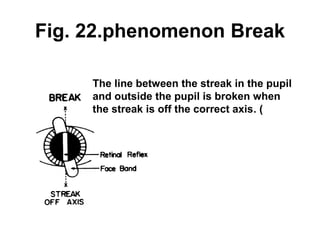
  • 130.
    THE ROLE OFTHE RETINOSCOPE IN A MODERN EYE CLINIC-Autorefraction • In the 21st century, we are faced with an ever-more automated world, and the ophthalmic practice has paralleled this move toward automation. ‫اللى‬ ‫أو‬ ‫التوماتى‬ ‫التشغيل‬ • The retinoscope, really little more than a light filament, lens, and mirror, is now joined by many more sophisticated (and certainly more expensive) devices developed to help us obtain information regarding the refractive state of our patients.
  • 131.
    THE ROLE OFTHE RETINOSCOPE IN A MODERN EYE CLINIC-Autorefraction • One family of such instruments consists of the automated refractors—tabletop or hand- held devices that perform an objective refraction in a matter of seconds at the touch of a button. • The largest advantage of the automated refractor is that clinic personnel‫الموظفين‬ ‫مجموع‬ who have almost no knowledge in the art of refraction can use it. For the average patient, automated refractors are reasonably accurate when compared with the retinoscope and generally agree within ½ D.
  • 132.
    • Autorefraction • Ifautomated refractors err‫يخطئ‬ , they tend to overestimate minus sphere by a fraction of a diopter. This discrepancy ‫ق ض‬ُ‫ض‬‫تنا‬ . ‫ر ض‬ُ‫ض‬ ‫تعا‬ probably stems from the fact that patients accommodate in response to their sense that the automated refractor is at a closer distance to the patient than is the 6 meter far point used in retinoscopy. This is true even though the devices are designed to relax accommodation while fixing on an artificial distant target.
  • 133.
    Autorefraction • Where theautomated refractor is at an undeniable ‫ال‬ ‫حد‬َ a ‫ج‬ْ‫َر‬ ‫ي‬ُ‫ض‬ ‫ال‬ . ‫كر‬َ a ‫ن‬ْ‫َر‬‫ي‬ُ‫ض‬ disadvantage to the retinoscope is in evaluating patients with irregular astigmatism, either from pathology (e.g., keratoconus, pellucid marginal degeneration) or postsurgically (e.g., corneal transplant, laser in situ keratomileusis [LASIK]). All the automated refractor operator can do is press a button while having the patient fixate on the target. • The automated refractor then either calculates a “best fit” refraction or flashes an error message that there too much irregular astigmatism exists to make a reading.( Over cylinder)
  • 134.
    Autorefraction • The retinoscopist,however, can gain much more information about the refractive state of the patient by judging the quality of the light reflex observed in the patient's pupil. • A skilled retinoscopist usually can deduce quantities and qualities of astigmatism in patients for whom the automated refractor fails. This is especially true in patients with poor best-corrected visual acuity. • Other instruments that must be compared with the retinoscope are the keratoscope and the automated corneal modeling systems. Although it is tempting to compare these instruments with the retinoscope because they each provide important information regarding astigmatism,
  • 135.
    Autorefraction • it mustbe remembered that these instruments serve different purposes within the ophthalmic practice. The keratoscope and corneal topographers are used to evaluate corneal astigmatism only. • The retinoscope, however, is used to determine the entire refractive state of the eye. These instruments all have their place and can complement‫تكملة‬ each other well.
  • 136.
    THE ROLE OFTHE RETINOSCOPE IN A MODERN EYE CLINIC-Autorefraction • A final issue, one that is becoming more important with every passing year, is the role of the retinoscope in managing the refractive surgery patient. Few studies address this problem. Retinoscopy has been shown to be accurate in evaluating the postoperative patient. Anecdotally, ‫هة‬َ a ‫كو‬ُ‫ض‬‫ف‬ْ‫َر‬‫أ‬ُ‫ض‬ ; ‫فة‬َ a‫رو‬ُ‫ض‬ ‫ط‬ْ‫َر‬ ‫أ‬ُ‫ض‬ we agree with these results. In our practice, we rely heavily on retinoscopy in evaluating pre- and postoperative refractive surgery patients.
  • 137.
    THE ROLE OFTHE RETINOSCOPE IN A MODERN EYE CLINIC-Autorefraction • We believe that automated refractors cannot accurately evaluate the refractive state of someone with a surgically altered cornea and therefore believe that they have no role in providing data on these patients. • Other studies have shown that corneal topography alone is not adequate in evaluating patient satisfaction after laser refractive surgery.
  • 138.
    THE ROLE OFTHE RETINOSCOPE IN A MODERN EYE CLINIC-Autorefraction • Remembering that the critical zone of the retinoscopy reflex is the central 3 mm, and that the average excimer laser ablation diameter is 6 mm, one can see that the retinoscope is well suited to evaluate these patients. • When patients who had previously had corneal refractive surgery subsequently undergo cataract extraction with intraocular lens (IOL) implantation, there is more variability in the postoperative refractions than for typical cataract patients.
  • 139.
    THE ROLE OFTHE RETINOSCOPE IN A MODERN EYE CLINIC-Autorefraction The IOL calculations rely not on retinoscopy (objective refraction), but instead on keratometry (corneal curvature) and a-scan ultrasonography (axial length). One can only wonder if the diagnostic procedure of choice for these patients might someday be for the surgeon to remove the cataract, perform intraoperative retinoscopy of the aphakic eye, calculate the necessary lens power, then place the desired IOL implant.
  • 140.
    THE ROLE OFTHE RETINOSCOPE IN A MODERN EYE CLINIC-Autorefraction •In that way, the IOL would depend on the patient's refractive state rather than on artificial calculations based on the patient's altered ocular anatomy.
  • 141.
    Degrees of Astigmatism Mild Astigmatism 1.00 diopters Moderate Astigmatism 1.00to2.00 diopters Severe Astigmatism 2.00to 3.00 diopters Extreme Astigmatism 3.00 diopters
  • 142.
    Clinical classification ofastigmatism 1. Regular astigmatism :in which the two principle meridians are at right angle and is susceptible to easy correction by cylindrical lenses. 2. Oblique astigmatism :in which the two principle meridians are not at right angle but are crossed obiquely,it is corrected by using spherocylindrical lenses ,it is not very common. 3. Irregular astigmatism :where there are irregularities in the curvature of the meridians so that no geometrical figure is formed ,and the correction is very difficult.
  • 143.
    Types of astigmatism 1.Simpleastigmatism :where one of the foci falls upon the retina while the other focus may fall in front or behind the retina so that while one meridian is emmetropic the other meridian is either myopic or hypermetropic .
  • 144.
    Types of astigmatism 2.Compoundastigmatism :where neither of the two foci lies upon the retina but both are placed in front of or behind the retina on the same direction ,the state of refraction is then entirely myopic (compound myopic astigmatism) or entirely hypermetropic (compound hypermetropic astigmatism) .
  • 145.
    Types of astigmatism 3.Mixedastigmatism :where one focus is in front of and the other is behind the retina, so that the refraction is myopic in one direction and hypermetropic in the other.
  • 146.
  • 147.
    Split focus inastigmatism
  • 148.
    Other classification Direct astigmatism:when the vertical curve is greater than the horizontal curve. Indirect astigmatism :when the horizontal curve is greater than the vertical curve. B a c k
  • 149.
    1.Patients with astigmatismhave blurred or distorted vision at all distances. 2. It can also cause images to appear doubled, particularly at night. 3.Patients have difficult focusing on various objects such as finely printed words and lines. 4.Headache and fatigue of the eye are common as the person tends to strain his eyes. 5.Eye discomfort and irritation are also frequent. What are the general symptoms of Astigmatism ?
  • 150.
    Symptoms of lowastigmatism (1.0D) include 1. Asthenopia {tired eyes}, especially when doing precise ‫قيق‬ِ‫قي‬‫د‬َ a work at a fixed distance. 2. Transient blurred vision relieved by rubbing the eyes as in hyperopia when doing precise work at a fixed distance. 3. Frontal headaches with long periods of visual concentration on a task.
  • 151.
    Symptoms of highastigmatism (1.0D) include 1. Blurred vision , asthenopia and frontal headache are more severe than in low astigmatism 2. Tilting of the head for oblique astigmatism 3. Slinting to achieve pinhole vision clarity. 4. Reading material held close to eyes to achieve large (as in myopia) but blurred retinal image. 5. The letters in the book appear as running together i.e. getting mixed up.
  • 152.
  • 153.
    Causes of Astigmatism Heriditary: • The exact cause remains unknown; however some common types of astigmatism seem to run in families and may be inherited. • It is thought that most people have some form of astigmatism as it is rare to find perfectly shaped curves in the cornea and lens, but the defect is rarely serious. • The majority of these studies demonstrate an autosomal (of asexual chromosomes )dominant form of genetic transmission. Autosomal recessive transmission has been shown occasionally. Rarely, X-linked recessive form has also been reported.
  • 154.
    Acquired causes ofastigmatism 1. Diseases of the cornea result in its deformity; an extreme example is seen in conical cornea (keratoconus), while inflammations and ulceration of the cornea produce corneal scar. 2. Traumatic interference with the cornea may bring about the same result in this category we should include surgical trauma, particularly operations for cataract. Furthermore, corneal astigmatism can be induced by the pressure of swellings of the lids, whether the humble chalazion or a true neoplasm. 3. A transient deviation form normal can be produced by finger pressure on the eye, by contraction of the lids (blepharospasm ), or by the action of the extra-ocular muscles.
  • 155.
    Acquired causes ofastigmatism 4. Curvature astigmatism of the lens also occurs with great frequency. In great majority of cases such anomalies are small; but on occasion, as in lenticonus, they may be marked. 5. Not uncommonly the lens is placed slightly obliquely or out of line in the optical system and this, causing a certain amount of decentring, produces a corresponding astigmatism; 6. A traumatic subluxation of the lens has similar results
  • 156.
    Keratoconus (KC) Keratoconus isa progressive disorder in which the cornea assumes an irregular conical shape. The onset is at around puberty with slow progression thereafter. Though the ectasia may become stationary at any time, both eyes are affected, if only topographically, in almost all cases.
  • 157.
  • 158.
    Characteristics INCIDENCE: Keratoconus is bilateralin approximately 96% of cases. Typically, one eye is affected earlier, and the disease progresses further than in the fellow eye. Keratoconus is often diagnosed in persons in their early teens to early twenties. There does not appear to be a significant difference in the incidence of keratoconus between left and right eyes nor between male and female subjects.
  • 159.
    Histopathologic changes It isstill unclear what causes the corneal changes that occur in keratoconus. A triad of classic histopathologic changes has been observed: 1. Thinning of the corneal stroma. 2. Breaks in bowman's layer. 3. Iron deposition in the basal layers of the corneal epithelium( Fleischer’s ring).
  • 160.
    Etiology Of KC 1.Heredity 2. Eye rubbing and atopy 3. Contact lens wear 4. Abnormalities in ocular rigidity and structure
  • 161.
    Associations  Ocular associationsinclude: 1. vernal keratoconjunctivities, 2. blue sclera, 3. aniridia, 4. ectopia lentis, 5. Leber congenital amaurosis and 6. retinitis pigmentosa.
  • 162.
    predisposing factors 1. Rigidcontact lens wear and 2. Constant eye rubbing have also been proposed as predisposing factors.
  • 163.
    By keratometry keratoconusis classified as mild (48 D), moderate (48- 54D) and severe (54D). Morphologically, the following are the three types: 1. Nipple ‫حلمة‬ cones, characterized by their small size (5mm) and steep curvature. The apical center is often either central or paracentral and displaced inferonasally Classification and progressionClassification and progression
  • 164.
    2. Oval conesor sagging‫لى‬ّ‫ة‬‫يتد‬ . ‫يرتخي‬ , which are larger than the nipple form equals 5-6mm, ellipsoid‫م‬ٌ ‫ان‬‫س‬َّ‫م‬ ‫ج‬َ a ‫م‬ُ‫ض‬ ‫ق ص‬ِ‫قي‬‫نا‬ and commonly displaced inferotemporally. Classification andClassification and progressionprogression
  • 165.
    3. Globus cones, whichare the largest 6mm and may involve over 75 % of the cornea. Classification andClassification and progressionprogression
  • 166.
    Clinical picture/ symptoms 1.Presentation is with impaired vision in one eye caused by progressive astigmatism and myopia. 2. The patient may report frequent changes in spectacle prescription or decreased tolerance to contact lens wear. 3. As a result of the asymmetrical nature of the condition, the fellow eye usually has normal vision with negligible astigmatism at presentation, which however, increases as the condition progresses.
  • 167.
    1. Direct ophthalmoscopy 2.Retinoscopy 3. Slitlamp biomicroscopy 4. Keratometry 5. Placido disc 6. Corneal topography 7. Videokeratoscopy signs Clinical picture/DIAGNOSIS
  • 168.
    Often subtle, canbe detected as follows: 1. Direct ophthalmoscopy from a distance of one foot shows an “oil droplet” reflex 2. Retinoscopy shows an irregular “scissor” reflex. Clinical picture/ Early signs
  • 169.
    Clinical picture/ Earlysigns Slitlamp biomicroscopy shows very fine, vertical, deep stromal striae ( vogt lines) which disappear with external pressure on the globe. Prominent corneal nerves may also be present.
  • 170.
    Clinical picture/ Earlysigns Keratometry shows irregular astigmatism where the principal meridians are no longer 90 degree apart and the mires cannot be superimposed.
  • 171.
     Videokeratoscopy signs: 1.Compression of mires in affected region. 2. Color map showing increased power in isolated area of cone . 3. Inferior- superior dioptric asymmetry. Clinical picture/ Early signs
  • 172.
    These devices areused to detect and quantify corneal surface curvature and the presence of astigmatism. A keratoscope uses light to project rings on the cornea. Observation through the keratoscope of the reflection of light from the cornea and inspection of the shape and spacing of the rings provide information about the degree of astigmatism. Keratoscope and videokeratoscope
  • 173.
    A keratoscope fittedwith a video camera is called a videokeratoscope. A videokeratoscope is the most common instrument used to quantify the change in corneal surface curvature, in a process called corneal topography.
  • 174.
    Placido disk andkeratoscope •Photokeratoscopy, which employ optical principles that are similar to those of the keratometer, measure a larger surface area and provide a more complete appreciation of corneal shape.
  • 175.
    Placido disk andkeratoscope
  • 176.
  • 177.
    Videokeratography of with-the-rule,against-the rule, oblique regular astigmatism
  • 178.
    Clinical picture/ Earlysigns Corneal topography is the most sensitive method for detecting very early keratoconus.
  • 179.
  • 180.
  • 181.
  • 182.
  • 183.
    Large Inferior ConeSuperior coneSmall nipple cone
  • 184.
    Clinical picture/ Latesigns • Late signs: 1. Slit lamp shows:  Progressive corneal thinning, to as little as one – third of normal thickness,  Marked increase of the depth of A C 2. Associated with poor visual acuity resulting from marked irregular myopic astigmatism with steep keratometry (k) readings. 3. Bulging of the lower lid in down gaze (Munson’s sign)
  • 185.
    Clinical picture/ Latesigns 4. Epithelial iron deposits (Fleischer’s ring) may surround the base of the cone and are visualized best with a cobalt blue filter of the slit lamp 5. Stromal scarring in severe cases.
  • 186.
    Clinical picture/ Latesigns  6.Acute hydrops is an acute influx of aqueous in to the cornea as a result of a rupture in descemet membrane. This causes a sudden drop in visual acuity associated with discomfort and watering. Although the break usually heals within 6-10 weeks and the corneal oedema clears, avariable amount of stromal scarring may develop.
  • 187.
    Clinical picture/ Latesigns  Acute hydrops are initially treated with hypertonic saline and patching or a soft bandage contact lens.  Healing may result in improved visual acuity as a result of scarring and flattening of the cornea. Keratoplasty should be deferred‫يرجئ‬ . ‫جل‬ِّ ‫يؤ‬ until the oedema has resolved.
  • 188.
    Differential diagnosis 1. CornealWarpage ‫ج‬َ a ‫و‬َّ‫م‬ ‫ع‬َ a Syndrome 2. High-riding rigid Gas-permeable lens 3. Keratoglobus
  • 189.
    The topography ofkeratoconus: LECTURE 8The topography of keratoconus: LECTURE 8 The photokeratoscope orThe photokeratoscope or placido discplacido disc can provide ancan provide an overview of the cornea and can show the relativeoverview of the cornea and can show the relative steepness of any corneal area.steepness of any corneal area. keratoconic corneakeratoconic cornea Normal corneaNormal cornea
  • 190.
    EyeSys System The cornealsurface has 75% of the refractive or light focusing ability of the eye. The EyeSys System utilizes placido disk technology to acquire images of the corneal surface. Placido disk technology is based on a technique that captures the reflection of rings of light off the surface of the cornea and measures the different distances between the ring reflections. Current software technology captures the reflected images with a digital camera, processes ‫يعالج‬ . ‫يعامل‬ُ the data, and displays‫باداء‬ْ‫اد‬‫إ‬ِ‫ب‬ ; ‫ن ة‬َ‫ة‬‫با‬َ‫ة‬‫إ‬ِ‫ب‬ the information in multiple formats.
  • 191.
    A Placido deviceis made up of many concentric light rings. The exact arrangement and number of rings may vary with different manufacturers Light rings are projected on the cornea above.This image is captured and analyzed as thousands of computations are performed instantly.
  • 192.
    corneal topography ‫ش ف‬ِ‫ف‬ ‫ك‬ْ‫ِش‬ ‫ت‬َ‫ْك‬‫س‬ْ‫ِش‬ ‫م‬ُ‫س‬ ; ‫ فاف‬‫ش‬َّ‫ا‬ ‫ك‬َ‫ْك‬
  • 193.
    • The mapabove was taken prior to simulated treatment. The horizontal red and orange areas are elevated above the cooler colors green blue areas demonstrating this patient’s against the rule astigmatism.
  • 194.
    corneal topography • Thesame map is below after LASIK simulated laser treatment. Observe the more uniform neutral green color centrally indicating a much smoother uniform surface without astigmatism (corrected with LASIK).
  • 195.
    Photokeratoscopy view ofearly keratoconus Note the pear-shaped ‫الشكل‬ ‫كمثري‬ pulling of the central keratoscopy mires. The close proximity of the rings (in the inferior-temporal portion of the eye( indicates corneal steepening and greater distance between the rings (in the superior-nasal portion of the eye( indicates flattening.
  • 196.
    corneal topography • Thetypical spiral pattern of keratoconus progression. The condition commonly begins in the inferior-temporal quadrant, with the last area of the cornea to be topographically affected in the superior-nasal quadrant. • In color-coded topographic images, red represents steeper corneal curvature, and the spectrum of yellow, green, and blue represents progressively flatter curvatures.
  • 197.
    corneal topography • Thenipple-shaped form of keratoconus demonstrates a small central ectasis surrounded by 360 degrees of “normal” cornea.
  • 198.
    corneal topography The moststriking features of the nipple topography are: • The often high degree of with-the-rule corneal toricity confined to the central 5.0 mm of the cornea. • The nearly 360 degrees of “normal” mid-peripheral cornea that surrounds the base of the cone. • The occasional presence of an elevated fibroplastic nodule ‫ن ة‬َ‫ة‬‫ر‬َ‫ة‬ ‫د‬َ‫ة‬ at the apex of the cornea, hence the name nipple keratoconus. The superficial nodules are frequently eroded‫ت‬ّ ‫ح‬ُ ‫ي‬َ‫ة‬ . ‫كل‬ّ ‫يتأ‬ by the presence of a rigid contact lens, often necessitating: rigid gas permeable/soft contact lens (RGP/SCL( or piggyback designs,
  • 199.
    corneal topography Nipple-shaped keratoconusmay also manifest as a small central ectasia with moderate to high with-the-rule corneal astigmatism in the form of regular bow tie.
  • 200.
    corneal topography Oval-shaped keratoconusis hallmarked by steepening of the inferior cornea
  • 201.
    Globus-Shaped Topography • Theglobus form of keratoconus affects the largest area of the cornea, often encompassing nearly three quarters(75%) of the corneal surface. • Due to its size, nearly all of the keratoscopy rings will be encompassed‫ ن‬w‫م‬َّ‫ا‬ ‫ض‬َ‫ْك‬ ‫م‬ُ‫س‬ ; ‫ملول‬ُ‫س‬ ‫ش‬ْ‫ِش‬ ‫م‬َ‫ْك‬ within the area of the ectasia. Unlike the advanced forms of nipple or oval keratoconus, the globus cone has no island of “normal” mid-peripheral cornea above or below the midline.
  • 202.
    Globus-Shaped Topography Due tothe size of the globus-shaped keratoconus, all nine rings of the photokeratoscopy image are encompassed by the conical area and no “islands” of normal mid-peripheral cornea are seen.
  • 203.
    Normal corneal topography Fivequalitative patterns of normal corneal topography using a normalized scale. Top left, round; top center, oval; top right, symmetric bow-tie; bottom left, = asymmetric bow tie; bottom center, irregular. In the normalized scale (bottom right( the range of dioptric power represented by each color varies among eyes, depending on the degree of corneal asphericity. Classification of normal corneal topography based on computer-assisted videokeratograph.
  • 204.
    Keratoconus topography • Videokeratographsmirror this distortion by producing mires that are typically oval. The distance between rings is smallest at the steepest corneal slope and farthest apart superiorly where the cornea is flattest. • Tangential curvature maps of projection-based systems provide additional information. On these maps the steepest slope is easily located as being inferior to the apex, producing an asymmetric bow tie‫الشكل‬ ‫ي‬ّ ‫ش‬ِ‫ب‬ ‫فرا‬َ‫ة‬ ‫رقب ة‬ ‫رباط‬ . This corresponds to the exaggerated prolate‫متطاول‬ shape of the keratoconic eye. • Projection-based systems can be used to locate the apex of the cone on elevation maps as the highest point.
  • 205.
    Axial map • Axialmap. Also called the power or sagittal map, this output is the simplest of all the topographical displays. It shows variations in corneal curvature as projections ‫ فاشة‬‫ش‬‫ال‬ ‫على‬ ‫المتحركة‬ ‫الصلور‬ ‫عرض‬ and uses colors to represent dioptric values. Warm colors such as red and orange show steeper areas; cool colors such as blue and green denote the flatter areas.
  • 206.
    Sometimes referred toas the instantaneous‫،فورى‬ ‫ىروف، ىوتوى‬ ‫لحظى‬ , local, or true map, it also displays the cornea as a topographical illustration, using colors to represent changes in dioptric value. However, the tangential strategy bases its calculations on a different mathematical approach that can more accurately determine the peripheral corneal configuration. Tangential ‫ي‬ّ ‫س‬ّ ‫ما‬َ ‫م‬ُ map
  • 207.
    Tangential map • Itdoes not assume the eye is spherical, and does not have as many presumptions‫رض‬ْ‫ِش‬ ‫ف‬َ‫ْك‬ as the axial map regarding corneal shape. • In fact it is the map that more closely represents the actual curvature of the cornea over the axial map. The tangential map recognizes sharp power transitions more easily than the axial map, and eliminates the smoothing appearance that appears on the axial map.
  • 208.
    This utilizes yetanother algorithm to give additional information about the cornea. An elevation map shows the measured height from which the corneal curvature varies (above or below) from a computer-generated reference surface. Warm colors depict . .‫صف‬ِ ‫ي‬ ‫ور‬ّ ‫يص‬ ‫يرسم‬ points that are higher than the reference surface; cool colors designate lower points. This map is most useful in predicting fluorescein patterns with rigid lenses. Higher elevations (reds) represent potential areas of lens bearing, while the lower areas (greens) will likely show fluorescein pooling. Elevation map.
  • 209.
  • 210.
  • 211.
  • 212.
  • 213.
  • 214.
  • 215.
  • 216.
  • 217.
    corneal topography •Corneal topographyand imaging. Symmetric bow tie typical for regular astigmatism.
  • 218.
    corneal topography •This elevationmap shows inferior thinning in a patient's left eye.
  • 219.
    Treatment Of keratoconus Non- surgical Surgical Spectacles Contact lensesPenetrating Keratoplasty Lamellar Keratoplasty Lamellar keratoplasty Intracorneal rings Other Surgery C3RC3R
  • 220.
    Treatment that preventTreatmentthat prevent progression of KCprogression of KC Collagen cross linking treatments (C3RCollagen cross linking treatments (C3R)) Recent treatment which is based on strengthenRecent treatment which is based on strengthen the cross-linking of corneal collagen by utilizesthe cross-linking of corneal collagen by utilizes riboflavin and ultraviolet (UV) light exposureriboflavin and ultraviolet (UV) light exposure.. During the 30-minute riboflavin eyedrops areDuring the 30-minute riboflavin eyedrops are applied to the cornea, which are then activatedapplied to the cornea, which are then activated by a UV light. This is the process that has beenby a UV light. This is the process that has been shown in laboratory and clinical studies toshown in laboratory and clinical studies to increase the amount of collagen cross-linking inincrease the amount of collagen cross-linking in the cornea and strengthen the corneathe cornea and strengthen the cornea..
  • 222.
    Collagen cross linkingtreatments causes theCollagen cross linking treatments causes the collagen fibers to thicken, stiffen, crosslink collagen fibers to thicken, stiffen, crosslink re-attach to each other, making the corneare-attach to each other, making the cornea stronger and more stable thus convincinglystronger and more stable thus convincingly halting the progression of the disease. Thehalting the progression of the disease. The figures below demonstrate almost 10 dioptersfigures below demonstrate almost 10 diopters of corneal flattening in one patient before (left)of corneal flattening in one patient before (left) after this combined treatment (rightafter this combined treatment (right).).
  • 223.
    Advantages ofAdvantages of C3RC3R:: 1.1.Simple one time treatmentSimple one time treatment 2.2. No periodic treatments requiredNo periodic treatments required 3.3. Halts the progress and causes someHalts the progress and causes some regressionregression 4.4. It is permanentIt is permanent 5.5. No handling of lenses every dayNo handling of lenses every day 6.6. Does not need any eye donationDoes not need any eye donation 7.7. No precautionNo precaution 8.8. No injectionNo injection 9.9. No stitches as in keratoplastyNo stitches as in keratoplasty 10.10. No incisions as in IntacsNo incisions as in Intacs 11.11. Quick recovery, short follows upQuick recovery, short follows up
  • 224.
    spectacle lensesspectacle lenses Askeratoconus progresses,As keratoconus progresses, spectacle lensesspectacle lenses often fail tooften fail to provide adequate visual acuityprovide adequate visual acuity:: 1.1. EspeciallyEspecially at night.at night. 2.2. This can be further complicated by the fact that theThis can be further complicated by the fact that the patient's glasses prescription maypatient's glasses prescription may change frequentlychange frequently duedue to the disease progress and can be limited by the degreeto the disease progress and can be limited by the degree ofof myopia and astigmatismmyopia and astigmatism that must be corrected.that must be corrected. 3.3. Also, keratoconus is often asymmetric therefore fullAlso, keratoconus is often asymmetric therefore full spectacle correction may be intolerable because ofspectacle correction may be intolerable because of anisometropia and aniseikoniaanisometropia and aniseikonia.. However, despite these limitations, spectacles can oftenHowever, despite these limitations, spectacles can often provide surprisingly good visual results in theprovide surprisingly good visual results in the early stagesearly stages of the condition.of the condition.
  • 225.
    contact lenses Contact lensoptions for keratoconusContact lens options for keratoconus • When a keratoconic patient is no longer able toWhen a keratoconic patient is no longer able to obtain good visual acuity with spectacle lensesobtain good visual acuity with spectacle lenses because of increasing levels of irregular myopicbecause of increasing levels of irregular myopic astigmatism and higher-order aberrations, rigidastigmatism and higher-order aberrations, rigid contact lenses will be required, effectively tocontact lenses will be required, effectively to provide a new anterior surface to the eye.provide a new anterior surface to the eye. • Contact lenses are considered when vision isContact lenses are considered when vision is not correctible to 6/9 by spectaclesnot correctible to 6/9 by spectacles and patientsand patients become symptomatic.become symptomatic.
  • 226.
    contact lenses The successfulfitting of contact lenses forThe successful fitting of contact lenses for keratoconus requires that three objectiveskeratoconus requires that three objectives‫أهداف‬‫أهداف‬ be met :be met : 1.1. The lens-to-cornea fitting relationship shouldThe lens-to-cornea fitting relationship should create the least possible physicalcreate the least possible physical traumatrauma to theto the cornea.cornea. 2.2. The lens should provideThe lens should provide stable visual acuitystable visual acuity throughout the patient's entire wearingthroughout the patient's entire wearing schedule.schedule. ‫ل‬َ‫ْك‬ ‫و‬َ‫ْك‬ ‫د‬ْ‫ِش‬ ‫ج‬َ‫ْك‬‫ل‬َ‫ْك‬ ‫و‬َ‫ْك‬ ‫د‬ْ‫ِش‬ ‫ج‬َ‫ْك‬ 3.3. The lens should provideThe lens should provide all day wearing comfort.all day wearing comfort.
  • 227.
    Lens Designs forKeratoconusLens Designs for Keratoconus Soft lensesSoft lenses Soft lenses have a limited role in correcting cornealSoft lenses have a limited role in correcting corneal irregularity, as they tend to drapeirregularity, as they tend to drape‫على‬ ‫ل‬ّ ‫اد‬َ‫ة‬‫مت‬‫على‬ ‫ل‬ّ ‫اد‬َ‫ة‬‫مت‬ over theover the surface of the cornea and result in poor visualsurface of the cornea and result in poor visual acuity .acuity . Hence, soft lenses are used only in theHence, soft lenses are used only in the earlyearly stages of the diseasestages of the disease. In such cases, the lenses. In such cases, the lenses are usually toric, and are fitted in the sameare usually toric, and are fitted in the same manner, as they would be on a patient withmanner, as they would be on a patient with myopic astigmatism. The fitting procedure beginsmyopic astigmatism. The fitting procedure begins by placing a soft lens with powers equal to theby placing a soft lens with powers equal to the manifest refraction vertexedmanifest refraction vertexed ‫القم ة‬ ‫على‬to the plane ofto the plane of the cornea on the eye. Final lens power is bestthe cornea on the eye. Final lens power is best calculated by performing a sphero-cylindercalculated by performing a sphero-cylinder refraction.refraction.
  • 228.
    Toric soft contactlenses for earlyToric soft contact lenses for early KCKC
  • 229.
    soft contact lensesfor early KCsoft contact lenses for early KC •However, some hydrogel lenses have been designedHowever, some hydrogel lenses have been designed specially for keratoconus.specially for keratoconus. Hydrogel lenses are made relatively large in diameter, usually 13.5 to 14.5 mm in diameter which results in the lens edge being beyond the limbus on the sclera. •They are designed to be thicker than regular soft lensesThey are designed to be thicker than regular soft lenses so they retain a rigid shape to some extent. For thisso they retain a rigid shape to some extent. For this reason they compress the central cornea and partiallyreason they compress the central cornea and partially trap atrap a tear pooltear pool, as with rigid corneal lenses. In effect,, as with rigid corneal lenses. In effect, they are rigid lenses made from hydrogel materials, andthey are rigid lenses made from hydrogel materials, and they do appear to be giving a reasonable visual resultthey do appear to be giving a reasonable visual result with some types of keratoconuswith some types of keratoconus..
  • 230.
    HYDROGEL (SOFT) LENSES •Hydrogel lenses increase the amount of oxygen reaching the cornea as do most contact lenses. By making the lenses thinner or increasing the water content, or both, more oxygen will reach the cornea. It is not uncommon to have hydrogel lenses made as thin as 0.035 mm. • Lenses are available up to about 75% water content with most lenses being used today range from 38% to 65% water . Thick Thin
  • 231.
    soft contact lensesfor early KCsoft contact lenses for early KC Criteria to useCriteria to use:: 1.1. One criterion to use to determine if softOne criterion to use to determine if soft lenses are acceptable is that they shouldlenses are acceptable is that they should induce no scarring. Often, soft contactinduce no scarring. Often, soft contact lenses lead to repeated corneallenses lead to repeated corneal abrasions, which can result in scarring.abrasions, which can result in scarring. 2.2. Another criterion is the patient must beAnother criterion is the patient must be happy with his vision and is able tohappy with his vision and is able to function properly in their daily activities.function properly in their daily activities.
  • 232.
    soft contact lensesfor early KCsoft contact lenses for early KC AdvantagesAdvantages 1) They afford higher levels of1) They afford higher levels of comfortcomfort andand longer wearing times, especially inlonger wearing times, especially in patients intolerant to RGP corneal lensespatients intolerant to RGP corneal lenses or in monocular keratoconus.or in monocular keratoconus. 2) They are useful where the cone apex2) They are useful where the cone apex may bemay be displaceddisplaced, especially if it is very, especially if it is very low.low. 3) They are relatively3) They are relatively simple to fitsimple to fit..
  • 233.
    soft contact lensesfor early KCsoft contact lenses for early KC DisadvantagesDisadvantages 1) Visual acuity may be variable (less corrected) in1) Visual acuity may be variable (less corrected) in cases of very high minus lenses.cases of very high minus lenses. 2) Low-powered2) Low-powered diagnosticdiagnostic lenses may not providelenses may not provide an accurate guide to the fit of thean accurate guide to the fit of the final lensfinal lens,, which may be extremely high powered.which may be extremely high powered. 3) If the condition (KC) has progressed, it may be3) If the condition (KC) has progressed, it may be difficult to change to RGP lenses at a laterdifficult to change to RGP lenses at a later stage.stage.
  • 234.
    Rigid gas permeablelensesRigid gas permeable lenses Rigid gas permeable (RGP) corneal lenses are theRigid gas permeable (RGP) corneal lenses are the lenses of first choice for correcting keratoconus.lenses of first choice for correcting keratoconus. They provide the best possible vision with theThey provide the best possible vision with the maximum comfort so that the lenses can be wornmaximum comfort so that the lenses can be worn for a long period of timefor a long period of time.. The purpose of the lens is to cover the irregularThe purpose of the lens is to cover the irregular astigmatism and the disordered anterior surfaceastigmatism and the disordered anterior surface optics of an ectatic cornea by providing a regular,optics of an ectatic cornea by providing a regular, spherical, optic surface before the eye (Figurespherical, optic surface before the eye (Figure below). The lens does not retard the progressionbelow). The lens does not retard the progression of the diseaseof the disease..
  • 235.
    Rigid gas permeablelensesRigid gas permeable lenses
  • 236.
    RGP contact lensesare primaryRGP contact lenses are primary option for correcting KC visionoption for correcting KC vision Keratoconic cornea RGP lens
  • 237.
    Piggyback Soft LensesPiggybackSoft Lenses • The technique of placing a rigid contact lens on top ofThe technique of placing a rigid contact lens on top of a soft lens (piggyback) was first described in the mida soft lens (piggyback) was first described in the mid 1970’s. Early piggyback systems consisted of thick,1970’s. Early piggyback systems consisted of thick, low Dk, soft lenses in combination with low Dklow Dk, soft lenses in combination with low Dk silicone/acrylate rigid lenses. It was not surprising thatsilicone/acrylate rigid lenses. It was not surprising that this combination frequently resulted in corneal hypoxiathis combination frequently resulted in corneal hypoxia and neovascularisation, which limited its usefulness.and neovascularisation, which limited its usefulness. However, with the recent introduction of high DkHowever, with the recent introduction of high Dk silicone hydrogel lenses and stable high Dk GPsilicone hydrogel lenses and stable high Dk GP materials, the dual lens system is now enjoying amaterials, the dual lens system is now enjoying a rebirth, particularly for keratoconus patientsrebirth, particularly for keratoconus patients experiencing comfort or lens position issueexperiencing comfort or lens position issue‫ف ذ‬َ‫ْك‬‫مفن‬َ‫ْك‬ . ‫ر ج‬َ‫ْك‬ ‫مرخ‬َ‫ْك‬‫ف ذ‬َ‫ْك‬‫مفن‬َ‫ْك‬ . ‫ر ج‬َ‫ْك‬ ‫مرخ‬َ‫ْك‬ ..
  • 238.
  • 239.
    A recent piggybacklens system forA recent piggyback lens system for keratoconuskeratoconus consisting of a high Dk soft lens and an RGP lensconsisting of a high Dk soft lens and an RGP lens combinationcombination.. A rigid lens riding piggyback over a soft lens.
  • 240.
    Scleral lensesScleral lenses •Scleral lenses play a very significant roleScleral lenses play a very significant role in cases of advanced keratoconus wherein cases of advanced keratoconus where corneal lenses do not work and cornealcorneal lenses do not work and corneal surgery is contra-indicated. Scleralsurgery is contra-indicated. Scleral lenses completely neutralize any corneallenses completely neutralize any corneal irregularity and can help patientsirregularity and can help patients maintain a normal quality of life. Thesemaintain a normal quality of life. These are large diameter lenses (23-25mm)are large diameter lenses (23-25mm) that rest on the sclera, and vaults overthat rest on the sclera, and vaults over the cornea .the cornea .
  • 242.
    A scleral anda corneal lens toA scleral and a corneal lens to compare the sizecompare the size.. Because of their size, they doBecause of their size, they do not fall out; dust or dirtnot fall out; dust or dirt particles cannot get behindparticles cannot get behind them during wear. They arethem during wear. They are surprisingly comfortable tosurprisingly comfortable to wear because the edges ofwear because the edges of the lens rests above andthe lens rests above and below the eye lid margins sobelow the eye lid margins so there is no lens awareness.there is no lens awareness. The introduction of rigid gasThe introduction of rigid gas permeable (RGP( materialspermeable (RGP( materials has made this design morehas made this design more readily availablereadily available..
  • 243.
    Scleral lensesScleral lenses AdvantagesAdvantages 1.1.Comfortable to eyes.Comfortable to eyes. 2.2. Any type of corneal irregularity is corrected.Any type of corneal irregularity is corrected. 3.3. Easy to store.Easy to store. 4.4. Long life.Long life. DisadvantagesDisadvantages 1.1. Much chair time is needed.Much chair time is needed. 2.2. A very specialized fitting techniqueA very specialized fitting technique .
  • 244.
    Rose K lensRoseK lens •The Rose K lens is probably the most widelyThe Rose K lens is probably the most widely fitted keratoconus lens worldwide and achievesfitted keratoconus lens worldwide and achieves an 85% first fit success in the UK. The Rose Kan 85% first fit success in the UK. The Rose K lens design is alens design is a fully flexible lensfully flexible lens that works wellthat works well onon early to advanced keratoconus patientsearly to advanced keratoconus patients .. Complex lens geometry, combined with theComplex lens geometry, combined with the enhanced material benefits makes the Rose Kenhanced material benefits makes the Rose K lens the good fit enhancing patient comfort andlens the good fit enhancing patient comfort and visual acuity. Multiple parameters make fittingvisual acuity. Multiple parameters make fitting the Rose K lens possible for most keratoconicthe Rose K lens possible for most keratoconic eyes. The design starts with a standard 8.7mmeyes. The design starts with a standard 8.7mm diameter and works by decreasing the opticdiameter and works by decreasing the optic zone diameter as the base curve gets steeperzone diameter as the base curve gets steeper..
  • 245.
    Rose K™Rose K™contact lens with smallcontact lens with small optic zoneoptic zone
  • 246.
    The Rose K™lensThe Rose K™ lens Rose K lensRose K lens
  • 247.
    Rose K lensRoseK lens Rose K™ contact lens with large optic zoneRose K™ contact lens with large optic zone
  • 248.
    The Rose K™lensThe Rose K™ lens AdvantagesAdvantages:: 1. Its complex geometry can be customized to suit1. Its complex geometry can be customized to suit each eye and can correct all of the myopia andeach eye and can correct all of the myopia and astigmatism associated with keratoconus.astigmatism associated with keratoconus. 2. They are easy to insert, remove and clean .2. They are easy to insert, remove and clean . 3. They provide excellent health to the eye,3. They provide excellent health to the eye, because they allow the cornea to breathbecause they allow the cornea to breath oxygenoxygen directly through the lens.directly through the lens. 4. Practitioners have the Rose K™ trial set fitting4. Practitioners have the Rose K™ trial set fitting system which achieves a first fitsystem which achieves a first fit successsuccess in overin over 80% of patients' internationally80% of patients' internationally
  • 249.
    surgical procedures  INTACS Penetrating keratoplasty  Lamellar keratoplasty  Epikeratophakia  Thermokeratoplasty
  • 250.
    Treatment Management IntrastromalRing (Intacs®(Intrastromal Ring (Intacs®( • Definition: Intacs® were originally designedDefinition: Intacs® were originally designed and FDA approved in 1999 to correct mildand FDA approved in 1999 to correct mild nearsightedness (myopia(. In patients withnearsightedness (myopia(. In patients with keratoconus, Intacs® are indicated to reducekeratoconus, Intacs® are indicated to reduce myopia and astigmatism in those who are nomyopia and astigmatism in those who are no longer able to achieve adequate vision withlonger able to achieve adequate vision with contact lenses or glasses.contact lenses or glasses. Intacs are indicatedIntacs are indicated for contact lens intolerant patients withfor contact lens intolerant patients with keratoconus who have minimal central stromalkeratoconus who have minimal central stromal scarring.scarring.
  • 251.
    Intacs® are tiny(0.25mms thick( acrylicIntacs® are tiny (0.25mms thick( acrylic ring segmentsring segments
  • 252.
    Intrastromal Ring (IntacsIntrastromalRing (Intacs®(®( • They are an effective way to manage theThey are an effective way to manage the condition and restore functional acuity by helpingcondition and restore functional acuity by helping to restore the natural shape of a corneato restore the natural shape of a cornea weakened by keratoconus.weakened by keratoconus. • In a number of patients, Intacs® may delay orIn a number of patients, Intacs® may delay or ultimately prevent the need for cornealultimately prevent the need for corneal transplantation. A small incision is made in thetransplantation. A small incision is made in the periphery of the cornea and two thin arcs ofperiphery of the cornea and two thin arcs of polymethyl methacrylatepolymethyl methacrylate slidslid ‫يفنزلق‬‫يفنزلق‬ between thebetween the layers of the corneallayers of the corneal stromastroma, the incision then, the incision then being closed.being closed. • The segments push out against the curvature ofThe segments push out against the curvature of the cornea, flattening the peak of the cone andthe cornea, flattening the peak of the cone and returning it to a more natural shape.returning it to a more natural shape.
  • 253.
    The procedure, carriedout on an outpatient basis underThe procedure, carried out on an outpatient basis under local anesthesialocal anesthesia, offers the benefit of being reversible and even, offers the benefit of being reversible and even potentially exchangeable as it involves no removal of eye tissuepotentially exchangeable as it involves no removal of eye tissue
  • 254.
    Intrastromal Ring (IntacsIntrastromalRing (Intacs®(®( • The inserts are designed to be placed at a depth ofThe inserts are designed to be placed at a depth of approximately two-thirds the corneal thickness andapproximately two-thirds the corneal thickness and are surgically inserted through a small radial incisionare surgically inserted through a small radial incision into a troughinto a trough‫مجرى‬ . ‫ فاة‬‫فن‬‫ق‬‫مجرى‬ . ‫ فاة‬‫فن‬‫ق‬ created within the cornealcreated within the corneal stroma. The inserts shorten the corneal arc lengthstroma. The inserts shorten the corneal arc length and have a net effect of flattening the central cornea.and have a net effect of flattening the central cornea. • The amount of flattening is determined by theThe amount of flattening is determined by the insert's thickness. Rings are available in thicknessesinsert's thickness. Rings are available in thicknesses of 0.25, 0.275, 0.3, 0.325 and 0.35 mm and areof 0.25, 0.275, 0.3, 0.325 and 0.35 mm and are oriented horizontally in the cornea at 3 and 9 o'clock.oriented horizontally in the cornea at 3 and 9 o'clock.
  • 255.
    Intacs® - ClinicalFactsIntacs® - Clinical Facts • Clinical studies on the effectiveness ofClinical studies on the effectiveness of intrastromal rings on keratoconus are in theirintrastromal rings on keratoconus are in their early stages, and results have so far beenearly stages, and results have so far been generally encouraging, though they have yet togenerally encouraging, though they have yet to enter into wide acceptance with all refractiveenter into wide acceptance with all refractive surgeons.surgeons. • In comparison with a penetrating keratoplasty,In comparison with a penetrating keratoplasty, the requirement for some vision correction in thethe requirement for some vision correction in the form of hydrophilic (soft) contact lenses orform of hydrophilic (soft) contact lenses or spectacles may remain subsequent to thespectacles may remain subsequent to the Intacs®Intacs® operation.operation.
  • 256.
    Intacs® - ClinicalFactsIntacs® - Clinical Facts Potential complications of intrastromal ringsPotential complications of intrastromal rings include :include : 1.1. accidental penetration through to theaccidental penetration through to the anterior chamber when forming theanterior chamber when forming the channel.channel. 2.2. post-operativepost-operative infectioninfection of the cornea.of the cornea. 3.3. migration or extrusion of the segments.migration or extrusion of the segments.
  • 257.
    Intacs® - ClinicalFactsIntacs® - Clinical Facts • Thousands of keratoconus eyes have beenThousands of keratoconus eyes have been treated successfully with Intacs®. Mosttreated successfully with Intacs®. Most patients have experienced better quality of life,patients have experienced better quality of life, improved visual quality and stabilization of theimproved visual quality and stabilization of the keratoconic condition. The rings offer a goodkeratoconic condition. The rings offer a good chance of vision improvement even inchance of vision improvement even in otherwise hard to manage eyes, but it is nototherwise hard to manage eyes, but it is not guaranteed and in a few cases may worsen.guaranteed and in a few cases may worsen. • Considerable research has been collected onConsiderable research has been collected on patients having undergone the surgery sincepatients having undergone the surgery since 1997 as demonstrated by the following results:1997 as demonstrated by the following results:
  • 258.
    Intrastromal Ring (IntacsIntrastromalRing (Intacs®(®( IMPROVED VISION :IMPROVED VISION : • 71% gained71% gained 1 or more lines1 or more lines of Best Correctedof Best Corrected Visual Acuity.Visual Acuity. • 73% gained73% gained 2 or more lines2 or more lines in Uncorrectedin Uncorrected Visual Acuity.Visual Acuity. • Eyes with worse preoperative acuity hadEyes with worse preoperative acuity had greater improvements ingreater improvements in postoperativepostoperative acuity.acuity. • Eyes withEyes with corneal scarringcorneal scarring also showed somealso showed some improvementimprovement
  • 259.
    Intacs® - ClinicalFactsIntacs® - Clinical Facts SAFETY:SAFETY: • Intacs® for keratoconus mirror the safety of FDA-Intacs® for keratoconus mirror the safety of FDA- approved Intacs® for Myopia.approved Intacs® for Myopia. • If required, Intacs® can be removed preserving theIf required, Intacs® can be removed preserving the option for corneal transplantation.option for corneal transplantation. STABILIZED VISION:STABILIZED VISION: • Intacs® may restore functional vision by allowingIntacs® may restore functional vision by allowing the eye to be effectively corrected with contactthe eye to be effectively corrected with contact lenses or glasses besides intacs if needed.lenses or glasses besides intacs if needed. • Intacs® flatten and shift the cone centrally,Intacs® flatten and shift the cone centrally, restructuring the corneal architecture to a normalrestructuring the corneal architecture to a normal prolate shape.prolate shape. • Intacs® add structural integrityIntacs® add structural integrity ‫سلم ة‬‫سلم ة‬ to the corneato the cornea without invading the opticalwithout invading the optical zonezone .
  • 260.
    Corneal topography beforeand afterCorneal topography before and after Intacs® insertionIntacs® insertion
  • 261.
    Penetrating KeratoplastyPenetrating Keratoplasty Lecture10Lecture 10 Since the 1950’s, penetrating keratoplasty hasSince the 1950’s, penetrating keratoplasty has been the primary surgical procedure forbeen the primary surgical procedure for treatment of keratoconus. A cornealtreatment of keratoconus. A corneal transplant,transplant, also known as aalso known as a corneal graftcorneal graft, or, or as aas a penetrating keratoplastypenetrating keratoplasty, involves the, involves the removal of the central portion (called aremoval of the central portion (called a button) of the diseased cornea and replacingbutton) of the diseased cornea and replacing it with a matched donor button of cornea.it with a matched donor button of cornea.
  • 262.
    Penetrating keratoplasty forPenetratingkeratoplasty for treatment of keratoconustreatment of keratoconus.. Donated button Patient’s corneal rim
  • 263.
    penetrating keratoplastypenetrating keratoplasty IndicationsIndications Theprimary indications for penetrating keratoplasty in patientsThe primary indications for penetrating keratoplasty in patients with keratoconus are :with keratoconus are : 1.1. contact lens intolerance,contact lens intolerance, 2.2. progression of cone toward the corneal limbus,progression of cone toward the corneal limbus, 3.3. in severe cases, threatened corneal perforationin severe cases, threatened corneal perforation.. 4.4. Uncomplicated corneal hydrops.Uncomplicated corneal hydrops. 5.5. If the contact lenses fail to provide adequate visualIf the contact lenses fail to provide adequate visual acuity due to corneal scarring.acuity due to corneal scarring. 6.6. Sharp bilateral visual acuity is required forSharp bilateral visual acuity is required for recreationalrecreational ‫ي‬ّ ‫م‬ِ‫ب‬ ‫ما‬َ‫ة‬ ‫ج‬ْ‫اد‬ ‫ت‬ِ‫ب‬‫س‬ْ‫اد‬ ‫ا‬ِ‫ب‬‫ي‬ّ ‫م‬ِ‫ب‬ ‫ما‬َ‫ة‬ ‫ج‬ْ‫اد‬ ‫ت‬ِ‫ب‬‫س‬ْ‫اد‬ ‫ا‬ِ‫ب‬ or professional requirements.or professional requirements.
  • 264.
    Penetrating Keratoplasty SurgicaltechniquesPenetrating Keratoplasty Surgical techniques The figures from below illustrate the procedureThe figures from below illustrate the procedure This technique is suitable when disease A circular cut is made intoThis technique is suitable when disease A circular cut is made into through the full thickness of the cornea. the diseased corneathrough the full thickness of the cornea. the diseased cornea
  • 265.
    Penetrating KeratoplastyPenetrating Keratoplasty Thediseased cornea isThe diseased cornea is removedremoved AA healthy cornea ishealthy cornea is transplantedtransplanted
  • 266.
    The cornea transplantis held inThe cornea transplant is held in place with ultra-fine sutures. Theseplace with ultra-fine sutures. These are not visible to the naked eye. The transplant bonds slowly to theare not visible to the naked eye. The transplant bonds slowly to the patient’s cornea and the sutures are then removedpatient’s cornea and the sutures are then removed..
  • 267.
    Penetrating KeratoplastyPenetrating Keratoplasty Postoperative carePost operative care • The healing process following transplant is long,The healing process following transplant is long, often taking a year or longer. The time fromoften taking a year or longer. The time from surgery to the removal of the stitches issurgery to the removal of the stitches is commonly 6 to 17 months.commonly 6 to 17 months. • The patient may be on steroid drops for months.The patient may be on steroid drops for months. • Initially following surgery the donor button isInitially following surgery the donor button is swollen and even following healing the button isswollen and even following healing the button is usually thicker than the corneal bed in which itusually thicker than the corneal bed in which it rests. A thick white ring of scarring between therests. A thick white ring of scarring between the donated button and the patient's outer cornea isdonated button and the patient's outer cornea is performed.performed. • The white radial marks are where stitches wereThe white radial marks are where stitches were placed to hold the transplant in position.placed to hold the transplant in position.
  • 268.
    Penetrating KeratoplastyPenetrating Keratoplasty Graftrejection reactions occur in 11% to 18% ofGraft rejection reactions occur in 11% to 18% of the patients. Signs of graft rejection include:the patients. Signs of graft rejection include: 1.1. ciliary's flush.ciliary's flush. 2.2. anterior chamber flare.anterior chamber flare. 3.3. keratic precipitates.keratic precipitates. 4.4. KhodaoustKhodaoust line and Krachmer's spots. Signsline and Krachmer's spots. Signs of graft rejection are reported to occur from 1of graft rejection are reported to occur from 1 month to 5 years following surgery. Themonth to 5 years following surgery. The rejection rate for bilateral grafts is higher than ifrejection rate for bilateral grafts is higher than if onlyonly one eye is graftedone eye is grafted. In the. In the bilateralbilateral casescases, when a rejection reaction occurs it is, when a rejection reaction occurs it is commonly in both eyes.commonly in both eyes.
  • 269.
  • 270.
  • 271.
    Penetrating KeratoplastyPenetrating Keratoplasty •If the second eye is to be grafted, there isIf the second eye is to be grafted, there is usually a period of at least one year betweenusually a period of at least one year between grafts. If signs of rejection occur, aggressivegrafts. If signs of rejection occur, aggressive treatment with steroids is begun.treatment with steroids is begun. • Usually the reaction is overcome and the graftUsually the reaction is overcome and the graft remains clear. Over 90% of the corneal graftsremains clear. Over 90% of the corneal grafts are successful with some studies reportingare successful with some studies reporting 97% to 99% success rates at 5 and 10 years.97% to 99% success rates at 5 and 10 years.
  • 272.
    Penetrating KeratoplastyPenetrating Keratoplasty •Large amounts of astigmatism are commonLarge amounts of astigmatism are common following keratoplasty. One study found anfollowing keratoplasty. One study found an average of 5.56 DC with a range from 0 to 17 Daverage of 5.56 DC with a range from 0 to 17 D following suture removal, with other studiesfollowing suture removal, with other studies showing an average of 5.4 DC .showing an average of 5.4 DC . • The patient's spectacle prescription mayThe patient's spectacle prescription may fluctuate for some months following surgery.fluctuate for some months following surgery. Refractive changes and keratometry or cornealRefractive changes and keratometry or corneal topography can be used to follow the healingtopography can be used to follow the healing processprocess .
  • 273.
    Complications of keratoplastyComplicationsof keratoplasty Surgery of keratoplasty involvesSurgery of keratoplasty involves risksrisks that include:-that include:- 1.1. High post-operative regular and/or irregularHigh post-operative regular and/or irregular astigmatism. myopia and astigmatism mayastigmatism. myopia and astigmatism may reduce vision directly or from aniseikonia.reduce vision directly or from aniseikonia. 2.2. Graft rejection.Graft rejection. 3.3. Infection inside the eye (endophthalmitis(.Infection inside the eye (endophthalmitis(. 4.4. Glaucoma.Glaucoma. 5.5. Steep or flat grafts.Steep or flat grafts. 6. Recurrence of KC in the new graft.
  • 274.
    Lamellar KeratoplastyLamellar Keratoplasty Lecture11Lecture 11 1.1. Recently a major step forward in corneaRecently a major step forward in cornea transplantation for keratoconus hastransplantation for keratoconus has occurred. This is the adventoccurred. This is the advent ‫دوم‬ُ‫س‬‫ق‬ُ‫س‬ ; ‫جءيء‬ِ‫ ف‬ ‫م‬َ‫ْك‬‫دوم‬ُ‫س‬‫ق‬ُ‫س‬ ; ‫جءيء‬ِ‫ ف‬ ‫م‬َ‫ْك‬ of aof a form of partial corneal transplantation calledform of partial corneal transplantation called deep anterior lamellar keratoplasty.deep anterior lamellar keratoplasty. 2.2. In this technique a circular disc of diseasedIn this technique a circular disc of diseased tissue from the centre of the patient’s owntissue from the centre of the patient’s own cornea iscornea is removedremoved, but the innermost layer, but the innermost layer (endothelium ) of the patient’s cornea is left(endothelium ) of the patient’s cornea is left behind.behind. 3.3. The transplanted donor cornea has its ownThe transplanted donor cornea has its own endothelium removed before it is sutured inendothelium removed before it is sutured in place.place.
  • 275.
    Lamellar KeratoplastyLamellar Keratoplasty •This technique is appropriate in keratoconusThis technique is appropriate in keratoconus because in this disease the stroma is abnormalbecause in this disease the stroma is abnormal whilst the endothelium is healthy.whilst the endothelium is healthy. • Preserving the patient’s healthy endothelium hasPreserving the patient’s healthy endothelium has major advantages because in this form ofmajor advantages because in this form of cornea transplantationcornea transplantation rejection of the transplantrejection of the transplant almost never occurs.almost never occurs. • Always perform partial or deep anterior lamellarAlways perform partial or deep anterior lamellar keratoplasty in keratoconus when it is possiblekeratoplasty in keratoconus when it is possible to do so.to do so. • However if the keratoconus is too advanced, forHowever if the keratoconus is too advanced, for example the cornea isexample the cornea is severely scarred, thisseverely scarred, this surgery may not be possiblesurgery may not be possible and penetratingand penetrating keratoplasty will be done insteadkeratoplasty will be done instead .
  • 276.
    Lamellar KeratoplastyLamellar Keratoplasty Diseasedcorneas may be scarred and/or abnormallyDiseased corneas may be scarred and/or abnormally shaped.shaped.
  • 277.
    Air is injectedinto the cornea to separate theAir is injected into the cornea to separate the abnormal front region from endothelialabnormal front region from endothelial back regionback region
  • 278.
    The surgeon willremove the diseased stromal regionThe surgeon will remove the diseased stromal region retaining the endotheliumretaining the endothelium the diseased stromal regionthe diseased stromal region Is removedIs removed
  • 279.
    TheThe abnormal stromais then completely removedabnormal stroma is then completely removed
  • 280.
    A healthy donatedcornea is transplanted into theA healthy donated cornea is transplanted into the patient’s cornea to replace the diseased front region.patient’s cornea to replace the diseased front region. The corneal transplant consists only of the front regionThe corneal transplant consists only of the front region of healthy cornea – the endothelial back region hasof healthy cornea – the endothelial back region has been removed- so that the new cornea fits exactly intobeen removed- so that the new cornea fits exactly into the patient’s endotheliumthe patient’s endothelium. Unremoved endothelium
  • 281.
    The cornea transplantis secured with ultra-fineThe cornea transplant is secured with ultra-fine suturessutures 11/0 ultra-fine sutureultra-fine suture
  • 282.
    LASIK in KeratoconusLASIKin Keratoconus • Keratoconus is generally considered to beKeratoconus is generally considered to be a contraindication for Lasik, PRK, LASEK,a contraindication for Lasik, PRK, LASEK, or any other refractive surgery techniqueor any other refractive surgery technique that removes tissue.that removes tissue. • There is a possibility that theseThere is a possibility that these procedures could further weaken a corneaprocedures could further weaken a cornea that is affected by keratoconus resulting inthat is affected by keratoconus resulting in a further unstable cornea , liable to futurea further unstable cornea , liable to future perforation.perforation.
  • 283.
    • Epikeratoplasty iseffective in patients intolerant to contact lenses without significant central corneal scarring. In this procedure a preshaped button of donor stromal tissue called a lenticule is placed on the deepithelialized anterior surface of the recipient cornea. Epikeratoplasty (Epikeratophakia(
  • 284.
  • 285.
    Prevalence‫سيادة‬ of Refractive Errors Factorsthat affect the prevalence of refractive errors :- About refractive error distribution for example Daniel Etyale of the W.H.O. reported at a special session on refractive error at an International Agency for Prevention of Blindness meeting in 2001, that 5 -15 percent of children are considered to have refractive errors, the majority of which are uncorrected (neglected). I-Gender : Some studies found higher prevalence of myopia among females than among males.
  • 286.
    Prevalence of RefractiveErrors II-Race : 1. Prevalence of myopia is higher among Americans of European ancestry‫ةلسلسلسلة‬ ‫النسب‬ than among African Americans . 2. Very high prevalence of myopia have been, reported among Asians.
  • 287.
    Prevalence of RefractiveErrors III-Occupation : 1. Myopia is more common in persons who have occupations involving near work. 2. Hyperopia has often been found to be associated with poor reading ability.
  • 288.
    Screening of RefractiveErrors IV-Family history : Myopia is more common among persons with a family history of myopia. Familial resemblance is probably due in part to inheritance and in part to common life style factors.
  • 289.
    Screening of RefractiveErrors • Recent studies about refractive error distribution :Data from 29,281 people in the US, western Europe and Australia below 12 years of age showed a prevalence for hyperopia (plus 3D or greater) of 9.9 percent, 11.6 percent, and 5.8 percent, respectively, and for myopia (minus 1D or more) 25.4 percent, 26.6 percent, and 16.4 percent for these population samples.
  • 290.
  • 291.
    General guidelines fortreatment ofGeneral guidelines for treatment of hypermetropiahypermetropia Optical correction  Spectacles : – In young children below the age of 6 or 7, some degree of hypermetropia is physiological, and a correction needs to be given only if the error is high or if strabismus is present . – In those between 6 and 16 years, especially when they are working strenuously at school, smaller errors may require correction . – If a suspicion of eye strain is suggested by more indefinite signs, a complaint of headache or unaccountable lassitude ‫راهاق‬ْ‫اه‬ ‫إ‬ِ‫ر‬ ; ‫جاهاد‬ْ‫اه‬ ‫إ‬ِ‫ر‬ in all these cases the refraction should be conducted under a cycloplegic eye drops.
  • 292.
    Correction of refractiveerrors Hyperopia Unless there is esodeviation or evidence of reduced vision , it is not necessary to correct hyperopia . • When hyperopia and esotropia coexist , initial management includes full correction of the refractive error after cycloplegia . • When there is spasm of the accommodation we correct the whole of the error . • In a school – age child , the full refractive correction may cause blurring of distance vision because of the inability to relax accommodation fully ,thus we deduce about one diopter of the objective full cycloplegic refraction for better distant vision.
  • 293.
    Hypermetropia HM Generally, the more fully the error is corrected , the better the result , always provided that the lenses are compatible with good vision. As a compromise in a difficult case like high HM , it may be well to under correct considerably at first ,and to strengthen the lenses at intervals gradually of a few months until the full correction is comfortably borne , Or it may help to advise weaker lenses to correct for distance and the full correction for close work.
  • 294.
    Hypermetropia HM Finallythe symptoms of accommodative asthenopia may indicate a general constitutional state as a part of general body strain. Its Rx is to be adequate , should not be confined to the correction of the optical apparatus alone , but should include an inquiry into the general physical and nervous state , and if necessary , should involve a reorganization of the habits and activities of the individual so that he lives within the limits of his capabilities.
  • 295.
    Predisposing factors forasthenopia Thus typical symptoms of asthenopia come on in:- 1. The child starting school . 2. In the young studying for an examination . 3. In the girl leaving the comparative ease of home life and setting out in business . 4. In the adult in periods of over work and anxiety , 5. And in them all in states of physical debility ( systemic diseases) and mental depression .
  • 296.
    Surgery for highHM a- Thermokeratoplasty , in which corneal curvature is by appropriately sited burns , produces such variable effects as to vitiate ‫يفسد‬its widespread acceptability at present b- The use of Excimer laser and holmium lasers surgery Laser in-situ keratomileusis (LASIK( is now well known to correct up to 5 D of HM.
  • 297.
    Treatment of myopia Generalguidelines for TreatmentGeneral guidelines for Treatment:: The goals for managementThe goals for management of the patient with myopia are:of the patient with myopia are: 1.1. Clear, comfortable, efficient binocular visionClear, comfortable, efficient binocular vision 2.2. Good ocularGood ocular healthhealth.. • The primary symptom in patients with low andThe primary symptom in patients with low and moderate myopia ismoderate myopia is lack of clear vision at distancelack of clear vision at distance,, which can be restored by optical correction.which can be restored by optical correction. • Treatment directed to slow the progression of myopiaTreatment directed to slow the progression of myopia is referred to as myopia control. Effective myopiais referred to as myopia control. Effective myopia control results in less severe myopia and less vitreouscontrol results in less severe myopia and less vitreous chamber elongation than would otherwise havechamber elongation than would otherwise have occurred.occurred.
  • 298.
    Treatment of myopia •Regimens to reduce myopia lessen dependenceRegimens to reduce myopia lessen dependence on spectacles or contact lenses, but they do noton spectacles or contact lenses, but they do not lessen the risk for myopic sequelae.lessen the risk for myopic sequelae. • ChildrenChildren should be fully corrected and, if undershould be fully corrected and, if under 8 years of age, instructed to wear their glasses8 years of age, instructed to wear their glasses constantlyconstantly both to avoid developing the habit ofboth to avoid developing the habit of squinting (Slinting)squinting (Slinting) and to enhance developing aand to enhance developing a normal accommodation-convergencenormal accommodation-convergence reflex.reflex. • If the refractive error is low, the child may wearIf the refractive error is low, the child may wear the glassesthe glasses intermittentlyintermittently as needed, e.g., atas needed, e.g., at schoolschool .
  • 299.
    Treatment of myopia •Undercorrection of myopiaUndercorrection of myopia in early childhoodin early childhood may result in an adult who has never developedmay result in an adult who has never developed a normal amount of accommodation for neara normal amount of accommodation for near focus. This person will be uncomfortable in fullfocus. This person will be uncomfortable in full correction and complain that the glasses are toocorrection and complain that the glasses are too strong and pull his or her eyes.strong and pull his or her eyes. • Cycloplegic refractionsCycloplegic refractions are mandatory. Allare mandatory. All strabismic children need cycloplegia, especiallystrabismic children need cycloplegia, especially esotropic children and very high myopes ( 10esotropic children and very high myopes ( 10 D), atropine refraction may be necessary.D), atropine refraction may be necessary.
  • 300.
    Treatment of myopia •In generalIn general, the refractive error, including, the refractive error, including cylinder, should be fully corrected. Youngcylinder, should be fully corrected. Young children tolerate cylinder well.children tolerate cylinder well. • Intentional undercorrection of a myopicIntentional undercorrection of a myopic esotropeesotrope to decrease the angle ofto decrease the angle of deviation is rarely tolerated.deviation is rarely tolerated. • Intentional overcorrectionIntentional overcorrection of a myopicof a myopic refractive error may be of some value inrefractive error may be of some value in controlling an intermittent exodeviation.controlling an intermittent exodeviation.
  • 301.
    Treatment of myopia •ParentsParents should be educated about the naturalshould be educated about the natural progression of myopia and the need for frequentprogression of myopia and the need for frequent refractions and possible prescription changes.refractions and possible prescription changes. • Contact lensesContact lenses may be a desirable option inmay be a desirable option in older children to avoid the problem of imageolder children to avoid the problem of image minification found with high- minus lenses.minification found with high- minus lenses. • AutorefractometerAutorefractometer may be used to refractmay be used to refract myopic patients, but prescribing directly from themyopic patients, but prescribing directly from the findings can be hazardous.findings can be hazardous.
  • 302.
    Available Treatment OptionsforAvailable Treatment Options for myopiamyopia Lecture 12 Optical correctionOptical correction :in the form of spectacles or contact:in the form of spectacles or contact lenses provides clear distance vision. Whetherlenses provides clear distance vision. Whether spectacles or contact lenses are preferable in aspectacles or contact lenses are preferable in a given case depends upon numerous factors,given case depends upon numerous factors, including:including: 1.1. patient's agepatient's age,, 2.2. motivationmotivation ‫حفز‬ ، ‫تشويق‬‫حفز‬ ، ‫تشويق‬ for wearing contact lenses,for wearing contact lenses, 3.3. compliancecompliance ‫قاياد‬ِ‫اي‬‫ن‬ْ‫ِق‬‫ا‬ِ‫اي‬ ; ‫صاياع‬ِ‫اي‬ ‫ن‬ْ‫ِق‬‫ا‬ِ‫اي‬‫قاياد‬ِ‫اي‬‫ن‬ْ‫ِق‬‫ا‬ِ‫اي‬ ; ‫صاياع‬ِ‫اي‬ ‫ن‬ْ‫ِق‬‫ا‬ِ‫اي‬ with contact lens carewith contact lens care procedures,procedures, 4.4. corneal physiologycorneal physiology,, 5.5. andand financialfinancial considerations.considerations.
  • 303.
    Treatment of myopia •Spectacle:Spectacle:(Spherical(Spherical concaveconcave lenseslenses)) • FOCUS FOCUS
  • 304.
    Treatment of myopia 11)Below 6 D (I.e. for low and moderate myopia).) Below 6 D (I.e. for low and moderate myopia). Full correction must be ordered. Children shouldFull correction must be ordered. Children should wear their distant vision glasseswear their distant vision glasses constantlyconstantly forfor two reasons:two reasons: aa) Visual development: If the glasses are not worn,) Visual development: If the glasses are not worn, the image is not formed on the retina. It is nothe image is not formed on the retina. It is no longer stimulated and the eye becomes 'lazy'longer stimulated and the eye becomes 'lazy' (amblyopic).(amblyopic). b(b( Mental development - without glasses myopesMental development - without glasses myopes do not take interest in school since they cannotdo not take interest in school since they cannot see the blackboard, also they can not form asee the blackboard, also they can not form a good idea about the nature or the real shapegood idea about the nature or the real shape and size of objects.and size of objects.
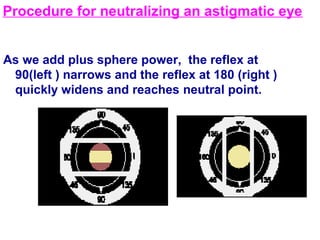

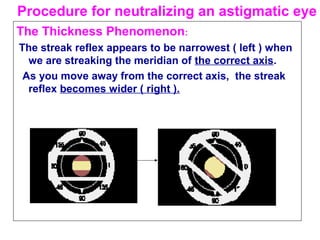
  • 305.
    Treatment of myopia 2(2(Above 6 D (high myopia) - slight underAbove 6 D (high myopia) - slight under correction, because strong minus lensescorrection, because strong minus lenses considerably diminish the size (minify) ofconsiderably diminish the size (minify) of the retinal images and make them verythe retinal images and make them very bright and clear. The very bright and clearbright and clear. The very bright and clear images are uncomfortable to the myopeimages are uncomfortable to the myope because the retina has been accustomedbecause the retina has been accustomed to large and indistinct images.to large and indistinct images.
  • 306.
    Treatment of myopia Contactlenses are indicatedContact lenses are indicated particularly in high myopia.particularly in high myopia. •
  • 307.
    Advantages and disadvantagesof contact lenses Advantages: 1. Contact lenses may have optical advantages for some patients in addition to the cosmetic benefit and the convenience ‫ملمءمة‬ of not having to wear glasses. 2. In high degrees of ametropia, peripheral distortions are reduced with contact lenses due to their small diameter and thinness. 3. Even binocular aphakics enjoy the better peripheral vision, minimum distortion, and reduced magnification that they get with contact lenses. 4. A patient with keratoconus or an irregular cornea for some other reason can frequently achieve satisfactory vision with contact lenses when little or no improvement can be obtained with spectacle. 5. The advantages for those engaged in athletics or with special occupational needs are obvious.
  • 308.
    Disadvantages: 1. Contact lensesare expensive and easily lost or destroyed. 2. Rigid lenses are initially uncomfortable and require a period of adaptation. 3. With the exception of extended-wear lenses, which are replaced at prescribed intervals, the care and cleaning of daily-wear contact lenses are important and must be done on a daily basis. 4. Wearing time may be limited by physiologic factors, and the patient may still have to wear glasses part of the time. 5. A superficial ocular infection becomes more significant in the contact lens patient. 6. Corneal ulcers may occur with contact lenses; they never occur as a result of wearing spectacles. 7. Foreign bodies may become entrapped under a contact lens instead of being immediately washed out by tears.
  • 309.
    Treatment of myopia •Advantages of contact lens over spectacles :Advantages of contact lens over spectacles : 1(1( Provide normal field of vision.Provide normal field of vision. 2(2( Aberrations associated with spectacles –Aberrations associated with spectacles – prismatic distortion, spherical and chromaticprismatic distortion, spherical and chromatic aberration are eliminated.aberration are eliminated. 3(3( Cosmetically contact lenses are more pleasantCosmetically contact lenses are more pleasant than thick myopic glasses. However contrary tothan thick myopic glasses. However contrary to popular belief contact lenses have not beenpopular belief contact lenses have not been proved to reduce the degree of myopia.proved to reduce the degree of myopia.
  • 310.
    Treatment of myopia OrthokeratologyOrthokeratology •Orthokeratology is the programmed fitting of aOrthokeratology is the programmed fitting of a series of contact lenses, over a period of weeksseries of contact lenses, over a period of weeks or months, to flatten the cornea and reduceor months, to flatten the cornea and reduce myopia. Studies of orthokeratology with standardmyopia. Studies of orthokeratology with standard rigid contact lenses show that individual’srigid contact lenses show that individual’s response varies considerably to orthokeratology,response varies considerably to orthokeratology, with myopia reduction up to 3.00 D obtained inwith myopia reduction up to 3.00 D obtained in some patients.some patients. • The average reduction reported in studies wasThe average reduction reported in studies was 0.75-1.00 D; most of this reduction occurs within0.75-1.00 D; most of this reduction occurs within the first 4-6 months of the orthokeratologythe first 4-6 months of the orthokeratology program.program.
  • 311.
    Treatment of myopia •Corneas with greater peripheral flatteningCorneas with greater peripheral flattening are thought more likely to have successfulare thought more likely to have successful central flattening, thus leading to reducedcentral flattening, thus leading to reduced myopia via orthokeratology.myopia via orthokeratology. • With adequate follow up care,With adequate follow up care, orthokeratology is a safe and effectiveorthokeratology is a safe and effective procedure. However, studies suggest thatprocedure. However, studies suggest that refractive error shifts toward the originalrefractive error shifts toward the original baseline( starting linebaseline( starting line ) in patients.n patients.
  • 312.
    Treatment of myopia VisualhygieneVisual hygiene recommendationsrecommendations includeinclude the following:the following: 1.1. When reading or doing intensive nearWhen reading or doing intensive near work, take a break about every 30work, take a break about every 30 minutes. During the break, stand up andminutes. During the break, stand up and look out a window.look out a window. 2.2. When reading, maintain proper distanceWhen reading, maintain proper distance from the book .The book should be atfrom the book .The book should be at least as far from the eyes as 40 cm.least as far from the eyes as 40 cm.
  • 313.
    Treatment of myopia 3.3.Be sure that illumination is sufficient forBe sure that illumination is sufficient for reading. Avoid glare on the page by using areading. Avoid glare on the page by using a diffuse light source and allowing it to shine ondiffuse light source and allowing it to shine on the page from behind (over the shoulder)the page from behind (over the shoulder) ,rather than shining or reflecting toward the,rather than shining or reflecting toward the eyes.eyes. 4.4. Read or do other visual work using a relaxedRead or do other visual work using a relaxed upright posture.upright posture. 5.5. Place a limit on the time spent watchingPlace a limit on the time spent watching television and watching video games. Sit 5-6television and watching video games. Sit 5-6 feet away from the television.feet away from the television.
  • 314.
    Treatment of myopia •LasikLasik (laser Assisted in situ(laser Assisted in situ keratomileusiskeratomileusis): In LASIK a thin, central flap is): In LASIK a thin, central flap is created in the outer layers of the cornea,created in the outer layers of the cornea, consisting of the epithelium and a portion of theconsisting of the epithelium and a portion of the outer stroma. Following lifting of the flap, theouter stroma. Following lifting of the flap, the laser is used to reshape the exposed stromallaser is used to reshape the exposed stromal bed. The flap is replaced without the need forbed. The flap is replaced without the need for sutures, and the edges heal over night.sutures, and the edges heal over night. • The entire process takes just minutes toThe entire process takes just minutes to perform. As the flap of the epithelium remainsperform. As the flap of the epithelium remains intact immediately following the procedure,intact immediately following the procedure, vision recovers quickly and discomfort is kept tovision recovers quickly and discomfort is kept to a minimum.a minimum.
  • 315.
    General guidelines forfinalGeneral guidelines for final correction of astigmatismcorrection of astigmatism 1.1. In children requiring correction, the fullIn children requiring correction, the full astigmatic correction is given.astigmatic correction is given. 2.2. If the child is amblyopic from unilateralIf the child is amblyopic from unilateral astigmatism; a trial of lenses is indicated beforeastigmatism; a trial of lenses is indicated before occlusion therapy.occlusion therapy. 3.3. In adult who is asymptomatic, be waryIn adult who is asymptomatic, be wary. ‫ذ ر‬ِ‫اي‬‫ح‬. ‫ذ ر‬ِ‫اي‬‫ح‬ ‫ر س‬ِ‫اي‬ ‫ت‬َ‫ِر‬‫ح‬ْ‫ِق‬ ‫م‬ُ‫ر س‬ِ‫اي‬ ‫ت‬َ‫ِر‬‫ح‬ْ‫ِق‬ ‫م‬ُ of changing the axis of their correctingof changing the axis of their correcting cylinder even if apparently incorrect, they havecylinder even if apparently incorrect, they have achieved adaptation to distortion and blur andachieved adaptation to distortion and blur and will often be unhappy with any change.will often be unhappy with any change.
  • 316.
    General guidelines forfinalGeneral guidelines for final correction of astigmatismcorrection of astigmatism 4.4. If an adult was previously fully corrected andIf an adult was previously fully corrected and the amount of astigmatism has changed, hethe amount of astigmatism has changed, he will probably tolerate full correction, especiallywill probably tolerate full correction, especially if the axis at 90 or 180.if the axis at 90 or 180. 5.5. If an adult was not corrected for the fullIf an adult was not corrected for the full amount of astigmatism, distortion may result inamount of astigmatism, distortion may result in a real problem. The only way to predict this isa real problem. The only way to predict this is with full correctionwith full correction in placein place in the trial framein the trial frame under binocular condition and ask the patientunder binocular condition and ask the patient about any distortion.about any distortion.
  • 317.
    General guidelines forfinalGeneral guidelines for final correction of astigmatismcorrection of astigmatism 6.6. If the patient is intolerant of the cylinderIf the patient is intolerant of the cylinder correction,correction, contact lensescontact lenses will reduce thewill reduce the distortion associated with the correctiondistortion associated with the correction of the astigmatism.of the astigmatism. 7.If the patient is equally intolerant of the7.If the patient is equally intolerant of the distortion or incapable or intolerant ofdistortion or incapable or intolerant of contacts, consideration of refractivecontacts, consideration of refractive surgery (LASIK) should be given.surgery (LASIK) should be given.
  • 318.
    Treatment of Astigmatism SpectacleLenses have an inverse proportion of correction with the degree of astigmatism. • According to the type of astigmatism the corrective lens will be determined:- 1. Regular astigmatism :in which the two principle meridians are at right angle and is susceptible to easy correction by cylindrical lenses. 2. Oblique astigmatism :in which the two principle meridians are not at right angle but are crossed obliquely , it is corrected by using spherocylindrical lenses ,it is not very common. 3. Irregular astigmatism :where there are irregularities in the curvature of the meridians so that no geometrical figure is formed ,and the correction is very difficult.
  • 319.
    Treatment of Regular Astigmatism Uncorrectedastigmatism Corrected astigmatism
  • 320.
    Because the lightis split into two separate foci in astigmatic eye, a lens with two different power curves is needed to correct the astigmatism. These lenses are called cylindrical Lenses. Because of the different powers, these lenses have a variable edge profile that is thinner in some places and thicker in others. These lenses are more complex and have to be of the highest optical quality in order to produce good vision for the astigmatic patient.. Spectacles
  • 321.
    Treatment of Irregular Astigmatism Theoptical treatment of all these varieties of irregular astigmatism is often unsatisfactory. • The refraction must be estimated by a time- consuming method of trial and error, which is frequently unrewarding (unsatisfactory(. • Improvement with spectacle lenses will in many cases be disappointingly small, but determined attempts to improve the vision by this means should be made as the results may occasionally be surprisingly satisfactory.
  • 322.
    Treatment of Irregular Astigmatism •Typically in conical cornea but even in other cases with actual opacities present, an immense‫هائل‬ visual improvement may be obtained by employing hard or semi-soft contact lenses. • In other cases where the condition is serious lamellar keratoplasty in central area of a conical cornea or excision of a scar and its replacement by a graft (Epikeratoplasty( is the most effective method of treatment.
  • 323.
    Surgeries available forastigmatism 1. AK( (Astigmatic keratotomy 2. PRK 3. LASIK 4. Lens surgery 5. LASEK 6. Intacs Lecture 13
  • 324.
    Corneal surgery 1. Arcuatekeratotomy involves making paired arcuate incisions on opposite sides of the cornea in the axis of the correcting plus cylinder (the steep meridian(. The resultant flattening of the steep meridian coupled with a smaller steepening of the flat meridian at 90 degree to the incisions reduces astigmatism. • The desired result can be controlled by varying the length, depth of the incisions and their distance from the optical centre of the cornea. • Arcuate keratotomy may be combined with compression sutures placed in the perpendicular meridian, when treating large degrees of astigmatism such as may occur following penetrating keratoplasty.
  • 325.
    Surgeries available forastigmatism •2.PRK can correct up to 3D. • Since the advent of LASIK the procedure is being performed less frequently and is largely reserved for patients who are unsuitable for LASIK . • 3. LASIK can correct up to 15D.
  • 326.
    Surgeries available forastigmatism 4-Lens surgery : • Involves using a toric intraocular implant at the time of cataract extraction. However, postoperative rotation of the implant away from the desired axis may occur. • Lens surgery involves: A-Removal of the crystalline lens without I.OA-Removal of the crystalline lens without I.O Lens implantation.Lens implantation. B- Nonremoval of the crystalline lens with I.OB- Nonremoval of the crystalline lens with I.O Lens implantationLens implantation
  • 327.
    Non corneal interventionNoncorneal intervention A( Removal of lens was attempted occasionallyA( Removal of lens was attempted occasionally in the past to neutralize high myopia.in the past to neutralize high myopia. The operation is hazardous since it may cause :The operation is hazardous since it may cause : 1.1. Vitreous lossVitreous loss 2.2. Retinal detachment.Retinal detachment. 3.3. Loss of accommodationLoss of accommodation 4.4. Near work should be restricted.Near work should be restricted. 5.5. Illumination must be good, print should be large.Illumination must be good, print should be large. B( Nonremoval of the crystalline lens with I.OB( Nonremoval of the crystalline lens with I.O Lens implantation in AC to decrease theLens implantation in AC to decrease the refractivity of the eye.refractivity of the eye.
  • 328.
    Astigmatic keratotomy( AK) •Astigmatic keratotomy is a variation of RK (radial keratotomy(, used to treat astigmatism. • AK uses arc-shaped incisions in the cornea, whereas RK uses radial incisions, like the spokes of a wheel. Neither RK nor AK is performed with a laser.
  • 329.
    Glare at nightcan also be expected for the same length of time. Some patients have complained for up to 3 years. However, glare testing shows no significant glare after 1 year in 99.3% of the cases. Approximately 83% of patients in the expected range achieve unaided post-operative 20/40 (or better) vision.
  • 330.
    The Procedure OfAK The patient is given a mild sedative prior to surgery and the eye is prepared normally. Generally, the non-dominant eye is selected for the first operation , with an average minimum wait of one week before surgery is performed on the dominant eye.
  • 331.
    •During the operation,the front surface of the eye is numbed with drops (TOPICAL ANAESTHESIA). •Some surgeons advocate retro-bulbar anesthesia. •A mark in a spoke-like pattern is then impressed the cornea. This is temporary and is used for marking where the surgeon will make the incisions. The marks are based upon a formula determining your prescription, age, and the amount of correction needed. The Procedure Of AK
  • 332.
    The Procedure OfAK The surgeon will then make several incisions (keratotomies) in the cornea using a microscope and a microscopic surgical instrument that has a diamond tip. This diamond instrument has a safeguard which prevents it from penetrating into your eye. The actual surgery time takes about 5 minutes but with pre-operative preparations it can take up to an hour.
  • 333.
    Precise microscopic controlmust be maintained over the length, depth, and arrangement of these micro-incisions in order to achieve proper optical correction. These micro-incisions allow the central cornea to be regular, removing the asymmetric shape that causes astigmatism, thus partially or completely correcting the vision impairment. The Procedure Of AK
  • 334.
    The Procedure OfAK • Antibiotic and cycloplegic drops are then applied and the lid speculum removed. • A patch is then placed on the eye for approximately 2 hours. • Other than diligent ‫ق ن‬َ‫ِر‬‫مت‬ُ . ‫مجتهد‬ care to avoid getting the eye patch soiled or wet, there are no restrictions placed on the patient. • Antibiotic drops are used for l-2 weeks after the surgical procedure.
  • 335.
    After Operation 1-For thefirst 24 hours after the surgery, the patient may experience some sensitivity to light, mild scratchiness, and/or redness in the operated eye. 2-There may also be some pain which is usually alleviated by common, pain killer medication. 3-Vision is usually good within the first week, but fluctuation of visual acuity from morning to night can be expected for up to 6 months or longer. Occasionally, a second operation is needed to reduce any residual myopia.
  • 336.
    PRK: Photorefractive Keratectomy PRK:Photorefractive Keratectomy uses the cool beam of the excimer laser to reshape the front of the eye by treating the surface of the cornea so that light rays focus more sharply on the retina. The outer surface of the cornea, called the epithelium, must be removed. This is accomplished by carefully scraping it away. The laser is then applied to remove microscopic amounts of corneal tissue, measured in microns.
  • 337.
    PRK: Photorefractive Keratectomy •The epithelium grows back over the treated area within several days. A bandage contact lens is placed on the eye to minimize discomfort during this healing period. • Complete healing and visual recovery can take as long as 3-6 months with PRK.
  • 338.
    Excimer laser PHOTOREFRACTIVE KERATECTOMY • Theexcimer laser makes pulses of invisible ultraviolet light. Each pulse of light removes a microscopic layer from the corneal stroma, changing the curvature of the cornea ever so slightly.
  • 339.
    PHOTOREFRACTIVE KERATECTOMY • To correctnearsightedness, the curvature of the cornea must be decreased the cornea must be made flatter. • To correct farsightedness, the curvature of the central cornea must be increased. • To correct astigmatism, the curvature must be altered in one specific direction.
  • 340.
    PHOTOREFRACTIVE KERATECTOMY • Low amountsof nearsightedness, astigmatism or farsightedness, will require smaller amounts of tissue removal, and larger corrections will require greater amounts. The total treatment usually takes less than one minute of actual laser time
  • 341.
    PHOTOREFRACTIVE KERATECTOMY • A computerrunning specialized software determines the exact pattern of pulses needed to remove the right amount of corneal tissue. The computer also directs the actual operation of the laser system.
  • 342.
    PHOTOREFRACTIVE KERATECTOMY DISADVANTAGES ANDCOMPLICATIONS • 1-Discomfort is very minimal during or after the procedure. • 2-Fewer than 2% report any kind of pain. • 3-It is normal to have a sensation of dryness or tired eyes after surgery. This sensation diminishes with time. • 4-The eyes may be red following the procedure. This redness is harmless, and will fade within a few days.
  • 343.
    PHOTOREFRACTIVE KERATECTOMY DISADVANTAGES ANDCOMPLICATIONS 5-Many people will experience glare or haloes at night for a few weeks to several months postoperatively. This diminishes, and in most cases will disappear entirely over time. 6-Undercorrection or overcorrection
  • 344.
    If any ofthe following conditions apply to you, then you are NOT a good candidate for PRK Contraindications of PRK 1. KERATOCONUS. 2. High I.O.P 3. Intraocular inflammation 4. Weak cornea due to local or general disease 5. Cataract
  • 345.
    6.Pregnancy. 7. Unstable refractiveerror (your vision has been changing over the past 12 months). 8. Collagen/Vascular disease. 9. Active ocular disease. 10. Under 18 years of age. 11. Pacemaker users. Contraindications of PRK
  • 346.
    ‫اللايــزك‬ ‫عملايــــة‬LASIK Laser in-situkeratomileusis •‫الزكزيمرلايز ر‬ ‫أشعة‬ ‫تسلايط‬ ‫عملاية‬ ‫ع ن‬ ‫عبا رة‬ ‫هي‬ ‫اللايزك‬ ‫عملاية‬ ‫القرناية‬ ‫م ن‬ ‫جزء‬ ‫قطع‬ ‫يتم‬ ‫حايث‬ ،‫الداخلاية‬ ‫القرناية‬ ‫طبقات‬ ‫على‬ ‫بمقدا ر‬ ‫اللكتروني‬ ‫القطع‬ ‫جهاز‬ ‫بوةلسلساطة‬270‫وبعد‬ ،‫د رجة‬ ‫على‬ ‫اللايز ر‬ ‫أشعة‬ ‫وتسلايط‬ ‫المقطوع‬ ‫الجزء‬ ‫ثني‬ ‫يتم‬ ‫ذلك‬ ‫المقطوع‬ ‫الجزء‬ ‫إعادة‬ ‫يتم‬ ‫ذلك‬ ‫بعد‬ ،‫للقرناية‬ ‫الداخلاية‬ ‫الطبقات‬ .‫خاياطه‬ ‫بدون‬ ‫الطبايعي‬ ‫مكانه‬ ‫إلى‬ ‫القرناية‬ ‫م ن‬ LASIK combines the precision of the excimer laser that is used in PRK surgeries with the flap technique that characterizes this surgery.
  • 347.
    LASIK Surgery Laser in-situkeratomileusis There are FDA regulations governing which particular excimer laser may be used to correct which particular type and degree of refractive error. For instance, one excimer laser was recently approved for LASIK treatment of nearsightedness up to -14.0 diopters with or without up to -5.0 diopters of astigmatism. These are high amounts of refractive error and include most nearsighted people. But there are quite a few people with more than -14.0 diopters of nearsightedness, and the FDA feels they will not achieve a satisfactory result.
  • 348.
    LASIK LASIK FACTS • Rangeof Correction: LASIK, Laser Assisted In Situ Keratomileusis, is state- of-the-art in refractive surgery. It is used to correct nearsightedness up to 20 diopters, farsightedness up to 5 diopters, and astigmatism up to 5 diopters
  • 349.
    LASIK • However withLASIK, the epithelium is not removed. Instead, using a precision instrument called a microkeratome, a hinged flap consisting of an extremely thin layer of epithelial tissue is created. • This flap is then gently folded back out of the way while precisely measured pulses of cool laser light are applied to the underlying tissue.
  • 350.
    LASIK • The non-thermallaser breaks the molecular bonds of corneal cells, which are vaporized a layer at a time, until the desired correction is achieved. These changes to the cornea are so minute that they must be measured in microns… thousandths of a millimeter (It would take 200 pulses of the laser to cut through the thickness of a single human hair!)
  • 351.
    LASIK • Afterward theflap is carefully repositioned where, thanks to the remarkable natural bonding qualities of the corneal tissue, it adheres and quickly heals without the need for stitches. Drops to prevent infection may be used for a few days following LASIK.
  • 352.
    LASIK • Where isit done? LASIK is performed as an outpatient procedure with topical anesthetic and a mild sedative. It takes about fifteen minutes per eye, with both eyes being done on the same day.
  • 353.
    LASIK • Age isa factor: We do not offer LASIK to anyone under 18. Young people's eyes are often still changing rapidly. A stable eyeglasses prescription (no significant changes in the past two years) is important to a good outcome.
  • 354.
    LASIK • During theuse of the microkeratome some patients notice a sensation of pressure and a graying of vision, associated with a suction ring which holds the eye steady.
  • 355.
    LASIK • Recovery withLASIK is very rapid. Most people achieve good, functional vision and can go back to work within 2 days.
  • 356.
    LASIK Results • Theresults are even better: 96% of the patients achieve 20/20 or better vision without glasses, with 99% of the patients achieving 20/25 or better vision. After the initial treatment, 90% of patients will have 20/25 or better vision without glasses, and 99% will have 20/40 or better vision without glasses. 20/40 vision is good enough to pass the driver's vision test without glasses For patients with mild nearsightedness, farsightedness, or astigmatism, the results are even better. Patients requiring higher amounts of correction will have less accurate results.
  • 357.
    LASIK Advantages • 1-Thequality of vision after laser vision correction is usually superior to vision with contact lenses or glasses. • 2-Patients generally have less glare than they had with contact lenses • 3-The inconvenience and discomfort of contact lenses is eliminated. • 4-Side vision isn't blocked, as it is with glasses • 5- There is no longer the problem of dirty, wet or scratched glasses.
  • 358.
    RESULTS • 6-The vastmajority of patients no longer need glasses or contact lenses for distance vision after laser vision correction treatment.
  • 359.
    PRK versus LASIK:Comparisons range of correction PRK LASIK low to moderate low to severe wound depth superficial 20%deep intraoperative pain none none post-operative medications 3months, possibly more 1-2weeks functional vision recovery 3to 5 days 24hours Corneal epithelium Completely removed Completely repositioned visual results fully recognized 3weeks to several months 1to 4 weeks return to work 3to 5 days 1day risk of complications low (more surgeon dependent( low (less surgeon dependent( risk of scarring in central cornea 1-2% 1%
  • 360.
    ‫الليزك‬ ‫لعملية‬ ‫التحضيرية‬‫الخطوات‬ Indications and Contraindications Of LASIK ‫خطوات‬ ‫وهي‬ ،‫اللايزك‬ ‫لعملاية‬ ‫التحضايرية‬ ‫الخطوات‬ ‫الجدول‬ ‫يباي ن‬ ‫ل‬ ‫مما‬ ‫للعاي ن‬ ‫ودقايق‬ ‫زكامل‬ ‫بفحص‬ ‫القايام‬ ‫وتستدعي‬ ‫مطولة‬ ‫تتراوح‬ ‫طويلة‬ ‫مدة‬ ‫التحضاير‬ ‫عملاية‬ ‫تستغرق‬ ‫أن‬ ‫معه‬ ‫يستغرب‬ .‫الزم ن‬ ‫م ن‬ ‫ةلسلساعتاي ن‬ ‫إلى‬ ‫ةلسلساعة‬ ‫باي ن‬ ‫ما‬ ‫الفحوصات‬ ‫أهم‬ ‫م ن‬ ‫واحد‬ ‫للعاي ن‬ ‫الطبوجرافي‬ ‫للتصوير‬ ‫صو رة‬ ‫واللايزك‬ ‫اللايز ر‬ ‫لعملايات‬ ‫التحضايرية‬
  • 361.
    ‫العاي ن‬ ‫ضغط‬‫قايا س‬1 ،‫اللايزك‬ ‫عملاية‬ ‫قبل‬ ‫عاينه‬ ‫ضغط‬ ‫المريض‬ ‫يعرف‬ ‫أن‬ ‫المهم‬ ‫م ن‬ ‫إجراء‬ ‫بعد‬ ‫العاي ن‬ ‫لضغط‬ ‫حقايقي‬ ‫غاير‬ ‫ا‬ً ‫انخفاض‬ ‫هناك‬ ‫لن‬ ‫العاي ن‬ ‫ضغط‬ ‫يقال‬ ‫ال‬ً ‫فمث‬ ‫بال رقام‬ ‫العاي ن‬ ‫ضغط‬ ‫يكتب‬ ‫العملاية‬ 17‫م ن‬ ‫للعاي ن‬ ‫الطبايعي‬ ‫الضغط‬ ‫بأن‬ ‫ا‬ً ‫علم‬ ‫زئبق‬ ‫ملايمتر‬11 ‫إلى‬19‫زئبق‬ ‫ملايمتر‬
  • 362.
    ‫للعاي ن‬ ‫الطبوجرافي‬‫التصوير‬2 .‫العملاية‬ ‫إجراء‬ ‫قبل‬ ‫أةلسلساةلسلسي‬ ‫متطلب‬ ‫للعاي ن‬ ‫الطبوجرافي‬ ‫التصوير‬ .‫مخروطاية‬ ‫قرناية‬ ‫اشتباه‬ ‫بها‬ ‫يوجد‬ ‫التي‬ ‫العاي ن‬ ‫لةلسلستبعاد‬ ‫وذلك‬ ‫للعاي ن‬ ‫الطبوجرافي‬ ‫الشكل‬ ‫تباي ن‬ ‫ملونة‬ ‫صو رة‬
  • 363.
    The Before imageis relatively steep, as indicated by the green and yellow colors. This patient also had astigmatism (irregularly shaped cornea) seen as an hourglass shape, in yellow. After the procedure, topography shows a much flatter, and more even cornea. This patient had nearly 8 diopters of myopia and astigmatism corrected.
  • 364.
    ‫قايا س‬‫القرنية‬ ‫سماكة‬3 Pachymetry ‫بعض‬‫في‬ ‫العملية‬ ‫إجرامء‬ ‫من‬ ‫يمنع‬ ‫قد‬ ‫القرنية‬ ‫سماكة‬ ‫انخفاض‬ ‫نظر‬ ‫قصر‬ ‫لدياهم‬ ‫لمن‬ ‫الكامل‬ ‫التصحيح‬ ‫من‬ ‫يحد‬ ‫وقد‬ ،‫اليحيان‬ ‫القرنية‬ ‫سماكة‬ ‫يقال‬ ‫ل‬ً ‫ي‬ ‫فمث‬ ‫بالرقام‬ ‫القرنية‬ ‫سماكة‬ ‫تكتب‬ ‫شديد‬ 520‫مايكرون‬
  • 365.
    ‫النكساري‬ ‫النحراف‬ ‫قياس‬4 ASTIGMATISM ‫إمكاناية‬‫مدى‬ ‫تحديد‬ ‫يمك ن‬ ‫النكسا ري‬ ‫النحراف‬ ‫قايا س‬ ‫على‬ ‫ء‬ً ‫بنا‬ .‫إجرائها‬ ‫حال‬ ‫في‬ ‫النجاح‬ ‫ونسبة‬ ‫عدمه‬ ‫م ن‬ ‫العملاية‬ ‫إجراء‬ ‫وزكتابة‬ ‫ناقص‬ ‫أو‬ ‫زائد‬ ‫عالمة‬ ‫وضع‬ ‫مع‬ ‫بال رقام‬ ‫المقا س‬ ‫يكتب‬ ‫النحراف‬ ‫زاوية‬ ‫وجود‬ ‫حالة‬ ‫في‬Axis of cylinder
  • 366.
    ‫أخرى‬ ‫موانع‬5 ‫عند‬ ‫المختص‬‫الطبايب‬ ‫يكتشفها‬ ‫قد‬ ‫أخرى‬ ‫موانع‬ ‫إلى‬ ‫بالضافة‬ ‫هذا‬ .‫العملاية‬ ‫قبل‬ ‫العاي ن‬ ‫على‬ ‫الكشف‬ ‫المزم ن‬ ‫الفايروةلسلسي‬ ‫القرناية‬ ‫التهاب‬ ‫مثل‬
  • 367.
    ‫العين‬ ‫من‬ ‫المامي‬‫الجزمء‬ ‫فحص‬6 ‫معرفة‬ ‫م ن‬ ‫الجراح‬ ‫يمك ن‬ ‫العاي ن‬ ‫م ن‬ ‫المامي‬ ‫الجزء‬ ‫فحص‬ ‫ناتج‬ ‫العملاية‬ ‫إجراء‬ ‫م ن‬ ‫تمنع‬ ‫وقد‬ ‫العاي ن‬ ‫تعانايها‬ ‫أخرى‬ ‫أمراض‬ ‫والجف ن‬ ‫والملتحمة‬ ‫والعدةلسلسة‬ ‫القرناية‬ ‫وضع‬ ‫ع ن‬ ‫بايانات‬ ‫الفحص‬ ‫العاي ن‬ ‫م ن‬ ‫المامي‬ ‫الجزء‬ ‫وبقاية‬ As iridocyclitis and corneal scarring and keratoconjuctival sicca
  • 368.
    ‫العين‬ ‫قاع‬ ‫فحص‬7 ‫عالجها‬‫يلزم‬ ‫فإنه‬ ‫الشبكاية‬ ‫في‬ ‫ثقوب‬ ‫او‬ ‫امراض‬ ‫وجود‬ ‫حالة‬ ‫في‬ ‫اختصاصي‬ ‫بمراجعة‬ ‫ينصح‬ ‫زكما‬ ‫اللايزك‬ ‫عملاية‬ ‫في‬ ‫البدء‬ ‫قبل‬ ‫العالي‬ ‫النظر‬ ‫بقصر‬ ‫المصاباي ن‬ ‫لكل‬ ‫ا‬ً ‫دو ري‬ ‫شبكاية‬ ‫البصري‬ ‫العصب‬ ‫وحالة‬ ‫الشبكاية‬ ‫لشكل‬ ‫ رةلسلسم‬ ‫الفحص‬ ‫ناتج‬ ِ‫اي‬As complications of high myopia
  • 369.
    ‫قرب‬ ‫عن‬ ‫البصار‬8 Presbyopia ،‫الربعاي ن‬ ‫ةلسلس ن‬ ‫م ن‬ ‫يقتربون‬ ‫الذي ن‬ ‫للشخاص‬ ‫مهم‬ ‫الفحص‬ ‫هذا‬ ‫إجراء‬ ‫بعد‬ ‫قراءة‬ ‫نظا رة‬ ‫إلى‬ ‫لحتاياجهم‬ ‫ل‬ً ‫احتما‬ ‫هناك‬ ‫إن‬ ‫حايث‬ ‫اللايزك‬
  • 370.
    ‫اللوان‬ ‫رؤية‬ ‫قياس‬9 Colourvision ‫أجروا‬ ‫الذي ن‬ ‫للخدمة‬ ‫المتقدماي ن‬ ‫تقبل‬ ‫العسكرية‬ ‫الكلايات‬ ‫بعض‬ ‫هنا‬ ‫وم ن‬ ‫لللوان‬ ‫طبايعاية‬ ‫ رؤية‬ ‫تشترط‬ ‫ولكنها‬ ،‫اللايزك‬ ‫عملاية‬ ‫ناتج‬ ‫الشخاص‬ ‫م ن‬ ‫النوع‬ ‫لهذا‬ ‫الفحص‬ ‫هذا‬ ‫أهماية‬ ‫جاءت‬ ‫لللوان‬ ‫طبايعاية‬ ‫ رؤية‬ :‫التالي‬ ‫النحو‬ ‫على‬ ‫عادة‬ ‫يكتب‬ ‫الفحص‬ ‫لللوان‬ ‫طبايعاية‬ ‫غاير‬ ‫ رؤية‬ ‫أو‬
  • 371.
    ‫والسكري‬ ‫الحمل‬ ‫فحص‬10 ‫اضطراب‬،‫الوضع‬ ‫حاي ن‬ ‫إلى‬ ‫العملاية‬ ‫يؤجل‬ ‫قد‬ ‫ال‬ُ ‫مث‬ ‫الحمل‬ ‫وجود‬ ‫وهكذا‬ ‫العملاية‬ ‫إجراء‬ ‫م ن‬ ‫يمنع‬ ‫قد‬ ‫السكر‬ ‫مريض‬ ‫لدي‬ ‫السكري‬ ‫أخرى‬ ‫باطناية‬ ‫أمراض‬ ‫وجود‬ ‫معرفة‬
  • 372.
    ‫العام‬ ‫الصحى‬ ‫الوضع‬11 ‫قبل‬‫وطبايبه‬ ‫المريض‬ ‫باي ن‬ ‫والتشاو ر‬ ‫الفحص‬ ‫م ن‬ ‫مهم‬ ‫جزء‬ ‫هذا‬ ،‫إلايها‬ ‫الوصول‬ ‫يمك ن‬ ‫التي‬ ‫الواقعاية‬ ‫النتائج‬ ‫ومعرفة‬ ‫العملاية‬ ‫إلايها‬ ‫الوصول‬ ‫يمك ن‬ ‫ل‬ ‫مثالاية‬ ‫توقعات‬ ‫تخايل‬ ‫المريض‬ ‫يجنب‬ ‫المضاعفات‬ ‫ونسب‬ ‫النجاح‬ ‫نسب‬ ‫معرفة‬ ‫العملاية‬ ‫خالل‬ ‫م ن‬ ‫والتعلايمات‬ ‫العملاية‬ ‫عقب‬ ‫الرؤية‬ ‫لةلسلستقرا ر‬ ‫المتوقع‬ ‫والوقت‬ ‫وبعدها‬ ‫العملاية‬ ‫قبل‬ ‫اتباعها‬ ‫المطلوب‬
  • 373.
    ‫القرنية‬ ‫تحدب‬ ‫قياس‬12 Keratometry ‫مضاعفات‬‫حدوث‬ ‫احتمال‬ ‫م ن‬ ‫يزيد‬ ‫قد‬ ‫القرناية‬ ‫تحدب‬ ‫ا رتفاع‬ ‫وجود‬ ‫ا‬ً ‫ناتج‬ ‫يكون‬ ‫قد‬ ‫الكباير‬ ‫ال رتفاع‬ ‫أن‬ ‫زكما‬ ،‫العملاية‬ ‫خالل‬ ‫العادة‬ ‫في‬ ‫والتي‬ ‫القرناية‬ ‫تحدب‬ ‫د رجة‬ ‫تحديد‬ ‫مخروطاية‬ ‫قرناية‬ ‫باي ن‬ ‫ما‬ ‫تكون‬42-44‫د رجة‬
  • 374.
    ‫البؤبؤ‬ ‫قطر‬ ‫قياس‬13 ‫عقب‬‫اللايلاية‬ ‫الرؤية‬ ‫مستوى‬ ‫على‬ ‫يؤثر‬ ‫قد‬ ‫العاي ن‬ ‫بؤبؤ‬ ‫قطر‬ ‫ا رتفاع‬ ‫باي ن‬ ‫يكون‬ ‫ما‬ ‫عادة‬ ‫العاي ن‬ ‫بؤبؤ‬ ‫قطر‬ ‫معرفة‬ ‫اللايزك‬ ‫عملاية‬5-7 ‫ملايمترات‬