Frame Selection
Hira Nath Dahal
Frame purpose
Primary purpose – to hold the prescribed lenses in
such a way as to provide the optimum visual
efficiency.
Secondly- frame should be physically comfortable ,
attractive in appearance and meet the
expectation of the patient.
Thirdly – fashion ( spectacles frames have become
an important component of fashion)
Choosing frames to suit you?
• Careful choice of frame can make a difference
to the way you look and the image you create.
• Do you want to blend in or stand out in
crowd?
• An intellectual or something very modern and
individual?
Spectacle frame selection criteria
• LOOKS
• PRESCRIPTION OF YOUR EYES.
• YOUR WORKING ENVIRONMENT
• YOUR HABIT
• Of course YOUR BUDGET
General guidelines for selecting
frame.
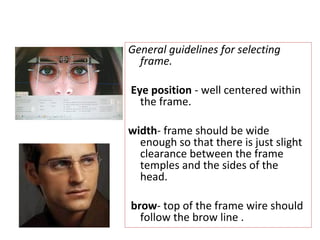
Eye position - well centered within
the frame.
width- frame should be wide
enough so that there is just slight
clearance between the frame
temples and the sides of the
head.
brow- top of the frame wire should
follow the brow line .
• Proportion- size and weight of frame should
be in proportion to the body size and weight.
Slim build – thinner more delicate frames.
• Lenses- thinner , lighter ,reflection free lenses
are always the best choice.
• Attractive frames gently counterbalance your
face shape and features.
For suitable frame..
Consider-
• The shape of your face.
• Your coloring.
• Your nose
• Your eyes
• Your hairline
• The image you wish to project.
Determining face shape
Looking at
the mirror
Face morphology and frame selection
• Frame shape should contrast
with the face shape.
• Frame size should be in scale
with the face size.
• Eye wear should repeat your
personal best feature.
blue frame to match blue eyes.
(Vision Council of America)
The nose
Frame must properly adjust to the nose.
Thin nose- narrow bridge
Large nose-lower and larger bridge
Long nose- lower bridge narrow or large.
Short nose – higher bridge narrow or large.
Shape of the face
Round face
• Frames with angular shapes will
counter balance the roundness of
face- more attractive.
• A clear bridge that widens the eye
and frames.
• Round frames?
• Exaggerate the roundness of face ,
make your face look like a ball.
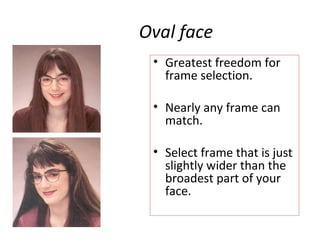
Oval face
• Greatest freedom for
frame selection.
• Nearly any frame can
match.
• Select frame that is just
slightly wider than the
broadest part of your
face.
Base Up triangle
• Frames wider at
the bottom –
minimize the width
of top of face.
• Very light colors
and materials.
• Rimless frame style.
Oblong- shaped face
• Face longer than wide.
• Frames with top to bottom
depth-face appear shorter
and more balanced.
• Decorative or contrasting
temples- add width to face.
• Low bridge- shorten nose.
Base down triangle face
• Narrow forehead, wide
chin area.
• Frames heavily accented
with colors .
• Detailing on the top half
• To add width and
emphasize the narrower
upper third of the face.
Diamond shaped face
• Goal is to add width to
the forehead and jaw
and make cheekbones
appear narrow.
• Use of softly curved
frames no wider than
cheekbones.
• Square frames.
Square face
• Oval or slightly angular
frame styles with curved.
• Frames with hinges
located above eye level
can help lengthen the
face.
• A bridge located near the
top of the frame can also
add length.
Frame and coloring
• Chose color that
complements your skin
tone.
• Cool complexions have
blue or pink undertones
and will look good in black,
magenta, pink and some
blues.
• Warm complexions have a
yellow cast and should be
complemented by camel,
gold, peach and orange .
Eyes
• Eyes widely spaced-
a thick or dark
bridge will help to
draw them
together.
• Eyes closer-slim or
clear bridge make
less noticeable.
hairline
• Receding hairlines lengthen the face .
• To balance try wider frames with a strong
top line.
• To highlight the eyes and define the check
bones try frames with detail or distinctive
brow lines.
Image
• Important aspect of
frame selection.
• Consider your
occupation when
choosing the
frame.
• Frame should
emphasize personal
image.
Working environment and frame
selection
• Field job exposed to lot of heat and dust-
Avoid metal frames.
• Engaged in sport- plastic frames.
• Heavy labor- protective frames .
Frame and habit
• Habit should be considered while selecting
frame.
• Metal frames not suitable for children who
usually jump, fight , play carelessly.
• reader may bend his metal frames while he
doses with them on his nose.
Prescription and frame selection
High myopia
• Small, round frame shapes
are best to reduce lens
thickness
• Angular frames with sharp
corners will accent the
thickness of the lenses
• Frames that look good
with Plano lenses may be
very unattractive with high
minus lenses
Aphakia and high hyperopia
• Sturdy, light weight, easily adjustable frame.
• Avoid frames with thick wires – increase the
width of the ring scotoma.
• Adjustable pads, jumbo pads
• Pads adjusted – lens fit as close to the eye as
possible.
• Select frame with relatively small eye size with
symmetrical lens shape.
Frame for PAL
• The frame selected should
provide a minimum vertical
distance of 22mm from the
centre of the pupil.
• The vertical measurement of
frame must be minimum of
38mm.
• To provide a wide lateral field of
view through the progressive
corridor and stabilize the near
vision area , the patents frame at
as close a vertex distance as
possible.
Frame selection for children
• comfortable and practical as well as
stylish
• Well designed and attractive with
features like
small and symmetrical
colourful
adjustable nose pads
saddle bridge for small nose.
spring hinge for durability and comfort.
• Nickel-free - Hypo-allergenic for
those with metal allergies
• Rimless Frames - very light and
almost invisible, like wearing no
spectacles at all.
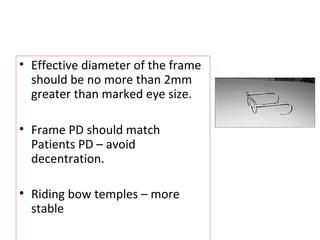
• Effective diameter of the frame
should be no more than 2mm
greater than marked eye size.
• Frame PD should match
Patients PD – avoid
decentration.
• Riding bow temples – more
stable
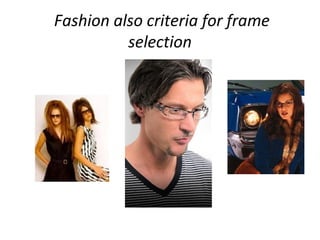
Fashion also criteria for frame
selection
• Recently eye ware have become
an important component of
fashion.
• The public is convinced that
attractiveness in eyeglasses, as
judged in relation to current
fashion norms , is not an option
but a necessity.
• So eye care practitioner must
consider the spectacle frame not
only as a” clinical appliance "but
also as an item of style and
fashion.

Frame slection

  • 1.
  • 2.
    Frame purpose Primary purpose– to hold the prescribed lenses in such a way as to provide the optimum visual efficiency. Secondly- frame should be physically comfortable , attractive in appearance and meet the expectation of the patient. Thirdly – fashion ( spectacles frames have become an important component of fashion)
  • 3.
    Choosing frames tosuit you? • Careful choice of frame can make a difference to the way you look and the image you create. • Do you want to blend in or stand out in crowd? • An intellectual or something very modern and individual?
  • 4.
    Spectacle frame selectioncriteria • LOOKS • PRESCRIPTION OF YOUR EYES. • YOUR WORKING ENVIRONMENT • YOUR HABIT • Of course YOUR BUDGET
  • 5.
    General guidelines forselecting frame. Eye position - well centered within the frame. width- frame should be wide enough so that there is just slight clearance between the frame temples and the sides of the head. brow- top of the frame wire should follow the brow line .
  • 6.
    • Proportion- sizeand weight of frame should be in proportion to the body size and weight. Slim build – thinner more delicate frames. • Lenses- thinner , lighter ,reflection free lenses are always the best choice. • Attractive frames gently counterbalance your face shape and features.
  • 7.
    For suitable frame.. Consider- •The shape of your face. • Your coloring. • Your nose • Your eyes • Your hairline • The image you wish to project.
  • 8.
  • 9.
    Face morphology andframe selection • Frame shape should contrast with the face shape. • Frame size should be in scale with the face size. • Eye wear should repeat your personal best feature. blue frame to match blue eyes. (Vision Council of America)
  • 10.
    The nose Frame mustproperly adjust to the nose. Thin nose- narrow bridge Large nose-lower and larger bridge Long nose- lower bridge narrow or large. Short nose – higher bridge narrow or large.
  • 11.
    Shape of theface Round face • Frames with angular shapes will counter balance the roundness of face- more attractive. • A clear bridge that widens the eye and frames. • Round frames? • Exaggerate the roundness of face , make your face look like a ball.
  • 12.
    Oval face • Greatestfreedom for frame selection. • Nearly any frame can match. • Select frame that is just slightly wider than the broadest part of your face.
  • 13.
    Base Up triangle •Frames wider at the bottom – minimize the width of top of face. • Very light colors and materials. • Rimless frame style.
  • 14.
    Oblong- shaped face •Face longer than wide. • Frames with top to bottom depth-face appear shorter and more balanced. • Decorative or contrasting temples- add width to face. • Low bridge- shorten nose.
  • 15.
    Base down triangleface • Narrow forehead, wide chin area. • Frames heavily accented with colors . • Detailing on the top half • To add width and emphasize the narrower upper third of the face.
  • 16.
    Diamond shaped face •Goal is to add width to the forehead and jaw and make cheekbones appear narrow. • Use of softly curved frames no wider than cheekbones. • Square frames.
  • 17.
    Square face • Ovalor slightly angular frame styles with curved. • Frames with hinges located above eye level can help lengthen the face. • A bridge located near the top of the frame can also add length.
  • 18.
    Frame and coloring •Chose color that complements your skin tone. • Cool complexions have blue or pink undertones and will look good in black, magenta, pink and some blues. • Warm complexions have a yellow cast and should be complemented by camel, gold, peach and orange .
  • 19.
    Eyes • Eyes widelyspaced- a thick or dark bridge will help to draw them together. • Eyes closer-slim or clear bridge make less noticeable.
  • 20.
    hairline • Receding hairlineslengthen the face . • To balance try wider frames with a strong top line. • To highlight the eyes and define the check bones try frames with detail or distinctive brow lines.
  • 21.
    Image • Important aspectof frame selection. • Consider your occupation when choosing the frame. • Frame should emphasize personal image.
  • 22.
    Working environment andframe selection • Field job exposed to lot of heat and dust- Avoid metal frames. • Engaged in sport- plastic frames. • Heavy labor- protective frames .
  • 23.
    Frame and habit •Habit should be considered while selecting frame. • Metal frames not suitable for children who usually jump, fight , play carelessly. • reader may bend his metal frames while he doses with them on his nose.
  • 24.
    Prescription and frameselection High myopia • Small, round frame shapes are best to reduce lens thickness • Angular frames with sharp corners will accent the thickness of the lenses • Frames that look good with Plano lenses may be very unattractive with high minus lenses
  • 25.
    Aphakia and highhyperopia • Sturdy, light weight, easily adjustable frame. • Avoid frames with thick wires – increase the width of the ring scotoma. • Adjustable pads, jumbo pads • Pads adjusted – lens fit as close to the eye as possible. • Select frame with relatively small eye size with symmetrical lens shape.
  • 26.
    Frame for PAL •The frame selected should provide a minimum vertical distance of 22mm from the centre of the pupil. • The vertical measurement of frame must be minimum of 38mm. • To provide a wide lateral field of view through the progressive corridor and stabilize the near vision area , the patents frame at as close a vertex distance as possible.
  • 27.
  • 28.
    • comfortable andpractical as well as stylish • Well designed and attractive with features like small and symmetrical colourful adjustable nose pads saddle bridge for small nose. spring hinge for durability and comfort. • Nickel-free - Hypo-allergenic for those with metal allergies • Rimless Frames - very light and almost invisible, like wearing no spectacles at all.
  • 29.
    • Effective diameterof the frame should be no more than 2mm greater than marked eye size. • Frame PD should match Patients PD – avoid decentration. • Riding bow temples – more stable
  • 30.
    Fashion also criteriafor frame selection
  • 31.
    • Recently eyeware have become an important component of fashion. • The public is convinced that attractiveness in eyeglasses, as judged in relation to current fashion norms , is not an option but a necessity. • So eye care practitioner must consider the spectacle frame not only as a” clinical appliance "but also as an item of style and fashion.