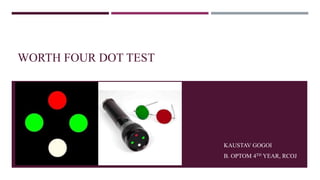
WORTH FOUR DOT TEST
KAUSTAV GOGOI
B. OPTOM 4TH YEAR, RCOJ
LAYOUTS
 INTRODUCTION
 PRINCIPLE
 USES
 METHODS
 REQUIREMENTS
 PROCEDURE
 INTERPRETATION
 ADVANTAGES & DISADVANTAGES
 REFERRENCES
INTRODUCTION
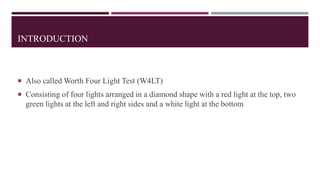
 Also called Worth Four Light Test (W4LT)
 Consisting of four lights arranged in a diamond shape with a red light at the top, two
green lights at the left and right sides and a white light at the bottom
PRINCIPLE
 Based on Anaglyphic method
 Utilizes different colors,such as RED and GREEN,while presenting the two images to
the eyes.
 When the images are viewed,the visual cortex of the brain fuses the images to
produce one integrated stereoscopic image.
WHY IT IS USED -
 To determine suppression
 To determine the nature and type of diplopia
 To identify vertical and horizontal strabismus
METHODS
 There are two ways to perform –
1. Distance worth four dot test: At a 6-meter distance from the patient, there are two
fixed targets that can be presented on a screen or an illuminated box
2. Near worth four dot test: Target is fixed at a distance of 33cm from the patient which
consists of a flashlight to alter the projection angle
REQUIREMENTS
 Trial frame with a red and green filter or Armstrong Goggle
 Illuminated worth four dot box or flashlight
SETUP
 Describe to the patient the test and procedure
 The patient must put on green-and-red glasses (Armstrong glasses). Red light will be visible to the eye
with the red filter on its front (often the right eye), and green light will be visible to the eye with the
green filter on its front (typically the left eye). Before putting on the red and green spectacles, make
sure the patient can’t see the torch.
1. To test at distance (6m) : Make that the patient is using the glasses or contact lenses that are prescribed.
2. To test at near (33cm) : Hold the Worth 4-dot torch or flashlight such that the patient is reading it while
slanting his or her head slightly downward. Make that the patient is wearing the correct refractive
correction for near-distance testing if they have presbyopia. Usually, a red light is at the top and a white
light is at the bottom of the torch.
3. Turn on the Worth 4-dot instrument by keeping the room lights on
PROCEDURE
 Cover the patient’s left eye and ask, ‘How many lights do you see?’
 Now cover the right eye and ask, ‘How many lights do you see?’
 Now with the both eyes open ask the patient, ‘How many lights do you see?’
 Are all lights in line or some higher than the others?
 Do all the lights show up at one time,or are they flashing on and off ?
INTERPRETATIONS
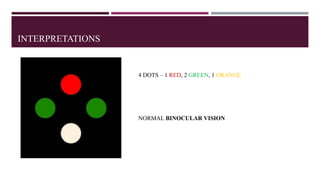
4 DOTS – 1 RED, 2 GREEN, 1 ORANGE
NORMAL BINOCULAR VISION
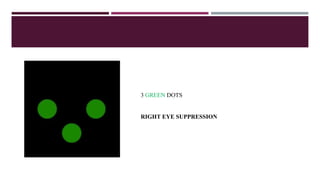
3 GREEN DOTS
RIGHT EYE SUPPRESSION
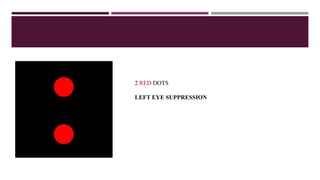
2 RED DOTS
LEFT EYE SUPPRESSION
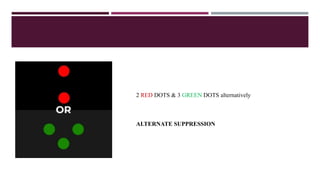
2 RED DOTS & 3 GREEN DOTS alternatively
ALTERNATE SUPPRESSION
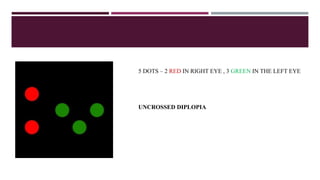
5 DOTS – 2 RED IN RIGHT EYE , 3 GREEN IN THE LEFT EYE
UNCROSSED DIPLOPIA
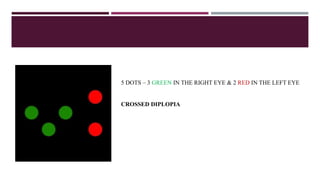
5 DOTS – 3 GREEN IN THE RIGHT EYE & 2 RED IN THE LEFT EYE
CROSSED DIPLOPIA
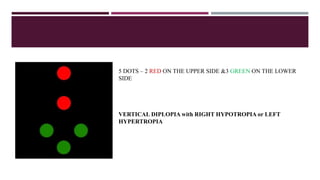
5 DOTS – 2 RED ON THE UPPER SIDE &3 GREEN ON THE LOWER
SIDE
VERTICAL DIPLOPIA with RIGHT HYPOTROPIA or LEFT
HYPERTROPIA
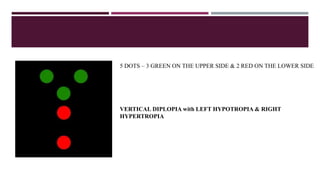
5 DOTS – 3 GREEN ON THE UPPER SIDE & 2 RED ON THE LOWER SIDE
VERTICAL DIPLOPIA with LEFT HYPOTROPIA & RIGHT
HYPERTROPIA
ADVANTAGES
 Widely available, cheap, practical, and easy to use
 Results were quite simple to record
 Refractive correction can be worn under the goggles
DISADVANTAGES
 Dependent on the responses of the patients and subjective in character
 If the test is administered twice,for instance,close-up and far-away,the patient-
particularly kids-might recall their previous response and provide the same response
from the previous test,leading to incorrect results
RELIABILITY IN RED-GREEN COLOR VISION DEFECT
 A retrospective study was done by Eunoo Bak et al.Optom Vis Sci in May 2017
on Validity of the Worth 4 Dot Test in Patients with Red-Green Color
Vision Defect where they found that congenital red-green color vision defect
patients of different types and variable degree of binocularity could successfully
perform the W4DT and they showed reliable results
REFERRENCES
 A K KHURANA,Page No-132,Theory and Practice of Squint and Orthoptics
 BRUCE EVANS&SANDIP DOSHI,Page No-60,Binocular Vision and Orthoptics
 Mitchell Scheiman-Bruce Wick Page No-3t,4,15-16,44
 Eunoo Bak, Hee Kyung Yang, Jeong-Min Hwang. Validity of the Worth 4 Dot Test in Patients with
Red-Green Color Vision Defect, Optom Vis Sci. 2017 May;94(5):626-629
• https://en.wikipedia.org/wiki/Worth_4_dot_test
• https://eyewiki.aao.org/Worth_4_dot
WORTH FOUR DOT TEST.pptx

WORTH FOUR DOT TEST.pptx

  • 1.
    WORTH FOUR DOTTEST KAUSTAV GOGOI B. OPTOM 4TH YEAR, RCOJ
  • 2.
    LAYOUTS  INTRODUCTION  PRINCIPLE USES  METHODS  REQUIREMENTS  PROCEDURE  INTERPRETATION  ADVANTAGES & DISADVANTAGES  REFERRENCES
  • 3.
    INTRODUCTION  Also calledWorth Four Light Test (W4LT)  Consisting of four lights arranged in a diamond shape with a red light at the top, two green lights at the left and right sides and a white light at the bottom
  • 4.
    PRINCIPLE  Based onAnaglyphic method  Utilizes different colors,such as RED and GREEN,while presenting the two images to the eyes.  When the images are viewed,the visual cortex of the brain fuses the images to produce one integrated stereoscopic image.
  • 5.
    WHY IT ISUSED -  To determine suppression  To determine the nature and type of diplopia  To identify vertical and horizontal strabismus
  • 6.
    METHODS  There aretwo ways to perform – 1. Distance worth four dot test: At a 6-meter distance from the patient, there are two fixed targets that can be presented on a screen or an illuminated box 2. Near worth four dot test: Target is fixed at a distance of 33cm from the patient which consists of a flashlight to alter the projection angle
  • 7.
    REQUIREMENTS  Trial framewith a red and green filter or Armstrong Goggle  Illuminated worth four dot box or flashlight
  • 8.
    SETUP  Describe tothe patient the test and procedure  The patient must put on green-and-red glasses (Armstrong glasses). Red light will be visible to the eye with the red filter on its front (often the right eye), and green light will be visible to the eye with the green filter on its front (typically the left eye). Before putting on the red and green spectacles, make sure the patient can’t see the torch. 1. To test at distance (6m) : Make that the patient is using the glasses or contact lenses that are prescribed. 2. To test at near (33cm) : Hold the Worth 4-dot torch or flashlight such that the patient is reading it while slanting his or her head slightly downward. Make that the patient is wearing the correct refractive correction for near-distance testing if they have presbyopia. Usually, a red light is at the top and a white light is at the bottom of the torch. 3. Turn on the Worth 4-dot instrument by keeping the room lights on
  • 9.
    PROCEDURE  Cover thepatient’s left eye and ask, ‘How many lights do you see?’  Now cover the right eye and ask, ‘How many lights do you see?’  Now with the both eyes open ask the patient, ‘How many lights do you see?’  Are all lights in line or some higher than the others?  Do all the lights show up at one time,or are they flashing on and off ?
  • 10.
    INTERPRETATIONS 4 DOTS –1 RED, 2 GREEN, 1 ORANGE NORMAL BINOCULAR VISION
  • 11.
    3 GREEN DOTS RIGHTEYE SUPPRESSION
  • 12.
    2 RED DOTS LEFTEYE SUPPRESSION
  • 13.
    2 RED DOTS& 3 GREEN DOTS alternatively ALTERNATE SUPPRESSION
  • 14.
    5 DOTS –2 RED IN RIGHT EYE , 3 GREEN IN THE LEFT EYE UNCROSSED DIPLOPIA
  • 15.
    5 DOTS –3 GREEN IN THE RIGHT EYE & 2 RED IN THE LEFT EYE CROSSED DIPLOPIA
  • 16.
    5 DOTS –2 RED ON THE UPPER SIDE &3 GREEN ON THE LOWER SIDE VERTICAL DIPLOPIA with RIGHT HYPOTROPIA or LEFT HYPERTROPIA
  • 17.
    5 DOTS –3 GREEN ON THE UPPER SIDE & 2 RED ON THE LOWER SIDE VERTICAL DIPLOPIA with LEFT HYPOTROPIA & RIGHT HYPERTROPIA
  • 18.
    ADVANTAGES  Widely available,cheap, practical, and easy to use  Results were quite simple to record  Refractive correction can be worn under the goggles
  • 19.
    DISADVANTAGES  Dependent onthe responses of the patients and subjective in character  If the test is administered twice,for instance,close-up and far-away,the patient- particularly kids-might recall their previous response and provide the same response from the previous test,leading to incorrect results
  • 20.
    RELIABILITY IN RED-GREENCOLOR VISION DEFECT  A retrospective study was done by Eunoo Bak et al.Optom Vis Sci in May 2017 on Validity of the Worth 4 Dot Test in Patients with Red-Green Color Vision Defect where they found that congenital red-green color vision defect patients of different types and variable degree of binocularity could successfully perform the W4DT and they showed reliable results
  • 21.
    REFERRENCES  A KKHURANA,Page No-132,Theory and Practice of Squint and Orthoptics  BRUCE EVANS&SANDIP DOSHI,Page No-60,Binocular Vision and Orthoptics  Mitchell Scheiman-Bruce Wick Page No-3t,4,15-16,44  Eunoo Bak, Hee Kyung Yang, Jeong-Min Hwang. Validity of the Worth 4 Dot Test in Patients with Red-Green Color Vision Defect, Optom Vis Sci. 2017 May;94(5):626-629 • https://en.wikipedia.org/wiki/Worth_4_dot_test • https://eyewiki.aao.org/Worth_4_dot