Kamal thakur
2nd year bsc opto
Nethradhama college of opto
Definition;
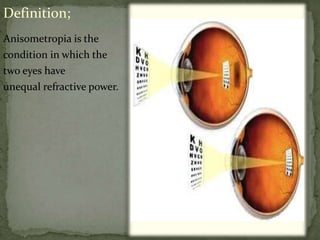
Anisometropia is the
condition in which the
two eyes have
unequal refractive power.
 Congenital anisometropia; it occur due to differential
growth of the eyeballs.
 Acquired anisometropia; may occur due to uniocular
aphakia after removal of crystalline lens or due to
implantation of IOL of wrong power.
 Absolute anisometropia; it is that condition in which
the refractive power of two eyes is unequal.
 Relative anisometropia; the total refraction of the two
eyes can be equal, but the axial length may be
different. This will lead to clear retinal image but a
difference in the size of the retinal images.
 Simple
 Compound
 Mixed
 Simple astigmatic anisometropia
 Compound astigmatic anisometropia
 Mixed astigmatic anisometropia
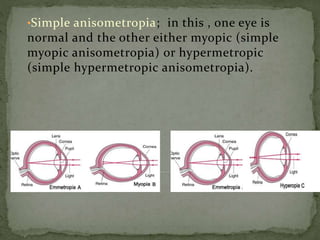
•Simple anisometropia; in this , one eye is
normal and the other either myopic (simple
myopic anisometropia) or hypermetropic
(simple hypermetropic anisometropia).
•Compound anisometropia; both eyes are
either hypermetropic or myopic , but one eye
is having higher refractive error than the other.
•Mixed anisometropia; In this , one eye is
myopic and the other is hypermetropic. This is
also called antimetropia.
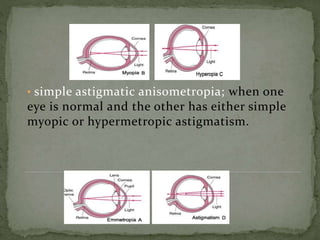
• simple astigmatic anisometropia; when one
eye is normal and the other has either simple
myopic or hypermetropic astigmatism.
•Compound astigmatic anisometropia; when
the both eyes are astigmatic but of unequal
degree.
Three possibilities are there :
1. Binocular single vision is present in small degree
of anisometropia .
2. Uniocular vision. When refractive error in one eye
is of high degree.
3. Alternate vision occurs when one eye is
hypermetropic and other myopic , then
hypermetropic eye is used for distant vision and
myopic for near.
1. Spectacles. The corrective spectacles can be
tolerated up to maximum difference of 4D.After
that diplopia may occurs.
2. Contact lenses are advised for higher degrees of
anisometropia .
3. IOL implantation for uniocular aphakia.
4. Refractive corneal surgery for unilateral high
myopia , astigmatism and hypermetropia.
•Comprehensive Ophthalmology
•google
Anisometropia

Anisometropia

  • 1.
    Kamal thakur 2nd yearbsc opto Nethradhama college of opto
  • 2.
    Definition; Anisometropia is the conditionin which the two eyes have unequal refractive power.
  • 3.
     Congenital anisometropia;it occur due to differential growth of the eyeballs.  Acquired anisometropia; may occur due to uniocular aphakia after removal of crystalline lens or due to implantation of IOL of wrong power.
  • 4.
     Absolute anisometropia;it is that condition in which the refractive power of two eyes is unequal.  Relative anisometropia; the total refraction of the two eyes can be equal, but the axial length may be different. This will lead to clear retinal image but a difference in the size of the retinal images.
  • 5.
     Simple  Compound Mixed  Simple astigmatic anisometropia  Compound astigmatic anisometropia  Mixed astigmatic anisometropia
  • 6.
    •Simple anisometropia; inthis , one eye is normal and the other either myopic (simple myopic anisometropia) or hypermetropic (simple hypermetropic anisometropia).
  • 7.
    •Compound anisometropia; botheyes are either hypermetropic or myopic , but one eye is having higher refractive error than the other. •Mixed anisometropia; In this , one eye is myopic and the other is hypermetropic. This is also called antimetropia.
  • 8.
    • simple astigmaticanisometropia; when one eye is normal and the other has either simple myopic or hypermetropic astigmatism.
  • 9.
    •Compound astigmatic anisometropia;when the both eyes are astigmatic but of unequal degree.
  • 10.
    Three possibilities arethere : 1. Binocular single vision is present in small degree of anisometropia . 2. Uniocular vision. When refractive error in one eye is of high degree. 3. Alternate vision occurs when one eye is hypermetropic and other myopic , then hypermetropic eye is used for distant vision and myopic for near.
  • 11.
    1. Spectacles. Thecorrective spectacles can be tolerated up to maximum difference of 4D.After that diplopia may occurs. 2. Contact lenses are advised for higher degrees of anisometropia . 3. IOL implantation for uniocular aphakia. 4. Refractive corneal surgery for unilateral high myopia , astigmatism and hypermetropia.
  • 12.