Hira Nath Dahal
Common Binocular Vision
Disorders Often Neglected
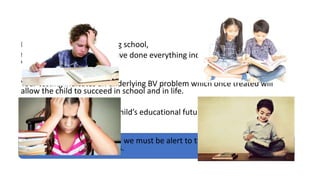
Imagine a child who is failing school,
the parents and the child have done everything including hiring tutors,
without success.
Your testing indicates an underlying BV problem which once treated will
allow the child to succeed in school and in life.
You won’t only change the child’s educational future, but their social and
emotional make-up as well.
In the practice of optometry, we must be alert to the signs and symptoms
associated with BV problems.
Common BV disorders
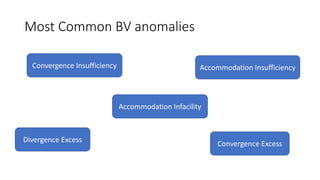
Most Common BV anomalies
Accommodation Insufficiency
Convergence Insufficiency
Accommodation Infacility
Divergence Excess
Convergence Excess
What your eyes sees is what your
brain knows
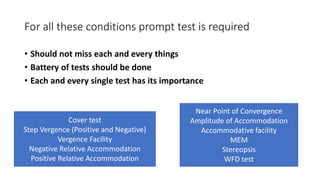
For all these conditions prompt test is required
• Should not miss each and every things
• Battery of tests should be done
• Each and every single test has its importance
Cover test
Step Vergence (Positive and Negative)
Vergence Facility
Negative Relative Accommodation
Positive Relative Accommodation
Near Point of Convergence
Amplitude of Accommodation
Accommodative facility
MEM
Stereopsis
WFD test
Only after proper diagnosis we can
successfully treat the patient
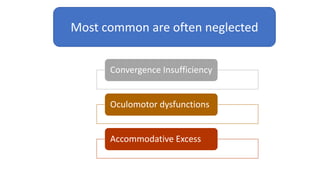
Most common are often neglected
Convergence Insufficiency
Oculomotor dysfunctions
Accommodative Excess
Convergence Insufficiency
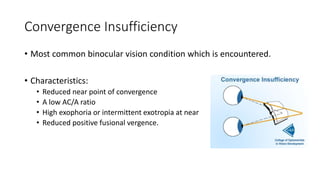
• Most common binocular vision condition which is encountered.
• Characteristics:
• Reduced near point of convergence
• A low AC/A ratio
• High exophoria or intermittent exotropia at near
• Reduced positive fusional vergence.
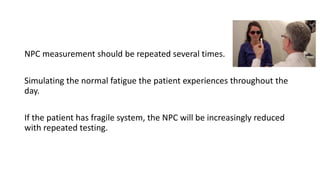
NPC measurement should be repeated several times.
Simulating the normal fatigue the patient experiences throughout the
day.
If the patient has fragile system, the NPC will be increasingly reduced
with repeated testing.
Symptoms
• Tired or sore eyes (eyestrain)
• Headache especially at the end of the day
• Difficulty reading – words seems to float on the page
• Difficulty concentrating
• Squinting, rubbing or closing one eye
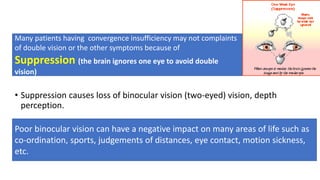
• Suppression causes loss of binocular vision (two-eyed) vision, depth
perception.
Many patients having convergence insufficiency may not complaints
of double vision or the other symptoms because of
Suppression (the brain ignores one eye to avoid double
vision)
Poor binocular vision can have a negative impact on many areas of life such as
co-ordination, sports, judgements of distances, eye contact, motion sickness,
etc.
Treatment
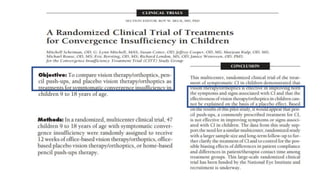
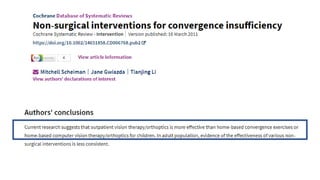
• Vision therapy
• Home based/office based
• Sometimes, low plus will help because it will reduce
the excess accommodative effort
What if not properly diagnosed and managed ?
• Functional Learning disability
• Children neglect academic activities
• If untreated, in some cases , convergence insufficiency can lead to
Intermittent exotropia.
Oculomotor Dysfunctions
Oculomotor dysfunctions
• Some times, patient presents with all testing within a normal range,
but continues to struggle in school, should think of oculomotor
dysfunction (OMD)
Fixation, Saccades, Pursuits
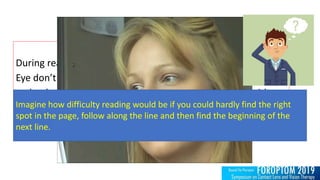
During reading,
Eye don’t move continuously along a line of text,
make short rapid movements (saccades) intermingled with
shot stops (fixations)
Imagine how difficulty reading would be if you could hardly find the right
spot in the page, follow along the line and then find the beginning of the
next line.
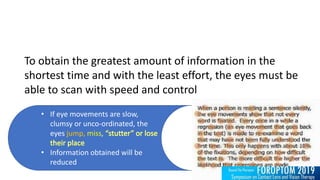
To obtain the greatest amount of information in the
shortest time and with the least effort, the eyes must be
able to scan with speed and control
• If eye movements are slow,
clumsy or unco-ordinated, the
eyes jump, miss,
• Information obtained will be
reduced
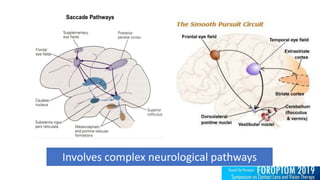
Involves complex neurological pathways
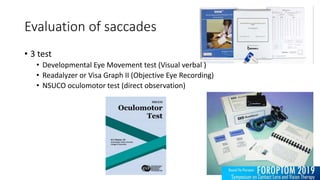
Evaluation of saccades
• 3 test
• Developmental Eye Movement test (Visual verbal )
• Readalyzer or Visa Graph II (Objective Eye Recording)
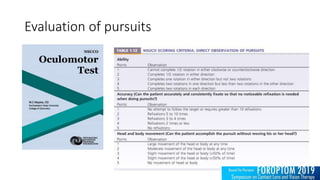
• NSUCO oculomotor test (direct observation)
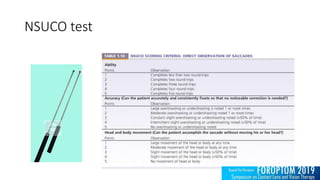
NSUCO test
Evaluation of pursuits
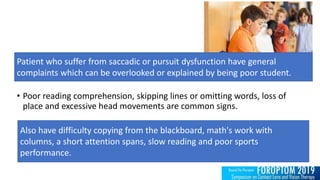
• Poor reading comprehension, skipping lines or omitting words, loss of
place and excessive head movements are common signs.
Patient who suffer from saccadic or pursuit dysfunction have general
complaints which can be overlooked or explained by being poor student.
Also have difficulty copying from the blackboard, math's work with
columns, a short attention spans, slow reading and poor sports
performance.
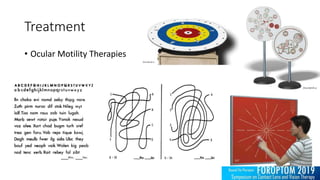
Treatment
• Ocular Motility Therapies
Accommodative Excess
Accommodative excess
• Asymptomatic condition
• So often neglected
• In school aged children, this is of concern as it not only reduces visual
efficiency but also delays ability to shift focus between distance and near
tasks.
• In case of accommodative excess, there is often the report of transient blur
in distance when looking up after doing near tasks such as reading.
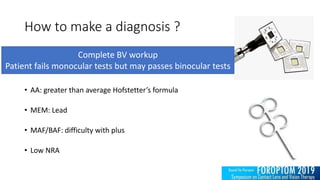
How to make a diagnosis ?
• AA: greater than average Hofstetter’s formula
• MEM: Lead
• MAF/BAF: difficulty with plus
• Low NRA
Complete BV workup
Patient fails monocular tests but may passes binocular tests
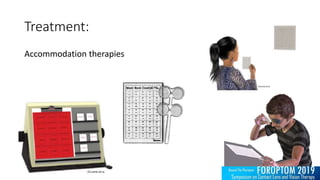
Treatment:
Accommodation therapies
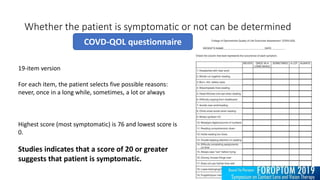
Whether the patient is symptomatic or not can be determined
19-item version
For each item, the patient selects five possible reasons:
never, once in a long while, sometimes, a lot or always
Highest score (most symptomatic) is 76 and lowest score is
0.
Studies indicates that a score of 20 or greater
suggests that patient is symptomatic.
COVD-QOL questionnaire
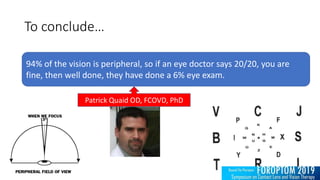
To conclude…
Patrick Quaid OD, FCOVD, PhD
94% of the vision is peripheral, so if an eye doctor says 20/20, you are
fine, then well done, they have done a 6% eye exam.
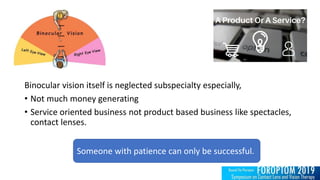
Binocular vision itself is neglected subspecialty especially,
• Not much money generating
• Service oriented business not product based business like spectacles,
contact lenses.
Someone with patience can only be successful.
• In the field of eye care, to put it simply, we help people see.
Whether dispensing spectacles or contact lenses, co-managing
LASIK or cataract surgery, treating disease such as glaucoma or
fitting a low Vision device, the ultimate goal is improved vision.
Rarely we do get the opportunity to alter the outcome of patient’s
lives.
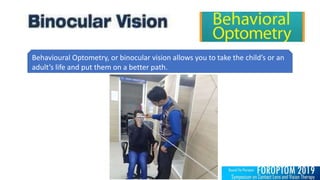
Behavioural Optometry, or binocular vision allows you to take the child’s or an
adult’s life and put them on a better path.
Thank You…!!!!
Any Questions ????

Common binocular vision disorder neglected

  • 1.
    Hira Nath Dahal CommonBinocular Vision Disorders Often Neglected
  • 2.
    Imagine a childwho is failing school, the parents and the child have done everything including hiring tutors, without success. Your testing indicates an underlying BV problem which once treated will allow the child to succeed in school and in life. You won’t only change the child’s educational future, but their social and emotional make-up as well. In the practice of optometry, we must be alert to the signs and symptoms associated with BV problems.
  • 3.
  • 7.
    Most Common BVanomalies Accommodation Insufficiency Convergence Insufficiency Accommodation Infacility Divergence Excess Convergence Excess
  • 8.
    What your eyessees is what your brain knows
  • 9.
    For all theseconditions prompt test is required • Should not miss each and every things • Battery of tests should be done • Each and every single test has its importance Cover test Step Vergence (Positive and Negative) Vergence Facility Negative Relative Accommodation Positive Relative Accommodation Near Point of Convergence Amplitude of Accommodation Accommodative facility MEM Stereopsis WFD test
  • 10.
    Only after properdiagnosis we can successfully treat the patient
  • 11.
    Most common areoften neglected Convergence Insufficiency Oculomotor dysfunctions Accommodative Excess
  • 12.
  • 13.
    Convergence Insufficiency • Mostcommon binocular vision condition which is encountered. • Characteristics: • Reduced near point of convergence • A low AC/A ratio • High exophoria or intermittent exotropia at near • Reduced positive fusional vergence.
  • 14.
    NPC measurement shouldbe repeated several times. Simulating the normal fatigue the patient experiences throughout the day. If the patient has fragile system, the NPC will be increasingly reduced with repeated testing.
  • 15.
    Symptoms • Tired orsore eyes (eyestrain) • Headache especially at the end of the day • Difficulty reading – words seems to float on the page • Difficulty concentrating • Squinting, rubbing or closing one eye
  • 16.
    • Suppression causesloss of binocular vision (two-eyed) vision, depth perception. Many patients having convergence insufficiency may not complaints of double vision or the other symptoms because of Suppression (the brain ignores one eye to avoid double vision) Poor binocular vision can have a negative impact on many areas of life such as co-ordination, sports, judgements of distances, eye contact, motion sickness, etc.
  • 17.
    Treatment • Vision therapy •Home based/office based • Sometimes, low plus will help because it will reduce the excess accommodative effort
  • 20.
    What if notproperly diagnosed and managed ? • Functional Learning disability • Children neglect academic activities • If untreated, in some cases , convergence insufficiency can lead to Intermittent exotropia.
  • 21.
  • 22.
    Oculomotor dysfunctions • Sometimes, patient presents with all testing within a normal range, but continues to struggle in school, should think of oculomotor dysfunction (OMD) Fixation, Saccades, Pursuits
  • 23.
    During reading, Eye don’tmove continuously along a line of text, make short rapid movements (saccades) intermingled with shot stops (fixations) Imagine how difficulty reading would be if you could hardly find the right spot in the page, follow along the line and then find the beginning of the next line.
  • 24.
    To obtain thegreatest amount of information in the shortest time and with the least effort, the eyes must be able to scan with speed and control • If eye movements are slow, clumsy or unco-ordinated, the eyes jump, miss, • Information obtained will be reduced
  • 25.
  • 26.
    Evaluation of saccades •3 test • Developmental Eye Movement test (Visual verbal ) • Readalyzer or Visa Graph II (Objective Eye Recording) • NSUCO oculomotor test (direct observation)
  • 27.
  • 28.
  • 29.
    • Poor readingcomprehension, skipping lines or omitting words, loss of place and excessive head movements are common signs. Patient who suffer from saccadic or pursuit dysfunction have general complaints which can be overlooked or explained by being poor student. Also have difficulty copying from the blackboard, math's work with columns, a short attention spans, slow reading and poor sports performance.
  • 30.
  • 31.
  • 32.
    Accommodative excess • Asymptomaticcondition • So often neglected • In school aged children, this is of concern as it not only reduces visual efficiency but also delays ability to shift focus between distance and near tasks. • In case of accommodative excess, there is often the report of transient blur in distance when looking up after doing near tasks such as reading.
  • 33.
    How to makea diagnosis ? • AA: greater than average Hofstetter’s formula • MEM: Lead • MAF/BAF: difficulty with plus • Low NRA Complete BV workup Patient fails monocular tests but may passes binocular tests
  • 34.
  • 35.
    Whether the patientis symptomatic or not can be determined 19-item version For each item, the patient selects five possible reasons: never, once in a long while, sometimes, a lot or always Highest score (most symptomatic) is 76 and lowest score is 0. Studies indicates that a score of 20 or greater suggests that patient is symptomatic. COVD-QOL questionnaire
  • 36.
    To conclude… Patrick QuaidOD, FCOVD, PhD 94% of the vision is peripheral, so if an eye doctor says 20/20, you are fine, then well done, they have done a 6% eye exam.
  • 37.
    Binocular vision itselfis neglected subspecialty especially, • Not much money generating • Service oriented business not product based business like spectacles, contact lenses. Someone with patience can only be successful.
  • 38.
    • In thefield of eye care, to put it simply, we help people see. Whether dispensing spectacles or contact lenses, co-managing LASIK or cataract surgery, treating disease such as glaucoma or fitting a low Vision device, the ultimate goal is improved vision. Rarely we do get the opportunity to alter the outcome of patient’s lives.
  • 39.
    Behavioural Optometry, orbinocular vision allows you to take the child’s or an adult’s life and put them on a better path.
  • 40.
  • 41.

Editor's Notes

  • #27 Demostration of NSUCO
  • #31 Lots of things we can do to improvise (letter tracking workbook)
  • #35 Accommodative rock cards
  • #36 Originally developed with 30 items Convergence Insufficiency Symptoms survey List of studies
  • #37 Patrick Quaid | MCOptom (UK), FCOVD (USA), PhD (CAN) | University of Waterloo, Waterloo | UWaterloo | School of Optometry & Vision Science