Dr. Dimple Prakash
Head Post Graduate Training Programme
SHADOW PLAY - RETINOSCOPY
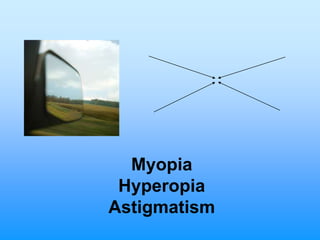
Myopia
 Hyperopia
Astigmatism
Plane Mirror Retinoscopy
 in case of Welsch Allen retinoscope
  when the lens is pushed down the
mirror acts like a plane mirror and the
          rays are divergent.
Concave Mirror Retinoscopy
  When the lens is pushed up the mirror
acts like a concave mirror so the rays are
               convergent.
  Practical importance : in plane mirror
retinoscopy a with movement will need +
lenses but in concave mirror retinoscopy
   a with movement will need – lenses.
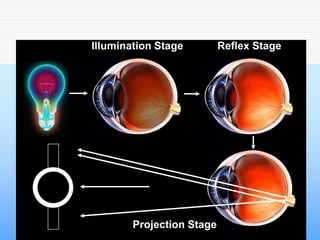
Illumination Stage         Reflex Stage


        Projection Stage
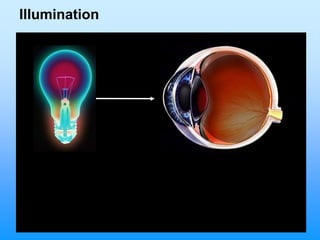
Illumination
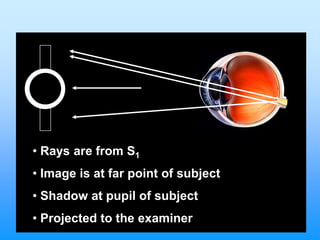
• Rays are from S1
• Image is at far point of subject
• Shadow at pupil of subject
• Projected to the examiner
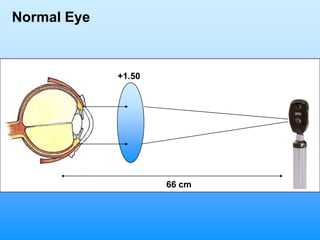
Normal Eye


             +1.50


                     66 cm
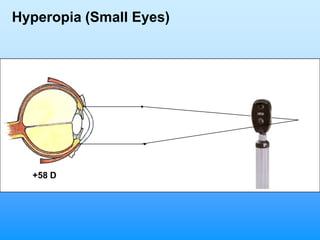
Hyperopia (Small Eyes)


  +58 D
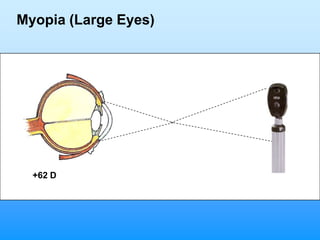
Myopia (Large Eyes)


  +62 D
Streak
Retinoscopy
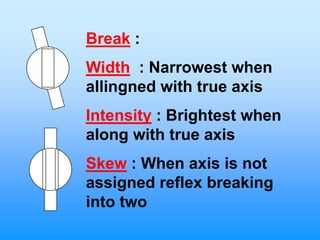
Break :
Width : Narrowest when
allingned with true axis
Intensity : Brightest when
along with true axis
Skew : When axis is not
assigned reflex breaking
into two
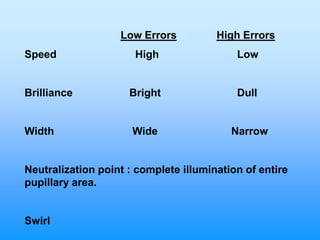
Low Errors          High Errors
Speed                 High                 Low


Brilliance           Bright                Dull


Width                 Wide                Narrow


Neutralization point : complete illumination of entire
pupillary area.


Swirl
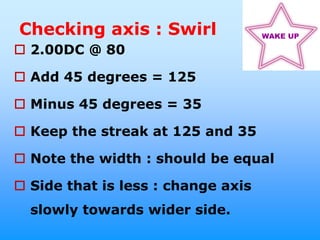
Checking axis : Swirl               WAKE UP

 2.00DC @ 80

 Add 45 degrees = 125

 Minus 45 degrees = 35

 Keep the streak at 125 and 35

 Note the width : should be equal

 Side that is less : change axis
  slowly towards wider side.
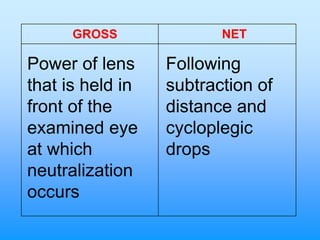
GROSS              NET

Power of lens     Following
that is held in   subtraction of
front of the      distance and
examined eye      cycloplegic
at which          drops
neutralization
occurs
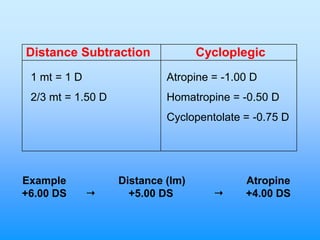
Distance Subtraction               Cycloplegic
 1 mt = 1 D                 Atropine = -1.00 D
 2/3 mt = 1.50 D            Homatropine = -0.50 D
                            Cyclopentolate = -0.75 D


Example            Distance (lm)           Atropine
+6.00 DS            +5.00 DS             +4.00 DS
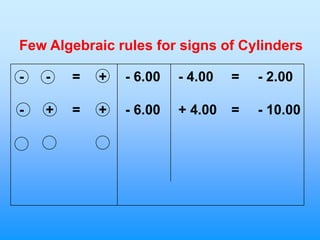
Few Algebraic rules for signs of Cylinders

-   -   =   +   - 6.00   - 4.00   =   - 2.00

-   +   =   +   - 6.00   + 4.00   =   - 10.00
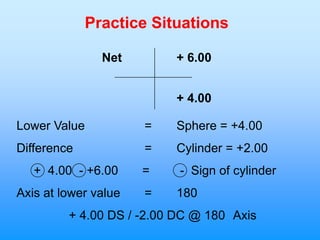
Practice Situations

               Net        + 6.00


                          + 4.00

Lower Value           =   Sphere = +4.00
Difference            =   Cylinder = +2.00
   + 4.00 - +6.00     =    - Sign of cylinder
Axis at lower value   =   180
         + 4.00 DS / -2.00 DC @ 180 Axis
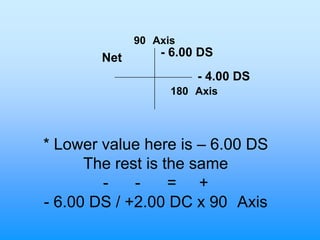
90 Axis
        Net       - 6.00 DS
                        - 4.00 DS
                    180 Axis


* Lower value here is – 6.00 DS
      The rest is the same
        -    -     = +
- 6.00 DS / +2.00 DC x 90 Axis
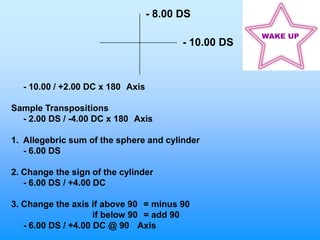
- 8.00 DS
                                                      WAKE UP
                                         - 10.00 DS


  - 10.00 / +2.00 DC x 180 Axis

Sample Transpositions
  - 2.00 DS / -4.00 DC x 180 Axis

1. Allegebric sum of the sphere and cylinder
   - 6.00 DS

2. Change the sign of the cylinder
   - 6.00 DS / +4.00 DC

3. Change the axis if above 90 = minus 90
                     if below 90 = add 90
   - 6.00 DS / +4.00 DC @ 90 Axis
Refinement
     of
Refraction
Methods
 Easiest : fogging. Over refraction,
  over retinoscopy

 Duchrome testing

 Jackson cross cylinder

 Astigmatic dial

 Astigmatic fan and block
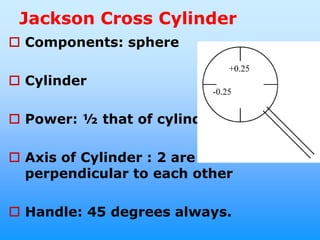
Jackson Cross Cylinder
 Components: sphere

 Cylinder

 Power: ½ that of cylinder

 Axis of Cylinder : 2 are
  perpendicular to each other

 Handle: 45 degrees always.
How it works?
 Axis first: handle in direction of
  the cylinder in the frame already.
  Eg) 2.00DC at 180 then keep
  handle at 180

 Va chart 2 lines above least visible.
  eg)6/12 if BCVA is 6/6.

 Flip + 0.50 or – in front of patient.

 At best vision point, rotate the DC
  by 10 degrees towards the red
  mark in case of – and towards
  white mark in +.
 E.g.) DC in trial frame= +2.00DC @
  180

 BCVA CLEAR when +0.50 DC is in
  front

 Rotate 10 degrees towards white
  mark

 +2.00 DC@ 170.
How it works?
                                    WAKE UP
 Power of DC. This is easy.

 Keeping the correct axis. Flip the
  JC by + or – and then add or
  subtract the correct power.

 E.g.) DC in trial frame = +2.00,Va
  better at +0.50 DC then final
  value= +2.50 DC.

 If equal Va at 2 flips: correct
  power.
Summary
 Most plus or least minus sphere:
  BCVA

 Va chart 2 lines above least visible.
  eg)6/12 if BCVA is 6/6.

 No cylinder, still flip at
  90,180,45,135.

 Axis first : Why?

 Lower powers 0.25 for 20/30 Va
  .Flip + 0.50 or 1.00 for lower
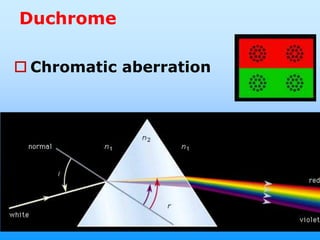
Duchrome

 Chromatic aberration
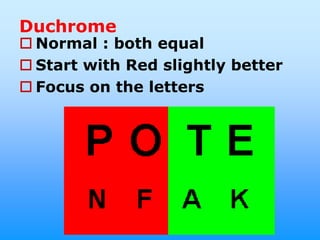
Duchrome
 Normal : both equal
 Start with Red slightly better
 Focus on the letters
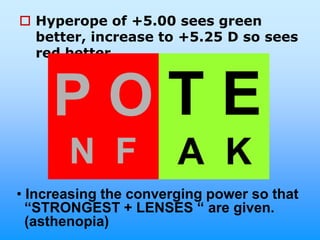
 Hyperope of +5.00 sees green
  better, increase to +5.25 D so sees
  red better.


                     TE
                       A K
• Increasing the converging power so that
  “STRONGEST + LENSES “ are given.
  (asthenopia)
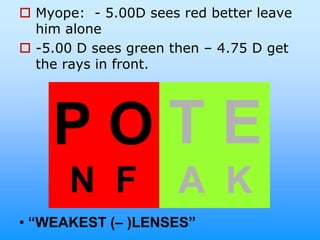
 Myope: - 5.00D sees red better leave
  him alone
 -5.00 D sees green then – 4.75 D get
  the rays in front.


    PO
      N F
• “WEAKEST (– )LENSES”
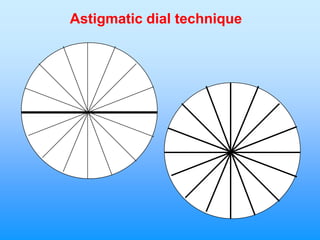
Astigmatic dial technique
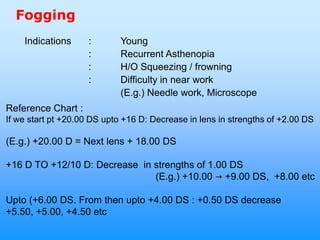
Fogging
    Indications     :        Young
                    :        Recurrent Asthenopia
                    :        H/O Squeezing / frowning
                    :        Difficulty in near work
                             (E.g.) Needle work, Microscope
Reference Chart :
If we start pt +20.00 DS upto +16 D: Decrease in lens in strengths of +2.00 DS

(E.g.) +20.00 D = Next lens + 18.00 DS

+16 D TO +12/10 D: Decrease in strengths of 1.00 DS
                               (E.g.) +10.00  +9.00 DS, +8.00 etc

Upto (+6.00 DS. From then upto +4.00 DS : +0.50 DS decrease
+5.50, +5.00, +4.50 etc
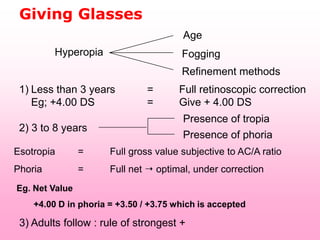
Giving Glasses
Giving Glasses
                                       Age
         Hyperopia                     Fogging
                                       Refinement methods
 1) Less than 3 years          =      Full retinoscopic correction
    Eg; +4.00 DS               =      Give + 4.00 DS
                                       Presence of tropia
 2) 3 to 8 years
                                       Presence of phoria
Esotropia       =     Full gross value subjective to AC/A ratio
Phoria          =     Full net  optimal, under correction
Eg. Net Value
    +4.00 D in phoria = +3.50 / +3.75 which is accepted

 3) Adults follow : rule of strongest +
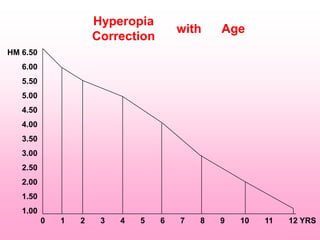
Hyperopia
                                       with    Age
                      Correction
HM 6.50
   6.00
   5.50
   5.00
   4.50
   4.00
   3.50
   3.00
   2.50
   2.00
   1.50
   1.00
          0   1   2    3   4   5   6   7   8   9   10   11   12 YRS
Giving Glasses : MYOPIA
Thumb rules
   Normal patients

1) From -1.00 to -6.00 DS : Full correction

2) Above -6.00 DS         : Under correct to meet subjectiveness

    Esotropia

High presence of -6.00 DS and above are under corrected
meet acceptance followed by optimal to full correction

   Exotropia
Over correct in intermittent EXOTROPIAS
Giving Glasses : Astigmatism

  Normal patients                          WAKE UP


: In a child less than 3 years = 1.25 DC,
   Regular

: Older than 3 years = all astigmatism to
  be corrected

• Child : follow-up 6 months
• Adult yearly
• Frequent change : over correct (0.25 D)
Giving glasses: child
 Ideal frame: large, sturdy, well
  balanced
 Ideal lenses: plastic,
  polycarbonates
 Ideal refraction:
 Less than 3 years: solely on
  retinoscopy
 All strabismus : retinoscopy
 Beyond 3 years: myopes do not
  need
Cycloplegic studies
 Rosenbaum and associates: atropine
  estimation of hyperopia 0.34 D more
  as compared to homatropine
 Hurol et al: no difference between 2
  and 3 days of cycloplegia
 Stolovich: 8 instillations vs 4
  instillations.
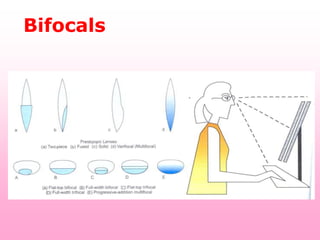
Bifocals
Bifocals
 Working distance

 0.2 m wide or smallest test
  type

 Blurred/ not readable = near
  point

 No doubling

 Keep 1/3rd reserve
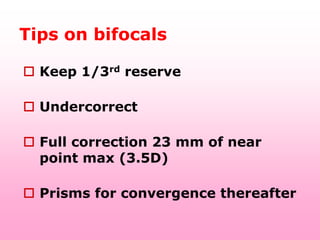
Tips on bifocals

 Keep 1/3rd reserve

 Undercorrect

 Full correction 23 mm of near
  point max (3.5D)

 Prisms for convergence thereafter
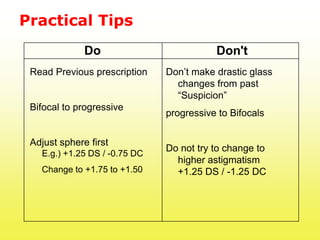
Practical Tips
              Do                          Don't
 Read Previous prescription    Don’t make drastic glass
                                 changes from past
                                 “Suspicion”
 Bifocal to progressive
                               progressive to Bifocals


 Adjust sphere first
                               Do not try to change to
   E.g.) +1.25 DS / -0.75 DC
                                 higher astigmatism
   Change to +1.75 to +1.50      +1.25 DS / -1.25 DC
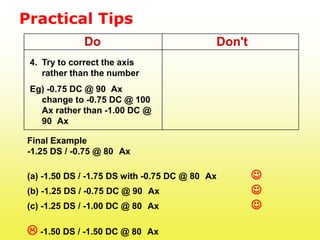
Practical Tips
             Do                             Don't
 4. Try to correct the axis
    rather than the number
 Eg) -0.75 DC @ 90 Ax
   change to -0.75 DC @ 100
   Ax rather than -1.00 DC @
   90 Ax

Final Example
-1.25 DS / -0.75 @ 80 Ax

(a) -1.50 DS / -1.75 DS with -0.75 DC @ 80 Ax       J
(b) -1.25 DS / -0.75 DC @ 90 Ax                     J
(c) -1.25 DS / -1.00 DC @ 80 Ax                     J

L -1.50 DS / -1.50 DC @ 80    Ax
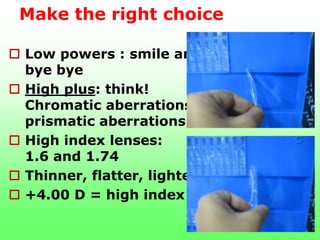
Make the right choice

 Low powers : smile and
  bye bye
 High plus: think!
  Chromatic aberrations
  prismatic aberrations
 High index lenses:
  1.6 and 1.74
 Thinner, flatter, lighter
 +4.00 D = high index
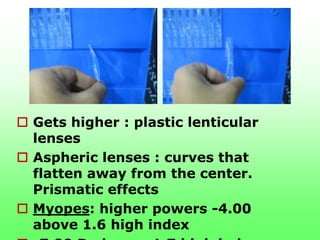
 Gets higher : plastic lenticular
  lenses
 Aspheric lenses : curves that
  flatten away from the center.
  Prismatic effects
 Myopes: higher powers -4.00
  above 1.6 high index
Power refraction you are now armed

 Retinoscopy
 Interpretation of numbers
 Giving glasses
 Refinement of numbers
 What not to do
Dr. DIMPLE PRAKASH
          Senior Consultant
         Pediatric and Squint
Head Post Graduate Training Programme

Refraction and Retinoscopy

  • 1.
    Dr. Dimple Prakash HeadPost Graduate Training Programme
  • 2.
    SHADOW PLAY -RETINOSCOPY
  • 3.
  • 4.
    Plane Mirror Retinoscopy in case of Welsch Allen retinoscope when the lens is pushed down the mirror acts like a plane mirror and the rays are divergent.
  • 5.
    Concave Mirror Retinoscopy When the lens is pushed up the mirror acts like a concave mirror so the rays are convergent. Practical importance : in plane mirror retinoscopy a with movement will need + lenses but in concave mirror retinoscopy a with movement will need – lenses.
  • 6.
    Illumination Stage Reflex Stage Projection Stage
  • 7.
  • 8.
    • Rays arefrom S1 • Image is at far point of subject • Shadow at pupil of subject • Projected to the examiner
  • 9.
    Normal Eye +1.50 66 cm
  • 10.
  • 11.
  • 12.
  • 13.
    Break : Width :Narrowest when allingned with true axis Intensity : Brightest when along with true axis Skew : When axis is not assigned reflex breaking into two
  • 14.
    Low Errors High Errors Speed High Low Brilliance Bright Dull Width Wide Narrow Neutralization point : complete illumination of entire pupillary area. Swirl
  • 15.
    Checking axis :Swirl WAKE UP  2.00DC @ 80  Add 45 degrees = 125  Minus 45 degrees = 35  Keep the streak at 125 and 35  Note the width : should be equal  Side that is less : change axis slowly towards wider side.
  • 16.
    GROSS NET Power of lens Following that is held in subtraction of front of the distance and examined eye cycloplegic at which drops neutralization occurs
  • 17.
    Distance Subtraction Cycloplegic 1 mt = 1 D Atropine = -1.00 D 2/3 mt = 1.50 D Homatropine = -0.50 D Cyclopentolate = -0.75 D Example Distance (lm) Atropine +6.00 DS  +5.00 DS  +4.00 DS
  • 18.
    Few Algebraic rulesfor signs of Cylinders - - = + - 6.00 - 4.00 = - 2.00 - + = + - 6.00 + 4.00 = - 10.00
  • 19.
    Practice Situations Net + 6.00 + 4.00 Lower Value = Sphere = +4.00 Difference = Cylinder = +2.00 + 4.00 - +6.00 = - Sign of cylinder Axis at lower value = 180 + 4.00 DS / -2.00 DC @ 180 Axis
  • 20.
    90 Axis Net - 6.00 DS - 4.00 DS 180 Axis * Lower value here is – 6.00 DS The rest is the same - - = + - 6.00 DS / +2.00 DC x 90 Axis
  • 21.
    - 8.00 DS WAKE UP - 10.00 DS - 10.00 / +2.00 DC x 180 Axis Sample Transpositions - 2.00 DS / -4.00 DC x 180 Axis 1. Allegebric sum of the sphere and cylinder - 6.00 DS 2. Change the sign of the cylinder - 6.00 DS / +4.00 DC 3. Change the axis if above 90 = minus 90 if below 90 = add 90 - 6.00 DS / +4.00 DC @ 90 Axis
  • 22.
    Refinement of Refraction
  • 23.
    Methods  Easiest :fogging. Over refraction, over retinoscopy  Duchrome testing  Jackson cross cylinder  Astigmatic dial  Astigmatic fan and block
  • 24.
    Jackson Cross Cylinder Components: sphere  Cylinder  Power: ½ that of cylinder  Axis of Cylinder : 2 are perpendicular to each other  Handle: 45 degrees always.
  • 25.
    How it works? Axis first: handle in direction of the cylinder in the frame already. Eg) 2.00DC at 180 then keep handle at 180  Va chart 2 lines above least visible. eg)6/12 if BCVA is 6/6.  Flip + 0.50 or – in front of patient.  At best vision point, rotate the DC by 10 degrees towards the red mark in case of – and towards white mark in +.
  • 26.
     E.g.) DCin trial frame= +2.00DC @ 180  BCVA CLEAR when +0.50 DC is in front  Rotate 10 degrees towards white mark  +2.00 DC@ 170.
  • 27.
    How it works? WAKE UP  Power of DC. This is easy.  Keeping the correct axis. Flip the JC by + or – and then add or subtract the correct power.  E.g.) DC in trial frame = +2.00,Va better at +0.50 DC then final value= +2.50 DC.  If equal Va at 2 flips: correct power.
  • 28.
    Summary  Most plusor least minus sphere: BCVA  Va chart 2 lines above least visible. eg)6/12 if BCVA is 6/6.  No cylinder, still flip at 90,180,45,135.  Axis first : Why?  Lower powers 0.25 for 20/30 Va .Flip + 0.50 or 1.00 for lower
  • 29.
  • 30.
    Duchrome  Normal :both equal  Start with Red slightly better  Focus on the letters
  • 31.
     Hyperope of+5.00 sees green better, increase to +5.25 D so sees red better. TE A K • Increasing the converging power so that “STRONGEST + LENSES “ are given. (asthenopia)
  • 32.
     Myope: -5.00D sees red better leave him alone  -5.00 D sees green then – 4.75 D get the rays in front. PO N F • “WEAKEST (– )LENSES”
  • 33.
  • 34.
    Fogging Indications : Young : Recurrent Asthenopia : H/O Squeezing / frowning : Difficulty in near work (E.g.) Needle work, Microscope Reference Chart : If we start pt +20.00 DS upto +16 D: Decrease in lens in strengths of +2.00 DS (E.g.) +20.00 D = Next lens + 18.00 DS +16 D TO +12/10 D: Decrease in strengths of 1.00 DS (E.g.) +10.00  +9.00 DS, +8.00 etc Upto (+6.00 DS. From then upto +4.00 DS : +0.50 DS decrease +5.50, +5.00, +4.50 etc
  • 35.
  • 36.
    Giving Glasses Age Hyperopia Fogging Refinement methods 1) Less than 3 years = Full retinoscopic correction Eg; +4.00 DS = Give + 4.00 DS Presence of tropia 2) 3 to 8 years Presence of phoria Esotropia = Full gross value subjective to AC/A ratio Phoria = Full net  optimal, under correction Eg. Net Value +4.00 D in phoria = +3.50 / +3.75 which is accepted 3) Adults follow : rule of strongest +
  • 37.
    Hyperopia with Age Correction HM 6.50 6.00 5.50 5.00 4.50 4.00 3.50 3.00 2.50 2.00 1.50 1.00 0 1 2 3 4 5 6 7 8 9 10 11 12 YRS
  • 38.
    Giving Glasses :MYOPIA Thumb rules  Normal patients 1) From -1.00 to -6.00 DS : Full correction 2) Above -6.00 DS : Under correct to meet subjectiveness  Esotropia High presence of -6.00 DS and above are under corrected meet acceptance followed by optimal to full correction  Exotropia Over correct in intermittent EXOTROPIAS
  • 39.
    Giving Glasses :Astigmatism  Normal patients WAKE UP : In a child less than 3 years = 1.25 DC, Regular : Older than 3 years = all astigmatism to be corrected • Child : follow-up 6 months • Adult yearly • Frequent change : over correct (0.25 D)
  • 40.
    Giving glasses: child Ideal frame: large, sturdy, well balanced  Ideal lenses: plastic, polycarbonates  Ideal refraction:  Less than 3 years: solely on retinoscopy  All strabismus : retinoscopy  Beyond 3 years: myopes do not need
  • 41.
    Cycloplegic studies  Rosenbaumand associates: atropine estimation of hyperopia 0.34 D more as compared to homatropine  Hurol et al: no difference between 2 and 3 days of cycloplegia  Stolovich: 8 instillations vs 4 instillations.
  • 42.
  • 43.
    Bifocals  Working distance 0.2 m wide or smallest test type  Blurred/ not readable = near point  No doubling  Keep 1/3rd reserve
  • 44.
    Tips on bifocals Keep 1/3rd reserve  Undercorrect  Full correction 23 mm of near point max (3.5D)  Prisms for convergence thereafter
  • 45.
    Practical Tips Do Don't Read Previous prescription Don’t make drastic glass changes from past “Suspicion” Bifocal to progressive progressive to Bifocals Adjust sphere first Do not try to change to E.g.) +1.25 DS / -0.75 DC higher astigmatism Change to +1.75 to +1.50 +1.25 DS / -1.25 DC
  • 46.
    Practical Tips Do Don't 4. Try to correct the axis rather than the number Eg) -0.75 DC @ 90 Ax change to -0.75 DC @ 100 Ax rather than -1.00 DC @ 90 Ax Final Example -1.25 DS / -0.75 @ 80 Ax (a) -1.50 DS / -1.75 DS with -0.75 DC @ 80 Ax J (b) -1.25 DS / -0.75 DC @ 90 Ax J (c) -1.25 DS / -1.00 DC @ 80 Ax J L -1.50 DS / -1.50 DC @ 80 Ax
  • 47.
    Make the rightchoice  Low powers : smile and bye bye  High plus: think! Chromatic aberrations prismatic aberrations  High index lenses: 1.6 and 1.74  Thinner, flatter, lighter  +4.00 D = high index
  • 48.
     Gets higher: plastic lenticular lenses  Aspheric lenses : curves that flatten away from the center. Prismatic effects  Myopes: higher powers -4.00 above 1.6 high index
  • 49.
    Power refraction youare now armed  Retinoscopy  Interpretation of numbers  Giving glasses  Refinement of numbers  What not to do
  • 50.
    Dr. DIMPLE PRAKASH Senior Consultant Pediatric and Squint Head Post Graduate Training Programme