 Cornea is the most powerful refractive
element of the eye contributing 43D(70%) of
refractive power of eye.
 Since the shape of corneal surface
determines its refractive power , even a
minor modification of its surface can lead to
significant alteration of image formed on
retina.
 Prolate shape
 Anterior surface of cornea: Elliptical
 Horizontal dia: 11.5mm
 Vertical dia:10.6mm
 Posterior surface of cornea is circular with
average diameter of 11.5mm
 Thickness of cornea:
 0.52mm at centre
 0.8mm at periphery
 1mm at limbus
 Anterior radius of curvature:7.8mm
 Posterior radius of curvature:6.5mm
 CENTRAL ZONE: Approximately 4mm
diameter.
 Also called the apical zone
 PARACENTRAL ZONE: 4-8mm diameter.
Flatter than the central zone.
 Central + Paracentral zone= optical zone.
 PERIPHERAL ZONE: 8-11 mm. It is the zone
where the normal cornea flattens the most
and becomes ashperic.
 LIMBAL ZONE
 Corneal topography refers to study of the
shape of corneal surface
 Placido based
 Elevation based
 Interferometric
 Rasterstereography
 Schiempflug imaging
 Devised by Helmholtz,who originally used the
term ophthalmometer
 Calculations are based on the geometry of a
spherical reflecting surface
 Based on fact that anterior surface of cornea
acts as convex mirror and size of image
varies with curvature
 Helps to measure the radius of curvature of
anterior corneal surface from 4 reflected
points within central 3mm of cornea
 Helmholtz keratometer
 Bausch and lomb keratometer
 Javal schiotz keratometer
 I/O=v/u
 Since image is formed near F so
v=F=r/2
therefore r can be calculated as
2uI/O
Thus for known object size ,
measurement of image size will
help determine radius of
curvature.
In all keratometers u is constant
being focal distance of viewing
telescope
 To overcome the natural movements of
patients eye for accurate measurements, the
principle of image doubling is used.
 The readings are obtained by aligning the
images with one another
 Fixed object size
 Image size is
adjusted to
measure corneal
curvature
 Uses rotationg
glass plates to
obtain doubling of
images
 Also based on
principle of
constant object
size and variable
image size
 Based on principle
of variable object
and constant
image size.
 Doubling of image
is achieved by
wollaston prism
 Assumes cornea to be spherical
 Details of only central 3mm ignoring
peripheral corneal zones
 Loses accuracy when measuring very steep or
flat corneas
 Small corneal irregularities preclude the use
due to irregular astigmatism.
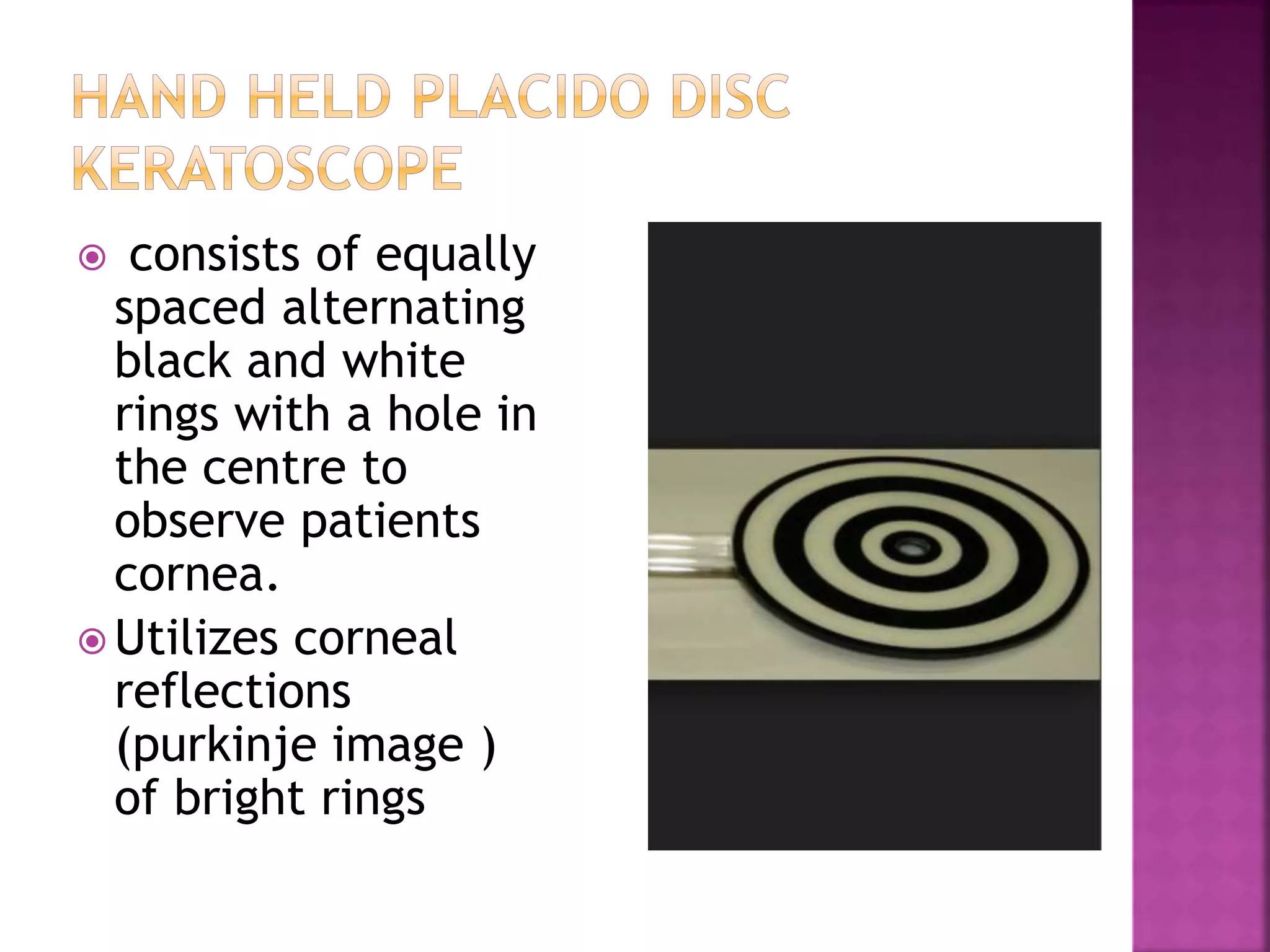
 consists of equally
spaced alternating
black and white
rings with a hole in
the centre to
observe patients
cornea.
 Utilizes corneal
reflections
(purkinje image )
of bright rings
 The steeper the
cornea the closer
reflected rings of
placido disc lie to
one another.
 DISADVANTAGE:
1. small degree of abnormality of corneal
shape are not easily identifiable.
2. Cannot be used in corneas with epithelial
defects and stromal ulcers etc because of
nonreflection of image by the cornea.
3. Anatomy of nose and orbit may limit field
size and restrict the corneal area that can
be examined
 A photographic film camera attached to a
keratoscope.
 Current photokeratoscopes(eg Nidek PKS
1000 or keracorneoscope) have 9-15 rings
which cover 55-75% of corneal surface.
 Closer the line steeper is the corneal surface
and the farther apart the lines flatter is the
corneal surface.
 Corneal cylinders of upto 3D can escape
detection by use of photokeratoscopy.
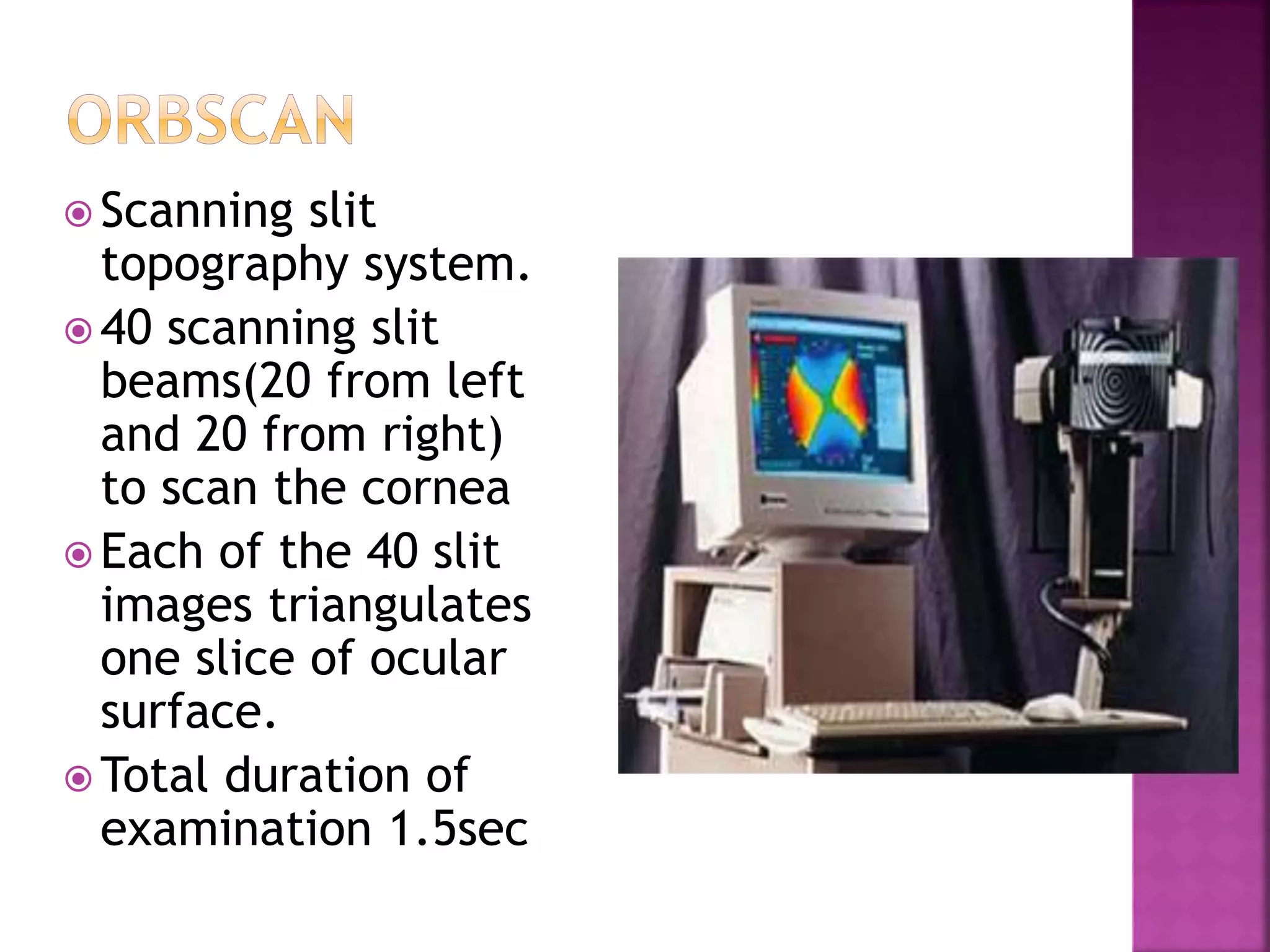
 Scanning slit
topography system.
 40 scanning slit
beams(20 from left
and 20 from right)
to scan the cornea
 Each of the 40 slit
images triangulates
one slice of ocular
surface.
 Total duration of
examination 1.5sec
Orbscan II :the placido disc added in orbscan 1
 Computer calculates
a hypothetical
sphere that matches
as close as possible
to to actual corneal
shape being
measured.
 Areas above sphere
shown in warm
colours and areas
below in blue colour
 The
Pentacam(Oculus
Inc) obtains
images of anterior
segment by
rotating
Schiempflug
camera which is a
digital charged
coupling device.
 Takes 50 meridonial sections through centre
of cornea which allows the system to realign
the central thinnest point of each section
before it reconstructs the corneal image.
Thus it eliminates any eye movement
occurring during the examination.
 Enables measurement of corneas with severe
irregularities such as keratoconus that may
not be amenable to placido imaging
 Enables calculation of pachymetry from
limbus to limbus
 It projects a calibrated grid onto fluroscein
stained tear film, takes photographs and uses
computer assisted algorithms to analyse the
pictures.
 The accuracy of the system is 0.3D for
diameter of 7mm.
 Uses the technique of lightwave interfernce.
 The interference fringes can cover the entire
anterior ocular surface not just cornea.
 Not in widespread clinical use.
 GREEN: near
normal power
 BLUE and its
shade: lower than
normal power
 RED and its shade:
higher than normal
power
 NORMALISED SCALE(VARIABLE SCALE):
 Different colour scales assigned to each map
 Instrument identifies actual minimal and
maximal keratometric diopteric value of
particular cornea
 Gives more detailed description
 ABSOLUTE SCALE(FIXED SCALE)
 Preset colour scale with same diopteric steps
 Minimum and maximum assigned to same
colours
 Larger increment in steps(0.5D) so may miss
subtle changes
 AXIAL MAP(SAGGITAL
MAP): original and most
commonly used map.
 Measures radius of
curvature for a
comparable sphere with
centre of rotation on
the axis of
videokeratoscope.
 Localised changes in
curvature and
peripheral changes are
poorly represented.
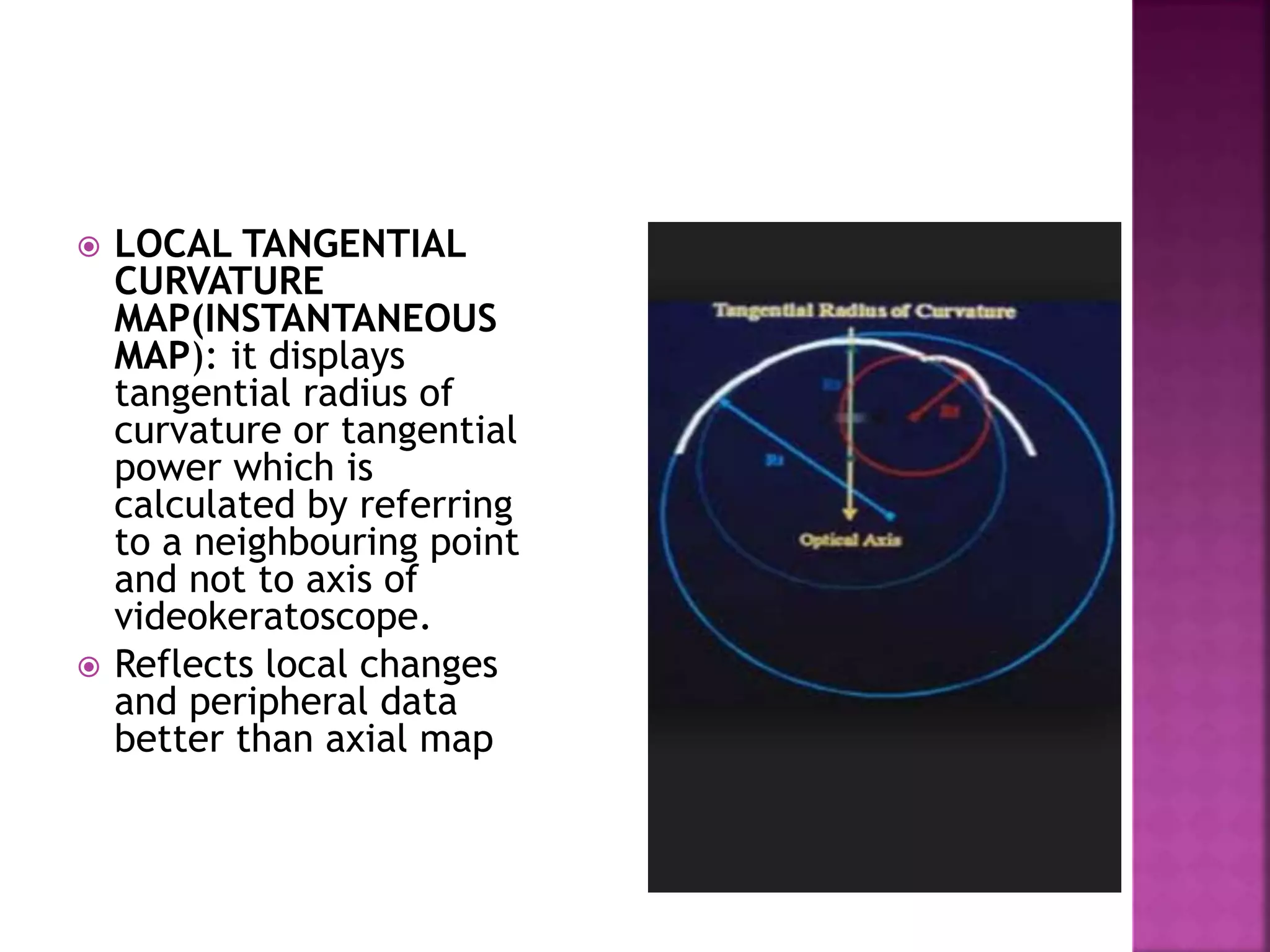
 LOCAL TANGENTIAL
CURVATURE
MAP(INSTANTANEOUS
MAP): it displays
tangential radius of
curvature or tangential
power which is
calculated by referring
to a neighbouring point
and not to axis of
videokeratoscope.
 Reflects local changes
and peripheral data
better than axial map
 REFRACTIVE MAP: displays refractive power
of cornea.
 ELEVATION MAP: displays corneal elevation
relative to a reference plane.
 DIFFERENCE MAP: displays changes in
certain values between 2 maps.
 RELATIVE MAP: displays some values by
comparing them to an arbitrary standard..
 Simulated keratometry(Sim K) :maximum
power of surface along any axis and the
power orthogonal to that axis(Sim K1 and Sim
K2)
 Surface Regularity Index(SRI): measure
regularity in central 4.5mm
 Zero for smooth surface, increases with
increasing astigmatism
 Surface Asymmetry Index(SAI):weighted
summation of differences in corneal power
between corresponding points 180 degrees
apart
 Asphericity: described quantitavely by the Q
value
 Q=0 for sphere
 Q<0 for prolate surface
 Q>0 for oblate surface
 Normal cornea has Q value of -0.26
 Anterior Float(Elevation Best Sphere):
 Anterior best fit sphere is calculated to best
match the anterior corneal surface.
 Elevation BFS map subtracts the calculated
BFS against the eye surface.
 Posterior Float(Elevation Best Sphere Map):
describes the back surface of the cornea in
the same manner.
 Keratometric(mean Power) Map:displays
refractive power of anterior surface of cornea
 Thickness (Pachymetry )map: displays
corneal thickness
 Warm colour indicates thinner cornea
 Keratometric
reading
 White to white
distance in mm
 Thinnest point of
cornea
 Angle kappa
readings
 Irregularity within
central 3mm and
5mm
 Normal cornea flattens progressively from
centre to periphery, nasal area flattening
more than temporal area
 Approximate distribution of keratographic
pattern varies as
 Round(23%)
 Oval(21%)
 Symmetric bow tie typical for regular
astigmatism(18%)
 Asymmetric bow tie(32%)
 Irregular(7%)
 Typically there is inferior area of steepening.
 Area of increased power surrounded by
concentric areas of decreased power
 An inferior superior power asymmetry
 A skewing of the steepest radial axis above
and below the horizontal meridian
 Keratoconus Predictability Index(KPI):
derived from 8 topographic indices.
KPI of >0.23 is indicative of keratoconus
KISA % index:
product of central K reading, I-S value,
astigmatism measured by Sim K value and
Skewed radial axis index(SRAX).
60%-or more is suspect
100% diagnostic
 RABINOWITZ DIAGNOSTIC CRITERIA :
 Consists of 3 topography derived indices
1.Keratometry value of 47.2 D or greater in the
central cornea
2. Inferior –Superior asymmetry value –
1.4D-1.9D is suggestive and >1.9D is
diagnostic
3. Posterior float elevation >40 micro m
suggestive of posterior ectasia
 Classical butterfly
appearance
 Against the rule
astigmatism in
early stage
 Thinning is
concentric to the
limbus generally
between 4 to 8 O
clock position
 Flattening over areas of peripheral
thinning(mostly superior and inferior cornea)
 High against the rule or oblique astigmatism
is a common feature
 Topographic
pattern with a
polygonal shape is
most common
pattern
 Depending on
number of
incisions made
square , hexagons
or octagons can be
seen
 Characterised by topograhic changes in
cornea following contact lens wear as a
result of mechanical pressure exerted by lens
 Usually 4 different form which occur alone or
with one another
i.Peripheral steepening
ii. Central flattening
iii. Furrow depression
iv. Central moulding
 To guide removal of tight sutures after
corneal surgery
 Guide contact lens fitting
 Evaluate effect of keratographic procedure

Corneal topography

  • 2.
     Cornea isthe most powerful refractive element of the eye contributing 43D(70%) of refractive power of eye.  Since the shape of corneal surface determines its refractive power , even a minor modification of its surface can lead to significant alteration of image formed on retina.
  • 3.
     Prolate shape Anterior surface of cornea: Elliptical  Horizontal dia: 11.5mm  Vertical dia:10.6mm  Posterior surface of cornea is circular with average diameter of 11.5mm  Thickness of cornea:  0.52mm at centre  0.8mm at periphery  1mm at limbus  Anterior radius of curvature:7.8mm  Posterior radius of curvature:6.5mm
  • 4.
     CENTRAL ZONE:Approximately 4mm diameter.  Also called the apical zone  PARACENTRAL ZONE: 4-8mm diameter. Flatter than the central zone.  Central + Paracentral zone= optical zone.  PERIPHERAL ZONE: 8-11 mm. It is the zone where the normal cornea flattens the most and becomes ashperic.  LIMBAL ZONE
  • 5.
     Corneal topographyrefers to study of the shape of corneal surface
  • 6.
     Placido based Elevation based  Interferometric  Rasterstereography  Schiempflug imaging
  • 7.
     Devised byHelmholtz,who originally used the term ophthalmometer  Calculations are based on the geometry of a spherical reflecting surface  Based on fact that anterior surface of cornea acts as convex mirror and size of image varies with curvature  Helps to measure the radius of curvature of anterior corneal surface from 4 reflected points within central 3mm of cornea
  • 8.
     Helmholtz keratometer Bausch and lomb keratometer  Javal schiotz keratometer
  • 9.
     I/O=v/u  Sinceimage is formed near F so v=F=r/2 therefore r can be calculated as 2uI/O Thus for known object size , measurement of image size will help determine radius of curvature. In all keratometers u is constant being focal distance of viewing telescope
  • 10.
     To overcomethe natural movements of patients eye for accurate measurements, the principle of image doubling is used.  The readings are obtained by aligning the images with one another
  • 11.
     Fixed objectsize  Image size is adjusted to measure corneal curvature  Uses rotationg glass plates to obtain doubling of images
  • 12.
     Also basedon principle of constant object size and variable image size
  • 14.
     Based onprinciple of variable object and constant image size.  Doubling of image is achieved by wollaston prism
  • 15.
     Assumes corneato be spherical  Details of only central 3mm ignoring peripheral corneal zones  Loses accuracy when measuring very steep or flat corneas  Small corneal irregularities preclude the use due to irregular astigmatism.
  • 17.
     consists ofequally spaced alternating black and white rings with a hole in the centre to observe patients cornea.  Utilizes corneal reflections (purkinje image ) of bright rings
  • 18.
     The steeperthe cornea the closer reflected rings of placido disc lie to one another.
  • 19.
     DISADVANTAGE: 1. smalldegree of abnormality of corneal shape are not easily identifiable. 2. Cannot be used in corneas with epithelial defects and stromal ulcers etc because of nonreflection of image by the cornea. 3. Anatomy of nose and orbit may limit field size and restrict the corneal area that can be examined
  • 20.
     A photographicfilm camera attached to a keratoscope.  Current photokeratoscopes(eg Nidek PKS 1000 or keracorneoscope) have 9-15 rings which cover 55-75% of corneal surface.  Closer the line steeper is the corneal surface and the farther apart the lines flatter is the corneal surface.  Corneal cylinders of upto 3D can escape detection by use of photokeratoscopy.
  • 21.
     Scanning slit topographysystem.  40 scanning slit beams(20 from left and 20 from right) to scan the cornea  Each of the 40 slit images triangulates one slice of ocular surface.  Total duration of examination 1.5sec
  • 22.
    Orbscan II :theplacido disc added in orbscan 1
  • 23.
     Computer calculates ahypothetical sphere that matches as close as possible to to actual corneal shape being measured.  Areas above sphere shown in warm colours and areas below in blue colour
  • 24.
     The Pentacam(Oculus Inc) obtains imagesof anterior segment by rotating Schiempflug camera which is a digital charged coupling device.
  • 25.
     Takes 50meridonial sections through centre of cornea which allows the system to realign the central thinnest point of each section before it reconstructs the corneal image. Thus it eliminates any eye movement occurring during the examination.  Enables measurement of corneas with severe irregularities such as keratoconus that may not be amenable to placido imaging  Enables calculation of pachymetry from limbus to limbus
  • 26.
     It projectsa calibrated grid onto fluroscein stained tear film, takes photographs and uses computer assisted algorithms to analyse the pictures.  The accuracy of the system is 0.3D for diameter of 7mm.
  • 27.
     Uses thetechnique of lightwave interfernce.  The interference fringes can cover the entire anterior ocular surface not just cornea.  Not in widespread clinical use.
  • 29.
     GREEN: near normalpower  BLUE and its shade: lower than normal power  RED and its shade: higher than normal power
  • 30.
     NORMALISED SCALE(VARIABLESCALE):  Different colour scales assigned to each map  Instrument identifies actual minimal and maximal keratometric diopteric value of particular cornea  Gives more detailed description
  • 31.
     ABSOLUTE SCALE(FIXEDSCALE)  Preset colour scale with same diopteric steps  Minimum and maximum assigned to same colours  Larger increment in steps(0.5D) so may miss subtle changes
  • 32.
     AXIAL MAP(SAGGITAL MAP):original and most commonly used map.  Measures radius of curvature for a comparable sphere with centre of rotation on the axis of videokeratoscope.  Localised changes in curvature and peripheral changes are poorly represented.
  • 33.
     LOCAL TANGENTIAL CURVATURE MAP(INSTANTANEOUS MAP):it displays tangential radius of curvature or tangential power which is calculated by referring to a neighbouring point and not to axis of videokeratoscope.  Reflects local changes and peripheral data better than axial map
  • 34.
     REFRACTIVE MAP:displays refractive power of cornea.  ELEVATION MAP: displays corneal elevation relative to a reference plane.  DIFFERENCE MAP: displays changes in certain values between 2 maps.  RELATIVE MAP: displays some values by comparing them to an arbitrary standard..
  • 35.
     Simulated keratometry(SimK) :maximum power of surface along any axis and the power orthogonal to that axis(Sim K1 and Sim K2)  Surface Regularity Index(SRI): measure regularity in central 4.5mm  Zero for smooth surface, increases with increasing astigmatism  Surface Asymmetry Index(SAI):weighted summation of differences in corneal power between corresponding points 180 degrees apart
  • 36.
     Asphericity: describedquantitavely by the Q value  Q=0 for sphere  Q<0 for prolate surface  Q>0 for oblate surface  Normal cornea has Q value of -0.26
  • 38.
     Anterior Float(ElevationBest Sphere):  Anterior best fit sphere is calculated to best match the anterior corneal surface.  Elevation BFS map subtracts the calculated BFS against the eye surface.  Posterior Float(Elevation Best Sphere Map): describes the back surface of the cornea in the same manner.  Keratometric(mean Power) Map:displays refractive power of anterior surface of cornea  Thickness (Pachymetry )map: displays corneal thickness  Warm colour indicates thinner cornea
  • 39.
     Keratometric reading  Whiteto white distance in mm  Thinnest point of cornea  Angle kappa readings  Irregularity within central 3mm and 5mm
  • 40.
     Normal corneaflattens progressively from centre to periphery, nasal area flattening more than temporal area  Approximate distribution of keratographic pattern varies as  Round(23%)  Oval(21%)  Symmetric bow tie typical for regular astigmatism(18%)  Asymmetric bow tie(32%)  Irregular(7%)
  • 42.
     Typically thereis inferior area of steepening.  Area of increased power surrounded by concentric areas of decreased power  An inferior superior power asymmetry  A skewing of the steepest radial axis above and below the horizontal meridian
  • 43.
     Keratoconus PredictabilityIndex(KPI): derived from 8 topographic indices. KPI of >0.23 is indicative of keratoconus KISA % index: product of central K reading, I-S value, astigmatism measured by Sim K value and Skewed radial axis index(SRAX). 60%-or more is suspect 100% diagnostic
  • 44.
     RABINOWITZ DIAGNOSTICCRITERIA :  Consists of 3 topography derived indices 1.Keratometry value of 47.2 D or greater in the central cornea 2. Inferior –Superior asymmetry value – 1.4D-1.9D is suggestive and >1.9D is diagnostic 3. Posterior float elevation >40 micro m suggestive of posterior ectasia
  • 46.
     Classical butterfly appearance Against the rule astigmatism in early stage  Thinning is concentric to the limbus generally between 4 to 8 O clock position
  • 47.
     Flattening overareas of peripheral thinning(mostly superior and inferior cornea)  High against the rule or oblique astigmatism is a common feature
  • 48.
     Topographic pattern witha polygonal shape is most common pattern  Depending on number of incisions made square , hexagons or octagons can be seen
  • 49.
     Characterised bytopograhic changes in cornea following contact lens wear as a result of mechanical pressure exerted by lens  Usually 4 different form which occur alone or with one another i.Peripheral steepening ii. Central flattening iii. Furrow depression iv. Central moulding
  • 51.
     To guideremoval of tight sutures after corneal surgery  Guide contact lens fitting  Evaluate effect of keratographic procedure