AC/A RATIO
Presented by
Dr Anupama Manoharan
First year – D.O
Stanley Medical College
Chennai
INTRODUCTION
The Concept of AC/A Ratio
Designed by Fry who later with Haines introduced the abbreviation AC/A.
Definition
The ratio of the amount of accommodative convergence measured (in prism dioptre) to the
number of dioptres of accommodation which causes the convergence, other factor causing
convergence remaining constant. (Proposed by Fry)
The relationship between accommodation convergence and accommodation is constant
throughout the life in emmetropes.
The normal value of ac/a ratio is 3-5 prism dioptre for one dioptre of accommodation.
Unit expressed in ∆/D.
SIGNIFICANCE OF AC/A RATIO
• Has effect on near phoria.
• Abnormalities of the AC/A ratio are very important causes of strabismus.
• A high AC/A ratio may cause excessive convergence & produce a convergent
squint , during accommodation on a near object.
• A low AC/A ratio may cause a divergent squint when the patient look at a near
object.
TYPES
1. Stimulus AC/A ratio
Amount of accommodative convergence produced by a change of 1D in the
stimulus to accommodation.
Change in convergence is related to change in stimulus.
2. Response AC/A ratio
Amount of accommodative convergence produce by an actual change of 1D of
accommodation.
RESPONSE VS STIMULUS
• Usually Stimulus AC/A > Response AC/A.
• In practice - Stimulus AC/A is used.
• Difficult to measure - Response AC/A.
 Not appropriate to measure in older age (accommodation gradually decreased)
 Useful in younger Patient with binocular vision problems
• Alpern et. al (1959) found that response will be 10% less than the stimulus . Thus when we
measure accommodation response directly, we find for a +2.50D (40cms) stimulus there will be
a lag of accommodation of about +0.25 to +0.75 D.
METHODS OF MEASUREMENT OF AC/A RATIO
• Heterophoria method
• Gradient method
• Fixation disparity method
• Graphical method
TWO WAYS TO DETERMINE AC/A RATIO
• Clinical calculation
• Gradient method
 A simple comparison of deviation in distance and near fixation is commonly
used in clinical practice to estimate the AC/A ratio.
HETEROPHORIC METHOD
• Simple method , consists of comparing the measurement of the latent deviation of eye.
• Using prisms & alternate cover test at a point of distance fixation (6m) with full refractive correction
• At a point of near fixation (33 cm ) with refractive correction.
• Along with target like Snellen’s test type letter (to ensure a steady accommodation both at distance
and near ) or Maddox tangent scale.
• IPD should be measured.
• +ve sign for esodeviation, -ve sign of exodeviation.
• AC/A ratio is calculated from this following formula.
• AC/A = IPD +(N-D’/D).
CALCULATED AC/A RATIO
AC/A = IPD +[N - D¹] / D
Where,
IPD = interpupillary distance in centimetres
N = near fixation distance in meters
D¹= near phoria (eso is plus and exo is minus)
D = far phoria (eso is plus and exo is minus)
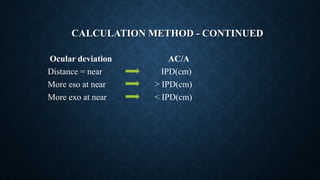
CALCULATION METHOD - CONTINUED
Ocular deviation AC/A
Distance = near IPD(cm)
More eso at near > IPD(cm)
More exo at near < IPD(cm)
GRADIENT METHOD
• The change in the stimulus to accommodation is produced by means of ophthalmic lenses and not
by a change in viewing distance.
• Concave lenses placed before the eyes increase the requirement for accommodation for the same
distance both for producing clear binocular single vision.
• Convex lenses relax accommodation.
• -1 D lenses produce an equivalent of 1D of accommodation,
• +1D lenses relax accommodation by 1D
• Estimation of AC/A : The difference between the deviation produced by placing spherical lenses
and the original deviation in prism dioptres, with a division of the difference by the power of the
lenses used in the determination.
AC/A=∆ⁱ−∆⁰/ D
FIXATION DISPARITY METHOD
• Used by Ogle & co-worker.
• Indirect method.
• More reliable due to test under binocular condition
• Consists of 2 set of data.
 First change in fixation disparity induced by force convergence using prism.
Second change in fixation disparity induced by altering the accommodative
stimulus with lens.
FIXATION DISPARITY - CONTINUED
• From these 2 sets of data they determined stimuli for convergence &
accommodation that gave same fixation disparity.
• Because of its complexity , the test is not performed in routine clinical
practice.
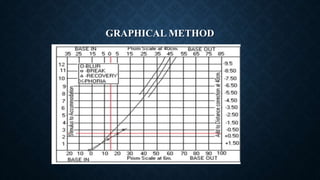
GRAPHICAL METHOD
• Convergence (in prism diopeter ) is plotted along the x axis.
• Stimulus to accommodation is indicated along the y – axis.
• Slope of graph represents AC/A ratio.
GRAPHICAL METHOD
USES OF AC/A RATIO
• Diagnosis of convergence excess type of esodeviation
• Divergence excess esodeviation
• Divergence insufficiency
• Convergence insufficiency
MANAGEMENT OF HIGH AC/A RATIO – USING OPTICAL
• Apply in those patient who have chance of obtaining some fusion when the
eyes are straight or within 10PD in distance with optical correction
• Try to keep eyes straight for distance upto age of 8 years
• If eso deviation is less than 10PD in distance has chance of developing
fusion with full optical correction
• If exodeviation is greater than 10PD in distance has no chance of
developing fusion unless the deviation is reduced to under 10PD
MANAGEMENT OF HIGH AC/A RATIO –
PHARMACOLOGICALLY
• Mitotic
• Long-acting cholinesterase inhibitors (eg, echothiophate iodide) can be used to
decrease accommodative convergence.
• These drugs act directly on the ciliary body, facilitating transmission at the
myoneural junction. They reduce the central demand for accommodative innervation
and thus reduce the amount of convergence induced by accommodation.
CONVERGENCE EXCESS
• N>D’
• High AC/A ratio
Treatment
 Near add (over correction of plus power or under correction of minus power most effective )
 Base – out prism ( alternative method )
 Base in training
DIVERGENCE EXCESS
• N<D
• High AC/A ratio
Treatment
 Over correction of minus power or under correction of plus power
 In mild case base in prism for full time wear.
DIVERGENCE INSUFFICIENCY
• N>D
• Low AC/A ratio
Treatment
Base out prism
Thank you

Ac/a ratio

  • 1.
    AC/A RATIO Presented by DrAnupama Manoharan First year – D.O Stanley Medical College Chennai
  • 2.
    INTRODUCTION The Concept ofAC/A Ratio Designed by Fry who later with Haines introduced the abbreviation AC/A. Definition The ratio of the amount of accommodative convergence measured (in prism dioptre) to the number of dioptres of accommodation which causes the convergence, other factor causing convergence remaining constant. (Proposed by Fry) The relationship between accommodation convergence and accommodation is constant throughout the life in emmetropes. The normal value of ac/a ratio is 3-5 prism dioptre for one dioptre of accommodation. Unit expressed in ∆/D.
  • 3.
    SIGNIFICANCE OF AC/ARATIO • Has effect on near phoria. • Abnormalities of the AC/A ratio are very important causes of strabismus. • A high AC/A ratio may cause excessive convergence & produce a convergent squint , during accommodation on a near object. • A low AC/A ratio may cause a divergent squint when the patient look at a near object.
  • 4.
    TYPES 1. Stimulus AC/Aratio Amount of accommodative convergence produced by a change of 1D in the stimulus to accommodation. Change in convergence is related to change in stimulus. 2. Response AC/A ratio Amount of accommodative convergence produce by an actual change of 1D of accommodation.
  • 5.
    RESPONSE VS STIMULUS •Usually Stimulus AC/A > Response AC/A. • In practice - Stimulus AC/A is used. • Difficult to measure - Response AC/A.  Not appropriate to measure in older age (accommodation gradually decreased)  Useful in younger Patient with binocular vision problems • Alpern et. al (1959) found that response will be 10% less than the stimulus . Thus when we measure accommodation response directly, we find for a +2.50D (40cms) stimulus there will be a lag of accommodation of about +0.25 to +0.75 D.
  • 6.
    METHODS OF MEASUREMENTOF AC/A RATIO • Heterophoria method • Gradient method • Fixation disparity method • Graphical method
  • 7.
    TWO WAYS TODETERMINE AC/A RATIO • Clinical calculation • Gradient method  A simple comparison of deviation in distance and near fixation is commonly used in clinical practice to estimate the AC/A ratio.
  • 8.
    HETEROPHORIC METHOD • Simplemethod , consists of comparing the measurement of the latent deviation of eye. • Using prisms & alternate cover test at a point of distance fixation (6m) with full refractive correction • At a point of near fixation (33 cm ) with refractive correction. • Along with target like Snellen’s test type letter (to ensure a steady accommodation both at distance and near ) or Maddox tangent scale. • IPD should be measured. • +ve sign for esodeviation, -ve sign of exodeviation. • AC/A ratio is calculated from this following formula. • AC/A = IPD +(N-D’/D).
  • 9.
    CALCULATED AC/A RATIO AC/A= IPD +[N - D¹] / D Where, IPD = interpupillary distance in centimetres N = near fixation distance in meters D¹= near phoria (eso is plus and exo is minus) D = far phoria (eso is plus and exo is minus)
  • 10.
    CALCULATION METHOD -CONTINUED Ocular deviation AC/A Distance = near IPD(cm) More eso at near > IPD(cm) More exo at near < IPD(cm)
  • 11.
    GRADIENT METHOD • Thechange in the stimulus to accommodation is produced by means of ophthalmic lenses and not by a change in viewing distance. • Concave lenses placed before the eyes increase the requirement for accommodation for the same distance both for producing clear binocular single vision. • Convex lenses relax accommodation. • -1 D lenses produce an equivalent of 1D of accommodation, • +1D lenses relax accommodation by 1D • Estimation of AC/A : The difference between the deviation produced by placing spherical lenses and the original deviation in prism dioptres, with a division of the difference by the power of the lenses used in the determination. AC/A=∆ⁱ−∆⁰/ D
  • 12.
    FIXATION DISPARITY METHOD •Used by Ogle & co-worker. • Indirect method. • More reliable due to test under binocular condition • Consists of 2 set of data.  First change in fixation disparity induced by force convergence using prism. Second change in fixation disparity induced by altering the accommodative stimulus with lens.
  • 13.
    FIXATION DISPARITY -CONTINUED • From these 2 sets of data they determined stimuli for convergence & accommodation that gave same fixation disparity. • Because of its complexity , the test is not performed in routine clinical practice.
  • 15.
    GRAPHICAL METHOD • Convergence(in prism diopeter ) is plotted along the x axis. • Stimulus to accommodation is indicated along the y – axis. • Slope of graph represents AC/A ratio.
  • 16.
  • 17.
    USES OF AC/ARATIO • Diagnosis of convergence excess type of esodeviation • Divergence excess esodeviation • Divergence insufficiency • Convergence insufficiency
  • 18.
    MANAGEMENT OF HIGHAC/A RATIO – USING OPTICAL • Apply in those patient who have chance of obtaining some fusion when the eyes are straight or within 10PD in distance with optical correction • Try to keep eyes straight for distance upto age of 8 years • If eso deviation is less than 10PD in distance has chance of developing fusion with full optical correction • If exodeviation is greater than 10PD in distance has no chance of developing fusion unless the deviation is reduced to under 10PD
  • 19.
    MANAGEMENT OF HIGHAC/A RATIO – PHARMACOLOGICALLY • Mitotic • Long-acting cholinesterase inhibitors (eg, echothiophate iodide) can be used to decrease accommodative convergence. • These drugs act directly on the ciliary body, facilitating transmission at the myoneural junction. They reduce the central demand for accommodative innervation and thus reduce the amount of convergence induced by accommodation.
  • 20.
    CONVERGENCE EXCESS • N>D’ •High AC/A ratio Treatment  Near add (over correction of plus power or under correction of minus power most effective )  Base – out prism ( alternative method )  Base in training
  • 21.
    DIVERGENCE EXCESS • N<D •High AC/A ratio Treatment  Over correction of minus power or under correction of plus power  In mild case base in prism for full time wear.
  • 22.
    DIVERGENCE INSUFFICIENCY • N>D •Low AC/A ratio Treatment Base out prism
  • 23.