Subjective
Refraction
What is Refraction?
■ Determination of the refractive status
(prescription) of the eye.
OBJECTIVE
Retinoscopy
Autorefraction
SUBJECTIVE
Subjective Refraction
Phoropter
Epic
Subjective Refraction
■ To determine by subjective means the
combination of spherical and cylindrical
lenses necessary to to provide best visual
acuity.
■ (with accommodation relaxed)
Principles of Refraction
1. Accommodation-relaxed state
2. Maximum PLUS, minimum minus
Principles of Refraction
When can we ignore
accommodation?
How can we be sure accommodation
is relaxed?
■ Use PLUS lens to FOG
■ Ensure image is located in front of retina
■ This causes image / VA to become worse if
eye attempts to accommodate (Image point
becomes further away from the fovea)
Two sets of commonly used
instruments
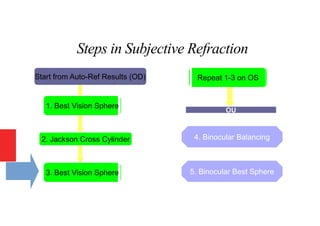
Start from Auto-Ref Results (OD)
1. Best Vision Sphere
2. Jackson Cross Cylinder
3. Best Vision Sphere
Repeat 1-3 on OS
4. Binocular Balancing
5. Binocular Best Sphere
OU
Steps in Subjective Refraction
Fogging
■ Place enough PLUS lenses to FOG vision
to 20/40 line
■ Pointer: every line is about 0.25 diopter
■ Slowly reduce the plus power until best
vision
■ Remember:
“Maximum plus power for best visual acuity”
Astigmatism
Step 2:JacksonCrossCylinder
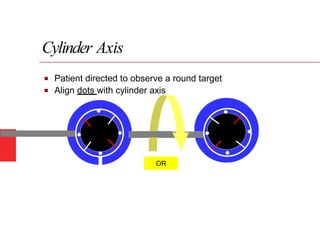
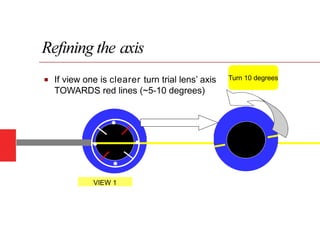
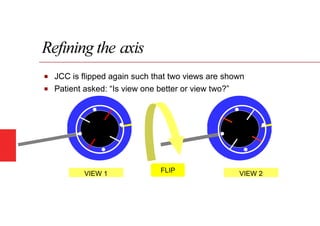
■ JCC used to find used to determine the
cylindrical axis and the cylindrical power for
the patient.
Yes, we have these!
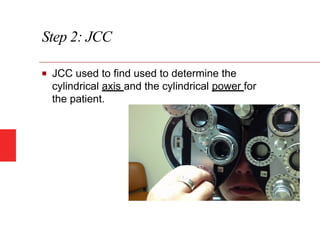
Step 2: JCC
■ JCC used to find used to determine the
cylindrical axis and the cylindrical power for
the patient.
How can we be sure accommodation
is relaxed?
■ Use PLUS lens to FOG
■ Ensure image is located in front of retina
■ This causes image / VA to become worse if
eye attempts to accommodate (Image point
becomes further away from the fovea)
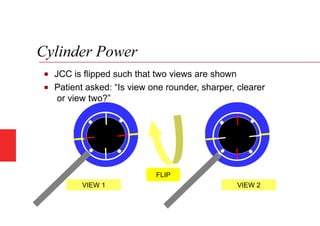
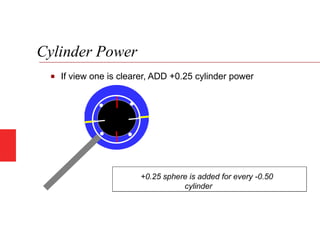
Cylinder Power
■ Patient directed to observe a round target
■ Align red lines OR white lines to trial lens axis
Cylinder Power
■ If view one is clearer, ADD +0.25 cylinder power
Steps in Subjective Refraction
Start from Auto-Ref Results (OD)
1. Best Vision Sphere
2. Jackson Cross Cylinder
3. Best Vision Sphere
Repeat 1-3 on OS
4. Binocular Balancing
5. Binocular Best Sphere
OU
Fogging like before...
■ Use PLUS lens to FOG
■ Ensure image is located in front of retina
■ This causes image / VA to become worse if
eye attempts to accommodate (Image point
becomes further away from the fovea)
What about for reading?
I'm over 40 years old and I can't read my phone.
What's that from?
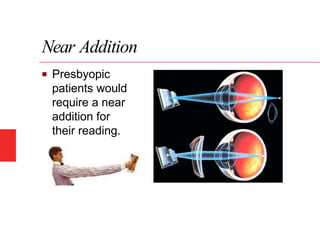
Near Addition
■ Presbyopic
patients would
require a near
addition for
their reading.
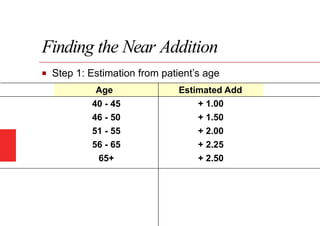
Finding the Near Addition
■ Step 1: Estimation from patient’s age
+ 1.00
+ 1.50
+ 2.00
+ 2.25
+ 2.50
40 - 45
46 - 50
51 - 55
56 - 65
65+
Age Estimated Add
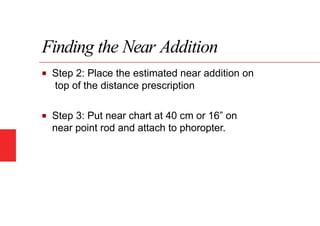
Finding the Near Addition
■ Step 2: Place the estimated near addition on
top of the distance prescription
■ Step 3: Put near chart at 40 cm or 16” on
near point rod and attach to phoropter.
Finding the Near Addition
■ Optional stuff after this!
Range of clear vision
20CM 60CM
40CM
■ Patient’s
habitual
reading
distance in
the middle of
the range of
clear vision.
Range of clear vision
10CM 50CM
40CM
■ If range is
too close to
patient:
Add
-0.25DS in
steps
Range of clear vision
30CM 70CM
40CM
■ If range is
too far to
patient: Add
+0.25DS in
steps

Subjective refraction final

  • 1.
  • 3.
    What is Refraction? ■Determination of the refractive status (prescription) of the eye. OBJECTIVE Retinoscopy Autorefraction SUBJECTIVE Subjective Refraction Phoropter Epic
  • 4.
    Subjective Refraction ■ Todetermine by subjective means the combination of spherical and cylindrical lenses necessary to to provide best visual acuity. ■ (with accommodation relaxed)
  • 5.
    Principles of Refraction 1.Accommodation-relaxed state 2. Maximum PLUS, minimum minus
  • 6.
    Principles of Refraction Whencan we ignore accommodation?
  • 7.
    How can webe sure accommodation is relaxed? ■ Use PLUS lens to FOG ■ Ensure image is located in front of retina ■ This causes image / VA to become worse if eye attempts to accommodate (Image point becomes further away from the fovea)
  • 8.
    Two sets ofcommonly used instruments
  • 9.
    Start from Auto-RefResults (OD) 1. Best Vision Sphere 2. Jackson Cross Cylinder 3. Best Vision Sphere Repeat 1-3 on OS 4. Binocular Balancing 5. Binocular Best Sphere OU Steps in Subjective Refraction
  • 10.
    Fogging ■ Place enoughPLUS lenses to FOG vision to 20/40 line ■ Pointer: every line is about 0.25 diopter ■ Slowly reduce the plus power until best vision ■ Remember: “Maximum plus power for best visual acuity”
  • 11.
  • 12.
    Step 2:JacksonCrossCylinder ■ JCCused to find used to determine the cylindrical axis and the cylindrical power for the patient. Yes, we have these!
  • 13.
    Step 2: JCC ■JCC used to find used to determine the cylindrical axis and the cylindrical power for the patient.
  • 16.
    How can webe sure accommodation is relaxed? ■ Use PLUS lens to FOG ■ Ensure image is located in front of retina ■ This causes image / VA to become worse if eye attempts to accommodate (Image point becomes further away from the fovea)
  • 20.
    Cylinder Power ■ Patientdirected to observe a round target ■ Align red lines OR white lines to trial lens axis
  • 23.
    Cylinder Power ■ Ifview one is clearer, ADD +0.25 cylinder power
  • 24.
    Steps in SubjectiveRefraction Start from Auto-Ref Results (OD) 1. Best Vision Sphere 2. Jackson Cross Cylinder 3. Best Vision Sphere Repeat 1-3 on OS 4. Binocular Balancing 5. Binocular Best Sphere OU
  • 25.
    Fogging like before... ■Use PLUS lens to FOG ■ Ensure image is located in front of retina ■ This causes image / VA to become worse if eye attempts to accommodate (Image point becomes further away from the fovea)
  • 26.
    What about forreading? I'm over 40 years old and I can't read my phone. What's that from?
  • 27.
    Near Addition ■ Presbyopic patientswould require a near addition for their reading.
  • 28.
    Finding the NearAddition ■ Step 1: Estimation from patient’s age + 1.00 + 1.50 + 2.00 + 2.25 + 2.50 40 - 45 46 - 50 51 - 55 56 - 65 65+ Age Estimated Add
  • 29.
    Finding the NearAddition ■ Step 2: Place the estimated near addition on top of the distance prescription ■ Step 3: Put near chart at 40 cm or 16” on near point rod and attach to phoropter.
  • 30.
    Finding the NearAddition ■ Optional stuff after this!
  • 31.
    Range of clearvision 20CM 60CM 40CM ■ Patient’s habitual reading distance in the middle of the range of clear vision.
  • 32.
    Range of clearvision 10CM 50CM 40CM ■ If range is too close to patient: Add -0.25DS in steps
  • 33.
    Range of clearvision 30CM 70CM 40CM ■ If range is too far to patient: Add +0.25DS in steps