Refraction
What is Refraction?
 Determination of the refractive status
 (prescription) of the eye.

     OBJECTIVE              SUBJECTIVE

     Retinoscopy         Subjective Refraction
Subjective Refraction
 To determine by subjective means the
 combination of spherical and cylindrical
 lenses necessary to to provide best visual
 acuity. (with accommodation relaxed)
Principles of Refraction
1.   Accommodation-relaxed state
2.   Maximum PLUS, minimum minus

3.   Always trial frame before prescribing
4.   Take into account vertex distance
     especially for high prescription
     individuals
How to ensure accommodation is relaxed?
 Use PLUS lens to FOG
 Ensure image is located infront of retina
 This causes image / VA to become worse if
 eye attempts to accommodate (Image point
 becomes further away from the fovea)
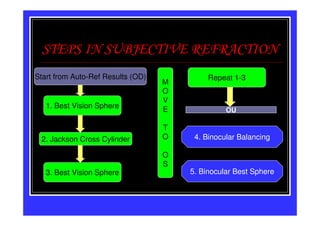
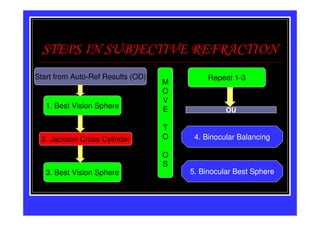
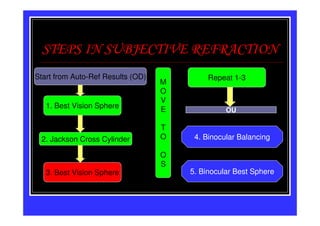
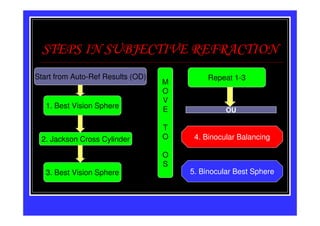
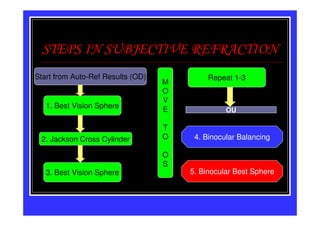
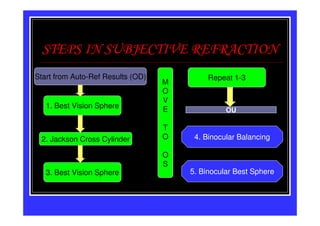
STEPS IN SUBJECTIVE REFRACTION
Start from Auto-Ref Results (OD)            Repeat 1-3
                                   M
                                   O
                                   V
   1. Best Vision Sphere           E             OU

                                   T
 2. Jackson Cross Cylinder         O    4. Binocular Balancing

                                   O
                                   S
   3. Best Vision Sphere               5. Binocular Best Sphere
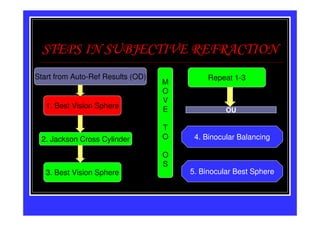
STEPS IN SUBJECTIVE REFRACTION
Start from Auto-Ref Results (OD)
Start from Ret Results (OD)                 Repeat 1-3
                                   M
                                   O
                                   V
   1. Best Vision Sphere           E             OU

                                   T
 2. Jackson Cross Cylinder         O    4. Binocular Balancing

                                   O
                                   S
   3. Best Vision Sphere               5. Binocular Best Sphere
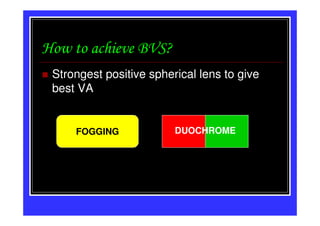
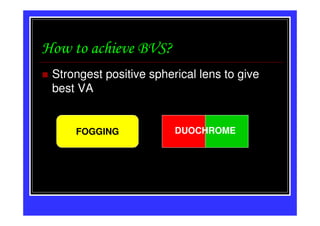
How to achieve BVS?
 Strongest positive spherical lens to give
 best VA


     FOGGING             DUOCHROME
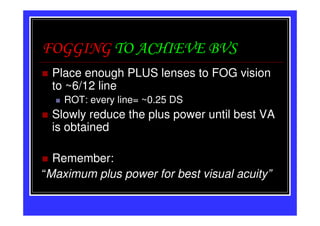
FOGGING TO ACHIEVE BVS
 Place enough PLUS lenses to FOG vision
 to ~6/12 line
    ROT: every line= ~0.25 DS
 Slowly reduce the plus power until best VA
 is obtained

  Remember:
“Maximum plus power for best visual acuity”
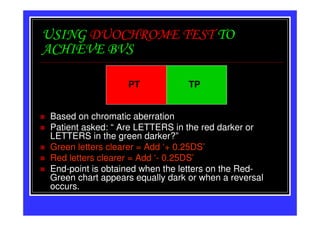
USING DUOCHROME TEST TO
ACHIEVE BVS

                  PT             TP


Based on chromatic aberration
Patient asked: “ Are LETTERS in the red darker or
LETTERS in the green darker?”
Green letters clearer = Add ‘+ 0.25DS’
Red letters clearer = Add ‘- 0.25DS’
End-point is obtained when the letters on the Red-
Green chart appears equally dark or when a reversal
occurs.
STEPS IN SUBJECTIVE REFRACTION
Start from Auto-Ref Results (OD)
Start from Ret Results (OD)                 Repeat 1-3
                                   M
                                   O
                                   V
   1. Best Vision Sphere           E             OU

                                   T
 2. Jackson Cross Cylinder         O    4. Binocular Balancing

                                   O
                                   S
   3. Best Vision Sphere               5. Binocular Best Sphere
STEP 2: JACKSON CROSS CYLINDER
(JCC)
 JCC used to find used to determine the
 cylindrical axis and the cylindrical power for
 the patient.
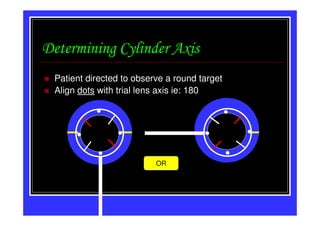
Determining Cylinder Axis
  Patient directed to observe a round target
  Align dots with trial lens axis ie: 180


                           OR
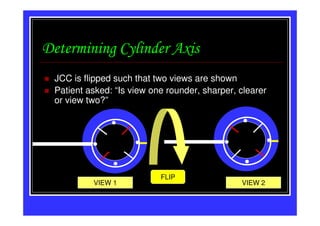
Determining Cylinder Axis
  JCC is flipped such that two views are shown
  Patient asked: “Is view one rounder, sharper, clearer
  or view two?”


                            FLIP
           VIEW 1                               VIEW 2
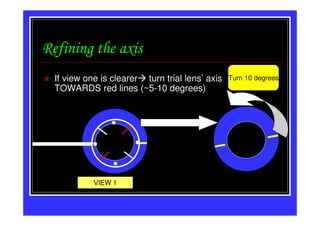
Refining the axis
  If view one is clearer turn trial lens’ axis   Turn 10 degrees
  TOWARDS red lines (~5-10 degrees)


            VIEW 1
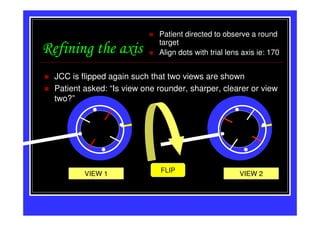
Patient directed to observe a round
                              target
Refining the axis             Align dots with trial lens axis ie: 170


  JCC is flipped again such that two views are shown
  Patient asked: “Is view one rounder, sharper, clearer or view
  two?”


                               FLIP
          VIEW 1                                        VIEW 2
Refining the axis
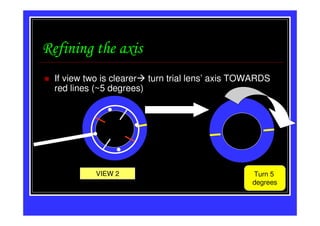
  If view two is clearer turn trial lens’ axis TOWARDS
  red lines (~5 degrees)


            VIEW 2                               Turn 5
                                                 degrees
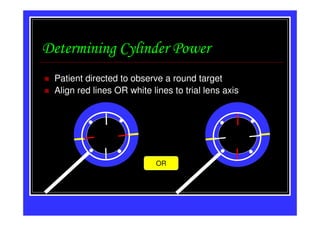
Determining Cylinder Power
 Patient directed to observe a round target
 Align red lines OR white lines to trial lens axis


                            OR
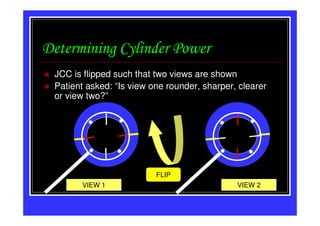
Determining Cylinder Power
 JCC is flipped such that two views are shown
 Patient asked: “Is view one rounder, sharper, clearer
 or view two?”


                          FLIP
       VIEW 1                                 VIEW 2
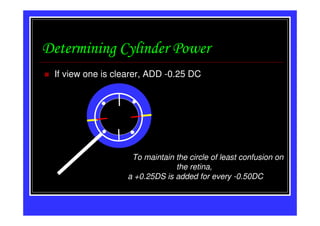
Determining Cylinder Power
 If view one is clearer, ADD -0.25 DC


                   To maintain the circle of least confusion on
                               the retina,
                  a +0.25DS is added for every -0.50DC
Determining Cylinder Power
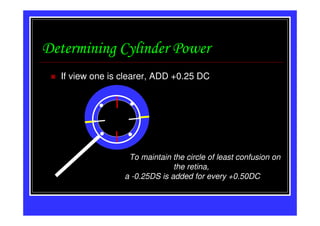
  If view one is clearer, ADD +0.25 DC


                  To maintain the circle of least confusion on
                               the retina,
                 a -0.25DS is added for every +0.50DC
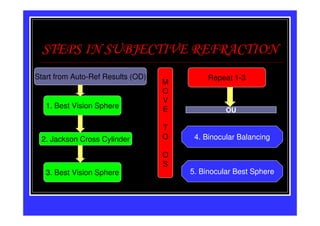
STEPS IN SUBJECTIVE REFRACTION
Start from Auto-Ref Results (OD)
Start from Ret Results (OD)                 Repeat 1-3
                                   M
                                   O
                                   V
   1. Best Vision Sphere           E             OU

                                   T
 2. Jackson Cross Cylinder         O    4. Binocular Balancing

                                   O
                                   S
   3. Best Vision Sphere               5. Binocular Best Sphere
How to achieve BVS?
 Strongest positive spherical lens to give
 best VA


     FOGGING             DUOCHROME
STEPS IN SUBJECTIVE REFRACTION
Start from Auto-Ref Results (OD)
Start from Ret Results (OD)                 Repeat 1-3
                                   M
                                   O
                                   V
   1. Best Vision Sphere           E             OU

                                   T
 2. Jackson Cross Cylinder         O    4. Binocular Balancing

                                   O
                                   S
   3. Best Vision Sphere               5. Binocular Best Sphere
STEPS IN SUBJECTIVE REFRACTION
Start from Auto-Ref Results (OD)
Start from Ret Results (OD)                 Repeat 1-3
                                   M
                                   O
                                   V
   1. Best Vision Sphere           E             OU

                                   T
 2. Jackson Cross Cylinder         O    4. Binocular Balancing

                                   O
                                   S
   3. Best Vision Sphere               5. Binocular Best Sphere
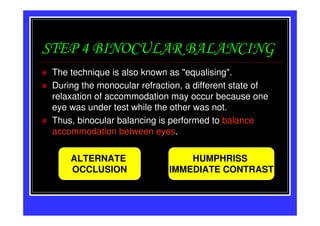
STEP 4 BINOCULAR BALANCING
 The technique is also known as "equalising".
 During the monocular refraction, a different state of
 relaxation of accommodation may occur because one
 eye was under test while the other was not.
 Thus, binocular balancing is performed to balance
 accommodation between eyes.

     ALTERNATE                   HUMPHRISS
     OCCLUSION               IMMEDIATE CONTRAST
BB: Alternate Occlusion
     Used only when VA is EQUAL in both eyes

1.   Fog both eyes with + 0.75DS
2.   Direct patient to view 3 lines above best VA
3.   Alternately occlude each eye for ~0.5 secs each while
     asking patient: “ Which eye sees clearer/sharper?”
4.   Add +0.25DS to the better eye
5.   Repeat step 3 and 4 until both eye’s vision is
     equalised
6.   Slowly reduce fog until best VA is reached
BB: Humphriss immediate contrast
     Used when VA is EQUAL or UNEQUAL between both
     eyes

1.   Fog OS with +0.75DS
2.   Direct patient to view OD’s best VA line
3.   (Perform BVS in OD)
4.   Add +0.25DS in OD       VA same or better Add
     +0.25DS, VA worse remove +0.25, until you achieve
     max plus min minus
5.   Repeat Step 1-3 to test OS
STEPS IN SUBJECTIVE REFRACTION
Start from Auto-Ref Results (OD)
Start from Ret Results (OD)                 Repeat 1-3
                                   M
                                   O
                                   V
   1. Best Vision Sphere           E             OU

                                   T
 2. Jackson Cross Cylinder         O    4. Binocular Balancing

                                   O
                                   S
   3. Best Vision Sphere               5. Binocular Best Sphere
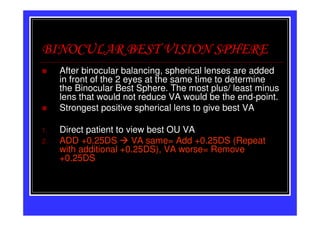
BINOCULAR BEST VISION SPHERE
     After binocular balancing, spherical lenses are added
     in front of the 2 eyes at the same time to determine
     the Binocular Best Sphere. The most plus/ least minus
     lens that would not reduce VA would be the end-point.
     Strongest positive spherical lens to give best VA

1.   Direct patient to view best OU VA
2.   ADD +0.25DS        VA same= Add +0.25DS (Repeat
     with additional +0.25DS), VA worse= Remove
     +0.25DS
STEPS IN SUBJECTIVE REFRACTION
Start from Auto-Ref Results (OD)
Start from Ret Results (OD)                 Repeat 1-3
                                   M
                                   O
                                   V
   1. Best Vision Sphere           E             OU

                                   T
 2. Jackson Cross Cylinder         O    4. Binocular Balancing

                                   O
                                   S
   3. Best Vision Sphere               5. Binocular Best Sphere
What about for reading?


“I can see clearly at distance, but I can’t read my
                     newspapers!”
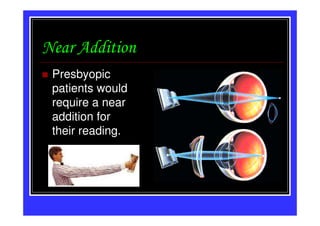
Near Addition
 Presbyopic
 patients would
 require a near
 addition for
 their reading.
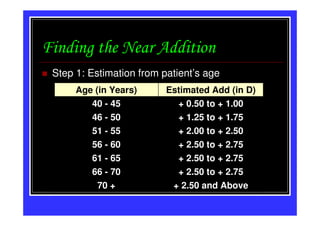
Finding the Near Addition
 Step 1: Estimation from patient’s age
      Age (in Years)      Estimated Add (in D)
         40 - 45            + 0.50 to + 1.00
         46 - 50            + 1.25 to + 1.75
         51 - 55            + 2.00 to + 2.50
         56 - 60            + 2.50 to + 2.75
         61 - 65            + 2.50 to + 2.75
         66 - 70            + 2.50 to + 2.75
           70 +            + 2.50 and Above
Finding the Near Addition
 Step 2: Place the estimated near addition on
 top of the distance prescription

 Step 3: Patients holds the near vision chart at
 habitual distance. The amount of near add is
 then adjusted to position the patient’s habitual
 reading distance in the middle of the range of
 clear vision.
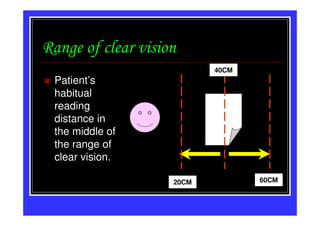
Range of clear vision
                           40CM
 Patient’s
 habitual
 reading
 distance in
 the middle of
 the range of
 clear vision.

                    20CM          60CM
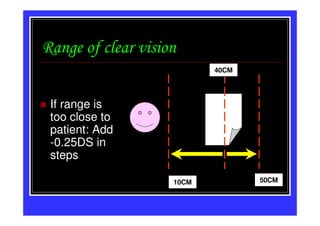
Range of clear vision
                           40CM


 If range is
 too close to
 patient: Add
 -0.25DS in
 steps

                    10CM          50CM
Range of clear vision
                           40CM


 If range is
 too far to
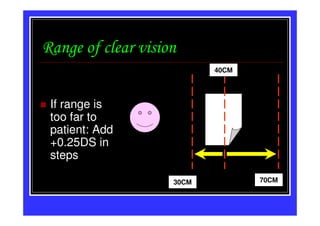
 patient: Add
 +0.25DS in
 steps

                    30CM          70CM
Instruments for
  Refraction
 Trial lens set and frame
         Phoropter
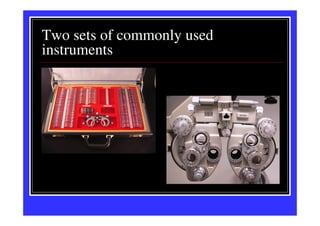
Two sets of commonly used
instruments
Clinical notes for trial lens and trial
frame

    Spherical lenses are usually placed first in the
    trial frame, while cylindrical lenses are then
    placed in the front of the spherical lenses.

    When there are 2 or more spherical lenses,
    the one with the strongest power should be
    placed in the cell closest to the eye.
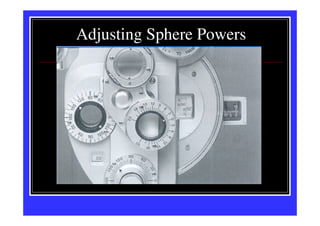
Adjusting Sphere Powers
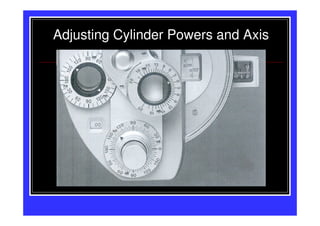
Adjusting Cylinder Powers and Axis
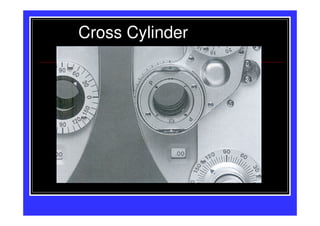
Cross Cylinder

subjective refraction

  • 1.
  • 2.
    What is Refraction? Determination of the refractive status (prescription) of the eye. OBJECTIVE SUBJECTIVE Retinoscopy Subjective Refraction
  • 3.
    Subjective Refraction Todetermine by subjective means the combination of spherical and cylindrical lenses necessary to to provide best visual acuity. (with accommodation relaxed)
  • 4.
    Principles of Refraction 1. Accommodation-relaxed state 2. Maximum PLUS, minimum minus 3. Always trial frame before prescribing 4. Take into account vertex distance especially for high prescription individuals
  • 5.
    How to ensureaccommodation is relaxed? Use PLUS lens to FOG Ensure image is located infront of retina This causes image / VA to become worse if eye attempts to accommodate (Image point becomes further away from the fovea)
  • 6.
    STEPS IN SUBJECTIVEREFRACTION Start from Auto-Ref Results (OD) Repeat 1-3 M O V 1. Best Vision Sphere E OU T 2. Jackson Cross Cylinder O 4. Binocular Balancing O S 3. Best Vision Sphere 5. Binocular Best Sphere
  • 7.
    STEPS IN SUBJECTIVEREFRACTION Start from Auto-Ref Results (OD) Start from Ret Results (OD) Repeat 1-3 M O V 1. Best Vision Sphere E OU T 2. Jackson Cross Cylinder O 4. Binocular Balancing O S 3. Best Vision Sphere 5. Binocular Best Sphere
  • 8.
    How to achieveBVS? Strongest positive spherical lens to give best VA FOGGING DUOCHROME
  • 9.
    FOGGING TO ACHIEVEBVS Place enough PLUS lenses to FOG vision to ~6/12 line ROT: every line= ~0.25 DS Slowly reduce the plus power until best VA is obtained Remember: “Maximum plus power for best visual acuity”
  • 10.
    USING DUOCHROME TESTTO ACHIEVE BVS PT TP Based on chromatic aberration Patient asked: “ Are LETTERS in the red darker or LETTERS in the green darker?” Green letters clearer = Add ‘+ 0.25DS’ Red letters clearer = Add ‘- 0.25DS’ End-point is obtained when the letters on the Red- Green chart appears equally dark or when a reversal occurs.
  • 11.
    STEPS IN SUBJECTIVEREFRACTION Start from Auto-Ref Results (OD) Start from Ret Results (OD) Repeat 1-3 M O V 1. Best Vision Sphere E OU T 2. Jackson Cross Cylinder O 4. Binocular Balancing O S 3. Best Vision Sphere 5. Binocular Best Sphere
  • 12.
    STEP 2: JACKSONCROSS CYLINDER (JCC) JCC used to find used to determine the cylindrical axis and the cylindrical power for the patient.
  • 13.
    Determining Cylinder Axis Patient directed to observe a round target Align dots with trial lens axis ie: 180 OR
  • 14.
    Determining Cylinder Axis JCC is flipped such that two views are shown Patient asked: “Is view one rounder, sharper, clearer or view two?” FLIP VIEW 1 VIEW 2
  • 15.
    Refining the axis If view one is clearer turn trial lens’ axis Turn 10 degrees TOWARDS red lines (~5-10 degrees) VIEW 1
  • 16.
    Patient directed toobserve a round target Refining the axis Align dots with trial lens axis ie: 170 JCC is flipped again such that two views are shown Patient asked: “Is view one rounder, sharper, clearer or view two?” FLIP VIEW 1 VIEW 2
  • 17.
    Refining the axis If view two is clearer turn trial lens’ axis TOWARDS red lines (~5 degrees) VIEW 2 Turn 5 degrees
  • 18.
    Determining Cylinder Power Patient directed to observe a round target Align red lines OR white lines to trial lens axis OR
  • 19.
    Determining Cylinder Power JCC is flipped such that two views are shown Patient asked: “Is view one rounder, sharper, clearer or view two?” FLIP VIEW 1 VIEW 2
  • 20.
    Determining Cylinder Power If view one is clearer, ADD -0.25 DC To maintain the circle of least confusion on the retina, a +0.25DS is added for every -0.50DC
  • 21.
    Determining Cylinder Power If view one is clearer, ADD +0.25 DC To maintain the circle of least confusion on the retina, a -0.25DS is added for every +0.50DC
  • 22.
    STEPS IN SUBJECTIVEREFRACTION Start from Auto-Ref Results (OD) Start from Ret Results (OD) Repeat 1-3 M O V 1. Best Vision Sphere E OU T 2. Jackson Cross Cylinder O 4. Binocular Balancing O S 3. Best Vision Sphere 5. Binocular Best Sphere
  • 23.
    How to achieveBVS? Strongest positive spherical lens to give best VA FOGGING DUOCHROME
  • 24.
    STEPS IN SUBJECTIVEREFRACTION Start from Auto-Ref Results (OD) Start from Ret Results (OD) Repeat 1-3 M O V 1. Best Vision Sphere E OU T 2. Jackson Cross Cylinder O 4. Binocular Balancing O S 3. Best Vision Sphere 5. Binocular Best Sphere
  • 25.
    STEPS IN SUBJECTIVEREFRACTION Start from Auto-Ref Results (OD) Start from Ret Results (OD) Repeat 1-3 M O V 1. Best Vision Sphere E OU T 2. Jackson Cross Cylinder O 4. Binocular Balancing O S 3. Best Vision Sphere 5. Binocular Best Sphere
  • 26.
    STEP 4 BINOCULARBALANCING The technique is also known as "equalising". During the monocular refraction, a different state of relaxation of accommodation may occur because one eye was under test while the other was not. Thus, binocular balancing is performed to balance accommodation between eyes. ALTERNATE HUMPHRISS OCCLUSION IMMEDIATE CONTRAST
  • 27.
    BB: Alternate Occlusion Used only when VA is EQUAL in both eyes 1. Fog both eyes with + 0.75DS 2. Direct patient to view 3 lines above best VA 3. Alternately occlude each eye for ~0.5 secs each while asking patient: “ Which eye sees clearer/sharper?” 4. Add +0.25DS to the better eye 5. Repeat step 3 and 4 until both eye’s vision is equalised 6. Slowly reduce fog until best VA is reached
  • 28.
    BB: Humphriss immediatecontrast Used when VA is EQUAL or UNEQUAL between both eyes 1. Fog OS with +0.75DS 2. Direct patient to view OD’s best VA line 3. (Perform BVS in OD) 4. Add +0.25DS in OD VA same or better Add +0.25DS, VA worse remove +0.25, until you achieve max plus min minus 5. Repeat Step 1-3 to test OS
  • 29.
    STEPS IN SUBJECTIVEREFRACTION Start from Auto-Ref Results (OD) Start from Ret Results (OD) Repeat 1-3 M O V 1. Best Vision Sphere E OU T 2. Jackson Cross Cylinder O 4. Binocular Balancing O S 3. Best Vision Sphere 5. Binocular Best Sphere
  • 30.
    BINOCULAR BEST VISIONSPHERE After binocular balancing, spherical lenses are added in front of the 2 eyes at the same time to determine the Binocular Best Sphere. The most plus/ least minus lens that would not reduce VA would be the end-point. Strongest positive spherical lens to give best VA 1. Direct patient to view best OU VA 2. ADD +0.25DS VA same= Add +0.25DS (Repeat with additional +0.25DS), VA worse= Remove +0.25DS
  • 31.
    STEPS IN SUBJECTIVEREFRACTION Start from Auto-Ref Results (OD) Start from Ret Results (OD) Repeat 1-3 M O V 1. Best Vision Sphere E OU T 2. Jackson Cross Cylinder O 4. Binocular Balancing O S 3. Best Vision Sphere 5. Binocular Best Sphere
  • 32.
    What about forreading? “I can see clearly at distance, but I can’t read my newspapers!”
  • 33.
    Near Addition Presbyopic patients would require a near addition for their reading.
  • 34.
    Finding the NearAddition Step 1: Estimation from patient’s age Age (in Years) Estimated Add (in D) 40 - 45 + 0.50 to + 1.00 46 - 50 + 1.25 to + 1.75 51 - 55 + 2.00 to + 2.50 56 - 60 + 2.50 to + 2.75 61 - 65 + 2.50 to + 2.75 66 - 70 + 2.50 to + 2.75 70 + + 2.50 and Above
  • 35.
    Finding the NearAddition Step 2: Place the estimated near addition on top of the distance prescription Step 3: Patients holds the near vision chart at habitual distance. The amount of near add is then adjusted to position the patient’s habitual reading distance in the middle of the range of clear vision.
  • 36.
    Range of clearvision 40CM Patient’s habitual reading distance in the middle of the range of clear vision. 20CM 60CM
  • 37.
    Range of clearvision 40CM If range is too close to patient: Add -0.25DS in steps 10CM 50CM
  • 38.
    Range of clearvision 40CM If range is too far to patient: Add +0.25DS in steps 30CM 70CM
  • 40.
    Instruments for Refraction Trial lens set and frame Phoropter
  • 41.
    Two sets ofcommonly used instruments
  • 42.
    Clinical notes fortrial lens and trial frame Spherical lenses are usually placed first in the trial frame, while cylindrical lenses are then placed in the front of the spherical lenses. When there are 2 or more spherical lenses, the one with the strongest power should be placed in the cell closest to the eye.
  • 43.
  • 44.
  • 45.