DR NILESH KATE
MBBS,MD
ASSOCIATE PROF
DEPT. OF PHYSIOLOGY
MOTOR
SYSTEM
OBJECTIVES
 Introduction.
 Components of Somatic motor control
system.
 Skeletal Muscle : The Effector organ of
somatic motor system.
 Reflex activity.
 Regulation of posture.
 Vestibular apparatus & equilibrium.
Monday, May 16, 2016
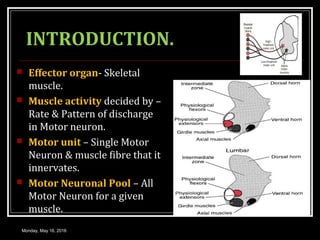
INTRODUCTION.
 Effector organ- Skeletal
muscle.
 Muscle activity decided by –
Rate & Pattern of discharge
in Motor neuron.
 Motor unit – Single Motor
Neuron & muscle fibre that it
innervates.
 Motor Neuronal Pool – All
Motor Neuron for a given
muscle.
Monday, May 16, 2016
INTRODUCTION.
 Lower Motor Neuron
& Final Common
Pathway – Alpha
motor neuron &
Motor nuclei of
cranial nerves.
Monday, May 16, 2016
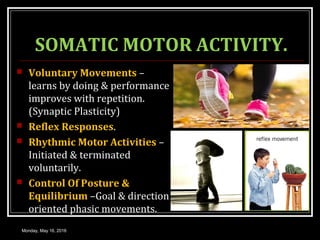
SOMATIC MOTOR ACTIVITY.
 Voluntary Movements –
learns by doing & performance
improves with repetition.
(Synaptic Plasticity)
 Reflex Responses.
 Rhythmic Motor Activities –
Initiated & terminated
voluntarily.
 Control Of Posture &
Equilibrium –Goal & direction
oriented phasic movements.
Monday, May 16, 2016
MEDIAL VS LATERAL MOTOR
SYSTEM.
 Medial Motor
System.
 Anterior Cortico-spinal
tract.
 Corticobulbar tract.
 Lateral & Medial
Vestibulospinal tract.
 Reticulospinal tract.
 Lateral Motor
System.
 Lateral corticospinal
tract.
 Rubro spinal tract.
 Corticobulbar tract.
Monday, May 16, 2016
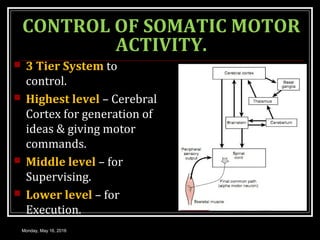
CONTROL OF SOMATIC MOTOR
ACTIVITY.
 3 Tier System to
control.
 Highest level – Cerebral
Cortex for generation of
ideas & giving motor
commands.
 Middle level – for
Supervising.
 Lower level – for
Execution.
Monday, May 16, 2016
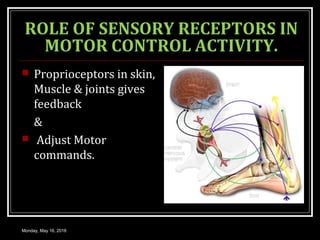
ROLE OF SENSORY RECEPTORS IN
MOTOR CONTROL ACTIVITY.
 Proprioceptors in skin,
Muscle & joints gives
feedback
&
 Adjust Motor
commands.
Monday, May 16, 2016
OVERVIEW TO STUDY MOTOR
CONTROL SYSTEM.
 Components of
somatic motor control
system.
 Skeletal muscles: the
effector organ.
 Reflexes.
 Regulation of
posture &
equilibrium.
Monday, May 16, 2016
COMPONENTS OF SOMATIC
MOTOR CONTROL SYSTEM.
 Highest level of motor control.
 Middle level of motor control.
 Lowest level of motor control.
Monday, May 16, 2016
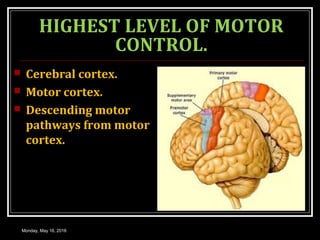
HIGHEST LEVEL OF MOTOR
CONTROL.
 Cerebral cortex.
 Motor cortex.
 Descending motor
pathways from motor
cortex.
Monday, May 16, 2016
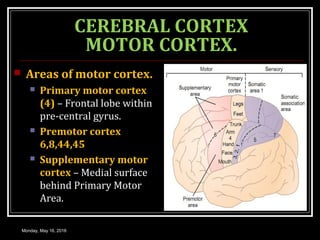
CEREBRAL CORTEX
MOTOR CORTEX.
 Areas of motor cortex.
 Primary motor cortex
(4) – Frontal lobe within
pre-central gyrus.
 Premotor cortex
6,8,44,45
 Supplementary motor
cortex – Medial surface
behind Primary Motor
Area.
Monday, May 16, 2016
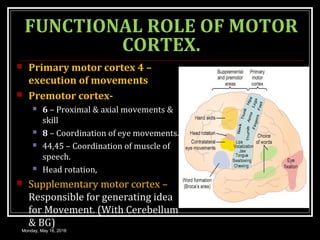
FUNCTIONAL ROLE OF MOTOR
CORTEX.
 Primary motor cortex 4 –
execution of movements
 Premotor cortex-
 6 – Proximal & axial movements &
skill
 8 – Coordination of eye movements.
 44,45 – Coordination of muscle of
speech.
 Head rotation,
 Supplementary motor cortex –
Responsible for generating idea
for Movement. (With Cerebellum
& BG)
Monday, May 16, 2016
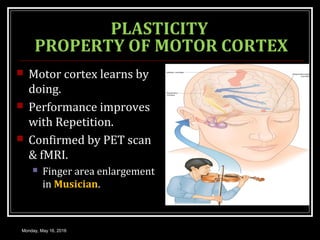
PLASTICITY
PROPERTY OF MOTOR CORTEX
 Motor cortex learns by
doing.
 Performance improves
with Repetition.
 Confirmed by PET scan
& fMRI.
 Finger area enlargement
in Musician.
Monday, May 16, 2016
TOPOGRAPHICAL REPRESENTATION
OF MOTOR AREAS IN CORTEX
Monday, May 16, 2016
MOTOR HOMONCULUS
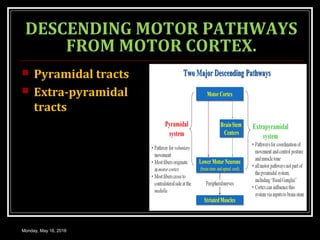
DESCENDING MOTOR PATHWAYS
FROM MOTOR CORTEX.
 Pyramidal tracts
 Extra-pyramidal
tracts
Monday, May 16, 2016
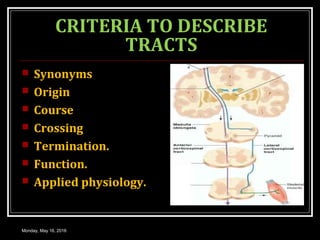
CRITERIA TO DESCRIBE
TRACTS
 Synonyms
 Origin
 Course
 Crossing
 Termination.
 Function.
 Applied physiology.
Monday, May 16, 2016
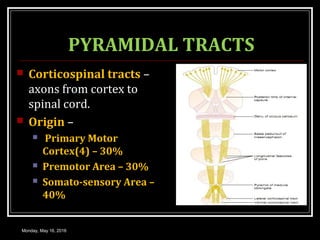
PYRAMIDAL TRACTS
 Corticospinal tracts –
axons from cortex to
spinal cord.
 Origin –
 Primary Motor
Cortex(4) – 30%
 Premotor Area – 30%
 Somato-sensory Area –
40%
Monday, May 16, 2016
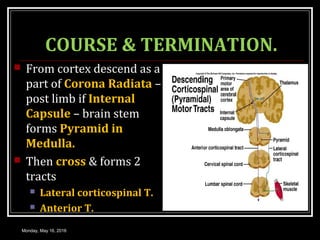
COURSE & TERMINATION.
 From cortex descend as a
part of Corona Radiata –
post limb if Internal
Capsule – brain stem
forms Pyramid in
Medulla.
 Then cross & forms 2
tracts
 Lateral corticospinal T.
 Anterior T.
Monday, May 16, 2016
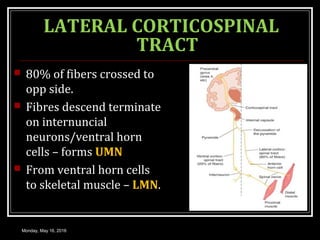
LATERAL CORTICOSPINAL
TRACT
 80% of fibers crossed to
opp side.
 Fibres descend terminate
on internuncial
neurons/ventral horn
cells – forms UMN
 From ventral horn cells
to skeletal muscle – LMN.
Monday, May 16, 2016
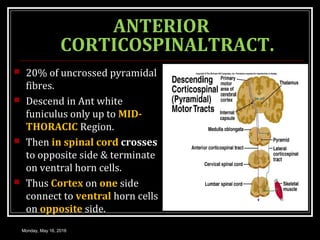
ANTERIOR
CORTICOSPINALTRACT.
 20% of uncrossed pyramidal
fibres.
 Descend in Ant white
funiculus only up to MID-
THORACIC Region.
 Then in spinal cord crosses
to opposite side & terminate
on ventral horn cells.
 Thus Cortex on one side
connect to ventral horn cells
on opposite side.
Monday, May 16, 2016
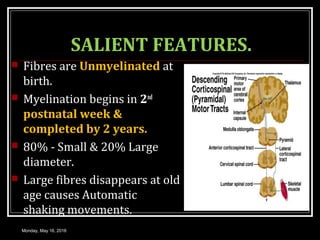
SALIENT FEATURES.
 Fibres are Unmyelinated at
birth.
 Myelination begins in 2nd
postnatal week &
completed by 2 years.
 80% - Small & 20% Large
diameter.
 Large fibres disappears at old
age causes Automatic
shaking movements.
Monday, May 16, 2016
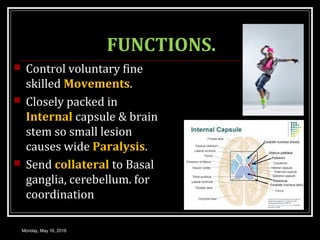
FUNCTIONS.
 Control voluntary fine
skilled Movements.
 Closely packed in
Internal capsule & brain
stem so small lesion
causes wide Paralysis.
 Send collateral to Basal
ganglia, cerebellum. for
coordination
Monday, May 16, 2016
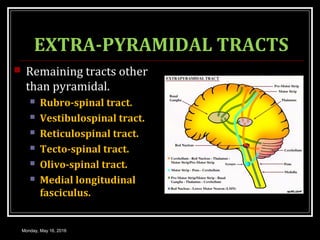
EXTRA-PYRAMIDAL TRACTS
 Remaining tracts other
than pyramidal.
 Rubro-spinal tract.
 Vestibulospinal tract.
 Reticulospinal tract.
 Tecto-spinal tract.
 Olivo-spinal tract.
 Medial longitudinal
fasciculus.
Monday, May 16, 2016
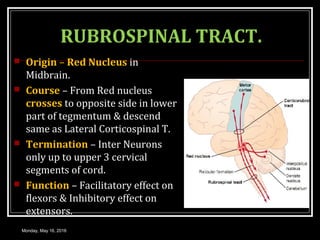
RUBROSPINAL TRACT.
 Origin – Red Nucleus in
Midbrain.
 Course – From Red nucleus
crosses to opposite side in lower
part of tegmentum & descend
same as Lateral Corticospinal T.
 Termination – Inter Neurons
only up to upper 3 cervical
segments of cord.
 Function – Facilitatory effect on
flexors & Inhibitory effect on
extensors.
Monday, May 16, 2016
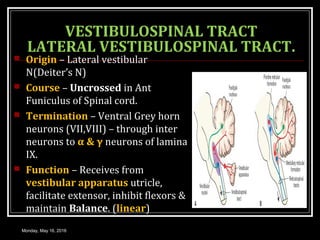
VESTIBULOSPINAL TRACT
LATERAL VESTIBULOSPINAL TRACT.
 Origin – Lateral vestibular
N(Deiter’s N)
 Course – Uncrossed in Ant
Funiculus of Spinal cord.
 Termination – Ventral Grey horn
neurons (VII,VIII) – through inter
neurons to α & γ neurons of lamina
IX.
 Function – Receives from
vestibular apparatus utricle,
facilitate extensor, inhibit flexors &
maintain Balance. (linear)
Monday, May 16, 2016
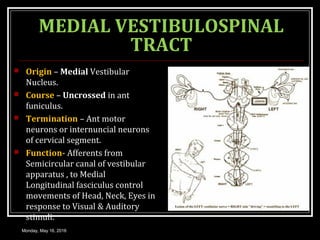
MEDIAL VESTIBULOSPINAL
TRACT
 Origin – Medial Vestibular
Nucleus.
 Course – Uncrossed in ant
funiculus.
 Termination – Ant motor
neurons or internuncial neurons
of cervical segment.
 Function- Afferents from
Semicircular canal of vestibular
apparatus , to Medial
Longitudinal fasciculus control
movements of Head, Neck, Eyes in
response to Visual & Auditory
stimuli.
Monday, May 16, 2016
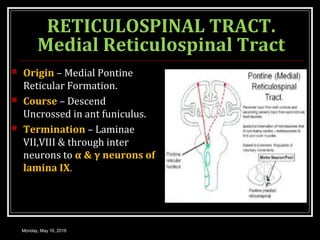
RETICULOSPINAL TRACT.
Medial Reticulospinal Tract
 Origin – Medial Pontine
Reticular Formation.
 Course – Descend
Uncrossed in ant funiculus.
 Termination – Laminae
VII,VIII & through inter
neurons to α & γ neurons of
lamina IX.
Monday, May 16, 2016
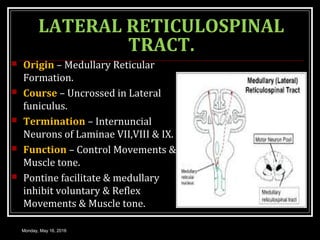
LATERAL RETICULOSPINAL
TRACT.
 Origin – Medullary Reticular
Formation.
 Course – Uncrossed in Lateral
funiculus.
 Termination – Internuncial
Neurons of Laminae VII,VIII & IX.
 Function – Control Movements &
Muscle tone.
 Pontine facilitate & medullary
inhibit voluntary & Reflex
Movements & Muscle tone.
Monday, May 16, 2016
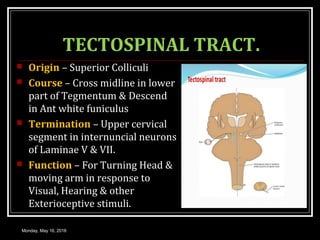
TECTOSPINAL TRACT.
 Origin – Superior Colliculi
 Course – Cross midline in lower
part of Tegmentum & Descend
in Ant white funiculus
 Termination – Upper cervical
segment in internuncial neurons
of Laminae V & VII.
 Function – For Turning Head &
moving arm in response to
Visual, Hearing & other
Exterioceptive stimuli.
Monday, May 16, 2016
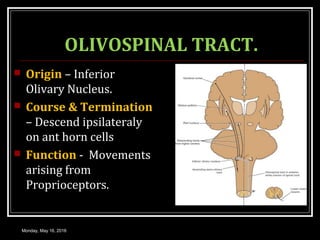
OLIVOSPINAL TRACT.
 Origin – Inferior
Olivary Nucleus.
 Course & Termination
– Descend ipsilateraly
on ant horn cells
 Function - Movements
arising from
Proprioceptors.
Monday, May 16, 2016
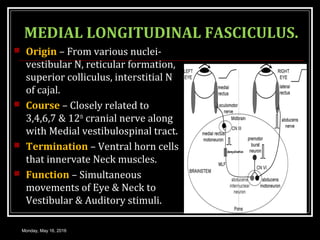
MEDIAL LONGITUDINAL FASCICULUS.
 Origin – From various nuclei-
vestibular N, reticular formation,
superior colliculus, interstitial N
of cajal.
 Course – Closely related to
3,4,6,7 & 12th
cranial nerve along
with Medial vestibulospinal tract.
 Termination – Ventral horn cells
that innervate Neck muscles.
 Function – Simultaneous
movements of Eye & Neck to
Vestibular & Auditory stimuli.
Monday, May 16, 2016
DESCENDING TRACTS ENDING
IN BRAIN STEM
 Cortico-Nuclear tracts.
 Cortico-Ponto-
cerebellar tracts.
 Cortico-Rubral.
 Cortico-olivary.
 Cortico-reticular.
All forms part of Extra-
Pyramidal system.
Monday, May 16, 2016
THANK YOU.

MOTOR SYSTEM MOTOR TRACTS

  • 1.
    DR NILESH KATE MBBS,MD ASSOCIATEPROF DEPT. OF PHYSIOLOGY MOTOR SYSTEM
  • 2.
    OBJECTIVES  Introduction.  Componentsof Somatic motor control system.  Skeletal Muscle : The Effector organ of somatic motor system.  Reflex activity.  Regulation of posture.  Vestibular apparatus & equilibrium. Monday, May 16, 2016
  • 3.
    INTRODUCTION.  Effector organ-Skeletal muscle.  Muscle activity decided by – Rate & Pattern of discharge in Motor neuron.  Motor unit – Single Motor Neuron & muscle fibre that it innervates.  Motor Neuronal Pool – All Motor Neuron for a given muscle. Monday, May 16, 2016
  • 4.
    INTRODUCTION.  Lower MotorNeuron & Final Common Pathway – Alpha motor neuron & Motor nuclei of cranial nerves. Monday, May 16, 2016
  • 5.
    SOMATIC MOTOR ACTIVITY. Voluntary Movements – learns by doing & performance improves with repetition. (Synaptic Plasticity)  Reflex Responses.  Rhythmic Motor Activities – Initiated & terminated voluntarily.  Control Of Posture & Equilibrium –Goal & direction oriented phasic movements. Monday, May 16, 2016
  • 6.
    MEDIAL VS LATERALMOTOR SYSTEM.  Medial Motor System.  Anterior Cortico-spinal tract.  Corticobulbar tract.  Lateral & Medial Vestibulospinal tract.  Reticulospinal tract.  Lateral Motor System.  Lateral corticospinal tract.  Rubro spinal tract.  Corticobulbar tract. Monday, May 16, 2016
  • 7.
    CONTROL OF SOMATICMOTOR ACTIVITY.  3 Tier System to control.  Highest level – Cerebral Cortex for generation of ideas & giving motor commands.  Middle level – for Supervising.  Lower level – for Execution. Monday, May 16, 2016
  • 8.
    ROLE OF SENSORYRECEPTORS IN MOTOR CONTROL ACTIVITY.  Proprioceptors in skin, Muscle & joints gives feedback &  Adjust Motor commands. Monday, May 16, 2016
  • 9.
    OVERVIEW TO STUDYMOTOR CONTROL SYSTEM.  Components of somatic motor control system.  Skeletal muscles: the effector organ.  Reflexes.  Regulation of posture & equilibrium. Monday, May 16, 2016
  • 10.
    COMPONENTS OF SOMATIC MOTORCONTROL SYSTEM.  Highest level of motor control.  Middle level of motor control.  Lowest level of motor control. Monday, May 16, 2016
  • 11.
    HIGHEST LEVEL OFMOTOR CONTROL.  Cerebral cortex.  Motor cortex.  Descending motor pathways from motor cortex. Monday, May 16, 2016
  • 12.
    CEREBRAL CORTEX MOTOR CORTEX. Areas of motor cortex.  Primary motor cortex (4) – Frontal lobe within pre-central gyrus.  Premotor cortex 6,8,44,45  Supplementary motor cortex – Medial surface behind Primary Motor Area. Monday, May 16, 2016
  • 13.
    FUNCTIONAL ROLE OFMOTOR CORTEX.  Primary motor cortex 4 – execution of movements  Premotor cortex-  6 – Proximal & axial movements & skill  8 – Coordination of eye movements.  44,45 – Coordination of muscle of speech.  Head rotation,  Supplementary motor cortex – Responsible for generating idea for Movement. (With Cerebellum & BG) Monday, May 16, 2016
  • 14.
    PLASTICITY PROPERTY OF MOTORCORTEX  Motor cortex learns by doing.  Performance improves with Repetition.  Confirmed by PET scan & fMRI.  Finger area enlargement in Musician. Monday, May 16, 2016
  • 15.
    TOPOGRAPHICAL REPRESENTATION OF MOTORAREAS IN CORTEX Monday, May 16, 2016 MOTOR HOMONCULUS
  • 16.
    DESCENDING MOTOR PATHWAYS FROMMOTOR CORTEX.  Pyramidal tracts  Extra-pyramidal tracts Monday, May 16, 2016
  • 17.
    CRITERIA TO DESCRIBE TRACTS Synonyms  Origin  Course  Crossing  Termination.  Function.  Applied physiology. Monday, May 16, 2016
  • 18.
    PYRAMIDAL TRACTS  Corticospinaltracts – axons from cortex to spinal cord.  Origin –  Primary Motor Cortex(4) – 30%  Premotor Area – 30%  Somato-sensory Area – 40% Monday, May 16, 2016
  • 19.
    COURSE & TERMINATION. From cortex descend as a part of Corona Radiata – post limb if Internal Capsule – brain stem forms Pyramid in Medulla.  Then cross & forms 2 tracts  Lateral corticospinal T.  Anterior T. Monday, May 16, 2016
  • 20.
    LATERAL CORTICOSPINAL TRACT  80%of fibers crossed to opp side.  Fibres descend terminate on internuncial neurons/ventral horn cells – forms UMN  From ventral horn cells to skeletal muscle – LMN. Monday, May 16, 2016
  • 21.
    ANTERIOR CORTICOSPINALTRACT.  20% ofuncrossed pyramidal fibres.  Descend in Ant white funiculus only up to MID- THORACIC Region.  Then in spinal cord crosses to opposite side & terminate on ventral horn cells.  Thus Cortex on one side connect to ventral horn cells on opposite side. Monday, May 16, 2016
  • 22.
    SALIENT FEATURES.  Fibresare Unmyelinated at birth.  Myelination begins in 2nd postnatal week & completed by 2 years.  80% - Small & 20% Large diameter.  Large fibres disappears at old age causes Automatic shaking movements. Monday, May 16, 2016
  • 23.
    FUNCTIONS.  Control voluntaryfine skilled Movements.  Closely packed in Internal capsule & brain stem so small lesion causes wide Paralysis.  Send collateral to Basal ganglia, cerebellum. for coordination Monday, May 16, 2016
  • 24.
    EXTRA-PYRAMIDAL TRACTS  Remainingtracts other than pyramidal.  Rubro-spinal tract.  Vestibulospinal tract.  Reticulospinal tract.  Tecto-spinal tract.  Olivo-spinal tract.  Medial longitudinal fasciculus. Monday, May 16, 2016
  • 25.
    RUBROSPINAL TRACT.  Origin– Red Nucleus in Midbrain.  Course – From Red nucleus crosses to opposite side in lower part of tegmentum & descend same as Lateral Corticospinal T.  Termination – Inter Neurons only up to upper 3 cervical segments of cord.  Function – Facilitatory effect on flexors & Inhibitory effect on extensors. Monday, May 16, 2016
  • 26.
    VESTIBULOSPINAL TRACT LATERAL VESTIBULOSPINALTRACT.  Origin – Lateral vestibular N(Deiter’s N)  Course – Uncrossed in Ant Funiculus of Spinal cord.  Termination – Ventral Grey horn neurons (VII,VIII) – through inter neurons to α & γ neurons of lamina IX.  Function – Receives from vestibular apparatus utricle, facilitate extensor, inhibit flexors & maintain Balance. (linear) Monday, May 16, 2016
  • 27.
    MEDIAL VESTIBULOSPINAL TRACT  Origin– Medial Vestibular Nucleus.  Course – Uncrossed in ant funiculus.  Termination – Ant motor neurons or internuncial neurons of cervical segment.  Function- Afferents from Semicircular canal of vestibular apparatus , to Medial Longitudinal fasciculus control movements of Head, Neck, Eyes in response to Visual & Auditory stimuli. Monday, May 16, 2016
  • 28.
    RETICULOSPINAL TRACT. Medial ReticulospinalTract  Origin – Medial Pontine Reticular Formation.  Course – Descend Uncrossed in ant funiculus.  Termination – Laminae VII,VIII & through inter neurons to α & γ neurons of lamina IX. Monday, May 16, 2016
  • 29.
    LATERAL RETICULOSPINAL TRACT.  Origin– Medullary Reticular Formation.  Course – Uncrossed in Lateral funiculus.  Termination – Internuncial Neurons of Laminae VII,VIII & IX.  Function – Control Movements & Muscle tone.  Pontine facilitate & medullary inhibit voluntary & Reflex Movements & Muscle tone. Monday, May 16, 2016
  • 30.
    TECTOSPINAL TRACT.  Origin– Superior Colliculi  Course – Cross midline in lower part of Tegmentum & Descend in Ant white funiculus  Termination – Upper cervical segment in internuncial neurons of Laminae V & VII.  Function – For Turning Head & moving arm in response to Visual, Hearing & other Exterioceptive stimuli. Monday, May 16, 2016
  • 31.
    OLIVOSPINAL TRACT.  Origin– Inferior Olivary Nucleus.  Course & Termination – Descend ipsilateraly on ant horn cells  Function - Movements arising from Proprioceptors. Monday, May 16, 2016
  • 32.
    MEDIAL LONGITUDINAL FASCICULUS. Origin – From various nuclei- vestibular N, reticular formation, superior colliculus, interstitial N of cajal.  Course – Closely related to 3,4,6,7 & 12th cranial nerve along with Medial vestibulospinal tract.  Termination – Ventral horn cells that innervate Neck muscles.  Function – Simultaneous movements of Eye & Neck to Vestibular & Auditory stimuli. Monday, May 16, 2016
  • 33.
    DESCENDING TRACTS ENDING INBRAIN STEM  Cortico-Nuclear tracts.  Cortico-Ponto- cerebellar tracts.  Cortico-Rubral.  Cortico-olivary.  Cortico-reticular. All forms part of Extra- Pyramidal system. Monday, May 16, 2016
  • 34.
    Monday, May 16,2016 THANK YOU.