EXTRAPYRAMIDAL   TRACTS BY:- DR. PRIYANKA GUPTA (B.P.T)
 
DEFINATION Extrapyramidal tracts are those motor pathways which may act as the alternative route for volitional impulses and which form the platform on which pyramidal system works skillfully Integrated at various level from cerebral cortex to spinal cord Cortical region controlling these tracts are area 8 and 6
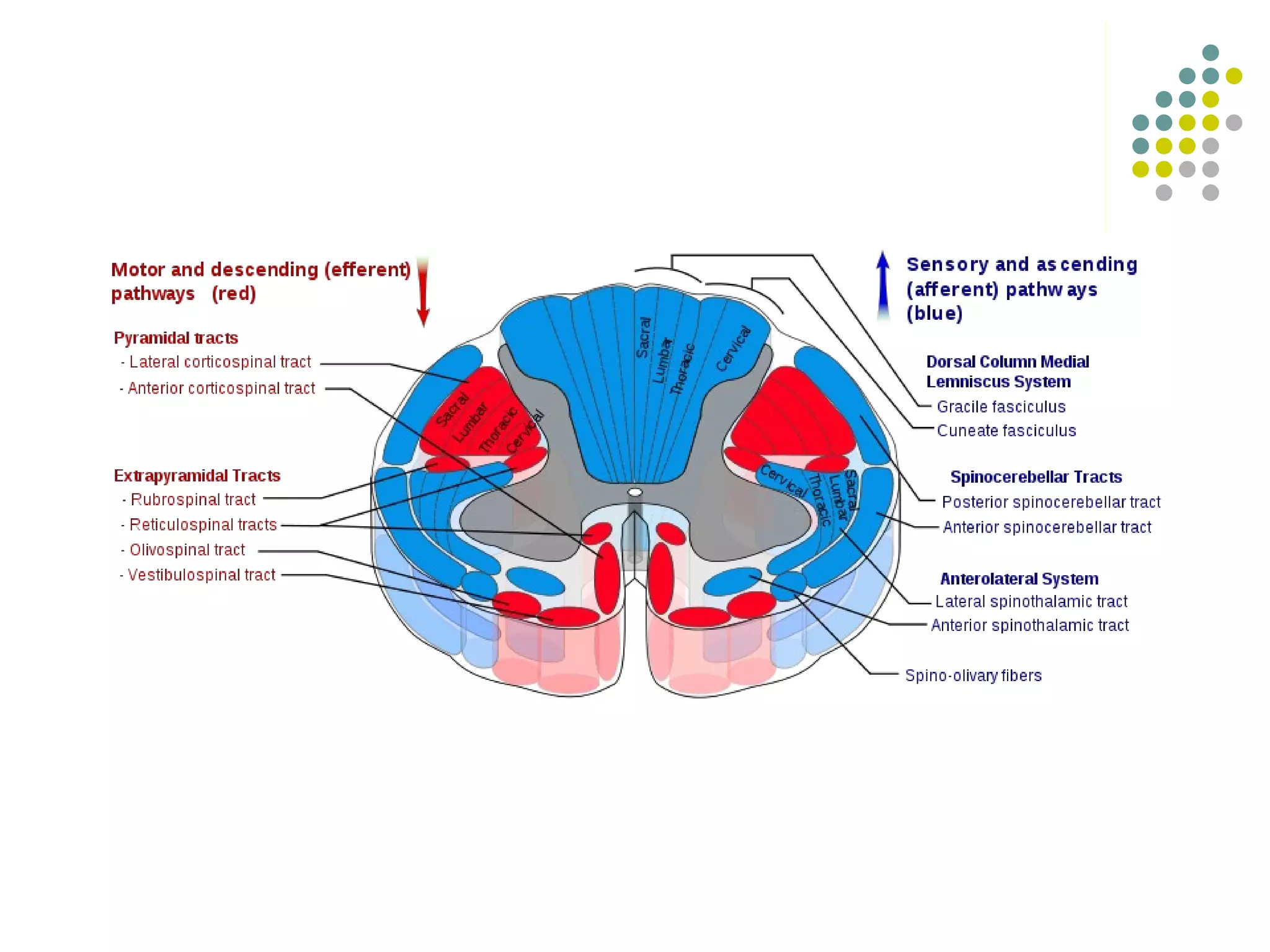
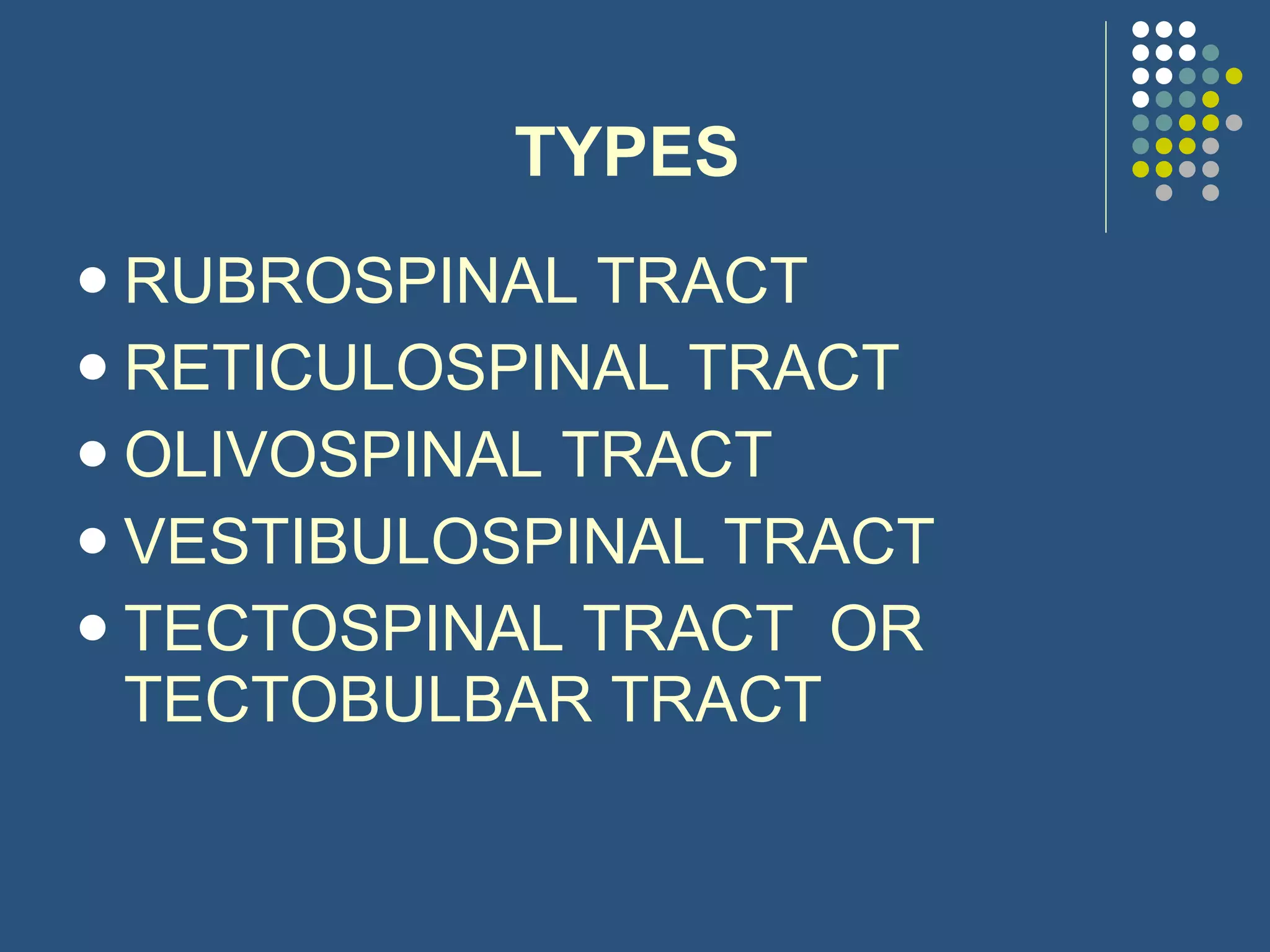
TYPES RUBROSPINAL TRACT RETICULOSPINAL TRACT OLIVOSPINAL TRACT VESTIBULOSPINAL TRACT TECTOSPINAL TRACT  OR TECTOBULBAR TRACT
Function of extrapyramidal tract Cortinuclear fibre  control movt of eyeball Other tract responsible for tone, posture(R.S. TRACT), visospinal reflex(T.S TRACT),equilibrium(V.S. TRACT) Control complex movt( co-ordinated movt) Exerts tonic inhibitory control over lower centers Carry volitional impulse when pyramidal tract damge
1.RUBROSPINAL TRACT
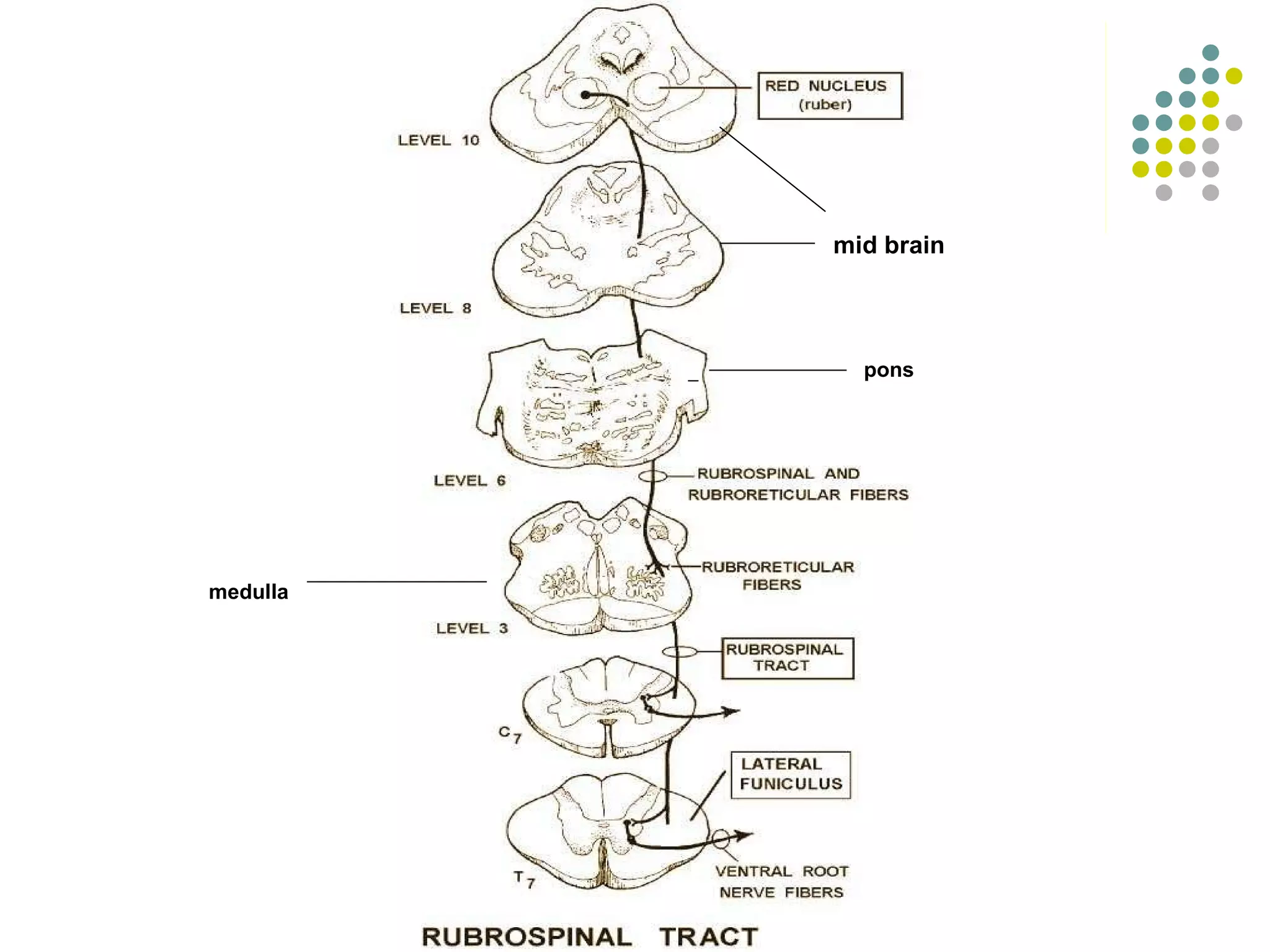
mid brain pons medulla
RED NUCLEUS The red nucleus is a prominent structure within the rostral midbrain and lies just dorsal to the substantia nigra. It appears to have a high iron content and is more vascular than the surrounding tissue, and in some brains is pinkish.    The most important efferent projection of the red nucleus is to the contralateral spinal cord i.e., the RUBROSPINAL projection
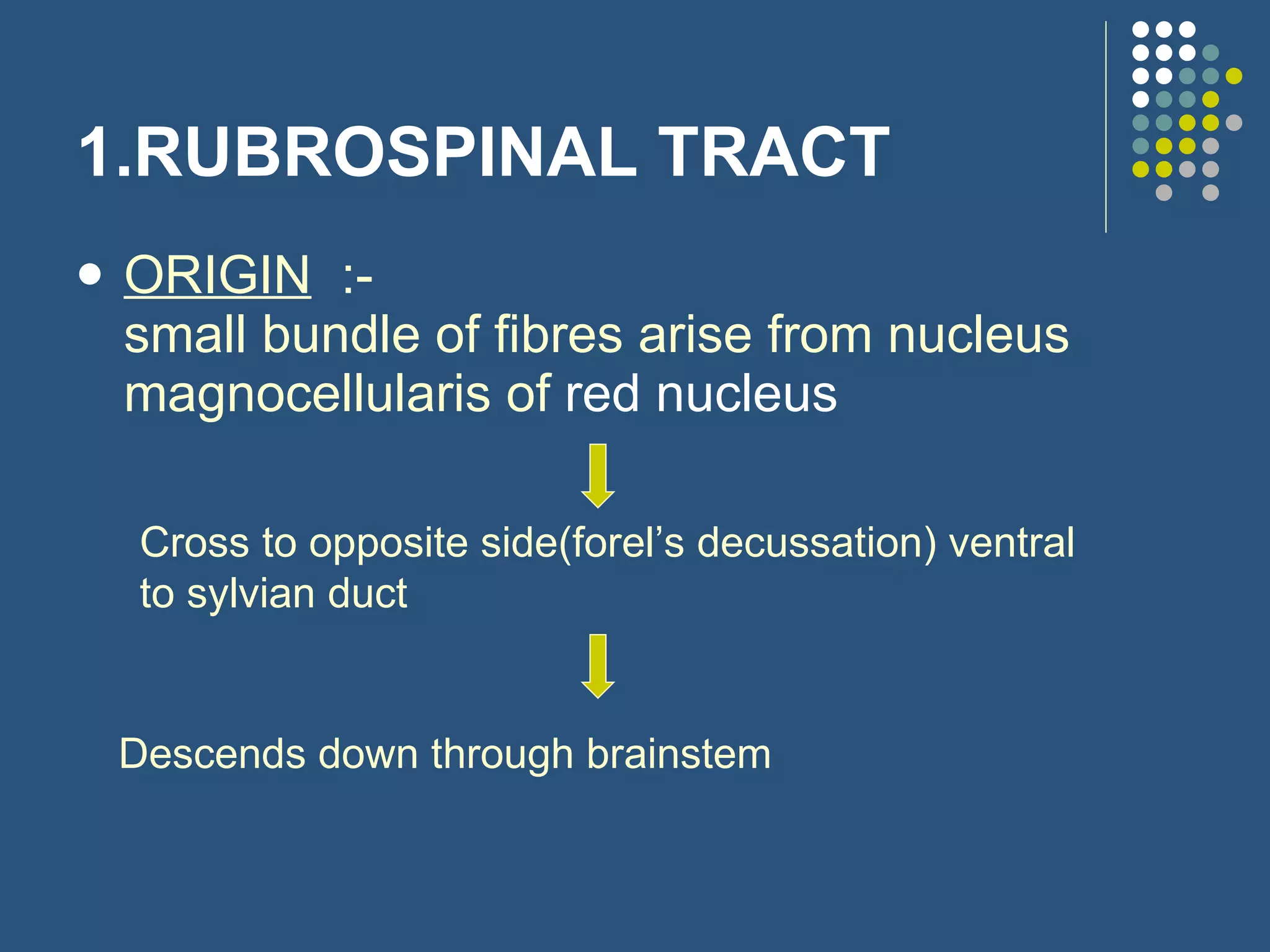
1.RUBROSPINAL TRACT ORIGIN   :-  small bundle of fibres arise from nucleus magnocellularis of  red nucleus   Cross to opposite side(forel’s decussation) ventral to sylvian duct Descends down through brainstem
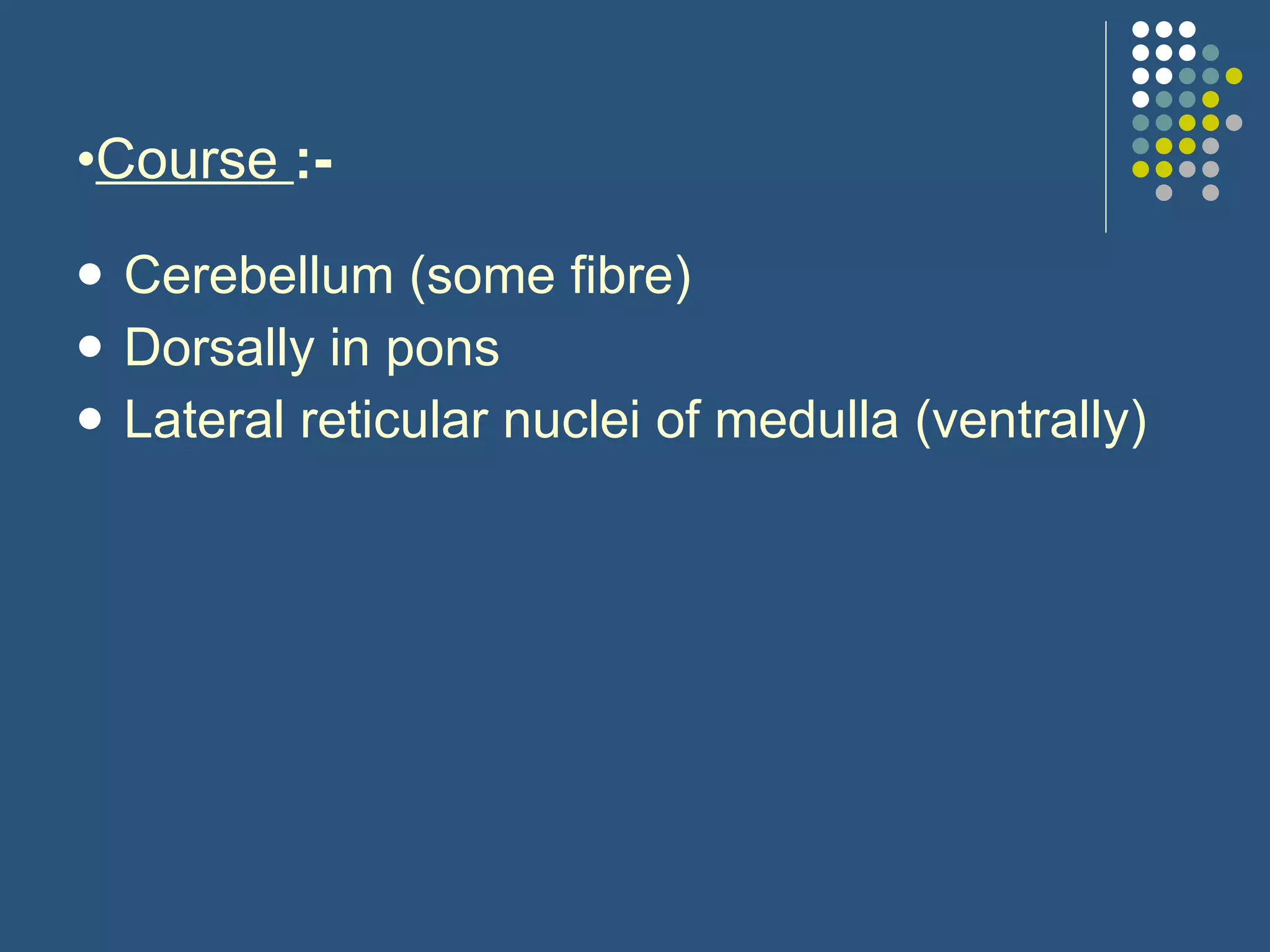
Course   :- Cerebellum (some fibre) Dorsally in pons Lateral reticular nuclei of medulla (ventrally)
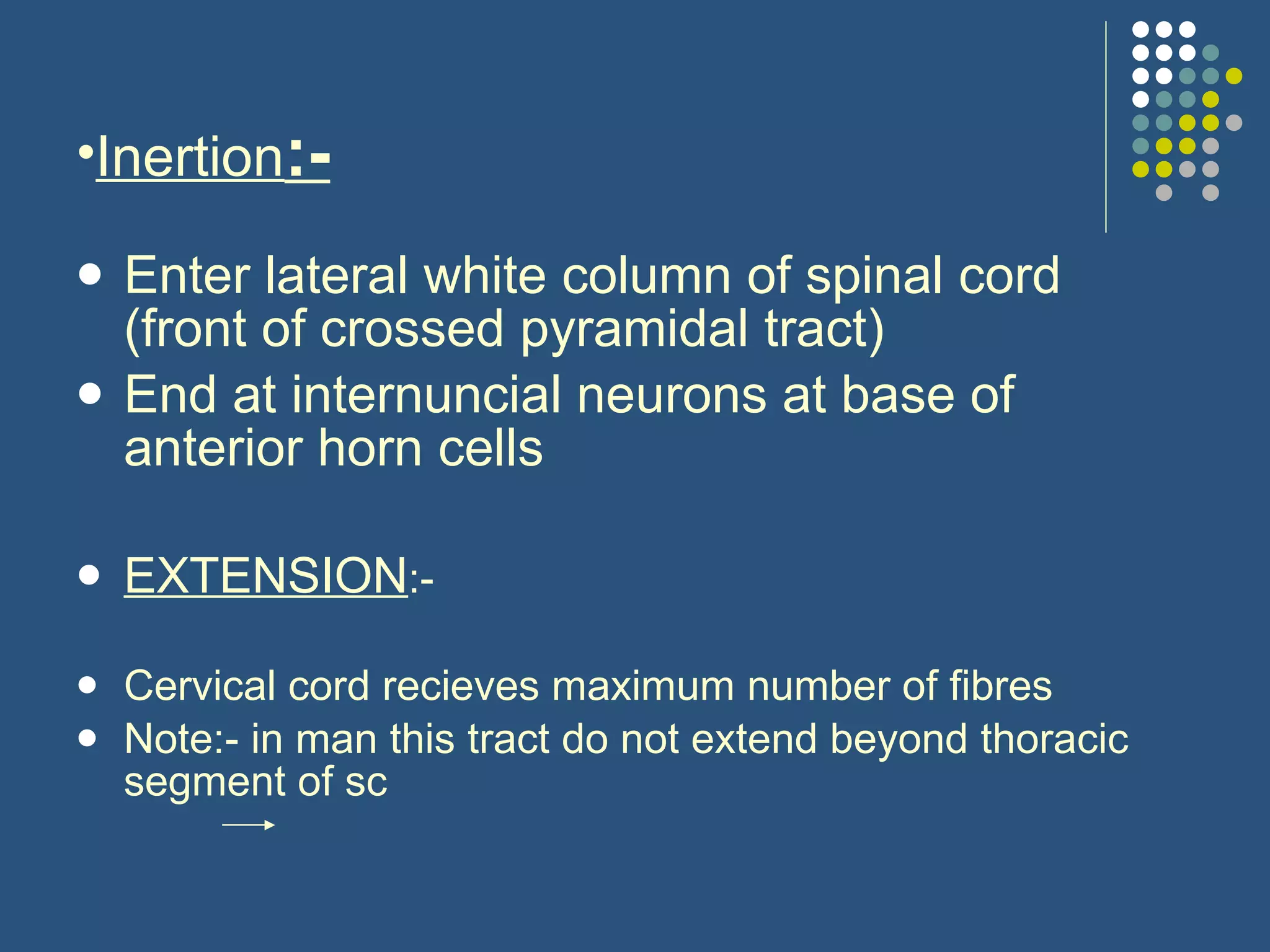
Inertion :- Enter lateral white column of spinal cord (front of crossed pyramidal tract)  End at internuncial neurons at base of anterior horn cells EXTENSION :-  Cervical cord recieves maximum number of fibres Note:- in man this tract do not extend beyond thoracic segment of sc
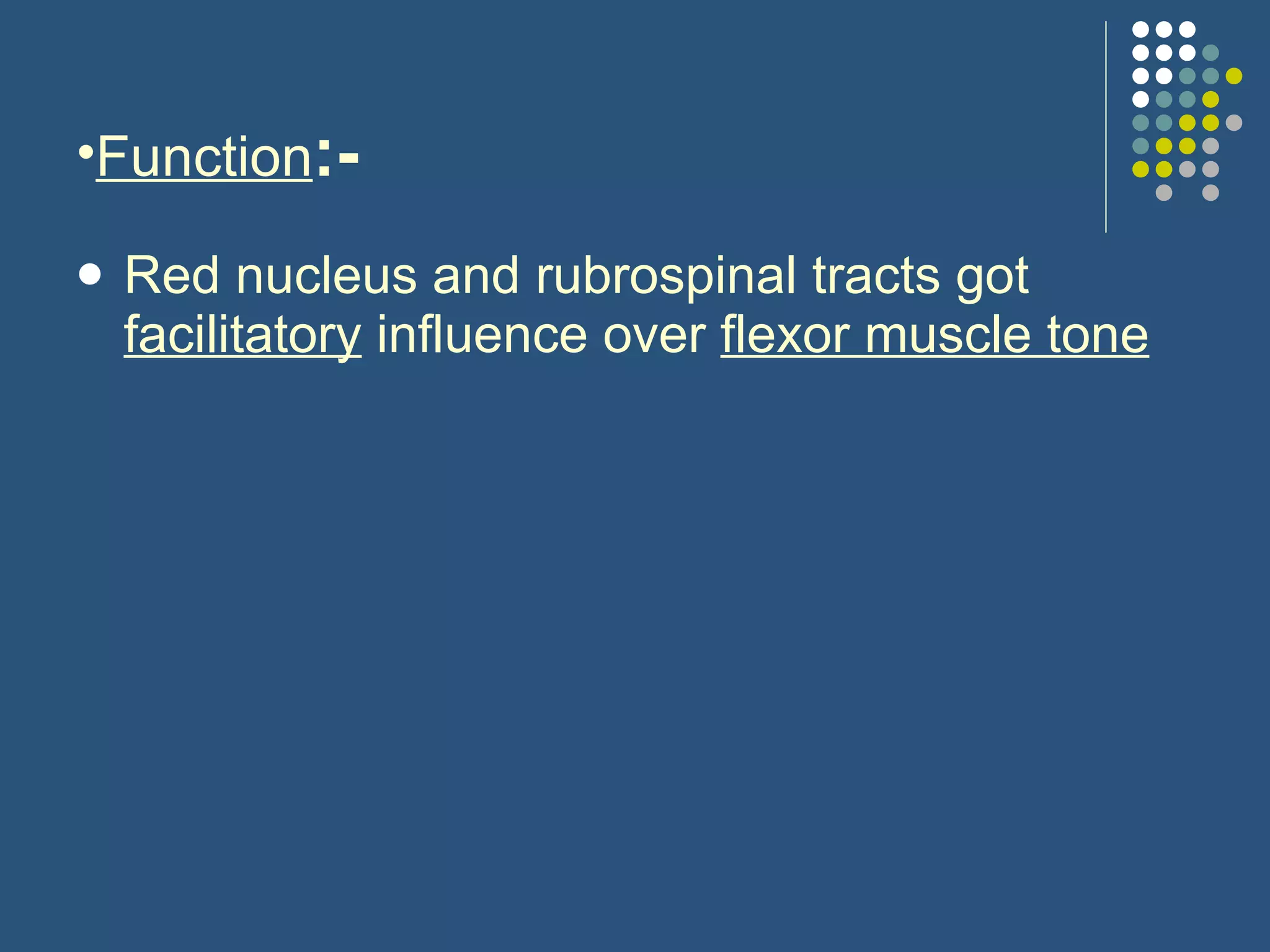
Function :- Red nucleus and rubrospinal tracts got  facilitatory  influence over  flexor muscle tone
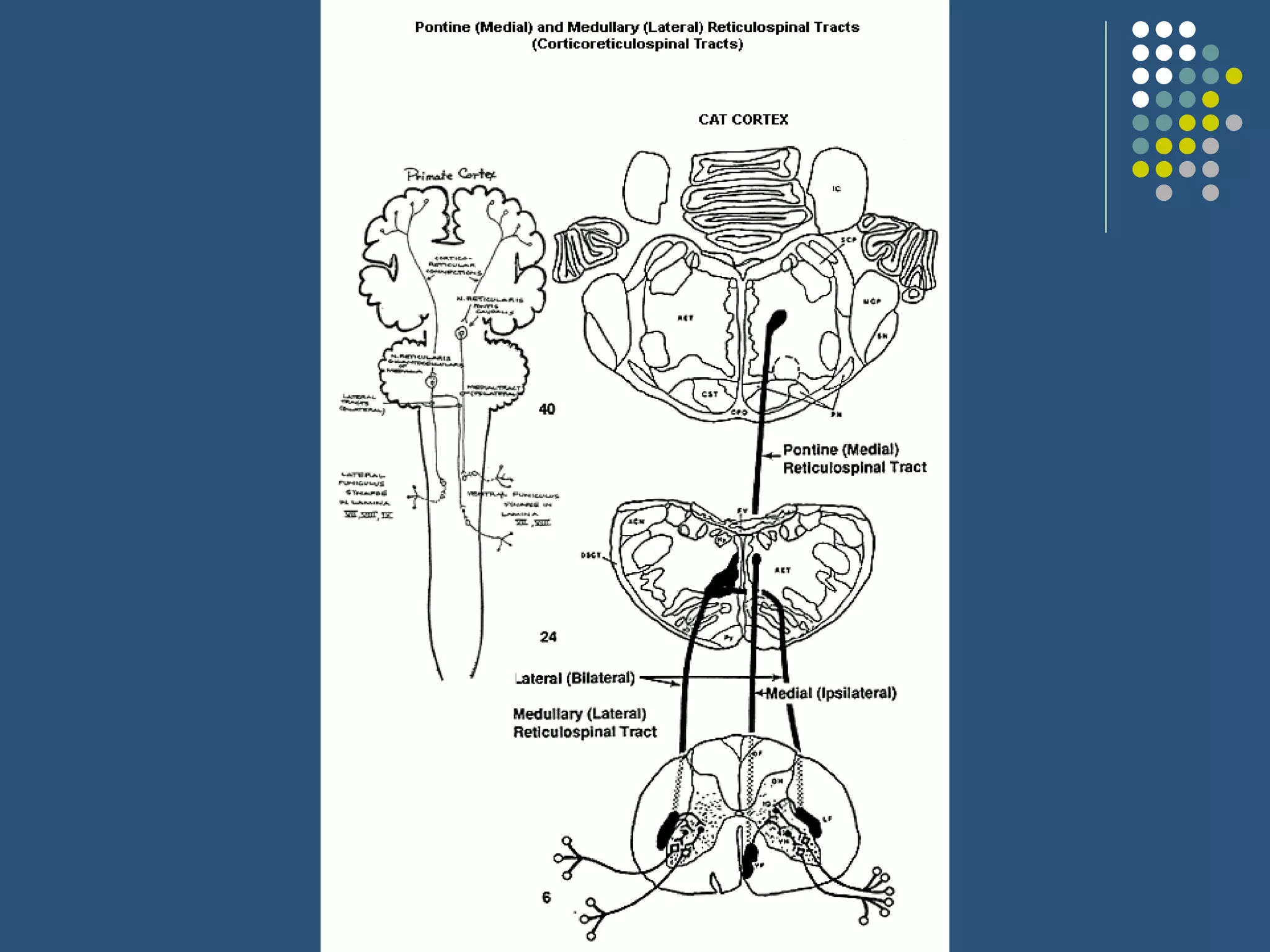
2. RETICULOSPINAL TRACT 2 TPYES OF FIBRES:- a)medial reticulospinal fibres b)lateral reticulospinal fibres
a) Medial reticulospinal fibres (pontine reticular tract) Origin from pontine reticular formation from nuclei of reticularis pontis oralis & reticularis pontis caudalis Run ipsilaterally through longitudinal fasciculus Medial part of Anterior funiculus of sc Terminates ipsilaterally at all spinal levels
b)Lateral reticulospinal fibres (medularry reticulospinal tract) Originated from nucleus reticularis gigantocellularis(in medulla) Some Fibre cross in midline , remaining run ipsilaterally Descend in anterior part of lateral funiculus Terminate on internuncial neurons of anterior horn of sc
Functions:- Integrates information from the motor systems to coordinate automatic movements of locomotion and posture. 2. Facilitates and inhibits voluntary movement, influences muscle tone. 3. Mediates autonomic functions 4. Modulates pain impulses 5. Influences blood flow to lateral geniculate
6.  The MRST is responsible for exciting anti-gravity, extensor muscles .   7. The LRST is responsible for the inhibiting excitatory axial extensor muscles of movement .
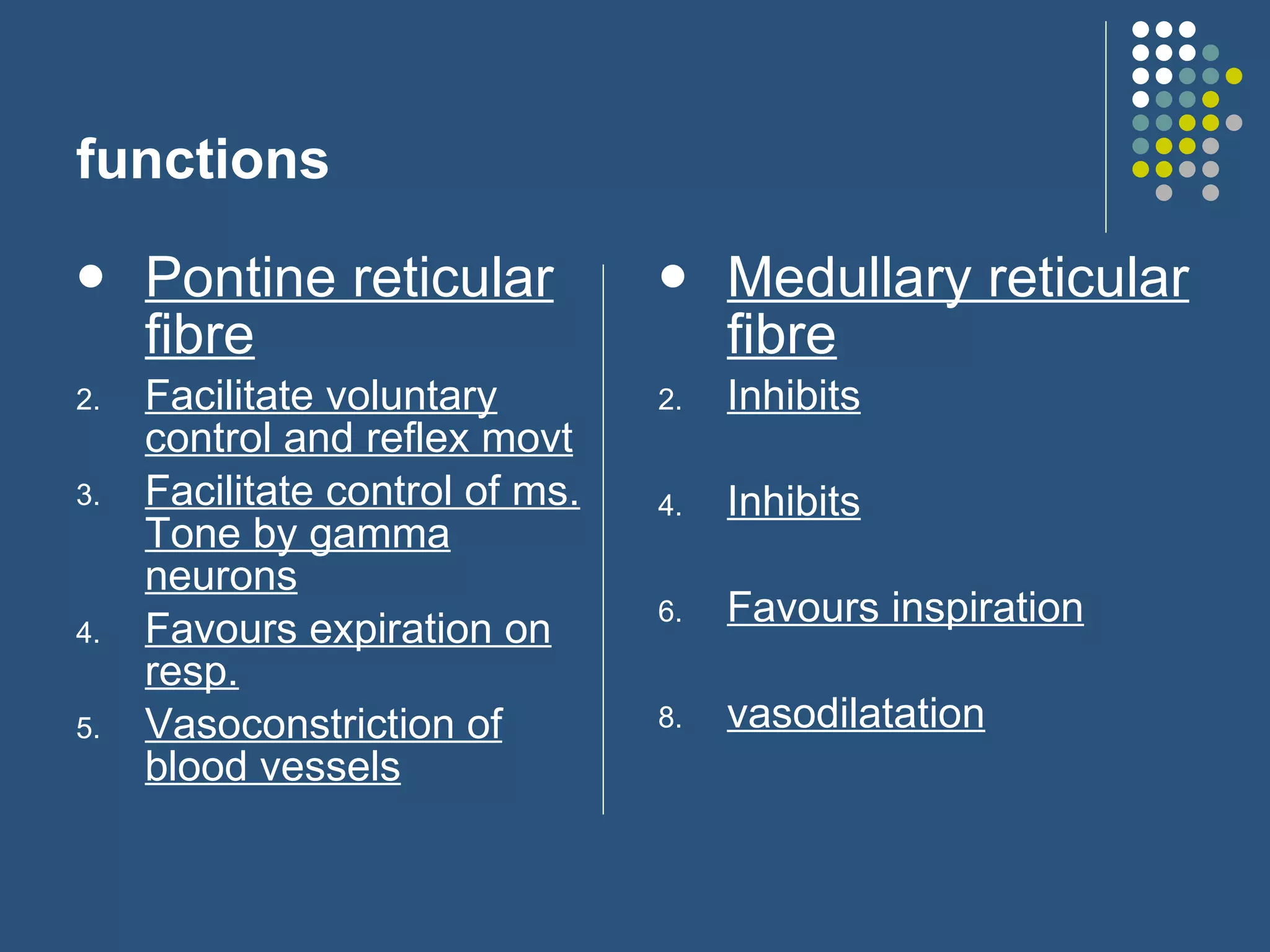
functions Pontine reticular fibre Facilitate voluntary control and reflex movt Facilitate control of ms. Tone by gamma neurons Favours expiration on resp. Vasoconstriction of blood vessels Medullary reticular fibre Inhibits Inhibits Favours inspiration vasodilatation
 
OLIVOSPINAL TRACT Also called bulbospinal tract / tract of helweg COURSE :-  Arise from inferior olivary nucleus Enter ant. Part of lateral white funiculus Terminate in an. Horn cells of sc Found in cervical region only FUNCTION :-Reflex movement arising from proprioception
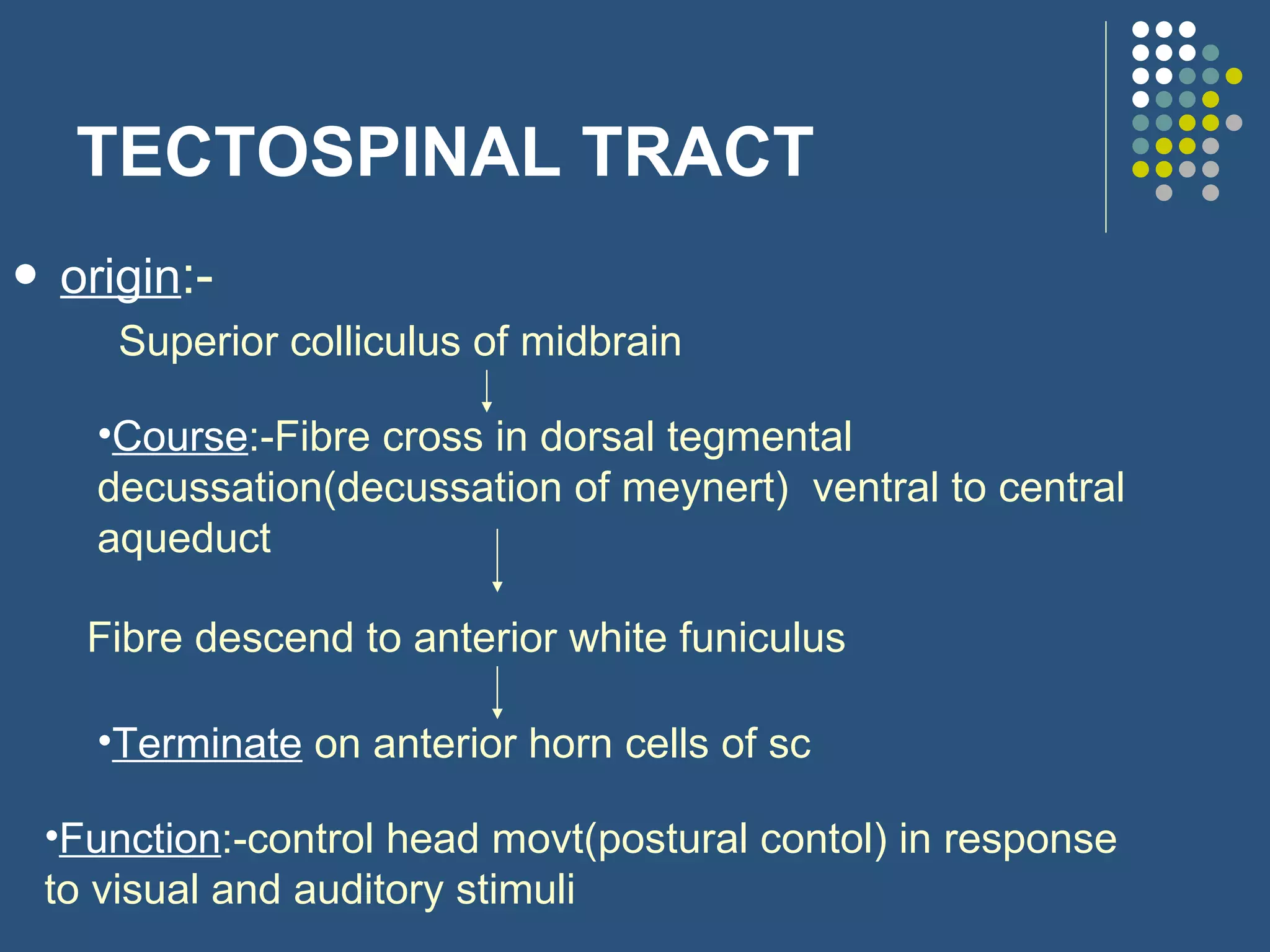
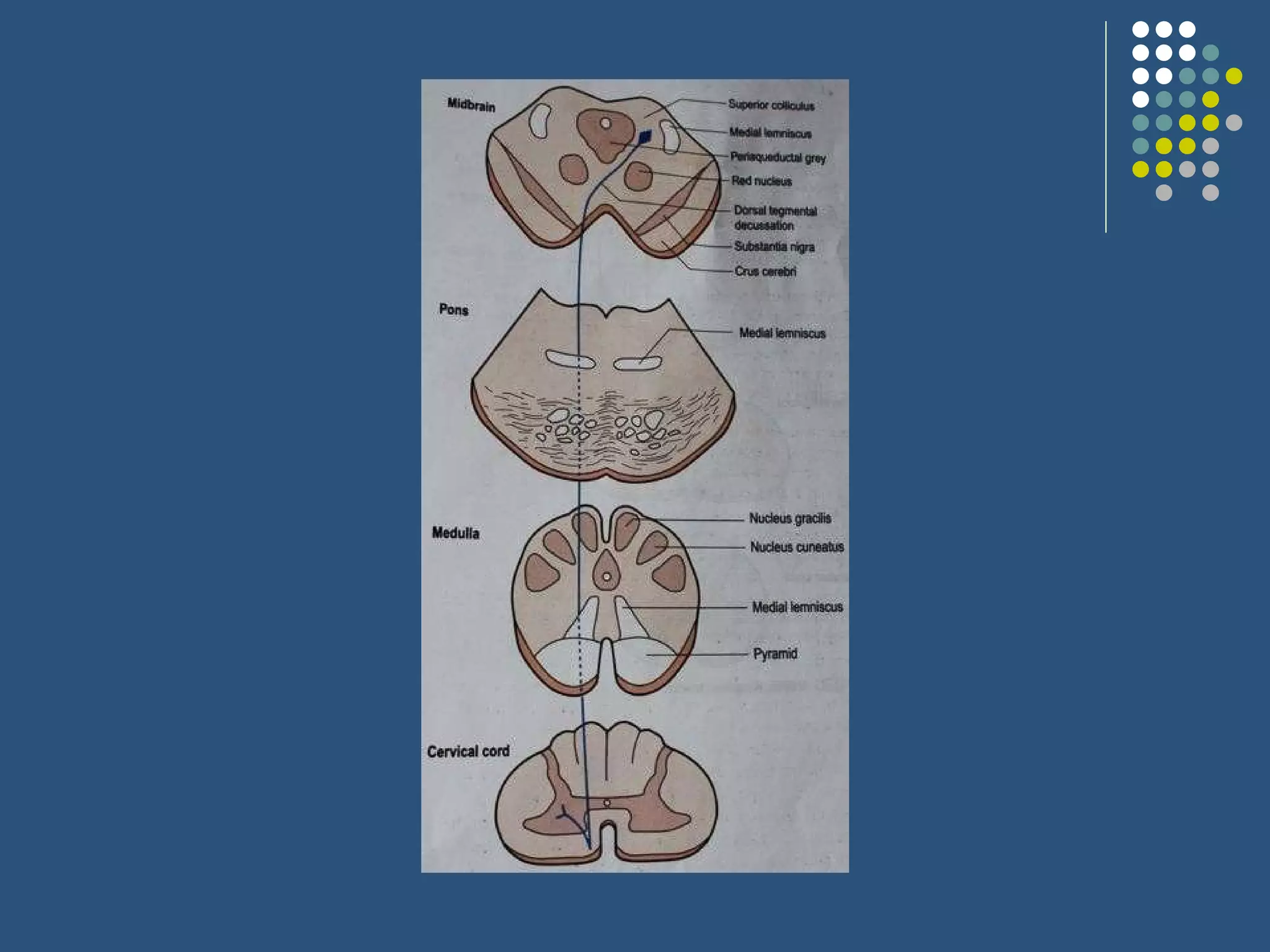
TECTOSPINAL TRACT origin :- Superior colliculus of midbrain Course :-Fibre cross in dorsal tegmental decussation(decussation of meynert)  ventral to central aqueduct Fibre descend to anterior white funiculus Terminate  on anterior horn cells of sc Function :-control head movt(postural contol) in response to visual and auditory stimuli
 
Vestibulospinal tracts 2 types Anterior vestibulospinal tract Lateral vestibulospinal tract
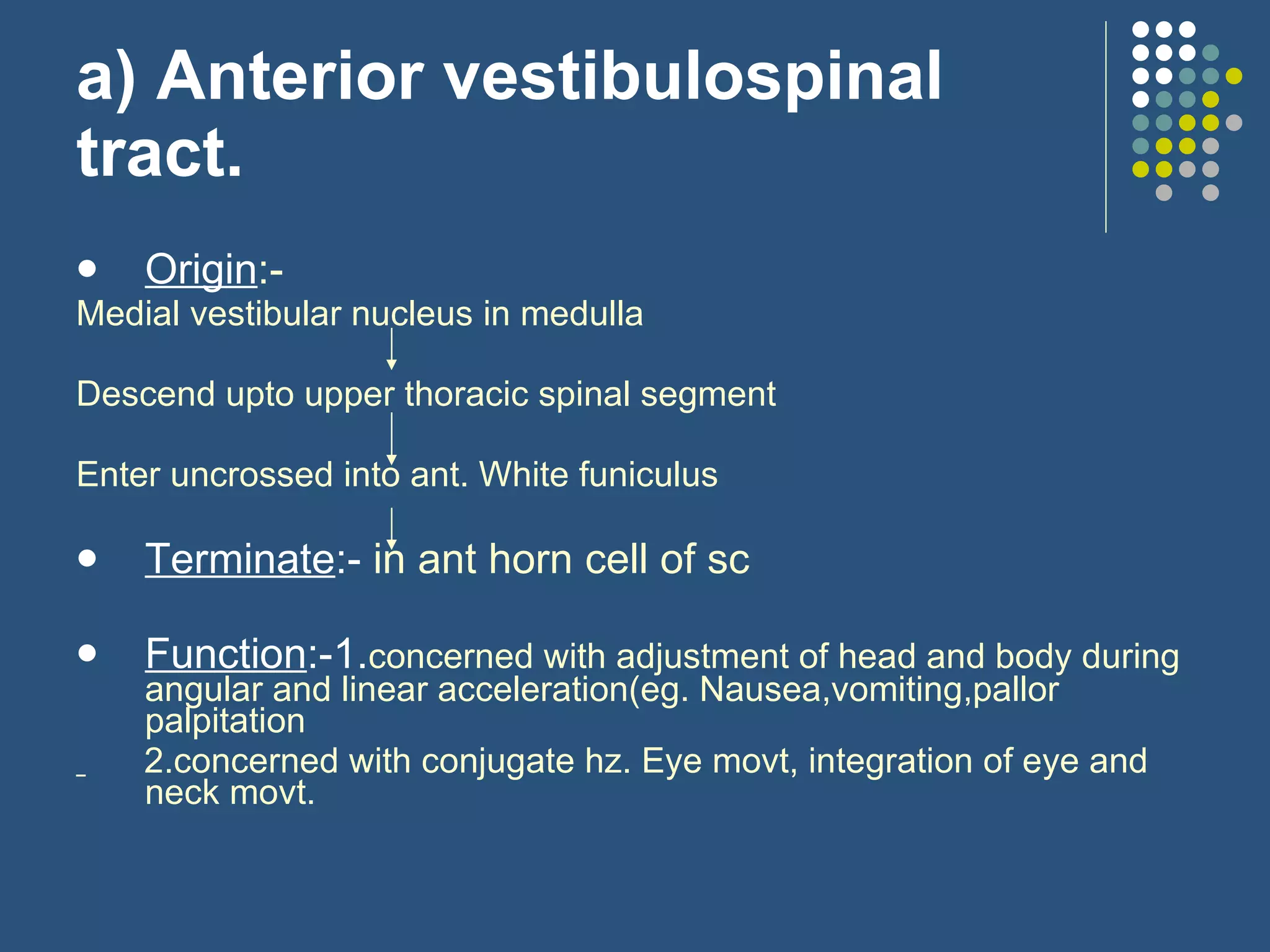
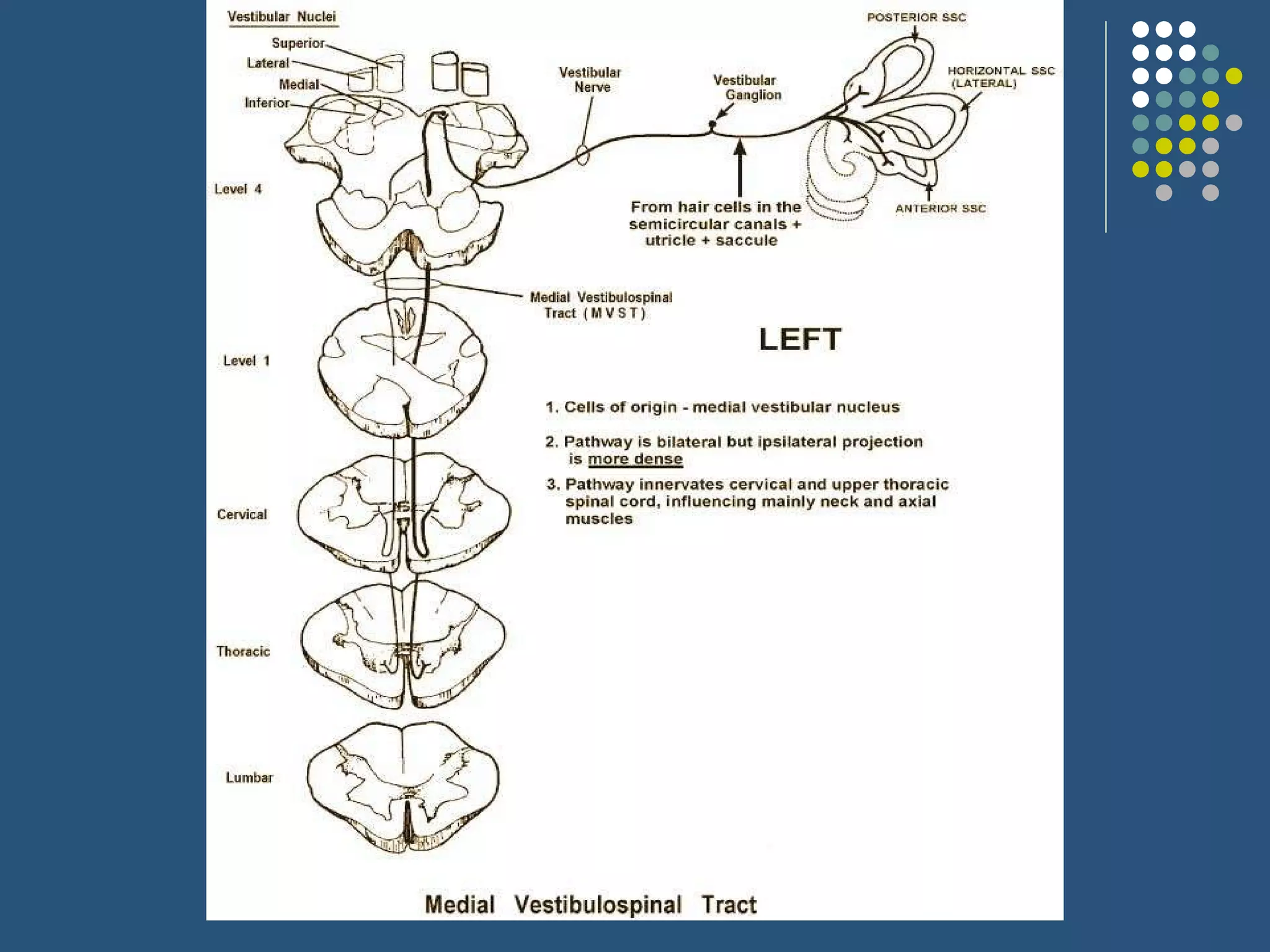
a) Anterior vestibulospinal tract. Origin :- Medial vestibular nucleus in medulla Descend upto upper thoracic spinal segment  Enter uncrossed into ant. White funiculus Terminate :-  in ant horn cell of sc Function :-1. concerned with adjustment of head and body during angular and linear acceleration(eg. Nausea,vomiting,pallor palpitation 2.concerned with conjugate hz. Eye movt, integration of eye and neck movt.
 
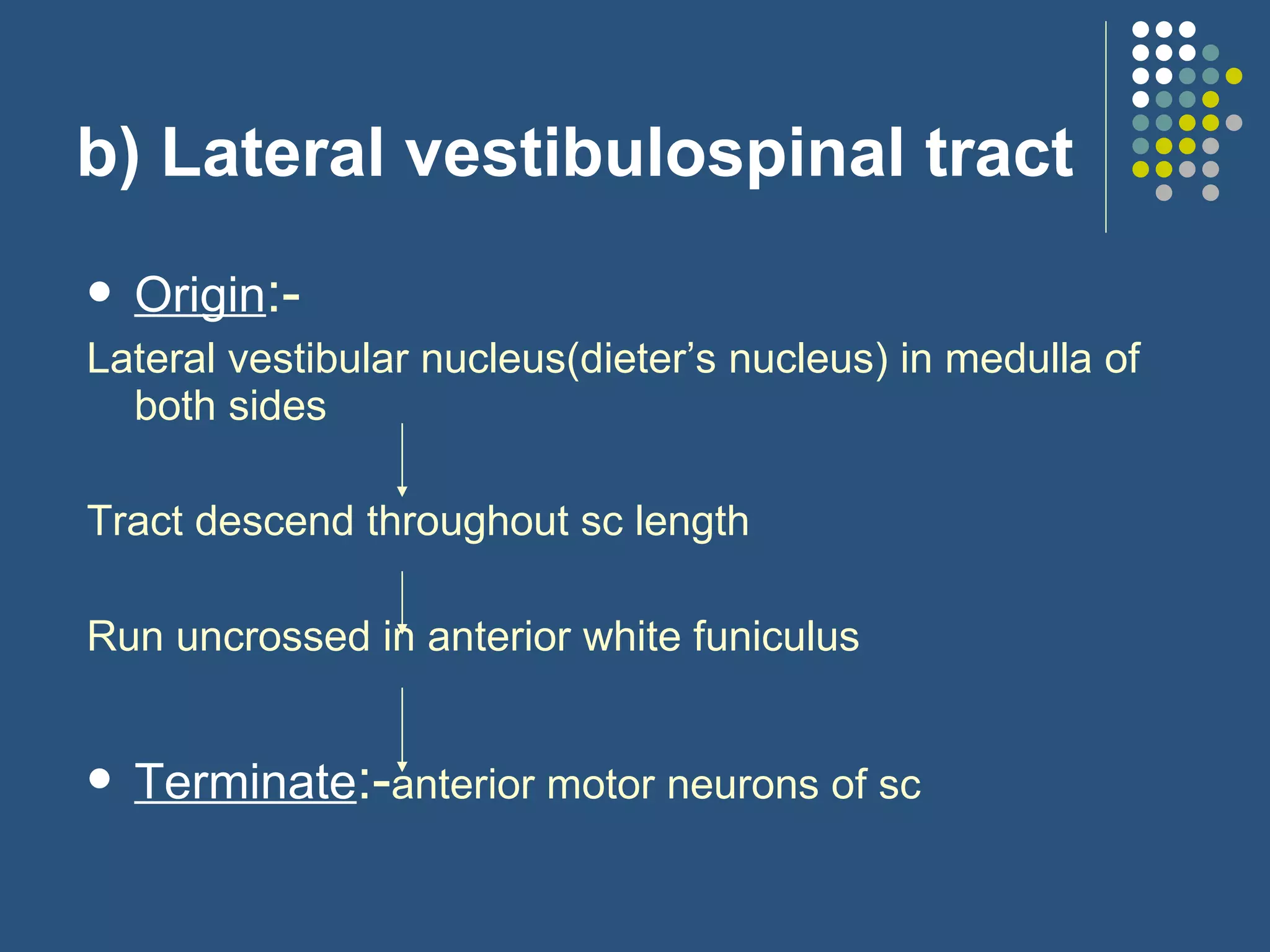
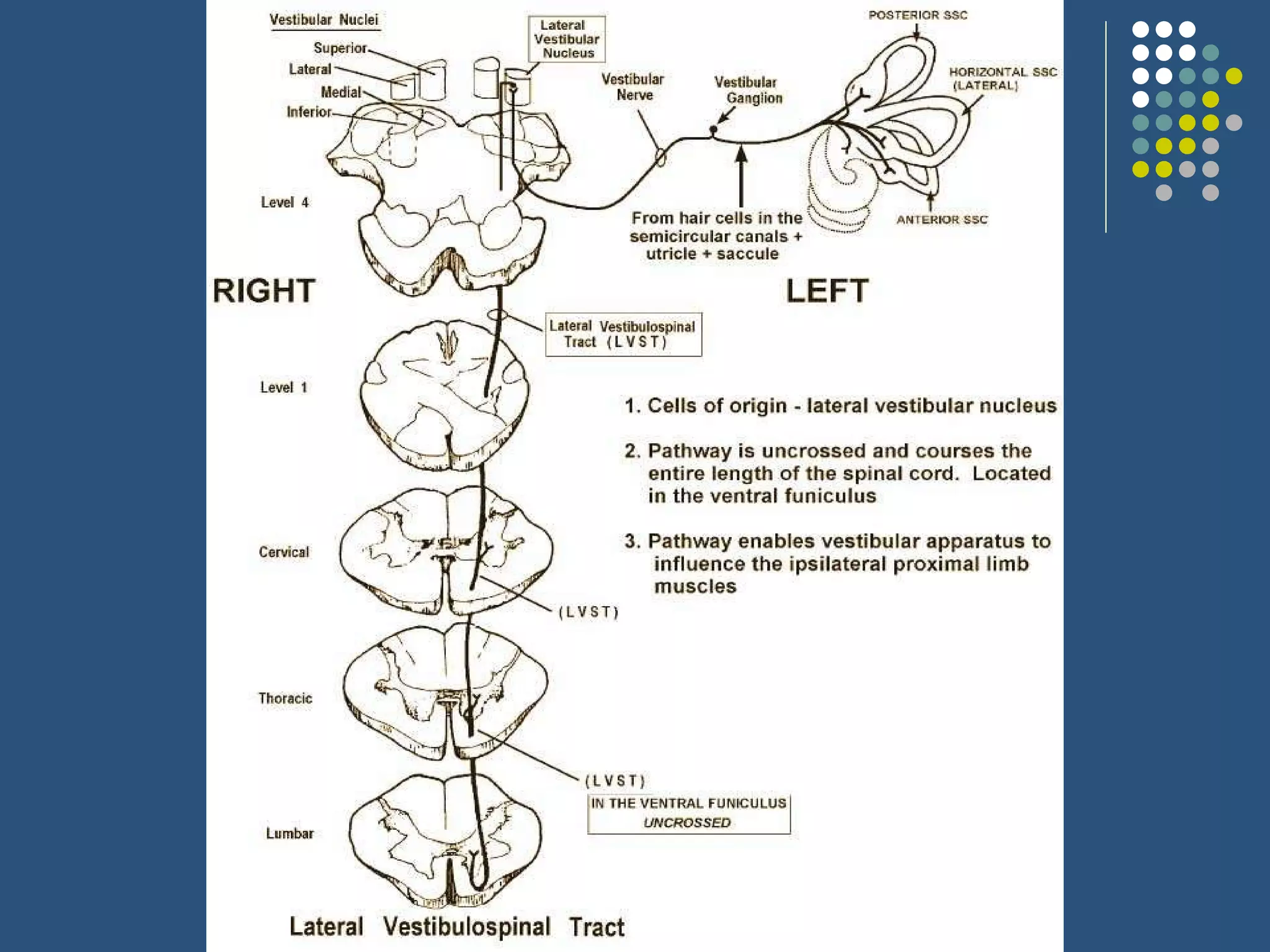
b) Lateral vestibulospinal tract Origin :- Lateral vestibular nucleus(dieter’s nucleus) in medulla of both sides Tract descend throughout sc length Run uncrossed in anterior white funiculus Terminate :- anterior motor neurons of sc
Function :- same as anterior reticulospinal tract Facilitatory influence on reflex spinal activities and spinal mechanism underlying ms. tone
 
Extrapyramidal disorders Parkinsonism Chorea Hemiballism Athetosis Dystonia Tardive dyskinesia
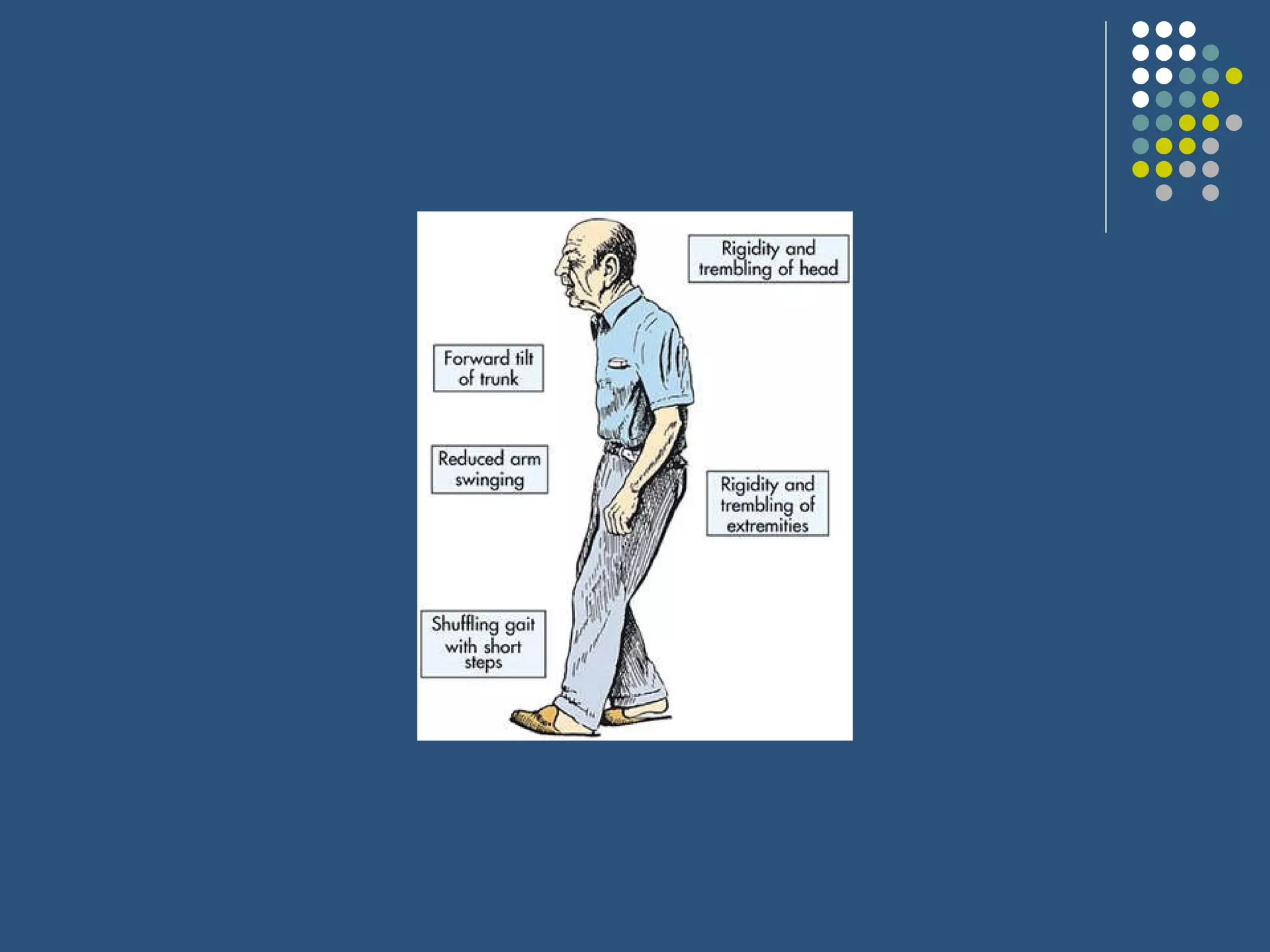
parkinsonism Degeneration of extrapyramidal tract Characterized by rigidity , bradykinesia. Tremours and postural deficits
 
chorea   type of involuntary movement disorder  characterized by irregular and fleeting movements of the limbs and/or axial musculature also including the muscles of the face, jaw and tongue. Degenerative and destructive processes in the striatum or striatal inhibition (due to certain classes of drugs) are the major pathologic substrates of chorea. 
 
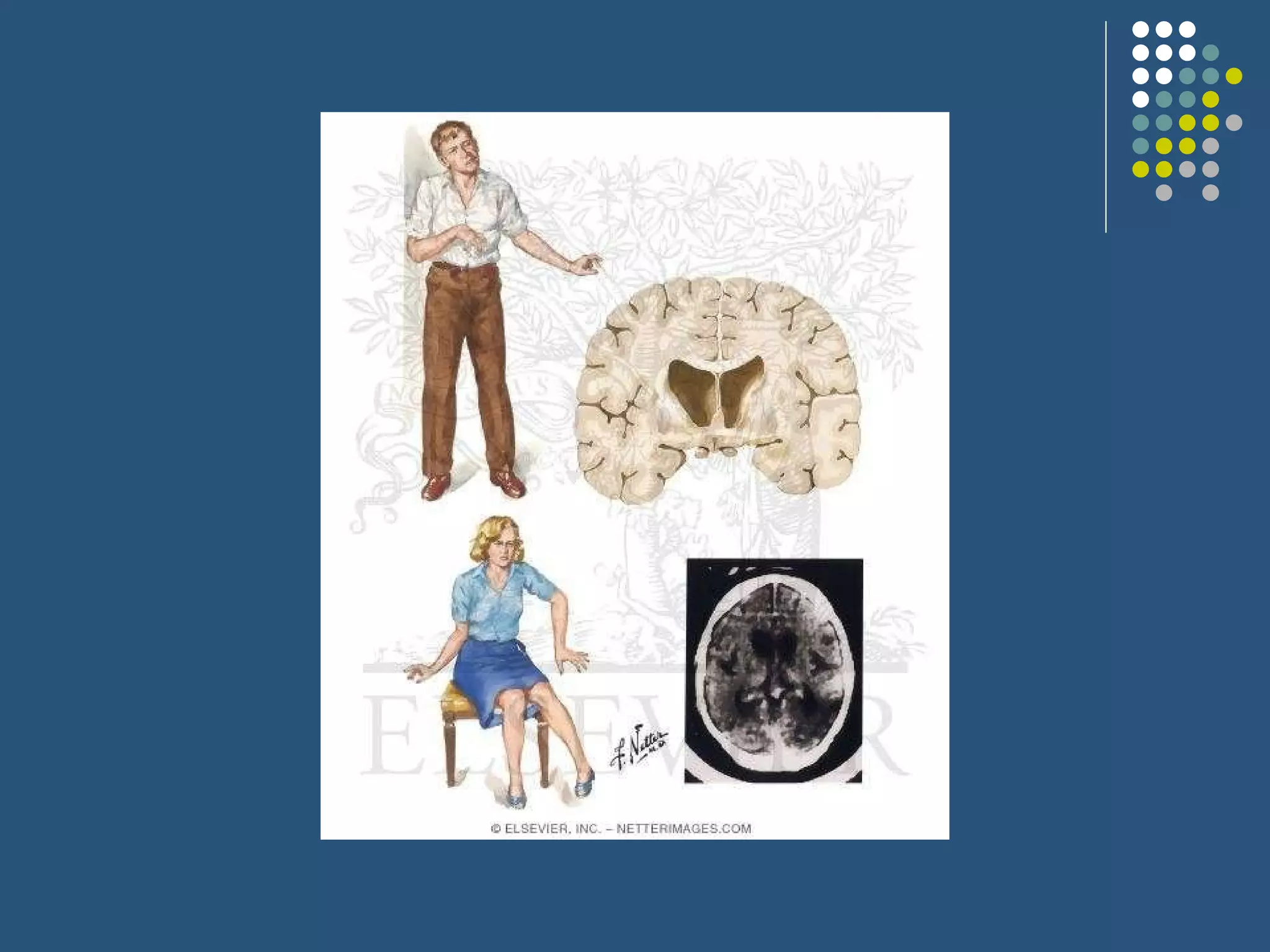
hemiballism Hemiballism is a violent, flailing chorea of the limbs opposite a lesion in the subthalamic nucleus or, rarely, the striatum.
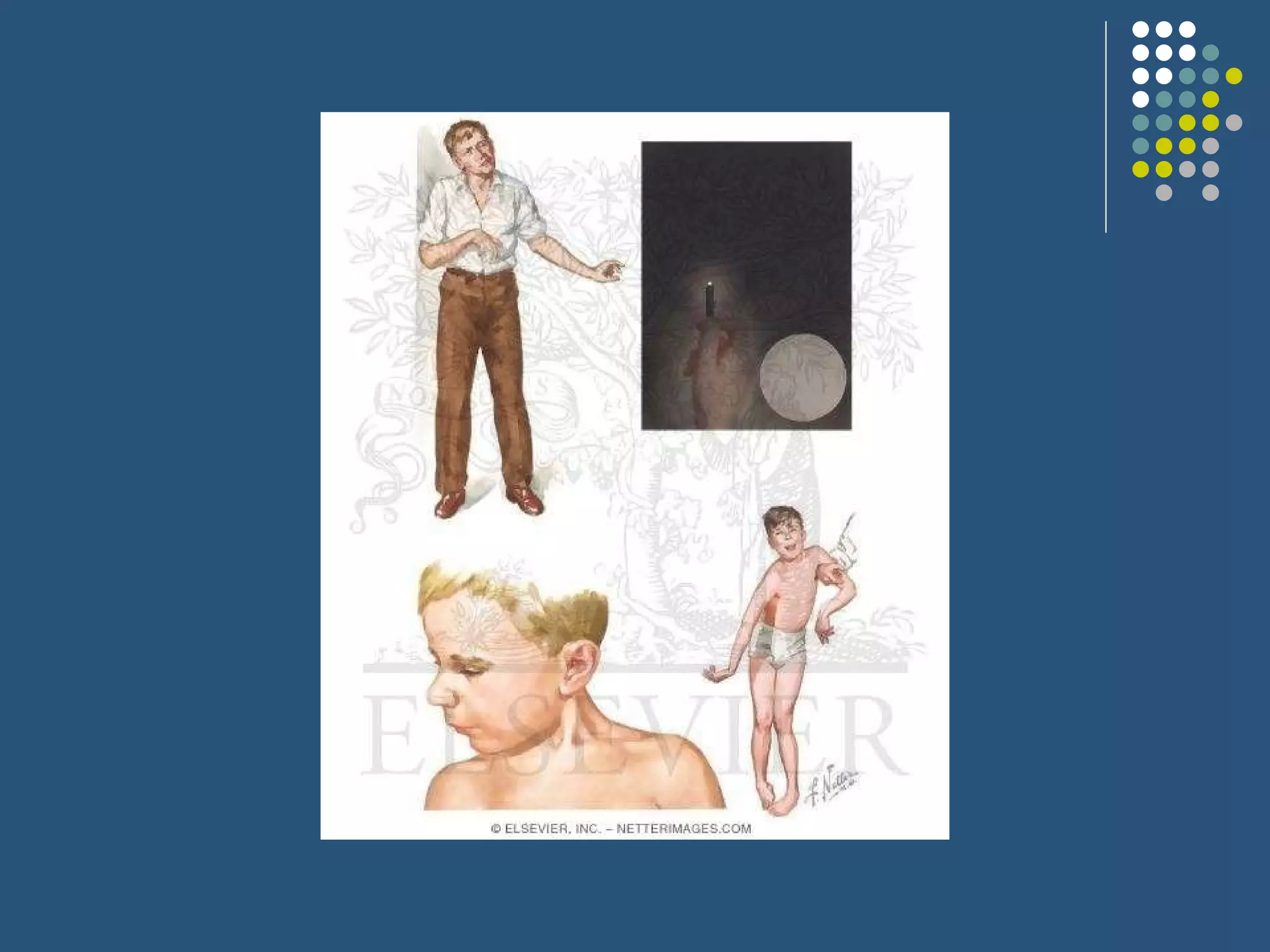
athetosis Athetosis is a rare movement disorder characterized by involuntary, slow, twisting, writhing movements of the trunk and limbs.  Striatal injury, particularly prominent in the putamen, has been considered the pathophysiologic substrate
 
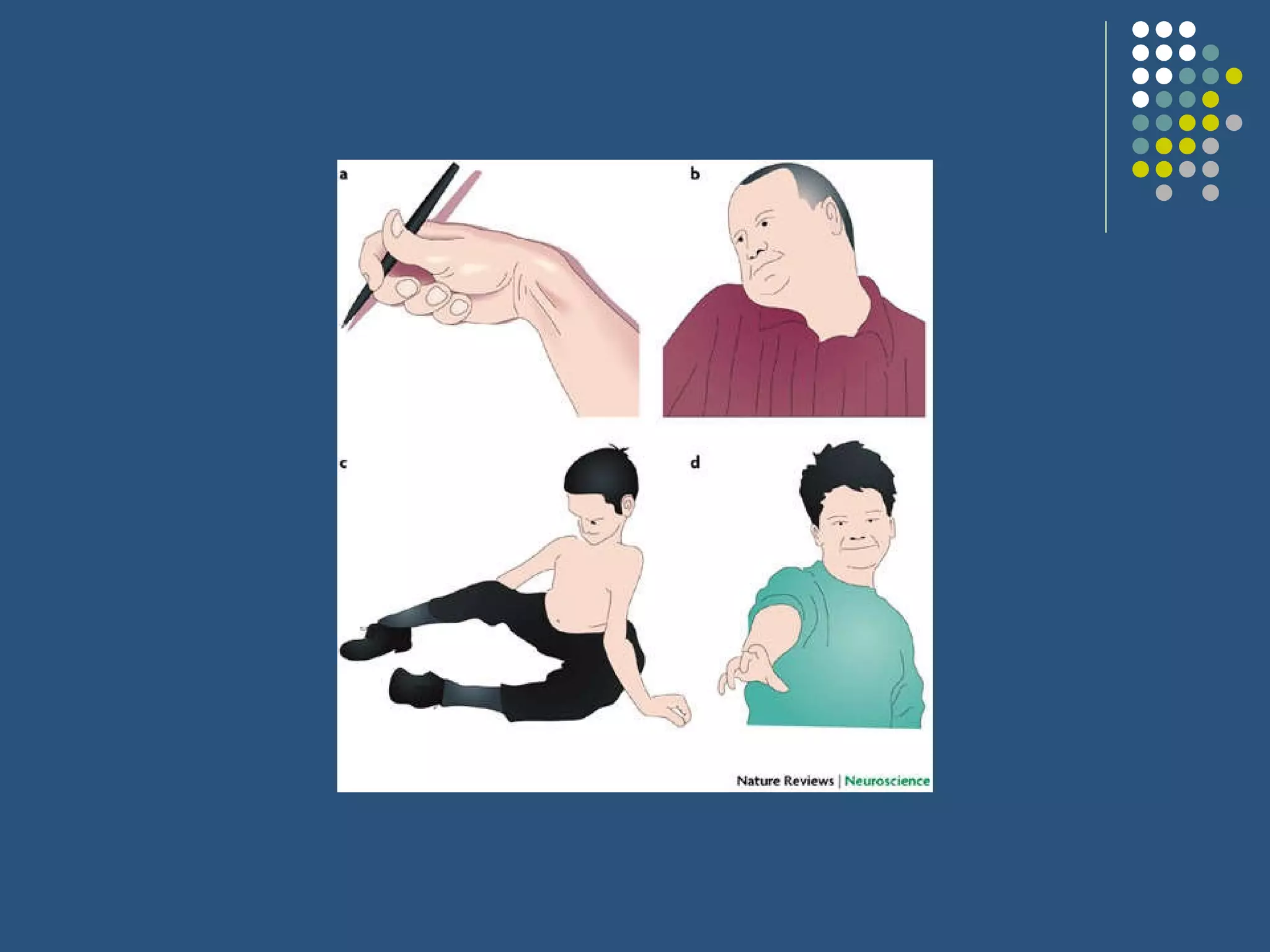
dystonia    characterized by torsion spasms of the limbs, trunk, and neck  progressive or static  but are usually idiopathic. Spasmodic torticollis is the most common idiopathic form  characterized by intermittent excessive and involuntary contractions of the sternomastoid muscle on one side (rarely bilateral giving retrocollis)
 
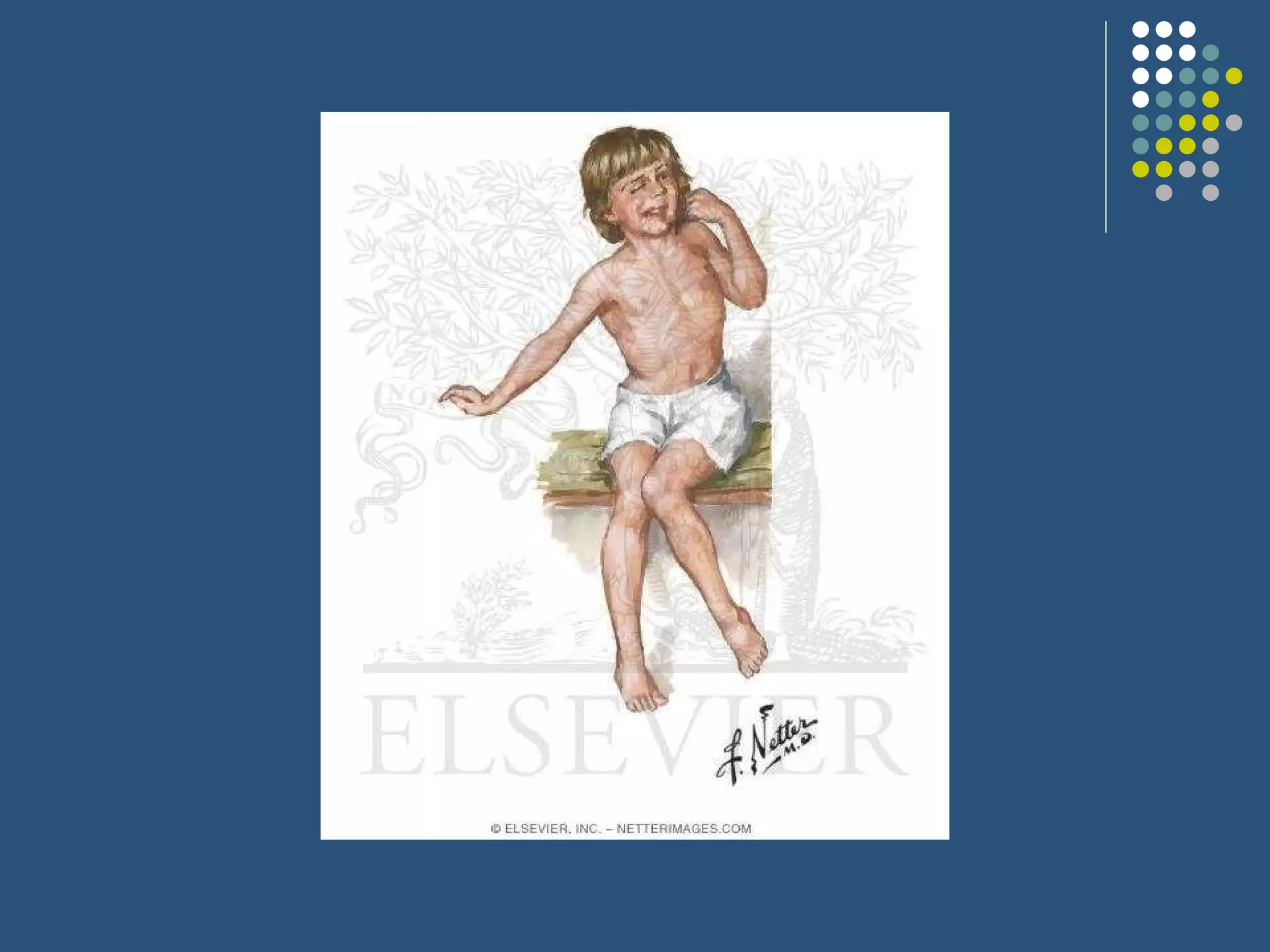
Tardive dyskinesia   iatrogenic axial chorea seen most often in women exposed to long-term neuroleptic use.   In its mildest form, constant mouthing with protrusion of the lips, mandible and tongue is seen, . In more advanced stages the trunk muscles are involved and there is a characteristic irregular, incessant pelvic thrusting, which can cause the patient to become a recluse.


Extrapyramidal tracts and disorders

  • 1.
    EXTRAPYRAMIDAL TRACTS BY:- DR. PRIYANKA GUPTA (B.P.T)
  • 2.
  • 3.
    DEFINATION Extrapyramidal tractsare those motor pathways which may act as the alternative route for volitional impulses and which form the platform on which pyramidal system works skillfully Integrated at various level from cerebral cortex to spinal cord Cortical region controlling these tracts are area 8 and 6
  • 4.
    TYPES RUBROSPINAL TRACTRETICULOSPINAL TRACT OLIVOSPINAL TRACT VESTIBULOSPINAL TRACT TECTOSPINAL TRACT OR TECTOBULBAR TRACT
  • 5.
    Function of extrapyramidaltract Cortinuclear fibre control movt of eyeball Other tract responsible for tone, posture(R.S. TRACT), visospinal reflex(T.S TRACT),equilibrium(V.S. TRACT) Control complex movt( co-ordinated movt) Exerts tonic inhibitory control over lower centers Carry volitional impulse when pyramidal tract damge
  • 6.
  • 7.
  • 8.
    RED NUCLEUS Thered nucleus is a prominent structure within the rostral midbrain and lies just dorsal to the substantia nigra. It appears to have a high iron content and is more vascular than the surrounding tissue, and in some brains is pinkish.   The most important efferent projection of the red nucleus is to the contralateral spinal cord i.e., the RUBROSPINAL projection
  • 9.
    1.RUBROSPINAL TRACT ORIGIN :- small bundle of fibres arise from nucleus magnocellularis of red nucleus Cross to opposite side(forel’s decussation) ventral to sylvian duct Descends down through brainstem
  • 10.
    Course :- Cerebellum (some fibre) Dorsally in pons Lateral reticular nuclei of medulla (ventrally)
  • 11.
    Inertion :- Enterlateral white column of spinal cord (front of crossed pyramidal tract) End at internuncial neurons at base of anterior horn cells EXTENSION :- Cervical cord recieves maximum number of fibres Note:- in man this tract do not extend beyond thoracic segment of sc
  • 12.
    Function :- Rednucleus and rubrospinal tracts got facilitatory influence over flexor muscle tone
  • 13.
    2. RETICULOSPINAL TRACT2 TPYES OF FIBRES:- a)medial reticulospinal fibres b)lateral reticulospinal fibres
  • 14.
    a) Medial reticulospinalfibres (pontine reticular tract) Origin from pontine reticular formation from nuclei of reticularis pontis oralis & reticularis pontis caudalis Run ipsilaterally through longitudinal fasciculus Medial part of Anterior funiculus of sc Terminates ipsilaterally at all spinal levels
  • 15.
    b)Lateral reticulospinal fibres(medularry reticulospinal tract) Originated from nucleus reticularis gigantocellularis(in medulla) Some Fibre cross in midline , remaining run ipsilaterally Descend in anterior part of lateral funiculus Terminate on internuncial neurons of anterior horn of sc
  • 16.
    Functions:- Integrates informationfrom the motor systems to coordinate automatic movements of locomotion and posture. 2. Facilitates and inhibits voluntary movement, influences muscle tone. 3. Mediates autonomic functions 4. Modulates pain impulses 5. Influences blood flow to lateral geniculate
  • 17.
    6. TheMRST is responsible for exciting anti-gravity, extensor muscles . 7. The LRST is responsible for the inhibiting excitatory axial extensor muscles of movement .
  • 18.
    functions Pontine reticularfibre Facilitate voluntary control and reflex movt Facilitate control of ms. Tone by gamma neurons Favours expiration on resp. Vasoconstriction of blood vessels Medullary reticular fibre Inhibits Inhibits Favours inspiration vasodilatation
  • 19.
  • 20.
    OLIVOSPINAL TRACT Alsocalled bulbospinal tract / tract of helweg COURSE :- Arise from inferior olivary nucleus Enter ant. Part of lateral white funiculus Terminate in an. Horn cells of sc Found in cervical region only FUNCTION :-Reflex movement arising from proprioception
  • 21.
    TECTOSPINAL TRACT origin:- Superior colliculus of midbrain Course :-Fibre cross in dorsal tegmental decussation(decussation of meynert) ventral to central aqueduct Fibre descend to anterior white funiculus Terminate on anterior horn cells of sc Function :-control head movt(postural contol) in response to visual and auditory stimuli
  • 22.
  • 23.
    Vestibulospinal tracts 2types Anterior vestibulospinal tract Lateral vestibulospinal tract
  • 24.
    a) Anterior vestibulospinaltract. Origin :- Medial vestibular nucleus in medulla Descend upto upper thoracic spinal segment Enter uncrossed into ant. White funiculus Terminate :- in ant horn cell of sc Function :-1. concerned with adjustment of head and body during angular and linear acceleration(eg. Nausea,vomiting,pallor palpitation 2.concerned with conjugate hz. Eye movt, integration of eye and neck movt.
  • 25.
  • 26.
    b) Lateral vestibulospinaltract Origin :- Lateral vestibular nucleus(dieter’s nucleus) in medulla of both sides Tract descend throughout sc length Run uncrossed in anterior white funiculus Terminate :- anterior motor neurons of sc
  • 27.
    Function :- sameas anterior reticulospinal tract Facilitatory influence on reflex spinal activities and spinal mechanism underlying ms. tone
  • 28.
  • 29.
    Extrapyramidal disorders ParkinsonismChorea Hemiballism Athetosis Dystonia Tardive dyskinesia
  • 30.
    parkinsonism Degeneration ofextrapyramidal tract Characterized by rigidity , bradykinesia. Tremours and postural deficits
  • 31.
  • 32.
    chorea   typeof involuntary movement disorder characterized by irregular and fleeting movements of the limbs and/or axial musculature also including the muscles of the face, jaw and tongue. Degenerative and destructive processes in the striatum or striatal inhibition (due to certain classes of drugs) are the major pathologic substrates of chorea. 
  • 33.
  • 34.
    hemiballism Hemiballism isa violent, flailing chorea of the limbs opposite a lesion in the subthalamic nucleus or, rarely, the striatum.
  • 35.
    athetosis Athetosis isa rare movement disorder characterized by involuntary, slow, twisting, writhing movements of the trunk and limbs. Striatal injury, particularly prominent in the putamen, has been considered the pathophysiologic substrate
  • 36.
  • 37.
    dystonia   characterized by torsion spasms of the limbs, trunk, and neck progressive or static but are usually idiopathic. Spasmodic torticollis is the most common idiopathic form characterized by intermittent excessive and involuntary contractions of the sternomastoid muscle on one side (rarely bilateral giving retrocollis)
  • 38.
  • 39.
    Tardive dyskinesia  iatrogenic axial chorea seen most often in women exposed to long-term neuroleptic use.  In its mildest form, constant mouthing with protrusion of the lips, mandible and tongue is seen, . In more advanced stages the trunk muscles are involved and there is a characteristic irregular, incessant pelvic thrusting, which can cause the patient to become a recluse.
  • 40.
  • 41.