Extrapyramidal Tracts
Name: Ali Al-Nasrullah
Learning Objectives
Identifying Pyramidal tract.
Identifying Extrapyramidal tracts origin, termination
and function.
Explaining extrapyramidal disorders.
Explaining Parkinson disease.
Pyramidal Tract
It is consisted of 3 tracts, Anterior & Lateral Corticospinal tract and some of
corticobulbar tract.
* While traveling form the cerebral cortex these fibers give the apperance of
a pyramid on the upper part of the medulla.
They terminate in the anterior grey matter.
Function: Voluntary, fine & skilled movements of the body.
Other fibers than these 3 are named extrapyrimdal.
Extrapyramidal Tracts
Definition :
The descending spinal tracts which is concerned with motor functions other
than pyramidal tract. They are considered as an indirect motor pathway.
Extrapyramidal Tracts
They are consisted of a series of tracts:
Rubrospinal Tract.
Reticulospinal Tract, Dividid into 2 types:
A- pontine reticulospinal tract. (Medial)
B- Medullary reticulospinal tract. (Lateral)
Tectospinal Tract.
Vestibulospinal Tract.
Rubrospinal Tract
Originated from the red nucleus located in the mesencephalon
Terminate in the lateral column of spinal cord.
Function: Motor functions of skeletal muscles of the limbs,
hands, and feet.
Reticulospinal Tract
A- pontine reticulospinal tract. (Medial & Excitatory)
Originated from pontine reticular nuclei in pons which terminate
in the medial anterior column.
B- Medullary reticulospinal tract. (Lateral & Inhibatory)
Originated from medulla and terminate in lateral anterior
column.
Function: It Facilitates extensor reflexes & Inhibits Flexor
reflexes.
Tectospinal Tract.
Origin: Superior colliculus of midbrain.
Terminate in the Anterior Column.
Function: Motor function of the Skeletal muscles of the head and
eyes in response to visual stimuli.
Vestibulospinal Tract
Origin: vestibular nucleus in medulla.
Terminate in the Anterior Motor Neuron.
Function: Motor function of muscle for maintaining balance in
response to head movements
Extrapyramidal Disorders
They are also named disorders of the Basal Ganglia, because the
basal ganglia were once considered to form a separate
extrapyramidal motor system.
CAUSES OF EXTRAPYRAMIDAL DISORDERS
Drugs, Toxins, hereditary.
It can be divided into two classes:
Hyperkinetic & hypokinetic
Extrapyramidal Disorders
Hyperkinetic:
seen in such disorders as
Chorea (dance)
Athetosis (“without position”) :
Slow, writhing, continuous, wormlike movements of the distal parts of the
extremities, which show bizarre posturing.
ballism (jump or throw), dystonia, tremor, and Huntington disease.
Extrapyramidal Disorders
Hypokinetic:
seen largely in Parkinson’s disease and Parkinson plus syndromes.
reduced facial expression (mask-like)
reduced blinking
reduced adjustments of posture when seated.
Extrapyramidal Disorders
Parkinsonism
Six features:
1. Rest Tremor, 2. Rigidity, 3. Bradykinesia, 4. Flexed posture, 5. Loss of
postural reflexes (fall), 6. Freezing phenomenon
Tremor, rigidity, and flexed posture are referred positive phenomena.
Bradykinesia, loss of postural reflexes, and freezing are negative phenomena.
Rest Tremor
Present in the extremities, almost always distally
Rest tremor disappears with action but reemerges as the limb maintain a
posture(at rest).
Rest tremor is also common in the lips, chin, and tongue
Rest tremor of the hands increases with walking
Stress worsens the tremor
Extrapyramidal Disorders
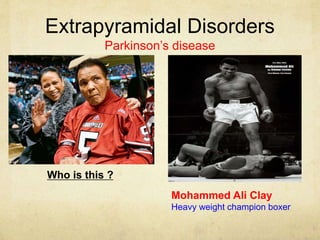
Parkinson’s disease
Who is this ?
Mohammed Ali Clay
Heavy weight champion boxer
Extrapyramidal Disorders
Parkinson’s disease
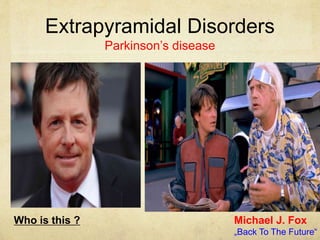
Who is this ? Michael J. Fox
„Back To The Future“
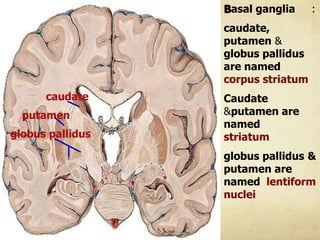
Basal ganglia :
caudate,
putamen &
globus pallidus
are named
corpus striatum
Caudate
&putamen are
named
striatum
globus pallidus &
putamen are
named lentiform
nuclei
caudate
putamen
globus pallidus
Extrapyramidal Disorders
Parkinson’s disease
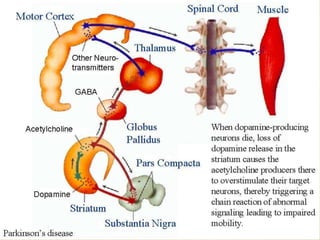
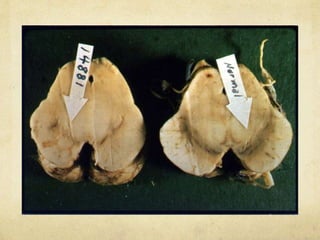
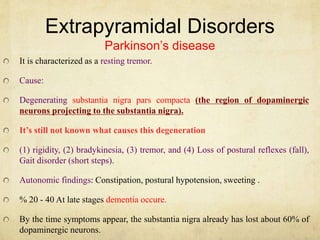
It is characterized as a resting tremor.
Cause:
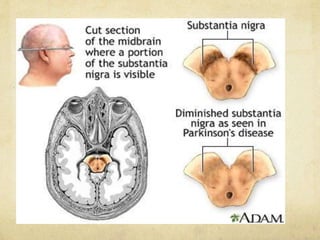
Degenerating substantia nigra pars compacta (the region of dopaminergic
neurons projecting to the substantia nigra).
It’s still not known what causes this degeneration
(1) rigidity, (2) bradykinesia, (3) tremor, and (4) Loss of postural reflexes (fall),
Gait disorder (short steps).
Autonomic findings: Constipation, postural hypotension, sweeting .
% 20 - 40 At late stages dementia occure.
By the time symptoms appear, the substantia nigra already has lost about 60% of
dopaminergic neurons.
Extrapyramidal Disorders
Parkinson’s disease
Mean age at onset in both sexes is 55 years
(range: 20-80).
Over 60 years of age risk of Parkinson’s disease is 1%
Male/female = 3/2.
Extrapyramidal Disorders
Parkinson’s disease
Diagnosis
Based on clinical findings and signs (The doctors information)
CT or MRI brain scan to exclude other causes. Positron Emission Tomography
may detect low levels of dopamine in the brain.
But PET scanning isn't commonly used to evaluate Parkinson's because it's very
expensive, not available in many hospitals, and only used experimentally.
Extrapyramidal Disorders
Parkinson’s disease
Treatment
Aimed at controlling symptoms.
It includes pharmacotherapy, physiotherapy and surgery.
Levodopa (Dopamine precursor) is the most effective drug, BUT 75% of
patients have serious complications after 5 years of LD therapy.
Dopamine agonists— bromocriptine, pergolide
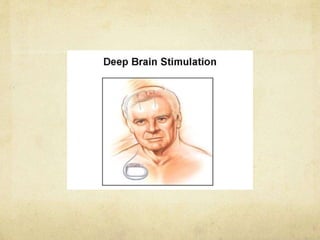
Deep brain stimulation is the main type of surgery for Parkinson’s disease
Extrapyramidal Disorders
Parkinson’s disease
Future Treatments:
Some researchers are hopeful that stem cell treatments or gene
therapy will be helpful for people with Parkinson’s disease.
Currently, research into stem cell treatments and gene therapy is
only in its initial stages.
Summary
Pyramidal tract is consisted of 3 tracts, Anterior & Lateral Corticospinal tract
and some of corticobulbar tract.
Extrapyramidal tracts is concerned with motor functions other than pyramidal
tract. They are considered as an indirect motor pathway.
Rubrospinal Tract. Reticulospinal Tract, Dividid into 2 types: A-pontine
reticulospinal tract. (Medial) B-Medullary reticulospinal tract. (Lateral),
Tectospinal Tract.,Vestibulospinal Tract.
Extrapyramidal disorders can be divided into two classes: Hyperkinetic &
hypokinetic
Hypokinetic is seen largely in Parkinson’s disease and Parkinson plus
syndromes.
Rest tremor present in the extremities, almost always distally
Degenerating substantia nigra pars compacta (the region of dopaminergic
neurons projecting to the substantia nigra) It’s still not known how.
Refrences
Neurology and Neurosurgery Illustrated
by Kenneth W. Lindsay, Ian Bone, and Geraint Fuller 5th edition
Guyton And Hall Textbook of Medical Physiology 12th Edition
Disorders of the nervous system
By Alexander G. Reeves, M.D.
Rand S. Swenson, M.D., Ph.D.
Hauser RA et al; Parkinson Disease, Medscape, Jan 2013
http://www.brainandspine.org.uk/parkinsons-disease

Extrapyramidal tract

  • 1.
  • 2.
    Learning Objectives Identifying Pyramidaltract. Identifying Extrapyramidal tracts origin, termination and function. Explaining extrapyramidal disorders. Explaining Parkinson disease.
  • 3.
    Pyramidal Tract It isconsisted of 3 tracts, Anterior & Lateral Corticospinal tract and some of corticobulbar tract. * While traveling form the cerebral cortex these fibers give the apperance of a pyramid on the upper part of the medulla. They terminate in the anterior grey matter. Function: Voluntary, fine & skilled movements of the body. Other fibers than these 3 are named extrapyrimdal.
  • 4.
    Extrapyramidal Tracts Definition : Thedescending spinal tracts which is concerned with motor functions other than pyramidal tract. They are considered as an indirect motor pathway.
  • 5.
    Extrapyramidal Tracts They areconsisted of a series of tracts: Rubrospinal Tract. Reticulospinal Tract, Dividid into 2 types: A- pontine reticulospinal tract. (Medial) B- Medullary reticulospinal tract. (Lateral) Tectospinal Tract. Vestibulospinal Tract.
  • 6.
    Rubrospinal Tract Originated fromthe red nucleus located in the mesencephalon Terminate in the lateral column of spinal cord. Function: Motor functions of skeletal muscles of the limbs, hands, and feet.
  • 7.
    Reticulospinal Tract A- pontinereticulospinal tract. (Medial & Excitatory) Originated from pontine reticular nuclei in pons which terminate in the medial anterior column. B- Medullary reticulospinal tract. (Lateral & Inhibatory) Originated from medulla and terminate in lateral anterior column. Function: It Facilitates extensor reflexes & Inhibits Flexor reflexes.
  • 8.
    Tectospinal Tract. Origin: Superiorcolliculus of midbrain. Terminate in the Anterior Column. Function: Motor function of the Skeletal muscles of the head and eyes in response to visual stimuli.
  • 9.
    Vestibulospinal Tract Origin: vestibularnucleus in medulla. Terminate in the Anterior Motor Neuron. Function: Motor function of muscle for maintaining balance in response to head movements
  • 10.
    Extrapyramidal Disorders They arealso named disorders of the Basal Ganglia, because the basal ganglia were once considered to form a separate extrapyramidal motor system. CAUSES OF EXTRAPYRAMIDAL DISORDERS Drugs, Toxins, hereditary. It can be divided into two classes: Hyperkinetic & hypokinetic
  • 11.
    Extrapyramidal Disorders Hyperkinetic: seen insuch disorders as Chorea (dance) Athetosis (“without position”) : Slow, writhing, continuous, wormlike movements of the distal parts of the extremities, which show bizarre posturing. ballism (jump or throw), dystonia, tremor, and Huntington disease.
  • 12.
    Extrapyramidal Disorders Hypokinetic: seen largelyin Parkinson’s disease and Parkinson plus syndromes. reduced facial expression (mask-like) reduced blinking reduced adjustments of posture when seated.
  • 13.
    Extrapyramidal Disorders Parkinsonism Six features: 1.Rest Tremor, 2. Rigidity, 3. Bradykinesia, 4. Flexed posture, 5. Loss of postural reflexes (fall), 6. Freezing phenomenon Tremor, rigidity, and flexed posture are referred positive phenomena. Bradykinesia, loss of postural reflexes, and freezing are negative phenomena.
  • 14.
    Rest Tremor Present inthe extremities, almost always distally Rest tremor disappears with action but reemerges as the limb maintain a posture(at rest). Rest tremor is also common in the lips, chin, and tongue Rest tremor of the hands increases with walking Stress worsens the tremor
  • 15.
    Extrapyramidal Disorders Parkinson’s disease Whois this ? Mohammed Ali Clay Heavy weight champion boxer
  • 16.
    Extrapyramidal Disorders Parkinson’s disease Whois this ? Michael J. Fox „Back To The Future“
  • 17.
    Basal ganglia : caudate, putamen& globus pallidus are named corpus striatum Caudate &putamen are named striatum globus pallidus & putamen are named lentiform nuclei caudate putamen globus pallidus
  • 21.
    Extrapyramidal Disorders Parkinson’s disease Itis characterized as a resting tremor. Cause: Degenerating substantia nigra pars compacta (the region of dopaminergic neurons projecting to the substantia nigra). It’s still not known what causes this degeneration (1) rigidity, (2) bradykinesia, (3) tremor, and (4) Loss of postural reflexes (fall), Gait disorder (short steps). Autonomic findings: Constipation, postural hypotension, sweeting . % 20 - 40 At late stages dementia occure. By the time symptoms appear, the substantia nigra already has lost about 60% of dopaminergic neurons.
  • 22.
    Extrapyramidal Disorders Parkinson’s disease Meanage at onset in both sexes is 55 years (range: 20-80). Over 60 years of age risk of Parkinson’s disease is 1% Male/female = 3/2.
  • 23.
    Extrapyramidal Disorders Parkinson’s disease Diagnosis Basedon clinical findings and signs (The doctors information) CT or MRI brain scan to exclude other causes. Positron Emission Tomography may detect low levels of dopamine in the brain. But PET scanning isn't commonly used to evaluate Parkinson's because it's very expensive, not available in many hospitals, and only used experimentally.
  • 24.
    Extrapyramidal Disorders Parkinson’s disease Treatment Aimedat controlling symptoms. It includes pharmacotherapy, physiotherapy and surgery. Levodopa (Dopamine precursor) is the most effective drug, BUT 75% of patients have serious complications after 5 years of LD therapy. Dopamine agonists— bromocriptine, pergolide Deep brain stimulation is the main type of surgery for Parkinson’s disease
  • 26.
    Extrapyramidal Disorders Parkinson’s disease FutureTreatments: Some researchers are hopeful that stem cell treatments or gene therapy will be helpful for people with Parkinson’s disease. Currently, research into stem cell treatments and gene therapy is only in its initial stages.
  • 27.
    Summary Pyramidal tract isconsisted of 3 tracts, Anterior & Lateral Corticospinal tract and some of corticobulbar tract. Extrapyramidal tracts is concerned with motor functions other than pyramidal tract. They are considered as an indirect motor pathway. Rubrospinal Tract. Reticulospinal Tract, Dividid into 2 types: A-pontine reticulospinal tract. (Medial) B-Medullary reticulospinal tract. (Lateral), Tectospinal Tract.,Vestibulospinal Tract. Extrapyramidal disorders can be divided into two classes: Hyperkinetic & hypokinetic Hypokinetic is seen largely in Parkinson’s disease and Parkinson plus syndromes. Rest tremor present in the extremities, almost always distally Degenerating substantia nigra pars compacta (the region of dopaminergic neurons projecting to the substantia nigra) It’s still not known how.
  • 28.
    Refrences Neurology and NeurosurgeryIllustrated by Kenneth W. Lindsay, Ian Bone, and Geraint Fuller 5th edition Guyton And Hall Textbook of Medical Physiology 12th Edition Disorders of the nervous system By Alexander G. Reeves, M.D. Rand S. Swenson, M.D., Ph.D. Hauser RA et al; Parkinson Disease, Medscape, Jan 2013 http://www.brainandspine.org.uk/parkinsons-disease