ASCENDING TRACTSASCENDING TRACTS
POSTERIOR COLUMNPOSTERIOR COLUMN
DR. NILESH N. KATE
M.D
ASSOCIATE PROFESSOR
Department Of Physiology
ESIC Medical College and
hospital, Gulbarga.
OBJECTIVES
At the end of the class, you should
know
1.1. Tracts of spinal cord & brain stemTracts of spinal cord & brain stem
2.2. Posterior columnPosterior column
3.3. OriginOrigin
4.4. DistributionDistribution
5.5. CourseCourse
6.6. CrossingCrossing
7.7. TerminationTermination
8.8. AppliedApplied
Dorsal
Ventral
Dorsal
Lateral
Ventral
Horns
Spinal Cord
Spinal cord
Dorsal horn - sensory input
Lateral horn - autonomic N.S.
Ventral horn - motor output ~
Ascending Pathways
 Three-neuron pathways:Three-neuron pathways:
Primary sensory neurons:Primary sensory neurons:
From external receptorsFrom external receptors
Travel through dorsal roots of spinal cordTravel through dorsal roots of spinal cord
Secondary neurons:Secondary neurons:
Make up tracts in spinal cord andMake up tracts in spinal cord and
brainstembrainstem
Tertiary neurons:Tertiary neurons:
From thalamus to primary sensory cortexFrom thalamus to primary sensory cortex
Travel through internal capsuleTravel through internal capsule
Ascending Pathways
 For conscious perception:For conscious perception:
Spinothalamic systemSpinothalamic system
Medial Lemniscal systemMedial Lemniscal system
 For unconscious perception:For unconscious perception:
SpinocerebellarSpinocerebellar
Spino-olivarySpino-olivary
SpinotectalSpinotectal
SpinoreticularSpinoreticular
Medial Lemniscus System
 Also called posterior column system.Also called posterior column system.
 Carries sensations for two-pointCarries sensations for two-point
sensation (fine touch), pressure, andsensation (fine touch), pressure, and
vibration.vibration.
Medial Lemniscus System
 Primary fibers ascend entire length ofPrimary fibers ascend entire length of
spinal cord and synapse withspinal cord and synapse with
secondary neurons in medulla:secondary neurons in medulla:
Fasciculus gracilisFasciculus gracilis
Fasciculus cuneatusFasciculus cuneatus
Medial Lemniscus
 RedRed::
 GracilisGracilis
 BlueBlue
 cuneatuscuneatus
Medial Lemniscus System
 Fibers of fasciculus gracilis synapse inFibers of fasciculus gracilis synapse in
nucleus gracilis:nucleus gracilis:
Convey sensations from below midthoracicConvey sensations from below midthoracic
level.level.
 Fibers of fasciculus cuneatus synapseFibers of fasciculus cuneatus synapse
in nucleus cuneatus:in nucleus cuneatus:
Convey sensations from above midthoracicConvey sensations from above midthoracic
level.level.
Also conveys proprioceptive sensation fromAlso conveys proprioceptive sensation from
arms toarms to cerebellum.cerebellum.
Medial Lemniscus System
 Secondary fibers decussate.Secondary fibers decussate.
 Secondary fibers ascend to synapse inSecondary fibers ascend to synapse in
VPL of thalamus.VPL of thalamus.
 Tertiary fibers ascend throughTertiary fibers ascend through
internal capsule to primary sensoryinternal capsule to primary sensory
cortex.cortex.
Medial Lemniscus
Medial Lemniscus
Somatosensory Pathways
Crossover at spinal cord
Pain and Temperature
Tickle and Itch
Poorly localised touch
Crossover in medulla
Discriminative touch
Shape, size texture, weight
Vibration
Proprioception
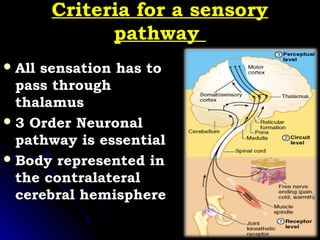
Criteria for a sensory
pathway
 All sensation has toAll sensation has to
pass throughpass through
thalamusthalamus
 3 Order Neuronal3 Order Neuronal
pathway is essentialpathway is essential
 Body represented inBody represented in
the contralateralthe contralateral
cerebral hemispherecerebral hemisphere
POSTERIOR COLUMN
Spino
thalamic
(lateral &
anterior)
Description of a tract
SynonymsSynonyms
OriginOrigin
DistributionDistribution
CourseCourse
CrossingCrossing
TerminationTermination
FunctionFunction
AppliedApplied
Ascending Spinal TractsAscending Spinal Tracts
 Convey sensoryConvey sensory
information frominformation from
cutaneouscutaneous
receptors,receptors,
proprioceptors andproprioceptors and
visceral receptors tovisceral receptors to
cerebral cortex.cerebral cortex.
 Sensory fiber tractSensory fiber tract
decussation maydecussation may
occur in medulla oroccur in medulla or
spinal cord.spinal cord.
Ascending tracts
MajorMajor
1)1)posteriorposterior
columncolumn
2)2)AnterolateralAnterolateral
system(spinothsystem(spinoth
alamic)alamic)
3)3)SpinoSpino
cerebellar tractcerebellar tract
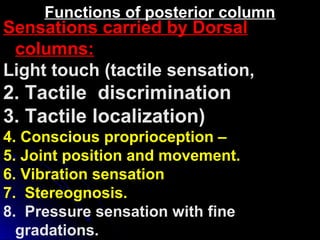
Sensations carried by Dorsal
columns:
Light touch (tactile sensation,
2. Tactile discrimination
3. Tactile localization)
4. Conscious proprioception –
5. Joint position and movement.
6. Vibration sensation
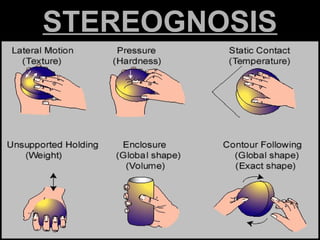
7. Stereognosis.
8. Pressure sensation with fine
gradations.
Functions of posterior column
Somatosensory Cortex
Area on somatosensory cortex related to degree of innervation
c. Dorsal Columnc. Dorsal Column
PathwayPathway
..The axons fromThe axons from
these first-orderthese first-order
neurons passneurons pass
upward in theupward in the
fasciculus gracilisfasciculus gracilis
or fasciculusor fasciculus
cuneatus.cuneatus.
c. Dorsal Column Pathwayc. Dorsal Column Pathway
The axons from the second-The axons from the second-
order neurons (nucleusorder neurons (nucleus
gracilis or nucleus cuneatus)gracilis or nucleus cuneatus)
cross to the opposite side ofcross to the opposite side of
the medulla and ascend to thethe medulla and ascend to the
thalamus through the medialthalamus through the medial
lemniscus of the medulla,lemniscus of the medulla,
pons, and midbrain.pons, and midbrain.
Ascending PathwaysAscending Pathways
Figure 13.33a
Tracts of the Spinal CordTracts of the Spinal Cord
Figure 13.32
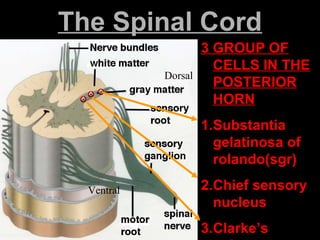
The Spinal CordThe Spinal Cord
Ventral
Dorsal
3 GROUP OF
CELLS IN THE
POSTERIOR
HORN
1.Substantia
gelatinosa of
rolando(sgr)
2.Chief sensory
nucleus
3.Clarke’s
Posterior ColumnPosterior Column
pinothalamic Pathways
Somatosensory cortex of Postcentral GyrusSomatosensory cortex of Postcentral Gyrus
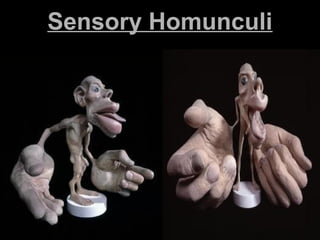
 Relative sizes ofRelative sizes of
cortical areascortical areas
 proportional to numberproportional to number
of sensory receptorsof sensory receptors
 proportional to theproportional to the
sensitivity of each partsensitivity of each part
of the bodyof the body
 Can be modified withCan be modified with
learninglearning
 learn to read Braille &learn to read Braille &
will have larger areawill have larger area
representing fingertipsrepresenting fingertips
Sensory HomunculiSensory Homunculi
Somatic SensorySomatic Sensory
PathwaysPathways First-order neuron conduct impulses toFirst-order neuron conduct impulses to
brainstem or spinal cordbrainstem or spinal cord
either spinal or cranial nerveseither spinal or cranial nerves
 Second-order neurons conducts impulsesSecond-order neurons conducts impulses
from spinal cord or brainstem to thalamus--from spinal cord or brainstem to thalamus--
cross over to opposite side before reachingcross over to opposite side before reaching
thalamusthalamus
 Third-order neuron conducts impulses fromThird-order neuron conducts impulses from
thalamus to primary somatosensory cortexthalamus to primary somatosensory cortex
(postcentral gyrus of parietal lobe)(postcentral gyrus of parietal lobe)
Posterior ColumnPosterior Column
• Proprioception, vibration,
discriminative touch, weight
discrimination &
stereognosis
• Signals travel up spinal cord in
posterior column
• Fibers cross-over in medulla to
become the medial lemniscus
pathway ending in thalamus
• Thalamic fibers reach cortex
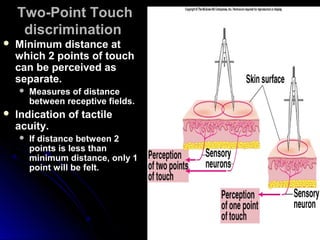
Two-Point TouchTwo-Point Touch
discriminationdiscrimination
 Minimum distance atMinimum distance at
which 2 points of touchwhich 2 points of touch
can be perceived ascan be perceived as
separate.separate.
 Measures of distanceMeasures of distance
between receptive fields.between receptive fields.
 Indication of tactileIndication of tactile
acuity.acuity.
 If distance between 2If distance between 2
points is less thanpoints is less than
minimum distance, only 1minimum distance, only 1
point will be felt.point will be felt.
Receptive FieldsReceptive Fields
Receptive fields in
the thalamusthalamus have
centre-surround
organization.
Cortical receptiveCortical receptive
fields (left)fields (left) are
smaller in the fingers
and larger on the
hand and forearm.
STEREOGNOSISSTEREOGNOSIS
Thank you…Thank you…
Today’s
PHYSIOLOGY
is
tomorrow’s
MEDICINE.
Thank
you.

ASCENDING TRACTS

  • 1.
    ASCENDING TRACTSASCENDING TRACTS POSTERIORCOLUMNPOSTERIOR COLUMN DR. NILESH N. KATE M.D ASSOCIATE PROFESSOR Department Of Physiology ESIC Medical College and hospital, Gulbarga.
  • 2.
    OBJECTIVES At the endof the class, you should know 1.1. Tracts of spinal cord & brain stemTracts of spinal cord & brain stem 2.2. Posterior columnPosterior column 3.3. OriginOrigin 4.4. DistributionDistribution 5.5. CourseCourse 6.6. CrossingCrossing 7.7. TerminationTermination 8.8. AppliedApplied
  • 3.
  • 4.
    Spinal cord Dorsal horn- sensory input Lateral horn - autonomic N.S. Ventral horn - motor output ~
  • 5.
    Ascending Pathways  Three-neuronpathways:Three-neuron pathways: Primary sensory neurons:Primary sensory neurons: From external receptorsFrom external receptors Travel through dorsal roots of spinal cordTravel through dorsal roots of spinal cord Secondary neurons:Secondary neurons: Make up tracts in spinal cord andMake up tracts in spinal cord and brainstembrainstem Tertiary neurons:Tertiary neurons: From thalamus to primary sensory cortexFrom thalamus to primary sensory cortex Travel through internal capsuleTravel through internal capsule
  • 6.
    Ascending Pathways  Forconscious perception:For conscious perception: Spinothalamic systemSpinothalamic system Medial Lemniscal systemMedial Lemniscal system  For unconscious perception:For unconscious perception: SpinocerebellarSpinocerebellar Spino-olivarySpino-olivary SpinotectalSpinotectal SpinoreticularSpinoreticular
  • 7.
    Medial Lemniscus System Also called posterior column system.Also called posterior column system.  Carries sensations for two-pointCarries sensations for two-point sensation (fine touch), pressure, andsensation (fine touch), pressure, and vibration.vibration.
  • 8.
    Medial Lemniscus System Primary fibers ascend entire length ofPrimary fibers ascend entire length of spinal cord and synapse withspinal cord and synapse with secondary neurons in medulla:secondary neurons in medulla: Fasciculus gracilisFasciculus gracilis Fasciculus cuneatusFasciculus cuneatus
  • 9.
    Medial Lemniscus  RedRed:: GracilisGracilis  BlueBlue  cuneatuscuneatus
  • 10.
    Medial Lemniscus System Fibers of fasciculus gracilis synapse inFibers of fasciculus gracilis synapse in nucleus gracilis:nucleus gracilis: Convey sensations from below midthoracicConvey sensations from below midthoracic level.level.  Fibers of fasciculus cuneatus synapseFibers of fasciculus cuneatus synapse in nucleus cuneatus:in nucleus cuneatus: Convey sensations from above midthoracicConvey sensations from above midthoracic level.level. Also conveys proprioceptive sensation fromAlso conveys proprioceptive sensation from arms toarms to cerebellum.cerebellum.
  • 11.
    Medial Lemniscus System Secondary fibers decussate.Secondary fibers decussate.  Secondary fibers ascend to synapse inSecondary fibers ascend to synapse in VPL of thalamus.VPL of thalamus.  Tertiary fibers ascend throughTertiary fibers ascend through internal capsule to primary sensoryinternal capsule to primary sensory cortex.cortex.
  • 12.
  • 13.
  • 14.
    Somatosensory Pathways Crossover atspinal cord Pain and Temperature Tickle and Itch Poorly localised touch Crossover in medulla Discriminative touch Shape, size texture, weight Vibration Proprioception
  • 15.
    Criteria for asensory pathway  All sensation has toAll sensation has to pass throughpass through thalamusthalamus  3 Order Neuronal3 Order Neuronal pathway is essentialpathway is essential  Body represented inBody represented in the contralateralthe contralateral cerebral hemispherecerebral hemisphere
  • 16.
  • 17.
    Description of atract SynonymsSynonyms OriginOrigin DistributionDistribution CourseCourse CrossingCrossing TerminationTermination FunctionFunction AppliedApplied
  • 18.
    Ascending Spinal TractsAscendingSpinal Tracts  Convey sensoryConvey sensory information frominformation from cutaneouscutaneous receptors,receptors, proprioceptors andproprioceptors and visceral receptors tovisceral receptors to cerebral cortex.cerebral cortex.  Sensory fiber tractSensory fiber tract decussation maydecussation may occur in medulla oroccur in medulla or spinal cord.spinal cord.
  • 19.
  • 20.
    Sensations carried byDorsal columns: Light touch (tactile sensation, 2. Tactile discrimination 3. Tactile localization) 4. Conscious proprioception – 5. Joint position and movement. 6. Vibration sensation 7. Stereognosis. 8. Pressure sensation with fine gradations. Functions of posterior column
  • 21.
    Somatosensory Cortex Area onsomatosensory cortex related to degree of innervation
  • 23.
    c. Dorsal Columnc.Dorsal Column PathwayPathway ..The axons fromThe axons from these first-orderthese first-order neurons passneurons pass upward in theupward in the fasciculus gracilisfasciculus gracilis or fasciculusor fasciculus cuneatus.cuneatus.
  • 24.
    c. Dorsal ColumnPathwayc. Dorsal Column Pathway The axons from the second-The axons from the second- order neurons (nucleusorder neurons (nucleus gracilis or nucleus cuneatus)gracilis or nucleus cuneatus) cross to the opposite side ofcross to the opposite side of the medulla and ascend to thethe medulla and ascend to the thalamus through the medialthalamus through the medial lemniscus of the medulla,lemniscus of the medulla, pons, and midbrain.pons, and midbrain.
  • 25.
  • 26.
    Tracts of theSpinal CordTracts of the Spinal Cord Figure 13.32
  • 27.
    The Spinal CordTheSpinal Cord Ventral Dorsal 3 GROUP OF CELLS IN THE POSTERIOR HORN 1.Substantia gelatinosa of rolando(sgr) 2.Chief sensory nucleus 3.Clarke’s
  • 28.
  • 29.
  • 30.
    Somatosensory cortex ofPostcentral GyrusSomatosensory cortex of Postcentral Gyrus  Relative sizes ofRelative sizes of cortical areascortical areas  proportional to numberproportional to number of sensory receptorsof sensory receptors  proportional to theproportional to the sensitivity of each partsensitivity of each part of the bodyof the body  Can be modified withCan be modified with learninglearning  learn to read Braille &learn to read Braille & will have larger areawill have larger area representing fingertipsrepresenting fingertips
  • 31.
  • 32.
  • 33.
    Somatic SensorySomatic Sensory PathwaysPathwaysFirst-order neuron conduct impulses toFirst-order neuron conduct impulses to brainstem or spinal cordbrainstem or spinal cord either spinal or cranial nerveseither spinal or cranial nerves  Second-order neurons conducts impulsesSecond-order neurons conducts impulses from spinal cord or brainstem to thalamus--from spinal cord or brainstem to thalamus-- cross over to opposite side before reachingcross over to opposite side before reaching thalamusthalamus  Third-order neuron conducts impulses fromThird-order neuron conducts impulses from thalamus to primary somatosensory cortexthalamus to primary somatosensory cortex (postcentral gyrus of parietal lobe)(postcentral gyrus of parietal lobe)
  • 34.
  • 35.
    Posterior ColumnPosterior Column •Proprioception, vibration, discriminative touch, weight discrimination & stereognosis • Signals travel up spinal cord in posterior column • Fibers cross-over in medulla to become the medial lemniscus pathway ending in thalamus • Thalamic fibers reach cortex
  • 36.
    Two-Point TouchTwo-Point Touch discriminationdiscrimination Minimum distance atMinimum distance at which 2 points of touchwhich 2 points of touch can be perceived ascan be perceived as separate.separate.  Measures of distanceMeasures of distance between receptive fields.between receptive fields.  Indication of tactileIndication of tactile acuity.acuity.  If distance between 2If distance between 2 points is less thanpoints is less than minimum distance, only 1minimum distance, only 1 point will be felt.point will be felt.
  • 37.
    Receptive FieldsReceptive Fields Receptivefields in the thalamusthalamus have centre-surround organization. Cortical receptiveCortical receptive fields (left)fields (left) are smaller in the fingers and larger on the hand and forearm.
  • 38.
  • 39.
  • 40.