DR NILESH KATE
MBBS,MD
ASSOCIATE PROF
ESIC MEDICAL COLLEGE, GULBARGA.
DEPT. OF PHYSIOLOGY
SLEEP AND
ELECTROENCEPHA
LOGRAM
OBJECTIVES.
 Electrical activity of the brain.
 Evolked cortical potential
 Electroencephalogram
 Wakefullness and sleep.
 Wakefullness
 Neural substrate
 Chemical mediators.
 Sleep
ELECTRICAL ACTIVITY OF THE
BRAIN.
 Evolked cortical
potential.
 Primary Evolked
potential.
 Diffuse secondary
response.
Wednesday, April 25, 2018
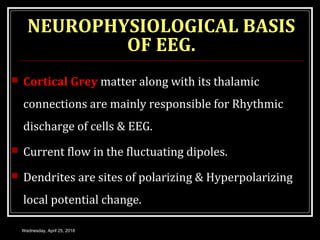
EVOLKED CORTICAL
POTENTIAL.
 Surface electrical
activity recorded from
scalp in response to
specific & adequate
stimulus.
 Electrical activity of
2 types.
Wednesday, April 25, 2018
PRIMARY EVOLKED
POTENTIAL.
 Initial brief & localized
response over the
specific sensory cortex.
 Characterized by
 Latency – 5-12 ms
 Surface positive followed
by negative wave.
 Highly specific in its
location.
Wednesday, April 25, 2018
DIFFUSE SECONDARY
RESPONSE.
 Latency – 20-80 ms
 Positive negative wave
sequence larger & more
prolonged.
 Not highly localized.
Wednesday, April 25, 2018
TYPES OF EVOLKED
POTENTIAL.
 Depending on type of
stimulus.
 Visual Evolked potential.
(VEP)
 Brain stem auditory
Evolked potential
(BAEP)
 Somatosensory Evolked
potential.
 Event related
potentials.
Wednesday, April 25, 2018
TYPES OF EVOLKED
POTENTIAL.
 Depending on
latency of
response.
 Stimulus related
potentials.
 Event related
Evolked potential.
Wednesday, April 25, 2018
STIMULUS RELATED
POTENTIALS.
 Series of waves relates to
sensory modality.
 Early latency response –
latency < 10ms
 Mid-latency response –
Latency 10-50 ms.
 Long latency response –
latency > 50 ms.
Wednesday, April 25, 2018
EVENT RELATED EVOLKED
POTENTIAL.
 Dependent on subject’s
attention & level of
arousal.
 Related to cognitive
events associated with
distinction of target
from non- target
stimuli.
Wednesday, April 25, 2018
CLINICAL USES OF EVOLKED
POTENTIALS.
 Stimulus related Evolked potential – Reflects
functional integrity of sensory pathway.
 So any defect is shown by delayed peak or Interpeak
latencies.
 Event related Evolked potential.
 Related to cognitive behavior.
 By use of ERP clinical assessment of Dementia &
Delirium is well established.
Wednesday, April 25, 2018
ELECTROENCEPHALOGRAM
 Introduced by German
Psychiatrists Hans
Berger.
 Record of spontaneous
electrical activity of
brain taken from
surface of scalp.
Wednesday, April 25, 2018
ELECTROENCEPHALOGRAM
 The wave oscillations differ
in frequency & amplitude
in different points on scalp
& during mental alertness.
 Frequency – range 1-50
cycles/sec.
 Amplitude – 50-200 μV.
 Irregular & without any
pattern.
Wednesday, April 25, 2018
WAVES OF EEG
 Alpha waves
 Beta waves.
 Theta waves.
 Delta waves.
Wednesday, April 25, 2018
ALPHA WAVES
 Most prominent
 Person awake, quiet at rest
, eyes closed.
 Characteristic features.
 Frequency – 8-13 Hz.
 Amplitude – 50 μV.
 Location – Parito-occipital
area.
 Disappear – During sleep.
Wednesday, April 25, 2018
ALPHA WAVES
 Causes of decreased
frequency.
 Old age, decreased
cerebral metabolism
 Low BSL
 Low body temp
 Low adrenal
Glucocorticoids.
 High arterial Pco2
 Sleep.
 Causes of increased
frequency.
 Alpha block – α waves
attenuates & replaced by
fast ,irregular & low
amplitude waves. Occurs in
 Open eyes
 During conscious mental
activities.
 During aroused & alerting
response.
Wednesday, April 25, 2018
BETA WAVES.
 CHARACTERISTIC
FEATURES.
 Frequency – 14-30 Hz.
 Amplitude – 5-10 μV.
 Location – Parietal &
frontal area.
 Appear – Tension & CNS
activation.
 Arousal response
 Infants & Barbiturates.
Wednesday, April 25, 2018
THETA WAVES.
 CHARACTERISTIC
FEATURES.
 Frequency – 4-7 Hz.
 Amplitude – 10 μV.
 Location – Temporal &
Parietal region in children.
Wednesday, April 25, 2018
THETA WAVES.
 Do not in normal waking
individuals (except in
Newborn)
 Seen in emotional states
like Disappointment &
Frustration.
 Many brain disorders.
 Increased during crying
in children.
Wednesday, April 25, 2018
DELTA WAVES.
 CHARACTERISTIC
FEATURES.
 Frequency – < 4 Hz.
 Amplitude – 20-200 μV.
 Location – Strictly in
cortex.
Wednesday, April 25, 2018
DELTA WAVES.
 CHARACTERISTIC
FEATURES.
 Do not occur in normal
waking individuals but
seen in
 Deep sleep (stage III &
IV of NREM)
 Infancy
 Serious brain damage.
Wednesday, April 25, 2018
NEUROPHYSIOLOGICAL BASIS
OF EEG.
 Cortical Grey matter along with its thalamic
connections are mainly responsible for Rhythmic
discharge of cells & EEG.
 Current flow in the fluctuating dipoles.
 Dendrites are sites of polarizing & Hyperpolarizing
local potential change.
Wednesday, April 25, 2018
NEUROPHYSIOLOGICAL BASIS
OF EEG.
 So cell dendrite relationship is constantly shifting
dipole.
 So becomes sites of current sink.
 EEG is due to Graded potentials which are post
synaptic potentials in Brain neurons.
Wednesday, April 25, 2018
SYNCHRONIZING
MECHANISMS.
 Rhythmic discharge from thalamus.
 Synchronizing activity of neighboring cells due to
 Effect of parietal neural process to each other.
 Interconnections of neurons by Inhibitory pathway.
Wednesday, April 25, 2018
DESYNCHRONIZING
MECHANISMS.
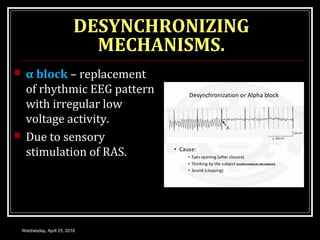
 α block – replacement
of rhythmic EEG pattern
with irregular low
voltage activity.
 Due to sensory
stimulation of RAS.
Wednesday, April 25, 2018
VARIATION IN EEG WAVE
FORMATION WITH AGE.
 In Infants – occipital
rhythm is slow(0.5 Hz)
than Adults (8-13 Hz).
 In children occipital
rhythm speeds up & adult α
pattern gradually appears
in adolescence.
 After 15 years EEG
waveforms become same
as adults.
Wednesday, April 25, 2018
ABNORMAL EEG WAVEFORMS
 1 Epilepsy.
 Idiopathic abnormal
waves as spike, sharp
wave & spike & slow
wave complex.
 Between abnormal
irregular slow wave
appears.
Wednesday, April 25, 2018
TYPES.
 GRANDMAL EPILEPSY
– Serious fits
accompanied by
convulsions with tonic
muscle contraction,
clonic jerks & loss of
consciousness.
 EEG shows continuous
spike or sharp waves.
Wednesday, April 25, 2018
TYPES
 PETITMAL EPILEPSY –
Sudden loss of consciousness
for few sec without
convulsions with local
twitching.
 PSYCHOMOTOR EPILEPSY –
Typical fit with inappropriate
movements with
hallucinations without loss of
consciousness.
Wednesday, April 25, 2018
ABNORMAL EEG WAVEFORMS
 2 Consciousness Dysfunction – slow wave
appears.
 Disturbance of consciousness in coma, stupor &
syncope.
Wednesday, April 25, 2018
ABNORMAL EEG WAVEFORMS
 3 Organic brain Dysfunction – when brain
functional trouble occurs – no wave is generated
from that part but slow wave is generated from
surrounding organization.
Wednesday, April 25, 2018
ABNORMAL EEG WAVEFORMS
 4 Brain Death –
Individual delclared
dead when brain cells
stop activity, EEG waves
becomes flat in all
channels & finally
disappears.
Wednesday, April 25, 2018
WAKEFULLNESS
 The RAS of Reticular
formation is the neural
substrate of the
consciousness & sleep
waking cycle.
Wednesday, April 25, 2018
NEURAL SUBSTRATE FOR
WAKEFULLNESS.
 Reticular activating system. – Responsible for
tonic maintenance of cortical activation &
Behavioural arousal of wake fullness.
 Thalamus – VM, Intra-laminar & Midline nuclei are
involved in activation of entire cerebral cortex.
Wednesday, April 25, 2018
NEURAL SUBSTRATE FOR
WAKEFULLNESS.
 Hypothalamus and
sub thalamus.
 Basal forebrain –
Mainly Nucleus Basalis
of Meynert, Nuclei of
Diagonal band &
septum.
 It receives impulses from
Reticular formation.
Wednesday, April 25, 2018
CHEMICAL MEDIATORS OF
WAKEFULLNESS
 Neurotransmitters.
 Cerebrospinal fluid
borne peptides.
 Blood borne
peptides.
Wednesday, April 25, 2018
NEUROTRANSMITTERS.
 Catecholamines – NE neurons of locus Coeruleus &
Brain stem project diffusly to forebrain & cortex
play an imp role
 Acetylcholine - – Cholinergic agonists &
anticholinesterase promote cortical activation &
wakefulness.
Wednesday, April 25, 2018
NEUROTRANSMITTERS.
 Histamine – Arousing effect produced by
intraventricular administration of Histamine
 Sedative effect produced by Antihistaminics.
 Glutamate- Excitatory Neurotransmitters released
from cerebral cortex in highest quantities in cortical
activation.
Wednesday, April 25, 2018
CEREBROSPINAL FLUID
BORNE PEPTIDES.
 Substance P
 Hypothalamic
releasing factors.
 Vasoactive intestinal
peptides.
Wednesday, April 25, 2018
BLOOD BORNE PEPTIDES.
 Epinephrine &
histamine – Do not cross
BBB but act on
circumventricular organ.
 Glucocorticoids – these
readily cross BBB.
Wednesday, April 25, 2018
SLEEP
 State of
Unconsciousness from
which person can be
aroused by sensory or
other stimuli.
Wednesday, April 25, 2018
SLEEP WAKE CYCLE AND
FACTORS AFFECTING SLEEP.
 Control of sleep wake cycle.
 Sleep wake cycle –
endogenous
 Biological clock – in
Suprachiasmatic Nucleus of
Anterior Hypothalamus.
 Zeitgebers – Time givers;
Most imp is sunlight
through
Retinohypothalamic tract.
Wednesday, April 25, 2018
FACTORS AFFECTING SLEEP.
 Darkened room
 Comfortable surrounding
temperature
 Silence
 Physical & mental
relaxation.
 Consumption of basic urge
 Low frequency stimulation.
Wednesday, April 25, 2018
TYPES AND STAGES OF SLEEP
 Non-REM sleep.
 REM SLEEP.
ALTERNATE IN A
SLEEP CYCLE.
Wednesday, April 25, 2018
TYPES AND STAGES OF SLEEP
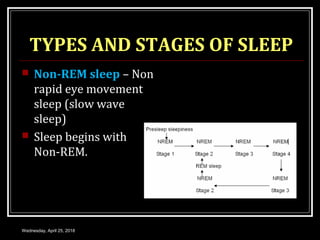
 Non-REM sleep – Non
rapid eye movement
sleep (slow wave
sleep)
 Sleep begins with
Non-REM.
Wednesday, April 25, 2018
STAGES AND EEG PATTERN OF
NON-REM SLEEP.
 Stage of wakefulness –
state of wakefulness &
consciousness due to RAS
stimulation to cortex.
 EEG – Low amplitude β
waves.
 Stage of quiet, awake rest
with eyes closed.
 Highly synchronized large α
waves
Wednesday, April 25, 2018
STAGE OF NON-REM SLEEP.
 Stage 1 – low amplitude
mix frequency activity.
 Stage 2 – Stage of light
sleep, sleep spindles
appears.
 These are bursts of α
like 10-14 Hz, 50 μv
waves.
Wednesday, April 25, 2018
STAGE OF NON-REM SLEEP.
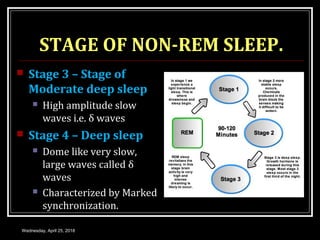
 Stage 3 – Stage of
Moderate deep sleep
 High amplitude slow
waves i.e. δ waves
 Stage 4 – Deep sleep
 Dome like very slow,
large waves called δ
waves
 Characterized by Marked
synchronization.
Wednesday, April 25, 2018
PHYSIOLOGICAL CHANGES
DURING NON-REM SLEEP
 Muscle tone
 Heart rate & BP
 Respiratory rate
 Body metabolism
 Eyes – slow rolling movements
until finally stop in stage 4 with
eyes turned upwards.
 Pituitary pulsatile release of
growth hormones & Gonadotropins
– slows down.
Wednesday, April 25, 2018
BEHAVIORAL CHANGES
DURING NON-REM SLEEP
 Consciousness – progressively reduced.
 Resistance to be awakened increases.
 When awake do not report Dreaming.
 Discriminate response to meaningful & non
meaningful stimuli.
Wednesday, April 25, 2018
INTELLECTUAL FUNCTIONS
DURING NON-REM SLEEP.
 Thoughts becomes
illogical & Incoherent
towards sleep.
 Retrograde Amnesia.
 Sleep inactivates
consolidation of short
term to long term
memory
Wednesday, April 25, 2018
REM SLEEP
 RAPID EYE
MOVEMENT SLEEP /
FAST WAVE SLEEP /
Paradoxical sleep /
Deepest sleep /
Dream sleep.
Wednesday, April 25, 2018
EEG PATTERN OF REM SLEEP.
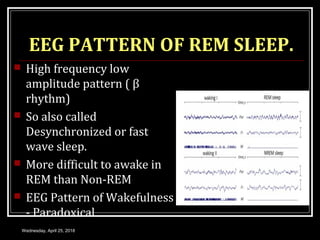
 High frequency low
amplitude pattern ( β
rhythm)
 So also called
Desynchronized or fast
wave sleep.
 More difficult to awake in
REM than Non-REM
 EEG Pattern of Wakefulness
- Paradoxical
Wednesday, April 25, 2018
PHYSIOLOGICAL CHANGES
DURING NON-REM SLEEP
 Rapid Eye Movement
 HR & RR – Irregular.
 Muscle tone – reduced.
 Twitching of limb.
 Middle ear muscles active
 Penile erection in males & Engorgement of Clitoris in
females.
 Impaired Thermoregulation
 Teeth Grinding.
Wednesday, April 25, 2018
BEHAVIORAL CHANGES
DURING REM SLEEP
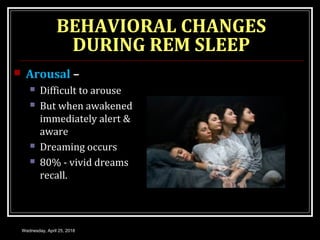
 Arousal –
 Difficult to arouse
 But when awakened
immediately alert &
aware
 Dreaming occurs
 80% - vivid dreams
recall.
Wednesday, April 25, 2018
SLEEP CYCLE.
 Average sleep period of
7-8 hr divided into 5
cycles of Non-REM &
REM, alternate with
each other.
Wednesday, April 25, 2018
SLEEP CYCLE.
 Duration of sleep cycles and sleep stages.
 Avg duration of each cycle – 90 min.
 In 1st
cycle 85 min is NREM & 5 min REM.
 25% of entire sleep is in REM.
 NREM decreases & REM increases in further cycles.
Wednesday, April 25, 2018
VARIATIONS IN SLEEP CYCLES.
 In adult sleep starts with REM in special
conditions as
 Jet lag, Chronic sleep deprivation, narcolepsy, acute
withdrawal of REM suppressing drugs, endogenous
depressions.
Wednesday, April 25, 2018
VARIATIONS IN TOTAL SLEEP
DURATIONS.
 Avg sleep time per day
 Infant – 16hrs.
 Childhood -10 hrs
 Adulthood -7-8 hrs.
 Old age - < 8 hrs.
Wednesday, April 25, 2018
VARIATIONS IN TIME PERIOD OF
DIFFERENT STAGES OF SLEEP.
 Effect of AGE.
 Premature infant – 80% in REM
 Full term infant – 50 % in REM.
 In adulthood reduction in total sleep time to 8 hrs.(2
REM; 6 NREM)
Wednesday, April 25, 2018
GENESIS OF SLEEP
 Genesis of Non-REM sleep.
 Genesis of REM sleep.
Wednesday, April 25, 2018
GENESIS OF NON-REM SLEEP.
 Diencephalic sleep zone
 Sleep fascilitatory center – Ant Hypothalamus.
 Sleep inhibitory center – Post Hypothalamus.
 Medullary synchronizing zone
 Basal forebrain sleep zone.
Wednesday, April 25, 2018
ACTIVITY OF NON-REM ON
CELLS
 Mechanism of production of sleep spindles and
slow waves of Non-REM sleep.
 These synchronized synaptic potentials are rhythmic
firing of thalamic relay neurons to cortex.
 This rhythmic firing is due to GABAergic inhibitory
neurons in Nucleus Reticularis around thalamus.
Wednesday, April 25, 2018
GENESIS OF REM SLEEP.
 Role of cholinergic neurons of Mid-brain and the
adjacent dorsal Pons.
 Role of Nucleus Reticularis pontis oralis.
 Cholinergic PGO on cells.
 REM waking on cells.
 REM on cells.
Wednesday, April 25, 2018
CHEMICAL MEDIATORS OF
SLEEP
 Neurotransmitters – Include Serotonin,
Acetylcholine & Noradrenaline.
 Sleep producing substances are – Muramyl
Dipeptide (found in bacterial cell wall), Interleukin-
1, adenosine, Delta sleep inducing peptide, PGD2,
Argenine vasotoxin.
Wednesday, April 25, 2018
PHYSIOLOGICAL SIGNIFICANCE
OF SLEEP.
 Sleep may serve as a period of body’s rest and
metabolic restoration.
 Sleep is necessary for certain forms of learning.
Wednesday, April 25, 2018
PHYSIOLOGICAL SIGNIFICANCE
OF SLEEP.
 REM sleep is necessary for mental wellbeing.
 REM sleep plays an important role in homeostatic
mechanism.
Wednesday, April 25, 2018
SLEEP DISORDERS.
 Insomnia.
 Fatal familial
insomnia.
 Narcolepsy.
 Some sleep
disorders associated
with non-REM sleep
(slow wave sleep)
Wednesday, April 25, 2018
THANK YOU

SLEEP AND EEG

  • 1.
    DR NILESH KATE MBBS,MD ASSOCIATEPROF ESIC MEDICAL COLLEGE, GULBARGA. DEPT. OF PHYSIOLOGY SLEEP AND ELECTROENCEPHA LOGRAM
  • 2.
    OBJECTIVES.  Electrical activityof the brain.  Evolked cortical potential  Electroencephalogram  Wakefullness and sleep.  Wakefullness  Neural substrate  Chemical mediators.  Sleep
  • 3.
    ELECTRICAL ACTIVITY OFTHE BRAIN.  Evolked cortical potential.  Primary Evolked potential.  Diffuse secondary response. Wednesday, April 25, 2018
  • 4.
    EVOLKED CORTICAL POTENTIAL.  Surfaceelectrical activity recorded from scalp in response to specific & adequate stimulus.  Electrical activity of 2 types. Wednesday, April 25, 2018
  • 5.
    PRIMARY EVOLKED POTENTIAL.  Initialbrief & localized response over the specific sensory cortex.  Characterized by  Latency – 5-12 ms  Surface positive followed by negative wave.  Highly specific in its location. Wednesday, April 25, 2018
  • 6.
    DIFFUSE SECONDARY RESPONSE.  Latency– 20-80 ms  Positive negative wave sequence larger & more prolonged.  Not highly localized. Wednesday, April 25, 2018
  • 7.
    TYPES OF EVOLKED POTENTIAL. Depending on type of stimulus.  Visual Evolked potential. (VEP)  Brain stem auditory Evolked potential (BAEP)  Somatosensory Evolked potential.  Event related potentials. Wednesday, April 25, 2018
  • 8.
    TYPES OF EVOLKED POTENTIAL. Depending on latency of response.  Stimulus related potentials.  Event related Evolked potential. Wednesday, April 25, 2018
  • 9.
    STIMULUS RELATED POTENTIALS.  Seriesof waves relates to sensory modality.  Early latency response – latency < 10ms  Mid-latency response – Latency 10-50 ms.  Long latency response – latency > 50 ms. Wednesday, April 25, 2018
  • 10.
    EVENT RELATED EVOLKED POTENTIAL. Dependent on subject’s attention & level of arousal.  Related to cognitive events associated with distinction of target from non- target stimuli. Wednesday, April 25, 2018
  • 11.
    CLINICAL USES OFEVOLKED POTENTIALS.  Stimulus related Evolked potential – Reflects functional integrity of sensory pathway.  So any defect is shown by delayed peak or Interpeak latencies.  Event related Evolked potential.  Related to cognitive behavior.  By use of ERP clinical assessment of Dementia & Delirium is well established. Wednesday, April 25, 2018
  • 12.
    ELECTROENCEPHALOGRAM  Introduced byGerman Psychiatrists Hans Berger.  Record of spontaneous electrical activity of brain taken from surface of scalp. Wednesday, April 25, 2018
  • 13.
    ELECTROENCEPHALOGRAM  The waveoscillations differ in frequency & amplitude in different points on scalp & during mental alertness.  Frequency – range 1-50 cycles/sec.  Amplitude – 50-200 μV.  Irregular & without any pattern. Wednesday, April 25, 2018
  • 14.
    WAVES OF EEG Alpha waves  Beta waves.  Theta waves.  Delta waves. Wednesday, April 25, 2018
  • 15.
    ALPHA WAVES  Mostprominent  Person awake, quiet at rest , eyes closed.  Characteristic features.  Frequency – 8-13 Hz.  Amplitude – 50 μV.  Location – Parito-occipital area.  Disappear – During sleep. Wednesday, April 25, 2018
  • 16.
    ALPHA WAVES  Causesof decreased frequency.  Old age, decreased cerebral metabolism  Low BSL  Low body temp  Low adrenal Glucocorticoids.  High arterial Pco2  Sleep.  Causes of increased frequency.  Alpha block – α waves attenuates & replaced by fast ,irregular & low amplitude waves. Occurs in  Open eyes  During conscious mental activities.  During aroused & alerting response. Wednesday, April 25, 2018
  • 17.
    BETA WAVES.  CHARACTERISTIC FEATURES. Frequency – 14-30 Hz.  Amplitude – 5-10 μV.  Location – Parietal & frontal area.  Appear – Tension & CNS activation.  Arousal response  Infants & Barbiturates. Wednesday, April 25, 2018
  • 18.
    THETA WAVES.  CHARACTERISTIC FEATURES. Frequency – 4-7 Hz.  Amplitude – 10 μV.  Location – Temporal & Parietal region in children. Wednesday, April 25, 2018
  • 19.
    THETA WAVES.  Donot in normal waking individuals (except in Newborn)  Seen in emotional states like Disappointment & Frustration.  Many brain disorders.  Increased during crying in children. Wednesday, April 25, 2018
  • 20.
    DELTA WAVES.  CHARACTERISTIC FEATURES. Frequency – < 4 Hz.  Amplitude – 20-200 μV.  Location – Strictly in cortex. Wednesday, April 25, 2018
  • 21.
    DELTA WAVES.  CHARACTERISTIC FEATURES. Do not occur in normal waking individuals but seen in  Deep sleep (stage III & IV of NREM)  Infancy  Serious brain damage. Wednesday, April 25, 2018
  • 22.
    NEUROPHYSIOLOGICAL BASIS OF EEG. Cortical Grey matter along with its thalamic connections are mainly responsible for Rhythmic discharge of cells & EEG.  Current flow in the fluctuating dipoles.  Dendrites are sites of polarizing & Hyperpolarizing local potential change. Wednesday, April 25, 2018
  • 23.
    NEUROPHYSIOLOGICAL BASIS OF EEG. So cell dendrite relationship is constantly shifting dipole.  So becomes sites of current sink.  EEG is due to Graded potentials which are post synaptic potentials in Brain neurons. Wednesday, April 25, 2018
  • 24.
    SYNCHRONIZING MECHANISMS.  Rhythmic dischargefrom thalamus.  Synchronizing activity of neighboring cells due to  Effect of parietal neural process to each other.  Interconnections of neurons by Inhibitory pathway. Wednesday, April 25, 2018
  • 25.
    DESYNCHRONIZING MECHANISMS.  α block– replacement of rhythmic EEG pattern with irregular low voltage activity.  Due to sensory stimulation of RAS. Wednesday, April 25, 2018
  • 26.
    VARIATION IN EEGWAVE FORMATION WITH AGE.  In Infants – occipital rhythm is slow(0.5 Hz) than Adults (8-13 Hz).  In children occipital rhythm speeds up & adult α pattern gradually appears in adolescence.  After 15 years EEG waveforms become same as adults. Wednesday, April 25, 2018
  • 27.
    ABNORMAL EEG WAVEFORMS 1 Epilepsy.  Idiopathic abnormal waves as spike, sharp wave & spike & slow wave complex.  Between abnormal irregular slow wave appears. Wednesday, April 25, 2018
  • 28.
    TYPES.  GRANDMAL EPILEPSY –Serious fits accompanied by convulsions with tonic muscle contraction, clonic jerks & loss of consciousness.  EEG shows continuous spike or sharp waves. Wednesday, April 25, 2018
  • 29.
    TYPES  PETITMAL EPILEPSY– Sudden loss of consciousness for few sec without convulsions with local twitching.  PSYCHOMOTOR EPILEPSY – Typical fit with inappropriate movements with hallucinations without loss of consciousness. Wednesday, April 25, 2018
  • 30.
    ABNORMAL EEG WAVEFORMS 2 Consciousness Dysfunction – slow wave appears.  Disturbance of consciousness in coma, stupor & syncope. Wednesday, April 25, 2018
  • 31.
    ABNORMAL EEG WAVEFORMS 3 Organic brain Dysfunction – when brain functional trouble occurs – no wave is generated from that part but slow wave is generated from surrounding organization. Wednesday, April 25, 2018
  • 32.
    ABNORMAL EEG WAVEFORMS 4 Brain Death – Individual delclared dead when brain cells stop activity, EEG waves becomes flat in all channels & finally disappears. Wednesday, April 25, 2018
  • 33.
    WAKEFULLNESS  The RASof Reticular formation is the neural substrate of the consciousness & sleep waking cycle. Wednesday, April 25, 2018
  • 34.
    NEURAL SUBSTRATE FOR WAKEFULLNESS. Reticular activating system. – Responsible for tonic maintenance of cortical activation & Behavioural arousal of wake fullness.  Thalamus – VM, Intra-laminar & Midline nuclei are involved in activation of entire cerebral cortex. Wednesday, April 25, 2018
  • 35.
    NEURAL SUBSTRATE FOR WAKEFULLNESS. Hypothalamus and sub thalamus.  Basal forebrain – Mainly Nucleus Basalis of Meynert, Nuclei of Diagonal band & septum.  It receives impulses from Reticular formation. Wednesday, April 25, 2018
  • 36.
    CHEMICAL MEDIATORS OF WAKEFULLNESS Neurotransmitters.  Cerebrospinal fluid borne peptides.  Blood borne peptides. Wednesday, April 25, 2018
  • 37.
    NEUROTRANSMITTERS.  Catecholamines –NE neurons of locus Coeruleus & Brain stem project diffusly to forebrain & cortex play an imp role  Acetylcholine - – Cholinergic agonists & anticholinesterase promote cortical activation & wakefulness. Wednesday, April 25, 2018
  • 38.
    NEUROTRANSMITTERS.  Histamine –Arousing effect produced by intraventricular administration of Histamine  Sedative effect produced by Antihistaminics.  Glutamate- Excitatory Neurotransmitters released from cerebral cortex in highest quantities in cortical activation. Wednesday, April 25, 2018
  • 39.
    CEREBROSPINAL FLUID BORNE PEPTIDES. Substance P  Hypothalamic releasing factors.  Vasoactive intestinal peptides. Wednesday, April 25, 2018
  • 40.
    BLOOD BORNE PEPTIDES. Epinephrine & histamine – Do not cross BBB but act on circumventricular organ.  Glucocorticoids – these readily cross BBB. Wednesday, April 25, 2018
  • 41.
    SLEEP  State of Unconsciousnessfrom which person can be aroused by sensory or other stimuli. Wednesday, April 25, 2018
  • 42.
    SLEEP WAKE CYCLEAND FACTORS AFFECTING SLEEP.  Control of sleep wake cycle.  Sleep wake cycle – endogenous  Biological clock – in Suprachiasmatic Nucleus of Anterior Hypothalamus.  Zeitgebers – Time givers; Most imp is sunlight through Retinohypothalamic tract. Wednesday, April 25, 2018
  • 43.
    FACTORS AFFECTING SLEEP. Darkened room  Comfortable surrounding temperature  Silence  Physical & mental relaxation.  Consumption of basic urge  Low frequency stimulation. Wednesday, April 25, 2018
  • 44.
    TYPES AND STAGESOF SLEEP  Non-REM sleep.  REM SLEEP. ALTERNATE IN A SLEEP CYCLE. Wednesday, April 25, 2018
  • 45.
    TYPES AND STAGESOF SLEEP  Non-REM sleep – Non rapid eye movement sleep (slow wave sleep)  Sleep begins with Non-REM. Wednesday, April 25, 2018
  • 46.
    STAGES AND EEGPATTERN OF NON-REM SLEEP.  Stage of wakefulness – state of wakefulness & consciousness due to RAS stimulation to cortex.  EEG – Low amplitude β waves.  Stage of quiet, awake rest with eyes closed.  Highly synchronized large α waves Wednesday, April 25, 2018
  • 47.
    STAGE OF NON-REMSLEEP.  Stage 1 – low amplitude mix frequency activity.  Stage 2 – Stage of light sleep, sleep spindles appears.  These are bursts of α like 10-14 Hz, 50 μv waves. Wednesday, April 25, 2018
  • 48.
    STAGE OF NON-REMSLEEP.  Stage 3 – Stage of Moderate deep sleep  High amplitude slow waves i.e. δ waves  Stage 4 – Deep sleep  Dome like very slow, large waves called δ waves  Characterized by Marked synchronization. Wednesday, April 25, 2018
  • 49.
    PHYSIOLOGICAL CHANGES DURING NON-REMSLEEP  Muscle tone  Heart rate & BP  Respiratory rate  Body metabolism  Eyes – slow rolling movements until finally stop in stage 4 with eyes turned upwards.  Pituitary pulsatile release of growth hormones & Gonadotropins – slows down. Wednesday, April 25, 2018
  • 50.
    BEHAVIORAL CHANGES DURING NON-REMSLEEP  Consciousness – progressively reduced.  Resistance to be awakened increases.  When awake do not report Dreaming.  Discriminate response to meaningful & non meaningful stimuli. Wednesday, April 25, 2018
  • 51.
    INTELLECTUAL FUNCTIONS DURING NON-REMSLEEP.  Thoughts becomes illogical & Incoherent towards sleep.  Retrograde Amnesia.  Sleep inactivates consolidation of short term to long term memory Wednesday, April 25, 2018
  • 52.
    REM SLEEP  RAPIDEYE MOVEMENT SLEEP / FAST WAVE SLEEP / Paradoxical sleep / Deepest sleep / Dream sleep. Wednesday, April 25, 2018
  • 53.
    EEG PATTERN OFREM SLEEP.  High frequency low amplitude pattern ( β rhythm)  So also called Desynchronized or fast wave sleep.  More difficult to awake in REM than Non-REM  EEG Pattern of Wakefulness - Paradoxical Wednesday, April 25, 2018
  • 54.
    PHYSIOLOGICAL CHANGES DURING NON-REMSLEEP  Rapid Eye Movement  HR & RR – Irregular.  Muscle tone – reduced.  Twitching of limb.  Middle ear muscles active  Penile erection in males & Engorgement of Clitoris in females.  Impaired Thermoregulation  Teeth Grinding. Wednesday, April 25, 2018
  • 55.
    BEHAVIORAL CHANGES DURING REMSLEEP  Arousal –  Difficult to arouse  But when awakened immediately alert & aware  Dreaming occurs  80% - vivid dreams recall. Wednesday, April 25, 2018
  • 56.
    SLEEP CYCLE.  Averagesleep period of 7-8 hr divided into 5 cycles of Non-REM & REM, alternate with each other. Wednesday, April 25, 2018
  • 57.
    SLEEP CYCLE.  Durationof sleep cycles and sleep stages.  Avg duration of each cycle – 90 min.  In 1st cycle 85 min is NREM & 5 min REM.  25% of entire sleep is in REM.  NREM decreases & REM increases in further cycles. Wednesday, April 25, 2018
  • 58.
    VARIATIONS IN SLEEPCYCLES.  In adult sleep starts with REM in special conditions as  Jet lag, Chronic sleep deprivation, narcolepsy, acute withdrawal of REM suppressing drugs, endogenous depressions. Wednesday, April 25, 2018
  • 59.
    VARIATIONS IN TOTALSLEEP DURATIONS.  Avg sleep time per day  Infant – 16hrs.  Childhood -10 hrs  Adulthood -7-8 hrs.  Old age - < 8 hrs. Wednesday, April 25, 2018
  • 60.
    VARIATIONS IN TIMEPERIOD OF DIFFERENT STAGES OF SLEEP.  Effect of AGE.  Premature infant – 80% in REM  Full term infant – 50 % in REM.  In adulthood reduction in total sleep time to 8 hrs.(2 REM; 6 NREM) Wednesday, April 25, 2018
  • 61.
    GENESIS OF SLEEP Genesis of Non-REM sleep.  Genesis of REM sleep. Wednesday, April 25, 2018
  • 62.
    GENESIS OF NON-REMSLEEP.  Diencephalic sleep zone  Sleep fascilitatory center – Ant Hypothalamus.  Sleep inhibitory center – Post Hypothalamus.  Medullary synchronizing zone  Basal forebrain sleep zone. Wednesday, April 25, 2018
  • 63.
    ACTIVITY OF NON-REMON CELLS  Mechanism of production of sleep spindles and slow waves of Non-REM sleep.  These synchronized synaptic potentials are rhythmic firing of thalamic relay neurons to cortex.  This rhythmic firing is due to GABAergic inhibitory neurons in Nucleus Reticularis around thalamus. Wednesday, April 25, 2018
  • 64.
    GENESIS OF REMSLEEP.  Role of cholinergic neurons of Mid-brain and the adjacent dorsal Pons.  Role of Nucleus Reticularis pontis oralis.  Cholinergic PGO on cells.  REM waking on cells.  REM on cells. Wednesday, April 25, 2018
  • 65.
    CHEMICAL MEDIATORS OF SLEEP Neurotransmitters – Include Serotonin, Acetylcholine & Noradrenaline.  Sleep producing substances are – Muramyl Dipeptide (found in bacterial cell wall), Interleukin- 1, adenosine, Delta sleep inducing peptide, PGD2, Argenine vasotoxin. Wednesday, April 25, 2018
  • 66.
    PHYSIOLOGICAL SIGNIFICANCE OF SLEEP. Sleep may serve as a period of body’s rest and metabolic restoration.  Sleep is necessary for certain forms of learning. Wednesday, April 25, 2018
  • 67.
    PHYSIOLOGICAL SIGNIFICANCE OF SLEEP. REM sleep is necessary for mental wellbeing.  REM sleep plays an important role in homeostatic mechanism. Wednesday, April 25, 2018
  • 68.
    SLEEP DISORDERS.  Insomnia. Fatal familial insomnia.  Narcolepsy.  Some sleep disorders associated with non-REM sleep (slow wave sleep) Wednesday, April 25, 2018
  • 69.