GOLGI TENDON
ORGAN
DR NILESH KATE
MBBS,MD
PROFESSOR
ESIC MEDICAL COLLEGE, GULBARGA.
DEPT. OF PHYSIOLOGY
Tuesday, February 4, 2020
Golgi tendon reflex
Inverse Stretch reflex
(Disynaptic Reflex)
 Golgi tendon organ
 Pathway & activity of
reflex
 Physiological role
 Clasp knife reflex
Tuesday, February 4, 2020
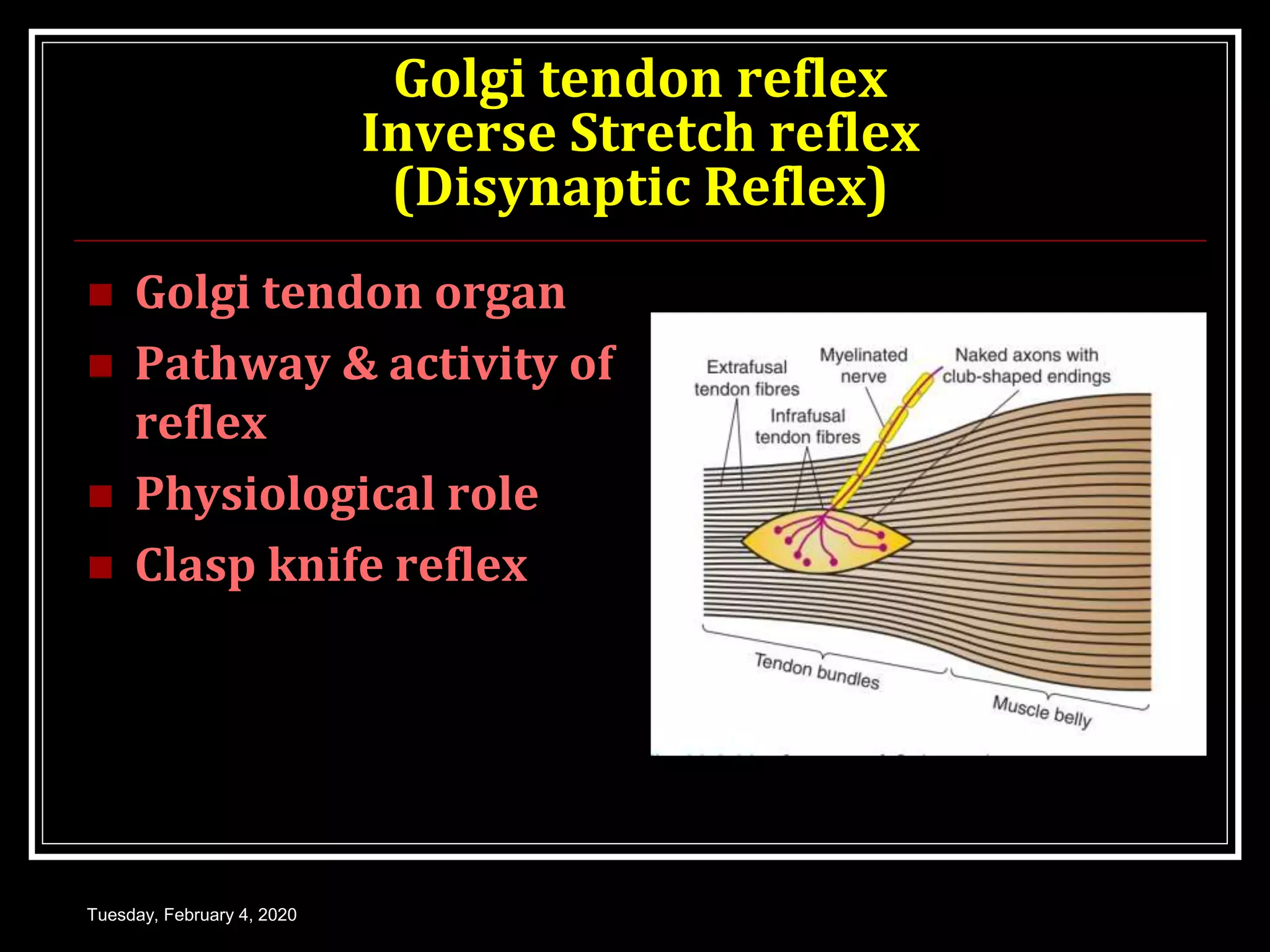
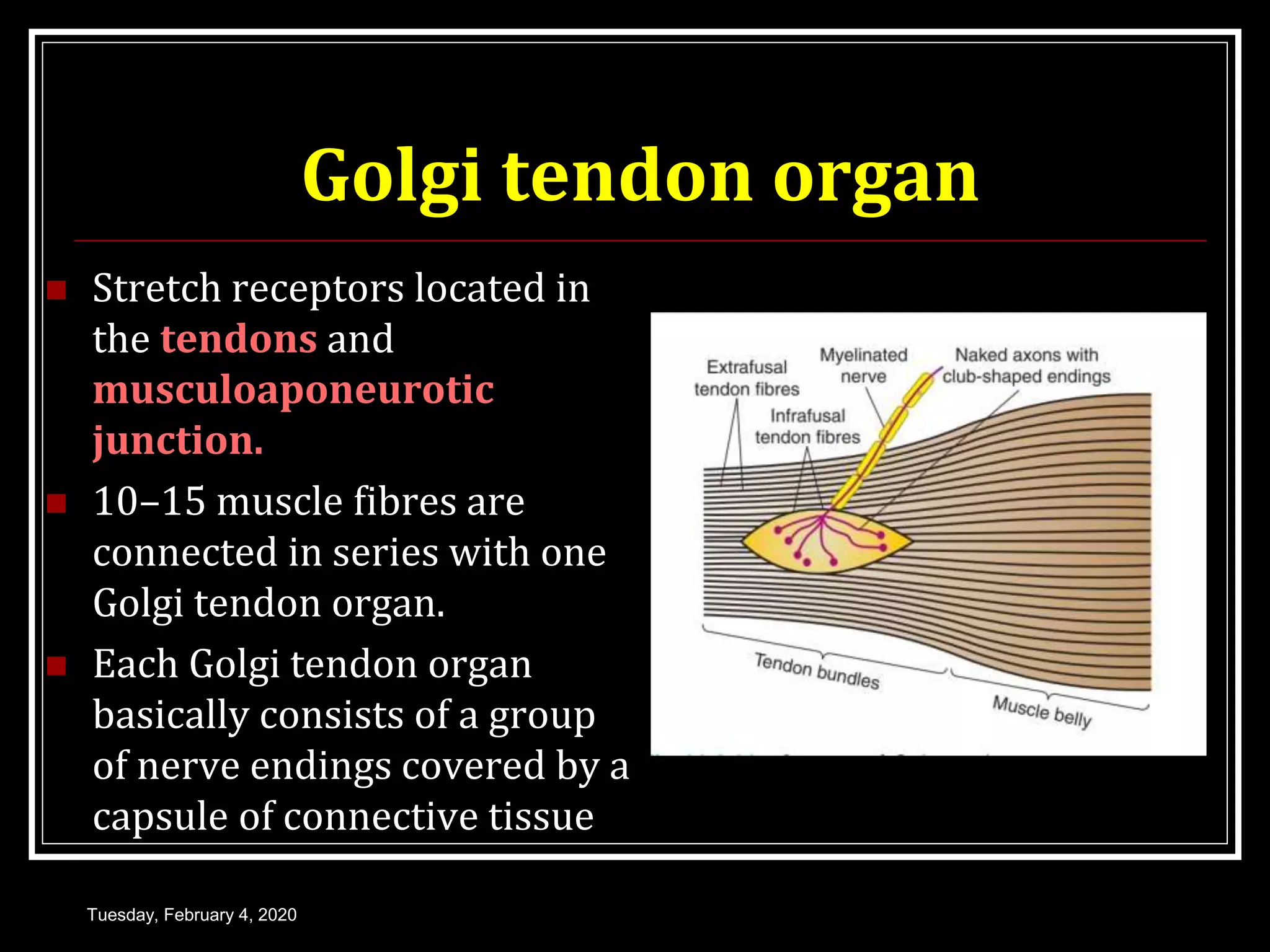
Golgi tendon organ
 Stretch receptors located in
the tendons and
musculoaponeurotic
junction.
 10–15 muscle fibres are
connected in series with one
Golgi tendon organ.
 Each Golgi tendon organ
basically consists of a group
of nerve endings covered by a
capsule of connective tissue
Tuesday, February 4, 2020
Golgi tendon organ
 Nerve supply
 Ib-type sensory nerve fibres.
 It ramifies into many
branches. Each branch ends
in the form of a knob.
 The Golgi tendon organs have
neither muscle fibres nor
an efferent innervation.
Tuesday, February 4, 2020
Pathway and activity of reflex
 When a muscle contracts, the muscle
tension increases. The Golgi tendon organ
detects the muscle tension.
 Sends impulses through afferent (group Ib)
fibres-- It stimulate the inhibitory
interneurons.
 Release inhibitory mediator GLYCINE,
Tuesday, February 4, 2020
 which inhibits α-motor neurons and cause
relaxation of the muscle that was originally
contracted.
 At the same time, due to reciprocal
innervation, the antagonistic muscles are
excited. The Golgi tendon reflex, thus,
displays reciprocal innervation but lacks
after discharge and irradiation.
Physiological role
 Protective function – from damaging
forceful contraction.
 Regulation of tension during normal muscle
activity - Autogenic inhibition, -- the force
generated when the muscle contracts is
the stimulus for its own relaxation.
Tuesday, February 4, 2020
Withdrawl reflex
(Polysynaptic reflex)
 Definition
 Flexor reflex, is a cutaneous
reflex which occurs in
response to nociceptive
(pain) stimuli and is
characterized by the removal
of a body part from painful
stimulus.
 Nociceptors located in
free nerve endings of Aδ and
C fibres.
Tuesday, February 4, 2020
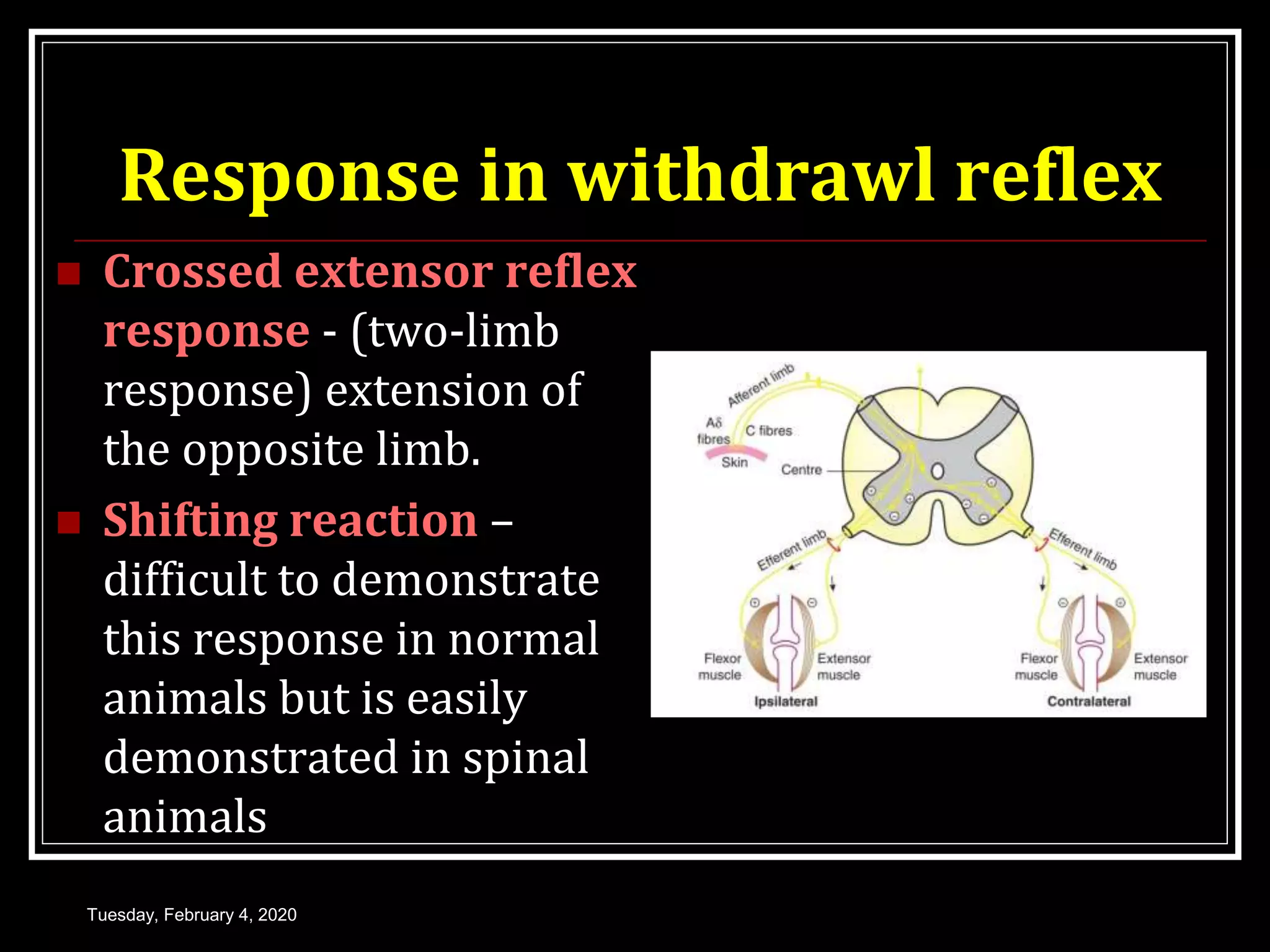
Pathway
 Receptor – afferent fibres
– enter spinal cord – end
on interneurons – some
forms reverberating
circuits (For After
discharge)
 Relay on αmn of ipsilateral
flexors & stimulate, & few
on αmn of ipsilateral
extensors & relax.
Tuesday, February 4, 2020
Response in withdrawl reflex
 Local sign – one limb response – removal of
one hand
 Flexor response - Response is in the form of
contraction of flexors and inhibition of
extensors leading to flexion of the stimulated
limb.
Tuesday, February 4, 2020
Response in withdrawl reflex
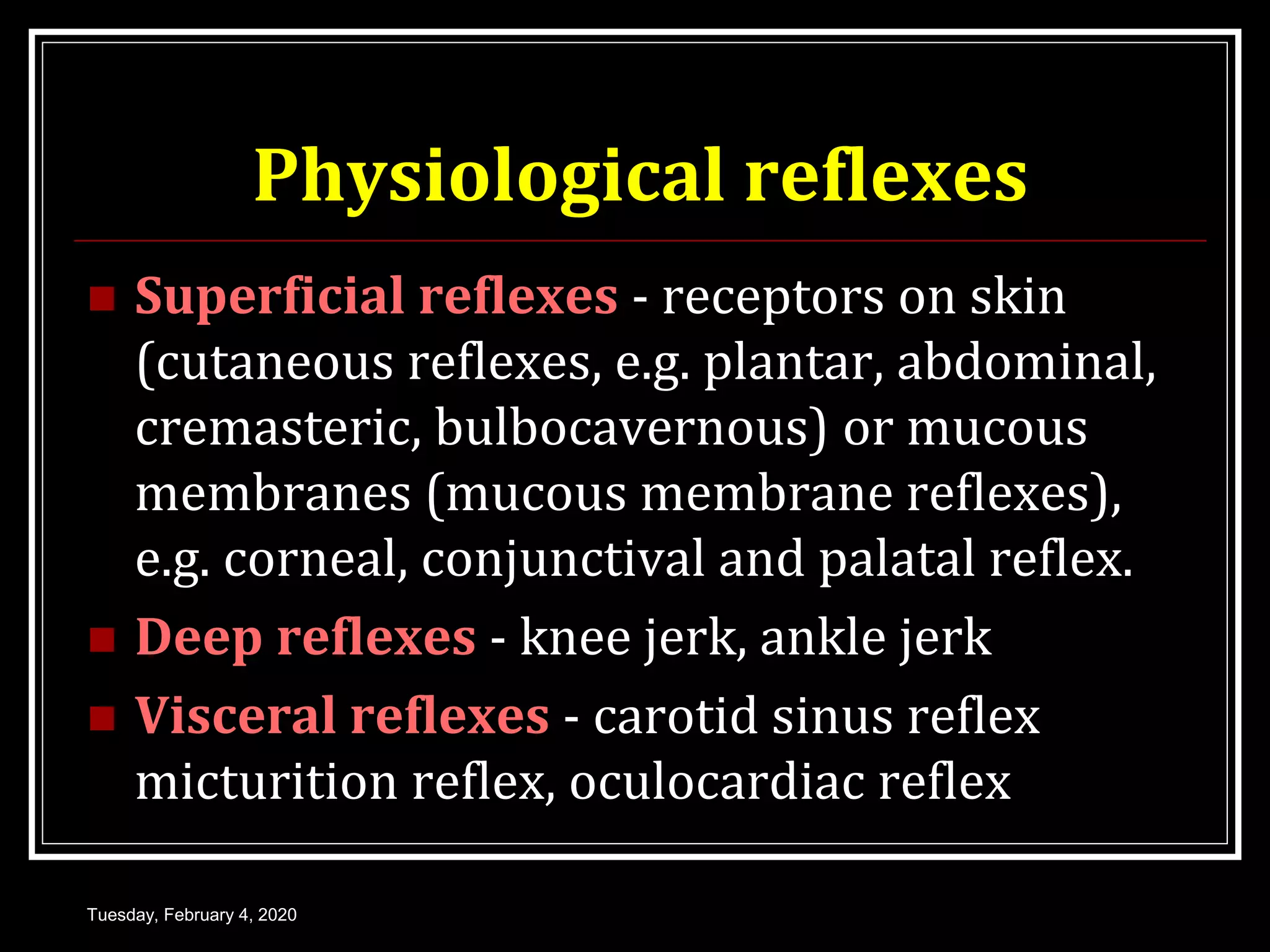
 Crossed extensor reflex
response - (two-limb
response) extension of
the opposite limb.
 Shifting reaction –
difficult to demonstrate
this response in normal
animals but is easily
demonstrated in spinal
animals
Tuesday, February 4, 2020
Response in withdrawl reflex
 Widespread withdrawl response. - when
the noxious stimulus is very strong.
Tuesday, February 4, 2020
Mechanism of varied grades of
withdrawl response
 Irradiation
 Recruitments of
motor units
Tuesday, February 4, 2020
Characteristics of withdrawl
reflex.
 Long latency
 Response outlasts stimulus
 Patterened response
 Summation
 Occlusion
 Subliminal fringe
 Recruitment
 Irradiation
 Reciprocal inhibition
Tuesday, February 4, 2020
Function of withdrawl reflex
 Protective reflex
 The flexor response takes the limb away from the source
of irritation.
 Withdrawal reflex is associated with a crossed extensor
reflex, which helps to support the body and is of
physiological significance in the context of regulation of
posture.
 Withdrawal reflex is prepotent, i.e. it pre-empts all other
reflex activities taking place at that time in the involved
spinal cord segment.
Tuesday, February 4, 2020
Clinical reflexes
 Physiological
reflexes
 Pathological
reflexes.
Tuesday, February 4, 2020
Physiological reflexes
 Superficial reflexes - receptors on skin
(cutaneous reflexes, e.g. plantar, abdominal,
cremasteric, bulbocavernous) or mucous
membranes (mucous membrane reflexes),
e.g. corneal, conjunctival and palatal reflex.
 Deep reflexes - knee jerk, ankle jerk
 Visceral reflexes - carotid sinus reflex
micturition reflex, oculocardiac reflex
Tuesday, February 4, 2020
Pathological reflexes.
 Babinski sign,
 Mass reflex,
 Clonus
 Pendular
movements.
Tuesday, February 4, 2020
THANK
YOU

Golgi tendon organ

  • 1.
    GOLGI TENDON ORGAN DR NILESHKATE MBBS,MD PROFESSOR ESIC MEDICAL COLLEGE, GULBARGA. DEPT. OF PHYSIOLOGY Tuesday, February 4, 2020
  • 2.
    Golgi tendon reflex InverseStretch reflex (Disynaptic Reflex)  Golgi tendon organ  Pathway & activity of reflex  Physiological role  Clasp knife reflex Tuesday, February 4, 2020
  • 3.
    Golgi tendon organ Stretch receptors located in the tendons and musculoaponeurotic junction.  10–15 muscle fibres are connected in series with one Golgi tendon organ.  Each Golgi tendon organ basically consists of a group of nerve endings covered by a capsule of connective tissue Tuesday, February 4, 2020
  • 4.
    Golgi tendon organ Nerve supply  Ib-type sensory nerve fibres.  It ramifies into many branches. Each branch ends in the form of a knob.  The Golgi tendon organs have neither muscle fibres nor an efferent innervation. Tuesday, February 4, 2020
  • 5.
    Pathway and activityof reflex  When a muscle contracts, the muscle tension increases. The Golgi tendon organ detects the muscle tension.  Sends impulses through afferent (group Ib) fibres-- It stimulate the inhibitory interneurons.  Release inhibitory mediator GLYCINE, Tuesday, February 4, 2020
  • 6.
    Tuesday, February 4,2020  which inhibits α-motor neurons and cause relaxation of the muscle that was originally contracted.  At the same time, due to reciprocal innervation, the antagonistic muscles are excited. The Golgi tendon reflex, thus, displays reciprocal innervation but lacks after discharge and irradiation.
  • 7.
    Physiological role  Protectivefunction – from damaging forceful contraction.  Regulation of tension during normal muscle activity - Autogenic inhibition, -- the force generated when the muscle contracts is the stimulus for its own relaxation. Tuesday, February 4, 2020
  • 8.
    Withdrawl reflex (Polysynaptic reflex) Definition  Flexor reflex, is a cutaneous reflex which occurs in response to nociceptive (pain) stimuli and is characterized by the removal of a body part from painful stimulus.  Nociceptors located in free nerve endings of Aδ and C fibres. Tuesday, February 4, 2020
  • 9.
    Pathway  Receptor –afferent fibres – enter spinal cord – end on interneurons – some forms reverberating circuits (For After discharge)  Relay on αmn of ipsilateral flexors & stimulate, & few on αmn of ipsilateral extensors & relax. Tuesday, February 4, 2020
  • 10.
    Response in withdrawlreflex  Local sign – one limb response – removal of one hand  Flexor response - Response is in the form of contraction of flexors and inhibition of extensors leading to flexion of the stimulated limb. Tuesday, February 4, 2020
  • 11.
    Response in withdrawlreflex  Crossed extensor reflex response - (two-limb response) extension of the opposite limb.  Shifting reaction – difficult to demonstrate this response in normal animals but is easily demonstrated in spinal animals Tuesday, February 4, 2020
  • 12.
    Response in withdrawlreflex  Widespread withdrawl response. - when the noxious stimulus is very strong. Tuesday, February 4, 2020
  • 13.
    Mechanism of variedgrades of withdrawl response  Irradiation  Recruitments of motor units Tuesday, February 4, 2020
  • 14.
    Characteristics of withdrawl reflex. Long latency  Response outlasts stimulus  Patterened response  Summation  Occlusion  Subliminal fringe  Recruitment  Irradiation  Reciprocal inhibition Tuesday, February 4, 2020
  • 15.
    Function of withdrawlreflex  Protective reflex  The flexor response takes the limb away from the source of irritation.  Withdrawal reflex is associated with a crossed extensor reflex, which helps to support the body and is of physiological significance in the context of regulation of posture.  Withdrawal reflex is prepotent, i.e. it pre-empts all other reflex activities taking place at that time in the involved spinal cord segment. Tuesday, February 4, 2020
  • 16.
    Clinical reflexes  Physiological reflexes Pathological reflexes. Tuesday, February 4, 2020
  • 17.
    Physiological reflexes  Superficialreflexes - receptors on skin (cutaneous reflexes, e.g. plantar, abdominal, cremasteric, bulbocavernous) or mucous membranes (mucous membrane reflexes), e.g. corneal, conjunctival and palatal reflex.  Deep reflexes - knee jerk, ankle jerk  Visceral reflexes - carotid sinus reflex micturition reflex, oculocardiac reflex Tuesday, February 4, 2020
  • 18.
    Pathological reflexes.  Babinskisign,  Mass reflex,  Clonus  Pendular movements. Tuesday, February 4, 2020
  • 19.