TUBULAR
REABSORPTION
DR.NILESH KATE.
M.D.
ASSOCIATE PROFESSOR,
DEPARTMENT OF
PHYSIOLOGY,
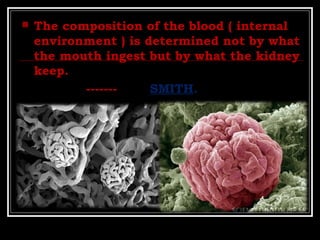
 The composition of the blood ( internal
environment ) is determined not by what
the mouth ingest but by what the kidney
keep.
------- SMITH.
OBJECTIVES
 General principles of renal tubular transport.
 Transport across different segments of renal tubule.
 Renal handling of common solutes & water.
 Renal threshold,
 Tubular maximum.
TUBULAR FUNCTION
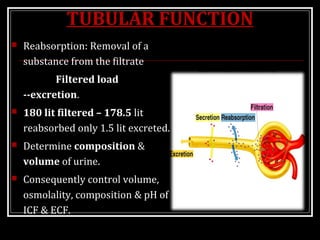
 Reabsorption: Removal of a
substance from the filtrate
Filtered load
--excretion.
 180 lit filtered – 178.5 lit
reabsorbed only 1.5 lit excreted.
 Determine composition &
volume of urine.
 Consequently control volume,
osmolality, composition & pH of
ICF & ECF.
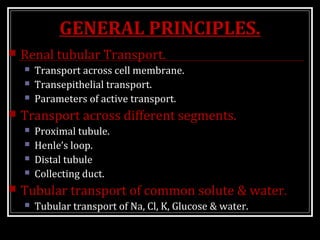
GENERAL PRINCIPLES.
 Renal tubular Transport.
 Transport across cell membrane.
 Transepithelial transport.
 Parameters of active transport.
 Transport across different segments.
 Proximal tubule.
 Henle’s loop.
 Distal tubule
 Collecting duct.
 Tubular transport of common solute & water.
 Tubular transport of Na, Cl, K, Glucose & water.
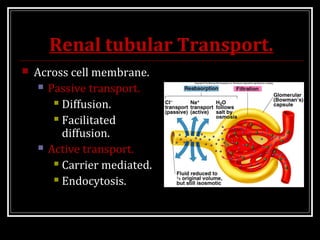
Renal tubular Transport.
 Across cell membrane.
 Passive transport.
 Diffusion.
 Facilitated
diffusion.
 Active transport.
 Carrier mediated.
 Endocytosis.
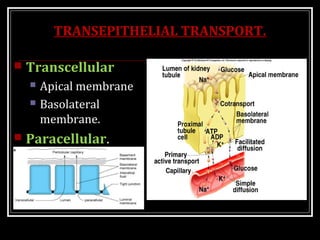
TRANSEPITHELIAL TRANSPORT.
 Transcellular
 Apical membrane
 Basolateral
membrane.
 Paracellular.
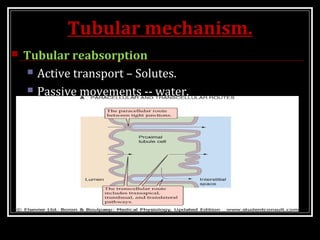
Tubular mechanism.
 Tubular reabsorption
 Active transport – Solutes.
 Passive movements -- water.
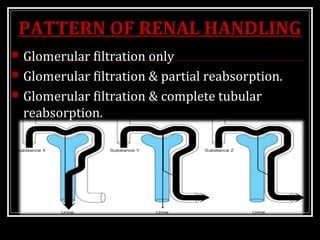
PATTERN OF RENAL HANDLING
 Glomerular filtration only
 Glomerular filtration & partial reabsorption.
 Glomerular filtration & complete tubular
reabsorption.
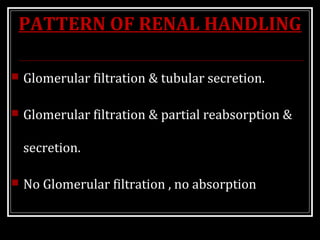
PATTERN OF RENAL HANDLING
 Glomerular filtration & tubular secretion.
 Glomerular filtration & partial reabsorption &
secretion.
 No Glomerular filtration , no absorption
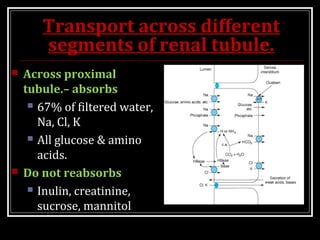
Transport across different
segments of renal tubule.
 Across proximal
tubule.– absorbs
 67% of filtered water,
Na, Cl, K
 All glucose & amino
acids.
 Do not reabsorbs
 Inulin, creatinine,
sucrose, mannitol
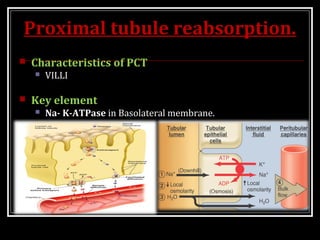
Proximal tubule reabsorption.
 Characteristics of PCT
 VILLI
 Key element
 Na- K-ATPase in Basolateral membrane.
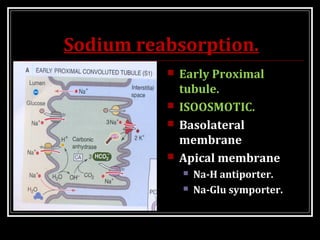
Sodium reabsorption.
 Early Proximal
tubule.
 ISOOSMOTIC.
 Basolateral
membrane
 Apical membrane
 Na-H antiporter.
 Na-Glu symporter.
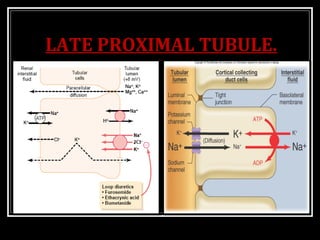
LATE PROXIMAL TUBULE.
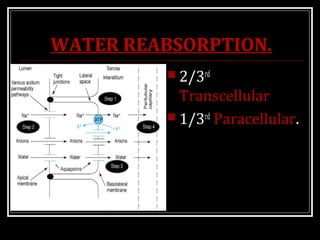
WATER REABSORPTION.
 2/3rd
Transcellular
 1/3rd
Paracellular.
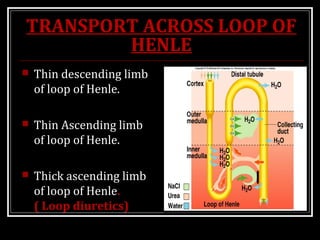
TRANSPORT ACROSS LOOP OF
HENLE
 Thin descending limb
of loop of Henle.
 Thin Ascending limb
of loop of Henle.
 Thick ascending limb
of loop of Henle.
( Loop diuretics)
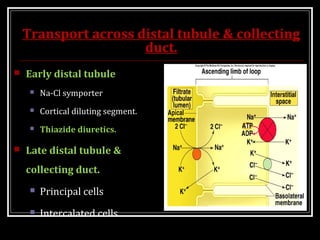
Transport across distal tubule & collecting
duct.
 Early distal tubule
 Na-Cl symporter
 Cortical diluting segment.
 Thiazide diuretics.
 Late distal tubule &
collecting duct.
 Principal cells
 Intercalated cells.
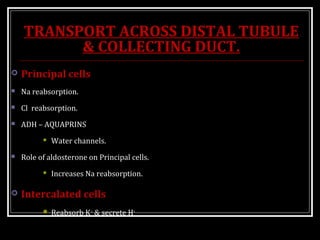
TRANSPORT ACROSS DISTAL TUBULE
& COLLECTING DUCT.
 Principal cells
 Na reabsorption.
 Cl reabsorption.
 ADH – AQUAPRINS
 Water channels.
 Role of aldosterone on Principal cells.
 Increases Na reabsorption.
 Intercalated cells
 Reabsorb K+
& secrete H+
RENAL HANDLING OF SODIUM
& WATER.
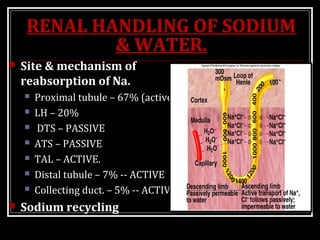
 Site & mechanism of
reabsorption of Na.
 Proximal tubule – 67% (active)
 LH – 20%
 DTS – PASSIVE
 ATS – PASSIVE
 TAL – ACTIVE.
 Distal tubule – 7% -- ACTIVE
 Collecting duct. – 5% -- ACTIVE
 Sodium recycling
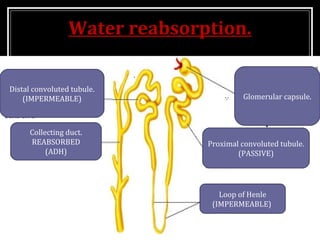
Water reabsorption.
11
Proximal convoluted tubule.
(PASSIVE)
Loop of Henle
(IMPERMEABLE)
Distal convoluted tubule.
(IMPERMEABLE)
Collecting duct.
REABSORBED
(ADH)
Glomerular capsule.
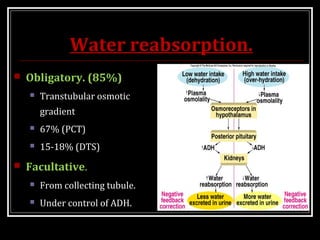
Water reabsorption.
 Obligatory. (85%)
 Transtubular osmotic
gradient
 67% (PCT)
 15-18% (DTS)
 Facultative.
 From collecting tubule.
 Under control of ADH.
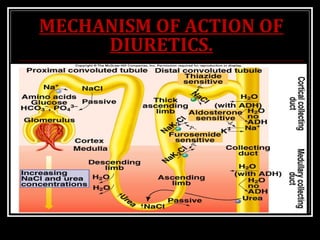
MECHANISM OF ACTION OF
DIURETICS.
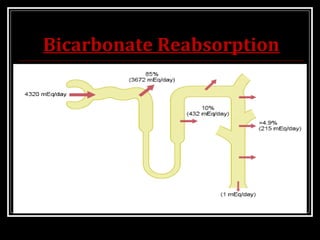
Bicarbonate Reabsorption
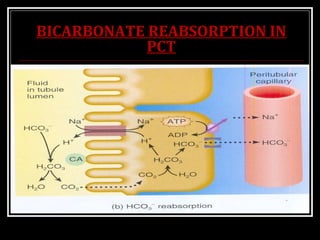
BICARBONATE REABSORPTION IN
PCT
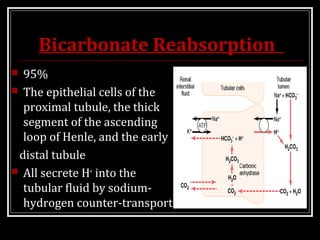
Bicarbonate Reabsorption
 95%
 The epithelial cells of the
proximal tubule, the thick
segment of the ascending
loop of Henle, and the early
distal tubule
 All secrete H+
into the
tubular fluid by sodium-
hydrogen counter-transport
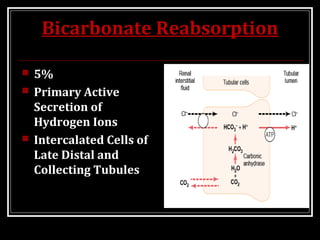
Bicarbonate Reabsorption
 5%
 Primary Active
Secretion of
Hydrogen Ions
 Intercalated Cells of
Late Distal and
Collecting Tubules
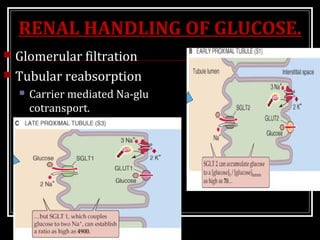
RENAL HANDLING OF GLUCOSE.
 Glomerular filtration
 Tubular reabsorption
 Carrier mediated Na-glu
cotransport.
 Facilitated diffusion.
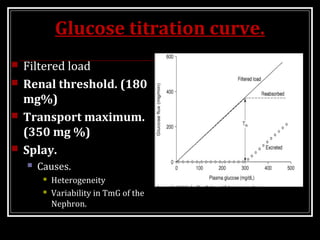
Glucose titration curve.
 Filtered load
 Renal threshold. (180
mg%)
 Transport maximum.
(350 mg %)
 Splay.
 Causes.
 Heterogeneity
 Variability in TmG of the
Nephron.
APPLIED
 Mechanism of actions of Diuretics.
 Renal handling of clearance.
 Importance of ADH.
 Basis of counter current mechanism.
 Glycosuria in Diabetes mellitus.
 Acidification of urine.
Thank
You

TUBULAR REABSORPTION

  • 1.
  • 2.
     The compositionof the blood ( internal environment ) is determined not by what the mouth ingest but by what the kidney keep. ------- SMITH.
  • 3.
    OBJECTIVES  General principlesof renal tubular transport.  Transport across different segments of renal tubule.  Renal handling of common solutes & water.  Renal threshold,  Tubular maximum.
  • 4.
    TUBULAR FUNCTION  Reabsorption:Removal of a substance from the filtrate Filtered load --excretion.  180 lit filtered – 178.5 lit reabsorbed only 1.5 lit excreted.  Determine composition & volume of urine.  Consequently control volume, osmolality, composition & pH of ICF & ECF.
  • 5.
    GENERAL PRINCIPLES.  Renaltubular Transport.  Transport across cell membrane.  Transepithelial transport.  Parameters of active transport.  Transport across different segments.  Proximal tubule.  Henle’s loop.  Distal tubule  Collecting duct.  Tubular transport of common solute & water.  Tubular transport of Na, Cl, K, Glucose & water.
  • 6.
    Renal tubular Transport. Across cell membrane.  Passive transport.  Diffusion.  Facilitated diffusion.  Active transport.  Carrier mediated.  Endocytosis.
  • 7.
    TRANSEPITHELIAL TRANSPORT.  Transcellular Apical membrane  Basolateral membrane.  Paracellular.
  • 8.
    Tubular mechanism.  Tubularreabsorption  Active transport – Solutes.  Passive movements -- water.
  • 9.
    PATTERN OF RENALHANDLING  Glomerular filtration only  Glomerular filtration & partial reabsorption.  Glomerular filtration & complete tubular reabsorption.
  • 10.
    PATTERN OF RENALHANDLING  Glomerular filtration & tubular secretion.  Glomerular filtration & partial reabsorption & secretion.  No Glomerular filtration , no absorption
  • 11.
    Transport across different segmentsof renal tubule.  Across proximal tubule.– absorbs  67% of filtered water, Na, Cl, K  All glucose & amino acids.  Do not reabsorbs  Inulin, creatinine, sucrose, mannitol
  • 12.
    Proximal tubule reabsorption. Characteristics of PCT  VILLI  Key element  Na- K-ATPase in Basolateral membrane.
  • 13.
    Sodium reabsorption.  EarlyProximal tubule.  ISOOSMOTIC.  Basolateral membrane  Apical membrane  Na-H antiporter.  Na-Glu symporter.
  • 14.
  • 15.
  • 16.
    TRANSPORT ACROSS LOOPOF HENLE  Thin descending limb of loop of Henle.  Thin Ascending limb of loop of Henle.  Thick ascending limb of loop of Henle. ( Loop diuretics)
  • 17.
    Transport across distaltubule & collecting duct.  Early distal tubule  Na-Cl symporter  Cortical diluting segment.  Thiazide diuretics.  Late distal tubule & collecting duct.  Principal cells  Intercalated cells.
  • 18.
    TRANSPORT ACROSS DISTALTUBULE & COLLECTING DUCT.  Principal cells  Na reabsorption.  Cl reabsorption.  ADH – AQUAPRINS  Water channels.  Role of aldosterone on Principal cells.  Increases Na reabsorption.  Intercalated cells  Reabsorb K+ & secrete H+
  • 19.
    RENAL HANDLING OFSODIUM & WATER.  Site & mechanism of reabsorption of Na.  Proximal tubule – 67% (active)  LH – 20%  DTS – PASSIVE  ATS – PASSIVE  TAL – ACTIVE.  Distal tubule – 7% -- ACTIVE  Collecting duct. – 5% -- ACTIVE  Sodium recycling
  • 20.
    Water reabsorption. 11 Proximal convolutedtubule. (PASSIVE) Loop of Henle (IMPERMEABLE) Distal convoluted tubule. (IMPERMEABLE) Collecting duct. REABSORBED (ADH) Glomerular capsule.
  • 21.
    Water reabsorption.  Obligatory.(85%)  Transtubular osmotic gradient  67% (PCT)  15-18% (DTS)  Facultative.  From collecting tubule.  Under control of ADH.
  • 22.
    MECHANISM OF ACTIONOF DIURETICS.
  • 23.
  • 24.
  • 25.
    Bicarbonate Reabsorption  95% The epithelial cells of the proximal tubule, the thick segment of the ascending loop of Henle, and the early distal tubule  All secrete H+ into the tubular fluid by sodium- hydrogen counter-transport
  • 26.
    Bicarbonate Reabsorption  5% Primary Active Secretion of Hydrogen Ions  Intercalated Cells of Late Distal and Collecting Tubules
  • 27.
    RENAL HANDLING OFGLUCOSE.  Glomerular filtration  Tubular reabsorption  Carrier mediated Na-glu cotransport.  Facilitated diffusion.
  • 28.
    Glucose titration curve. Filtered load  Renal threshold. (180 mg%)  Transport maximum. (350 mg %)  Splay.  Causes.  Heterogeneity  Variability in TmG of the Nephron.
  • 29.
    APPLIED  Mechanism ofactions of Diuretics.  Renal handling of clearance.  Importance of ADH.  Basis of counter current mechanism.  Glycosuria in Diabetes mellitus.  Acidification of urine.
  • 30.