DR NILESH KATE
MBBS,MD
PROFESSOR
ESIC MEDICAL COLLEGE, GULBARGA.
DEPT. OF PHYSIOLOGY
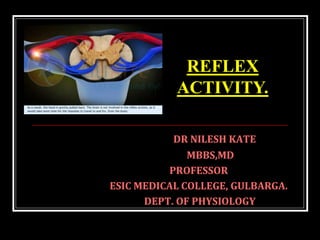
REFLEX
ACTIVITY.
OBJECTIVES.
 Skeletal muscle :- the effector organ
 Motor unit
 Muscle sensors
 Muscle tone
 Reflex activity
 General considerations
 Spinal cord reflexes
 Clinical reflexes
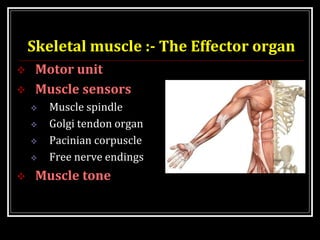
Skeletal muscle :- The Effector organ
 Motor unit
 Muscle sensors
 Muscle spindle
 Golgi tendon organ
 Pacinian corpuscle
 Free nerve endings
 Muscle tone
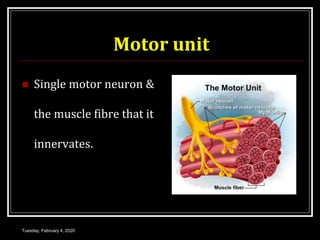
Motor unit
 Single motor neuron &
the muscle fibre that it
innervates.
Tuesday, February 4, 2020
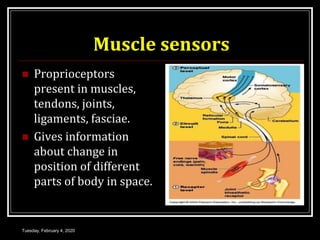
Muscle sensors
 Proprioceptors
present in muscles,
tendons, joints,
ligaments, fasciae.
 Gives information
about change in
position of different
parts of body in space.
Tuesday, February 4, 2020
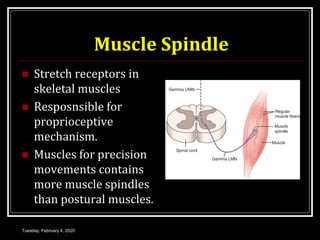
Muscle Spindle
 Stretch receptors in
skeletal muscles
 Resposnsible for
proprioceptive
mechanism.
 Muscles for precision
movements contains
more muscle spindles
than postural muscles.
Tuesday, February 4, 2020
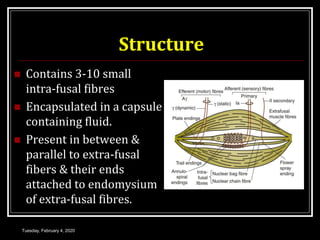
Structure
 Contains 3-10 small
intra-fusal fibres
 Encapsulated in a capsule
containing fluid.
 Present in between &
parallel to extra-fusal
fibers & their ends
attached to endomysium
of extra-fusal fibres.
Tuesday, February 4, 2020
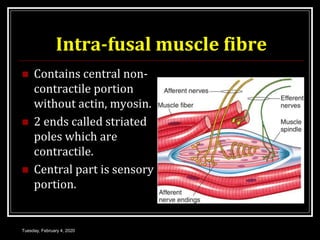
Intra-fusal muscle fibre
 Contains central non-
contractile portion
without actin, myosin.
 2 ends called striated
poles which are
contractile.
 Central part is sensory
portion.
Tuesday, February 4, 2020
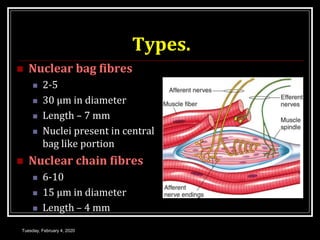
Types.
 Nuclear bag fibres
 2-5
 30 µm in diameter
 Length – 7 mm
 Nuclei present in central
bag like portion
 Nuclear chain fibres
 6-10
 15 µm in diameter
 Length – 4 mm
Tuesday, February 4, 2020
Nerve supply of muscle
spindle
Only receptor in body which has
got motor nerve supply.
Tuesday, February 4, 2020
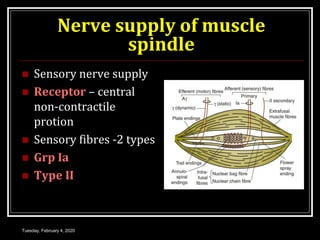
Nerve supply of muscle
spindle
 Sensory nerve supply
 Receptor – central
non-contractile
protion
 Sensory fibres -2 types
 Grp Ia
 Type II
Tuesday, February 4, 2020
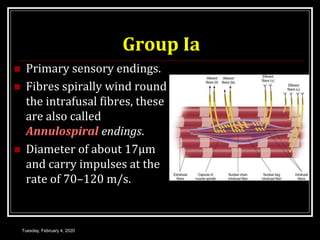
Group Ia
 Primary sensory endings.
 Fibres spirally wind round
the intrafusal fibres, these
are also called
Annulospiral endings.
 Diameter of about 17μm
and carry impulses at the
rate of 70–120 m/s.
Tuesday, February 4, 2020
Group Ia
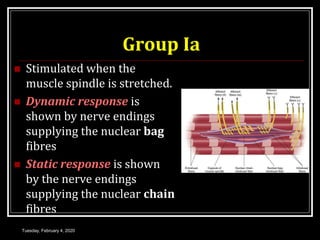
 Stimulated when the
muscle spindle is stretched.
 Dynamic response is
shown by nerve endings
supplying the nuclear bag
fibres
 Static response is shown
by the nerve endings
supplying the nuclear chain
fibres
Tuesday, February 4, 2020
Type II
Flower spray endings.
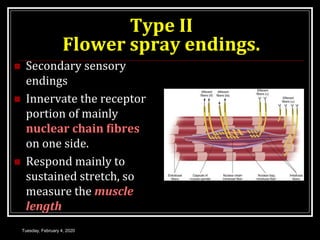
 Secondary sensory
endings
 Innervate the receptor
portion of mainly
nuclear chain fibres
on one side.
 Respond mainly to
sustained stretch, so
measure the muscle
length
Tuesday, February 4, 2020
Motor supply γ-fibres
two types
 Dynamic γ-fibres primarily innervate the
striated poles of nuclear bag fibres, where
they end as motor end plate, hence also
called plate endings.
 These fibres increase the sensitivity of the Ia
afferent fibres to stretch.
Tuesday, February 4, 2020
Static γ-fibres
 Primarily innervate the striated poles
of Nuclear chain fibres where they end as a
network of branches called trail endings.
 They increase the tonic activity in the Ia
afferent fibres at any given muscle
length
Tuesday, February 4, 2020
Functions of muscle spindle
 Role in stretch reflex
 Role in maintaining
muscle tone
 Role in maintaining
skeletal muscle at a
certain physiological
length.
 Role as a
proprioceptor
 Unconscious
proprioceptive
sensations and
 Conscious kinaesthetic
sensations
Tuesday, February 4, 2020
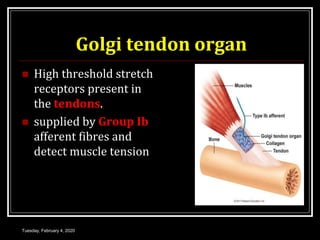
Golgi tendon organ
 High threshold stretch
receptors present in
the tendons.
 supplied by Group Ib
afferent fibres and
detect muscle tension
Tuesday, February 4, 2020
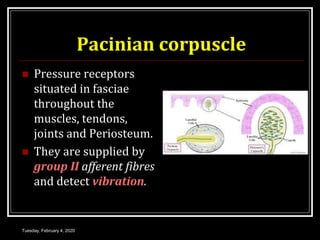
Pacinian corpuscle
 Pressure receptors
situated in fasciae
throughout the
muscles, tendons,
joints and Periosteum.
 They are supplied by
group II afferent fibres
and detect vibration.
Tuesday, February 4, 2020
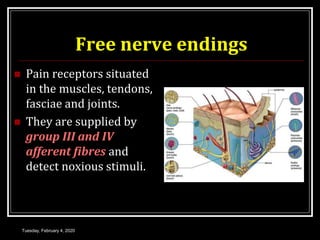
Free nerve endings
 Pain receptors situated
in the muscles, tendons,
fasciae and joints.
 They are supplied by
group III and IV
afferent fibres and
detect noxious stimuli.
Tuesday, February 4, 2020
Muscle tone
 Definition
 Basis of muscle tone
 Anomalies of muscle
tone
 Hypotonia
 hypertonia
Tuesday, February 4, 2020
Definition
 Muscle tone is defined
as a resistance offered
to active or passive
stretch.
OR
 sustained partial state
of contraction of the
muscle under resting
condition,
Tuesday, February 4, 2020
Basis of muscle tone
 Purely a function of myotactic (stretch reflex),
occurring due to low frequency and
asynchronous discharge of γ motor neurons.
Tuesday, February 4, 2020
Anomalies of muscle tone
 Hypotonia
 Hypertonia.
Tuesday, February 4, 2020
Hypotonia
 muscle tone
 The hypotonic, flaccid
muscle.
 when the rate of γ
efferent discharge is
low, i.e. when
stretch reflex becomes
hypoactive.
Tuesday, February 4, 2020
Hypertonia
 muscle tone
 The hypertonic,
spastic muscle.
 when the rate of γ
efferent discharge is
high, i.e. when
stretch reflex becomes

hyperactive.
Tuesday, February 4, 2020
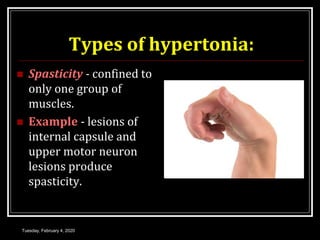
Types of hypertonia:
 Spasticity - confined to
only one group of
muscles.
 Example - lesions of
internal capsule and
upper motor neuron
lesions produce
spasticity.
Tuesday, February 4, 2020
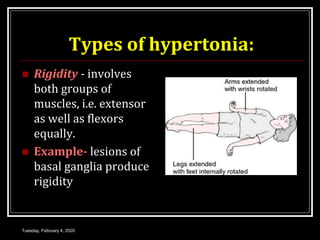
Types of hypertonia:
 Rigidity - involves
both groups of
muscles, i.e. extensor
as well as flexors
equally.
 Example- lesions of
basal ganglia produce
rigidity
Tuesday, February 4, 2020
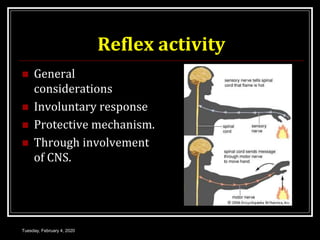
Reflex activity
 General
considerations
 Involuntary response
 Protective mechanism.
 Through involvement
of CNS.
Tuesday, February 4, 2020
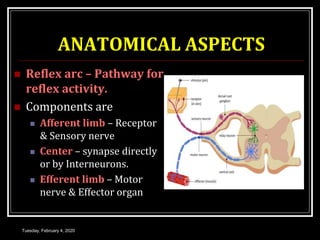
ANATOMICAL ASPECTS
 Reflex arc – Pathway for
reflex activity.
 Components are
 Afferent limb – Receptor
& Sensory nerve
 Center – synapse directly
or by Interneurons.
 Efferent limb – Motor
nerve & Effector organ
Tuesday, February 4, 2020
Classification of reflexes
 Depending on number of synapse
 Anatomical classification
 Physiolgical classification
 Inborn vs acquired
 Clinical classification
Tuesday, February 4, 2020
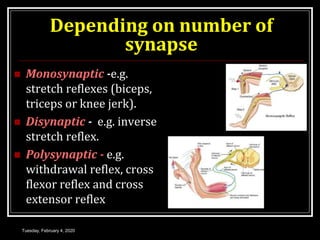
 Monosynaptic -e.g.
stretch reflexes (biceps,
triceps or knee jerk).
 Disynaptic - e.g. inverse
stretch reflex.
 Polysynaptic - e.g.
withdrawal reflex, cross
flexor reflex and cross
extensor reflex
Tuesday, February 4, 2020
Depending on number of
synapse
Anatomical classification
 Depending upon the location of reflex arc
centre
 Cortical reflexes
 Cerebellar reflexes have the centre of reflex arc in
cerebellum
 Mid brain reflexes
 Bulbar or medullary reflexes and
 Spinal reflexes
Tuesday, February 4, 2020
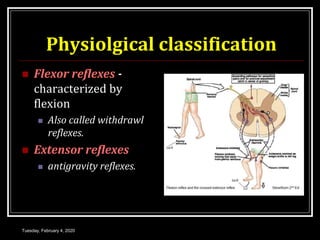
Physiolgical classification
 Flexor reflexes -
characterized by
flexion
 Also called withdrawl
reflexes.
 Extensor reflexes
 antigravity reflexes.
Tuesday, February 4, 2020
Inborn vs acquired
 Inborn or unconditional reflexes –
 Reflex salivation when any object is kept in mouth.
 Acquired or conditional reflexes
 Reflex salivation by the sight,
smell, thought or hearing of a known edible
substance.
Tuesday, February 4, 2020
Clinical classification
 Superficial
 Deep,
 Visceral and
 Pathological reflexes
Tuesday, February 4, 2020
Animal preparation for study
of reflexes
 Spinal preparation – reflexes are studies by
transecting spinal cord at different levels
 Decerebrate preparation - transection is
taken in the brain stem between superior
and inferior colliculi
Tuesday, February 4, 2020

Muscle spindle and reflex activity

  • 1.
    DR NILESH KATE MBBS,MD PROFESSOR ESICMEDICAL COLLEGE, GULBARGA. DEPT. OF PHYSIOLOGY REFLEX ACTIVITY.
  • 2.
    OBJECTIVES.  Skeletal muscle:- the effector organ  Motor unit  Muscle sensors  Muscle tone  Reflex activity  General considerations  Spinal cord reflexes  Clinical reflexes
  • 3.
    Skeletal muscle :-The Effector organ  Motor unit  Muscle sensors  Muscle spindle  Golgi tendon organ  Pacinian corpuscle  Free nerve endings  Muscle tone
  • 4.
    Motor unit  Singlemotor neuron & the muscle fibre that it innervates. Tuesday, February 4, 2020
  • 5.
    Muscle sensors  Proprioceptors presentin muscles, tendons, joints, ligaments, fasciae.  Gives information about change in position of different parts of body in space. Tuesday, February 4, 2020
  • 6.
    Muscle Spindle  Stretchreceptors in skeletal muscles  Resposnsible for proprioceptive mechanism.  Muscles for precision movements contains more muscle spindles than postural muscles. Tuesday, February 4, 2020
  • 7.
    Structure  Contains 3-10small intra-fusal fibres  Encapsulated in a capsule containing fluid.  Present in between & parallel to extra-fusal fibers & their ends attached to endomysium of extra-fusal fibres. Tuesday, February 4, 2020
  • 8.
    Intra-fusal muscle fibre Contains central non- contractile portion without actin, myosin.  2 ends called striated poles which are contractile.  Central part is sensory portion. Tuesday, February 4, 2020
  • 9.
    Types.  Nuclear bagfibres  2-5  30 µm in diameter  Length – 7 mm  Nuclei present in central bag like portion  Nuclear chain fibres  6-10  15 µm in diameter  Length – 4 mm Tuesday, February 4, 2020
  • 10.
    Nerve supply ofmuscle spindle Only receptor in body which has got motor nerve supply. Tuesday, February 4, 2020
  • 11.
    Nerve supply ofmuscle spindle  Sensory nerve supply  Receptor – central non-contractile protion  Sensory fibres -2 types  Grp Ia  Type II Tuesday, February 4, 2020
  • 12.
    Group Ia  Primarysensory endings.  Fibres spirally wind round the intrafusal fibres, these are also called Annulospiral endings.  Diameter of about 17μm and carry impulses at the rate of 70–120 m/s. Tuesday, February 4, 2020
  • 13.
    Group Ia  Stimulatedwhen the muscle spindle is stretched.  Dynamic response is shown by nerve endings supplying the nuclear bag fibres  Static response is shown by the nerve endings supplying the nuclear chain fibres Tuesday, February 4, 2020
  • 14.
    Type II Flower sprayendings.  Secondary sensory endings  Innervate the receptor portion of mainly nuclear chain fibres on one side.  Respond mainly to sustained stretch, so measure the muscle length Tuesday, February 4, 2020
  • 15.
    Motor supply γ-fibres twotypes  Dynamic γ-fibres primarily innervate the striated poles of nuclear bag fibres, where they end as motor end plate, hence also called plate endings.  These fibres increase the sensitivity of the Ia afferent fibres to stretch. Tuesday, February 4, 2020
  • 16.
    Static γ-fibres  Primarilyinnervate the striated poles of Nuclear chain fibres where they end as a network of branches called trail endings.  They increase the tonic activity in the Ia afferent fibres at any given muscle length Tuesday, February 4, 2020
  • 17.
    Functions of musclespindle  Role in stretch reflex  Role in maintaining muscle tone  Role in maintaining skeletal muscle at a certain physiological length.  Role as a proprioceptor  Unconscious proprioceptive sensations and  Conscious kinaesthetic sensations Tuesday, February 4, 2020
  • 18.
    Golgi tendon organ High threshold stretch receptors present in the tendons.  supplied by Group Ib afferent fibres and detect muscle tension Tuesday, February 4, 2020
  • 19.
    Pacinian corpuscle  Pressurereceptors situated in fasciae throughout the muscles, tendons, joints and Periosteum.  They are supplied by group II afferent fibres and detect vibration. Tuesday, February 4, 2020
  • 20.
    Free nerve endings Pain receptors situated in the muscles, tendons, fasciae and joints.  They are supplied by group III and IV afferent fibres and detect noxious stimuli. Tuesday, February 4, 2020
  • 21.
    Muscle tone  Definition Basis of muscle tone  Anomalies of muscle tone  Hypotonia  hypertonia Tuesday, February 4, 2020
  • 22.
    Definition  Muscle toneis defined as a resistance offered to active or passive stretch. OR  sustained partial state of contraction of the muscle under resting condition, Tuesday, February 4, 2020
  • 23.
    Basis of muscletone  Purely a function of myotactic (stretch reflex), occurring due to low frequency and asynchronous discharge of γ motor neurons. Tuesday, February 4, 2020
  • 24.
    Anomalies of muscletone  Hypotonia  Hypertonia. Tuesday, February 4, 2020
  • 25.
    Hypotonia  muscle tone The hypotonic, flaccid muscle.  when the rate of γ efferent discharge is low, i.e. when stretch reflex becomes hypoactive. Tuesday, February 4, 2020
  • 26.
    Hypertonia  muscle tone The hypertonic, spastic muscle.  when the rate of γ efferent discharge is high, i.e. when stretch reflex becomes hyperactive. Tuesday, February 4, 2020
  • 27.
    Types of hypertonia: Spasticity - confined to only one group of muscles.  Example - lesions of internal capsule and upper motor neuron lesions produce spasticity. Tuesday, February 4, 2020
  • 28.
    Types of hypertonia: Rigidity - involves both groups of muscles, i.e. extensor as well as flexors equally.  Example- lesions of basal ganglia produce rigidity Tuesday, February 4, 2020
  • 29.
    Reflex activity  General considerations Involuntary response  Protective mechanism.  Through involvement of CNS. Tuesday, February 4, 2020
  • 30.
    ANATOMICAL ASPECTS  Reflexarc – Pathway for reflex activity.  Components are  Afferent limb – Receptor & Sensory nerve  Center – synapse directly or by Interneurons.  Efferent limb – Motor nerve & Effector organ Tuesday, February 4, 2020
  • 31.
    Classification of reflexes Depending on number of synapse  Anatomical classification  Physiolgical classification  Inborn vs acquired  Clinical classification Tuesday, February 4, 2020
  • 32.
     Monosynaptic -e.g. stretchreflexes (biceps, triceps or knee jerk).  Disynaptic - e.g. inverse stretch reflex.  Polysynaptic - e.g. withdrawal reflex, cross flexor reflex and cross extensor reflex Tuesday, February 4, 2020 Depending on number of synapse
  • 33.
    Anatomical classification  Dependingupon the location of reflex arc centre  Cortical reflexes  Cerebellar reflexes have the centre of reflex arc in cerebellum  Mid brain reflexes  Bulbar or medullary reflexes and  Spinal reflexes Tuesday, February 4, 2020
  • 34.
    Physiolgical classification  Flexorreflexes - characterized by flexion  Also called withdrawl reflexes.  Extensor reflexes  antigravity reflexes. Tuesday, February 4, 2020
  • 35.
    Inborn vs acquired Inborn or unconditional reflexes –  Reflex salivation when any object is kept in mouth.  Acquired or conditional reflexes  Reflex salivation by the sight, smell, thought or hearing of a known edible substance. Tuesday, February 4, 2020
  • 36.
    Clinical classification  Superficial Deep,  Visceral and  Pathological reflexes Tuesday, February 4, 2020
  • 37.
    Animal preparation forstudy of reflexes  Spinal preparation – reflexes are studies by transecting spinal cord at different levels  Decerebrate preparation - transection is taken in the brain stem between superior and inferior colliculi Tuesday, February 4, 2020
  • 38.