Motor cortex
           and
   Descending pathways
D.A. Asir John Samuel, BSc (Psy), MPT (Neuro Paed),
             MAc, DYScEd, C/BLS, FAGE
      Lecturer, Alva’s college of Physiotherapy,
                      Moodbidri
Lobes of cerebral cortex

• Frontal lobe – in front of central sulcus or
  fissure of Roland

• Parietal lobe – central sulcus/parieto-occipital
  sulcus

• Occipital lobe – behind parieto-occipital cortex

• Temporal lobe – below lateral or sylvian fissure
Lobes of cerebral cortex

• Frontal lobe – in front of central sulcus or
  fissure of Roland

• Parietal lobe – central sulcus/parieto-occipital
  sulcus

• Occipital lobe – behind parieto-occipital cortex

• Temporal lobe – below lateral or sylvian fissure
Frontal lobe
• Broadmann’s Area 4 – precentral gyrus and is
  Primary motor Area

• Supplementary motor Area – ant. to Areas 4 & 6

• Premotor Area (Area 6) – ant. to Area 4

• Broca’s Area (Area 44) – motor area for speech,
  in post. part of frontal operculum in domi. H

• Frontal eye field (Area 8)
Broadmann’s Area 4
• Primary motor area

• Occupies posterior part of precentral gyrus
  and ant.lip and walls of central sulcus

• Highest centre for voluntary movements

• Gives origin to fibres of pyramidal tract and
  other descending tract

• Interconnected to Area 6 and sensory area
Broadmann’s Area representation
• Size of cortical area is proportional to
  functional importance and activity of region

• Order of representation from medial to lateral
  surface is toes, ankle, knee, hip, trunk,
  shoulder, arm, elbow, wrist, hand, fingers,
  thumb, eyes, face, jaw and tongue

• Motor homonuclus
Supplementary motor area

• Medial surface of hemisphere in front of area
  4 and 6, in medial frontal gyrus

• Representation is head to foot anteroposterly

• Provides   background     for      fine   complex
  movements from motor cortex
Area 6. Premotor area
• Anterior to area 4 and in medial aspect of H

• Planning and rehearsal takes place before
  execution

• Gives fibres to pyramidal tract and basal
  ganglia concerned with postural control

• Postural background for complex coordinated
  movements
Frontal eye field (Area 8)

• Middle frontal gyrus

• Receives association fibres from occipital
  cortex (Areas 18, 19)

• Projects of oculomotor nuclei

• Moving head and eyes towards the objects to
  be seen
Layers of cerebral cortex

1. Molecular layer (Plexiform layer)

2. External granular layer

3. External pyramidal layer

4. Internal granular layer

5. Ganglionic layer (Internal pyramidal layer)

6. Multiform layer (layer of polymorphic cells)
Descending pathways
• Corticospinal (Pyramidal) and corticobulbar
  tracts

• Vestibulospinal

• Reticulospinal

• Tectospinal

• Rubrospinal

• Olivospinal
Corticospinal tract

• Arise from axons of pyramidal cells situated in
  5th layer of cerebral cortex

• Primary motor area – 30%

• Premotor area – 30%

• Postcentral gyrus (Parietal lobe) – 40%
Corticospinal tract
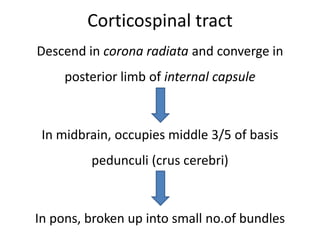
Descend in corona radiata and converge in
     posterior limb of internal capsule


 In midbrain, occupies middle 3/5 of basis
         pedunculi (crus cerebri)


In pons, broken up into small no.of bundles
Corticospinal tract

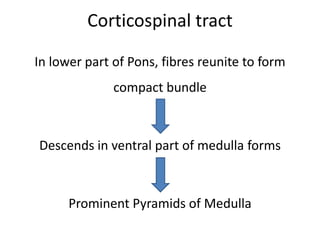
In lower part of Pons, fibres reunite to form
              compact bundle


Descends in ventral part of medulla forms


      Prominent Pyramids of Medulla
Corticospinal tract
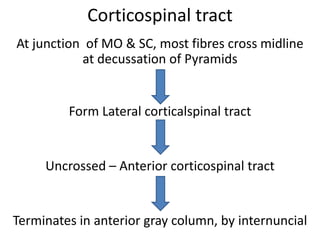
At junction of MO & SC, most fibres cross midline
           at decussation of Pyramids


         Form Lateral corticalspinal tract


     Uncrossed – Anterior corticospinal tract


Terminates in anterior gray column, by internuncial
Corticospinal tract

• Speed and agility to voluntary movements

• Rapid skilled movements

• Upper motor neuron lesion

• Spasticty
Vestibulospinal tract

• Vestibular nuclei are situated in pons and MO
  beneath floor of 4th ventricle`
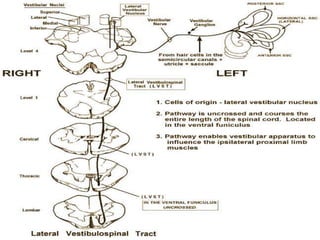
• Neurons of lateral vestibular nucleus give rise
  to axons that form VST
• Tract descends uncrossed though medulla and
  through length of SC in ant.white column
Vestibulospinal tract

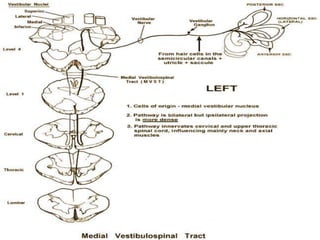
1. Ventral or anterior VST

2. Lateral VST

• Regulate muscle tone and equilibrium

• Facilitates activity of extensor muscles and
  inhibit activity of flexor muscles
Reticulospinal tract

• Throughout midbrain, pons and MO, groups of
  scattered nerve cells and nerve fibers exist
  that are collectively known as reticular
  formation

1. Pontine reticulospinal tract

2. Medullary reticulospinal tract
Reticulospinal tract

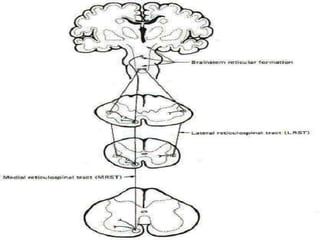
• From pons, neurons send axons, which are
 mostly uncrossed, down into SC and form
 pontine reticulospinal tract (medial RST)
• From medulla, which are crossed and
 uncrossed,    to   SC   and    form   medullary
 reticulospinal tract (lateral RST)
Reticulospinal tract

• Reticulospinal fibres from pons descend
 through ant.white column
• While from MO descend in lateral white
 column
• Both sets enter AGC and may facilitate or
 inhibit activity of α and β
Reticulospinal tract

• Influence voluntary movements and reflex
 activity

• Provide a pathway by which hypothalamus
 can control sympathetic outflow and sacral
 parasympathetic outflow
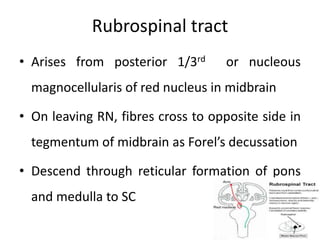
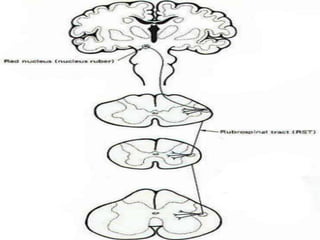
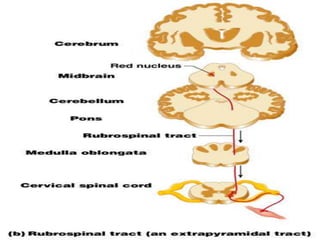
Rubrospinal tract
• Arises from posterior 1/3rd       or nucleous
  magnocellularis of red nucleus in midbrain

• On leaving RN, fibres cross to opposite side in
  tegmentum of midbrain as Forel’s decussation

• Descend through reticular formation of pons
  and medulla to SC
Rubrospinal tract

• Lies anterior to lateral corticospinal tract

• Prominent upto mid thoracic region

• Receives impulses from cerebral cortex,
  cerebellum and corpus striatum

• Part of lateral motor system

• Facilitates flexor muscle and inhibits ext./AG
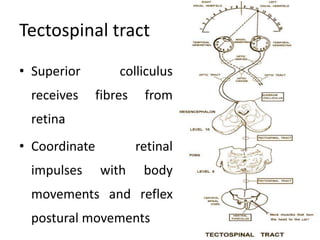
Tectospinal tract

• Arise in superior colliculus of midbrain

• Cross over to opposite side in tegmentum as
  Meynert’s decussation

• Descend through RF of pons and medulla
Tectospinal tract

• Superior         colliculus
 receives      fibres    from
 retina
• Coordinate            retinal
 impulses      with      body
 movements and reflex
 postural movements
Olivospinal tract

• Arise in inferior olivary nucleus of medulla

• Descend in anterolateral part of white column

• Traced only as far as cervical region

Motor cortex

  • 1.
    Motor cortex and Descending pathways D.A. Asir John Samuel, BSc (Psy), MPT (Neuro Paed), MAc, DYScEd, C/BLS, FAGE Lecturer, Alva’s college of Physiotherapy, Moodbidri
  • 2.
    Lobes of cerebralcortex • Frontal lobe – in front of central sulcus or fissure of Roland • Parietal lobe – central sulcus/parieto-occipital sulcus • Occipital lobe – behind parieto-occipital cortex • Temporal lobe – below lateral or sylvian fissure
  • 3.
    Lobes of cerebralcortex • Frontal lobe – in front of central sulcus or fissure of Roland • Parietal lobe – central sulcus/parieto-occipital sulcus • Occipital lobe – behind parieto-occipital cortex • Temporal lobe – below lateral or sylvian fissure
  • 4.
    Frontal lobe • Broadmann’sArea 4 – precentral gyrus and is Primary motor Area • Supplementary motor Area – ant. to Areas 4 & 6 • Premotor Area (Area 6) – ant. to Area 4 • Broca’s Area (Area 44) – motor area for speech, in post. part of frontal operculum in domi. H • Frontal eye field (Area 8)
  • 5.
    Broadmann’s Area 4 •Primary motor area • Occupies posterior part of precentral gyrus and ant.lip and walls of central sulcus • Highest centre for voluntary movements • Gives origin to fibres of pyramidal tract and other descending tract • Interconnected to Area 6 and sensory area
  • 6.
    Broadmann’s Area representation •Size of cortical area is proportional to functional importance and activity of region • Order of representation from medial to lateral surface is toes, ankle, knee, hip, trunk, shoulder, arm, elbow, wrist, hand, fingers, thumb, eyes, face, jaw and tongue • Motor homonuclus
  • 7.
    Supplementary motor area •Medial surface of hemisphere in front of area 4 and 6, in medial frontal gyrus • Representation is head to foot anteroposterly • Provides background for fine complex movements from motor cortex
  • 8.
    Area 6. Premotorarea • Anterior to area 4 and in medial aspect of H • Planning and rehearsal takes place before execution • Gives fibres to pyramidal tract and basal ganglia concerned with postural control • Postural background for complex coordinated movements
  • 9.
    Frontal eye field(Area 8) • Middle frontal gyrus • Receives association fibres from occipital cortex (Areas 18, 19) • Projects of oculomotor nuclei • Moving head and eyes towards the objects to be seen
  • 10.
    Layers of cerebralcortex 1. Molecular layer (Plexiform layer) 2. External granular layer 3. External pyramidal layer 4. Internal granular layer 5. Ganglionic layer (Internal pyramidal layer) 6. Multiform layer (layer of polymorphic cells)
  • 11.
    Descending pathways • Corticospinal(Pyramidal) and corticobulbar tracts • Vestibulospinal • Reticulospinal • Tectospinal • Rubrospinal • Olivospinal
  • 12.
    Corticospinal tract • Arisefrom axons of pyramidal cells situated in 5th layer of cerebral cortex • Primary motor area – 30% • Premotor area – 30% • Postcentral gyrus (Parietal lobe) – 40%
  • 13.
    Corticospinal tract Descend incorona radiata and converge in posterior limb of internal capsule In midbrain, occupies middle 3/5 of basis pedunculi (crus cerebri) In pons, broken up into small no.of bundles
  • 14.
    Corticospinal tract In lowerpart of Pons, fibres reunite to form compact bundle Descends in ventral part of medulla forms Prominent Pyramids of Medulla
  • 15.
    Corticospinal tract At junctionof MO & SC, most fibres cross midline at decussation of Pyramids Form Lateral corticalspinal tract Uncrossed – Anterior corticospinal tract Terminates in anterior gray column, by internuncial
  • 16.
    Corticospinal tract • Speedand agility to voluntary movements • Rapid skilled movements • Upper motor neuron lesion • Spasticty
  • 17.
    Vestibulospinal tract • Vestibularnuclei are situated in pons and MO beneath floor of 4th ventricle` • Neurons of lateral vestibular nucleus give rise to axons that form VST • Tract descends uncrossed though medulla and through length of SC in ant.white column
  • 20.
    Vestibulospinal tract 1. Ventralor anterior VST 2. Lateral VST • Regulate muscle tone and equilibrium • Facilitates activity of extensor muscles and inhibit activity of flexor muscles
  • 21.
    Reticulospinal tract • Throughoutmidbrain, pons and MO, groups of scattered nerve cells and nerve fibers exist that are collectively known as reticular formation 1. Pontine reticulospinal tract 2. Medullary reticulospinal tract
  • 22.
    Reticulospinal tract • Frompons, neurons send axons, which are mostly uncrossed, down into SC and form pontine reticulospinal tract (medial RST) • From medulla, which are crossed and uncrossed, to SC and form medullary reticulospinal tract (lateral RST)
  • 24.
    Reticulospinal tract • Reticulospinalfibres from pons descend through ant.white column • While from MO descend in lateral white column • Both sets enter AGC and may facilitate or inhibit activity of α and β
  • 25.
    Reticulospinal tract • Influencevoluntary movements and reflex activity • Provide a pathway by which hypothalamus can control sympathetic outflow and sacral parasympathetic outflow
  • 26.
    Rubrospinal tract • Arisesfrom posterior 1/3rd or nucleous magnocellularis of red nucleus in midbrain • On leaving RN, fibres cross to opposite side in tegmentum of midbrain as Forel’s decussation • Descend through reticular formation of pons and medulla to SC
  • 28.
    Rubrospinal tract • Liesanterior to lateral corticospinal tract • Prominent upto mid thoracic region • Receives impulses from cerebral cortex, cerebellum and corpus striatum • Part of lateral motor system • Facilitates flexor muscle and inhibits ext./AG
  • 30.
    Tectospinal tract • Arisein superior colliculus of midbrain • Cross over to opposite side in tegmentum as Meynert’s decussation • Descend through RF of pons and medulla
  • 31.
    Tectospinal tract • Superior colliculus receives fibres from retina • Coordinate retinal impulses with body movements and reflex postural movements
  • 32.
    Olivospinal tract • Arisein inferior olivary nucleus of medulla • Descend in anterolateral part of white column • Traced only as far as cervical region