
DR NILESH KATE
MBBS,MD
ASSOCIATE PROF
DEPT. OF PHYSIOLOGY
SKELETAL
MUSCLE
CIRCULATION
OBJECTIVES
Skeletal muscle circulation.
 Skeletal muscle blood flow –
characteristic features.
 Regulation of flow
 Auto regulation
 Metabolic control mechanism
 Nervous control mechanism.
Wednesday, April 6, 2016
SKELETAL MUSCLE BLOOD FLOW –
CHARACTERISTIC FEATURES.
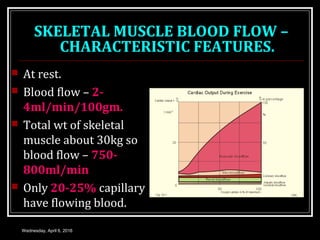
 At rest.
 Blood flow – 2-
4ml/min/100gm.
 Total wt of skeletal
muscle about 30kg so
blood flow – 750-
800ml/min
 Only 20-25% capillary
have flowing blood.
Wednesday, April 6, 2016
SKELETAL MUSCLE BLOOD FLOW –
CHARACTERISTIC FEATURES.
 During Exercise.
 Increases to 20
times,50-
80ml/min/100gm –
Exercise Hyperemia.
 Cause – dilatation of
Arteriole & Precapillary
sphincters by local
metabolite
Wednesday, April 6, 2016
SKELETAL MUSCLE BLOOD FLOW –
CHARACTERISTIC FEATURES.
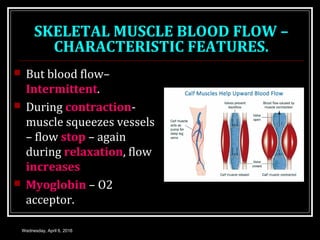
 But blood flow–
Intermittent.
 During contraction-
muscle squeezes vessels
– flow stop – again
during relaxation, flow
increases
 Myoglobin – O2
acceptor.
Wednesday, April 6, 2016
SKELETAL MUSCLE BLOOD FLOW –
CHARACTERISTIC FEATURES.
 Sustained, severe
contraction >10 sec,
cessation of blood flow,
fatigue & ischemic Pain.
 Also after severe phasic
exercise– flow
decreases slowly
Due to O2 Debt.
Wednesday, April 6, 2016
REACTIVE HYPERAEMIA.
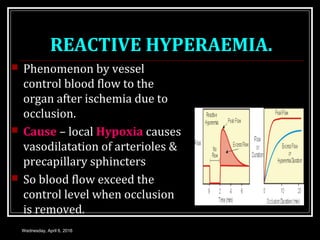
 Phenomenon by vessel
control blood flow to the
organ after ischemia due to
occlusion.
 Cause – local Hypoxia causes
vasodilatation of arterioles &
precapillary sphincters
 So blood flow exceed the
control level when occlusion
is removed.
Wednesday, April 6, 2016
WHITE VS RED MUSCLE BLOOD
FLOW.
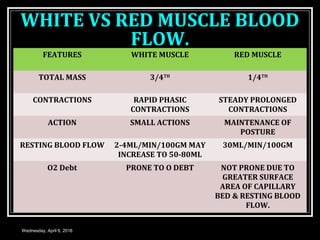
FEATURES WHITE MUSCLE RED MUSCLE
TOTAL MASS 3/4TH
1/4TH
CONTRACTIONS RAPID PHASIC
CONTRACTIONS
STEADY PROLONGED
CONTRACTIONS
ACTION SMALL ACTIONS MAINTENANCE OF
POSTURE
RESTING BLOOD FLOW 2-4ML/MIN/100GM MAY
INCREASE TO 50-80ML
30ML/MIN/100GM
O2 Debt PRONE TO O DEBT NOT PRONE DUE TO
GREATER SURFACE
AREA OF CAPILLARY
BED & RESTING BLOOD
FLOW.
REGULATION OF FLOW
 AUTO REGULATION
 METABOLIC CONTROL
MECHANISM
 NERVOUS CONTROL
MECHANISM.
Wednesday, April 6, 2016
AUTO REGULATION
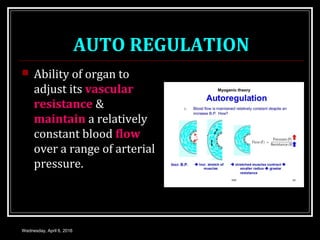
 Ability of organ to
adjust its vascular
resistance &
maintain a relatively
constant blood flow
over a range of arterial
pressure.
Wednesday, April 6, 2016
AUTO REGULATION
Myogenic theory
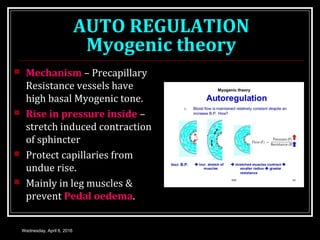
 Mechanism – Precapillary
Resistance vessels have
high basal Myogenic tone.
 Rise in pressure inside –
stretch induced contraction
of sphincter
 Protect capillaries from
undue rise.
 Mainly in leg muscles &
prevent Pedal oedema.
Wednesday, April 6, 2016
METABOLIC CONTROL
MECHANISM
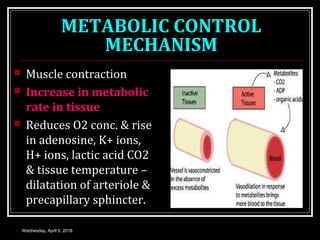
 Muscle contraction
 Increase in metabolic
rate in tissue
 Reduces O2 conc. & rise
in adenosine, K+ ions,
H+ ions, lactic acid CO2
& tissue temperature –
dilatation of arteriole &
precapillary sphincter.
Wednesday, April 6, 2016
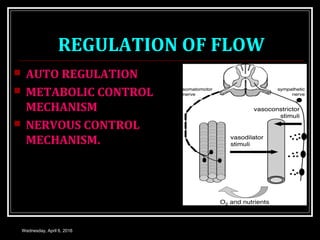
NERVOUS CONTROL
MECHANISM.
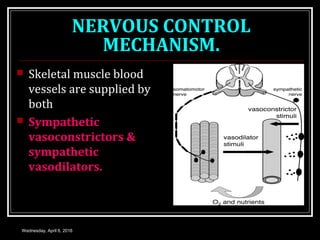
 Skeletal muscle blood
vessels are supplied by
both
 Sympathetic
vasoconstrictors &
sympathetic
vasodilators.
Wednesday, April 6, 2016
SYMPATHETIC
VASOCONSTRICTOR CONTROL
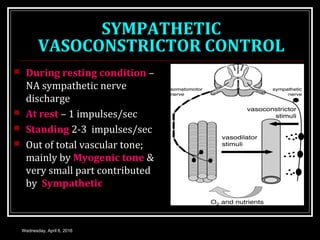
 During resting condition –
NA sympathetic nerve
discharge
 At rest – 1 impulses/sec
 Standing 2-3 impulses/sec
 Out of total vascular tone;
mainly by Myogenic tone &
very small part contributed
by Sympathetic
Wednesday, April 6, 2016
SYMPATHETIC
VASOCONSTRICTOR CONTROL
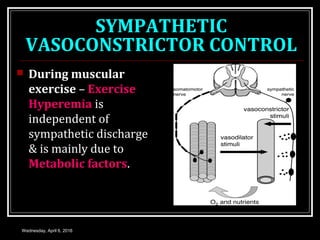
 During muscular
exercise – Exercise
Hyperemia is
independent of
sympathetic discharge
& is mainly due to
Metabolic factors.
Wednesday, April 6, 2016
SYMPATHETIC
VASOCONSTRICTOR CONTROL
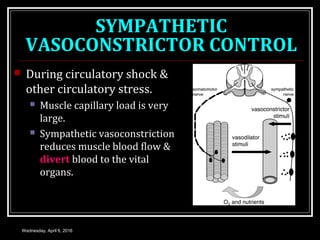
 During circulatory shock &
other circulatory stress.
 Muscle capillary load is very
large.
 Sympathetic vasoconstriction
reduces muscle blood flow &
divert blood to the vital
organs.
Wednesday, April 6, 2016
SYMPATHETIC VASODILATOE
FIBRES.
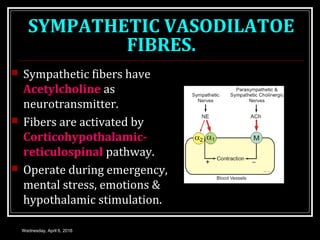
 Sympathetic fibers have
Acetylcholine as
neurotransmitter.
 Fibers are activated by
Corticohypothalamic-
reticulospinal pathway.
 Operate during emergency,
mental stress, emotions &
hypothalamic stimulation.
Wednesday, April 6, 2016
SYMPATHETIC VASODILATOE
FIBRES.
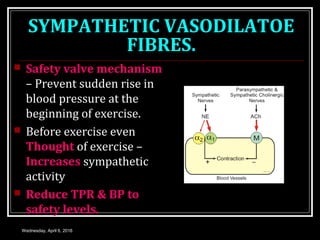
 Safety valve mechanism
– Prevent sudden rise in
blood pressure at the
beginning of exercise.
 Before exercise even
Thought of exercise –
Increases sympathetic
activity
 Reduce TPR & BP to
safety levels.
Wednesday, April 6, 2016
SYMPATHETIC VASODILATOE
FIBRES.
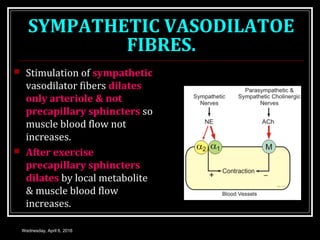
 Stimulation of sympathetic
vasodilator fibers dilates
only arteriole & not
precapillary sphincters so
muscle blood flow not
increases.
 After exercise
precapillary sphincters
dilates by local metabolite
& muscle blood flow
increases.
Wednesday, April 6, 2016
THANK YOU.
Wednesday, April 6, 2016

MUSCLE CIRCULATION

  • 1.
    DR NILESH KATE MBBS,MD ASSOCIATEPROF DEPT. OF PHYSIOLOGY SKELETAL MUSCLE CIRCULATION
  • 2.
    OBJECTIVES Skeletal muscle circulation. Skeletal muscle blood flow – characteristic features.  Regulation of flow  Auto regulation  Metabolic control mechanism  Nervous control mechanism. Wednesday, April 6, 2016
  • 3.
    SKELETAL MUSCLE BLOODFLOW – CHARACTERISTIC FEATURES.  At rest.  Blood flow – 2- 4ml/min/100gm.  Total wt of skeletal muscle about 30kg so blood flow – 750- 800ml/min  Only 20-25% capillary have flowing blood. Wednesday, April 6, 2016
  • 4.
    SKELETAL MUSCLE BLOODFLOW – CHARACTERISTIC FEATURES.  During Exercise.  Increases to 20 times,50- 80ml/min/100gm – Exercise Hyperemia.  Cause – dilatation of Arteriole & Precapillary sphincters by local metabolite Wednesday, April 6, 2016
  • 5.
    SKELETAL MUSCLE BLOODFLOW – CHARACTERISTIC FEATURES.  But blood flow– Intermittent.  During contraction- muscle squeezes vessels – flow stop – again during relaxation, flow increases  Myoglobin – O2 acceptor. Wednesday, April 6, 2016
  • 6.
    SKELETAL MUSCLE BLOODFLOW – CHARACTERISTIC FEATURES.  Sustained, severe contraction >10 sec, cessation of blood flow, fatigue & ischemic Pain.  Also after severe phasic exercise– flow decreases slowly Due to O2 Debt. Wednesday, April 6, 2016
  • 7.
    REACTIVE HYPERAEMIA.  Phenomenonby vessel control blood flow to the organ after ischemia due to occlusion.  Cause – local Hypoxia causes vasodilatation of arterioles & precapillary sphincters  So blood flow exceed the control level when occlusion is removed. Wednesday, April 6, 2016
  • 8.
    Wednesday, April 6,2016 WHITE VS RED MUSCLE BLOOD FLOW. FEATURES WHITE MUSCLE RED MUSCLE TOTAL MASS 3/4TH 1/4TH CONTRACTIONS RAPID PHASIC CONTRACTIONS STEADY PROLONGED CONTRACTIONS ACTION SMALL ACTIONS MAINTENANCE OF POSTURE RESTING BLOOD FLOW 2-4ML/MIN/100GM MAY INCREASE TO 50-80ML 30ML/MIN/100GM O2 Debt PRONE TO O DEBT NOT PRONE DUE TO GREATER SURFACE AREA OF CAPILLARY BED & RESTING BLOOD FLOW.
  • 9.
    REGULATION OF FLOW AUTO REGULATION  METABOLIC CONTROL MECHANISM  NERVOUS CONTROL MECHANISM. Wednesday, April 6, 2016
  • 10.
    AUTO REGULATION  Abilityof organ to adjust its vascular resistance & maintain a relatively constant blood flow over a range of arterial pressure. Wednesday, April 6, 2016
  • 11.
    AUTO REGULATION Myogenic theory Mechanism – Precapillary Resistance vessels have high basal Myogenic tone.  Rise in pressure inside – stretch induced contraction of sphincter  Protect capillaries from undue rise.  Mainly in leg muscles & prevent Pedal oedema. Wednesday, April 6, 2016
  • 12.
    METABOLIC CONTROL MECHANISM  Musclecontraction  Increase in metabolic rate in tissue  Reduces O2 conc. & rise in adenosine, K+ ions, H+ ions, lactic acid CO2 & tissue temperature – dilatation of arteriole & precapillary sphincter. Wednesday, April 6, 2016
  • 13.
    NERVOUS CONTROL MECHANISM.  Skeletalmuscle blood vessels are supplied by both  Sympathetic vasoconstrictors & sympathetic vasodilators. Wednesday, April 6, 2016
  • 14.
    SYMPATHETIC VASOCONSTRICTOR CONTROL  Duringresting condition – NA sympathetic nerve discharge  At rest – 1 impulses/sec  Standing 2-3 impulses/sec  Out of total vascular tone; mainly by Myogenic tone & very small part contributed by Sympathetic Wednesday, April 6, 2016
  • 15.
    SYMPATHETIC VASOCONSTRICTOR CONTROL  Duringmuscular exercise – Exercise Hyperemia is independent of sympathetic discharge & is mainly due to Metabolic factors. Wednesday, April 6, 2016
  • 16.
    SYMPATHETIC VASOCONSTRICTOR CONTROL  Duringcirculatory shock & other circulatory stress.  Muscle capillary load is very large.  Sympathetic vasoconstriction reduces muscle blood flow & divert blood to the vital organs. Wednesday, April 6, 2016
  • 17.
    SYMPATHETIC VASODILATOE FIBRES.  Sympatheticfibers have Acetylcholine as neurotransmitter.  Fibers are activated by Corticohypothalamic- reticulospinal pathway.  Operate during emergency, mental stress, emotions & hypothalamic stimulation. Wednesday, April 6, 2016
  • 18.
    SYMPATHETIC VASODILATOE FIBRES.  Safetyvalve mechanism – Prevent sudden rise in blood pressure at the beginning of exercise.  Before exercise even Thought of exercise – Increases sympathetic activity  Reduce TPR & BP to safety levels. Wednesday, April 6, 2016
  • 19.
    SYMPATHETIC VASODILATOE FIBRES.  Stimulationof sympathetic vasodilator fibers dilates only arteriole & not precapillary sphincters so muscle blood flow not increases.  After exercise precapillary sphincters dilates by local metabolite & muscle blood flow increases. Wednesday, April 6, 2016
  • 20.