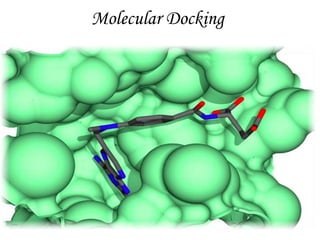
Molecular Docking

• S. Shahriar Arab
Presented by
VIVEK K
RAHUL BS
Drug discovery
Take years to decade for discovering a new drug and
very costly

 To cut down the research timeline and cost by
reducing wet-lab experiment

use computer modeling

softwares

Drugs interact with their receptors in a highly specific
and complementary manner.
Core of the (target-based) structure-based drug design
(SBDD) is lead generation and optimization
 Pharmacophore- the atoms and functional groups required
for a specific pharmacological activity, and their relative

position in space.
 3D arrangement of functional groups that enable a

compound to exert a particular biological effect.
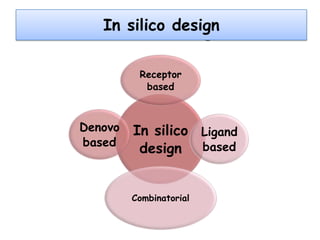
In silico design
In-silico design
Receptor
based

Denovo
based

In silico Ligand
design based
Combinatorial
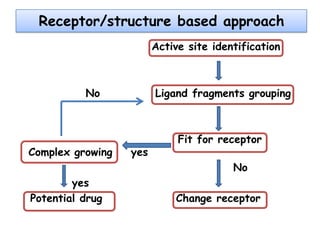
Receptor/structure based approach
Active site identification

No

Complex growing

Ligand fragments grouping

yes

Fit for receptor
No

yes
Potential drug

Change receptor
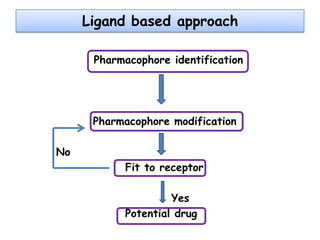
Ligand based approach
Pharmacophore identification

Pharmacophore modification
No
Fit to receptor
Yes
Potential drug
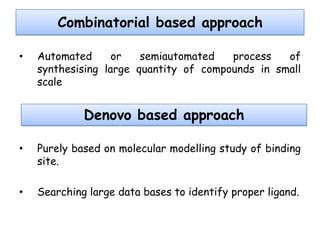
Combinatorial based approach
•

Automated
or
semiautomated
process
of
synthesising large quantity of compounds in small
scale

Denovo based approach
•

Purely based on molecular modelling study of binding
site.

•

Searching large data bases to identify proper ligand.
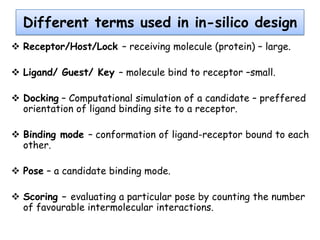
Different terms used in in-silico design
 Receptor/Host/Lock – receiving molecule (protein) – large.
 Ligand/ Guest/ Key – molecule bind to receptor –small.
 Docking – Computational simulation of a candidate – preffered
orientation of ligand binding site to a receptor.
 Binding mode – conformation of ligand-receptor bound to each
other.
 Pose – a candidate binding mode.
 Scoring – evaluating a particular pose by counting the number
of favourable intermolecular interactions.
 Ranking – classify ligands most likely to interact
favourably to a particular relation based on ∆G of binding.
 Hit – Ligand with high rank.

 Lead – hit with biological activity.
 Pharmacophore – spacial arrangement of atoms or groups
believed to be responsible for biological activity.
 Rational drug design – Modulation of specific biological
target may have therapeutic value.
 QSAR – Study of physico chemical properties of a
compound with its biological/pharmacological activity.
 Drug design – design of ligands.
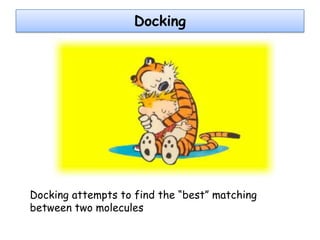
Docking

Docking attempts to find the “best” matching
between two molecules
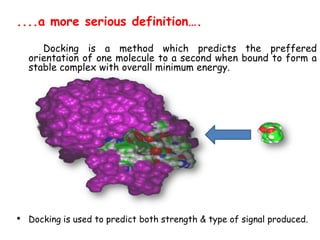
....a more serious definition….
Docking is a method which predicts the preffered
orientation of one molecule to a second when bound to form a
stable complex with overall minimum energy.

•

Docking is used to predict both strength & type of signal produced.
•

Aim of molecular docking is to achieve an optimized
conformation & relative orientation between protein ligand such
that ∆G is minimized.

It is to study. . . . .
 Whether the two molecules interact with each other

 If

so what is the orientation that maximizes the
interaction which minimizing the total energy of the
complex

Goal. . .
Given a protein structure and predict its ligand bindings.
Why is docking important?
It is of extreme relevance in cellular biology

It is the key to rational drug design
Docking approaches
i.

Uses a matching technique – describes the protein
and ligand as complementary surfaces.

ii. Simulates the actual docking process in which ligandprotein pairwise interaction energies are calculated
a) Shape complementarity


Receptor’s molecular surface – solvent accessible surface
area.



Ligand’s molecular surface – matching surface description.

Advantage
 Fast & robust
Disadvantage
 Can't model the dynamic changes in the ligand / protein
conformations accurately.
b) Simulation
 Protein and ligands are separated by a physical distance
 Binding takes place only after certain moves
(translations, rotations,& internal changes like torsional
angle rotations) in its conformational space.
 In every move total energy of the system is calculated.
Disadvantage
 It take longer time for evaluation (overcome by using grid
based technique & fast optimization methods)
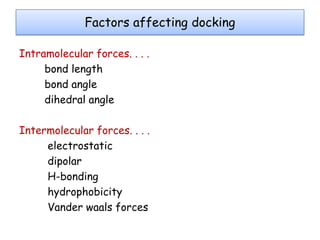
Factors affecting docking
Intramolecular forces. . . .
bond length
bond angle
dihedral angle
Intermolecular forces. . . .
electrostatic
dipolar
H-bonding
hydrophobicity
Vander waals forces
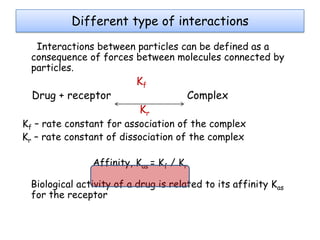
Different type of interactions
Interactions between particles can be defined as a
consequence of forces between molecules connected by
particles.

Drug + receptor

Kf

Kr

Complex

Kf – rate constant for association of the complex
Kr – rate constant of dissociation of the complex
Affinity, Kas = Kf / Kr
Biological activity of a drug is related to its affinity Kas
for the receptor
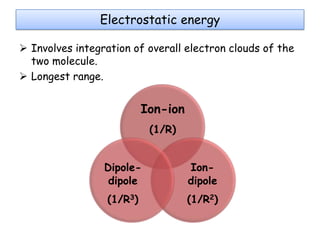
Electrostatic energy
 Involves integration of overall electron clouds of the
two molecule.
 Longest range.

Ion-ion
(1/R)
Dipoledipole

Iondipole

(1/R3)

(1/R2)
Electrodynamic forces
 Attractive forces existing between all pairs of atoms,even
between rare gas atoms.
 Depends on polarizability & number of valence electrons
of interacting molecule.
 Polarization energy involves the interaction of a molecule
that is already polar with another polar/non polar
molecule.
 Eg. London or Vander waals forces.
Steric forces
 Each atom wthin the molecule occupies a certain amount of
space.
 If atoms are too closer there is an associated lost in
energy due to overlapping electron cloud – may affect
molecules preferred shape, reactivity and activation
energies of most chemical reaction.
 Steric effect will determine how & at what rate a drug will
interact with its target biomolecule.
Solvent related forces
 these are forces generated due to chemical reaction
between the solvent & protein or ligand.
Eg. Hydrogen bonds (hydrophyllic interactions)
Hydrophobic interactions
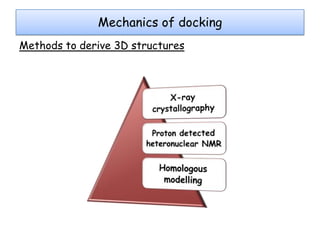
Mechanics of docking
Methods to derive 3D structures
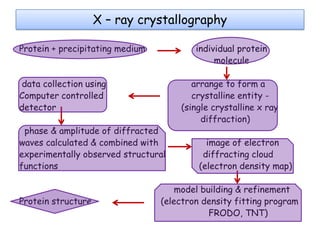
X – ray crystallography
Protein + precipitating medium

individual protein
molecule

data collection using
Computer controlled
detector
phase & amplitude of diffracted
waves calculated & combined with
experimentally observed structural
functions

Protein structure

arrange to form a
crystalline entity (single crystalline x ray
diffraction)
image of electron
diffracting cloud
(electron density map)

model building & refinement
(electron density fitting program
FRODO, TNT)
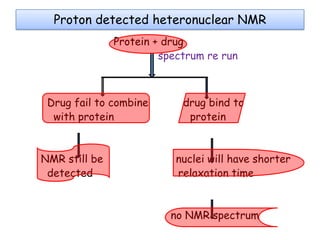
Proton detected heteronuclear NMR
Protein + drug
spectrum re run

Drug fail to combine
with protein

NMR still be
detected

drug bind to
protein

nuclei will have shorter
relaxation time

no NMR spectrum
Homologous modelling
 Align the amino acid sequence of protein with unknown
structural agent, the sequence of a homologous protein
whose 3D structure has already been determined.
 By converting structurally conserved region & structural
variable region, the core of the molecule can be identified.
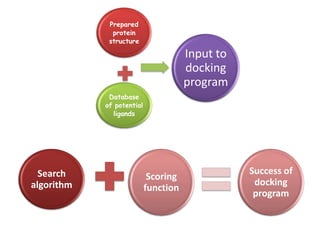
Prepared
protein
structure

Input to
docking
program
Database
of potential
ligands

Search
algorithm

Scoring
function

Success of
docking
program
a) Search algorithm
 Determine all possible optimal conformation for a given
complex (protein-ligand/ protein-protein)

 Calculate the energy of resulting complex & of each
individual interactions.
Conformational search strategies include

• Systematic/ stochastic torsional searches about rotatable
bonds.

• Molecular dynamic simulations
• Genetic algorithms to evolve new low energy conformations
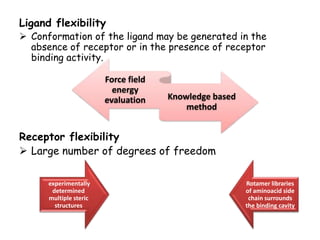
Ligand flexibility

 Conformation of the ligand may be generated in the
absence of receptor or in the presence of receptor
binding activity.
Force field
energy
evaluation

Knowledge based
method

Receptor flexibility
 Large number of degrees of freedom
experimentally
determined
multiple steric
structures

Rotamer libraries
of aminoacid side
chain surrounds
the binding cavity
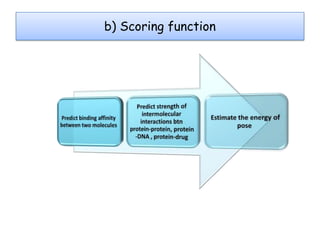
b) Scoring function
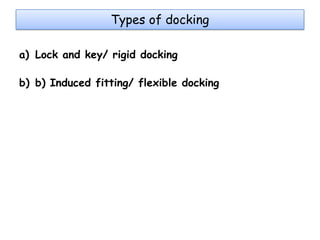
Types of docking
a) Lock and key/ rigid docking
b) b) Induced fitting/ flexible docking
MOLECULAR DOCKING
• Docking- the process by which molecular modeling

software fits a molecule into target binding sites.
• Used for finding binding modes of protein with
ligands/inhibitors
• In molecular docking, attempt to predict the structure of
the intermolecular complex formed between two or more
molecules
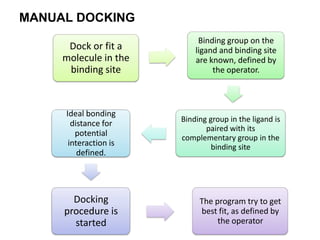
MANUAL DOCKING
Dock or fit a
molecule in the
binding site

Binding group on the
ligand and binding site
are known, defined by
the operator.

Ideal bonding
distance for
potential
interaction is
defined.

Binding group in the ligand is
paired with its
complementary group in the
binding site

Docking
procedure is
started

The program try to get
best fit, as defined by
the operator
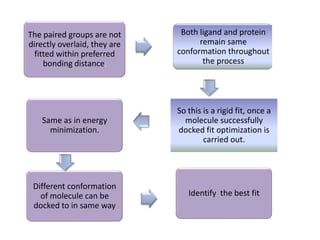
The paired groups are not
directly overlaid, they are
fitted within preferred
bonding distance.

Both ligand and protein
remain same
conformation throughout
the process

Same as in energy
minimization.

So this is a rigid fit, once a
molecule successfully
docked fit optimization is
carried out.

Different conformation
of molecule can be
docked to in same way

Identify the best fit
FLEXIBLE DOCKING
Rigid docking- the protein and the ligand as rigid bodies.

The

drawback

of

rigid

docking

is,

since

it neglects the conformational degrees of freedom of
ligands.

It fails to give satisfactory answer for flexible ligand, will

form different conformations.
To solve this, dock different conformations of ligand as
possible in order to get the best result.

FLOG (flexible ligand oriented on grid) is a program that
generates conformational libraries called flexibose, contain
10-20 conformations for each ligand studied.
DOCKING OF FLEXIBLE LIGANDS

Various programs
are for generate
different ligand
conformations

The popular
method is to
fragment the
ligand , identify a
rigid anchor
fragment which
can be docked

Examples of programs

Then reconstruct
or grow the
molecule back
onto the anchor.
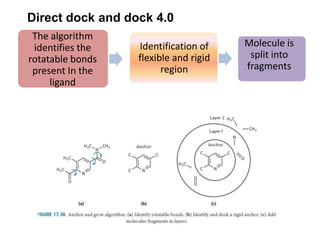
Direct dock and dock 4.0
The algorithm
identifies the
rotatable bonds
present In the
ligand

Identification of
flexible and rigid
region

Molecule is
split into
fragments
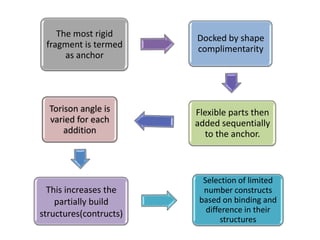
The most rigid
fragment is termed
as anchor

Torison angle is
varied for each
addition

This increases the
partially build
structures(contructs)

Docked by shape
complimentarity

Flexible parts then
added sequentially
to the anchor.

Selection of limited
number constructs
based on binding and
difference in their
structures
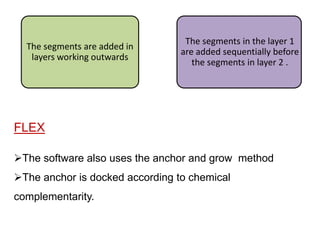
The segments are added in
layers working outwards

The segments in the layer 1
are added sequentially before
the segments in layer 2 .

FLEX
The software also uses the anchor and grow method

The anchor is docked according to chemical
complementarity.
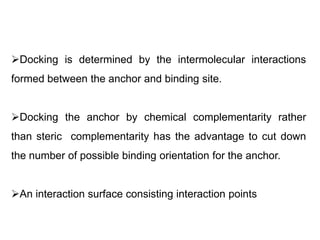
Docking is determined by the intermolecular interactions
formed between the anchor and binding site.

Docking the anchor by chemical complementarity rather
than steric complementarity has the advantage to cut down
the number of possible binding orientation for the anchor.
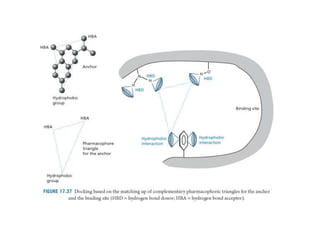
An interaction surface consisting interaction points
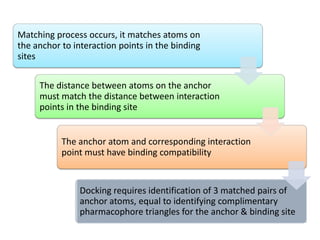
Matching process occurs, it matches atoms on
the anchor to interaction points in the binding
sites
The distance between atoms on the anchor
must match the distance between interaction
points in the binding site

The anchor atom and corresponding interaction
point must have binding compatibility

Docking requires identification of 3 matched pairs of
anchor atoms, equal to identifying complimentary
pharmacophore triangles for the anchor & binding site
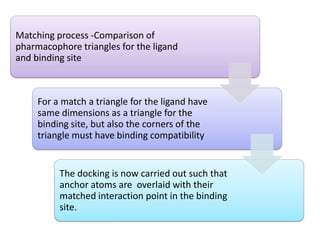
Matching process -Comparison of
pharmacophore triangles for the ligand
and binding site

For a match a triangle for the ligand have
same dimensions as a triangle for the
binding site, but also the corners of the
triangle must have binding compatibility

The docking is now carried out such that
anchor atoms are overlaid with their
matched interaction point in the binding
site.
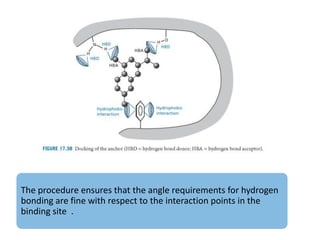
The procedure ensures that the angle requirements for hydrogen
bonding are fine with respect to the interaction points in the
binding site .
Problems

The anchor has to be chosen manually, becomes
difficult when large number of structures
Vast number of different pharmacophore triangles
constructed to represent the binding site.
HAMMERHEAD PROGRAM
Anchor and grow program

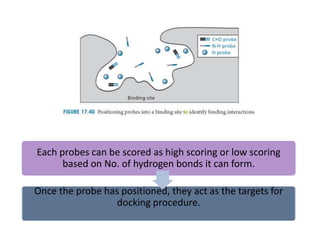
Probes are placed into the binding site in order to identify
locations of binding interactions

The probes used are hydrogen atoms as well as c=o and NH
fragments
Each probes can be scored as high scoring or low scoring
based on No. of hydrogen bonds it can form.
Once the probe has positioned, they act as the targets for
docking procedure.
Matching of atoms of a molecular fragment with probes,
docking must involve at least one of the high scoring probes.

Both steric and chemical complementarity is used in the
matching process.

Once the match has been identified the docking operation is
carried out.

Since the ligand is split into fragments, have limited
number of rotatable bonds
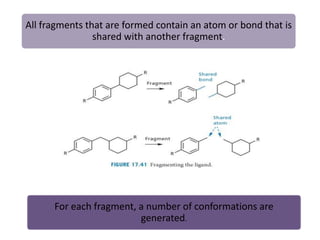
All fragments that are formed contain an atom or bond that is
shared with another fragment.

For each fragment, a number of conformations are
generated.
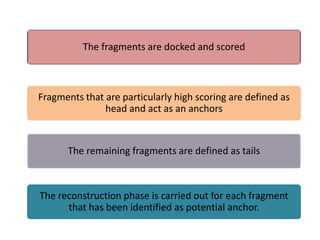
The fragments are docked and scored

Fragments that are particularly high scoring are defined as
head and act as an anchors

The remaining fragments are defined as tails

The reconstruction phase is carried out for each fragment
that has been identified as potential anchor.
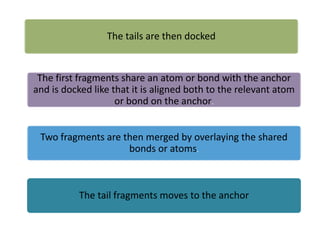
The tails are then docked

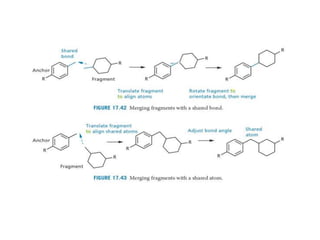
The first fragments share an atom or bond with the anchor
and is docked like that it is aligned both to the relevant atom
or bond on the anchor.
Two fragments are then merged by overlaying the shared
bonds or atoms.

The tail fragments moves to the anchor
Advantages

Anchors are chosen automatically

Different anchors possible and investigated
Docking Of Flexible Ligands, By Simulated
Annealing And Genetic Algorithm
 This method is viable for docking of the flexible ligands.
 It involves use of metropolis method by using montecarlo
algorithms for conformational analysis.
 The ligand is placed randomly in the space close to the
binding site.
 Montecarlo algorithms are used to generate different
conformations

 The molecules are translated and rotated such that it
tumbles within the binding site.
 Different conformations are generated at different
position and orientation with in the binding site.
 Binding energy of each structure is measured as it is
formed and compared with the previous structure.
Docking Programs Using Monte Carlo
Algorithms For Docking
 Auto dock
 Mcdock

 Prodock and pro-lead.

Disadvantage
The quality of result is often depends on how the initial
structure s placed in the binding site.

This can be over come by using combination of programs
Eg; DOCK and Montecarlo based programs
Docking programs
Docking programs
DOCK (I. D. Kuntz, UCSF)
AutoDock (Arthur Olson, The Scripps Research Institute)
AutoDock was designed to dock flexible ligands into
receptor binding sites
The strongest feature of AutoDock is the range of
powerful optimization algorithms available
RosettaDOCK (Baker, Washington Univ., Gray, Johns
Hopkins Univ.)
Overall steps in docking
1) Get the complex from P.D.B
2) Clean the complex
3) Add the missing hydrogens/side chain atoms & minimized
the complex
4) Clean the minimized complex
5) Separate the minimized complex in macromolecule (lock)
& ligand (key)
6) Prepare the docking suitable files for lock & key
7) Prepare all the needing files for docking
8) Run the docking
9) Analyze the docking results
Working methodology of Schrodinger
i.




ii.


Protein preparation (protein preparation wizard)
Prepare co crystallized ligands – correctly define
multiple bonds & adding hydrogen
Neutralize residues that do not participate in the salt
bridge
Preprocess the receptor before grid generation
Optimization of the protein
Ligand preparation (ligprep)
Generate energy minimized 3D structures –
tautomeric, stereochemical and ionization variations as
well as energy
minimizations
iii. Docking
 Generate receptor grid around the site using glide
 Docking conducted using XP GLIDE (Extra precision)
iv. Visual inspection
 Images were obtained using Glide XP Vsualiser panel
Applications
 Hit identification
 Lead optimization
 Bio remediation
 virtual screening of large databases
References
i. Introduction to molecular docking; Edelmiromomen;

Pharmaceutical & Medicinal chemistry; Saarland
university.
ii. Protein-ligand docking methods; Thomas Funkhouser;Princeton
university
iii.Introduction to molecular docking; Carlos. P.Sosa; university of Minnesofa
iv. Molecular docking tutorial; Khuled.H.Brakat; Pharma matrix work
shopin, Computational biophysics.
v. Principles of Docking: An overview of search Algorithm & a guide to scoring functions;
Inbal Halperin,Buyon Ma.
vi. An introduction to medicinal chemistry; 4th edition; Graham.L.Patrick; Pg no. 352-361

vii. The organic chemistry of drug design & drug action. 2nd edition; Richard.B.Silverman
All informations in this presentation is collected
from various sources available on internet and text
books….
This presentation is only for educational purpose….

we sincerely saying thanks to all

Molecular docking

  • 2.
  • 3.
  • 4.
    Drug discovery Take yearsto decade for discovering a new drug and very costly  To cut down the research timeline and cost by reducing wet-lab experiment use computer modeling softwares Drugs interact with their receptors in a highly specific and complementary manner. Core of the (target-based) structure-based drug design (SBDD) is lead generation and optimization
  • 5.
     Pharmacophore- theatoms and functional groups required for a specific pharmacological activity, and their relative position in space.  3D arrangement of functional groups that enable a compound to exert a particular biological effect.
  • 7.
    In silico design In-silicodesign Receptor based Denovo based In silico Ligand design based Combinatorial
  • 8.
    Receptor/structure based approach Activesite identification No Complex growing Ligand fragments grouping yes Fit for receptor No yes Potential drug Change receptor
  • 9.
    Ligand based approach Pharmacophoreidentification Pharmacophore modification No Fit to receptor Yes Potential drug
  • 10.
    Combinatorial based approach • Automated or semiautomated process of synthesisinglarge quantity of compounds in small scale Denovo based approach • Purely based on molecular modelling study of binding site. • Searching large data bases to identify proper ligand.
  • 11.
    Different terms usedin in-silico design  Receptor/Host/Lock – receiving molecule (protein) – large.  Ligand/ Guest/ Key – molecule bind to receptor –small.  Docking – Computational simulation of a candidate – preffered orientation of ligand binding site to a receptor.  Binding mode – conformation of ligand-receptor bound to each other.  Pose – a candidate binding mode.  Scoring – evaluating a particular pose by counting the number of favourable intermolecular interactions.
  • 12.
     Ranking –classify ligands most likely to interact favourably to a particular relation based on ∆G of binding.  Hit – Ligand with high rank.  Lead – hit with biological activity.  Pharmacophore – spacial arrangement of atoms or groups believed to be responsible for biological activity.  Rational drug design – Modulation of specific biological target may have therapeutic value.  QSAR – Study of physico chemical properties of a compound with its biological/pharmacological activity.  Drug design – design of ligands.
  • 13.
    Docking Docking attempts tofind the “best” matching between two molecules
  • 14.
    ....a more seriousdefinition…. Docking is a method which predicts the preffered orientation of one molecule to a second when bound to form a stable complex with overall minimum energy. • Docking is used to predict both strength & type of signal produced.
  • 15.
    • Aim of moleculardocking is to achieve an optimized conformation & relative orientation between protein ligand such that ∆G is minimized. It is to study. . . . .  Whether the two molecules interact with each other  If so what is the orientation that maximizes the interaction which minimizing the total energy of the complex Goal. . . Given a protein structure and predict its ligand bindings.
  • 16.
    Why is dockingimportant? It is of extreme relevance in cellular biology It is the key to rational drug design
  • 17.
    Docking approaches i. Uses amatching technique – describes the protein and ligand as complementary surfaces. ii. Simulates the actual docking process in which ligandprotein pairwise interaction energies are calculated
  • 18.
    a) Shape complementarity  Receptor’smolecular surface – solvent accessible surface area.  Ligand’s molecular surface – matching surface description. Advantage  Fast & robust Disadvantage  Can't model the dynamic changes in the ligand / protein conformations accurately.
  • 19.
    b) Simulation  Proteinand ligands are separated by a physical distance  Binding takes place only after certain moves (translations, rotations,& internal changes like torsional angle rotations) in its conformational space.  In every move total energy of the system is calculated. Disadvantage  It take longer time for evaluation (overcome by using grid based technique & fast optimization methods)
  • 20.
    Factors affecting docking Intramolecularforces. . . . bond length bond angle dihedral angle Intermolecular forces. . . . electrostatic dipolar H-bonding hydrophobicity Vander waals forces
  • 21.
    Different type ofinteractions Interactions between particles can be defined as a consequence of forces between molecules connected by particles. Drug + receptor Kf Kr Complex Kf – rate constant for association of the complex Kr – rate constant of dissociation of the complex Affinity, Kas = Kf / Kr Biological activity of a drug is related to its affinity Kas for the receptor
  • 22.
    Electrostatic energy  Involvesintegration of overall electron clouds of the two molecule.  Longest range. Ion-ion (1/R) Dipoledipole Iondipole (1/R3) (1/R2)
  • 23.
    Electrodynamic forces  Attractiveforces existing between all pairs of atoms,even between rare gas atoms.  Depends on polarizability & number of valence electrons of interacting molecule.  Polarization energy involves the interaction of a molecule that is already polar with another polar/non polar molecule.  Eg. London or Vander waals forces.
  • 24.
    Steric forces  Eachatom wthin the molecule occupies a certain amount of space.  If atoms are too closer there is an associated lost in energy due to overlapping electron cloud – may affect molecules preferred shape, reactivity and activation energies of most chemical reaction.  Steric effect will determine how & at what rate a drug will interact with its target biomolecule.
  • 25.
    Solvent related forces these are forces generated due to chemical reaction between the solvent & protein or ligand. Eg. Hydrogen bonds (hydrophyllic interactions) Hydrophobic interactions
  • 26.
    Mechanics of docking Methodsto derive 3D structures
  • 27.
    X – raycrystallography Protein + precipitating medium individual protein molecule data collection using Computer controlled detector phase & amplitude of diffracted waves calculated & combined with experimentally observed structural functions Protein structure arrange to form a crystalline entity (single crystalline x ray diffraction) image of electron diffracting cloud (electron density map) model building & refinement (electron density fitting program FRODO, TNT)
  • 28.
    Proton detected heteronuclearNMR Protein + drug spectrum re run Drug fail to combine with protein NMR still be detected drug bind to protein nuclei will have shorter relaxation time no NMR spectrum
  • 29.
    Homologous modelling  Alignthe amino acid sequence of protein with unknown structural agent, the sequence of a homologous protein whose 3D structure has already been determined.  By converting structurally conserved region & structural variable region, the core of the molecule can be identified.
  • 30.
  • 31.
    a) Search algorithm Determine all possible optimal conformation for a given complex (protein-ligand/ protein-protein)  Calculate the energy of resulting complex & of each individual interactions. Conformational search strategies include • Systematic/ stochastic torsional searches about rotatable bonds. • Molecular dynamic simulations • Genetic algorithms to evolve new low energy conformations
  • 32.
    Ligand flexibility  Conformationof the ligand may be generated in the absence of receptor or in the presence of receptor binding activity. Force field energy evaluation Knowledge based method Receptor flexibility  Large number of degrees of freedom experimentally determined multiple steric structures Rotamer libraries of aminoacid side chain surrounds the binding cavity
  • 33.
  • 34.
    Types of docking a)Lock and key/ rigid docking b) b) Induced fitting/ flexible docking
  • 35.
    MOLECULAR DOCKING • Docking-the process by which molecular modeling software fits a molecule into target binding sites. • Used for finding binding modes of protein with ligands/inhibitors • In molecular docking, attempt to predict the structure of the intermolecular complex formed between two or more molecules
  • 36.
    MANUAL DOCKING Dock orfit a molecule in the binding site Binding group on the ligand and binding site are known, defined by the operator. Ideal bonding distance for potential interaction is defined. Binding group in the ligand is paired with its complementary group in the binding site Docking procedure is started The program try to get best fit, as defined by the operator
  • 37.
    The paired groupsare not directly overlaid, they are fitted within preferred bonding distance. Both ligand and protein remain same conformation throughout the process Same as in energy minimization. So this is a rigid fit, once a molecule successfully docked fit optimization is carried out. Different conformation of molecule can be docked to in same way Identify the best fit
  • 38.
    FLEXIBLE DOCKING Rigid docking-the protein and the ligand as rigid bodies. The drawback of rigid docking is, since it neglects the conformational degrees of freedom of ligands. It fails to give satisfactory answer for flexible ligand, will form different conformations.
  • 39.
    To solve this,dock different conformations of ligand as possible in order to get the best result. FLOG (flexible ligand oriented on grid) is a program that generates conformational libraries called flexibose, contain 10-20 conformations for each ligand studied.
  • 40.
    DOCKING OF FLEXIBLELIGANDS Various programs are for generate different ligand conformations The popular method is to fragment the ligand , identify a rigid anchor fragment which can be docked Examples of programs Then reconstruct or grow the molecule back onto the anchor.
  • 41.
    Direct dock anddock 4.0 The algorithm identifies the rotatable bonds present In the ligand Identification of flexible and rigid region Molecule is split into fragments
  • 42.
    The most rigid fragmentis termed as anchor Torison angle is varied for each addition This increases the partially build structures(contructs) Docked by shape complimentarity Flexible parts then added sequentially to the anchor. Selection of limited number constructs based on binding and difference in their structures
  • 43.
    The segments areadded in layers working outwards The segments in the layer 1 are added sequentially before the segments in layer 2 . FLEX The software also uses the anchor and grow method The anchor is docked according to chemical complementarity.
  • 44.
    Docking is determinedby the intermolecular interactions formed between the anchor and binding site. Docking the anchor by chemical complementarity rather than steric complementarity has the advantage to cut down the number of possible binding orientation for the anchor. An interaction surface consisting interaction points
  • 46.
    Matching process occurs,it matches atoms on the anchor to interaction points in the binding sites The distance between atoms on the anchor must match the distance between interaction points in the binding site The anchor atom and corresponding interaction point must have binding compatibility Docking requires identification of 3 matched pairs of anchor atoms, equal to identifying complimentary pharmacophore triangles for the anchor & binding site
  • 47.
    Matching process -Comparisonof pharmacophore triangles for the ligand and binding site For a match a triangle for the ligand have same dimensions as a triangle for the binding site, but also the corners of the triangle must have binding compatibility The docking is now carried out such that anchor atoms are overlaid with their matched interaction point in the binding site.
  • 48.
    The procedure ensuresthat the angle requirements for hydrogen bonding are fine with respect to the interaction points in the binding site .
  • 49.
    Problems The anchor hasto be chosen manually, becomes difficult when large number of structures Vast number of different pharmacophore triangles constructed to represent the binding site.
  • 50.
    HAMMERHEAD PROGRAM Anchor andgrow program Probes are placed into the binding site in order to identify locations of binding interactions The probes used are hydrogen atoms as well as c=o and NH fragments
  • 51.
    Each probes canbe scored as high scoring or low scoring based on No. of hydrogen bonds it can form. Once the probe has positioned, they act as the targets for docking procedure.
  • 52.
    Matching of atomsof a molecular fragment with probes, docking must involve at least one of the high scoring probes. Both steric and chemical complementarity is used in the matching process. Once the match has been identified the docking operation is carried out. Since the ligand is split into fragments, have limited number of rotatable bonds
  • 53.
    All fragments thatare formed contain an atom or bond that is shared with another fragment. For each fragment, a number of conformations are generated.
  • 54.
    The fragments aredocked and scored Fragments that are particularly high scoring are defined as head and act as an anchors The remaining fragments are defined as tails The reconstruction phase is carried out for each fragment that has been identified as potential anchor.
  • 55.
    The tails arethen docked The first fragments share an atom or bond with the anchor and is docked like that it is aligned both to the relevant atom or bond on the anchor. Two fragments are then merged by overlaying the shared bonds or atoms. The tail fragments moves to the anchor
  • 57.
    Advantages Anchors are chosenautomatically Different anchors possible and investigated
  • 58.
    Docking Of FlexibleLigands, By Simulated Annealing And Genetic Algorithm  This method is viable for docking of the flexible ligands.  It involves use of metropolis method by using montecarlo algorithms for conformational analysis.  The ligand is placed randomly in the space close to the binding site.
  • 59.
     Montecarlo algorithmsare used to generate different conformations  The molecules are translated and rotated such that it tumbles within the binding site.  Different conformations are generated at different position and orientation with in the binding site.  Binding energy of each structure is measured as it is formed and compared with the previous structure.
  • 60.
    Docking Programs UsingMonte Carlo Algorithms For Docking  Auto dock  Mcdock  Prodock and pro-lead. Disadvantage The quality of result is often depends on how the initial structure s placed in the binding site. This can be over come by using combination of programs Eg; DOCK and Montecarlo based programs
  • 61.
    Docking programs Docking programs DOCK(I. D. Kuntz, UCSF) AutoDock (Arthur Olson, The Scripps Research Institute) AutoDock was designed to dock flexible ligands into receptor binding sites The strongest feature of AutoDock is the range of powerful optimization algorithms available RosettaDOCK (Baker, Washington Univ., Gray, Johns Hopkins Univ.)
  • 62.
    Overall steps indocking 1) Get the complex from P.D.B 2) Clean the complex 3) Add the missing hydrogens/side chain atoms & minimized the complex 4) Clean the minimized complex 5) Separate the minimized complex in macromolecule (lock) & ligand (key) 6) Prepare the docking suitable files for lock & key 7) Prepare all the needing files for docking 8) Run the docking 9) Analyze the docking results
  • 63.
    Working methodology ofSchrodinger i.     ii.  Protein preparation (protein preparation wizard) Prepare co crystallized ligands – correctly define multiple bonds & adding hydrogen Neutralize residues that do not participate in the salt bridge Preprocess the receptor before grid generation Optimization of the protein Ligand preparation (ligprep) Generate energy minimized 3D structures – tautomeric, stereochemical and ionization variations as well as energy minimizations
  • 64.
    iii. Docking  Generatereceptor grid around the site using glide  Docking conducted using XP GLIDE (Extra precision) iv. Visual inspection  Images were obtained using Glide XP Vsualiser panel
  • 65.
    Applications  Hit identification Lead optimization  Bio remediation  virtual screening of large databases
  • 66.
    References i. Introduction tomolecular docking; Edelmiromomen; Pharmaceutical & Medicinal chemistry; Saarland university. ii. Protein-ligand docking methods; Thomas Funkhouser;Princeton university iii.Introduction to molecular docking; Carlos. P.Sosa; university of Minnesofa iv. Molecular docking tutorial; Khuled.H.Brakat; Pharma matrix work shopin, Computational biophysics. v. Principles of Docking: An overview of search Algorithm & a guide to scoring functions; Inbal Halperin,Buyon Ma. vi. An introduction to medicinal chemistry; 4th edition; Graham.L.Patrick; Pg no. 352-361 vii. The organic chemistry of drug design & drug action. 2nd edition; Richard.B.Silverman
  • 68.
    All informations inthis presentation is collected from various sources available on internet and text books…. This presentation is only for educational purpose…. we sincerely saying thanks to all